Showing posts with label Luftwaffe heavy weapons. Show all posts

Sunday, 19 January 2025

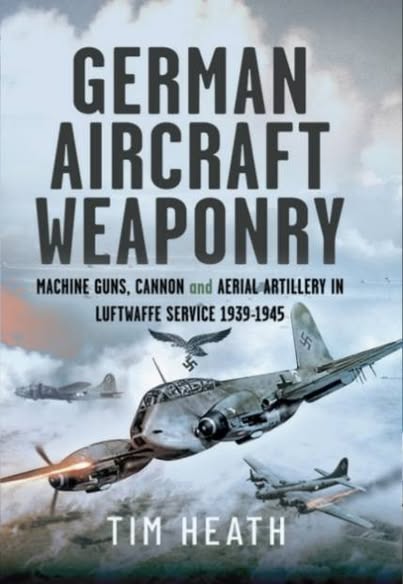
new book from Tim Heath - German Aircraft Weaponry-Machine Guns, Cannon and Aerial Artillery in Luftwaffe Service 1939-1945


 A new book from Tim Heath is due soon from Pen & Sword. Tim has worked with the German War Graves Commission and has written a dozen books on German history 1933-45. I was impressed by his 'history' of the Luftwaffe as told by the bomber and fighter crews in his book entitled "In furious skies" - a recommended read for anyone visiting this blog. His new book further develops the subject of aircraft armament . Visit his author's page at Pen and Sword here


"..hi Neil, I now have the front and rear cover design for my next book German Aircraft Weaponry-Machine Guns, Cannon and Aerial Artillery in Luftwaffe Service 1939-1945. Pen and Sword have done yet another fine job and I can't wait to see this one released. It was such a great project to work on and one I had wanted to do for so many years and have finally done. Thanks to the Pen and Sword Books Ltd team as these books require a team effort to produce and big thanks to Jon Wilkinson the graphics genius for bringing life to the books with his amazing graphics work. This new book is purely focused on the machine guns and cannons plus larger calibre guns including those which only got as far as proposal stage plus experimental weapons. This book also shows in the photos what these weapons could do to a human body. If you liked the brief coverage in 'In Furious Skies' you will love this one. Thanks so much for your kind words.."


Wednesday, 26 June 2024

Me 110 G heavy weapons - ebay photo find #377

Me 110 G of ZG 1 Bad Lippspringe, early 1944. Caption reads, (I think..), 'upper nose cannon have been removed and openings faired over to enable installation of GM-1 ..' Note the folding upper section of the canopy serving as a makeshift deckchair..

Bottom;  ZG 1 Bf 110 with Flak 18 3,7 cm cannon installation.


Saturday, 15 June 2024

special weapons for the Fw 190 (1) - ebay photo find # 375


The General der Jagdflieger looks on dubiously as he is shown the SG 'Harfe' - unguided 20 mm missile launchers mounted in the rear fuselage on both sides of a Fw 190 - during a visit to Jagdgruppe 10 in Parchim during November 1944. At least one prototype machine had such armament as here presented to Galland.

Monday, 3 June 2024

E Stelle Rechlin exhibition September 1943 - Hs 129 BK cannon -ebay photo find #372


Hs 129 with BK 75 cannon seen at the September 3, 1943 Rechlin test centre exhibition (Leistungsschau). Note He 219 visible in the background. (along with B-17 and B-24 tail fins..)


More on the September 1943 Rechlin exhibition on this blog here

Saturday, 16 March 2024

Fw 190 A-7 with 21 cm BR Werfer - ebay photo find #368


..the rear of this ebay photo print offering states "JG 11 March 1945" 

Two images of this machine are reproduced on p188 of Peter Rodeike's 'Jagdflugzeug 190'. Rodeike identifies this machine as a Fieseler-manufactured A-7 transferred to Toul in France to I./JG 26 in March 1944 with Stkz 'KU+BG' WNr. 643713. According to Rodeike's caption, 'note the rare combination of 'stovepipe' rocket launchers and 30mm cannon  in the outboard wing stations'  - such Fw 190s received the 'Zusatzbezeichnung' R2/R6. Note also this machine has an ETC 501 rack for a 300 Ltr. droptank..


The photo sold for 300 euros  which is a quite ridiculous and stupid amount of money for an image that has been published a number of times previously. Moreover, it will stay posted here.


Saturday, 1 October 2022

..the ultimate Luftwaffe fighters book from JaPo! 'German fighters in the West'


From the archives of Michael Meyer and Paul Stipdonk this new photo book from JaPo comprises 508 pages and features over 1,000 images. Detailed photo captions in German/English, profile artworks by Anders Hjortsberg -  physical edition due imminently. Having been involved in the compilation of this volume (a 'one off' stand-alone) this blogger has had the pdf for a while - some 10 years in the making!


Due before the end of 2022, see the publisher's website for more info here

Wednesday, 14 September 2022

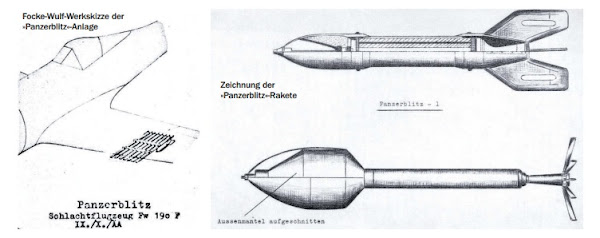
"Panzerblitz" missions - III./ SG 4, Lt. Irmfried Zipser III./SG 1


As a Schlachtflugzeug the Fw 190 brought an increased level of firepower to the Eastern Front, especially the F-8 version which appeared during the spring of 1944. Erprobungskommando 26 under specialist anti-tank pilot Maj. Hubert Eggers had been established at Udetfeld (near Gleiwitz in Upper Silesia) to test suitable armament and quickly set about adapting the German Army's successful  'Panzerschreck' for airborne carriage and launch. Similar to the US 'bazooka' the 'Panzer Granate 4322' was a larger 88 mm calibre hollow-charge anti-tank rocket. Testing with rockets mounted on underwing ETC carriers started in August 1944 and trials against tanks during September took place at distances from 100 metres, the weapon being launched in salvos of six. The rockets were regarded as a big improvement in comparison to the Mk 103-equipped Hs 129 or the Ju 87 Kanonenvogel  with Flak 18. Fw 190 F-8s of 5./ SG 77 under Oblt. Stephan Schmitt were among the first to deploy 'Panzerschreck' in action being fitted out at Udetfeld in late September 1944 and flying their first missions from Sarospatak in Hungary in early October. Attacking Soviet tanks close to the Hungarian–Rumanian border on October 7, the Staffelkapitän was hit by anti-aircraft fire and killed. He was subsequently awarded the Knight’s Cross posthumously on 29 October. Other units understood to have taken delivery of the rocket in late 1944 included III./SG 3 at Frauenberg in Latvia, II./SG 2 and 8./SG 1, with further elements of SG 10 following in 1945. Around 90 Fw 190s had been equipped to launch Panzerschreck by December 1944. 

 'Panzerblitz' was not a development of the 'Panzerschreck' but a slightly more 'sophisticated' second anti-tank unguided rocket developed from the R4M Orkan air-to-air rocket used by the Messerschmitt Me 262. It was fitted with either an 80 mm (3.1 in)-diameter standard warhead, in Panzerblitz I, or a 210 mm (8.3 in)-diameter hollow charge warhead, in the Panzerblitz II. Special launch or discharge rails were designed for Panzerblitz by Curt Heber of Osterode, the firm also constructing launch racks for the R4M air to air rocket ; the Einzelschussgerät Panzerblitz (EG Pb) were 'single shot' rails which could be combined together in a launch ‘system’, the Abschussschienegerät Pb (AG Pb) of six or eight rails bolted together. Capable of 410 m/s, the higher velocity of the 'Panzerblitz'  enabled tanks to be destroyed at greater ranges of up to 200 m distance with rockets being fired in salvo or in pairs. The only limitation was a maximum speed of 490 km/h, not to be exceeded during missile firing. Up to February 1945 the Luftwaffe received 115 Fw 190 F-8/Pb 1 machines. The Fw190 F-8/Pb2 - Panzerblitz 2 (Pb 2) unit differed in the replacement of the M8 warhead by a hollow-charge warhead able to penetrate up to 180 mm armour. Also developed was the new missile system Panzerblitz 3 (Pb 3) with a 210 mm hollow-charge warhead, but it was not operational by the end of the war.

III./SG 4 was one of the first Gruppen to deploy 'Panzerblitz' in action,  certainly in the West, flying their first operational sorties with the missiles during December 1944, having trained at Udetfeld during November. Extracts from the III./ SG 4 KTB;

".. in Udetfeld Beginn des Schiessens mit Panzerblitz auf Beutepanzer auf den Luftschiessplatz.."


 " ...the Kommandeur stated that training has suffered from persistent bad weather and ever-increasing technical damage to the launcher racks.  Target hit accuracy is completely unsatisfactory .....at least two more full flying days of additional training are necessary ....In Udetfeld Schlechtwetter, Unterricht über Angriffstaktik, Panzererkennungsdienst...


III./ SG 4's first operational sortie with eight Panzerblitz-toting Fw 190s ('Beladung Panzerblitz') took place on December 7, 1944...Mission order - attack on road columns in the sector Zabern -Strasbourg -Schledtstatt....both the Kette led by the Kommandeur (south of Strasburg) and the Schwarm led by Oblt. Eissele  (south-west of Hagenau) were met with such intense anti-aircraft fire, that the attacks, carried out at low-level because of the weather, were not effective....six trucks and two anti-aircraft batteries were knocked out.  One total loss due to anti-aircraft fire, two a/c returned to manufacturer, two a/c require three-day and two further a/c one-day interventions in the repair shop. Obfhr. Rüttgers failed to return..


Twelve machines of the Gruppe also took part in the Luftwaffe’s  Bodenplatte New Year’s Day attacks - at least five Fw 190s launched their missiles to report 'successful' sorties.  9. Staffel pilot Fw. Rudolf Fye was shot down by USAAF P‑47s and his Fw 190 F‑8 crashed near to the road that ran between Asch and Mechelen, Allied air and technical intelligence recovering a number of 'live' Panzerblitz rockets.


 In the period 21 January–20 February 1945, the Fw 190 F‑8s and F‑9s of III./SG 4 accounted for the destruction of 23 Allied tanks and inflicted serious damage to 11 more, as well as causing the destruction of two armoured vehicles. This tally was achieved over  the course of 115 sorties flown in 16 operational missions in which the Panzerblitz was deployed.


In the East Lt. Irmfried Zipser's III./ SG 1 gave up their Ju 87 Stukas during May 1944 and converted on to the Fw 190 F;

"Since we Stuka pilots had no idea about flying fighters, we also received a short course of fighter instruction, during which we were at least taught how to get out of trouble if necessary..." 

Within two months  Zipser's Gruppe was back at the front and had flown their first combat sorties in the Fw 190 from Radzyn. Less than four weeks later, the Red Army launched its major summer offensive, completely destroying the German Heeresgruppe Mitte.

 "At first we were deployed in the central section, in the Warsaw area, then we moved north to Insterburg, and finally to Courland and on the Memel. Everywhere it was burning like a torch." 


Zipser's Leistungsbuch (performance book) bears witness to the devastating effect of the attacks mounted by the rocket-equipped Fw 190s and to the heavy fighting in which III./SG 1 was involved and gives daily details. Numerous "dive" ('Sturz') and 'Schrägangriffe' "slanting or oblique" attacks, often followed by ‘Schießanflüge’, or “firing approaches" or strafing passes against "deployments, troop concentrations, columns, vehicles of all kinds, artillery and flak positions, convoys and tanks". With often disastrous consequences: "Very good hits! - High enemy losses! - Flak or Ari positions very well covered! Numerous vehicles destroyed! Tanks set on fire, then exploded! Direct hits in ammunition transports! 'Volltreffer in Munitionstransporter! Heavy fires observed!" Zipser remembered;

" ..the 'Panzerblitz' missile was much more effective than the 'Panzerschreck' and with it we achieved considerable success. We carried twelve of them under the wings, six on each side. The firing sequence was programmed in advance in the control box. They could not be fired individually, at least three at a time, but most of the time all twelve were salvoed simultaneously. Such a salvo was then one hundred percent deadly. Even for the most heavily armoured tanks. The first 'Panzerblitz' missions were a shock to the Russians – ‘die ersten Panzerblitz- Einsätze wirkten auf die Russen wie ein Schock’. But within a few days they came to terms with it. We shot up an unbelievable number of tanks, but for what? I hit one tank. And maybe another. But 100 others were behind it, that was our reality. The mass of attackers can't even be imagined. The Russians didn't care about camouflage either any more. They marched and crushed us with their mass. Especially since our losses could no longer be made good, while the Russians had a seemingly inexhaustible arsenal. I saw masses of tanks, rows upon rows, and when those at the front had been shot-up the next in the line would move forward and just drove over the ones that were left behind. I can still see these images in my mind's eye today. Just the battles at the Oderbruch near Berlin claimed tens of thousands of lives in a single day! Just imagine it! Mountains of corpses! In the Oderbruch, too, numerous pontoon bridges were destroyed by "Panzerblitz". Just as quickly as the Germans destroyed them, the Red Army soldiers rebuilt them again.."  

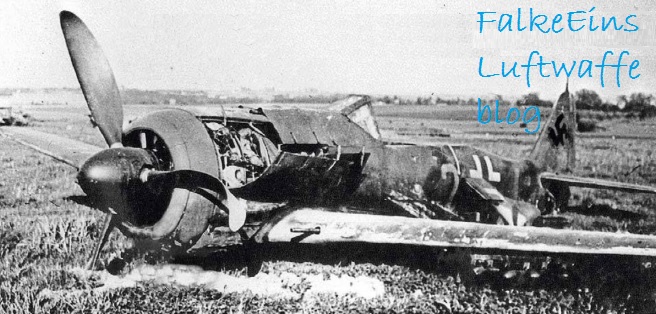
Force-landed F-8 displaying a III.Gruppe vertical bar aft of the fuselage cross. The Panzerblitz installation underneath the port wing is visible.


Irmfried Zipser told his story to Peter Cronauer in Flugzeug Classic (2016). A good source for more on German air-to-ground weapons is Robert Forsyth's "Luftwaffe Special Weapons" published by Osprey. 

 Also on this blog; 

Sunday, 22 January 2017

Bf 110 Pulkzerstörer 'bomber destroyers' -daily ebay photo find #205


A well-known image currently on offer here that dates from the Defence of the Reich period of autumn 1943 to spring 1944. While a heavily tinted view of the same shot featured on the jacket of Don Caldwell's superlative 'Day fighters in Defence of the Reich' the image was not captioned and does not appear inside the book. Bf 110 Pulkzerstörer (lit. 'formation destroyers') in action over a snow-covered landscape. These are Bf 110 G-2/R1 sub-types. The aircraft appear to be toting the imposing 37 mm Bordkanone Flak 18 cannon under the fuselage. This large-calibre weapon was trialed and briefly employed against USAAF bomber formations, first equipping ZG 76 in early 1944, so these machines may be on the strength of that unit. However the close-up view on the Caldwell book jacket appears to show an aircraft coded "2N + BP" - presumably of ZG 1. (ZG 76 used the M8 code through 1944-45). Bf 110 G-2 sub-types could mount various armament kits -the M 1 conversion kit (2 x MG 151/20) under the fuselage, the M 5 kit comprising two BR 21 double pipe 21 cm Raketenwerfer grenade launchers (as here) and the M 3 armament kit of two MK 108 30 mm cannon. Aircraft such as these were heavily armed for the bomber destroyer role but particularly ill suited for combat with enemy fighters.

Pilot Flugzeugführer Uffz. Herbert Weiner of 1./ ZG 26 seen wearing his EK I in Wunstorf in late 1943 in front of his Me 110 G-2 toting the BK 37mm Flak 18 cannon.


A line-up of Me 110 G-2 37mm Flak 18 cannon toting Zerstörer of 1./ZG 1 in Wunstorf in August 1943.


On offer here

 More on the BK 37mm Flak 18 cannon equipped Bf 110s in the Defence of the Reich on this blog

http://falkeeins.blogspot.co.uk/2010/01/bf-110-g-with-37mm-flak-18-cannon.html

Tuesday, 16 June 2015

Me 110 ZG 26 BK 37 mm Flak 18


Pilot Flugzeugführer Uffz. Herbert Weiner of 1./ ZG 26 seen wearing his EK I in Wunstorf in late 1943 in front of his Me 110 G-2 toting the BK 37mm Flak 18 cannon. This large-calibre weapon was trialed and briefly employed against USAAF bomber formations. Click to view large.

More Me 110s with Flak 18 cannon on this blog

http://falkeeins.blogspot.co.uk/2010/01/bf-110-g-with-37mm-flak-18-cannon.html


Saturday, 4 August 2012

Bückers with bazookas - Bü 181 'Bestmann' mit Panzerfäusten (1)


Above; Bücker Bü 181 'Bestmann' WNr 501659 was built in Czechoslovakia in early 1944 and served at the FFS A/B 23 in Kaufbeuren with the Kennung RM+HE where it was converted to mount Panzerfaust bazookas in the final weeks of the war. Today it is exhibited at the Deutsche Technik Museum in Berlin. Photo courtesy Marc Hasenbein.

Below; first published in the Modell Magazin issue of 3/83 this was for a long time the only known photo of a fully-armed Panzerfaust-toting Bücker Bü 181 'Bestmann' seen here undergoing trials with the Panzerfaust Versuchskommando (test detachment) at Trebbin on 01 April 1945.


According to Christian Möller in his book “ Das letzte Aufgebot..” , “ kaum jemand weiß, dass die deutsche Luftwaffe kurz vor dem Kriegsende ab April 1945 langsame Schulmaschinen vom Typ Bücker Bü 181 als Schlachtflugzeuge gegen die Bodentruppen der Alliierten eingesetzt hat - very few know that shortly before the end of the war the German Luftwaffe was employing in a ground-attack role slow training types such as the Bücker Bü 181 against Allied ground forces” .

Of course in his inimitable style – his Nachtschlacht book featured well over a 1,000 footnotes - author Möller then provides a footnote detailing a lengthy list of references which prove if anything that there has, on the contrary, been a decent amount of (mostly German-language) coverage, including magazine and web articles, devoted to the late-war combat role of the Bücker Bü 181. I will be covering a few of these over the course of some forthcoming blog posts.

Cover illustration from Christian Möller's “ Das letzte Aufgebot..”  - click on the image to go direct to publisher Helios


Of course I'm being a little unfair to Christian and  I guess the point is nonetheless worth making again for those Luftwaffe 'enthusiasts' who cannot see past the jets and other so-called Wunderwaffen; the reality of late-war collapse was that for every single advanced jet fighter or bomber being put into service by March/April 1945, the Luftwaffe in its death throes was hurriedly deploying antiquated biplanes or obsolescent ab initio type trainers in a combat role- either night ground attack Nachtschlächter or 'tank-hunting' Panzerknacker. With training schools closed and the Luftwaffe starved of fuel - these types did not demand much in the way of piloting skills or even require much gasolene - Bückers and Arados were thus hastily formed into a host of Kommandos and “attack” Staffeln in the forlorn hope of being able to continue the fight to the bitter end. Inexperienced ex-instructors were being ordered to launch perilous early-morning or late-evening ground attack missions against Allied supply columns or tank spearheads with the most derisory of means - the Bü 181 Schulflugzeug (trainer) mounting Panzerfauste rocket launchers on and under the wings. These Panzerfauste bomb-toting Bückers – aerobatic-capable, low-wing, unarmoured monoplanes- were barely able to manage 150 km/h and featured side-by-side seating and dual control columns. It was even planned to re-equip the III. Gruppe of the famed Junkers Ju 87-equipped Schlachtgeschwader 2 with these machines.


In a last-ditch attempt to stem the flow of Allied armour pouring into southern Germany 3. Panzerjagdstaffel was just one such ad-hoc tank-hunting Staffel deployed in the Panzerbekämpfung (tank hunting) role from mid-April 1945 - it was planned to establish some fourteen similar anti-tank units comprising twelve aircraft and some twenty pilots with the units divided between east and western fronts. Established at Kaufbeuren in early March 1945, the Bü 181 trainers of 3. Panzerjagdstaffel were crewed (pilot/observer) by qualified flying instructors from Flugschule A/B 23 under Staffelsfuehrer Oberleutnant Karl-Heinz Dragenscheck. Some details of this unit's exploits - one of the few to actually see service - were given in an issue of Flugzeug classic magazine during 2006. Boring in at low level at barely 150 kph, the intrepid pilots had trained to close to within 500 m of enemy tanks before pulling up to around 20-30 metres altitude and then diving on their targets, unleashing the rockets at a distance of only some 100 metres before banking sharply away in order to escape the blast wave from the exploding rocket. To nullify Allied air supremacy, sorties were to be flown at the crack of dawn or as darkness was falling.

"....Die Bü 181 der 3. Panzerjagdstaffel erhielten am 19. April 1945 ihre Feuertaufe. Sechs Bestmann starteten um 20.20 Uhr vom Flugplatz Ringingen aus in den Raum Tübingen. Zwar entdeckten die Besatzungen keine Panzer, konnten aber einige alliierte Lastkraftwagen zerstören. Einen Tag später, an Adolf Hitlers letztem Geburtstag, wiederholten die Bücker ihre Angriffe. Im Morgengrauen des 24. April startete die 3. Panzerjagdstaffel zum vermutlich letzten Kampfeinsatz...."

Airborne from Ringingen six Bü 181s of 3. Panzerjagdstaffel (tank hunting squadron) underwent their baptism of fire against Allied armour at 20h20 in the vicinity of Tübingen on 19 April 1945. Although the crews (pilot and navigator) failed to locate any tanks, a number of Allied trucks were destroyed. The sortie was repeated on the following day. 3. Panzerjagdstaffel flew what was probably their last sortie of the war at dawn on the 24th. In this instance the targets were not even Allied tanks but abandoned German aircraft left on the field at Memmingen. After this the unit fell back via a number of different airfields to the Bavarian Alps before the personnel surrendered to the Americans at Reit im Winkl on 9 May 1945.... As can be seen in the photo (bottom) the Panzerfaust rockets were fired by means of Bowden cables laid across the wings from the cockpit and the engine cowl mounted a crude aiming device. In practise the upper wing mounted rockets were only rarely fitted - the exhaust gases at launch had a tendency to set the wooden wing surfaces on fire!
Prior to the unit's first sortie there was an event of some note - one of the unit's Bü 181 was stolen by two defectors - former flying instructors Unteroffiziere Hans Ficker and Werner Diermeyer. The two 24-year old officers appropriated one of the light trainers at dawn on 19 April 45 and flew off to Switzerland at the controls of the machine illustrated. Ficker had lost his brother during the Battle of Britain and had himself been badly injured in a crash during October 1944. By January 1945 the lack of fuel for training had effectively ended the careers of the two flying instructors, both now likely candidates to be re-mustered as infantry or as flak crews. Dying a heroes' death for Volk und Vaterland in some muddy trench was not for Unteroffizier Diermeyer. Diermeyer had at one point been offered a chance to re-train on the Me 262 but in the chaos of the last months of the war nothing had come of this. At some stage during the story Diermayer had got wind of the aerial activities taking place at Kaufbeuren. So instead of reporting to barracks in Hoersching, Ostmark (Austria) for infantry service, Diermayer made his way to Munich where he met up with Ficker. The two men carefully prepared their flight and on the evening of 18 April 1945 made their way out to the airfield. Luck was on their side. Training for the first anti-tank missions had just been completed and the following day the tank hunting Bü 181s were to fly their first combat sorties. At that moment an air-raid alarm sent everyone to the bunkers and the two men were able to enter a hangar where the Bü 181 assigned to the Staffelkapitän of 3. PzJgSt was being serviced. Ficker managed to get the engine started, taxiied out onto the field and quickly getting airborne the two men headed for Bregrenz and the Swiss border, touching down at Duebendorf some ninety minutes later. Post war this particular machine served - along with five others - in the Swiss Air Force before being retired in the mid-fifties. 


Saturday, 25 December 2010

Junkers Ju 87 Stuka Kanonenvogel -last edit March 2016

Bundesarchiv Bild 101I-728-0323-24A, Flugzeug Junkers Ju 87


Flugzeug Junkers Ju 87 G "Stuka" mit 3,7-cm-Kanonen FlaK 18 ("Kanonenvogel") auf einem Feldflugplatz -  images via Wikicommons (cooperation agreement providing Bundesarchiv images free for re-use on the web)

The Panzerknacker or tank 'cracker' was, if we are to believe the history, dreamt up by Stuka 'ace' Rudel as a means of aiding the hard-pressed German ground troops in their defensive struggles against the Red Army and their T-34 tank fleets. It seems to me that this machine has acquired a certain 'aura' that it simply does not warrant -especially with modellers. Indeed the Kanonenvogel bore witness to the appalling penury and deficiencies of Luftwaffe resources on the Eastern Front. Here was a machine conceived for taking out tanks individually - one by one if you will. Rudel in his first day's flying at the controls of his BK 3.7 mm toting Stuka managed to knock out around ten Russian tanks according to Nauroth's German-language Stukageschwader Immelmann history. (Rudel's own account states twelve). Yet just a few hundred miles east of where Rudel would have been operating during July 1943, Soviet factories were churning out hundreds of tanks weekly - well out of the range of  any Luftwaffe bombers. The Luftwaffe did not possess a decent long-range heavy bomber as we know. All the Luftwaffe could come up with at this stage of the war was a Stuka 'D' model expedient with the flying characteristics of a brick - it was impossible for all but the most experienced pilots to fly well, especially in the turn where the massively laden Stuka bucked and wobbled on the edge of the stall.. At the time of course Rudel's efforts and those of his comrades were feted in the Nazi propaganda media. Today they are still 'celebrated' in just about every account you might care to read devoted to combat flying on the Eastern Front. In reality Rudel's 'achievements' were but a drop in the ocean, a mere pinprick in the overall scheme of battle on the Eastern Front..

Bundesarchiv Bild 101I-655-5976-04, Russland, Sturzkampfbomber Junkers Ju 87 G

Sturzkampfbomber Junkers Ju 87 ("Stuka") mit 3,7 cm Panzerabwehrkanonen unter den Flügeln. Anlassen des Motors des Flugzeugs von Hans-Ulrich Rudel ("Kanonenvogel") mit einer Handkurbel

Stuka mounting 3.7 cm anti-tank cannon under the wings. Turning over the engine of Rudel's aircraft with the hand-crank starter.


Bundesarchiv Bild 101I-646-5184-26, Russland, Flugzeug Junkers Ju 87


not a Panzerknacker but a lovely detail view of a Ju 87 on the northern sector of the Estern Front, December 1943 from the same PK photographer Doege

Bundesarchiv Bild 101I-726-0224-26A, Russland, Junkers Ju 87