Showing posts with label ZG 26. Show all posts

Saturday, 4 October 2025

" Die England-Einsätze " - Oblt. Theo Rossiwall 5./ZG 26


Extracted from a period 'booklet' published in late 1941 ("our third Christmas at the front") for members of 5./ZG 26 and apparently written/compiled by the Staffelkapitän of 5./ZG 26 Hptm. Rossiwall and individually signed by him. I was given this on a trip to Belgium a few years ago. Rossiwall's introduction alludes to the fact that ZG 26 had by this stage of the war shot down over 700 enemy aircraft and destroyed around 1,000 on the ground and the last sentence of his diary text concludes " [..].. the end of the huge campaign in the East is slowly drawing near.."


Die England-Einsätze

 ".. the period of missions against England ('England-Einsätze'began in mid-August 1940. For obvious reasons I can't go into as much detail as I have done on the campaigns already concluded. Looking back on it though everyone says that it was the best time in terms of combat ("..so sagt jeder, dass es kämpferisch die schönste Zeit war..") We shifted from Crécy to St.Omer and found ourselves assigned the best accommodation in a small farmhouse with running water and electricity. We later moved to St. Aubin near Lisieux were we were put up in a villa with a bathroom and warm running water. In total we flew 45 missions over England, firstly against London and targets in the vicinity of the capital - usually from our Absprungshafen or 'jump-off' airfield at Théville - and then against towns along the south coast, penetrating inland as far as Yeovil and Bristol.  

The Staffel was extremely fortunate
(..' Die Staffel war ausgesprochen vom Glück begünstigt..'). We shot down twenty enemy aircraft - all fighters - for the loss of just a single crew. Although this one hit us hard - Ofw. Rochel and his BF Uffz. Schöffler failed to return from an 'enemy flight' on 2 September (Feindflug or sortie). It was not until 24 September that we were enormously relieved to hear that they were both uninjured in British captivity. Uffz. Franke with his radio operator Uffz. Hübner were assigned to 6. Staffel the unit they were flying with when they were shot down on 30 August. We learnt on 13 September that they too were in British hands..attempting to put down on one engine on 2 September Fw. Müller crashed from a height of 10 metres and flipped over on his back. He himself was able to return to the Staffel in December but his Funker Uffz. Gröhl was badly injured and as I write this is still undergoing hospital treatment. On 23 August we lost Oblt. Niebuhr who was posted to take charge of 4. Staffel. He took Uffz. Thiessen with him. On 31 August Uffz. Lohoff - BF in Uffz. Leinfelder's crew - was slightly injured and hospitalised in Brussels. On 29 September Oblt. Hubel took over the leadership of 4. Staffel with his BF Uffz. Schrodt following the death of  Oblt. Niebuhr ( shot down and KIA on 27 September in Bf 110 '3U+IM' with his BF Thiessen near Arne, Dorset) Oblt. Ihrcke was transferred to 6. Staffel... "


ZG 26 Kommodore was Oberst Huth up to 31 August 1940, succeeded from 01 September by Oberstleutnant Johannes Shalk. ZG 26’s I Gruppe was commanded by Hptm. Wilhelm Makrocki through the Battle of Britain. Awarded the RK in October 1940 he was shot down on 21 May 1941 off the coast of Crete during the operation to take the island - 'Merkur'. Hptm Ralph von Rettberg headed II Gruppe during the Battle of Britain. Rettberg was awarded the RK on the eve of Barbarossa on June 14, 1941.

In addition to these aces, ZG 26’s line-up included several among the Staffelkapitäne: Hptm Wilhelm Spies (RK also on 14 June, 1941) of 1./ZG 26 later Kommandeur I./ZG 26, Oberleutnant Johannes Kiel of 4./ ZG 26 and Oblt Theodore Rossiwall of 5./ZG 26 who had replaced Hptm. d'Elsa badly wounded on 18 May. 


Above; Hptm. Makrocki with RK awarded 6 October 1940. 

A 'souvenir' photo of flying personnel and ground-crew of I./ZG 26 taken in northern France (St. Omer) probably just prior to the Battle of Britain during June. Makrocki's Bf 110 with Kommandeur chevrons is the backdrop. 


Frankreich-West.- Zerstörergeschwader 26, Oberleutnant Theodor Rossiwall am Cockpit seiner Messerschmitt Me 110 (BA Bild 101I-341-0496-33)


Bottom left;  portrait in Rossiwall's booklet of Oblt. Sophus Baagoe who claimed two Spitfires off Dover on 14 July and two more on 18 August ('the hardest day') and made further Spitfire claims on 11,12 and 13 September with 8./ZG 26. At the time of his death - just prior to the landings on Crete - he was flying with 5./ZG 26 and with around 14 claims was one of the leading Zerstörer pilots. His BF Ofw. Daniel Becker is lower right.

Thursday, 21 March 2024

ZG 26 Bf 110 - archive photo scan #17


A 7.Staffel ZG 26 Bf 110 E/F possibly on Sicily or in North Africa. A good view of the penguin emblem with 'Sonnenschirm' parasol/sunshade over the Zerstörer vertical chevrons. Note too the white spinner tip, another 7.Staffel marking. The exhaust has a deflector plate to prevent intake ingestion of hot gases.

Friday, 10 November 2023

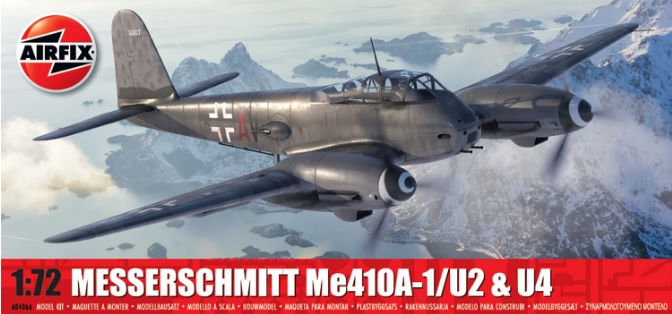
new tool Me 410 from Airfix - surprise kit announcement!


...Just checking its not 01 April... and just in time for this weekend's 2023 Scale Model World in Telford. Via the Airfix web site.

" We are thrilled to announce the newly tooled 1:72 Messerschmitt Me 410A-1/U2 and U4, the ‘backbone of Germany’s home defence’. The Messerschmitt Me 410 is undoubtedly one of the most impressive-looking aircraft types of the Second World War, the ultimate incarnation of Germany's fascination with the Zerstörer heavy fighter concept. Featuring two intriguing schemes, 137 parts, and an exceptional level of detail, this kit is bound to pique your interest.."

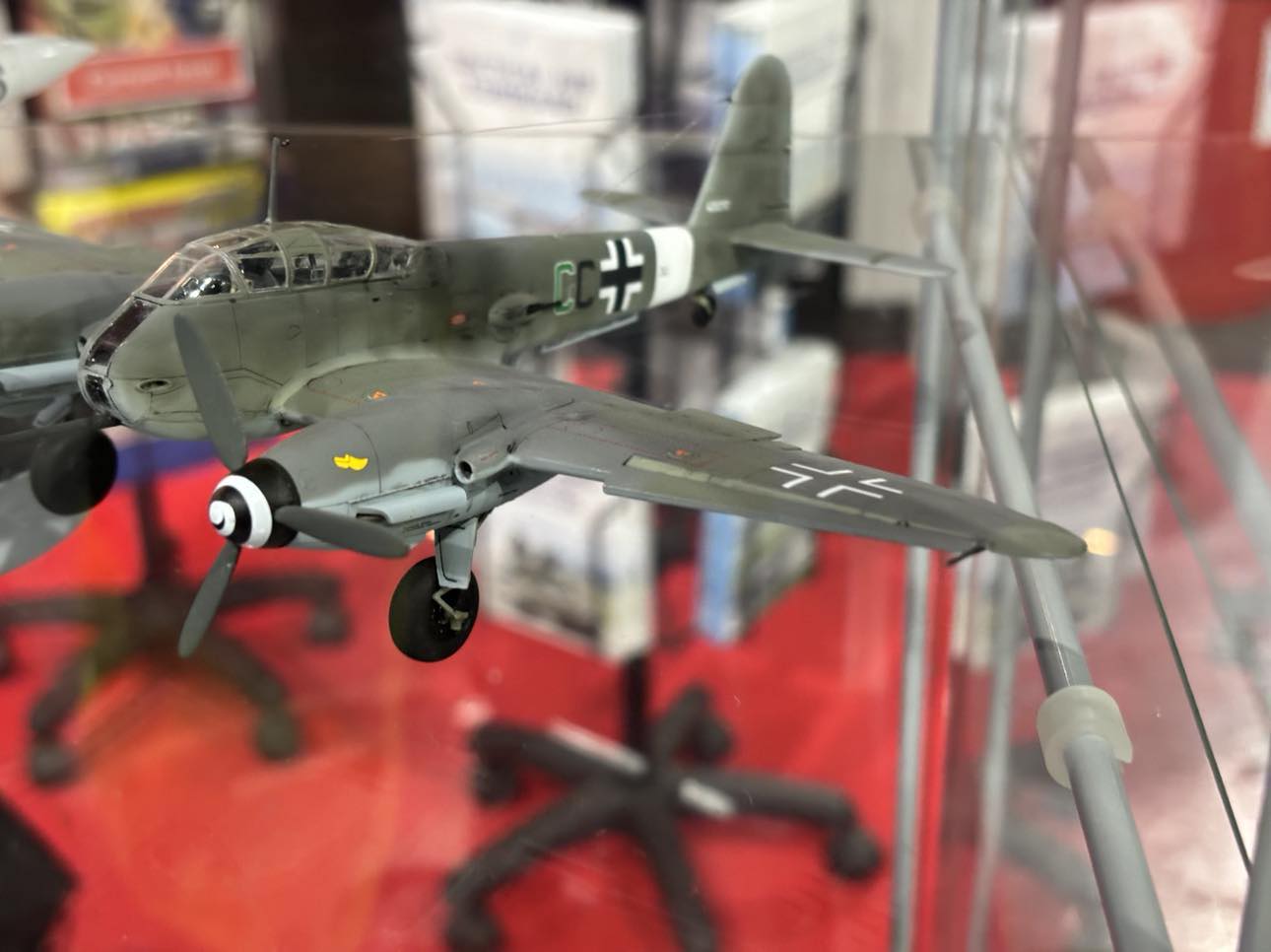
It would appear that the kit does not feature the ZFR (Zielfernrohr) telescopic sight visible in the windscreen when toting the heavy cannon. Model on display at the Airfix stand (Telford Scale Model World) . A look at the sprues here


Below; model build by Luke Flynn of Mach Models. See link below.


Below; III./ZG 26 Kommandeur Maj. Johann (Hans) Kogler dismounting his Me 410 in spring 1944. Kogler was appointed Kommodore ZG 26 that summer. According to one source he had three 'kills' as Kommandeur of III./ZG 26:-

24th February 1944 a B-24 at 1330 hrs
8th March 1944 a B-17 at 1335 hrs
11th April 1944 a B-17 at 1200 hrs

He was awarded the DKiG during July 1944 for his command of Zerstörer units. As Kommodore of JG 6 he was shot down and taken captive near Venlo during the Bodenplatte 1945 New Year’s Day airfield attacks.  


Via Michael Meyer expired ebay auction

..Mach Models have already built the kit on youtube - some views of the cockpit detail follow
Mach Models build of the kit on youtube. A single click to view here


Tuesday, 12 January 2021

Aus dem Nachlass eines Piloten Feldwebel Pöggeler, ZG 26 Me 410, KG 26 "Löwengeschwader", Zerstörer Geschwader "HW", Do 217, Me 410 - eBay photo find #344


Aus dem Nachlass eines Piloten Feldwebel Pöggeler, KG 26 "Löwengeschwader", Zerstörer Geschwader "HW", Do 217, He 111 cockpit, Me 410 mit Raketen, Fw 190s JG 2 Triqueville 

 Kommodore Maj. Kogler ZG 26


Orig. Foto Luftwaffe Flugzeug Flugzeugführer Heinkel He 111 Cockpit Löwe KG26


Thursday, 2 January 2020

The 'Luchy' trial - III./ZG 26 pilot murder - May/June 1940


Roadside grave in northern France of Uffz. Wilhelm Ross shot in cold blood after jumping clear of his stricken III./ZG 26 Bf 110 on May 20, 1940.


On May 20, 1940, while flying an escort mission for He 111s on a bombing mission to Beauvais, two Bf 110s of III./ZG 26 were shot down by Sgt Edouard Le Nigen of GC III/3. One of the twin-engine aircraft crashed in Luchy along the Amiens-Beauvais road, the two crew successfully bailing out of their stricken machine. The aviators touched down in a field between the road and the hamlet of Rougemaison. The pilot, Uffz Wilhelm Ross, was then attacked by refugees before being shot in the head by a French soldier or officer, whose unit in retreat was apparently on the road in the same refugee column, possibly intentionally. A sergeant in charge of the 106th artillery regiment held off a baying crowd, which enabled the radio operator/gunner, Gefr Alfred Wetzel, to avoid a similar fate to his pilot.

left; Gefr Alfred Wetzel, a witness at the Luchy trial during September 1940

Wetzel went into captivity and was released after the fall of France. Ross was briefly buried by the roadside for a while. With the end of hostilities on the continent, an investigation was conducted by the German authorities.

Ross was not of course the only German airman murdered by military or civilian personnel on the basis of a foolish and criminal order promulgated by the French military authorities according to which any 'paratrooper' had to be shot. The order in question was 'reviewed' on or around May 20 after several French and British airmen were killed by 'friendly' fire. Despite the repeated occurrence of these gratuitous crimes, the German authorities apparently had little desire to make publicity out of them, possibly to avoid memories of those few snipers of August 1914 whose disordered actions had led to bloody uncontrolled and disproportionate reprisals in Belgium as well as in northern France.

Somewhat unusually the 'Luchy case' resulted in a 'show trial' that would attract media attention.

As the responsible French soldier had not been identified, a local farmer Alfred Mullot who lived in Rougemaison was charged with the crime. Mullot had seen the German aircraft coming down and had been quickly on the scene with his shotgun. He had been denounced by another local as the murderer. The 'witness', an agricultural worker, apparently wanted to 'settle a score' following a humdrum village dispute. Mullot was arrested on August 2, 1940 and imprisoned for a time in Ghent.


Brought back to Beauvais, he was put on trial in a very theatrical manner on September 12 in the village square of Luchy itself. Photos taken at this "trial" were widely published in the press. Although Bordfunker Wetzel, a witness at the 'hearing', stated that he did not recognise Mullot, the farmer was nonetheless sentenced to death. However, his sentence was soon commuted to five years in prison. After a year and a half in the Reich, he was sent back to Luchy (where he died in 1980). Mullot's release demonstrated that, in the end, no one had seriously considered him to be the killer and that the 'Luchy trial' was something of a farce.


(Farmer Mullot accused of murdering III./ ZG 26 pilot Uffz. Wilhelm Ross on May 20, 1940 at his 'trial' - the newspaper caption read " I was only following the orders of the Prefecture"...)


However, his release raised a number of questions. Why did the German authorities expend so much unnecessary energy on this 'show' trial when a simple examination of Ross' remains would have revealed that he was killed by a bullet fired by a soldier and not by Alfred Mullot's shotgun? Why even use such publicity to condemn an innocent man (even if, according to how events could have played out, Mullot might well have acted in the manner of a 'franc-tireur'). After all, far less coverage was given to the four civilians sentenced to death and executed after the murder of a KG 54 crew at Vimy on 18 May 1940. Was the Luchy trial the 'unfortunate' initiative of a local German official... the answer to this and other questions will probably never be known.


Extracted with permission from Jean-Louis Roba's new history of III./ZG 26 published by Lela Presse. Free shipping on this title up to 10 January 2020. Go to the Lela Presse website for pdf extracts and ordering info.

Best wishes and Happy New Year/ Meilleurs Voeux to all friends and contributors at Lela Presse!

Monday, 25 November 2019

8 May 1945 - the end of the war in Europe. Berlin-Karlshorst: Deutsch-Russisches Museum


In the leafy south-east Berlin suburb of Karlshorst in an incongruous building at the end of Zwieseler Straße, World War Two in Europe officially came to an end with the unconditional surrender of the Wehrmacht.

 Zwieseler Straße 4 in Berlin-Karlshorst: Deutsch-Russisches Museum am 66. Jahrestag der bedingungslosen Kapitulation der Wehrmacht.

Zwieseler Straße 4, Berlin-Karlshorst, 357-462
 

Nowadays, thanks to the Soviets, it is a museum, one of the best in the city, telling the story of the 'Great Patriotic War' against Nazi Germany, the capture of the city by the Soviet Army and the impact of all that on its hapless citizens. One of the main attractions of the museum is the 'surrender room' - preserved today as it was then. The room is almost exactly as it was on 8 May 1945, save for the carpet allegedly pilfered from the ruins of the Reichskanzlei on Vossstrasse. Much of the furniture is not original however.


After the signing of the official surrender document at Rheims on 7 May 1945, insisted on by General Eisenhower, who stated that if the Germans did not surrender unconditionally, then bombing of Germany would resume, Stalin was furious. How could the Allies force the Germans to sign a document of surrender with no Soviet participation, after what the Soviet people had been through? Given that the Soviets suffered the largest human and material losses of any country that took part in WW2, the absence of Soviet representatives at the surrender table was not acceptable. That night, everyone was packed into aircraft and flown to Berlin.  Signing the Wehrmacht surrender in Berlin was Keitel.

From Zhukov's diary;

 "The first to enter, slowly and feigning composure, was Generalfeldmarschall [Wilhelm] Keitel, Hitler's closest associate. Keitel was followed by Generaloberst [Hans-Jurgen] Stumpff. he was a short man whose eyes were full of impotent rage. With him entered Generaladmiral [Hans-Georg] von Friedeburg who looked prematurely old. The Germans were asked to take their seats at a separate table close to the door through which they had entered. The Generalfeldmarschall slowly sat down and pinned his eyes on us, sitting at the Presaedium table. Stumpff and von Friedeburg sat down beside Keitel. The officers accompanying them stood behind their chairs."


The tall figure behind Keitel (to the right) in Luftwaffe uniform is his 'English translator' - credited with around 10 victories Karl Boehm-Tettelbach was a former Kommodore of ZG 26. His account of the events of that day can be seen in Guido Knopp's 1980s ZDF series 'Der verdammte Krieg' which is available to watch on youtube. Post-war Boehm-Tettelbach went on to work with Pan Am and served as station manager at Nuremberg airport. His memoir published in 1981 was entitled Als Flieger in der Hexenküche.

Thursday, 28 February 2019

more Bf 110s - Wespen, Nachtjagd, ZGs - ebay photo find 304


Below; 'S9' code and GB badge on nose