Showing posts with label Defence of the Reich. Show all posts

Sunday, 20 September 2026

The court martial of Hptm. Willi Elstermann - I./JG 6 in Schroda, 21-22 January 1945


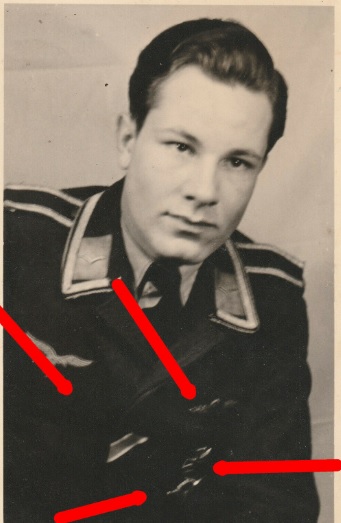
In July 1944 two Gruppen of Oblt. Johann Kogler's ZG 26 converted from the Me 410 to the Fw 190 and a new Jagdgeschwader 6 was established. Kogler retained his position as Kommodore. Hptm. Willi Elstermann was appointed Gruppenkommandeur of II./JG 6. Elstermann was a pre-war pilot, born in December 1917, and a decorated career officer -awarded the EK I and the combat clasp in Gold - and rated as 'above average'. Having flown in ZG 52 - and been shot down by French H-75 Hawks during September 1939 - he flew combat in NJG 3 prior to being appointed Kdr. of II./ZG 26. His 'Einsatzfreudigkeit' was especially noted - his 'enthusiasm and commitment to combat'. By mid-January 1945 he had flown some 150 combat sorties and returned seven victories. Although he had been 'sanctioned' after the disastrous performance of his Gruppe in France during late August 1944 (some 50 machines lost in around two weeks combat) he had been re-appointed to command later in the year, taking over as Kommandeur of I./JG 6.

In late January 1945 Elstermann and elements of his Gruppe had the misfortune to find themselves directly in the advance of the so-called Soviet 'Vistula-Oder' operation - the 'steamroller' that brought the Red Army in a matter of weeks to within striking distance of Berlin. I./JG 6 was on the airfield of Schroda-Ost.  Schroda (now Środa Wielkopolska) was a German town and administrative district (Kreis) within the Prussian province of Posen (Poznań region), located some 30 km south-east of the city of Posen (Poznań). Posen lies on the river Warta (Werte in German or Werthe in English), one of Poland's longest rivers. It meets the Oder at Kostrzyn on the Polish-German border - the then German 'fortress' of Küstrin. Alongside Elstermann and I./JG 6 in Schroda were elements of I./JG 301 under Gruppenkommandeur Hptm. Friedrich-Karl Wodtke and III./SG 77 under the Staffelkapitän of 7./SG 77 Hptm Günther Ludigkeit. Wodtke was another pre-war pilot (born 1916 in Ansbach) transferring from the Aufkl.Kette AS/88 to 3./Kü.Fl.Gr. 406, prior to retraining as a bomber pilot. As Stafü in III./KG 1 he attended the Verbandsführerschule/KG 101 and during September 1943 held the rank of Hptm. and was StaKa in 3./KG 30. Ludigkeit was a decorated Stuka pilot in St.G 77 with the DKiG. He had subsequently been awarded the Ritterkreuz in March 1944 having then flown some 765 combat sorties.  All three of the Gruppen led by these officers were assigned to 3. Flieger-Division. 

I./JG 301 had barely arrived  in Schroda, transferring on 21 January 1945 as part of the wholesale shift of Western fighter Gruppen to the Eastern Front. Unfortunately for the hapless fighter pilots Schroda was so close to the front lines that pilots were among some of the men immediately deployed to the ground forces attempting to hold up the Russians. At least two pilots were killed in theses clashes.


But crucially for what happened next, all three Gruppen were then 'socked-in' by bad weather with little chance of getting airborne...

On Monday 22 January takeoffs were impossible at Schroda Ost due to weather conditions. I./JG 6 had twelve operational and four non-operational Focke-Wulf aircraft at Schroda; also present were elements of I./JG 301—with two operational and two non-operational Fw 190s each—and III./SG 77 with eight aircraft. Other units had parked their aircraft at the airfield and handed them over to the airfield commandant. All told, the Schroda-Ost airfield held approximately 65 aircraft. Over the course of the day and the following night, the situation there became critical, as the capture of the airfield by Soviet troops became ever more likely. In light of this, the Kommandeur I./JG 6 was placed in command of I./JG 301 and III./SG 77 present on site, by order of the 3. FL. Div. (3rd Air Division). Furthermore, it was ordered that only the minimum number of aircrew and technical personnel required to ready the aircraft for takeoff and ferry them away were to remain at the airfield. All other personnel were to withdraw immediately to Posen, travelling by road as a unified group. The mission assigned to the Gruppenkommandeur I./JG 6 was to order and oversee the transfer of the aircraft to Posen, subject to weather conditions. As a precaution, the aircraft were to be concentrated together in a tight formation and at the same time prepared for demolition—an action the Gruppenkommandeur was to order should the airfield come under direct fire and takeoffs become impossible. Subsequently, the detachment remaining at the airfield was to be deployed for the airfield's continued defense or begin the march back to Posen, in accordance with the instructions of the Horstkommandant (Airfield Commander). As the situation grew increasingly critical and repeated telephone appeals to the 3rd Air Division failed to yield an evacuation order, the Gruppenkommandeur of I./JG 6—acting in concert with the commanders of I./JG 301 and III./SG 77—decided to load the available vehicles and ready all personnel (with the exception of the I./JG 6 Gruppenkommandeur himself and a small demolition squad) for departure outside the airfield perimeter. That evening, when the column could see from a distance that the Schroda-West airfield was being destroyed and demolitions were also taking place at Schroda Ost, it began its withdrawal. In reality, however, only the permanent structures at the East airfield were demolished at that stage, while the remaining detachment continued to hold its position. It was not until 05:30 on the morning of January 23—prompted by the approach of enemy forces—that the aircraft assembled at the airfield were actually destroyed - some 60-odd aircraft. As a result of these events, court-martial proceedings were initiated against the three Kommandeure involved; following an oral hearing on January 27, all three were sentenced to several weeks of aggravated barracks arrest ( geschärfter Stubenarrest) for negligent breach of duty..

The events at Schroda-Ost as recounted above are based on the field court-martial verdict issued by the Special Court of the Commander-in-Chief of *Luftflotte* 6 on 27 January 1945 (BA/MA RL 7/529).


. To quote from JfV 16/I (Prien/Balke) 

".. The verdict leaves a decidedly ambivalent impression; while formally correct, the presiding judge appears to have been torn between the higher command's implicit demand for harsh penalties and a discernible desire to ensure justice for the highly decorated officers on trial—particularly given that they were neither responsible for the desperate situation that arose at Schroda nor had their actions resulted in damage that could have been avoided through proper conduct... " 

In other words - and as understood by this blog - Elstermann would likely have been court-martialed and punished regardless of whether he had blown up 60 perfectly good aircraft or let them fall into Russian hands - all of this through no fault of his own....


".. The accused are convicted of negligent breach of duty— Hptm. Wodtke also of negligent disobedience—as follows: 

Hptm. Elstermann is sentenced to 6 (six) weeks of strict room arrest, 
Hptm. Wodtke to (four) weeks of strict room arrest, 
Hptm. Ludigkeit to 3 (three) weeks of strict room arrest. 
Hptm. Ludigkeit is acquitted of the charge of cowardice on the grounds of lack of culpability.."


Sunday, 5 October 2025

Uffz. Karl Schmitz, 6./JG 27 -archive photo scan #40


Uffz. Karl Schmitz of 6.Staffel JG 27 is seen here on the presentation of an EK II for his first victory, a B-17 downed over Nancy during the Schweinfurt-Regensburg raid on 14 October 1943. Wearing the award, Schmitz poses proudly for photos in front of his Bf 109 G-6 ‘yellow 4’. 

After shifting back to Germany from Italy in late July 1943, the Gustavs of II./JG 27 were based in Wiesbaden but from early September regularly flew out to their 'advanced' airfield at St. Dizier (north-eastern France, west of Strasbourg) when put on alert to counter USAAF raids. According to Schmitz - who flew as Rottenflieger to Oblt. Kientsch - 6. Staffel claimed 14 victories during their brief spell on mainland Italy, 13 of which were 'credited' to Kientsch.....


For personal accounts and more images from Karl Schmitz see my 16-page feature "JG 27 in the defence of the Reich" published in "Luftwaffe Fighters - Combat on all Fronts" Vol 2

Saturday, 27 September 2025

PK photographer Hebenstreit (part 1 JG 27) - Bundesarchiv photo report #10


PK photographer Hebenstreit is probably responsible for several of the most-published Bundesarchiv photos ever. Like the shot above, Bild 101I-662-6659-37, here enlarged and cropped to show a slightly different view with a little more of the detail. Click once on the image to view in full-screen mode. Note Bundesarchiv images may be reproduced on non-commercial sites such as this one under a creative commons licence. The 'official' caption reads;

 "Jagdflugzeug Messerschmitt Me 109 G-6 des Jagdgeschwader 27 (I./JG 27; Maschine von Gruppenkommandeur Major Ludwig Franzisket ?) mit zwei MG 151/20 unter den Tragflächen im Flug; ca. Februar/März 1944.." 

It may be that this image dates from September-October 1943 when  I./JG 27 was on 'defence of the Reich' duties involved in defending Austria (the so-called 'Ostmark') from Fels am Wagram. Franzisket was credited with two Fortresses on the 14 October Schweinfurt raid. Always interesting to look at some of the other less well-known images in his various film strips. 


Above; this image is probably not one of Hebenstreit's but shows Gustav 'gun-boats' probably at Fels. Note the long antenna mast and absence of DF loop..


For more see my 16-page feature "JG 27 in the defence of the Reich" in "Luftwaffe Fighters - Combat on all Fronts" Vol 2

Thursday, 1 August 2024

Bf 109 G-6/AS Hptm. Horst Carganico Kommandeur I./JG 5 'Mickey Maus' - archive photo scan #27


A 'new' view - at least not published by Mombeeck in his JG 5 history or elsewhere - of Hptm. Horst Carganico's Kommandeur I./JG 5 machine, an overall blue-grey 76 Bf 109 G-6/AS, seen at Herzogenaurach during May 1944. (incorrectly listed as a G-5/U2 on p243 of 'Eismeerjaeger'). Note the refined cowl bulge, tall tail, Erla Haube, short antenna mast and enlarged supercharger intake. Although not visible here - apart from an 'ear' above the officer's cap, middle - markings included Carganico's large 'Mickey Maus' on the port fuselage side. Artworks show the lower engine cowl in yellow although that now looks unlikely. Carganico had claimed some 60 victories by the time he was KIA on 27 May 1944 attempting a crash-landing after clipping high tension wires following combat with US fighters - 27 May 1944 was a 'black day' for I./JG 5 who lost 13 Gustavs (at least seven or eight G-6/AS machines) shot down in high altitude combat over the Franco-German border (south-west of Strasbourg) out of 19 machines scrambled. One of the first downed was 'black 7' of the Stab flown by Hptm. Heinz Deuschle, Carganico's wingman and the officer partially visible behind Carganico in the image below, seen exchanging words with Carganico's mother.


Sunday, 21 July 2024

yet more late-war Gustav profile artworks from Angantyr


 A third installment of late-war Gustav profile artworks from Angantyr.


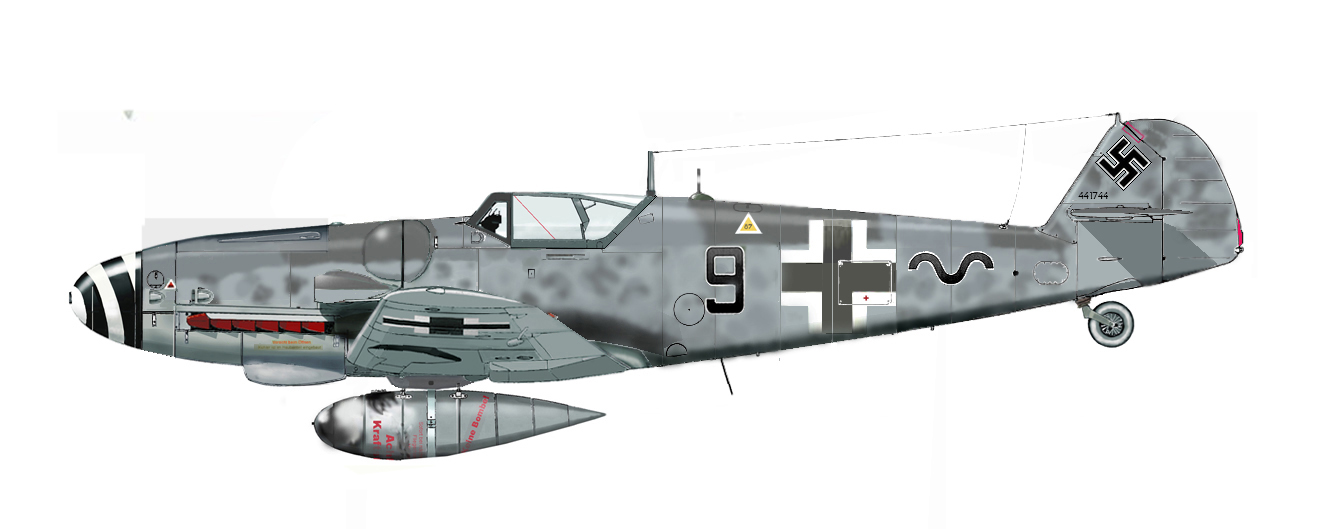
First out is a WNF Bf 109 G-6/U4 WNr 441744. Flown by 11./JG 27 -  it was lost (31.07.1944) in Saint-Germain-d´Elle near Saint-Lô in Normandie, captured by US troops. The original Staffel was back in Dortmund by this time. 


Next is a WNF Bf 109 G-14 of Stab I./JG 4 as seen in Babenhausen in April 1945. WNr 510XXX. The fuselage seems to be covered with something, as the Balkenkreuz cannot be seen. By this time, I Gruppe personnel was being drafted as infantry. (source MAH)


Next, the speculative aircraft last flown by the German cousin of the French fighter ace Pierre Clostermann, namely Bruno Klostermann of 11./JG 300 who was KIA on 14 January 1945 in a Bf 109 G-10 manufactured by Erla. There seems to be some disagreement as to whether he flew “Green 2” or “Green 12” . Erla production G-10's lacked the black cross on the fuselage, only showing the white outline, sometimes “filled in” by the ground crew(as here).


Lastly I have reworked a profile presented in Falcons Messerschmitt website depicting a Bf 109 G-10 produced by Erla, which, in my opinion, is grossly inaccurate, more resembling a Bf 109 G-6/AS than anything else. It also carries the camouflage that was used by 460XXX series G-14:s, ie “spotted dog” pattern. Anyhow, this is WNr 491 375 flown by Uffz Franz Keicher of 3./JG 4 who was lost on 11 February 1945 in air combat over Lübben/Steinau. Pilot was declared MIA.


The last two are both from JG 300, one from 3 Staffel, flown by an unknown pilot in the summer of 1944, the last one is a G-14 flown in the winter of 44-45 by Gefr Ernst Sharf of 16 Staffel.


More late-war Gustav artwork from Angantyr on this blog here

Friday, 19 July 2024

Fw 190 A-6s Gruppenstabschwarm III./JG 11, Oldenburg, March 1944 (Hackl)


JG 11 ace Hptm.Anton Hackl (left) preparing for a sortie with the Gruppenstabschwarm of III./JG 11 during March 1944 in Oldenburg. The Focke Wulfs appear to be lined-up prior to engine start. The Fw 190 A-6 in the background is 'chevron 2 + I' and the 'Drache' (dragon) Wappenschild can be seen under the cockpit. The Kommandeur of III./JG 1 Hptm. Friedrich Eberle is an interested spectator. As the machines prepare to start their takeoff runs (below), Hackl's Kommandeur machine ('chevron triangle') can be seen far left with the all-white tailfin. See pages 225-227 'Jagdflugzeug 190' (Rodeike, Struve)

Monday, 18 December 2023

Sitzbereitschaft ! More 3./ JG 11 Fw 190s


This image of Fw 190s of 3./JG 11 apparently at cockpit readiness in their dispersal at Husum during the summer of 1943 has been published on several occasions, most recently in the ultimate Luftwaffe fighters book "German fighters in the West" by Paul Stipdonk and Michael Meyer (JaPo, 2022).. However no-one AFAIK has taken the original image and 'blown it up' so that we can see more details of the machines in the background. 

Below;  a closer view of the three Fw 190s seen in the top left of the original pic. The 'Waffenmixer' (armourer) appears to be working on the cowl MGs of 'Yellow 14'  while pilots are at readiness in 'Yellow 12' and 'Yellow 5' which features a Schwarm leader's red 'Vee' stripe..Thanks once again  to Delmar for image manipulation!


I sent the 'enlargement' to Claes Sundin  -  and was thrilled that he wanted and was able to produce some exclusive artwork for the blog. His comments on these machines follows. Click on the image to view large.

'Yellow 12' is a Fw 190 A-5/U12 with the underwing cannon packs - just visible - usually flown by Oblt. Hans Pancritius.  'Yellow 14' was probably flown by Lt. Heinz Hanke. Unfortunately the name of the Staffel leader who flew in 'Yellow 5' with the red 'Vee' is not known. Note the rather large and 'compressed' numerals on the fuselages of these 3./JG 11 machines and the Staffel emblem on the cowl. Click on the image to view large..


Claes Sundin's Centura Publishing book shop for Luftwaffe profile books and prints is here

Saturday, 18 March 2023

JG 11 Fw 190 'low-viz' camouflage schemes

On page 38 of his book 'Frontal durch die Bomberpulks' Fritz Engau (I./JG 11) writes;

"...When I arrived at I./JG 11 in early 1944 a number of our Fw 190s, including the Kommandeur's machine, had been sprayed in a light grey scheme overall, toning down the usual mottle finish, while on all our machines the Haken- and Balkenkreuze were only barely visible ('schwach erkennbar')...It has often been imagined that this unusual finish served as 'camouflage' (in 'English' in the German text) so that our opponents would find it harder to pick us out as German machines in the air..[..] You could hardly disguise the distinctive form of the Fw 190 or the Bf 109 in the air. In addition all JG 11 fighters displayed a yellow fuselage band which was highly visible. Ultimately the reasons for adopting the finish were obscure and it can be supposed with a certain degree of certainty they probably had more to do with  testing of colours/paint finishes- than any other consideration. Certainly at the time the subject was not one we pilots discussed....."

The images below are just two from a series that appear in the outstanding Jochen Prien Jagdfliegerverbände series (Volume 13, 1944 - Defending the West) depicting III./JG 11 Fw 190s with over-painted crosses. Note on the 'overhead' photo the wing crosses are just visible...


Also on this blog;

JG 11 Gustavs defending the Reich 1943, Jochen Prien's Jagdfliegerverbände series

'Frontal durch die Bomberpulks' Fritz Engau (I./JG 11)


Wednesday, 19 October 2022

Fw 190 & pilots from the album of Heinz Stöwer I./JG 11 - ebay photo find #358


The following images are from the album of Jagdflieger Heinz Stöwer (left) who flew with JG 1 and JG 11. He was KIA in late May 1944 with 3./JG 11 being shot down in combat with fighters near Blumenthal. He had claimed around 15 victories in total including B-17s on Feb 21 and 22 during 'Big Week'. During February 1944 and flying out of Husum I./JG 11 claimed 31 Viermots during the month having been ordered to only attack American bombers. (Prien, JfV Teil 13/V p38) Seven defensive missions were flown during the month for 10 Fw 190s and four pilots lost. Stöwer claimed two more B-17s on March 29 and  April 09. He claimed two B-17s on April 11, 1944 for his 10th and 11th victories. On 29 April he claimed his 12th (a B-24). I./JG 11 claimed 43 Viermots and 8 fighters during April 1944. Two more B-17s fell to Stöwer's guns during May - I./JG 11 flew eleven defensive missions in the month for only 22 Viermots claimed, evidence of increasing American air superiority over Germany. On the last of these missions on May 30, Stöwer was shot down and killed by escort fighters in his Fw 190 A-7' yellow 1' (WNr. 430694).

The tall Major Anton Mader, first Kommodore of JG 11 - seen here with the Kommandeur III./JG 11, Anton Hackl. Hackl took over the leadership of JG 11 following Kommodore Graf's downing on March 29, 1944. 
JG 11 was established in April 1943. Kommodore Mader, born January 7, 1913 in Castelnuovo joined the Luftwaffe after the annexation of Austria. At the outbreak of war he commanded 3./JG 76 and then served on the staff of JG 2 and I./JG 2. In June 1941 he took up the post of Kommandeur II./JG 77, fighting at the head of his unit in Russia and Africa. Having scored 40 victories he was awarded the Knight’s Cross. 


Kommandeur I./JG 11. was Hptm. Irwin Clausen (left), born on August 5, 1911 in Berlin. Clausen began his career in the Navy and in 1935 moved to the Luftwaffe. In September 1939, with the rank of Feldwebel he scored his first victory over Poland with I./LG 2. During operation “Barbarossa” he commanded 1./JG 77, and from July, 1942 he was Staffelkapitan of 6./JG 77. In July he tallied some 45 victories within three weeks. Because of his distinctive facial profile he was nicknamed “Caesar”. As an Oberleutnant, having scored 52 victories he was awarded the Knight Cross on May 19, 1942. On July 23, 1942 he was awarded the Oak Leaves to his Knight’s Cross on the occasion of his 101st victory. 


3. Staffel JG 11 Fw 190 A-6 - note mid-wing pitot tube position and the thin white fuselage bands on these machines. The first Fieseler-produced Fw 190 A-6s arrived at 3./JG 11 in late July 1943 in Husum. 'Yellow 7' (below) is Fieseler WNr 530106 and was regularly flown by FhjFw. Hans-Georg Guethenke and belly-landed by this pilot on August 17, 1943. (see Rodeike, p205)


The 3. Staffel cowl emblem can be seen on the A-7 below along with the yellow fuselage band. Although previously published in at least two works, this image recently sold on ebay for 665 euros!


" ....With Oblt. (Hans-Heinrich) Koenig leading we headed towards the formation all guns blazing. Suddenly there was a flash. Koenig had failed to pull up in time and had smashed full tilt into a B-17...."  Fritz Engau's account of I./JG 11 in action on May 22, 1944 here


Friday, 29 July 2022

'Frontal durch die Bomberpulks' - Fritz Engau NJG 1, JG 11


Fritz Engau was a Bf 110 Nachtjagd pilot who flew with Schnaufer in NJG 1 before joining JG 11 in the defence of the Reich. His memoir  - 'Frontal durch die Bomberpulks' - is a rather poorly organised and photographically weak account but then memoirs from Focke Wulf 190 pilots and in this instance a JG 11 Staffelführer in the defence of the Reich are rather thin on the ground.

Engau provides a fairly detailed bio on page 11 of his book. He went to flying school with Schnaufer. He was promoted to Leutnant on 1 April 1941, and to Oberleutnant on 1 April 1943. He first served in II./NJG 1 (again with Schnaufer), where he led 5. Staffel. On May 30, 1943 he was WIA after the engines of his Bf 110 G-4 (G9+FN) were hit by enemy fire. He bailed out near Glimmes, 17 km SSW of Tirlemont/Belgium. After his convalescence, he was appointed Staffelkapitän of 2./JG 11 during May 1944 and promoted to Oblt. On several occasions, he assumed acting command of the Gruppe (I./JG 11) and the Geschwader. He claimed one Viermot and three P-51s and damaged a B-17, all between 29 April 1944 and 7 June 1944 (his 1st, a B-17 at Nienburg on 29 April, 1944. His 2nd, a P-51 SW of Walsrode on 8 May, 1944. His 3rd, a P-51 NE of Kiel on 19 May, 1944. His 4th, a B-17 (HSS) at Müritz on 29 May, 1944. His 5th, a P-51 at Wald by Rambouillet on 7 June, 1944). Some sources credit him with two RAF bombers with NJG 1 giving him seven victories. He was badly injured in a crash landing at Rennes on 15 June 1944 in Fw 190 A-7 'black 1' (WNr. 643701)and sent home the next month. Prien describes him as one of the "experienced and successful Staffel leaders who formed the backbone of the flying organizations".

In 'Frontal durch die Bomberpulks' - sub-titled '1944 Reichsverteidigung - Normandie-Invasion: Deutsche Jadgflieger in ihren schwersten Kämpfen' or German fighter pilots in their hardest combats - Engau describes his experiences in 1944 over the Reich and the Normandy invasion front.  Engau recalled one of his most notable sorties. On May 24, 1944 616 Fortresses of 1 and 3 BD escorted by over 900 fighters headed for Berlin crossing the coast from the north over Schleswig-Holstein. Some 14 Tagjagd Gruppen were directed against this raid including Engau’s I./JG 11;

 “..it was one of the sorties I flew as a day fighter that I would never forget. We could only fly the occasional mission in the kind of poor visibility we met that day. We were about ten Fw 190s and we flew in an arrow-head formation. We managed to turn into a box of two or three Pulks – each of 18 bombers - but were not quite correctly lined up on them. With Oblt. (Hans-Heinrich) Koenig leading we headed towards the formation all guns blazing. Suddenly there was a flash. Koenig had failed to pull up in time and had smashed full tilt into a B-17. The bright explosion was probably his explosive rounds going off. I saw huge pieces of debris spinning away. As we passed through the Pulk and swept into a turn to fly a second pass there was no sign of the B-17 that had been hit. But I could still see the wreck of Koenig’s machine tumbling down, wings torn off. It was not burning ..but there was no parachute..”


Saturday, 19 February 2022

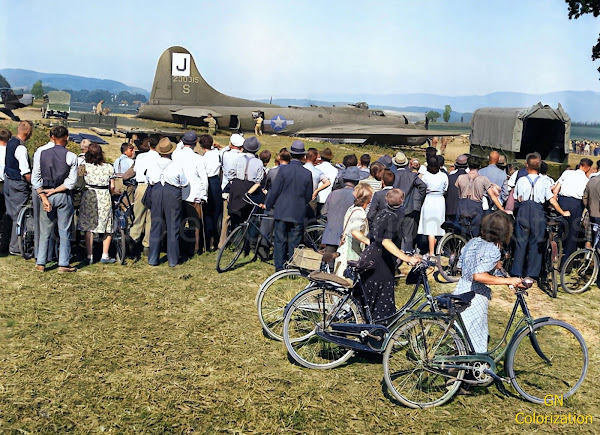
B-17 F-95-BO, "Battle Queen – Peg of my Heart" Regensburg mission, August 17, 1943 - I hate 'colorised' images #2


I don't much care for colorized photos although the net (and certain publications like Andy Saunder's dreadful 'Iron Cross') are full of them. This particular image though caught my eye as being quite well done, although with everyone wearing 'blue' or 'white' its obvious that the 'colorizer' (I'm not calling him an artist ..) got tired of shuffling pixels around..

It depicts B-17 F-95-BO, Serial Nr. 42-30315, Marking: S, named "Battle Queen – Peg of my Heart" 8th Air Force, 390th BG, (569th BS), based at Framlingham, England following a belly-landing in Utzenstorf, Switzerland on 17 August 1943, the Regensburg mission. Image via the 390th BG Memorial musuem at Framlingham/Parham airfield and 'Increbile Colorization Photos'


The RAF-Waffe visit Framlingham, home to the 390th BG


Are colorized images 'fraud'?

Friday, 18 February 2022

Gfr. Hans Dahmen 2./JG 300 Bf 109 G-6 - Ebay photo find #353


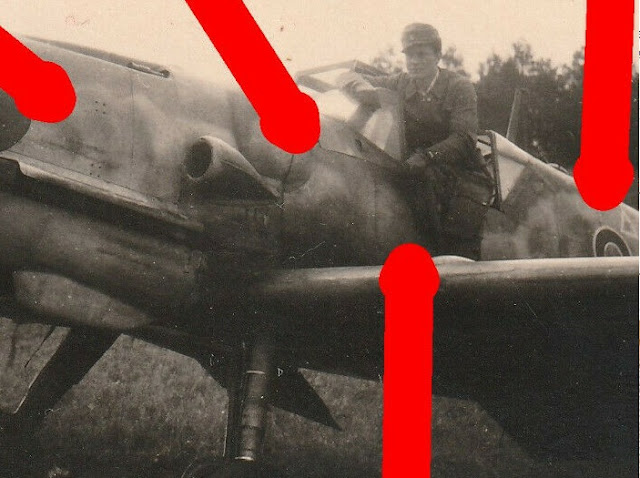
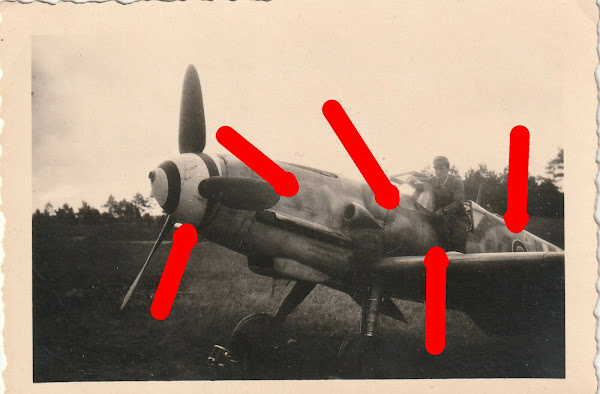
I./JG 300 Bf 109 G-6 seen at Bad Wörishofen, photo dated August 10, 1944. The inscription on the reverse of the photo - 'in friendship, from Hans, Bad Wörishofen, August 1944' - suggests that the pilot seated on the cockpit was one of Kommandeur Hptm. Stamp's 2. Staffel teenagers, 19-year old Gfr. Hans “Hänschen” Dahmen.. Dahmen's 'regular' machine was 'red 2'. Current bid is over 330 euros with two days to go, no doubt some 'mad Frenchie' keeping the bidding high. 

Edit- final selling price was a frankly quite mind-boggling 1,561 euros.....


Dahmen downed a bomber on 18 July 1944 and two more 15th AF Viermots fell to his fire on 25 July over Linz. He registered hits on a third B-24 during this action for an endgültige Vernichtung. Dahmen's Kaczmarek was Uffz. Wolfgang Hundsdörfer. Both Dahmen and Hundsdörfer brought down B-17s on August 22 raiding refineries in Austria but I./JG 300 ran into 31st and 52nd FG Mustangs. Gfr. Hans Dahmen was brought down near Raab. Some Hungarian villagers found him staggering along a track, blinded by blood pouring from numerous facial wounds. The windscreen of Dahmen’s Bf 109 G 6 had been shattered by several impacts, the shards ripping into the young pilot’s face and eyes.

Uffz. Dahmen was KIA flying against Soviet spearheads on the Eastern Front on February 3, 1945, his G-10 'red 14' brought down by anti-aircraft fire as recalled by Lt. “Timo” Schenk; 

" ..The Rotte Hundsdörfer- Dahmen was hunting over the Warthe, to the east of Göritz. Hans Dahmen, usually very cagey and wily, was flying as number 2 just behind Hundsdörfer, when they roared over a column of refugees. They hauled around at low altitude and straightened out flying parallel to the road.Suddenly the canvas awnings of two trucks fell away. Soviet anti-aircraft cannon mounted on the trucks opened up with a wall of fire. Although the fusillade missed Hundsdörfer’s Messerschmitt, shells slammed into the second. Hans Dahmen’s 109 went down out of control and crashed in flames..."

Photo portrait of Dahmen sold for 89 euros.


Saturday, 1 January 2022

Notes on the Me 262s of JV 44. Munich, Innsbruck, Salzburg, Hans Ekkehard Bob, Heinz Bär (part 1)


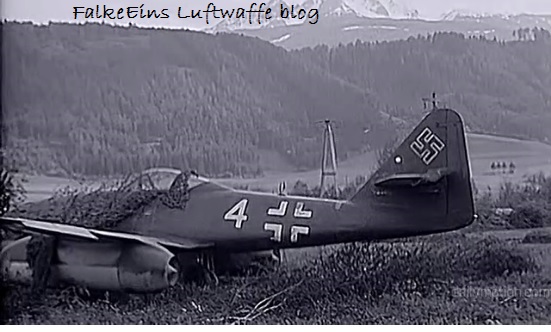
A view of what may or may not have been W.Nr. 170 061 "white 4" of JV 44 seen in a US film excerpt at Innsbruck-Hötting. 

A small post looking at some of the Me 262 Turbos assigned to JV 44. It is relatively well established which aircraft were assigned to Galland's outfit.  Czech writer Martin Sila, " ..at the beginning of its existence, JV 44 received 12 Me 262 aircraft, which probably received a fuselage designator (white) from "1" to "11" while Galland's command machine (the twelfth machine) displayed a ' white double chevron'. In photos the machines look as if they are painted with a uniform color, but in reality they are finished in two shades of green. Some serial numbers from this first group of twelve aircraft are also known.."

Late on JV 44 "absorbed" a number of aircraft from other units (III./EJG 2, KG 51, trial prototype machines). Robert Forsyth's "JV44 The Galland Circus" narrative highlights just how chaotic the circumstances around the unit's formation and its subsequent operations were, with aircraft arriving from a number of units and pilots bringing their own machines with them! Even the Luftwaffe High Command didn't always know the strength of this unit!  

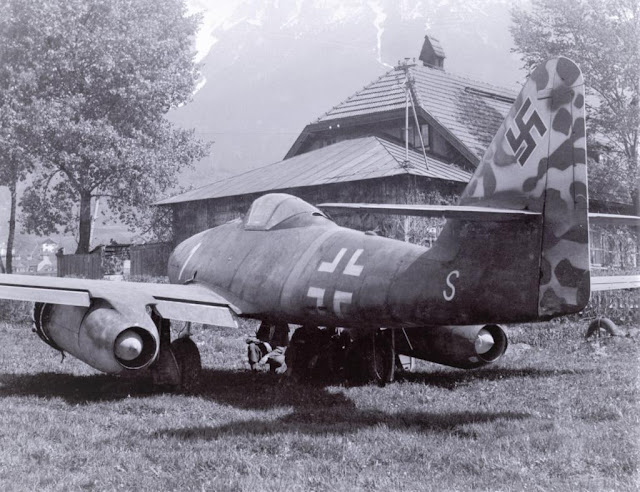
Below;  two JV 44 Turbos that may depict "White 6" and "White 3" W.Nr. 111740 and W.Nr. 111746 operational with JV 44 at München-Riem in April 1945. This image is apparently captioned "Me 262 General Galland and Lt. Willi Roth, Staffelkapitän of 4./JG 103 [sic]." Lt Roth is listed as one of the JV 44-pilots in the well known document dated 27. April 1945 but not mentioned in Forsyth. Notable JV 44 pilots from JG 103 included former instructors Ofw. Dobnig and Ofw. Rudolf Nielinger. 'White 6' is usually assigned to Steinhoff...


The aircraft in which Johannes Steinhoff was badly burnt on 18 April 1945 was "white 6" (WNr. 111740) and Galland flew his last combat sortie on 26 April 1945 in 'white 3' (WNr. 111746). This machine was not destroyed (as has been generally stated) that day, but only damaged. Another well-known member of JV 44 Franz Stigler stated that this "white" 3 "was his machine. According to Sila, "..Stigler's role in the JV 44 is overestimated. He served as Techn.Offz. As to combat flights, it is interesting that other witnesses from JV 44 do not mention him in their recollections .."

The "sister" machine to WNr. 111745 was "white 5" which Eduard Schallmoser damaged heavily on 4 April colliding with a P-38. "White 5" was one of the twelve Me 262s which Jagdverband 44 had taken over in March 1945. A number of pilots flew it in combat. Schallmoser had been assigned to JV 44 as a freshly trained fighter pilot, after completing an accelerated training programme in the Me 262. On 4 April 1945, his Rotte met a group of twelve P-38’s of the 15th USAAF in area of München-Riem, which the German pilots attacked. In the following combat Uffz. Schallmoser collided with one of the Lightnings piloted by Lt. William Randle as a result most probably of his excessive speed. While Schallmoser managed to land his damaged “White 5”, Lt. Randle bailed out of his Lightning and became a POW. 


Below;  'white 6'  in the background seen behind the tail of 'white 5' on the right. The Kennziffer '6' is partially obscured by the camouflage netting. Both machines display the typically basic JV 44 camouflage scheme consisting of RLM 82/83 on the upper surfaces. Eduard Schallmoser is on the right. 


In late April 1945 Galland's unit was ordered to depart Munich - effectively ceasing combat operations - and commencing on April 28, JV 44 began transferring to bases (or rather field strips) in Austria - Salzburg and Innsbruck. Of particular interest is the (unknown) fate of Galland's own 'white double chevron'. According to one account 'white double chevron'  was flown to Innsbruck on 29 April 1945. In Innsbruck, Major Hans Ekkehard Bob was ordered to the landing ground at nearby Hötting to prepare for the arrival of jet aircraft. The runway strip area had to be extended to 1,200 metres necessary for takeoffs and landings by Me 262 and an attempt was made by Bob to adapt the airstrip to the necessary length. However there was no J2 fuel at the base. Bob's efforts were in vain. 

There were two airstrips at Innsbruck at that time. At Innsbruck-Reichenau, a few kilometers east of Hötting, at least two Me 262s came into land, and according to one account, Me 262 A-2a "White 1 "  almost hit buildings on the run-out. The landing strip was still too short for a Me 262 to take-off from, so of the 12 Turbos that landed  in Innsbruck according to Bob's recollections,  all were stuck and subsequently abandoned. However if Galland's  'white double chevron' did go to Innsbruck it does not appear to have been documented photographically there by US personnel. From the video material available there is no sign of such a distinctively marked machine. More on this in part 2.


'White 8' (above) -Me 262 A-1 "White 8 S", WNr. 500492 - was one of possibly two Me 262s that landed at Reichenau, a few kilometers east of the temporary airfield at Hötting where the other JV 44 Me 262s landed and were dispersed. Note that the machine was previously with III./EJG 2 operating from Lechfeld, with the white `8`on the nose and narrow yellow fuselage band behind the cockpit.

  On the evening of 29 April 1945, at about 1800 hrs., Ofw. Rothert of 2./Fl.U.G. 1 transferred Me 262 A-2a WNr. 170047 'white 1' from München-Brunnthal to Innsbruck-Reichenau. The port view of this machine  (last of the four images) shows the white 'S'  ('Schule') under the horizontal stabilizer - as seen in the well-known Kommando Nowotny line-up from where it went to JV 44. 


Major Bob remained in Innsbruck until 3 May 1945, when he received an order to 'disable' his jets  and transfer to Salzburg which he did as the US Army approached. Based on this information, it is possible to state that all of the Me 262s abandoned here were unserviceable.. 

At least 12 Me 262 Turbos were flown to Innsbruck. However a memo dated 2 May quoted in O'Connell's 'Me 262 Production Log' states that as many as 22 Me 262s of JV 44 were transferred to Hötting and that 7 of them crashed on landing. [The memo states that there was 25 cm. of snow at Hötting on 2 May.]

 JV 44 Me 262s that can be identified at Innsbruck (primarily Hötting airfield) included;

 W.Nr. 111 712 (EZ 42, no Kennziffer)
 W.Nr. 500 490 Me 262 A-1a. No markings, full-fuselage RLM 83 camo 
 W.Nr. 111 857 (original "white 5")
 W.Nr. 111 751
 W.Nr. 500 524
 W.Nr. 112 360
 W.Nr. 170 047 - "white 1"   Innsbruck-Reichenau
 W.Nr. 111 974 - "white 8"   Innsbruck-Reichenau
 W.Nr. 170 061 - "white 4"
 W.Nr. ??? ???  - "white 11"
 W.Nr. ??? ???  - "white 12" (according to David. E. Brown the 113 series aircraft ...)
 W.Nr. ??? ???  -  "red 1" ( another 113 series machine ...)


Below;  Me 262 A-1a, uncoded, JV 44, WNr.111857, Innsbruck-Hotting. Previously 'white 5', III.EJG 2. NSG 9 Stuka D-3 with exhaust flame dampers in the barn in the background.


(to be continued)