an overview of Me 410 ops compiled by Jim G
Jan Horn's self-published German-language history of KG 51 features a chapter entitled "The unequal fight in the West" which describes Me 410 long-range bomber and night intruder missions carried out by I. and II./KG 51 between February 1944 and August 1944 in the context of 'Steinbock' ( the 'Baby Blitz'). From other sources it is possible to compile a list of missions flown by the Me 410s of V./KG 2 over the UK prior to this Gruppe becoming II./KG 51.
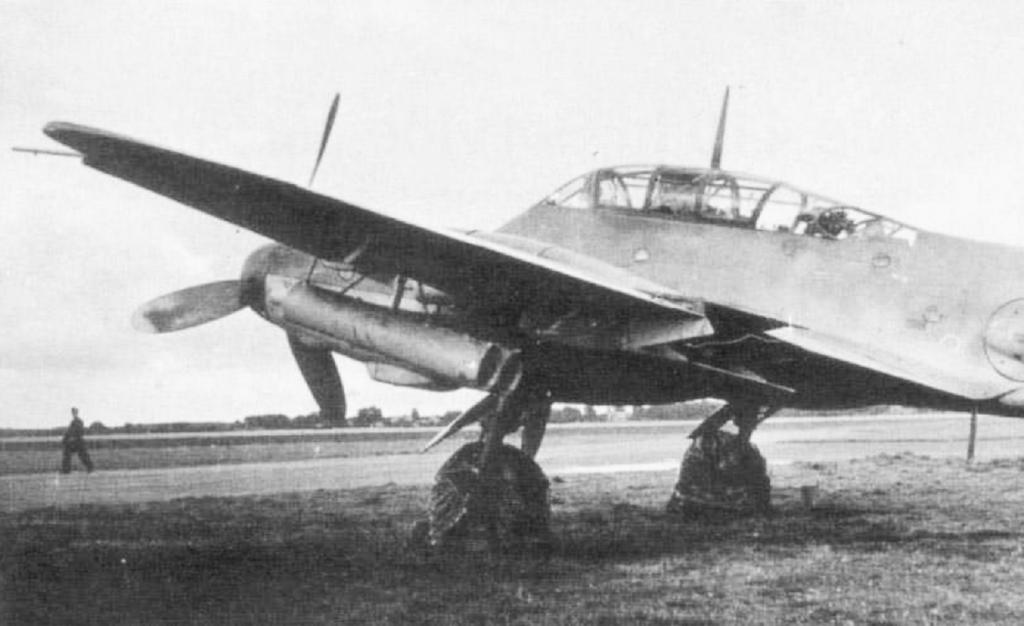
Below; Me 410 A-1 WNr. 238 "U5+KG" was an early aircraft assigned to 16./KG 2 for Fernnachtjagd (long range night intruder) operations over the UK. While it still has the RLM 76 undersides of a day fighter, this is a great view of the long, tubular flame suppressors attached to the exhaust ports of the engine. This feature was crucial to night operations over England in mid-1943. The Besatzung (crew) of Flugzeugführer (pilot) Fw. Franz Zwissler and Bordfunker (radio operator) Ofw. Leo Raida was shot down by a Mosquito NF of 85 RAF Squadron on the night of 13/14 July 1943 in "U5+KG" (RL 2-III/1191 p. 126).

During the night of 2/3 January 1944 fourteen Me 410s of V./KG 2 based in northern France at Athies dropped bombs on Greater London. RAF Mosquito ace W/C John 'Cats eyes' Cunningham leading 85 Sqd shot one down just over the French coast, the RAF's first victory of 1944 - his radio/nav Cecil Rawnsley has left an account of this victory identifying the target as a Me 410. Also on this night Me 410 'U5+AJ' of 16./KG 2 exploded over Dover, victim of F/O Douglas Bergemann of 488 Sqd. On the night of 4/5 January, fifteen Me 410s were launched. During mid-January V./KG 2 was briefly deployed to Achmer and launched by day against USAAF bombers.
Oblt. Rudolf Abrahamczik (centre), Staka of 4./KG 51 in February 1944, stands in front of Me 410 A-1 "U5+FE" as a flat tyre is changed. The Me 410 is still in the livery of 14./KG 2 and as late as 15 March 1944 he would be flying "U5+AE" to his next assignment as Staffelkapitän of 12./KG 51. Note that the Me 410s of V./KG 2 now had black undersides.


At the same time as V./KG 2 was entering the intruder role, Hptm. Klaus Häberlen's I./KG 51 was converting to the Zerstörer mission at Lechfeld and Memmingen. "Fahrwerkschaden infolge Bedienungsfehler" (undercarriage damage due to pilot error) (RL 2-III/1191 p. 21) could result in severe damage and a court of inquiry. Eberhard Winkel's Bordfunker, Arnold Schwachenwald, on p. 87 of Wolfgang Derich's English edition of Kampfgeschwader 'Edelweis' bemoaned the fact that as a result of pilot error, "many a pilot came to spent a week inside the 'glasshouse' [the guardroom at Fl. Pl Lechfeld]. Note the larger white nose cap on the black propeller hub seen on other aircraft of KG 51 at this time. (Horn, p. 123) This is a standard Me 410 A-1 with a bomb-bay and exhaust flame suppressors.

Below; this Me 410 A-1/U-2 matches Schwachenwald's description (p. 85) of I./KG 51's aircraft equipped with four W.Gr. 21 mortar launchers used to try and penetrate the effective 1000 m of defensive fire of American daylight bomber formations. According to Schwachenwald, on their first operation on 6 September 1943, I./KG 51 blew an American bomber out of the sky but Winkel's aircraft had one of its engines shot out and barely made it back to base. I can find no record of either incident but Harald Haverstadt was wounded and his Bordfunker killed that same day. (RL 2-III/1193 p.86 and p.118) Note that this version of the Me 410 has two longer barrels of additional guns mounted in a ventral container mounted in the bomb-bay.
Me 410 A of II./ZG 26 (note the heel of the 'wooden shoe' on the port engine) shows to good advantage the installation of two W.Gr. 21 mortar launchers under each wing, with their upward tilt calculated for firing outside the 1000 m range
Ground crew load a 21 cm. mortar into its launcher. Note that the mortar has no stabilizing fins visible. As far as is known, there were no official claims made by I./KG 51 in the West in 1943 before they moved to France in December for night bombing operations. As a result, Häberlen was sacked by Peltz and Göring on 11 October 1943 in an acrimonious meeting at Fels am Wagram.
Sixteen V./KG 2 Me 410s were despatched to bomb London docks on the night of 3/4 February alongside some 237 'standard' Luftwaffe bombers, and fourteen more Me 410s bombed Kent during the early morning of 6 February 1944. It was on this date that V./KG 2 was re-designated II./KG 51 and 5./KG 51 under Puttfarken was designated the
Fernnachtjagdstaffel tasked with hunting RAF bombers over the UK. Sixteen Me 410s were despatched against London on the night of 12/13 February. Rawnsley describes how he and Cunningham made a visual interception but were unable to catch the Me 410 and get to within firing range in their Mosquito. Rawnsley describes another Me 410 interception on the night of 21/22 February (Cunningham's last) but despite chasing the 410 all the way back to France they could not catch it. I./KG 51 launched their first Me 410s against England on the night of 22/23 February. Ofw. Adolf Schwachenwald of 1.Staffel has left a small account of bombing London;
"..On February 20, I flew with my pilot, Hptm Eberhard Winkel, as an advance party for our Staffel, 1./KG 51. We landed at St André. As the weather improved, we were invited to take part in an operation over England as part of the other Staffel (Note: probably the recent II./KG 51, ex V./KG 2). We volunteered for the operation on the night of the 22nd/23rd. It was an attack on London. The aircraft took off at two minute intervals, the runway lighting quickly switched on for take-off before we were plunged back into the dark. We zigzagged along at set altitudes. An aircraft dropping flare bombs was hovering ten thousand meters above us. Everything went like clockwork. As soon as we crossed the Channel, we were greeted by the powerful fire of flak ships. Then came the searchlights which, like fingers, sought us out in the sky. Coastal batteries joined in, sometimes exploding shells at our height. It took nerves of steel to stay on course and keep moving towards our objective. We arrived in London a few minutes early, passed over the city then turned to drop our bombs while our 'Obermann' dropped his flares. Fires broke out. In a swooping flight (reaching six to seven hundred km/h), we crossed the English Channel to reach the French coast. We were again greeted by gunfire from ships. About a hundred metres from us, a slower German bomber was engaged by night fighters and came down in flames in the Channel. We picked up our comrade's last message: 'Ju 88... Code... SOS. we're going down in flames' (Note: a KG 6 or 54 aircraft). A few minutes later, we were flying over land and, by radio, were guided to our airfield. We landed and took a breather after an adventurous 118-minute flight. We thought that anyone who survived such a flight over England must have been incredibly lucky, and had God on his side.."
Winkel flew another sortie over London on the night of 24/25 March 1944 taking off shortly before midnight in his Me 410 '9K+CL'. After completing his attack, he was on his way back to France when he heard over the radio about the sudden onset of bad weather, shrouding his departure airfield in fog. Winkel flew over the Netherlands before spotting an airfield through the fog. He fired off a signal flare and quickly put down, narrowly avoiding high-voltage power lines. He was at München-Gladbach, an airfield with a runway far too short for a 410. He had to 'stand on his brakes' to avoid a catastrophic runway excursion. Firefighters and paramedics were already on the scene. Winkel was to learn that, just a few minutes earlier, a comrade's machine had been shot down on the airfield by an RAF night fighter.