Showing posts with label Westfeldzug. Show all posts

Wednesday, 3 April 2024

Caudron CR. 714 in the Battle for France - GC 1/145 ('Les Polonais de Varsovie')


..the following is based on Grzegorz Slizewski's book  "The Lost Hopes - Polish fighters over France " with some important corrections and additional material from Comas/Ledet 'The Caudron Fighters' published by Lela Presse and the highly recommended book "Les aviateurs polonais en France" (B. Belcarz, Artipresse).

On 17 February 1940 French Air Minister Guy La Chambre signed an agreement with Polish General Sikorsky to establish a Polish fighter Group comprising two escadrilles in the Armee de l'Air. This would naturally be established from the DIAP (Depot d'instruction de l'Aviation Polonaise - Polish air training centre) then based in Lyon. On the opening day of the German offensive in the West, 10 May, the Poles of CG 1/145 were in Lyon with just a handful of Ms 406s and CR. 714s.  'Defence flights' for the city were quickly formed and the aircraft relocated to Mions outside Lyons - from where the air raid warnings sounded from the city could just about be heard (radios were defective). Eager to fight with whatever types the French could supply, the Poles had been accumulating training time on the CR. 714 even before the 'official' establishment of the first 'French' Polish fighter squadron. The first Caudrons arrived at Lyon-Bron during March 1940. But it was not originally envisaged that they would be deployed in combat. The French knew full well that the light-weight Caudron powered by its small Renault engine would be severely outclassed by Luftwaffe types, so had used the type as a cheap 'training' machine. But in the end there were no other types available in numbers. By 21 May some 16 machines had been taken on strength and the Groupe had relocated to Villacoublay, south of Paris (part of the 23rd Groupement de chassse) and close to the Caudron factory at Guyancourt for further deliveries. The French Minister of Air, Guy La Chambre, inspected GC 1/145 ('Les Polonais de Varsovie') on 25 May. The aircraft were being delivered straight from the production line and presented a litany of defects forcing the minister to  suspend all flying on the "Cyclone". He was told about the aircraft's poor climb rate, a weak landing gear and its faulty lowering mechanism, as well as an imperfect propeller pitch-changing device, engine cowling 'ballooning' during dives and unreliable dashboard instruments. While the Minister's reaction was perhaps the proper one, it served to deprive the Polish pilots in France of the only aircraft available to them. The French Air Ministry had originally ordered the Armee de l'Air to equip the Poles with the Bloch 152, aircraft which were not available. Despite Polish pilots having more hours on the Ms 406 they were not offered these aircraft either far less the D.520 - types for which they were probably not considered 'suitable'. The very next day, they elected to continue flying the defective Caudrons. On 2 June the squadron moved to the airfield at Dreux, some 30 km west of Paris. There were no facilities on the field and it was not until the ground echelon arrived that the aircraft could be dispersed and carefully camouflaged around the airfield. Two days later, the Poles finally received the long-awaited radios. Up to that point, they scrambled at the signal of an automobile horn. To beef up GC II/10, on 5 June the squadron was ordered to patrol in the Rouen area. This was done by Flight "B". Half an hour later, Flight "A" was moved to Bretingy-sur-Orge, south of Paris, with the task of defending the French capitol. The next day, the squadron was charged with the same duties.

In the evening of June 6, the squadron was attached to the 42eme Groupement de Chasse, defending a sector of the Seine Valley between Vernon and Meulan.

Two three-aircraft reconnaissance flights on the route Meulan-Magny-en-Vexin-Fleury-sur-Andelle-Vernon and along the Seine were the squadron's only activity on 7 June. The next day found the squadron with twenty-one serviceable aircraft. The remaining thirteen required much attention from the ground crews. Some were being generally checked after forced landings, while multiple tasks were performed on others; changing a stabilizer or rudder, replacing Plexiglas in a cockpit, a carburettor, parts of an electrical installation, and so on. That day "A" Flight was assigned to GC II/10. At 15:54 a section of five aircraft, led by kpt. Wczelik, took off to patrol over the Vernon-Meulan area. South of Rouen, the Poles attacked a group of about twenty Messerschmit 110 Cs of III./ ZG 26 escorting a group of Stukas. After several months of inaction the Poles were spoiling for a fight. They landed at 17:10. Officers Wczelik and Czerwinski claimed victories, but none of the other pilots saw the enemy aircraft crash. Commander Kepinski recognized only one of them as probable but soon after, around the area of that clash, the wreck of a single Me-110 was found, all five Polish pilots receiving a victory share as was usual French practise.


 por. Tadeusz Czerwinski  kpt. Wczelik, ppor. Aleksy Zukowski, ppor. Jerzy Godlewski and kpr. Piotr Zaniewski were credited with one Bf 110 each - for one aircraft shot down.  Belcarz points out that the only Bf 110 losses were over the German-Swiss border zone while in Comas/Ledet one notable French historian argues that the German loss does not appear in most recognised sources (including Vasco and Cornwell) since it was not reported until later in the year. The squadron suffered no losses, but most of the aircraft were shot-up and temporarily unserviceable.

At Bernay, on 9 June the squadron joined up with Flight "B", to fly a sweep at full strength over the front-line area. Eighteen aircraft took off at 2:30 p.m. Led by maj. Kepinski were Commandant de Marmier, kpt. Laguna, kpt. Wczelik,por. Zdzislaw Zadrozinski, por. Jan Obuchowski, por. Julian Kowalski, ppor. Czeslaw Glowczynski, ppor. Jerzy Czerniak, ppor. Lech Lachowicki-Czechowicz,ppor. Jerzy Godlewski, ppor. Bronislaw Skibinski, sierz. Jan Palak, plut. Andrzej Niewiara, plut. Mieczyslaw Parafinski and kpr. Edward Uchto. Over Vernon, the squadron attacked an enemy formation of about 50 Dornier Do 17s escorted by about 20 Bf 109s. Due to  radio malfunction the attack was poorly coordinated.

 Czeslaw Glowczynski recalled;

 ".. My radio didn't work so I wasn't aware of any warnings. I soon noticed a group of about 30 Bf 109s, some 3,000 feet below. Since our leader didn't react. I come close to him and waggled my wings. I pointed down; he nodded to indicate that he had seen them and continued straight and level. I gave him a sign that I would attack. I thought that at least a part of our group would follow me in this attack, but I found myself alone, with the exception of my wingman, ppr. Czerniak. Our position was advantageous since we attacked from above, with the sun behind us. At top speed, I swept down on the rearmost Bf 109. The swiftness of my attack caused the whole German formation to break up. One of them went down steeply, smoking heavily. Immediately, I went after another one, which, after few bursts, crashed in a forest south of Rouen. I was then shot at from behind. Several bullets came near my head and shattered my instrument panel. I managed to force land on a front-line strip at Evreux. Czerniak got one Bf 109 as well, and he landed with me. It took the whole evening to fix my machine and I returned to the unit the next day.."

 Jerzy Czerniak recalled;

 "... The weather was beautiful and flying in the direction of our assigned zone of operation, we were climbing slowly. At 12 or 15 thousand, we started to look for game. For over thirty minutes, the flight was uneventful, and looking at Czeslaw, I could tell that he was greatly disappointed that there were no Huns around. That's when I saw aluminium flashes  glinting below us. I gave Czeslaw a sign, and we altered our course a little to put the sun directly behind us. Next, Czeslaw dived and I followed him, releasing the safety catch on my armament in case there was a scrap. And there was  one. We closed on the Messerschmitts and Czeslaw coolly positioned himself right behind one of them and opened fire. Others maneuvered themselves behind Czeslaw who continued spraying his wiggling victim. All this time, I flew behind my colleague, observing the scene. One Messerschmitt started to shoot at him and that's when I intervened. I jumped at the German and gave him a burst right in the cockpit. He must have got it since he flipped over, going down. I served him another portion and stayed with him till he crashed into a French farmer's yard.."

(p55 Comas/Ledet - The Caudron fighters)

 Ppor. Glowczynski was credited with one Bf 109 destroyed and one damaged, while ppor. Czerniak got one Bf 109 destroyed. Plut. Parafinski also scored, destroying a Bf 109, while kpt. Wczelik and sierz. Markiewicz shared one Dornier 17 destroyed. Two planes crashed south of Andelys and others near Louviers. This time, the squadron suffered a loss of three pilots. Killed in action were por. Obuchowski, ppor. Lachowicki-Czechowicz and kpr. Uchto. por. Kowalski was slighty wounded, while ppor. Godlewski force landed at Villacoblay. The rest of the pilots landed at 3:50 p.m. A few aircraft were unserviceable. Godlewski tried to join his unit on a new plane but nose-dived during the takeoff. He come out of the accident unscathed, but couldn't catch up with the squadron. The Poles clashed with the Emils of II./JG 27 (some sources state III./JG 26). The pilots from this unit claimed three Moranes shot down. Credited with victories were: Gruppenkomandeur Hauptmann Werner Andres, Feldwebel Karl Witzel and Feldwebel Karl-Heinz Bendert. In reality, the Luftwaffe lost three Bf 109s. Leutnant Hans Bosch ( Hptm. Andres wingman ) and Feldwebel Karl-Heinz Kranich become POWs. Leutnant Hermann Kugler went missing. Slightly wounded, Hptm. Andres force landed near Creil...

Below;  when CG 1/145 evacuated the airfield at Dreux they left behind some fifteen Caudrons. The reverse of the image below - an expired Ebay.de auction - is captioned, 'Dreux 22 July 1940'. Compare with the image on page 180 of  "Les aviateurs polonais en France" (B. Belcarz, Artipresse). First machine visible "1" is the aircraft assigned to plut. Markiewicz.


Above; reproduced on p55 of the Comas/Ledet title and p181 of the Belcarz ' Les aviateurs polonais en France', three 2e escadrille machines at Dreux on 22 June 'white 10 and 'white 13' with 'white 7' in the background. 'White 13' was flown by the future 56th FG ace Boleslaw Gladych. 

1/145 pilots had 12 victories 'officially' confirmed (Bf 110s, Do 17s and four Bf 109s) for the loss of 3 Caudron pilots KIA. Ppor. Jerzy Godlewski -officially MIA- reached England and joined 72 Sqd


"The Caudron fighters - the Cr. 714 and variants" authored by Matthieu Comas and Michel Ledet 


"Les aviateurs polonais en France" (B. Belcarz, Artipresse).


And a rare page-view look into the huge Belcarz book on the Cr. 714 "Cyclone" - details of the cockpit/instrument panel


Dr Belcarz founder of Stratus and Mushroom recently succumbed to cancer RIP


Thursday, 30 November 2023

Stuka crews of 10.(St)/LG 1 relax ahead of the attack in the West


A Stuka crew from 10.(St)/LG 1 relaxing by their machine just prior to the Westfeldzug, the campaign in the West. The Ju 87s of IV./LG 1 departed their field near Cologne on 19 May 1940 and headed for Belgium. Their new base was a field strip near Hargimont (Marche). This 10. Staffel machine was Ju 87 B-1 'L1+CU'.


Just one of the many excellent photos published in the latest BA (issue 104) from Lela Presse " Stuka dans la Blitzkrieg " Part II (the  attack in the West. Part I covered Poland and Scandinavia..). BATAILLES AÉRIENNES is the leading French-language quarterly from Lela Presse, in continuous publication since 1997. Features rare first person accounts, rarely seen photos and superlative artwork from Eric Schwartz, still only 13 euros (100 pages, 200 illustrations, 10-15 artworks). Available here

" Here is the second part of our study dedicated to the terrifying weapon -in its day- that was the Stuka. After a successful trial in Poland, the Ju 87 was to prove its worth on the battlefield in the West. As we know, it was a great success. And the Allied anti-aircraft defences of the time were not the equivalent of the German Flak; not to mention the Allied fighters who, although overwhelmed by the scale of the Luftwaffe attacks, were able to score a few successes against the Stuka, successes which already revealed the vulnerability of the dive-bomber. So, no, the Stuka was not a miracle weapon; it was simply a question of making good use of a weapon in a rather favorable context. Mention is often made of the Stuka's siren, which terrorized the population and Allied troops. Certainly, this was the case during certain attacks, and this is essentially what was remembered and, above all, peddled. Nevertheless, numerous photographs show that personnel were happy to get rid of this equipment... whose effectiveness could not have been as radical as later reported...

To this day, the Stuka remains a legendary weapon, inseparable from the 'Blitzkrieg' waged by the 3rd Reich. The author's account shows us that the reality needs to be nuanced, as the losses suffered by Stuka units were not negligible; nor were those suffered by other Luftwaffe units, even in a context of near-total victory..."

Tuesday, 25 April 2023

No 1 Squadron Hurricanes in France 1939-40 - Sqn Leader 'Bull' Halahan and 'blue 109s'


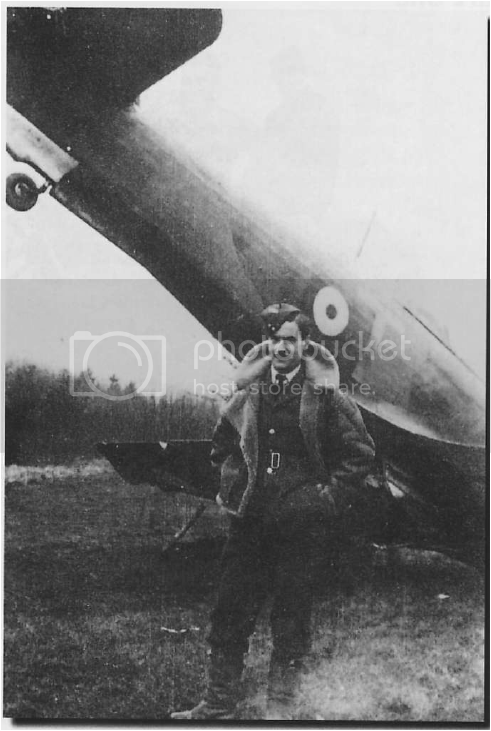
During late 1939 No. 1 Squadron was commanded by Squadron Leader Patrick J. H. ‘Bull’ Halahan. While airmen from all over the Empire served in 1 Sqd,  the Irish squadron leader earned a certain notoriety. Patrick Halahan, a Dubliner, nicknamed ‘Bull’ - apparently because of his sturdy broad-shouldered physique - had what might then have been referred to as a 'strong character'. He spoke with a thick Irish accent and according to one account, " his language was colorful and down-to-earth. " As part of 67 Wing, 1 Squadron was sent to France during October 1939 along with No. 73 squadron as part of the air component of the BEF (British Expeditionary Force) assigned to escort and protect the BEF's Fairey Battle bomber and recce machines. No. 1 Squadron was to settle in at the airfield at Vassincourt (Champagne-Ardennes region), while No. 73 Squadron under Squadron Leader Brian W. ‘Red’ Knox was stationed at Rouvres. The field at Vassincourt was perched above the small village of Neuville where No 1 squadron’s pilots were quartered in private lodgings. It was, according to the pilots, a ‘real hole’. Squadron Leader Halahan soon had good cause to call upon the services of the new French interpreter assigned to the unit - a certain Jean Demozay. With Jean’s help the pilots were able to establish their ‘mess’ in the local town hall, rather than utilize the ancient and run down buildings on the airfield. This was the first real contact between the two men and their paths would subsequently cross on several more occasions.

'Bull' was soon embroiled in struggles with RAF command. This became evident when he insisted on back armour being installed in the Hurricane. The authorities believed this would disrupt the aircraft's centre of gravity, but Halahan took the armour from a Fairey Battle bomber and had it installed. It was soon apparent that it did not affect the Hurricane’s handling. He demanded – against regulations – that the convergence distance for the eight machine guns be reduced to short range, which increased the effectiveness of the Hurricanes. 


Pilots of No 1 Squadron at Vassincourt show off one of their Hurricanes to Mr Mahmoud Abu Fath, a member of the Egyptian Parliament, January 1940. Looking at the camera is Flying Officer Billy Drake, who became a 20-kill ace and survived the war.


Below; Thierry Dekker artwork of No. 1 Sqd Hurricane Mk 1. s/n L1679 'JX-G' of F/O Paul Richey, Vassincourt, May 1940. Note the French-style rudder stripes. Note the aircraft is fitted with a reflector gun sight. The photo also appears to show aluminium or blue lower surfaces (rear fuselage) - as Richey put it in his account ; " all German aircraft were difficult for us to see from below as they were painted duck-egg blue. Our  [..aircraft ] stood out like chequer-boards. Not without a struggle 'Bull' had our machines painted blue underneath, a colour subsequently adopted for all RAF fighters..."


As noted by Richey in his memoir 'Fighter Pilot' 'Bull' also filed a report regarding the lower surface colours of RAF fighters which was forwarded to AASF HQ and dated May 7, 1940 and had originated from test flying a captured Bf 109 against Hurricanes on May 2, 1940 at Orleans. S/Ldr Halahan wrote:

" ..during these tests one point became abundantly clear, namely that the 109, due to its better under camouflage, was very much more difficult to spot from underneath than was the Hurricane. This gives the 109 a definite tactical advantage, namely when they are below us they can spot us at long distance, which we when below them find most difficult. As in all our combats initial surprise is the ideal at which we aim, I strongly recommend the undersides of Hurricanes be painted a duck egg blue, the roundels remaining the same, as it is the contrast between the black and the white only which is noticeable from below.."


Above, Bull Halahan (CO) and Johnny Walker in front of 'L', still apparently with black/white undersides


Below; P/O Peter 'Boy' Mould of 1 Sqd is often credited with scoring the first RAF victory over France on Oct 30, 1939 in Hurricane L1842 coded 'T'. In fact he did not - a JGr. 152 Bf 109 D flown by Gfr. Joseph Scherm was shot down by return fire when attacking a Battle of No. 103 Sqd on September 27. Three weeks later a Hurricane coded 'T' was lost after a mid-air collision with a French H-75A. The Hurricane was flown by Sgt A.V. Clowes (of JX-B with wasp fame) and the photo shows Clowes alongside the machine - note the 'T'  - the serial 'JX' appears to have been overpainted, as was common practice at the time. While codes change in service of course this may well have been Mould's aircraft.


Loss report for P/O Mould, flying a replacement Hurri, coded "T" on May 10, 1940
Type: Hurricane Mk 1
Serial number: P2649, JX-T
Operation: Patrol
Damaged: 10/05/1940
P/O W.O. Mould - unhurt
Took off from Vassincourt. Hit by return fire from Do 17 engaged east of Rouvres 05.00 hrs. Returned with slight damage and punctured tyre. Aircraft damaged but repairable.


Another Irish pilot to benefit from Halahan’s leadership in 1 Sqd was John Ignatius Kilmartin from Dundalk, County Louth. ‘Killy’ claimed several aircraft destroyed during the Battle of France, including a Messerschmitt Bf 109 on 12 May 1940.  (claimed as a Heinkel He 112). On that same day, his leader, ‘Bull’ Halahan shot down a ‘real’ Bf 109 before being brought down himself. Luckily, he was unhurt and managed to return to his unit. He continued to lead them to numerous victories in the air until the exhausted Squadron was granted a return to Britain on 24 May. Both pilots became instructors at No. 5 Operational Training Unit at RAF Aston Down. Halahan became its commander, but Kilmartin was sent to RAF Tangmere to participate in the Battle of Britain, shooting down two aircraft in the first three days. 

Surprisingly the experienced Halahan was not involved in the Battle of Britain. In April 1941 he led a formation of 24 Hurricanes, taking off from the aircraft carrier HMS Ark Royal and flying to the besieged Malta, enabling the island to hold off Italian-German air attacks. However, in June 1941, he took responsibility for a riotous drinking spree of some of his men and was transferred to the Middle East. With his career stalled, he retired from the RAF in 1943. This, together with his absence from the Battle of Britain, may be the reason why he is largely forgotten. 

The memoirs of Richey and Drake, two direct witnesses suggest other reasons. For example, Halahan is described as  having a certain contempt for the French ally and made no secret of it according to the Francophile Richey. Drake describes him as an unwelcoming fellow who did not wish to have any ongoing contact with his men. He lived in a chateau or, although married, indulged in adultery with local girls (his Francophobia was therefore 'two-speed'). It is perhaps for his 'harsh' temperament ('Bull') and his various misdemeanours that led to his eclipse rather than for his 'non-participation' in the Battle of Britain.... 

Kilmartin had a much longer career, flying Typhoons and Thunderbolts and taking command of several units from Scotland to Sierra Leone and from Middle Wallop to Sumatra. After the war, Kilmartin stayed in the RAF and held several positions in NATO until 8th July 1958, when he retired as a Wing Commander.


Also on this blog;


Friday, 12 June 2020

'Chamberlain' emblem on Knullenkopf Do 17 P - ebay photo find #332


another 'Chamberlain' emblem on this Knullenkopf 1.(F)/123 Dornier Do 17 coded "4U+CH". With the Adjutant of the Aufklärungsgruppe, Oblt Goebel, on board, the crew of this particular machine flew a sortie over the Dunkirk 'pocket' on June 3, 1940. See page 56 of Rabader's "Knullenkopfstaffel". Note the Knullenkopf emblem on the engine cowl.


More 'Churchill and Chamberlain ' emblem on Knullenkopfstaffel Dornier also on this blog here

Thursday, 2 January 2020

The 'Luchy' trial - III./ZG 26 pilot murder - May/June 1940


Roadside grave in northern France of Uffz. Wilhelm Ross shot in cold blood after jumping clear of his stricken III./ZG 26 Bf 110 on May 20, 1940.


On May 20, 1940, while flying an escort mission for He 111s on a bombing mission to Beauvais, two Bf 110s of III./ZG 26 were shot down by Sgt Edouard Le Nigen of GC III/3. One of the twin-engine aircraft crashed in Luchy along the Amiens-Beauvais road, the two crew successfully bailing out of their stricken machine. The aviators touched down in a field between the road and the hamlet of Rougemaison. The pilot, Uffz Wilhelm Ross, was then attacked by refugees before being shot in the head by a French soldier or officer, whose unit in retreat was apparently on the road in the same refugee column, possibly intentionally. A sergeant in charge of the 106th artillery regiment held off a baying crowd, which enabled the radio operator/gunner, Gefr Alfred Wetzel, to avoid a similar fate to his pilot.

left; Gefr Alfred Wetzel, a witness at the Luchy trial during September 1940

Wetzel went into captivity and was released after the fall of France. Ross was briefly buried by the roadside for a while. With the end of hostilities on the continent, an investigation was conducted by the German authorities.

Ross was not of course the only German airman murdered by military or civilian personnel on the basis of a foolish and criminal order promulgated by the French military authorities according to which any 'paratrooper' had to be shot. The order in question was 'reviewed' on or around May 20 after several French and British airmen were killed by 'friendly' fire. Despite the repeated occurrence of these gratuitous crimes, the German authorities apparently had little desire to make publicity out of them, possibly to avoid memories of those few snipers of August 1914 whose disordered actions had led to bloody uncontrolled and disproportionate reprisals in Belgium as well as in northern France.

Somewhat unusually the 'Luchy case' resulted in a 'show trial' that would attract media attention.

As the responsible French soldier had not been identified, a local farmer Alfred Mullot who lived in Rougemaison was charged with the crime. Mullot had seen the German aircraft coming down and had been quickly on the scene with his shotgun. He had been denounced by another local as the murderer. The 'witness', an agricultural worker, apparently wanted to 'settle a score' following a humdrum village dispute. Mullot was arrested on August 2, 1940 and imprisoned for a time in Ghent.


Brought back to Beauvais, he was put on trial in a very theatrical manner on September 12 in the village square of Luchy itself. Photos taken at this "trial" were widely published in the press. Although Bordfunker Wetzel, a witness at the 'hearing', stated that he did not recognise Mullot, the farmer was nonetheless sentenced to death. However, his sentence was soon commuted to five years in prison. After a year and a half in the Reich, he was sent back to Luchy (where he died in 1980). Mullot's release demonstrated that, in the end, no one had seriously considered him to be the killer and that the 'Luchy trial' was something of a farce.


(Farmer Mullot accused of murdering III./ ZG 26 pilot Uffz. Wilhelm Ross on May 20, 1940 at his 'trial' - the newspaper caption read " I was only following the orders of the Prefecture"...)


However, his release raised a number of questions. Why did the German authorities expend so much unnecessary energy on this 'show' trial when a simple examination of Ross' remains would have revealed that he was killed by a bullet fired by a soldier and not by Alfred Mullot's shotgun? Why even use such publicity to condemn an innocent man (even if, according to how events could have played out, Mullot might well have acted in the manner of a 'franc-tireur'). After all, far less coverage was given to the four civilians sentenced to death and executed after the murder of a KG 54 crew at Vimy on 18 May 1940. Was the Luchy trial the 'unfortunate' initiative of a local German official... the answer to this and other questions will probably never be known.


Extracted with permission from Jean-Louis Roba's new history of III./ZG 26 published by Lela Presse. Free shipping on this title up to 10 January 2020. Go to the Lela Presse website for pdf extracts and ordering info.

Best wishes and Happy New Year/ Meilleurs Voeux to all friends and contributors at Lela Presse!

Sunday, 17 March 2019

Bf 110 Zerstörergeschwader 76 -ebay photo find #311


Gruppenkommandeur Walter Grabmann of II. Gruppe of the Zerstörergeschwader 76 ("Haifischgruppe") alongside a sharkmouth Bf 110, seen here shortly after his return from captivity (POW on 18 May 1940) on the field at Sovet, near Dinant and Ciney, Belgium, 1940


Tim de Craene's Ebay sales are here

Wednesday, 23 January 2019

engine maintenance Bf 110 ZG 26 Erprobungsgruppe 210 Calais Marck - ebay photo find #301


..   .Techniker führen regelmäßige Wartungsarbeiten durch. Sie arbeiten hart am Limit, leben monatelang aus dem Koffer...

 'Ringelpitz' ('ring o roses') emblem  (German 'pike' in a tail-chase with a British 'fish') seen on a Bf 110 C/D of the Stab ZG 26 undergoing maintenance at Calais Marck


 " ...Most frustrating moment: this is ongoing - not yet finding a single confirmed photo of Rubensdörffer's S9+AB..." interview with John Vasco on this blog here.

Now I'm not saying that is Rubensdörffer at the controls above but that is him two images below..


still on offer at the time of posting from ebay seller kriegsjahre here

Sunday, 29 July 2018

1./ JG 20, Oblt. Walter Oesau Staffelkapitän 7./JG 51 Me 109 E - ebay photo find #260


1./JG 20 was established primarily from elements of JG 2 in Döberitz on 15 July 1939. The unit was subsequently re-designated 7./JG 51 in mid-1940. Oblt. Walter Oesau was the first Staffelkapitän. The Staffel 'Pfeil und  Bogen' emblem can be seen on the cowl of the Emil in the image above.. which may or may not be Oesau's 'white 1'...or 'white 13'.

Below; tail of Oesau's WNr. 1432 'white 1' with 10 Abschuss markings dating this image to mid-July 1940 - each kill is dated and the aircraft type noted. The 'kill' marking closest to the rudder hinge line is marked 'Defiant'  - Oesau claimed a 141 Sqd Defiant shot down on 19 July 1940. Oesau was awarded the Ritterkreuz during August 1940, the fifth Jagdwaffe pilot to achieve the award..the second image shows the tail of his 'white 13' much later in the Battle of Britain..


here


Messerschmitt Bf 109 E4 7./JG 51 'White 13' Walter Oesau WNr 1432 during late August-September 1940


Also on this blog

Walter Oesau and JG 20 in the French campaign

Kommodore Oesau's last sortie May 1944 JG 1 Bf 109 G-6/AS

the aces of JG 2 victory claims and credits during 1941

Maj. Walter Oesau JG 2 100th Luftsieg October 1941 Channel Front Aces

Sunday, 17 September 2017

Henschel Hs 123 LG 2 auf Feldflugplatz Polen, Frankreich


a neat selection currently on offer from dw-auction here depicting Hs 123 of LG 2 and other types on various field strips in Poland and France. Above;  " for your 4 o'clock tea-time "