Showing posts with label Luftwaffe training types. Show all posts

Tuesday, 14 April 2026

Siebel Si 204 with FuG - ebay photo find #388


A rare interesting ebay photo find from the Petrick repro sale. Siebel Si 204 trainer fitted with FuG airborne search radar for training Nachtjagd Bordfunker. Thanks to Pablo for the heads-up.


Friday, 11 August 2023

Beute Flugzeuge - Czech Aero 101, Caudron C.445 Goéland - ebay photo find #362


Above; Czech Aero 101
Below; franz. Beute Flugzeug Caudron C.445 Goéland (Innenraum Cockpit)


Below;   C.445 "TE+WC" was no 945/9681 which left the factory on 17 January 1943 for the Luftwaffe to serve with FFS A2. On 16 April 1944 this machine made an emergency landing near Luxeuil after coming under attack by Allied fighters - damages assessed at 40%. It was repaired and reported at Toulouse in December 1945 and served with GC I/3 from January to March 1946. It was destroyed in a takeoff accident at Friedrichshafen on 17 March 1946. 


According to F. Picard in his 1976 book "L'Epopée de Renault" the Germans discovered some 75 part-constructed C.445 Goélands at Issy les Moulineaux in June 1940 and subsequently requested that these be completed and handed over to the Luftwaffe as 'war booty'. In view of the fact that all these machines were part of a French government order and had been already partly paid for, the directors of Caudron requested an order to this effect from the Vichy authorities enabling an 'official' restarting of the production line.  In the end Vichy 'ordered' and financed the completion of construction on these 75 aircraft, took delivery of them and then handed them over to the German authorities. The first C.445 completed for the Germans was no. 253 delivered to the Luftwaffe on 6 September 1940.  Johannes Kaufmann;

".. we liked flying the C.445 and we had good 'specialists' on hand to give advice. It was a nice machine and featured one innovation - the radio compass.."

It is an indisputable fact that French industry was responsible for training hundreds of German fighter and bomber pilots and radio operators - also leaving German industry free to produce those more 'important' types. In total some 515 C.445s were constructed for the Luftwaffe from new. In late 1942 those C.445s still in the former 'zone libre' were shared out with the Italians. Heinz J. Nowarra;

 ".. During 1942-44 when I worked for Junkers at their factories throughout central Germany I often saw C.445 Goélands in the air, most notably over Nietleben (Halle) where there was a radio operators' training school. The C5 FFS pilots school at Neubrandenburg also used the type. The aircraft also served for liaison and communication flights. The ace Marseille's outfit  -I./JG 27 - had at least one of them in North Africa. The Goéland was also employed as an air-sea rescure type. "SK+XM" was used by III./JG 2 while 'CD+YF' flew the commanders of L.fl. 2 to Italy.." 

from Cortet and Espérou in "Le Caudron Goéland"  - the first aircraft monograph from Lela Presse (undated)


Also on this blog; 

More C.445 reference for the RS models kit here


Saturday, 28 January 2023

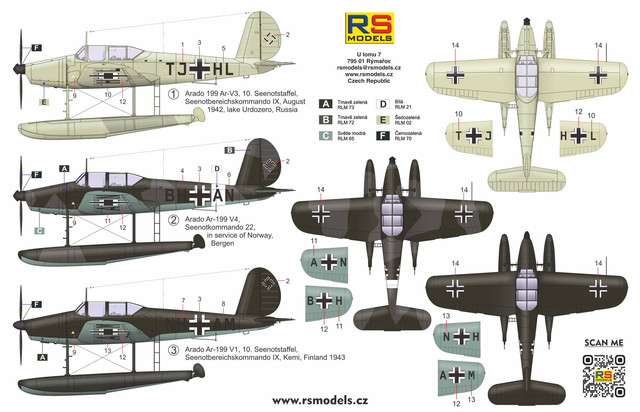
more on the Arado Ar 199s - 'TJ+HL' Ar 199 V-3 10. Seenotstaffel, Norway, August 1942.


A little reference for a build of the RS Models Arado Ar 199 as recently featured in SAM (Scale Aircraft Modelling)  


 The Ar.199 was a development of the Ar.79 two-seat sports/trainer, 'crossed' with the Ar.196 float design conceived during 1938-9 for advanced training of seaplane flight crews. The cockpit featured twin tandem (side by side) pilot controls, and in the rear cockpit, equipment and space for a trainee/radio operator. 

Unlike the wooden Ar 79, the new aircraft was all-metal and was suitable for ship-borne catapult launch. The first prototype (Ar.199V-1) flew in 1939, followed by the V-2 and V-3. All were powered by the 450 hp Argus As 410C engine with two bladed prop. Although a 'successful' design only around 30 aircraft of the type were built, most of them being constructed in Paris at the SIPA factory (see link below) .

 Very little is known about the career of the Arado 199; most were dispersed piecemeal in schools or Seenot rescue units. Two of the prototypes, including the V4, were stationed in Bergen for some time, starting in late 1940. It is known that the V3 was lost on 14 August 1942 while attempting to rescue a shot-down Bf 110 crew in Finland; surprised by Soviet fighters, it was wrecked by their machine gun fire (full story below). Left to rot in its remote location it was still in situ as late as 1994, when the wreck was recovered and dispatched across the Atlantic. The V1 served with 10. Seenotstaffel and was photographed at Santahamina (Finland) in June 1943. It is also likely that A-0 0007, 0011 and 0026 joined it at the same time.  Ar 199 coded 'KK+BT', served at the Seefliegerschule Bug in Rügen in May 1944. Finally, 'KK+BX' joined 5. Seenotstaffel in Tromsö in January 1944. An A-0 coded DM+ZE had to make an emergency landing near Tournai on 15 May 1943 and was destroyed there. A few days later, on its way from the SIPA factory to Travemünde, WNr. 0017 sustained slight damage  during a forced landing in the Chartres area.

Two 'new' and rare views of a 'stranded' Arado Ar 199 - is this WNr. 0017? Further details unknown..


The third prototype (Ar.199 V-3, above) initially had the civil code D-ITLF (WNr. 3673). During the summer of 1942 and coded "TJ+HL" the machine  served with 10. Seenotstaffel, the main base of which was the port of Tromsø, Norway. It was lost during August 1942 during a 'rescue attempt' . The story via 'Jet & Prop' 6/94, Girbig's Jagdgeschwader Eismeer and the sk16ru forum -  translated and edited by FalkeEins.

On August 13, 1942 at 14:12 some fourteen Ju.88s were airborne from Banak airfield to raid the Varlamovo-1 airfield (as the Germans called Vaenga-1). Bombing at 15:47 from a height of 6500 m, they attacked the northern part of the airfield and observed "good hits on the edge of the airfield and aircraft dispersals." Some 13 SD 250 and 246 SD 50s were dropped. As defensive measures, the Junkers noted only well-aimed anti-aircraft guns in the area from Rost to Polyarny. They sustained no losses. Escorting the Ju 88s were six Bf 110s of the 'Dackelstaffel' 13.(Z)/JG 5 airborne from Kirkenes airfield at 15:02. One returned home due to technical problems. After completing their mission 3 "Messers" under the command of the future ace Weissenberger were caught up in combat with a group of Soviet aircraft, identified by the Germans as 8 "Tomahawks" some 10 km west of Murmansk at  an altitude of 3000 m. The Germans filed a claim for one Soviet fighter, which was allegedly shot down by the gunner-radio operator Uffz. F.K Schröder. He did not have time to celebrate his victory: his Bf 110, flown by Lt. Hans-Bodo von Rabenau, received fatal hits. With one engine on fire and the other streaming glycol, the Bf 110 stood little chance of making it home.

Von Rabenau ordered the crew to jump. In addition to his BF there was a third 'crew' member on board, Kriegsberichter (war correspondent), Sonderführer Kuhnke. Schröder, wounded in his arm, was the first to leave the machine. He was followed by the "propagandist". Judging by his report, at that time the pilot was alive and well, and the plane was at an altitude of 1500 m. However, Rabenau did not bail out, but crashed and burned at the controls of his Bf 110 F-2  (WNr.4547, coded 'LN+MR') attempting a forced landing on the tundra. The crews of the other Bf 110s looked on as their comrade went down. They also saw the two parachutes. The location for these events was described as 40 km southwest of Murmansk. From Soviet accounts Rabenau and his crew fell victim to pilots of the 19th IAP.

As soon as it became clear that the Bf 110 had been downed and that the crew remained on enemy territory, the Germans began to conduct search sorties. For this purpose, Bf 109s were sent out along with Hs 126s from 1.(H)/32 which were airborne from Petsamo between 17:26-20:33. It was the Hs 126 that located the burned-out plane 6 km east of Lake Urd, but failed to spot any sign of the surviving crew. At 22:30, two Bf 110s flew to the scene - Weissenberger and Hauptmann Schmidt. They also found the downed 110, only its location was determined as "9 km east of the southern tip of Lake Urdozero." A kilometer away, Kuhnke was also found and the Bf 110 dropped flares and an emergency supply of food. The Soviets had noted the German search activity in the area of Lake Urdozero and suspected that a particularly important crew member had been shot down there - in their words " no ordinary 'Fritz' pilot would have been looked for as carefully nor for as long.."


Sorties continued through the Arctic 'night' - the Schmidt-Weissenberger Rotte escorted one "Storch" at 03:50 flown by Ofw.Rollnik from the "Zerstörerstaffel". Having found Kuhnke, the Fieseler attempted to land and pick him up, but the terrain was unsuitable - swamps and small lakes. So another "summer emergency kit" was dropped off to the 'propagandist', as well as directions on how to proceed. The Sonderführer was supposed to reach the southern tip of Lake Urd by 10:00 and wait there, marking himself with light signals and coloured smoke cannisters.

Since they were going to save Kuhnke from the shore of a large lake, the Germans decided to send a small seaplane in for him. At 13:07 the Ar.199 coded "TJ + HL" took off from Kirkenes with Ofw. G. Urtel at the controls and Hptm Schmidt's BF radio-operator as a 'guide' in the rear. The Arado was escorted by the same pair of Bf 110s. The German planes arrived at the rendezvous site with no problem but found no one there. However, after circling overhead, they nevertheless found the missing crew. Hptm.Schmidt spotted Kuhnke on the shore of the neighboring Lake Veznyavrsh (south of Lake Urd). Inexperienced in traveling through the tundra, the Sonderführer was apparently lost and was at the wrong lake. This 'mistake' would have sad consequences for them. Just as the Arado managed to put down and launch its inflatable dinghy to attempt to retrieve Kuhnke from the eastern shore, Soviet fighters intervened in the rescue operation.

As soon as the Germans appeared in the area of Lake Urd, pilots of the 19th GIAP and their colleagues from the 197th IAP were quickly in the air - two P-39s and two P-40s and six Hurricanes at around 14:00..

The descriptions on both sides look rather confusing. According to the Germans, two "MIGs" suddenly appeared and attacked the Arado already taxiing to take off and were able to damage it. The right float was shot through, which made it impossible to get airborne. Photographs of the wrecked Arado show that it is listing to the left, and it is the left float that is in the water. Immediately after their success, the Soviet machines themselves were hit by "three" Me-110s, claiming one downed - small consolation for the failure of the rescue mission.

The Germans continued sorties to the area of ​​Lake Urd. From 15:00 to 22:00, 16 Bf 109s from II./JG 5 flew there from Petsamo and at 18:25-19:30 a pair of Bf 110s from Kirkenes. Four crew members people were found 10 km west of Lake Urd on the march towards the front. They were told to move in the direction of field patrol No. 11, from where, in turn, German soldiers were advancing towards them.

..When the seaplane took hits, the pilot Urtel was able to taxy it to the northern shore of the lake. Having taken out an emergency ration and a canister of water from an undamaged float, the Germans destroyed the dashboard and radio, and then went ashore. They also took with them a machine gun, 2 drums with cartridges and navigational instruments. According thier account Soviet aircraft soon arrived and began to strafe the Arado, however, they could not even set fire to it. The Germans at that time were hiding in the forest along the shoreline and escaped with only a slight fright.  According to Soviet accounts, on the next day (August 15) and on the morning of August 16, an Sh-2 seaplane twice returned to the scene.  As recorded in their report Soviet pilots found the enemy seaplane burned out and wrecked but also removed weapons and instruments from it. However, judging by the photo, the Arado, although crippled, does not show signs of a fire.

On August 15, Bf 109s and Bf 110s flew a number of sorties in search of comrades wandering through the tundra. The fugitives were again found walking in the right direction, there was no pursuit. A German patrol was located just 60 km from the 'place of death' of the Arado. Fortunately for the four pilots, Friedrich had just put it on his map recently. Therefore, laying the route was not difficult, and the main task was to cross the road from the Motovka camp to Ristikent. Here, too, the shot-down crew were lucky. The “road” marked on the map in reality turned out to be just a well-trodden path.  It was hard enough overcoming the numerous swamps, while enduring the rain and the cold over night wind. Half-frozen they finally reached German lines on August 15.

It is worth mentioning that Schroeder, who was not discovered during the search operations, was also able to get to German-controlled territory alone, and on August 16 he almost reached Petsamo airfield itself. After treatment in the hospital, he did not return to Norway, but was assigned to V./KG 40.

The Arado remained for many years in the lake, its floats sinking deeper and deeper into the bottom sediments. The place was quite remote and no one touched the “exotic waterfowl” until a power line was pulled past. For the sake of interest, the workers tried to pull the plane ashore with the help of a tractor. At the same time, the struts of the floats broke, and one float remained in the water. In the intervening period the Arado lying on the shore was visited by curious hunters and fishermen. They left traces of their "curiosity" - a tail section with the swastika shot through, the cockpit smashed. When told that the Arado had been located H-H Schmidt was amazed that anything survived as the machine was regularly overflown by JG 5 and used for 'target' practise as the Germans sought to set it alight. 

Also on this blog;

Arado Ar 199 manufactured in Paris by SIPA here

Friday, 9 October 2020

La Luftwaffe en France 1939-1945, tome 1 (Arès, 2020)


Jean-Louis ROBA has just published his latest hardback, book 1 of two to cover the history of the Luftwaffe in France during the Second World War. My pre-ordered copy arrived yesterday from French publisher Arès - better 'known' apparently for their histories of French military units. This fine A-4 hardback is jam-packed with photos and data - nearly 600 images according to the publisher's blurb. The author's approach to his subject matter is geographical, chronological and global. The almost two hundred pages of text are abundantly (!) illustrated with pictures taken by the veterans themselves, providing an almost 'intimate' view of life for operational and training units stationed on French soil, in many instances far removed from the usual propaganda clichés (men of JG 2 buying crabs in Morlaix, an excursion to Mont St. Michel etc etc). There are of course multiple views of aircraft and 'personalities'. Side-bars and text boxes (blue background) include DFS 230 and Gotha Go 232 training operations from Valence, the He 111 Z of the LLG, profiles of Harlinghausen, Sperrle and the commanders of 1. and 2. Fallschirmjäger Divisionen and even 'Lion cubs in the Luftwaffe ' or 'Göring in Paris'. Unusually for this type of work and because they are so numerous and spread throughout the volume, there is an 'index of side-bars' alongside a 'conventional' list of contents - although in the typical French format this appears at the rear of the book.

This first volume covers the first half of the war, from the Phoney War to the invasion of the 'zone libre' or the 'unoccupied territory'. Individual chapters cover the fighting during operations in the West in May and June 1940, the Battle of Britain, the defense of French airspace against the RAF's 'non-Stop' offensive incursions, the organisation of Luftflotte 3 after Luftflotte 2's deployment towards the USSR, the protection of Operation Donnerkeil and the reaction to the raid on Dieppe.


Chapter I covers pre-war Franco-German relations in the aeronautical field while chapter 2 is devoted to the 'Phoney War' including a full list of Luftwaffe losses over the border areas during this period.  Chapter 3 is a daily 'diary' of the Westfeldzug combats over France principally from the view of the St.G and KG committed in operations. Aerial activity did not cease in the intermediate period between the battles of 1940 and the intensification of the Allied bombing of Germany. Chapter 4 is entitled ' the first year in France' and there are four pages devoted to the dispositions of Luftflotten 2 and 3 with side-bars devoted to the 'Nahaufklärungsgruppen' and the establishment of the air-sea rescue service (Seenot). There is a fascinating overview of the aerodromes and installations exploited and occupied by the Luftwaffe  including graveyards and their often elaborately 'decorated' honour cemeteries (pages 102-104) or Ehrenfriedhöfe. The text does not just focus on airborne units. Ground units, anti-aircraft (Flak) and parachute (Fallschirmjäger) units as well as the various administrative entities are also featured. Luftnachrichten Schule 4 is covered on one page (radio operators school). Chapter VI covers a whole range of training units including the FFS pilot training schools, the Dewoitine D.520-equipped JFS 5 at Villacoublay and the Fiat Cr.42 -equipped JG 107 at Toul. There are 'annexes' that detail JFS 5 losses and two pages of Flak claims along the Channel coast for 1941.


Activities at Pau, Blagnac, Cazaux. Rennes, Istres etc etc along with other 'secondary' airfields feature, with first-person accounts detailing daily life (if you can handle the French text..). 

Mechanic Heinz Zimmer recalled; " ..in December 1940 I left Germany for the first time in my life and was sent to France in Cognac. I was assigned as a mechanic to the Ergänzungsstaffel 26, the operational training unit of JG 26, commanded by Oblt. Freiherr Hubertus von Holthey, a Baron. I arrived with a group of mechanics from Merseburg. We were billeted in a college. We worked on the Bf 109 Emil and Friedrich. The winter of 40/41 was very wet. The runway wasn't very good either. The Bf 109 was difficult to manoeuvre during take-off and landing. There were many accidents due to these factors. Nevertheless, as mechanics, we had many compensations in France. The climate was milder than in Central Europe and we ate much better. Eggs for breakfast but too often goulash the rest of the time.."

 The Ergänzungsgruppen established throughout France are covered in some detail. At the beginning of 1942, all the Ergänzungsgruppen subordinate to the Jagdgeschwader were disbanded and divided into four large school units, the EJG Süd, West, Ost and Nord. They were primarily established in the South of France, where the climate was more favourable for training (this was at a time and in a sector where British intrusions were very rare). Heinz Zimmer was posted to Cazaux, one of the airfields of the EJG Ost; " ..I found the climate quite debilitating. We were bored. There was no food to buy in the area and the only recreation was going to the beach at Pilloy-sur-Mer near Arcachon. In the spring of 1943, we were moved to Landes de Bussac (Ste Marie). I had barely arrived when I ran into ... Hermann Graf who recognized me, his former mechanic. He ran the school and I was delighted to run into him again. Apart from this excellent surprise, life remained the same. The track was sandy and many machines were damaged. At that time we received a visit from General Adolf Galland.."

 Another mechanic Uffz. Philip Schmelzer had re-trained to fly the Bf 110 and then moved to fighters. In May 1943 he was posted to Toulouse-Blagnac; "We arrived in Blagnac. There were only pilots in our group, since we were going to be re-trained on single-seaters. At the school we were introduced to Heinz Bär, who had been withdrawn from a front unit because of his differences with Hermann Göring after the fall of Africa. We were first trained on the Bf 109. But we had been told so many bad things about this aircraft (it was hard to fly, it's undercarriage was fragile, visibility was poor...) that we were somewhat terrified when we took the controls. Accidents were commonplace. Graf then brought us together and calmed us down by taking the drama out of this plane. After his explanations, things went much better. We then passed out on the FW 190 and I very much appreciated this machine".        

 Below;

 a veteran of 1940, Oberfeldwebel Herbert Kaiser flew with III./JG 77. In late January 1943, he had been evacuated from Tunsia and sent as an instructor to the Er. JGr. Süd in Marseille. On March 14, 1943, at Marignane airfield, he was awarded the Knight's Cross for his 54 victories by the school's commander, Oberstleutnant Alfred Müller, a former Great War pilot. Kaiser returned to JG 77 and then JG 1, surviving the war with 68 victories to his credit. On the left is Oberleutnant Erwin Clausen, a JG 77 comrade also attached to the school as an instructor.  Clausen was KIA as Kommandeur I./JG 11.


There are a number of colour profile artworks distributed throughout the book (by Jean-Marie Guillou) but the content is so dense I almost failed to notice them on initial perusal. Images of period documents (and the odd newspaper report) that add so much visual interest and additional data are dotted throughout the text. And I have not yet mentioned chapters covering night fighters and the 'invasion' of the southern zone following 'Torch'. While there is a large range of material featured, the author is at pains to point out that this work is 'merely' a synthesis of the variety of subject matter that could have been included in a more 'exhaustive' work, but I have to say he has done a fabulous job with the material he has presented. The lay-out is a little 'crowded' even so and some of the images are just a little on the small side since there are so many of them. I would have liked to have seen some details of aircraft production too since a number of types went straight into Luftwaffe service from French factories - although there is some detail in the photo captions perhaps this is for part two. The text makes clear that increasingly hard-pressed resources were spread ever more thinly over larger and larger territorial areas, forcing the staffs to make choices and the hard-pressed personnel to perform  with sometimes very limited or obsolescent means. Overall though any comments or criticisms of mine are pretty minor-league and it is impossible to do justice to the book in a short review.. Congratulations to the author. If you have any interest in the history of the Luftwaffe then this work devoted to the daily life of Luftwaffe units in France is highly recommended. Hopefully Part 2 will be with us some time next year!

Below;

Hermann Göring  seemed to enjoy visiting Paris and France rather more than his Führer who preferred Rome according to most accounts. Contrary to popular opinion Göring did not visit France just to acquire artworks. Here he is seen arriving in Buc to visit 1.(F)/123 on 15 August 1941 with Barbarossa in full swing. The descent from his Fw 200 was probably a little awkward. Later in the year he met Petain at Saint-Florentin and also visited Dieppe following the abortive Canadian landing in August 1942.


Published during September 2020. Publisher's website for ordering and more page views is here

Format 215 x 305 mm - Bound, hardcover, 196 pages, 600 photos, 7 color artworks. French text

Friday, 29 September 2017

more Henschel Hs 123, Fw 189, Arado Ar 96 - ebay photo finds #223


Move down the page for a super selection of HS 123 images currently on offer


Some current ebay sales from reliable sellers. Courtesy Manuel and Darius....


Below; Hs 123 in action during the Polish campaign 


Below, Bf 110 C/D displaying ZG 52 emblem


Saturday, 1 April 2017

Bücker Bü 181 Bestmann "Panzerjagdstaffeln" in 1/48 (Special Hobby 48189)


Latest Special Hobby release


Above; Bücker Bü 181 'Bestmann' WNr 501659 was built in Czechoslovakia in early 1944 and served at the FFS A/B 23 in Kaufbeuren with the Kennung RM+HE where it was converted to mount Panzerfaust bazookas in the final weeks of the war. Today it is exhibited at the Deutsche Technik Museum in Berlin. Photo courtesy Marc Hasenbein.

Below; first published in the Modell Magazin issue of 3/83 this was for a long time the only known photo of a fully-armed Panzerfaust-toting Bücker Bü 181 'Bestmann' seen here undergoing trials with the Panzerfaust Versuchskommando (test detachment) at Trebbin on 01 April 1945.


Also on this blog;

Bückers with bazookas - Bü 181 'Bestmann' mit Panzerfäusten