Lentolaivue 24 Brewster being refueled in Tiiksjärvi. The Model 239 had two 300 ltr integral wing tanks
I guess most aviation enthusiasts know something about the F2A Buffalo - typically that the USMC, the RAF and other air forces suffered at the hands of the Japanese while north of the Arctic Circle the Finns achieved some success with the type against the Soviets during the Continuation war.
" The Marines on Midway had no combat experience and were fighting IJN pilots with extensive combat experience. The Dutch and British faced similarly experienced IJAAF pilots over the DEI and Malaysia, with limited time in the Buffaloes and experience in high altitude fighting over Europe. Fighting in the Pacific was at lower altitudes and required different tactics. The Finns were all combat veterans of the Winter War and when the later Continuation War began they were also quite familiar with their Buffaloes. They knew their aircraft and their enemy..."
The F2A was of course probably not as bad as it is often portrayed. Usually decried as being 'heavy and under-powered', on both counts the F2A-3 (Wright R-1820 Cyclone) came out with better numbers than the F4F Wildcat (Twin Wasp R-1830). The Finnish B-239s were modified from US Navy F2A-1s, featuring a more powerful engine, no armour, integral wing tanks, and extra machine guns. The elite Finnish Lelv 24 claimed 477 victories for the loss of 19 in combat and six more in accidents or destroyed on the ground during the period 1941-44 in their Brewsters. This blog is not about to suggest that the Buffalo - or Brewster Model 239 as the export 'version' was designated - was superior to the Bf 109 G. But by certain criteria it actually was.
Take for example, 'drag coefficient'. The drag coefficient is perhaps the most important aerodynamic parameter in aircraft design, representing how "streamlined" its shape is. A lower figure directly correlates to better performance, fuel efficiency and speed. Somewhat surprisingly the stubby, radial-engined, short-winged Buffalo had a lower drag coefficient than the Bf 109 G as this Finnish data table highlights.
The Buffalo had been extensively wind-tunnel tested during its design, while the Me 109 was - in its early variants - usually described as 'kantig' (or 'angular'). The 109 'famously' underwent a 're-design' to a more 'aerodynamic' profile with the Friedrich. The F2A used the same NACA 230xx aerofoil sections that were employed in a number of US designs including the P-38, F4U, F6F and even the later Bearcat.
The Buffalo performed well in Finland. Firstly, it was probably the easiest of the Finnish fighters to handle all round. In the summer of 1941 there were fighter pilots flying it with fewer than 150 total hours. Second, it was quite reliable. It was a sound design, no major faults and it was also "erk friendly". Third, for a significant period of time its performance was adequate (up to late 1942). The Soviets still used lots of I-153 and I-16. Fourth, the enemy pilots in general were not particularly good and especially their aggressiveness left much to be desired.
Pure comparison accounts are surprisingly few even if most Buffalo pilots continued on to the 109. In the 1990s the-then director of the FAF museum published his 109 book which had a chapter with personal reports. The author had requested accounts from pilots and mechanics for their opinions on the 109. Basically very few were by "the aces" (most had died by then) and most were from pilots who flew it only post-war. There is quite a lot of variance. For example, Eino Luukkanen considered the 109 easier to handle than the Fokker D. 21. But he was one of the most experienced of them all.
Some Finnish pilots actually preferred the Buffalo - or the 239- over their later 109 Gustavs received from Germany;
SSgt Heimo 'Hemmi' Lampi recounted his attachment to the Brewster to historian Dan Ford;
“The old friend Messerschmitt, who was a real hard fighter, was my next plane after the Brewster, but it totally lacked in humaneness.. [..]..I could not love it the way I loved my friend Brewster. Nor any other plane for that matter.”
Having scored during the Winter War, Lampi became an ace on day 1 of the Continuation War - 25 June 1941 - then later became an ace on the Brewster 239 and added eight more victories in the 109.
Warrant Officer Juutilainen (with 34, second-highest scoring ace on the Brewster Model 239) referred to the 239s as “fat hustlers, just like bees. They had speed, agility and good weaponry, too.…We were happy to take them anywhere to take on any opponent.”
The top three Buffalo pilots - Lt. Wind (with 39 victories in a Brewster), and 1st Lt. Jorma Karhunen (26.5)—claimed 23 Polikarpov I-16 monoplane fighters, 18 Polikarpov I-153 biplanes and 11 Hawker Hurricanes. Encounters with more modern Russian fighters—Yaks, MiGs and LaGGs—were rare until the Finns began the conversion to Messerschmitts in early 1943.
The men of Llv 24's 4th Flight putting CO Llv 24' Major 'Eka' Magnusson's aircraft BW-380 in the firing butts, Rantasalmi, July 10, 1941. The fuel drum on which the machine is about to be balanced is just visible. Note tactical number 'black 1'
Many have claimed that at 25-to-1 Finnish Brewsters recorded the highest victory-loss ratio of the war.
Juutilainen described his combat experiences in the memoir Double Fighter Knight, referring to his two Mannerheim Crosses. He pressed attacks to minimum range to ensure lethal accuracy. Juutilainen recalled one particularly close-in dogfight with a Soviet Hurricane:
" I came in at high speed from above and behind and pulled the throttle back to idle. The target grew in my gunsight. It was a very clean airplane and looked brand new. Now I was approaching the perfect firing range and looked around me one more time. No other enemies were in sight. The pipper on my sight was just slightly in front of the nose of the Hurricane, and my glide angle was about 10 degrees. Now I could count rivets on the target..."
The Buffalo is often thought of as being obsolete by 1941. It could not survive in Western Europe and did not survive in the Pacific. Ultimately the Finns were successful with the type because they stripped out as much weight as possible, leading to even better performance. It was piloted by combat veterans who knew the tactics of their enemy and in an environment that better suited the aircraft. And for the first year or so of the Continuation War they were also up against ancient I-16s and other obsolescent Soviet types flown by poorly trained pilots.
(Thanks to Jukka for help with this post)
Captain Ahola's victorious flight crew around their aircraft at Tiiksjärvi, May 21, 1942.
Ahead of a new boxing of the IAR 80 to be released imminently by IBG Models here are some images of Claudio Maura's beautiful rendition of the IAR 80 'Early' release. (Claudio, muito obrigado pelas suas fotos. Desculpe ter demorado tanto tempo para mostrá-las a todos)
The new I.A.R.80 coming this month from IBG is the 'B' variant which was introduced in 1941 to improve firepower against Soviet aircraft. It was equipped with six machine guns (two 13.2 mm and four 7.92 mm Brownings) and later featuring lengthened fuselage and wings. During the Stalingrad campaign, Romanian units equipped with I.A.R.80A, 80B, and 81 aircraft supported Axis operations from forward airfields such as Tusov and Morozovskaya, mainly providing bomber escort and ground attack missions. Harsh winter conditions and the Soviet counteroffensive during Operation Uranus forced Romanian pilots to adapt to freezing temperatures and emergency combat roles. Despite their courage and skill, the I.A.R. units suffered heavy losses and were withdrawn to Romania in early 1943, marking the end of their participation in one of the war’s fiercest battles.
As usual with IBG releases there will be a range of 3D-printed accessories for those wanting extra detail.
Finally two more views of Claudio's exceptional work on the 'Early' boxing. More on IBG Models IAR 80/81 kits on this blog here and here
Continuing our look at the IBG models IAR 80/81 kits. In our first post here we looked at the historical background to the IBG Models IAR 81 C 'Great Air Battles of 1944' (72nd) kit. Now to see what's in the box. As a modeller who has built both the IBG D-9 and PZL. P.11 (see links below) I know that I am going to be impressed! IBG Models kit number 72570 "IAR 81 C- Great Air Battles of 1944" was designed by IAR 80/81 expert Radu Brinzan and features five frames of some 90 finely moulded parts and seven clear parts, a sheet of photo-etch with 17 parts and a decal sheet with four colourful options and full stencil data.
Above; PK shot of Grupul 6 IAR 81 Cs with the heavy cannon in the wings.
Below; a closer look at some of the sprues. Construction starts with the cowl gun assembly which locates onto the cockpit sill/instrument panel at the top and the foot rails which plug into the bottom of the seat. The cockpit is well detailed with 14 plastic parts and seven photo-etched pieces, including two types of harness straps. Note the engine parts - including both banks of cylinders -the radial comprising some 13 parts.
Note the recessed panel lines and riveting detail. I'm probably not the only modeller to think that this is a little 'finer' than the surface texture of the IBG Dora series, but I had no issues with those in any case. You really have to get the light on the rivets to notice them. The fabric texture on the control surfaces looks good (below) and note the raised cockpit wall detail.
IBG have also produced some 3-D printed accessories, including a beautifully detailed seat and wheels/tyres.
In summary then, this looks like a slightly less complex kit than the Doras, although that may well be down to the radial as opposed to in-line engine which made for a very large internal sub-assembly. The build starts now!
Below; Escadrila 61 commander Dumitrescu (right) describes a recent combat encounter in front of his IAR 81 C No.320, a markings option in the kit. Note the gunsight in the cockpit. The triangle (left) is red, one of two that identifies the Escadrila. The unit's unoffical emblem was Disney's Bambi and the quails. The bigger white triangle (right) denoted the CO's aircraft. (LFT SO F2557 L32)
IBG Models IAR 81 C 'Great Air Battles of 1944' box-art depicting IAR- 81 C no. 320 flown by Slt. Av. Mircea Dumitrescu, commander of Escadrilla 61 downing a 15 AF P-38 on 10 June 1944.
The most 'prestigious' achievement of the Industria Aeronautica Romana works during WWII was the IAR 80 fighter of which 450 examples were constructed at a monthly rate of around 10-13 aircraft during the period 1940-43. Construction numbers would have been higher but for shortages of machine guns, gun sights etc. During testing the prototype exceeded 500 km/h at 4000 m altitude. The main armament comprised four Belgian Browning FN (7.62) machine guns. The fighter was powered by the (license-built Gnome Rhone) 1025 hp IAR 14K engine.
Design work which had started in 1937 was to a certain extent based on Polish expertise - Romanian engineers Grosu and Cosereanu conceived the IAR 80 around the modified and strengthened rear fuselage and tail section of a Polish PZL P.24E fighter while the wings were based on the Italian SM 79 reduced in size by 50%; authors Roba and Craciunoiu in 'Romanian Aeronautics' conclude that " the IAR 80 was an outstanding achievement, perhaps the best example of how to do a job with limited resources.." The machine underwent continuous improvement, resulting in a number of different versions - the first significant variant was the IAR 80 B featuring a lengthened fuselage starting with aircraft No. 201 (by 70 mm in front of the firewall) and extended wing span of 11 metres starting with aircraft No. 212.
The IAR 81 was an improved fighter-bomber variant, featuring the long nose and wings and bomb racks under the fuselage and wings, while the 80/81 C were heavy fighters equipped with two 20 mm MG FF or MG 151/20 cannon and Browning machine guns. With 150 airframes the IAR 81 C was the most numerous of all versions. The longer fuselage, wide-span wings and engine cowling air filter also made this variant probably the most distinctive of the IAR 80/81 series.
The box art of IBG Models kit number 72570 "IAR 81 C- Great Air Battles of 1944" features IAR- 81 C no. 320 flown by Slt. Av. Mircea Dumitrescu, commander of Escadrilla 61. Dumitrescu claimed two P-38s on the 10 June 1944 raid (see below). His machine features the unofficial Esc. 61 Disney 'Bambi' emblem on the beautiful box-top artwork. Pilot and fighter were captured on film by a PK Berichter in a photo 'reportage' that can be seen in the ECPA-D archive. (sample images below - click on the images to view full-screen)
Following the disastrous 'Tidal Wave' mission on 1 August 1943, the Allied air offensive against the Ploesti oilfields and refineries only got underway again in the spring of 1944, this time from airfields around Foggia, Italy. The raid on 10 June 1944 was notable for being flown not by heavy bombers but by more than 75 P-38s from the 1st and 82nd Fighter groups - the 82nd FG machines being fitted with 300 gallon drop tanks and a 1000 kg bomb. Intercepted at low altitude over the oilfields, Bf 109s from III./JG 77 and I./JG 53 dove on the P-38 fighter-bombers with the 39 1st FG P-38 escorts late on the scene. The usual smoke-screens had not been deployed by the defenders, so 15th AF planners achieved the element of surprise they had hoped for. And in the ensuing combats Lt. Herbert B. Hatch claimed five IAR 80s - mistaking the Romanian fighters for 'FW-190s'. But he was the only 71st FS pilot to return to Italy that day! The 82nd FG lost 8 and the 1st FG a further 14 P-38s. For the loss of four machines the IAR 81s of Grupul 6 claimed 23 P-38s. Needless to say the 15th AF did not repeat their 'Lightning' attack of 10 June..
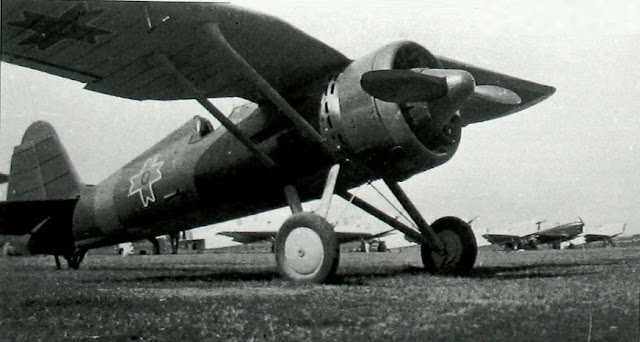
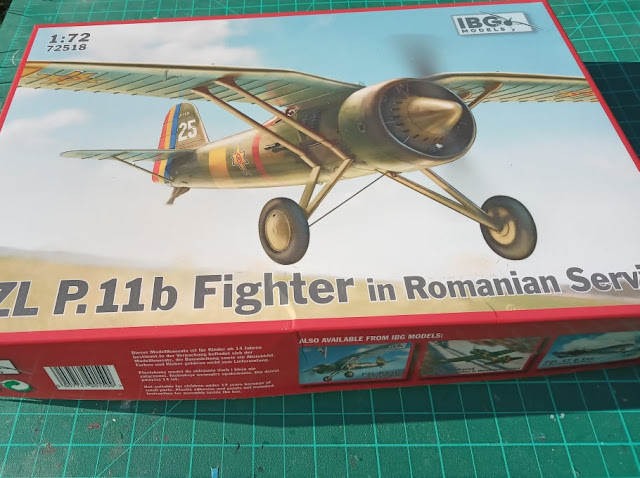
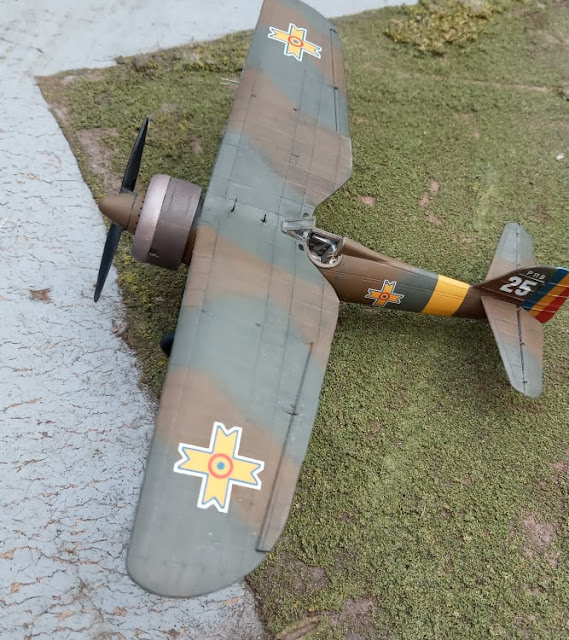
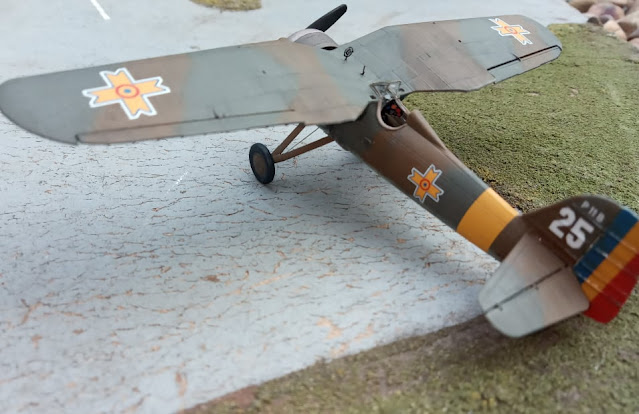
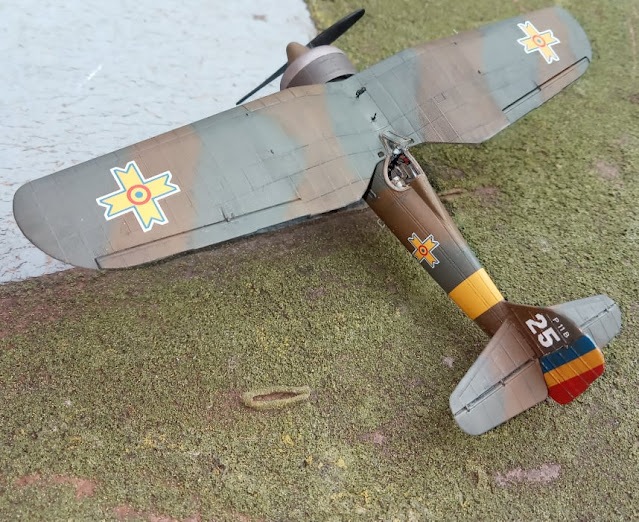
Zygmunt Puławski’s PZL Państwowe Zakłady Lotnicze (or State Aviation Works) P.11 fighter was for a brief period between the wars one of the world's leading fighter designs. While most fighters of the time were of biplane configuration, Pulawski developed a 'family' of fighters fitted with a high-mounted and aerodynamically clean gull wing faired into the fuselage replacing the cabane struts of the biplane and which provided the pilot with a superior field of view. The P.11 was Poland's primary fighter during the 1930s and the aircraft enjoyed considerable export success. Romania (with 14 P.7s, 190 P.11s and 30 P.24s) was the second main user of the PZL "gull wing" fighters. The PZL P.11b was the Romanian 'export' version of the P.11a.
During 1932 French engine manufacturer Gnome-Rhône expressed interest in equipping the P.11 fighter with their engine, counting on export orders. In the same year the prototype P.11/IV with Gnome-Rhône 9Kcr Mistral 550 hp engine aroused interest from the Turkish, Romanian, Portugese, Greek, Swedish, Czechoslovak, Japanese and Yugoslavian air forces.
Several of these countries decided to purchase the subsequent P.24 version. Romania ordered the P.11 version equipped with the GR 9K Mistral produced in Romania under licence. The PZL factory started Romanian production ahead of the Polish Air force's P.11a. To speed up the work some of the structural solutions (the wing) from the previous PZL P.7a were used. The order for 50 aircraft was delivered at the turn of 1933-34 (coded from 1 to 50) and the type was still in service as an advanced trainer in Romania during WW II. In Romania, manufacturer IAR subsequently produced ninety-five P.11f’s under licence. Production started in 1936 at IAR’s Brasov plant, airframe codes 51 to 145 being allocated to these machines. At Poland’s fall large quantities of Polish aircraft, including some P.11c’s, escaped to Rumania.
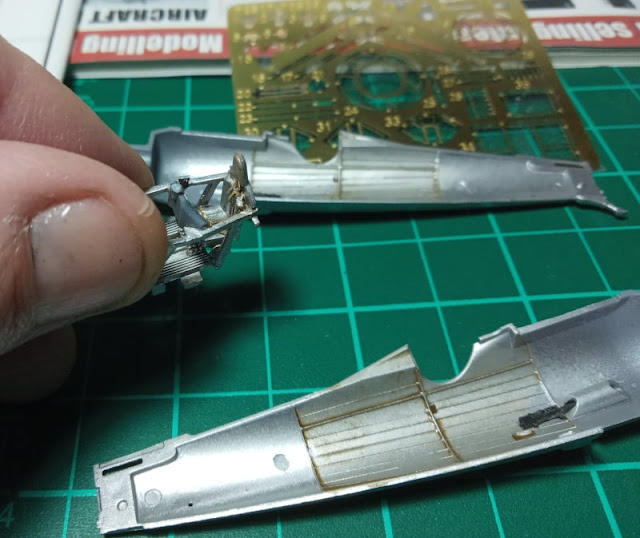
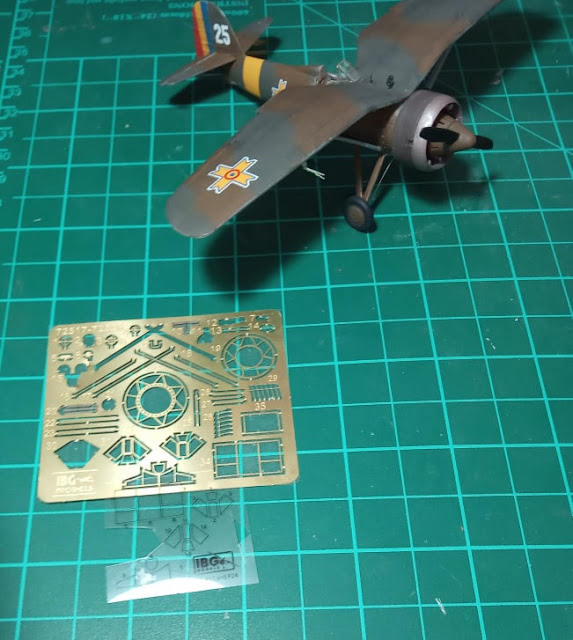
IBG's family of PZL P.11 models in 72nd scale are very nicely detailed kits, well-engineered and superbly molded. The scale effect 'corrugated' skinning on the wings is probably the best representation of it I've seen, certainly in 1:72nd scale. The kit also features a detailed IAR 9K engine and a photoetched fret with some tiny details such as throttle lever, seat harness, rudder pedals, gun-sight, undercarriage strengthening wires and the windscreen frame. Much of the sheet in fact is not required for this kit. Inevitably perhaps - for those of us with 'fatter' fingers and poorer eyesight - not every etch part will be used. The control surfaces - elevators, rudder and ailerons- are all separate parts. Fit is very good - as it has to be with so many small parts. Decals are by Techmod with options for three Romanian machines.
".. As a child I was given a bound copy of some Aircraft In Profiles, volume 5 I think. The dust jacket has long since gone. I was model mad anyway, it was the second real aircraft book I owned, and was much looked at over the years. As with anything new, certain images stayed with me, as it was all new, one was the Croatian "G-10" with stylised leaf fuselage cross ...
..but recently this 'new' image turned up on-line... "Bf 109 G-14/AS W.Nr. 782 104 (?) "Crni 4", flown by deserting pilot Vladimir Sandtner, I.Zrakoplovna Skupina. 2. Lovačko Jato, seen at Falconara after 16 April 1945.."
This image was totally new to me, and pretty jaw dropping... note the B-25 in the background too. I realised that the Croat 'cross' is much further forward than the original German one, and centered on a filler point (oxygen?) The colour looks washes out so I'm wondering if this is actually a base colour of 82/75. There was much gnashing of teeth when this pic surfaced recently and essentially retired all those cherished late war brown/green camo theories. The goat's head emblem is still debated but IMO it's the variation of the one seen on a Fiat G.50. This newly released photo will hopefully result in a new set of decals..."
Note too the over-painted wing crosses
Below; another view, taken with a film or filter that has made the yellow appear dark, has also made the area round the cockpit really dark, so maybe it is green/grey?
"...This view shows the port side artwork, note the goats head design which is just visible below the cockpit, and the C3 in the filler triangle. ..."
Are there any suitable decals out there ? I have a set from Intech but they do not include the cockpit artwork. some Kora sheets do..
Below; original intel report confirms that the type was a G-14 as flown by defecting pilot Sandtner. According to "Bf 109 Late Versions" (Wolowski, published by MMP) the 78xxxx serial confirms that this was a G-14/AS built by Messerschmitt Regensburg. Even though the small "chin" bulges were not required by the DB 605 AS engine, the theory is that this was done to increase parts commonality with the DB 605 D-engined G-10 and K-4 also being built at that time..
click on the images to view full screen
The external visible difference between the G-14/AS and the G-10 was apparently the position of the cold weather starter hatch on the starboard side of the nose - on the G-10 it was in line with the little hole on the rear of the cowl, on the G-14/AS it was lower down - this picture of Black 4 shows this clearly (just above the A of viscarra).
In his original post on Kari Stenman’s book “Mersu” blog author Neil Page made mention of the case involving Veikko Karu and his post-war criminal conviction. For non-Finnish speakers not familiar with the background of the comment (that was originally due to my instigation), a more comprehensive explanation is perhaps appropriate.
To people used to a more complete treatment of fighter aces, their lives and personalities, it may come as a great surprise to find that the Finnish historiography on Finnish fighter aces tends to be of "Battler Britain" heroic style with perfect heroes having perfect lives. To date, not a single ace biography meeting the basic requirements for a serious historical study has been published in Finland. Most have no proper referencing and even feature dialogue that cannot be verified with any trustworthy source (Franz Kurowski-style).
As most Finnish AF history enthusiasts know, Kari Stenman has written numerous key books on the topic. One of these books is “Lentävät ritarit” (Flying Knights), a book with short biographies on all FAF Mannerheim Cross awardees. One of the awardees was Veikko Karu. Veikko Karu was a very brave and courageous soldier with an impeccable service record. However, in the early 1960s he was convicted of killing his wife and disposing of her corpse by incinerating it. He received a sentence of 10 years in prison.
This incident has never been mentioned in any of Stenman’s books or articles, nor in any standard literature on Finnish fighter aces. The topic is still a sore one in some Finnish circles, as I discovered to my great astonishment last year. I wrote a book review for the prestigious Finnish military journal Sotilasaikakauslehti who published it in their April 2018 issue. I made a mention of the Karu case in the review. Some time after the review was published, I received a phone call from a person of military background. While neutral in tone, one got the feeling that my text had angered some people who feel that any such negative publicity is akin to “defaming the veterans”. I wonder does similar atmosphere exist in the U.S. or U.K.?
As for the crime Karu committed, the latest information (although coming from several sources, the intel is based on hearsay, though I am inclined to believe it is true) suggests that Veikko Karu’s only crime was the disposition of his wife’s corpse after discovering that one of his sons had actually killed her. That son was apparently mentally “slow” and Karu believed that he could not cope with imprisonment and decided to take the blame instead. He did his time and after release continued his life. Apparently, his closest family knew the truth but decided to keep it to themselves.
If it is indeed true that Karu took the blame for his son’s crime, one has to wonder why to tiptoe about it? After all, what can be a higher demonstration of highest character of a war hero than to make a huge sacrifice for his own family in civilian life as well?
Summary of video interview by Jukka Juutinen.
The interview begins with the question when did Karu first see an aeroplane. Karu responds that he was about 10 years old. Then Karu explains that his original plan was to study electric engineering after his Abitur as his family (he uses the expression “we had”) owned an automobile dealership representing e.g. General Motors. The firm had an auto repair shop with some 10 mechanics. I.e. Karu intended to become employed by that firm. At that time aeroplanes and “their droning” did not much interest Karu.
In 1936 he had his Abitur exam and then entered AF Reserve Officer’s Course. He states that he was very lucky as there were over 1000 applicants and only 30 were approved. He then describes the selection process. At the first stage over one half were rejected on the basis of application papers.
Then he notes that when he for the first time climbed onboard an aeroplane and took controls, he made up his mind: this was to be his life career. Then he had struggle to get approval from his mother who at first resisted his plans. Veikko was his mother’s “support and security” as he had a significant share in running the auto business already. He then says “That much I can confess you that had my mother not given in, I would have given up my flying career”. “I am eternally grateful for her approval.” “Flying has been everything for me in my life.”
Then he is asked that was the AF cadet school the only way to become an airman. Karu responds that it would have been possible to become a civilian pilot for Aero (Finnish airliner), but he adds that driving Aero’s aeroplanes is akin to driving a bus and “it is not flying until you get a plane under you and can do whatever you want”.
He then describes when he was caught stunting over his then girlfriend’s home. His CO first held a loud sermon over the incident but then added that such stunting is what makes a pilot and the case is closed for good.
Then Karu describes his first aerial combat on 20.2.1940. He describes how he climbed to 7000 metres without an oxygen mask. He shot down/at 2 enemy aircraft and then had dive vertically to get away. He was so weary that he wonders how he got back to home base.
The Continuation War began with Fokker D.XXI for him. Then he was ordered to begin training night fighter pilots. That was when the friendly fire incident occurred. He was flying at night at about midnight when he spotted a black shape flying over a field. He asked on radio whether own aircraft were in their air. Negative was the response. He radioed “I’ll go after it.”
He then pursued the black form and says that he recognized it as a He 111. He notes that also Soviets were known to use (captured) He 111s. He kept asking on the radio that are there friendlies in the air. “Negative”. He then radioed that hurry up, the frontline is approaching, what should I do. He asked for permission to shoot. He shot one engine on fire. The aircraft kept going on. Then he asked can he shoot the other engine. “Posotie”. Then he shot that too on fire and then the aircraft turned away from the enemy lines. Right at that moment he hear on the radio “It is friendly!”.
Some 10 to 20 km before reaching the base the aircraft blew up in the air and debris hit Karu’s plane too. He flew back to base, he jumped into a car and drove to the crash site. He heard shouts “Wasser! Wasser!”. There were still two airmen alive. Afterwards Karu requested that he be informed at once when the Germans are buried. The Germans were buried in Helsinki and Karu acquired a wreath for the grave. The Germans were very adamant that Karu was not responsible, it was their own fault.
When Fuhrer’s wreath was lowered, a gun salute was fired. Karu says that Germans fired only such salute when something very important was happening. “I was wondering that what is this ceremony. Then a German whispered it was my turn. When I lowered my wreath, didn’t those cursed Germans just fire a gun salute! I felt that I now should sink under the ground, so pissed up I was. When I got back, I asked the German that why the hell did they do that? The German responded “Don’t you realize that we did this to emphasize that shooting down the plane was not your fault.”
Then the interviewer cites from the official Mannerheim Cross award document.
Then Karu describes how he was shot down. He and one another spotted a Russian truck column. Karu attacked and on the first run set 9 of the 10 trucks on fire. Then he made a mistake: he did not leave that one alone and attacked again. And so the flak got him.
Then he describes how he was able to escape from the enemy territory. He says he was extremely lucky. He was able to cross an old barbed fire fence over a fallen pine tree. He was able to steal a rifle by knocking out a Russian who had come out of a bunker for urges of nature. He was then able to cross a minefield probably due to thick snow over the area, or “the guy up in the sky helped”. Then he faced a problem when the Finns guarding the line did not originally believe he was Finnish.
At the end Karu sends his greetings to his comrades, who after his long absence (which is presumably a reference to his incarceration) welcomed him with heartwarming comradeship.
”Ylipäällikkö on pvm:llä 6.11.42 nimittänyt Vapaudenristin 2. luokan Mannerheim-ristin ritariksi kapteeni Veikko Johannes Karun.
Kapteeni Karu on johtanut erittäin tarmokkaasti ja ansiokkaasti hävittäjälaivuetta. Itse taitavana ja aina taisteluihin valmiina sekä rauhallista harkintaa osoittaen on hän esimerkillään kannustanut alaisensa ohjaajat erinomaisiin tuloksiin. Hänen henkilökohtaisella tilillään on useita ilmavoittoja, jotka hän on suurimmaksi osaksi saanut meririntamalla taistelussa vihollisen lentoveneitä vastaan. Hänen johtamansa partiot ovat menestyksellisesti toimineet erikoisesti vihollisen keveitä merivoimia vastaan upottaen lukuisia aluksia. Kerran hyökkäsi kapteeni Karu partioineen kolmea vihollisen moottoritorpeedovenettä vastaan. Alukset syttyivät vuorotellen tuleen, räjähtivät ja upposivat. Taistelun aikana oli vihollisen ilmatorjuntatuli hyvin kiivasta ja sai kapteeni Karu omaan koneeseensa useita räjähtäviä luodinosumia, mutta jatkoi siitä huolimatta taistelua loppuun saakka. Kapteeni Karun tuhotessa erään toisen kerran rintaman takana toistakymmentä autoa, sai hänen koneensa ilmatorjuntatulesta niin pahoja osumia, että hänen oli tehtävä pakkolasku vihollisen puolelle. Pelastettuaan koneesta kaikki tärkeät paperit ja kartat lähti hän pyrkimään omalle puolelle ja onnistuikin siinä kahakoituaan kiivaasti vihollisen kanssa. Kapteeni Karu on suorittanut kaikkiaan 146 sotalentoa ja on hänen johtamansa osasto upottanut 22 vihollisalusta sekä ampunut alas lukuisia viholliskoneita.”
Translation:
The Supreme Commander has awarded Captain Veikko Johannes Karu on the date 6.11.1941 the Mannerheim Cross of the 2. Class of the Cross of Freedom.” [literally it says “has nominated as a knight of the…].
Captain Karu has led with great vigour and merit a fighter squadron. Displaying great skill, readiness for combat and calm thinking he has encouraged his subordinate pilots to great results through his personal example. His personal victory list has several victories, most of which have been cored over the seafront against enemy flying boats. Patrols led by him have successfully engaged especially enemy’s light naval forces sinking numerous vessels. On one occasion Karu and his patrol attacked 3 enemy torpeedo [intentional error as in original text!] boats. One by one the vessels caught fire, exploded and sank. Duringt the fight the enemy AA fire was very heavy and Captain Karu’s plane received several hits by HE bullets, but still he kept fighting on till the end. On another occasion, Kaptain Karu destroyed behing enemy lines over a 10 enemy vehicles, his plane took so severe hits that he had to force-land on the enemy side. After saving all important papers [documents] and maps from the plane he began his journey to own side [of the front] and succeeded in doing so despite heavy skirmishes with the enemy. Captain Karu has performed 146 combat missions all in all, and the unit under his command has sank 22 enemy vessels and shot down numerous enemy aircraft.”
" 11 November 1940 - today we have brought down more enemy aircraft than on any previous day. Among them for the first time were at least eight Italian machines. The PM chuckled with joy when I reported this information to him..."
John Colville, Churchill's private secretary.
Hoping to participate in the 'invasion' of Britain the Italians dispatched a hastily assembled expeditionary force of some 200 aircraft to the Channel coast. Theso-called Corpo Aereo Italiano transferred to Belgium (Ursel) between 27 September and 19 October 1940 and would 'participate' in the tail end of the Battle of Britain; the Cant. Z 1007 of 172 Squadriglia RST (Ricognizione Strategica Terrestre, above) was one of five sent to Belgium, while the Fiat CR.42 Falco fighters of 18 Gruppo seen setting out from Milan for Belgium on 6 October 1940 (below) were part of a contingent of some fifty of the type. The transfer from Italy was something of a fiasco - as a result of poor weather, lack of fuel or technical faults no fewer than 19 Fiat BR.20 bombers had to make emergency landings while a further four bombers and three Fiat G.50s were posted missing! After stops in Munich and Brussels the Italian detachment finally reached Ursel on 19 October!
While a comparatively strong force on paper it took a mere handful of familiarisation flights for the realisation to dawn that the Fiat fighters- the CR. 42 in particular - were totally unsuited to 'winter' conditions in north-west Europe. Many of the aircraft had no seat armour nor functioning radio equipment, pitot tube heating was insufficient to prevent them freezing and the Fiat CR. 42 Falco biplane fighters with their open cockpits were hardly suited to missions over the UK in winter. Among other items the pilots had to procure lifebelts from the Luftwaffe. The Italians were operating from Belgium as the Luftwaffe leadership had refused to allow them to operate from their airfields in northern France, which considerably hampered their radius of action (the endurance of the CR.42 was 775 km and the Fiat G.50 445 km), allowing them barely ten minutes over southern England. In addition, of the 200+ Italian pilots only five had received instrument or blind flying training.
Regia Aeronautica Fiat G. 50 seen in Belgium during the Battle of Britain.
11 November 1940 was a hard day for the forces of the Regia Aeronautica stationed in Belgium on the North Sea coast. The Italians had planned a raid over the UK under the code name 'Cinzano' - a bombing raid on Harwich by ten Fiat BR. 20s escorted by 40 Fiat CR.42s and G.50s and a diversionary attack on London by the five Canz Z. 1007 bombers in concert with the Luftwaffe. However everything that could go wrong, did go wrong...the G.50s turned for home unable to locate the bombers, the bombers, late for their rendezvous, arrived unescorted over Harwich and the RAF was able to claim eight Italian machines shot down - in reality three BR 20M bombers and three CR.42 biplanes were lost. Falco coded '95-13' flown by Sergente Pietro Salvadori put down on the beach at Orford Ness in Suffolk with an over-heating engine as a result of a ruptured oil line - the aircraft today displayed at the RAF Museum, Hendon. The Italians claimed nine Hurricanes shot down in the engagement - the RAF reported three Hurricanes damaged..M.llo Giuseppe Ruzzin was credited with a Hurricane shot down for his fifth victory following his four confirmed in Spain. To compound the mission's lack of success and running short of fuel, no fewer than nineteen Falcos made emergency landings along the Belgian coast with ten of these machines subsequently written off.
The second and final confrontation with RAF fighters for the CAI took place on 23 November - 12 Spitfires of 603 Sqn intercepted 23 Fiat CR.42s on a 'free-hunt' over the south Kent coast in the vicinity of Folkestone. After attempting to chase some Hurricanes the twenty-four Fiat G.50s of 20 Gruppo flying the mission had already turned for home. According to Luigino Caliaro (in 'Avions' 227) the Fiat pilots threw their maneuverable biplanes into the combat with alacrity and claimed five Spitfires shot down in the space of just a few minutes - the Spitfires made claims for nine Fiats. In reality two Fiats were shot down and three made forced landings in Belgium for one Spitfire damaged. With winter setting in the Falcos and Freccias made just one more sortie over southern England (28 November) without encountering the RAF. During December the Fiat CR 42s were recalled from Belgium to be sent to Africa and departed a snow-bound Ursel on 10 January 1941...
Below; Fiat BR.20M 242-3/MM22267 lost on 11 November 1940.
Further reading;
Luigino Caliaro's multi-part series on the Fiat CR. 42 in 'Avions' magazine. The latest issue No. 228 discusses CR.42 operations in the Med, Greece and East Africa
PDF extracts for all Lela Presse publications on their web site