Showing posts with label Luftwaffe in France. Show all posts

Friday, 31 July 2026

In the skies of France, MS 406 in combat - 3 Me 109s downed in 15 seconds, 8 June 1940 - "la journée la plus glorieuse.."


To paraphrase David Méchin in 'Le Fana..' the Morane-Saulnier 406 is an aircraft that symbolises the French defeat of 1940. It was old, it was slow (only 400 km/h, rate of climb 12m/sec) and it was poorly armed (two machine guns and a cannon) - its magazines held just enough ammunition for a very short 10-second burst of fire. On 10 May 1940 some 400 of the 900-front line fighter strength of the Armée de l’Air were Morane 406s. It was the first 'modern' French fighter -a low-wing monoplane with retractable landing gear and an enclosed cockpit - to enter service. Designed in 1934 and making its maiden flight in August 1935, it was a contemporary of the fighters being developed by the other belligerents – the Messerschmitt Bf 109 and the Hawker Hurricane – whose prototypes, designed to very similar specifications, were flying at around the same time, give or take three months. Their performance was comparable, and the Morane 405 prototype was not entirely undeserving of the title ‘world’s best fighter’ bestowed upon it by the French press at the time. However, between the prototype’s maiden flight and the delivery of production aircraft, a race against time would unfold – one that France would lose amidst the turbulent economic and political climate of the 1930s: a production aircraft that was already obsolete, an industrial concern lacking the cash flow to modernise production lines, administrative delays within the ministry, procrastination by the air force’s technical departments, social unrest, and delays in deliveries from equipment suppliers. The Luftwaffe had already been using the Bf 109 for over a year before production models of the Ms 406 came into service, whilst production of the ‘Jumo’-engined Bf 109 was coming to an end just as large-scale production of the Morane was getting underway! Worse still for the French, production of the re-engined version of the Me 109 - the 'Emil' - which was technically far superior to the MS.406 was moving ahead more or less seamlessly. The French, however, proved incapable of producing the successor to the Ms 406 - the MS.450 - just as they proved incapable of producing even a simply improved version, the MS.410. By the time of the German attack, the French Air Force’s main aircraft was technically far inferior to its opponents and was one of the causes of the debacle that ensued… Just one cause, amongst many other failings on the part of the French Air Force.

By 10 May 1940 the Moranes were being replaced as fast as was possible by Bloch 152s (armed with two HS 404 20m cannon and two machine guns) and of course the D.520s which were then starting to roll out of the factory. GC III/2’s Moranes were replaced by Curtiss H-75s at the beginning of June. On 24 June only five Morane-equipped Groupes de Chasse were left among a total of some 24 Groupes de Chasse (about 17 % of the fighter aircraft, as re-equipped units mostly received 30-36 new aircraft instead of 24-28) and these, too, would have been re-equipped, mainly with D.520s, had not the campaign concluded as rapidly as it did. Although slated to convert to the new Arsenal VG. 33, GC I/2 started and finished the campaign on the MS 406.

The Morane’s low speed was in some instances not always an obstacle to catching up with formations of Luftwaffe bombers and even to carrying out several firing passes; but in unfavourable circumstances, the French fighter was not up to much. Cne (Captain) Robert Williame describes an attack led by GC I/2 on 1 June 1940 in his 1945 account 'L'escadrille des Cigognes' (or 'Stork squadron');

"..As soon as the bombers spotted us, they closed ranks. We were faced with a veritable fortress of 30 large aircraft. We were still 800 metres away when some sixty machine guns opened fire on us, leaving an impressive trail of white smoke behind the formation. Our slow closing speed and the distance at which the bombers had opened fire left us exposed to their fire for a long time. Unwisely influenced, we fired long bursts from too far away instead of delivering short bursts at close range, manoeuvring into sectors that were difficult for our opponents to hit. It was a failure.

The very next day, a similar mission brought us into contact with another German formation. There were six of us: the Coubé 'flight' with its three aircraft, Puybusque, Chalupa, and myself. We were waiting in the Pontarlier area, when Puybusque spotted a Junkers 88. Having dropped its bombs, it was returning to Germany heading north. Mechanical trouble must have forced it to break away from its formation and we could easily catch up with it - or so I thought. A brief pursuit showed us the futility of this, and we turned back to head for Pontarlier. Then almost immediately, seven Heinkel 111s appeared, coming from the south. I launched the attack; then I noticed some hesitation in my escort 'flight'. At that moment, 300 metres above the formation I was attacking, and 500 metres behind it, I saw four more Heinkels whose machine guns were firing at us. Coubé had mistaken them for twin-engined Messerschmitt 110 heavy fighters and had moved in against them with his patrol to protect us. During this manoeuvre, in the course of which he had had to gain altitude rapidly, he lost speed and consequently fell slightly behind the bombers. He was never able to catch up with them, despite a 100-kilometre pursuit at full throttle. I broke away from the formation of seven [Heinkel 111s] and started a firing run against the formation of four. The difference in speed between the Heinkels and the Moranes must have been around 10 km/h in our favour. From Pontarlier to Montbéliard, a distance of around a hundred kilometres, with the throttle wide open throughout and under almost constant machine-gun fire between passes, we were only able to make three attacks. Each of them ended within 100 metres of our targets. We could see our bullets and shells hitting them every time. Pieces of metal were being torn away. But not a single aircraft went down. And we had run out of ammunition. On his second attack Puybusque's machine caught fire. The hapless pilot struggled to jettison the canopy, frozen fast in the cold atmosphere but by standing on the seat and bent double he managed to push it away with his back. He jumped clear and came down some 10 km from the Swiss border.[...] On landing back in Damblain my 'Juliette III' was in a sad state..[..] That evening, CO Captain Daru told me that the commander of the eastern theatre of operations (France) was surprised that, following these last two days of 1 and 2 June, we had not shot down a single enemy aircraft. With tears in my eyes, I replied that we could not have done any better: of the three aircraft that had attacked, one had been set ablaze and a second seriously damaged by enemy fire. It was not our fault that our outdated aircraft prevented us from leading combat...”


Above; Cne Robert Williame (right) in early June 1940 in front of his MS 406 (No. 966) of the 'Stork squadron'. The words of Sgt Pierre Boillot, a pilot with GC II/7, sum up in a sentence what an MS.406 pilot might have felt; “..with the Dewoitine 520, you could engage in a dogfight, whereas with the Morane 406, you simply had to endure it.” On 8 June 1940 Williame thought he had made 'ace in a day' in an MS 406, downing Me 109s of JG 26 and Ju 87s of St.G 2- but some of his 'kills' were 'shared'. The 'best' day for the French fighter forces was 5 June with over 50 claims. The Moranes scored more victories than other types due mostly to their superior numbers and competent pilots.  However, between September 1939 and the end of June 1940 the Luftwaffe aces shot down around 300-350 MS 406s, possibly more, approximately one third of total production..(Philippe via 'Avions')

On 8 June - five days after the launch of Unternehmen 'Paula', the large scale Luftwaffe assault on airfields around Paris intended to finish off the French air force - a three-aircraft patrol from GC I/2 led by Williame joined GC III/7 (equipped with D.520s) at Coulommiers airfield - crews from both units were soon scrambled on a 'destruction' mission over the sector Beauvais-Gisors-Persan-Beaumont, at an altitude of 4,500 metres, accompanied by Curtiss Hawks from II/4 providing top cover. Williame recalled:

“..Below us, the area south of Beauvais was ablaze, sending columns of smoke all the way to Paris that obscured the ground. Gisors was also on fire. There were fires everywhere – smaller in scale but numerous. It was a harrowing sight to behold. Suddenly, in the direction of Soissons, bursts of anti-aircraft fire caught my attention. I soon spotted a formation of some fifteen to twenty German bomber aircraft. Above and to the sides, numerous Messerschmitt 110s and 109s were accompanying them north-westwards. I headed towards them. Our escort was struggling to keep up. We had the sun behind us. I managed to position us behind a flight of three Messerschmitt 109s, which were part of a formation of nine aircraft flanking the southern quarter of the enemy force. I was able to get in closer and opened up at roughly the same time as Chalupa and Audebert. Both of us hit the Me 109 on the left, and then, on my own, I got the one in the centre from barely twenty metres. Both enemy fighters went into a spin and burst into flames. Pichon and Meunier saw the first one crash five kilometres north-west of Beauvais airfield, whilst, witnessed by Pichon and Audebert, the second suffered the same fate, at roughly the same spot. Seeing his leader and the other member of his patrol go up in flames, the third pilot made a slight turn to the right and spotted me twenty metres away from him. He fed in some rudder - two or three jerks - looking like a man who really didn’t know what he was going to do. I fired a burst at him. He went into a steep dive towards his own lines, spewing out a huge plume of smoke. Chalupa, Pichon and Meunier saw him just as I did, but no-one was able to witness his crash as more Messerschmitts were already trying to outmanoeuvre us. I glanced behind and above me. Our escort was no longer there. Perhaps they’d thrown themselves into the fray too and had done a good job? I never got to find out. I’d run out of ammunition. It was now a matter of getting us out of that hornet’s nest. We managed it without coming under attack and landed at Coulommiers...”

The Moranes flew a second sortie taking off in the evening for Soissons-Attichy, escorted by the D.520s of GC II/3. At around 19:45 two formations of gull-winged single-engine machines were intercepted over the sector - Stukas of St.G. 2. One of the Morane pilots (Sgt Jacques de Puybusque, seven victories) noted that the Ju 87s could manoeuvre well - both when defending themselves and they could 'attack' like fighters. But no fewer than six were claimed by GC I/2 shot down during this mission: Williame claimed two and a third shared and would subsequently be recommended for the cross of the Légion d'honneur for his leadership of the unit on this date. His 'score' on 8 June was the highest individual 'score' of a French fighter pilot during one day for the period May-June 1940 (aside from Le Gloan's exploit against the Italians). Two of the Morane pilots from the 'patrouille simple' of the second escadrille (Spa 103) were shot down: Adjt Streiff, the sole survivor, lost sight of his comrades during the dogfight. One of them, Lt Monty, was seen attacking enemy aircraft on his own: according to farmers’ accounts, he shot down two enemy aircraft before being shot down himself; the villagers of Longpont (Aisne) buried him in their village......

  ( In “L’escadrille des Cigognes” Cne Williame. Edition Arthaud, 1945)

More on the MS 406 and it's pilots - around 13 of them achieved 5 or more victories against the Luftwaffe during May-June 1940. The Lela Presse MS 406 title has recently been revised, expanded and reissued. See avions-bateaux.com


Monday, 13 July 2026

Dewoitine D.520 in the air war over France May-June 1940.


By the end of WWI the French were the largest producers of combat aircraft and their air force one of the biggest in the world. But during the interwar years, French aviation suffered under systemic political instability, and catastrophic nationalisation policies - the Front Populaire government nationalized the aircraft industry into regional conglomerates, the so-called Sociétés Nationales de Constructions Aéronautiques or SNCAs. This forced factories to merge based on geography rather than economic logic -aircraft procurement was based on a policy of 'prototypes'- small numbers of individual types being financed per factory to keep them in production. Émile Dewoitine had been named 'directeur délégué' of the SNCA du 'Midi' (SNCAM) but it was the State who decided which aircraft were to be developed. Work on what would become the D.520 was more or less shelved for a year as the Air Ministry placed large orders for the fighter that had won the 1934 C1 fighter competition, the MS 405 (which evolved into the MS 406) - the MS 405 C1 first flew a couple of months after the Me 109 and three months before the Hawker Hurricane. The SNCAM spent most of 1937 supplying spares to keep France's fleet of ancient D.510s in the air. 

By the time of the German invasion, these factors—combined with outdated tactical doctrines and a lack of integrated strategic command—left the Armée de l'Air struggling against the highly coordinated Luftwaffe which had spent its brief existence flying (highly coordinated) 'manoeuvres' with the army. As James S. Corum points out in his recent title 'France, 1940' the Allies were perfectly capable in May 1940 of deploying large numbers of bombers and fighters in support of Allied counter-attacks and armoured thrusts ...but failed to do so.  Similarly the French never developed a 'workable' strategic air power doctrine - at no time was there any attempt to deploy French bombers aggressively against German strategic targets even once war had been declared! This reluctance to 'offend' the Germans did not extend to the Italians -  port installations in Venice were bombed with ancient Blochs during June 1940...

 The French (and others..) continue to argue about the effectiveness of the Armée de l'Air.  The 'reputation' of the Air Force was deliberately 'undermined' by the Vichy government who sought scapegoats after the armistice. Some French authors maintain that in May 1940 the Armée de l'Air had the most modern types, the best aircraft armament etc anywhere...although most of it was obviously too little and too late. The four leading French fighter 'Groupes de Chasse' flew American H-75 Hawks - huge orders had been placed with the Americans in 1937-38 when the French realised that they could not actually mass-manufacture fighter aircraft. French pilots however were well-trained and experienced. French fighter pilots flew lots of aerobatics and although they did not practise gunnery there were already a number of French fighter aces by May 1940. From September 1939 they had deployed to satellite fields near the German borders - although infrastructure and communications were rudimentary. In one notable Phoney War battle during November 1939 nine Hawks from II/GC 5 took on 27 Bf 109s and shot down 12 of them including the leading German ace at the time. Unfortunately for the French the Germans were flying the older 'D' model and not the newer Emil. According to James Slaughter in his 'Air Power over the Rhine' ;

The Bf 109, which entered the conflict dominant, gained speed and firepower as a direct result of action in Spain as the war continued. Compare this with the French who worried that making the M.S.406 faster would unnecessarily increase tensions with Germany and lead to an arms race they apparently did not know they were already in. By 1940, the latest Bf 109s were far superior to virtually any fighter the French had, again largely due to the “Spanish laboratory.

The Hawks were pretty capable machines if poorly armed. Leading Hawk unit I/GC 5 under Jean-Mary Accart achieved around 125 victories in the French campaign - the highest scoring French fighter unit. The Dewoitine D.520 struggled into service principally with GC I/3 during May 1940 - although this Groupe had been flying the new fighter since January 1940 serviceability as with any 'new' aircraft was pretty poor and teething issues were notable. Communist trade unions in 'red' Toulouse did much to hamper production and even in the spring of 1940 aircraft factories were still only working a five-day week -  French communists took their orders from Moscow and the Soviets had a non-aggression pact with the Germans until Barbarossa. 

Groupe de Chasse I/3 was only the third highest scoring Armée de l'Air fighter unit during the Battle of France with 75 victories. Some French authors like to stress that the Armée de l'Air had more than just a handful of modern fighters - other types such as the LeO 451, Amiot 351-354, Br 693, the Bloch 174 were all state-of-the-art aircraft, often the best in the world in their category.. and although the Me 109 E was obviously better than the MS 406 which constituted around 45% of French front-line fighter strength the Ms 406 was a more maneuverable fighter and it carried heavier armament - only around eighty of these were actually shot down by 109s in combat.  In reality the Ms 406 was slow and 'difficult' to mass produce - it taking twice as long to build an Ms 406 as it did an Me 109. Despite this some 600 Ms 406s had been delivered within 18 months of the type's first flight in 1935. On the German side somewhere between 150-160 Me 109s were lost in France at a time when monthly production of the Luftwaffe fighter was comparatively very low - around 25 machines. Ultimately the French 'problem' was not the Air Force nor their fighters. You could argue of course that France had not managed by May 1940 to effectively re-equip itself with a substantial force of its best fighters, nor had France developed the integrated command, radar and reporting networks that might have contributed to a much more effective air defence organisation. An effective force for the tactical support of French armies in the field was also lacking. 

Some of the points above are made by David Méchin in the latest 'Le Fana de l'Aviation' 'Hors Serie' (No. 77) currently on French news stands. Entitled " D.520 - les batailles d'un redoutable chasseur" ('D.520, the battles of a formidable fighter') Méchin's 'book-a-zine' is available from publisher Larivière's site here  (10€ euros for 130 pages).  Just getting built and into service was  one of the machine's 'battles' - see the image on pages 18-19 which according to the caption shows ".. the SNCAM Toulouse factory at maximum output in early 1940 "  - four 'workers' standing around, hands on hips or in pockets, staring at three partially completed D.520s!

By mid-June 1940 there were nearly 2000 D.520s on the SNCAM's order books. Some 467 D.520s were constructed - less than half this number saw any service. Only 34 D.520s took part in the fighting from May 14 onwards (GC I/3), 68 from May 15 on (GC I/3 and II/3), about 102 on June 1 (add GC II/7) and so forth.

An account from générale de brigade aérienne Duval ;

 ".. The Dewoitines were being delivered to us piecemeal ('..au compte-goutte..') Finally five pilots and five mechanics flew to Toulouse on board a Bloch 220 on the afternoon of May 14. Once there more surprises awaited us - the aircraft were not ready for a variety of reasons..(...) ..during the spring GC I/3 in Cannes had been tasked with operational testing of the D.520 ("expérimentation opérationelle") and had established a listing of no fewer than 132 changes that would have to be made to production machines before they were suitable for service.** Obviously this had an impact on the rate of production of the aircraft. More seriously however, the CGT (communist trade union and 'maitresse d'oeuvre' at the Toulouse factory) had received an order from the PCF (French communist party) to 'go-slow' on the production of the D.520 as a direct result of the German-Soviet non-aggression pact. The airfield at Francazal was literally awash with aircraft that we couldn't use while our pilots continued to die at the controls of their Ms 406s...our five pilots finally returned with their aircraft ten days later on the 24th.."

( **see Danel/Cuny P.66-73 "..l'application des modifications 'bon de guerre'.." - 228 D.520s produced by May 10..only 75 in Armée de l'air service - of which 28 were declared 'non bon de guerre' (not serviceable). By 05 June a total of 138 D.520s had been declared 'bon de guerre' of which 68 (50%) had already been lost..)

A young GC III/6 pilot officer Jean Menneglier recounted his first contact with the D.520;

 "... In mid-June GC III/6, which had been at Le Luc since the beginning of the month, finally exchanged its Morane Saulnier MS 406 for the long-awaited Dewoitine D.520. As soon as the first detachment, including Jacobi, chef d'escadrille (squadron leader) of the 5th, and Le Gloan, had returned, we left for Toulouse. We landed on June 15 at Francazal where we abandoned our old Moranes without regret. We were taken by bus to Blagnac where we made contact with the Dewoitine 520. The one they gave me was number 358. It was a splendid machine, entirely of metal, equipped with a Hispano-Suiza 12-cylinder V engine with a power rating greater than that of the Morane, of the order of 920 HP. To compensate for the torque the engine was offset by 1°30' and the vertical stabilizer had a wing profile providing some compensation according to the speed. It was armed with a 20 mm Hispano gun firing through the prop axis, like the 406, but with a magazine of 80 explosive shells instead of 60, and 4 machine guns, 2 in each wing, with a belt magazine of 700 cartridges per gun instead of 350. These were heated. This gave 6 seconds of continuous fire with the gun (800 rounds/min) and 35 seconds with the machine guns, which was much better than the 406. The landing gear was mechanically locked in the "retracted" position, so there was no problem in case of a bullet lodged in the hydraulic system. It was a fast plane, credited with a speed of 550 km/h at the recovery altitude, very fine to fly, which started quite easily, which turned well and which had very sound reactions. It was almost the equivalent of the Me 109. If we had had it at the beginning of the war, things would certainly have been different. There was one amusing detail about the machine. The D.520 was equipped with a 'trunk' (baggage compartment) that sat in the fuselage behind the pilot. It was of decent size and it proved to be very handy when we were on the move, allowing us to take a lot of personal belongings with us. When I took control of my new aircraft, I was surprised by the sensitivity of the rudder and I was snaking a little at takeoff, but I got used to it very quickly. After a few minutes of flight I returned to land at Francazal which we left on patrol the next day to join Le Luc. As soon as we landed, we were told what had happened the day before during our absence and how Le Gloan and Assollant had been able to shoot down 5 Italian machines in less than 45 minutes... " 

For the Luftwaffe the campaign in the West was of course far from the 'walk-over' perhaps imagined. Every Gruppe regularly lost men and machines and certainly not the most inexperienced. On May 21, the Gruppenkommandeur III./JG 2 Maj. Erich Mix was shot down by Sous-Lieutenant Hubert de Salaberry in his GC I/3 Dewoitine D.520. Mix had just downed the D.520 flown by Sous-Lieutenant Jean Parisse (although he identified it as an Ms 406). De Salaberry wrote the following account in his unpublished memoir (via Persyn) ;

“ ..up ahead of me I caught sight of a D.520 on its back with its gear extended, a rather unusual sight at this altitude. It was wreathed in a huge sheet of bright orange flame, blazing from the engine cowl to the tail fin like a huge torch. The cockpit seemed to have disappeared. It was a haunting sight in the bright blue sky. Less than one hundred metres behind it a Bf 109 continued to squirt out burst after burst of fire as if at a fairground shooting range, sporadic flashes of flame dancing along its wing leading edges. I was filled with an overwhelming desire to deal this 109 some of its own medicine. After a quick glance behind to check my rear, I dropped down in behind the ‘Fritz’. He had seen me and understood straight away that the hunter was now the prey. He did what all German fighters do when they are caught napping – he rolled onto his back and dropped like a stone, counting on being able to build up enough speed to put some distance between us. I was not about to let him go. I rolled with him and headed down vertically, my engine screaming with the throttle against the stop. I had full confidence in my aircraft, the Dewoitine was very stable and the engine & prop behaved themselves impeccably... Reeling the 109 slowly in during our headlong dive I unleashed several brief bursts from directly astern. The German pilot did not react and continued on down. Suddenly I noticed the sky becoming darker, realised that the ground was rushing up toward us. Crushed by the deceleration as I eased out the dive I lost sight of the German. I orbited the area but could see nothing. Below me the countryside was peaceful and unremarkable...”

Below; Kommandeur III./JG 2 Maj. Mix at the controls of his Emil, May 1940. On May 21, he nursed down his shot-up machine for a belly-landing near Roye after combat with GC I/3 D.520s. Sustaining only minor injuries he was able to depart the scene, before being recovered two days later by German troops. He was awarded the EK I (Iron Cross First Class).


Below; GC I/3 D.520 of the unit's 2e escadrille probably assigned to S/Lt Parisse, shot down on 21 May 1940 in the vicinity of Fonches-Fonchette (Somme) after combat with Bf 109s. The pilot was seriously wounded, taking a round in the chest and although he managed to carry out a successful belly-landing in a field and climb out of the cockpit he collapsed and died a short while later. As the local villagers had all fled his body was not properly buried until after they returned in late June ....note the SPA 69 emblem has been cut out of the fuselage side by 'souvenir' hunters...(source "GC I/3 Les rois du Dewoitine 520" published by Lela Presse Avions). 


G.C I/3 D.520s flew their last sorties in the battle for France on the afternoon of June 16, 1940 - ordered to strafe German motorised columns en-route for Nevers. Sous-lieutenant  Pierre Salva recalled;

" ..suddenly they appeared ahead of us - some thirty motorcycle outriders and an unending column of vehicles displaying black crosses. They had not heard us arrive such was the noise of their tracks and engines which covered the roar of ours. I doubt very much that they thought there were any French fighters left in the skies to interrupt their 'marche triomphale' . Their anti-aircraft batteries did not react at all. The first tank in the column was neatly centred in my sight - a miss was impossible. I was about to fire - and then, there in the gun-sight, women and children, and a horse pulling a cart loaded with more refugees. If I unleashed a burst now I might damage the tank but I would inflict carnage on women and children. Despite my orders I did not open fire. Nor did Salaberry...."


Below; Dewoitine D 520 prototype no. 3 seen after capture by the Germans, probably Cazaux. This aircraft was written off in a takeoff accident on March 11, 1940. The hard-edged camouflage distinguishes this from D.520 no. 2.


Below; an early series aircraft as indicated by the location of the radio access hatch. Only 54 D.520s were lost as a direct result of enemy action during May-June 1940. A further 22 were abandoned/lost/destroyed by the French themselves.


Below; Dewoitines stocked at Francazal, post armistice, 28 June 1940.  The D.520 production line was located at Saint-Martin-du-Touch, production site of more recent ATR turboprop aircraft.


How many aircraft did the Luftwaffe lose in May-June 1940? French claims for May-June can range from 300-1000  victories. Mombeek in his history of JG 2 quoted the following figures for Luftwaffe losses for this period; 460 fighters, 635 twin engine bombers and 150 Stukas for total losses amounting to 25% of Luftwaffe front-line strength. The current 'official' score for the French fighter squadrons as quoted by the SHD (Service Historique de la Défense) is 650-675 Luftwaffe aircraft shot down. According to Peter Cornwell (page 529  'The Battle of France' ) the Luftwaffe lost no less than 3,278 aircrew killed (!) from Sept. ’39 through to the end of June 1940, as compared to the RAF’s 1,127 and the Armée de l’Air’s 923. Taking the period of the invasion on its own gives the German's a loss-rate during the campaign in France that was twice that of its BoB loss rate. Whatever the exact German losses for the French campaign they were pretty heavy. This obviously had an impact on the conduct of operations over England subsequently. In fact the 'myth' of French AF ineptitude during the Battle of France is probably closely related to the 'myth' of 'The Few' during the BoB.


D. 520 on display at the Le Bourget Air and Space museum. One of the last production examples, no. 862 was constructed for the Luftwaffe but is here repainted in the colours of GC III/6 ace Pierre Le Gloan..


Also on this blog;


Monday, 24 March 2025

Hs 126 and DFS 230 Agentur Karl Höffkes film archive


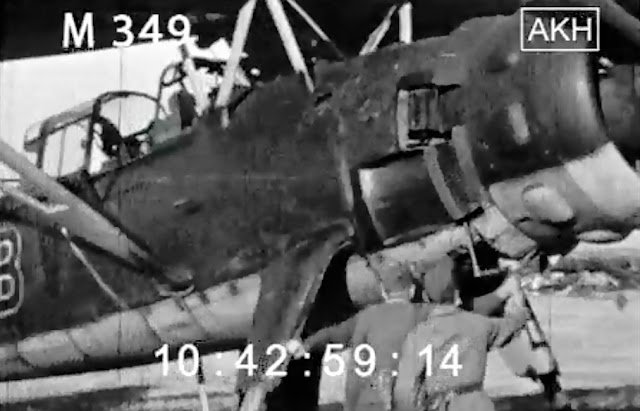
Del has been trawling through the footage made available via the Agentur Karl Höffkes film archive (AKH) and has come across some DFS 230 colour footage;

 " ...from the Agentur Karl Höffkes film archive - home movie taken by a Luftwaffe officer while training on the DFS 230.." 


This footage almost certainly looks to have been filmed in the south of France presumably during the summer of 1943, prior to Gran Sasso. Either Valence Chabeuil or Lézignan-Corbières. It features a Staffel of Luftlandegeschwader 1 equipped with DFS 230 gliders and Henschel Hs 126 and Avia B.534 tugs training for a new mission... Hauptmann Joseph Karl, Gruppenkommandeur of III./LLG.1 is seen in the footage. 

On 19 August 1943, 12./LLG1 was transferred to Ottana (Sardinia), then on 11 September 1943 to Pratica di Mare (south of Rome). Its mission in Italy was the transport of 1./FJR.7 (Fallschirmjäger-Regiment) to Gran Sasso for the ‘liberation’ of Mussolini. I have extracted a couple of time codes which correspond to the stills below... 

 10:40:11  arrival by train at a town in France, possibly Valence. Does anyone recognise it? 
 10:43:00  engine start Hs 126 tugs of LLG 1 on the airfield.
 10:43:27  pilot in cockpit of DFS 230. Note MG 34 with muzzle flash guard  attached to the fuselage and MG 15 mounted above the cockpit
 10:42:47  a group of officers chatting. In the white cap the Kommandeur of III./LLG 1  (I think..). Another officer in white cap shows off his "Kreta" cuff band for the camera.
 10:48:13  colour section - a DFS 230 with nose-mounted braking rockets, also shown in close-up
 10:49:10   DFS 230 comes into land and the glider's braking rockets are fired. This section concludes with a few shots of the DFS 230 passengers disembarking...  

 At this point I would provide a link to view reel M349 ..but since preparing this post I can no longer find the film... 

 As always these stills are reproduced here with the kind permission of Karl Höffkes


Thursday, 27 February 2025

8th AF raid on Avord airfield, 5 February 1944, Fw 200 C-4 of 8./KG 40


The airfield at Avord, ten miles east of Bourges in the Cher departement (Loire valley region), was one of the biggest military airfields in France even prior to the German invasion. From July 1940 it was continuously occupied by Gruppen of Luftwaffe bombers but escaped attack until February 5, 1944 when it was hit by the 8th AF flying mission no.210. A US reconnaissance mission carried out one month prior to the raid took photographs showing an Fw 200 on the northern ‘dispersal’, and a further five Fw 200s facing the hangars along the Avord-Farges road and a He 177 taking off. In front of the southern hangars, there was one Fw 200, two He 177s, two He 111s and a single Caudron C 445. Finally, three Fw 200s were stationed in the western part of the airfield. According to US intelligence, through 1943 the prinicpal activity was crew training. The attack on Avord on February 5, 1944, targeted along with Châteauroux and Tours, was flown by 8th AF B-17s and B-24s escorted by 20th and 55th FG P-38's (two kills) and several P-47 FGs (4 kills). By the time the American bombers reached Avord, the alerted Germans were apparently attempting to 'scramble' the aircraft occupying the taxi-ways. At 11.09 am, the first bombs fell on the base. A tail gunner recounted: ‘I saw a German bomber taking off, but four P-38 fighters swooped down on it and knocked it out’. Several hangars received direct hits and were seriously damaged. The surrounding area was not spared: 16 houses in the hamlet of ‘Les Vignes’ were hit by bombs and partially destroyed. Fw 200 C-4 of 8./KG 40 (W.Nr. 0170) was one of two machines to get airborne as the raid started but was caught and shot down along the Crosses-Saint-Just road, Annoix, some 10 km south of Bourges-Avord as seen here in the P-47 gun-camera stills. KG 40 pilot Hptm Anton Leder along with four other members of the crew was KIA. The Fw 200 came down in the marshes between Fenestrelay and Bourges. There were three survivors. Research by 'archaeologist'.


Saturday, 22 February 2025

Fw. Kurt Knappe - first Abschuss in the West


An 'unexpurgated' view of Fw. Kurt Knappe's rudder scoreboard on his Fw 190 A-4 WNr. 2413 from the ECPA-D file DAA 2693 - recently posted elsewhere without commentary. Knappe arrived in the West at III./JG 2 with 51 Eastern Front 'red star' victory markings on his rudder. This image was taken on the occasion of his first 'kill' in the West - his 52nd - marked with what appears to be an RAF 'roundel' visible here (bottom row) but which is in fact an American 'star'. This first victory with 7. Staffel was achieved on 30 December 1942 -a USAF B-17- shot down over the sea during a 1st Bomb Wing raid comprising some 40 B-17s on the U-boat pens at Lorient. B-17 'kills' were soon represented with a double-bar with US star superimposed on JG 2 rudder scoreboards. Knappe was posted to the West in late 1942 along with another JG 51 ace - Erich Hohagen - to 'beef up' 7./JG 2 who had lost Oblt. Egon Mayer following Mayer's appointment as Kommandeur of III./JG 2. Mayer replaced 'Assi' Hahn who departed for JG 54 in the East on 1 November 1942.


The 8th USAF's raid on the U-boat pens at Lorient on Wednesday 30 December 1942 - the 27th mission of this fledgling force- was significant in the story of the Fw 190-equipped III./ JG 2. Kommandeur Mayer and his Stab along with nine Fw 190s from 7. Staffel were airborne from Vannes to counter the incursion. Mayer was determined to carry out a new tactic that he had been considering over the previous weeks - the frontal attack, hitting the B-17s where their defensive fire was at its weakest. Flying alongside Knappe that morning was another ace encountering four-engine bombers for the first time - Lt. Georg-Peter Eder.
 

Friday, 24 January 2025

JG 2 Friedrich 'Notlandung Cherbourg' - ebay photo find #384


..and the seller also states 'Wick 1940'.  So probably not Cherbourg either - III./JG 2 was mostly based at St.Pol/Brias during the summer and autumn of 1941.

This yellow-nosed  7.Staffel JG 2 Bf 109 F-2 'white 10' with (barely visible and rare for a Friedrich) 'top hat' or Zylinderhut emblem on the cowl appears to have made a wheels-up landing and slid off the end of the field during the late summer of 1941 - or perhaps the gear has collapsed after the machine has run over the slight embankment around the perimeter. Certainly the prop does not appear to have been damaged. Subsequent images show the aircraft back on its gear and being pushed around the perimeter road. The focus of attention though in the picture below is not on the aircraft but on something in the road behind it - has the aircraft hit something? There certainly seems to be some damage on the spinner. Note (presumably) the pilot near the tailplane (in life jacket) and the onlooker behind him wearing a black beret. 7. Staffel gave up their Friedrichs in May 1942 to convert to the Fw 190. Kapitän during this period was Oblt. Egon Mayer.


also on this blog

III./JG 2 convert onto the Fw 190 May-June 1942 - 7. Staffel Kapitän Oblt. Egon Mayer.

Tuesday, 29 October 2024

Dewoitine D.520s and Arados in JG 105, Chartres


A line-up of D.520s with a single Ar 96 of JG 105 in early 1944. The story of JFS 5/JG 105 from June 1941 to June 1944 is told in Avions issue No. 253 (July/August 2023). 

The numbers of machines and pilots lost during 1944 is notable, no doubt the result of short-cuts in training programmes, the employment of non-German types, Allied bombing raids on French airfields and RAF fighter sweeps. During February 1944 there was an accident or incident every day of the month  - on 6 February a strafing attack destroyed two  D.520s and on the 9th a D.520 was shot down by 166 Sqn Typhoons**. During March 1944 Chartres was bombed on the 2nd (six D.520s damaged or destroyed), raided by RAF Typhoons of 174 Sqn on the 16th and bombed again on 27 March (five D.520s destroyed). During April 1944 there were over 60 accidents and incidents with an important bombing raid on April 10. In total, some 51 aircraft were damaged or written off during the month. The last mention of a D.520 in JG 105 was 20 April 1944 - by now spare parts were likely at a premium and none of the D.520s went back to Germany with the unit, a transfer that got underway on 7 June.

Click on the image for a wide-screen view.


A closer view of the two D.520s nearest the camera 'yellow 77' and 'yellow 76'. The spires of the cathedral in Chartres can be seen in the background.


**

"..During a 'Ranger' to the Chartres area on 9 February, Plt Off D. Erasmus of 266 Sqn claimed a Bf 109 shot down. This was in fact a Dewoitine D.520, an ex-Armée de l´Air fighter taken over by the Luftwaffe and used by JG 105, which was based at Chartres. D.520 No 483 was shot down and Uffz. Woll was killed. Four days later (on 13 February 1944) Sqn Ldr G.B. Warnes of 263 Squadron, also a Typhoon unit, claimed another Bf 109 in the same area. Again this was a D.520 of JG 105 - No 664 in which Uffz. Bartl was killed. It is interesting to note that at this time the Luftwaffe operated four such Jagdgeschwader in France, which would continue to operate until August 1944 (sic), when there was a general withdrawal back to Germany. The other units were JG 101 at Pau, JG 103 at Chateauroux and JG 107 at Nancy."

 In '2nd TAF' by Shores and Thomas

Thursday, 3 October 2024

Fw 190 in JG 26 - archive photo scan #32


An early JG 26 Fw 190 - an enlargement from a Nicolas Grebert image previously published in the author's " La Jagdgeschwader 26 - Histoire de quelques aérodromes de la Luftwaffe dans le nord de la France.." Note the aircraft shelter in the background. If this is Wissant/Audembert, about 23 km south of Calais, then the remnants of these are still visible from the road that runs alongside the field. 

Click on the image to view large..


Monday, 9 September 2024

Le Fana latest issue Sept 2024 - Luftwaffe pilot training in south-western France (excavating an Emil)


by Gilles Collaveri

"...31 January 1944, Pau, south-west France. Friedrich Kisslinger climbed into the cockpit of a Messerschmitt 109 E coded ‘red 5', an E-3 built by Erla in April 1940, from a batch of 500 constructed between August 1939 and April 1940. According to German archives, it had already been damaged twice, the first time on 29 August 1942, when it sustained 35% damages in northern France, and a second time on 25 March 1943, again at 35%, at La Rochelle Laleu airport [when a plane was damaged, the Luftwaffe recorded the degree of destruction. Thus 100% meant total loss]. Friedrich Kisslinger was 21 years old and had followed the standard curriculum by learning to fly gliders before arriving in Pau. On 31 January he got airborne. Once at altitude, he somehow lost control of his aircraft and was unable to stabilise it. When he finally bailed out he was too low. He was killed on impact with the ground, and his plane crashed nearby. How did the young Friedrich Kisslinger find himself in 1944 in south-west France? Quite simply because in 1943 and 1944, Tarbes, Pau and Toulouse were three major Luftwaffe training bases. These airfields were far from the front line and enjoyed decent weather, ideal for training young pilots. Jagdgeschwader 101 and the Jagdgruppe Ost, Süd and West were based here. Formed at the end of 1942, JG 101 was based in Pau, Tarbes and Ossun, while JGr. West and Ost were based in Cazaux, Biarritz, Toulouse, Mont de-Marsan and Landes-de-Bussac. These training units sometimes opposed Allied raids. On 5 March 1944, for example, Chuck Yeager's P-51 B was shot down by Irmfried Klötz, a young pilot from JGr. West flying the Fw 190..." 

So-called 'Idiotenbock' Emil trainer with 'fixed' landing gear and wing-tip 'stabilisers'  -   from reading the piece it is not clear if they were flown like this - that seems unlikely. These 'skids' were more likely designed as an aid to 'rough-field' taxiing. 


 After a long investigation and thanks to local eye witness accounts, Gilles Collaveri's association "Aérocherche" located the field where Friedrich Kisslinger's Me 109 crashed. Parts of the aircraft were uncovered, albeit damaged where the field had been ploughed. Nonetheless, one oil temperature gauge plate had miraculously remained intact because it was folded in half, protecting the inscriptions. It confirmed that the 'aviation archaeologists' of  'Aerocherche' were looking at the remains of an Emil. Numerous parts gradually came to light: equipment components, a fragment of an instrument panel counter, ammunition cases of different calibre: cannon and machine guns. Some of them still showed traces of green camouflage paint. In the spirit of respect and remembrance the pilot's family was located near Munich, more specifically the pilot's nephew, who shared the same first and last name as his uncle. He expressed a strong desire to visit the site of his uncle's crash. More than 70 years after the accident, Friedrich Kisslinger arrived from Germany with his son to visit the crash site of his uncle's Me 109 ‘red 5’. 

See Friedrich Kisslinger's visit towards the end of Gilles 20-minute film on Vimeo here

Parts of this article were previously posted on line at the Aérocherche FB page here


Wednesday, 7 August 2024

Ju 88 1(F)./123 Brittany, 1941 -archive photo scan #29


Luftwaffe Helferinnen welcome back a crew from 1.(F)/123 somewhere in Brittany, possibly Morlaix or Brest, following a 'milestone' sortie somewhere over England and the Channel during 1941.


Saturday, 8 June 2024

Stukageschwader 77 - archive photo scan #21


..a Kette of 1. Staffel of St.G 77 seen over northern France (Caen, Normandy) during late August 1940. New crews being trained in formation flying according to the period caption - 'Staffelausbildung mit neuen Besatzungen..'


Sunday, 12 November 2023

II./JG 77 Emils in Brest - archive photo scan (5). A new JG 77 monograph due soon!


..these photos simply labelled "Brest".  II./JG 77 departed Scandinavia** for France in early November 1940. Machine with Kommandeur chevrons and 'Seeadler' emblem probably belonged to Hptm. Karl Hentschel. Click on the image to view large!


A detailed account of II./JG 77 actions against RAF Bomber and Coastal Commands during the summer of 1940 appears in this blogger's "Luftwaffe Fighters -Combat on all Fronts" Volume I, published by Mortons)

Coming soon from the publishers of AÉROJOURNAL - due on 12 January 2024 is a 'special' (HS N° 47) devoted to JG 77 available to preorder now here


"..Heinz Bär, Joahnnes Steinhoff, Siegfried Freytag, Kurt Ubben, Wolf-Dietrich Huy, Gordon Gollob, Joachim Müncheberg or Armin Köhler - a number of illustrious Experten passed through JG 77, the Luftwaffe fighter arm's "ace of hearts" Geschwader, whose Gruppen quickly distinguished themselves at the start of the Second World War: I. /JG 77 in the Polish campaign and II./JG 77 protecting the Bay of Germany from RAF bomber raids. This was followed by the Western campaign for the former, the Norwegian campaign and protection of the fjords for the latter, and the unprecedented creation of III./JG 77 in July 1940 from the planned carrier fighter Gruppe that was to have manned the 'Graf Zeppelin', which was never completed. After the hard-fought Battle of Britain and victory in the Balkans and Crete, the three Gruppen of JG 77 were scattered across all fronts, in the Soviet Union of course, but above all in the Mediterranean. Hard-fought campaigns over Malta, North Africa and Italy were the Geschwader's 'finest hour' but which relentlessly wore down its fighting strength. In 1944, elements of the Geschwader took part in the Battle of Normandy and the defense of the Reich, with JG 77's last bloody feats of arms coming in the Ardennes and the "Bodenplatte" operation in December 1944-January 1945. This exceptional special issue is the complete history of this JG, which claimed some 4,000 victories between 1939 and 1945..."

Sunday, 29 October 2023

Death of the Kommandeur - Maj. Helmut Fuhrhop I./KG 6 (Junkers Ju 188 E)


Above; I./KG 6 Ju 188 E medium bombers were based in Chièvres, south of Brussels for the Steinbock raids over England during the first quarter of 1944.


Just after mid-day on the afternoon of 29 February 1944 (1944 was a leap year) two Junkers Ju 188 Es took off from Melsbroek, north of Brussels, and headed for Dreux, 50 miles east of Paris. They were part of a force scheduled to fly another 'Steinbock' bombing mission over southern England later that day which was transferring to Dreux in small groups. One of the Ju 188s (coded '3E+AB') was flown by the Kommandeur of I./KG 6, Maj Helmut Fuhrhop. An Eastern Front veteran with KG 51, Fuhrhop was an experienced career aviator and RK-holder credited with sinking at least 30,000 GRT of shipping in 250 missions. He had also flown over one hundred sorties at the controls of a Legion Condor K 88 He 111 (Taghon p.49) and was an obsessive athlete who made his crews run around the airfield almost daily! (Taghon, p.166) At the controls of the second machine was Uffz. Wilhelm Mayer of 1. Staffel. Both machines carried five aircrew and a handful of groundcrew, while Fuhrhop had his two dogs, Chica and Ciro, on board. Meanwhile, seven Hawker Typhoon Mk.1b aircraft of 609 Squadron were getting airborne from Manston (Kent) to carry out a fighter sweep in the sector Le Culot-Florennes-Cambrai across Belgium/northern France. Led by Sqn Ldr Johnny Wells the group comprised, in addition to the Englishman, one Australian, one Canadian and four Belgian pilots. They had already strafed barges and tugs when they sighted the two Ju 188s flying south-west past Cambrai at about 1,000 ft. One of the Belgian pilots flying that day, Fg. Off. Charles Demoulin, later recalled; 
 “..We were at 150 ft and had our hands full keeping station in the flurries of snow that alternated moments of zero visibility with sudden clear breaks. Suddenly, two shadows loomed out of the gloom, flitting across our heading, just feet above us, to then rapidly disappear to our left into skeins of broken cloud. But not quick enough to prevent me from identifying them. They were Ju 188s, night fighters (sic!) and medium bombers.."

“ All three of us (the two other Typhoon pilots were Flt Lt Lawrence Smith and Fg. Off. Georges Jaspis) banked into a sharp turn at the same time and at some risk of collision since the other Typhoons did likewise. The chase was on ('C'est l'hallali'!). Throttles wide open and engine screaming we went flat out after the Ju 188s and within a matter of moments come across them in a clear patch of sky.

“In front of me, a multi-coloured ribbon streamed towards my Typhoon and I could see the gunner of the second bomber bracketing my Typhoon with tracer. A little right rudder to correct and the turret fell silent as the body of the gunner slumped in his seat. At that moment the gunner of the first Junkers opened up - his rounds flashed just past my cockpit. Left rudder and gun-button depressed I rapidly shifted target - there were flashes on the grey fuselage and an explosion and the port engine of the Junkers burst into flames. ”


Below; I./KG 6 Ju 188 E "3E+KL" on a transfer flight - these machines were seen only rarely in the air during daylight hours during 1944, usually during transfer flights..


The combat was a slaughter and both bombers were sent down in flames. Meyer crashed at Bohain-en-Vermandois while Fuhrhop’s aeroplane came down three miles further south at Seboncourt, some 20 miles south-east of Cambrai. Everybody on board was killed, including Fuhrhop's long-time observer Ofw. Alfred Schuber.  According to one account, Fuhrhop's wrist watch was stopped at 13:13. The Adjutant of I./KG 6, Oblt. Roters, identified the recovered bodies wrapped in parachutes the following day laid out in a nearby monastery. Fuhrhop's wife and her sister attended the funeral in Mons. Fuhrhop's replacement as Kommandeur I./KG 6 was Hptm. and RK-holder Hans Thurner.

Below; Fuhrhop's widow and her sister in black at the Kommandeur's funeral. To the right in the front row  are, from the left, the Kommodore, Maj. Hermann Hogeback, the Kommandeur II./KG 6, Hptm. Hans Mader and  Fuhrhop's successor, Hptm. Hans Thurner..


Extracted and adapted from Peter Taghon's superb 328-page large-format French-language history " La Kampfgeschwader 6"  published by Lela Presse. Published in June 2021, an 18-page PDF extract of Peter's book is available on the publisher's web site here

Saturday, 21 October 2023

Paris, Buc or Le Bourget , summer 1941, Fw 190 'Fronterprobung' flight tests in II./JG 26 Otto Behrens - archive photo scan (4)


Above; Göring and staff examine the Fw 190 A-1 'brown 4' probably in Buc, Paris during August 1941. Göring - in pale blue uniform - is visible next to the port wing MG.

A fantastic contribution from Peter K. (Larry) who has forwarded photos from his grandfather's album - Peter's grandfather was (Oblt. later  Maj.) Otto Behrens, the man largely credited with getting the early teething problems wrung out of the Fw 190 and thus getting it into service. The unit charged with the introduction into Luftwaffe service of Kurt Tank's new BMW-radial engined fighter was an 'Erprobungskommando' (test detachment) under Behrens which started its work in Rechlin and then moved to Paris during 1941 to carry out operational trials (Fronterprobung). 

While the Behrens family who own the album are not entirely sure of the date and location of these images, one member of the General Staff who features on them - 'Hajo' Herrmann- recalls in his memoir (see chapter 8) that in July 1941 he was transferred to Paris and during that summer accompanied Göring to visit the latest 'innovations' on the airfield at Buc, 18 kms south-west of Paris (see third photo below, Herrmann at second left). 

Karl Borris (TO II./JG 26) writes that II./JG 26 moved to Le Bourget in August 1941 to convert onto the Fw 190 A-1 (Rodeike, 'Jagdflugzeug 190' p28) The Fliegerstabsingenieur (Technical Officer of JG 26) Ernst Battmer describes Otto Behrens was the man largely responsible for getting the Fw 190 into service - "..no praise is too high for his work" (Rodeike 'Jagdflugzeug 190' p33). The period of 'Fronterprobung' or operational testing in Paris was a disaster due to the constant engine over-heating issues - " die Fronterprobung wuchs sich zu einer Katastrophe aus.." Practically every flight ended up with some sort of engine damage and very often the engine over-heated just taxying out, causing any test flight to be scrubbed. ('..der Motor wurde bereits sauer beim Warmlaufen oder beim Rollen zum Start und die Maschine mit Kolbenfressern blieb stehen..') It was Behrens who forced through the changes required as Focke Wulf claimed that the BMW engine 'tauge nichts' (literally, was not worth a damn..) while BMW stressed that Fw had not allowed for enough cooling air flow to the big radial in the original design of the aircraft. The lack of cooperation between the two companies forced Behrens to knock heads together - probably not too onerous a task with the head of the Luftwaffe taking a keen interest in the new fighter. Rechlin had already test flown the Fw 190 against all leading Allied fighter aircraft then in service ..and it had not out-performed Messerschmitt's Friedrich in comparison testing. (see link below)


Above; far right alongside Göring at Buc airfield was the corpulent commander of Luftflotte 3 Sperrle. 

Following the death of Schneider in December 1941 Behrens resumed his former position as 6./JG 26 Staffelkapitän. During 1942 he transferred to the Kommando der Erprobungsstellen der Luftwaffe based in Rechlin. Here he was promoted to Hauptmann on 1 January 1943 and to Major on 1 June 1944. He ended the war as Kommandeur der Erprobungsstelle Rechlin.

He later went to Argentina - with Tank and Galland - and flew as test pilot in Tank's Ta 183 derivative the Pulqui. He was killed on 9 October 1952 in a crash while testing the Pulqui.

Otto Behrens (facing camera) with Göring during August 1941 (probably) at Buc airfield, Paris


Also on this blog;


Tuesday, 25 April 2023

No 1 Squadron Hurricanes in France 1939-40 - Sqn Leader 'Bull' Halahan and 'blue 109s'


During late 1939 No. 1 Squadron was commanded by Squadron Leader Patrick J. H. ‘Bull’ Halahan. While airmen from all over the Empire served in 1 Sqd,  the Irish squadron leader earned a certain notoriety. Patrick Halahan, a Dubliner, nicknamed ‘Bull’ - apparently because of his sturdy broad-shouldered physique - had what might then have been referred to as a 'strong character'. He spoke with a thick Irish accent and according to one account, " his language was colorful and down-to-earth. " As part of 67 Wing, 1 Squadron was sent to France during October 1939 along with No. 73 squadron as part of the air component of the BEF (British Expeditionary Force) assigned to escort and protect the BEF's Fairey Battle bomber and recce machines. No. 1 Squadron was to settle in at the airfield at Vassincourt (Champagne-Ardennes region), while No. 73 Squadron under Squadron Leader Brian W. ‘Red’ Knox was stationed at Rouvres. The field at Vassincourt was perched above the small village of Neuville where No 1 squadron’s pilots were quartered in private lodgings. It was, according to the pilots, a ‘real hole’. Squadron Leader Halahan soon had good cause to call upon the services of the new French interpreter assigned to the unit - a certain Jean Demozay. With Jean’s help the pilots were able to establish their ‘mess’ in the local town hall, rather than utilize the ancient and run down buildings on the airfield. This was the first real contact between the two men and their paths would subsequently cross on several more occasions.

'Bull' was soon embroiled in struggles with RAF command. This became evident when he insisted on back armour being installed in the Hurricane. The authorities believed this would disrupt the aircraft's centre of gravity, but Halahan took the armour from a Fairey Battle bomber and had it installed. It was soon apparent that it did not affect the Hurricane’s handling. He demanded – against regulations – that the convergence distance for the eight machine guns be reduced to short range, which increased the effectiveness of the Hurricanes. 


Pilots of No 1 Squadron at Vassincourt show off one of their Hurricanes to Mr Mahmoud Abu Fath, a member of the Egyptian Parliament, January 1940. Looking at the camera is Flying Officer Billy Drake, who became a 20-kill ace and survived the war.


Below; Thierry Dekker artwork of No. 1 Sqd Hurricane Mk 1. s/n L1679 'JX-G' of F/O Paul Richey, Vassincourt, May 1940. Note the French-style rudder stripes. Note the aircraft is fitted with a reflector gun sight. The photo also appears to show aluminium or blue lower surfaces (rear fuselage) - as Richey put it in his account ; " all German aircraft were difficult for us to see from below as they were painted duck-egg blue. Our  [..aircraft ] stood out like chequer-boards. Not without a struggle 'Bull' had our machines painted blue underneath, a colour subsequently adopted for all RAF fighters..."


As noted by Richey in his memoir 'Fighter Pilot' 'Bull' also filed a report regarding the lower surface colours of RAF fighters which was forwarded to AASF HQ and dated May 7, 1940 and had originated from test flying a captured Bf 109 against Hurricanes on May 2, 1940 at Orleans. S/Ldr Halahan wrote:

" ..during these tests one point became abundantly clear, namely that the 109, due to its better under camouflage, was very much more difficult to spot from underneath than was the Hurricane. This gives the 109 a definite tactical advantage, namely when they are below us they can spot us at long distance, which we when below them find most difficult. As in all our combats initial surprise is the ideal at which we aim, I strongly recommend the undersides of Hurricanes be painted a duck egg blue, the roundels remaining the same, as it is the contrast between the black and the white only which is noticeable from below.."


Above, Bull Halahan (CO) and Johnny Walker in front of 'L', still apparently with black/white undersides


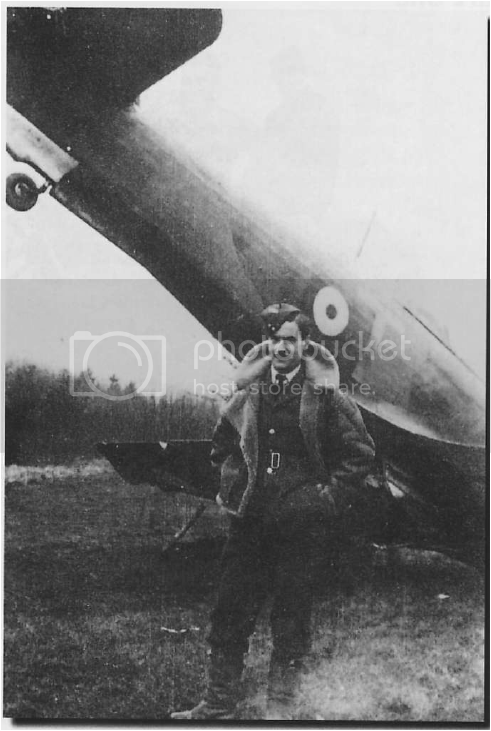
Below; P/O Peter 'Boy' Mould of 1 Sqd is often credited with scoring the first RAF victory over France on Oct 30, 1939 in Hurricane L1842 coded 'T'. In fact he did not - a JGr. 152 Bf 109 D flown by Gfr. Joseph Scherm was shot down by return fire when attacking a Battle of No. 103 Sqd on September 27. Three weeks later a Hurricane coded 'T' was lost after a mid-air collision with a French H-75A. The Hurricane was flown by Sgt A.V. Clowes (of JX-B with wasp fame) and the photo shows Clowes alongside the machine - note the 'T'  - the serial 'JX' appears to have been overpainted, as was common practice at the time. While codes change in service of course this may well have been Mould's aircraft.


Loss report for P/O Mould, flying a replacement Hurri, coded "T" on May 10, 1940
Type: Hurricane Mk 1
Serial number: P2649, JX-T
Operation: Patrol
Damaged: 10/05/1940
P/O W.O. Mould - unhurt
Took off from Vassincourt. Hit by return fire from Do 17 engaged east of Rouvres 05.00 hrs. Returned with slight damage and punctured tyre. Aircraft damaged but repairable.


Another Irish pilot to benefit from Halahan’s leadership in 1 Sqd was John Ignatius Kilmartin from Dundalk, County Louth. ‘Killy’ claimed several aircraft destroyed during the Battle of France, including a Messerschmitt Bf 109 on 12 May 1940.  (claimed as a Heinkel He 112). On that same day, his leader, ‘Bull’ Halahan shot down a ‘real’ Bf 109 before being brought down himself. Luckily, he was unhurt and managed to return to his unit. He continued to lead them to numerous victories in the air until the exhausted Squadron was granted a return to Britain on 24 May. Both pilots became instructors at No. 5 Operational Training Unit at RAF Aston Down. Halahan became its commander, but Kilmartin was sent to RAF Tangmere to participate in the Battle of Britain, shooting down two aircraft in the first three days. 

Surprisingly the experienced Halahan was not involved in the Battle of Britain. In April 1941 he led a formation of 24 Hurricanes, taking off from the aircraft carrier HMS Ark Royal and flying to the besieged Malta, enabling the island to hold off Italian-German air attacks. However, in June 1941, he took responsibility for a riotous drinking spree of some of his men and was transferred to the Middle East. With his career stalled, he retired from the RAF in 1943. This, together with his absence from the Battle of Britain, may be the reason why he is largely forgotten. 

The memoirs of Richey and Drake, two direct witnesses suggest other reasons. For example, Halahan is described as  having a certain contempt for the French ally and made no secret of it according to the Francophile Richey. Drake describes him as an unwelcoming fellow who did not wish to have any ongoing contact with his men. He lived in a chateau or, although married, indulged in adultery with local girls (his Francophobia was therefore 'two-speed'). It is perhaps for his 'harsh' temperament ('Bull') and his various misdemeanours that led to his eclipse rather than for his 'non-participation' in the Battle of Britain.... 

Kilmartin had a much longer career, flying Typhoons and Thunderbolts and taking command of several units from Scotland to Sierra Leone and from Middle Wallop to Sumatra. After the war, Kilmartin stayed in the RAF and held several positions in NATO until 8th July 1958, when he retired as a Wing Commander.


Also on this blog;