Showing posts with label Luftwaffe in colour. Show all posts

Sunday, 24 August 2025

Bf 110 nightfighters in colour -Lt. Herbert Ludwig (Adrian Matthes 'Fliegerschicksale im Landkreis Nürnberger Land 1918-1949')


Lt. Herbert Ludwig was an instructor and one of the leading aces in II./NJG 101 and flew the Bf 110, Do 217 J/N as well as the Ju 88 G. This Bf 110 is coded '9W+BO' and has 10 Abschussbalken on the tail fin - 9 British roundels and 1 Soviet star - and was likely one of Ludwig's machines. Ludwig claimed two RAF Halifax bombers during Allied resupply ops flown over Warsaw in support of the Polish uprising in late August 1944.  Ludwig was officially credited with around 13 kills although in a March 1945 letter to his wife  he mentions that he was getting close to 20. On the night of 16-17 March, 1945, he downed two Lancasters over Nuremberg before his Ju 88 G-6 was set alight (also coded '9W+BO'). He and his crew bailed out with slight injuries. This colourful machine is Profile no. 109 in Claes Sundin's "Luftwaffe Night fighters Profile Book No. 5 ". The 81 'meander' squiggle over the standard greys would be a challenge for any modeller. Screen grabs from the Fritzlar colour footage. 


As a result of his injuries sustained that night over Nuremburg, Ludwig was unable to fly for several weeks. On 4 April 1945, II./NJG 101, which was based in Unterschlauersbach, was disbanded. The three best crews of II./NJG 101 were Ludwig with 13, Rasper with 11 and Dörscheln with 8 kills. These three crews were transferred to IV./NJG 6 (under Kommandeur Hptm. Martin Becker) in Ingolstadt. The remaining personnel of NJG 101 were transferred to ground combat units. From Ingolstadt and Schleissheim, Becker's Gruppe flew night ground-attack sorties against US columns. Ludwig and his crew failed to return from one of these dangerous low-level missions.

Adrian Matthes has researched and written about Ludwig and his crew and their last weeks and published his in-depth research in a book Fliegerschicksale im Landkreis Nürnberger Land 1918-1949 and on the net. Please visit his web-page at the following link.


Also on this blog;

Monday, 24 March 2025

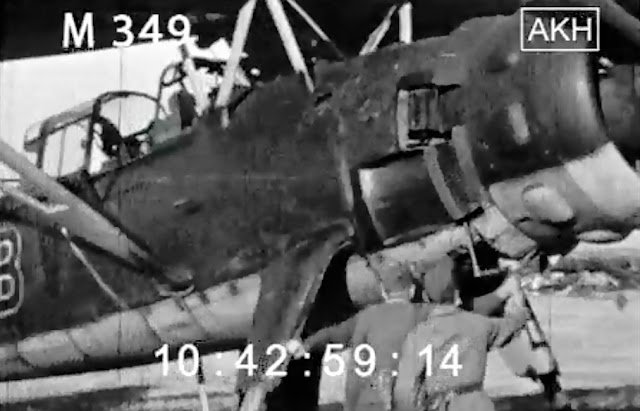
Hs 126 and DFS 230 Agentur Karl Höffkes film archive


Del has been trawling through the footage made available via the Agentur Karl Höffkes film archive (AKH) and has come across some DFS 230 colour footage;

 " ...from the Agentur Karl Höffkes film archive - home movie taken by a Luftwaffe officer while training on the DFS 230.." 


This footage almost certainly looks to have been filmed in the south of France presumably during the summer of 1943, prior to Gran Sasso. Either Valence Chabeuil or Lézignan-Corbières. It features a Staffel of Luftlandegeschwader 1 equipped with DFS 230 gliders and Henschel Hs 126 and Avia B.534 tugs training for a new mission... Hauptmann Joseph Karl, Gruppenkommandeur of III./LLG.1 is seen in the footage. 

On 19 August 1943, 12./LLG1 was transferred to Ottana (Sardinia), then on 11 September 1943 to Pratica di Mare (south of Rome). Its mission in Italy was the transport of 1./FJR.7 (Fallschirmjäger-Regiment) to Gran Sasso for the ‘liberation’ of Mussolini. I have extracted a couple of time codes which correspond to the stills below... 

 10:40:11  arrival by train at a town in France, possibly Valence. Does anyone recognise it? 
 10:43:00  engine start Hs 126 tugs of LLG 1 on the airfield.
 10:43:27  pilot in cockpit of DFS 230. Note MG 34 with muzzle flash guard  attached to the fuselage and MG 15 mounted above the cockpit
 10:42:47  a group of officers chatting. In the white cap the Kommandeur of III./LLG 1  (I think..). Another officer in white cap shows off his "Kreta" cuff band for the camera.
 10:48:13  colour section - a DFS 230 with nose-mounted braking rockets, also shown in close-up
 10:49:10   DFS 230 comes into land and the glider's braking rockets are fired. This section concludes with a few shots of the DFS 230 passengers disembarking...  

 At this point I would provide a link to view reel M349 ..but since preparing this post I can no longer find the film... 

 As always these stills are reproduced here with the kind permission of Karl Höffkes. 


Friday, 2 August 2024

Bf 110 nightfighters in colour - exhaust flame dampers

Some examples of the heavy flame dampers on Nachtjagd Bf 110s for modellers. I recall reading somewhere that they may have been painted in a special heat resistant (black) paint (?) as at Hendon (below) but one modeller convinced me that there were examples of the flame dampers in light blue-grey with his take on a couple of Eduard Bf 110 builds. Some screen grabs from the Fritzlar colour footage below..


And from Petr Zaras, Schnaufer's Bf 110 G-4 in 72nd from the Eduard Profipack. The Hakenkreuz was presumably obliterated for FB..


Wednesday, 5 October 2022

..150th issue of leading German aviation magazine "Klassiker der Luftfahrt" - Luftwaffe in Greece


"...  In the winter of 1999, when the editorial teams of the aviation group of Motor Presse Stuttgart decided to put the history articles from FLUG REVUE into a special issue, probably no one realised that 23 years later this magazine would become a permanent fixture in the German market. Today you are holding the 150th issue of the magazine for aviation history in your hands. 150 issues of emotion, detailed aircraft reports, news, glimpses behind closed hangar doors and the best photography. The latest warbirds and historic aircraft, completed restorations, hitherto unknown photographs from the  WW II era, as well as reports and photos from events and airshows around the world. The classic of aviation reliably provides you with the latest news and historical background... in this issue [..] exciting and previously unpublished colour photos taken by a German soldier stationed near Athens. We publish these rare photographs in our gallery.." 

 Colour image on the front cover of the 150th issue of 'Klassiker der Luftfahrt' - Bf 110s of the Sonderkommando Junck (4./ZG 76) seen in Athens during a stop-over en route to Iraq..


Note the air intake and the enlarged 'tropicalised' radiators, indicating that the machines visible here are Bf 110 E sub-types.  Given the absence of white spinner and nose these machines may have not originally been on the strength of ZG 76 - the third machine from the camera does not have the Haifischmaul (shark mouth) either.  (Thanks to GP for the pointer!)

Also on this blog;

PDF extract of the latest issue of 'Klassiker der Luftfahrt' on the publisher's website here

Saturday, 7 May 2022

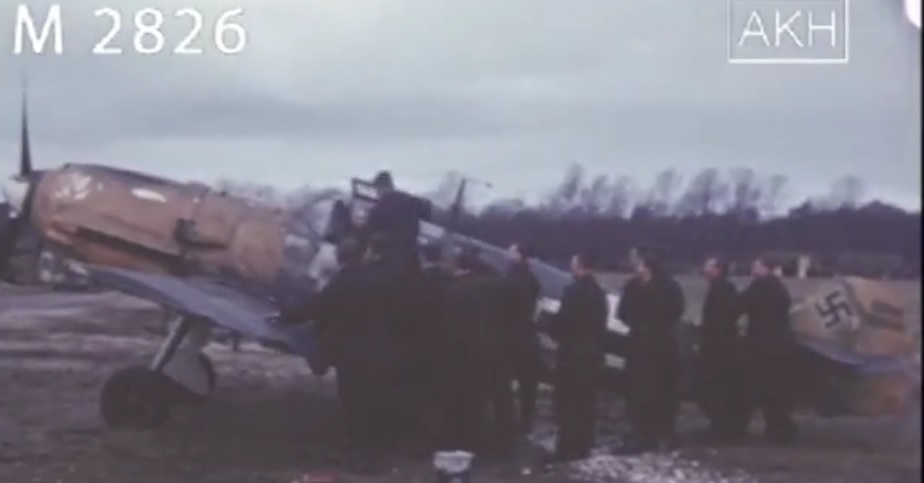
Battle of Britain Emil in colour - future 9./JG 3 Staffelkapitän Viktor Bauer's 'yellow 7' III./JG 3 Desvres late 1940


Film 2826 from the Agentur Karl Höffkes film archive features colour material depicting JG 3. The following stills are reproduced here with the kind permission of Karl Höffkes and feature "gelbe 7", the usual machine of the future Staffelkapitän 9./JG 3, Oblt. Viktor Bauer seen wearing a life jacket alongside his Emil speaking to a group.


 III./JG 3 was based at Desvres from Aug 8 1940 to Feb 16, 1941. The yellow rudders and full yellow noses would date this footage to between late October 1940 and Feb 1941. "Schwarze 5" of 8./JG 3 appears briefly in the background and was the machine of Oblt. Franz Beyer.


 " ..The camouflage appears to be in the new greys RLM 74/75 or the famous "mixed greys" - these aircraft do not seem to be in 02/71. Also, if you freeze the shot of the tail of "gelbe 7", you can see that the Hakenkreuz has been masked and a new, lighter shade of 65 (or 76?) has been applied to the airframe... the deeper blue of the original 65 is still visible between the arms of the Hakenkreuz.. The shiny finish on these aircraft is particularly noteworthy- these were well cared for..."

Note this colour section of the footage opens with the this Emil below taxying in.  Either a 'yellow 2' or 'yellow 7' again - note the two rows of Abschussbalken on the rudder. Bauer did not return his third until November. There are not many BoB candidates for this sort of victory total.. any candidates @G.R. Morrison ?


Thanks to GRM and L. Ritger for the captions


Wednesday, 6 February 2019

Colorizing images is fraud and forgery - but somebody's making money out of it !


I don't much care for colorized photos although the net and certain publications, like Andy Saunders' dreadful 'Iron Cross' magazine are full of them. Ordinarily 'Iron Cross' would be a decent read, but page after page is given over to 'colorised' pics - the 'colouriser' is even referred to as the 'artist'. 'Colourised' images are most likely created to be more 'accessible' and 'relatable' to a 'modern' audience. The risk is that they become the more widely distributed and looked-at version of the image. The original fades away into obscurity. It's the 'colorised' shot that gets re-scanned and re-distributed. But who knows whether the 'coloriser' has got the details right? He almost certainly hasn't. And everywhere you go on social media you come across a myriad examples of colorized images in varying degrees of quality. Some enthusiasts seem to be very positive about this while others are totally negative.

" ..I absolutely hate these kind of forgeries. A photograph is a document and colorizing it after the fact should be always treated as a forgery..."..

I find myself agreeing with that statement - basically 'colorizing' images amounts to nothing less than falsifying history. It's fraud, it's deception. 'Colorisation' can be inaccurate and misleading. Images like the two that follow also show that - at first glance - it is getting to the point where its impossible to tell what is 'real' and what isn't. Of course if you know what you are looking at, then you know what's wrong in the Fw 190 image below! The colour of the aircraft codes is wrong! But why let 'facts' get in the way..That said, people have been tampering with and colorizing images since the war..We only have to look at the sort of material that appeared in Signal to see how important manipulating color images were to those 'selling' (Nazi) propaganda. At its worst 'colorisation' has been described as 'a negligent falsification of history that sacrifices memory and truth..' All for a few nice colours. Something for the editor of 'Iron Cross' to bear in mind, but of course there's money to be made by publishing entire booklets full of colorised images!

 Gefechtsverband Kuhlmey from the SA-KUVA archive. Fw 190 Jabo is being prepared for a new mission, Stukas are returning, Immola July 1944 and crash-landed Yak -9.  Should be white Kennung (thanks GRM!) on this 4./JG 54 machine...


Also on this blog;

Generalleutnant Hans Seidemann and the Yak-3 - "Unbekannte Pflicht" Walter Wolfrum (296 Verlag)

https://falkeeins.blogspot.com/2017/08/generalleutnant-hans-seidemann-and-yak.html


Actual colour images are already 'under attack' from the atmosphere around them. This well-known picture looks 'different' every time it is published..


Thursday, 8 November 2018

film footage of the Junkers Frontbetriebreparatur (FBR - advanced maintenance facility) in the Nord Aviation factory at Méaulte, France 1940


Some neat footage of a selection of Ju 88s (note KG 51 badge in evidence) from the Junkers Frontbetriebreparatur (FBR - advanced maintenance facility) in the Nord Aviation factory at Méaulte in the Somme region of northern France seen during 1940. 

Following the French  defeat and subsequent armistice in June 1940 the Vichy French authorities had very quickly opened negotiations with their new German masters.  On the table was an offer to produce spares for German aircraft manufacturers and establish overhaul and repair facilities for aircraft operating from French territory and in so doing preserve industrial capacity in aviation and preserve employment and some of their manufacturing base in France. In making themselves useful to the Germans, the French authorities hoped to avoid all their workers being drafted east to work as 'Auslandarbeiter' in German aircraft factories. Their offer was quickly taken up and led to the establishment of so-called Frontbetriebreparatur or FBR plants - advanced overhaul facilities. With Ju 88s, for example, operating from no fewer than thirty eight aerodromes throughout France at the height of the Battle of Britain the French had quickly gained a certain amount of expertise on the type.  The Vichy Government thereafter concluded the so-called Wiesbaden Agreement with the Reich to bring the French aircraft industry fully into alignment with German production, with one aircraft or engine out of every three being retained for Vichy, the other two going to Germany. Certain types, such as the Messerschmitt Bf.108, Siebel Si.204 and Fiesler Fi.156 Storch were intended for wholesale transfer of their production to France. And indeed, even the Focke Wulf Fw 190 was intended for this move (and the post-war Armée de l'Air was briefly equipped with home-built Fw 190s, known as the NC.900). While some would argue that the French were not constructing war machines for the Germans, it is nonetheless the case that producing large numbers of transports and seaplanes enabled German industry to concentrate on fighters and other offensive weapons.

Today the Méaulte factory is home to Stelia Aerospace who turn out nose sections for Airbus.

The factory scenes appear in the first five-minutes of this 7-minute clip. A single click to view here.


Monday, 11 November 2013

Photo album Geschwaderkommodore KG 2 Maj. Walter Bradel - Beute Stirling


With a starting price of 8,500 euros, the photo album offered at the link below was compiled by a veteran of 9./ KG 2 and according to the seller contains some 42 wartime colour images. The album is dedicated to the former Staffelkapitän of 9./ KG 2 and later Geschwaderkommodore Major Walter Bradel (1911-1943). Features bucolic scenes taken at Soesterberg (Holland) 1940, Villacoublay, Paris, ( France 1941). A number of the photos feature Oberleutnant (later Hauptmann) Walter Bornschein (1914-1944) including the latter's RK award ceremony and celebrations, views of the Staffelhund "Strolch", the Bornschein crew shortly before a sortie and in-flight, various images of a captured Short Stirling (forced to make an emergency landing on 4 June 1943, repaired, made flight-worthy and repainted with KG 2 codes according to the album caption) The last images are perhaps the most interesting, depicting the up-turned Dornier 217 in which Walter Bradel  was killed. During the night of 4 May 1943 to 5 May Angriffsführer England ordered a consolidated attack on Norwich. Involved were 43 aircraft from KG 2 under the command of Bradel, who was airborne from Soesterberg. The attack force was augmented by aircraft from II./KG 40 and 36 Ju 88s of KG 6. Bradel's Do 217 K was attacked by a British nightfighter, and suffered engine damage. Pilot Leutnant Ernst Andres was eventually forced to attempt an emergency landing near Landsmeer, Amsterdam. The aircraft was 80% damaged and Bradel was killed when the aircraft over-turned. Album can be viewed in Dortmund before committing to buy according to the seller's blurb....

http://www.ebay.de/itm/Farbfotos-Luftwaffe-hohe-Ordenstrager-9-KG-2-Flugzeug-Plane-Beuteflugzeug-Camo-/321246746758?pt=Militaria&hash=item4acbcc5886


Friday, 6 September 2013

Luftwaffe Gallery no. 4; "Eagle" emblems, III./ JG 6 fuselage bands, JG 5 aces and more


Contents include

a round-up of "Eagle" emblems on Luftwaffe aircraft including Bf 109s, paint jobs on III./ JG 3 Bf 109s, a look at the variety of metal pennants featured both on Bf 109 aerial masts and in the ground, a colour photographic spread devoted to the Ju 87, more pilot victory sticks, featuring aces from JG 2 and JG 5 and an article by Kees Mol on the fuselage bands worn by some late-war Bf 109s of JG 6 along with a selection of reader photos and comments....

18 euros for 56 A-4 landscape pages direct from http://www.luftwaffe.be


Sunday, 4 November 2012

'Avions' magazine Bf 109 Emil 'special' issues from Lela Presse, new Airfix Bf 109 Emil boxing


Issues 189 and 190 of 'Avions' magazine published by Lela Presse feature a two-part Bf 109 Emil special compiled by noted Luftwaffe author Jean-Louis Roba and illustrated by Thierry Dekker. In total this excellent resource for modellers and Bf 109 fans amounts to some 60 pages of superlative Thierry Dekker artwork and rare archive photos over the two issues covering all variants and theatres and featuring an extensive colour section. I have shown a few highlights here with permission of the profile artist and 'Avions' editor Michel Ledet. The Bf 109 E-7 Jabo 'Black 4' of JG 51 in its winter scheme would make a super model subject! Highly recommended! Order your copies via Sylvie at the Avions mail order web page


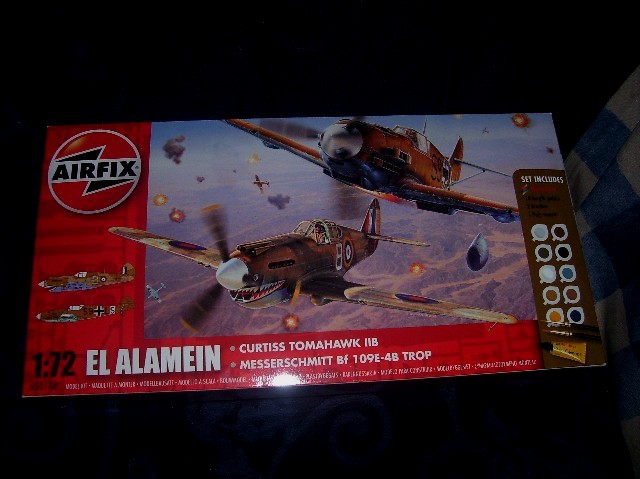
Elsewhere Airfix have re-boxed their superb new 1:72 Emil kit in an 'El Alamein' gift set featuring a Bf 109 E-4 Trop. Pictures via Ian 'Hewman 100' at the Airfix Tribute forum