Thursday, 22 October 2026
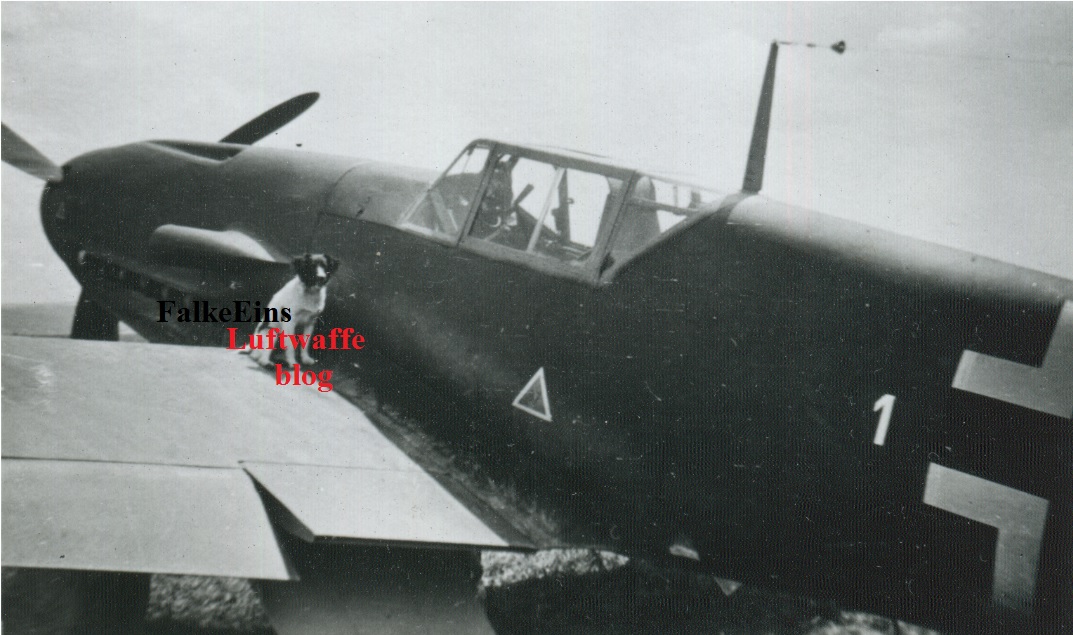
Ogfr. Alfred Papendick, 7./JG 77 - archive photo scan #54
Tuesday, 6 October 2026
"... und wird nach Luftkampf vermißt!.." JG 77 Bf 109 K-4s lost on 23 December 1944
"...and is missing following aerial combat!" by Werner Girbig in Jägerblatt, March 1972
Uffz. Hasso Fröhlich 11. Staffel verw.
Lt. W. Wildenauer 11. Staffel verw.
Tuesday, 19 May 2026
Establishment of II./JG 77 - Oberfeldwebel Georg Ries (Stabskompanie JG 77) - archive photo scan #52
Georg Ries had joined the Kriegsmarine in 1930 and served on the cruisers Leipzig and Köln before taking a position on Göring's 'yacht' 'Carin I'. For 'personal reasons' he decided to leave the navy and trained as an aircraft mechanic before being posted to Jever as an Unterfeldwebel and joining the Stabskompanie of JG 77 via a spell in Spain with the Legion Condor. By the time of the invasion of Norway during 1940 Ries was - in his own words - " ..responsible for all of II./JG 77's aircraft." This Gruppe was the only single-engine Luftwaffe fighter unit sent to Norway. Ries served as Werkstattzugführer in Stavanger and Trondheim.
His Gruppe initially assembled on Norwegian soil at Kristiansand/Kjevik. The first few days were quiet: the outgunned Norwegian fighter forces mainly flew Gladiators, which were vastly outclassed by the Bf 109s. But the RAF soon appeared in Norwegian skies. On 12 April, in poor weather, twelve Hampdens from No. 44 (Rhodesian) and No. 50 Squadrons made an incursion in search of German ships, appearing at around midday over the port of Kristiansand. German anti-aircraft guns opened up and downed two Hampdens. Several II./JG 77 Bf 109s managed to get airborne and caught up with the bombers. A fierce dogfight ensued in which six RAF bombers were claimed by the fighters - among the victorious pilots were Staffelkapitän Lange and Fw. Robert Menge – the latter had recently been transferred to 5./JG 77 from 6./Tr.Gr.186. British records partially confirm these losses: two twin-engine aircraft from No. 50 Sq. were shot down by anti-aircraft fire; three others (one from No. 50 Sq. and two from No. 44 Sq.) were shot down by Bf 109s. Below; wreckage from one of the Hampdens shot down over Kristiansand/Kjevik on 12 April 1940.
Ries departed Norway in late 1940 for Brest, II./JG 77 covering those Channel front fighter units returning to the Reich for rest and refit as the 'Luftschlacht um England' petered out. The advance detachment of II./JG 77 left Norway on 10 November, passing through Kiel, Charleroi-Gosselies and Paris before reaching Brest. Bad luck was to mark the transfer: on the 16th, one of the two Ju 52s carrying ground crew crashed near Brest, killing around ten men. The ground crews were accommodated in buildings on the airfield at Guivapas.
Ries participated in all of JG 77's early campaigns including the Balkanfeldzug and Barbarossa. He departed the Eastern Front in March 1942 posted to a training school as 'technischer Leiter'. In his correspondence dated 1989 he mentions that much of his documentation was lost at the end of the war, but that he still had a few photos from Norway and the pre-war period. Some of these show Ries (below, centre) supervising the dismantling and loading of Me 109s onto trucks for recovery back to Germany and/or onward rail transfer to Brest in France.
Ries' 'Bestallung' document appointing him to the rank of 'Feldwebel' (below). Note that 'Unterfeldwebel' was an NCO rank in the Wehrmacht, admittedly not a common one. Many or most in the Luftwaffe - especially flying personnel - went from Unteroffizier directly to Feldwebel, skipping Unterfeldwebel, a rank that seems to have been reserved for 'specialist' technical personnel. (a reviewer on amazon.com mentioned in his 'review' of my 'Day Fighters Aces of the Luftwaffe' (Casemate, 2021) that he had read all of Caldwell's books and had never encountered this rank before, suggesting somehow that this author must have made an error. Well, no.)
Tuesday, 28 April 2026
Fw. Albert Ullrich - an ace in 6./JG 77 - archive photo scan #51
Albert Ullrich was born 24 April 1920 in Sandweier (Baden-Württemberg). He enlisted in the Luftwaffe in 1941 and was in various flying schools (Marienbad, Karlsbad, Danzig and Magdeburg) before joining the EJG Süd (Orange). In August 1943 he was posted to 6./JG 77 then based in Italy. The Italian 'change-of-sides' took place shortly thereafter and II./JG 77 took on charge a full complement of Macchi Mc 205 fighters to make up the slow deliveries of Bf 109s that had been briefly interrupted. The Macchi 205 Veltro (or 'Maggie' as Ullrich referred to it in his correspondence..) was a 'more difficult' machine to fly ('schwieriger zu fliegen') and there were several losses - certain manoeuvres had to be flown with more speed and altitude than was usual in the Bf 109. The 'narrow' cockpit meant that pilots could not fly with German parachute packs and had to use Italian chutes - after one bad incident it was discovered that these had been 'sabotaged' after being 'treated' with acid...
Fw. Albert Ullrich (6./JG 77) in the cockpit of a Macchi 205. Ullrich achieved his first victory on 11 November 1943 - a B-24.
In his correspondence (dated 1991, letter #7) he described his first victory, achieved at the controls of a Macchi 205, a B-24 downed in PQ 75673 (south of Turin) on 11 November 1943;
"..a Schwarm was scrambled ('Alarmstart') under Lt. Ahlers. We were not in radio contact ('Funkverbindung') as the German sets could not be fitted in the Macchis. When I spotted the enemy aircraft I signalled this to Ahlers with hand gestures - which he appeared not to have understood. I dropped out of our formation and closed on the Viermot alone, setting one engine on fire with my bursts. On my second - and final - pass, the crew bailed out of their machine. Some six or seven men hanging under their chutes. Their Viermot went down in the vicinity of Cuneo. I do not know if the other Staffeln achieved any victories with the "Maggie" but this was the only enemy machine shot down by my 6. Staffel in the 205 .."
American troops entered the Italian capital on 4 June 1944. The next afternoon six 'waves' of B-24s and medium bombers attacked Ferrara, Forlì, and Rimini. The Bf 109s of II./JG 77 engaged them in combat from their airfield in Ferrara and claimed victories. Ullrich was airborne from Poggio-Renatico with his 6./JG 77. He encountered Liberators with fighter escort and downed his third B-24. He landed at 13:40. On 13 June 6./JG 77 was up from Poggio at around 08:20 to intercept more formations of escorted B-24s. Fw. Ullrich claimed his fourth victory against a B-24. His Staffel landed at Lavariano. By evening, the repaired runway at Ferrara allowed the two Staffeln - grounded since the bombing of 5 June - to rejoin 6. Staffel at Poggio Renatico. However, as early as the 16th, fearing a partisan attack, the Bf 109s temporarily left Poggio for Lavariano. This field was better situated for intercepting raids toward Austria. According to his own Flugbuch Ullrich downed his 5th B-24 on 22 June.
Ullrich shifted to the Eastern Front with his Staffel early in 1945. By now Staffelkapitän Deicke had been appointed Kommandeur of I./JG 77 and Ullrich was a seasoned ace whose experience was indispensable in 6./JG 77. He shot down his first Soviet fighter, an La-5, on 23 March 1945. He downed two Il-2s on 29 March. Ullrich left 6./JG 77 in April 1945 to be trained on the Me 262 at Lechfeld. He survived a transfer flight to Prague Rusin at the controls of a Me 262 and with a group of comrades 'absconded' in a truck as the Russians approached the city. He surrendered to American forces and was released by the French in 1947. J. Matthews credits him with 11 'claims', six of these over Italy and five in the 'East' during the last two months of the war.
Monday, 8 December 2025
Lt. Ernst-Günther Behling - JG 77, SG 2 - archive photo scan #48
Two images from the album of Lt. Ernst-Günther Behling. Below; an early F-4 in an interesting scheme, probably a machine of the Geschwaderstab JG 77. Note over-painted yellow rudder and the partial yellow engine cowl - an interesting alternative scheme for the new Airfix JG 77 Friedrich (1:72nd) . Günther Behling was born on 9 Nov 1919 in Halen (North Rhine-Westphalia). He trained in JFS 4 and joined the EJG 77 in July 41. Then in August 1941 he was posted to 7. (and later 8.)/JG 77. He transfered to 2./SG 2 sometime in April 1943 and, but for a short period in JG 102 (June 44) excepted, he flew only in Schlacht units (I./SG 10 in Jan 44 and Sch.G. 151 in Feb 45).
Sunday, 16 November 2025
Messerschmitt Bf 109 K-4 - a brief combat history (Part 1)
The K-series (Kurfürst - or maybe Konrad according to 'new' evidence, or perhaps Karl ) was introduced in late 1944 as an attempt to standardize the numerous earlier G-series sub-types (G-1 through G-14), which had become increasingly complex to produce and maintain. Production started in Regensburg during August 1944 while the various Gustav sub-types continued to be manufactured in parallel, including from September 1944, the G-10. Production and assembly was soon widely dispersed in the Bavarian forests while completed airframes were flight tested at two main centres, Amberg-Schafhof and Obertraubling. The K-series machines were planned as 'complete' aircraft - most of the Gustav 'options' were considered as 'standard' on the K-4, so 'add-on' Rüstsätze sets were basically limited to the R6 automatic pilot PKS 12. The K-4 was the only version of the K-series to enter mass production, as other planned variants (K-2, K-6 etc.) were only built in very limited numbers - perhaps just one prototype in the case of the K-6. Around 1,200 examples of the K-4 were delivered. The design featured a more refined fuselage/cowling with a fully retractable tall tail wheel, the larger vertical tail with bigger main wheels with new gear doors and amended wing bulges, all for better stability, along with a standardised Erla Haube for better visibility and MW 50 power boosting - the filler point of which is moved forward on the starboard fuselage. Other (external) recognition features could be the position (on the port side) of the fuel filler point, moved forward by one frame - as is the radio access hatch, also now higher up on the fuselage in comparison to the Gustav, while the DF loop is moved back one frame. Internal detail differences were numerous, including a new fuel circuit and instrument panel based on that of the Me 262. The K-4 primarily equipped Gruppen of Jagdgeschwader JG 4, JG 27, JG 52, JG 53, and JG 77. The idea that the K-4 could be a dangerous machine with its excellent climb rate and speed is difficult to prove in the face of overwhelming Allied air superiority, especially from P-51s and P-47s.
Having already given up a Staffel - 9./JG 77 - to the 'defence of the Reich' earlier in the year as well as pilots and aircraft to I./JG 53, III./JG 77 under Hptm. Armin Köhler abandoned their remaining Gustavs and departed Hungary during mid-September for rest and refit in Germany, transiting via Vienna to land in Neuruppin, Berlin on or around 13 October 1944. By the end of the month they had taken on strength a full complement of brand-new Bf 109 K-4s, around 75 machines. V./KG 2 was incorporated into the Gruppe as a fourth Staffel (see Prien JfV Teil 13/VI, page 46).
"I was hanging from my parachute, but the wind was spinning me around and this pendulum motion threatened to slam me violently into the ground as I descended at about eight metres per second. But it stopped just before I hit the ground - I landed in a trench with soft soil. Once again, I had been lucky. That same evening, I was back with the unit and noticed the many empty spaces within the Gruppe. The next day we went back into battle..."
27 November saw another large-scale USAF raid (1149 bombers accompanied by 900 escorts). Luftwaffe fighter losses totalled some 81 machines. Both II. and III./JG 27 lost K-4s as did III./JG 26 - WNr. 330372 'white 21' flown by Oblt. Gottfried Schmidt of 9./JG 26 came down near Münster, the 4th victory of 356th FG P-51 pilot Cpt. Ray Withers. Having lost most of its K-4s III./JG 26 converted onto the D-9 during January 1945..
Note the 'C3' fuel-filler stencil indicating that the K-4's DB 605 D has been uprated to take 96 octane fuel in conjunction with MW 50 power boosting. Note on the lower part of the engine fairing one of the four fixation points for the transformer powering certain cockpit instruments. WNr of Hackler's machine may have been 330 196. Another 'gelbe 10' WNr. 331 503 was lost on 26 December near Liege, pilot Uffz. Benno Kobsch KIA.
On the last day of 1944 and following recent aircraft losses, particularly during the bombing of Düsseldorf/Lohausen, a group of pilots from III./JG 77 left for Regensburg to pick up new aircraft. A few new recruits arrived from Neuruppin to fill the gaps in the pilot ranks. Although still 'top secret', the next day's operation 'Bodenplatte' did not prevent offensive patrols from being flown;
" On the afternoon of 31 December, 20 Bf 109 K-4s from what remained of our III./JG 77 were airborne under the command of Lt Hackler (StaKa 11./JG 77). Our mission was hunting enemy fighter-bombers attacking ground targets. We were then to land at Dortmund. Visibility was very poor: the cloud deck was at 300 m, while wisps of fog and cloud descended to the tree tops. Uffz Heinrich Munninger was my wingman. Over Münster, Spitfires dove down on us through a break in the clouds. Two Bf 109s were shot down." (Uffz Johann Twietmeyer, 10./JG 77)
During the two-against-one combat, three JG 77 pilots were in fact downed.. Ofhr Fritz von Rath (10./JG77) was killed near Memer, Lt Gerhard Eck (11./JG 77) was reported missing in the Münster sector; finally, Fw Karl Böttner (11./JG 77), a veteran of North Africa and an ace with 25 victories, was wounded in the leg. He was able to jump clear of his K-4, but the shock of the parachute opening caused him to lose a fur-lined boot and he hit the ground with a partially frozen foot. He did not return to the front..
Below; Fw Karl Böttner in Bf 109 K-4 'yellow 6' at cockpit readiness Note antenna mast on folding hood.. Born 11 Aug 1921, Hanover. In 1942 in EJG Ost. Went to 8./JG 77 in Jan 1943. Claimed his 25th victory on 23 Aug 1944. Was at that time in 11./JG 77. Shot down by Spitfires in 'yellow 2' (WNr. 330196) and WIA on 31 December 1944 and in Lazarett until 8 May 45. Deceased in 1995.
Sunday, 7 September 2025
JG 77 Herz As in the 'East', January -February 1945 (Bf 109 K-4)
The last fortnight of 1944 operating over the Ardennes and western Germany were some of the hardest days yet endured by the men of JG 77 - there was hardly a single sortie flown that was not marked by heavy losses. In total that short period saw 26 pilots killed, 13 seriously injured and one taken captive and around 80 Messerschmitts lost! No fewer than 26 of these were III. Gruppe Bf 109 K-4s. Among the losses were the Gruppenkommandeur of I./JG 77 Hptm. Lothar Baumann, the Staffelkapitän of 2./JG 77 Oblt. Iring Englisch (replaced by Lt. Ulrich Peiper), and 133-victory ace and Geschwaderkommodore Maj. Johannes Wiese. Ordered up by Galland on the morning of 25 December, and heading north-west over the Ruhr at 8,700m, Wiese and what was left of his Stabsschwarm (Fw. Hansch) failed to rendezvous with I./JG 77 over Duisberg and found themselves caught up with 401 Sqd Spitfires over Euskirchen;
" ...Flying at about 8700 m over Duisberg, I saw the Rhine in front of me and a little behind me - flying from west to east - enemy fighters. After a brief wing waggle, I immediately made a steep turn to the left towards their formation and, as I started the attack, I recognised further aircraft, now clearly identified as Spitfires, above, below and beside me. In the course of the ensuing sharp turn, I had difficulty jettisoning my drop tank. Behind me I saw a machine burning brightly. This was probably Fw. Hansch's aircraft. Despite all my evasive manoeuvres I came under repeated attack from all sides, received hits in the engine, a hit in the cabin and felt several impacts in the fuselage and tail. I had thrown the machine into such wild manoeuvres that it was now out of control. With the cockpit icing up and the engine smoking and losing power, I decided to parachute clear.."
14 January 1945 saw major battles in the air over the south-eastern corner of Germany. I. and II./JG 77 operated primarily to counter Allied ‘Jabos’ around Bastogne and St. Vith. While I./JG 77 suffered two fatalities over Münster/Düsseldorf, II./JG 77 had six killed and four wounded including Uffz. Fritz Giere who was forced to bail out of his G-10 in the region of Hamm (presumably Hamm am Rhein, a municipality south of Darmstadt). According to the loss listing Giere was shot up under his chute and came down in the Rhine and drowned. A Spitfire and a Beaufighter were claimed by II./JG 77.
On 15 January I./JG 77 received orders to transfer to the East, under new Kommodore Maj. Erich Leie - previously Kommandeur of I./JG 2 and high-scoring ace with JG 51 in the East (117 claims by October 1944). Below; part of a photo-set to mark the award of Leie's RK (21 victories) taken on August 1, 1941.
The situation on the 'Eastern Front' was catastrophic. The pilots of JG 77 flew several sorties per day, with the futile aim of slowing the Soviet advance. Casualties, mainly due to the Red Army's solid anti-aircraft fire, were severe and the incomplete official lists for this period give only a small idea of the scale of the losses. Nevertheless, although the Soviet air force enjoyed numerical superiority equal to that of the Western Allies, a handful of German aces continued to add to their scoreboards - undoubtedly due to the fact that the Soviet Boston and Pe-2 medium bombers were, for example, less ‘sophisticated’ than the B-24s and B-17s of the US bomber formations and the Soviet pilots less well trained (even if they were more of a handful than those encountered during ‘Barbarossa’).
Thursday, 4 September 2025
II./JG 77 Emil and Friedrich - ebay photo find #388
According to the seller this is a II./JG 77 Emil - and I'm inclined to think that he is correct. But for the II. Gruppe bar I might have said this was a I.(J)/LG 2 machine. Note narrow fuselage band ahead of the Kennung, yellow cowl and the interesting 'stripey mottling' probably of 71 and 02. Wing tips appear to be white..
See today's 'Featured blog post' entitled "..from Larissa to Salonika.." for similarly marked II./JG 77 machines in Greece during April 1941..(especially the combination of white wingtips and yellow rudder/cowl)
Another JG 77 Emil in Greece - note 'R' Richthofen badge beneath the cockpit...
Below; Another ex-JG 2 Bf 109 E in Greece, JG 77 ace Emil Omert in the cockpit probably at Molaoi
Saturday, 26 July 2025
Uffz. Hans-Ludwig Schwing, 6./JG 77
The son of a teacher, Hans Schwing was born on 5 Sep 1921 in Friedewald, a municipality in the Hersfeld-Rotenburg district near Bad Hersfeld. He had a younger brother and sister. He learnt to fly gliders in the HJ. He enlisted in the Luftwaffe in 1940. In April 41 he started his ab initio training at Klagenfurt and by November 1942 he was training with JFS 7 in Nancy, France. His unit became 2./JG 107 in January 1943. He went to 1./EJG Süd (in Orange, France) in mid-1943 before being posted to 6./JG 77 in July 1943, to undergo training on the Macchi 205 Veltro fighter - Uffz. Schwing was apparently an Italian speaker. However he was injured in a take-off accident attempting to get airborne with other machines on 20 December 1943 - damages were assessed at 90%. This would be one of the last reported losses of a Macchi 205 in II./JG 77 as 5. and 6. Staffel finally received their Bf 109s barely one week later. Schwing recovered from his injuries and returned to his Staffel but was (most likely) shot down and killed in combat with Spitfires on 18 March 1944 in the vicinity of Cassino. (reported missing when he failed to return from an afternoon sortie over the Nettuno bridgehead/Cassino area) His crashed Bf 109 'yellow 7' was only discovered several days later. He was buried at Fiuggi close to the site of his crash. His logbook returned to the family lists 739 flights including over 500 at Klagenfurt. Also returned with his effects was a 'blood-encrusted' wallet which he was carrying when he was shot down. This detail was noted in correspondence in 1989 received from his sister, Marga. Schwing's younger brother was also KIA with his Heer unit - killed in the West in January 1945 (Alsace) when his vehicle hit a mine..
Also on this blog
JG 77 in Italy - September, October 1943
Friday, 11 July 2025
Emil Omert, III./JG 77 in the Balkans
Born into a farming family in Ginolfs on 15 January 1918, Emil Omert was interested in gliding from an early age, given his proximity to the Rhön valley. Shortly before the outbreak of the Second World War, he joined the Luftwaffe and, after his training period, was posted to the future 'aircraft carrier' Staffel 6./Tr.Gr. 186. He took little part in the campaign in the West, was sent to occupy Norway and then returned near Berlin where the unit became III./JG 77.
The frequent relocations of the various parts of the Geschwader resulted in considerable technical and logistical problems but on 12 May 1941 ‘Merkur’ the invasion of Crete was launched, JG 77 being the only Luftwaffe Jagdgeschwader in this theatre. Other Gruppen were thus subordinated to the Geschwader, most notably Hptm. Herbert Ihlefeld’s I.(J)/LG 2.
Monday, 10 February 2025
Fw. Eugen Wintergerst 4./JG 77 - ebay photo find #385
Expired ebay auction
Bf 109 E "white 8" belonged to Fw. Eugen Wintergerst, ace of II./JG 77. Note 'Seeadler' emblem just forward of the cockpit. This image dates from August 1941 and shows his rudder scoreboard with some 14 Abschussbalken. He had filed seven claims following a single sortie on the early evening of 12 August 1941 on what was supposed to be a straightforward Werkstattflug or air test from Zebrikowo, north-west of Odessa. Wintergerst subsequently found himself single-handedly pursuing a Russian bomber formation of nine SB-3. When he returned to Zebrikowo, a 'higher-up' was waiting to congratulate him. Wintergerst was reluctant to get out of the cockpit of his Messerschmitt because of his (lack of) attire - he had got airborne clad only in swimming trunks...(see Jochen Prien's JG 77 Vol 2, p 749 pp). He quickly gained six further victories before colliding with Lt Zuzic's Bf 109 to become a POW on 24 September 41.
This image sold in December 2024 for nearly 500 euros...
Sunday, 4 August 2024
Bf 109 T, 2./JG 77 - archive photo scan #28
A 'Toni' from Kurt Hammel's photo album. 2. Staffel JG 77 Bf 109 T 'Red 1' appears to have suffered a landing accident as the port gear leg has collapsed. Fuel from the fuselage tank is being drained. The Staffel number appears to have been over-painted on a lighter pale patch perhaps obliterating a previous identity. Fuselage and wings have been re-sprayed at some point. See the neat Swiatlon artwork in the Chandos 'Graf Zeppelin's Eagles' title. According to the Marshall history this is Lister in 1941. Click on the image for a larger view..
Saturday, 15 June 2024
Uffz. Karl Richter 8./JG 77 - archive photo scan #22
Uffz. Karl Richter of 8./JG 77 seen in Mizil, Romania during April 1944. Perched on some mortar shells destined for the rocket launchers toted by the Bf 109s of his Staffel, he is proudly sporting his recently awarded EK II for bringing down an American bomber. He would be seriously injured in combat on April 21, 1944, just days after this photo was taken. Note yellow fuselage band and drop tank alongside the mortar shells. Photo previously published in "La Chasse de jour allemande en Roumanie " by Jean-Louis Roba (Bucharest, 1994)
Wednesday, 10 January 2024
Airfix 2024 range reveal - Wolfdieter Huy archive photo scan #13
Scintillating Tooby box-art (aside from the windscreen perhaps?) from the Airfix 2024 range 'reveal' yesterday, a 72nd Bf 109 Friedrich 'Starter set' in the markings of Wolf dieter Huy (III./JG 77). Huy was the long-time Staffelkapitän of the Jabo Staffel in III./JG 77, well-known for the dark green finish of their aircraft and their rudder 'scoreboards'. After Crete they moved to the southern sector of the Eastern Front for the launch of Barbarossa. Note this is a 'simplified' kit replicated by Airfix in a 'simplified' scheme - just four paints - for the 'Starter Set'.
A photo scan of one of Huy's early Friedrichs with a very unusual and very small Staffel number. The yellow band is presumably aft of the Balkenkreuz. Image below this depicts Huy's 'white 1' on the day of his RK award (July 1941) with Blumenstrauß alongside rudder decoration. Note 'white 6' with yellow band behind the fuselage cross in the background. Click to view large..