Showing posts with label JG 52. Show all posts

Saturday, 30 August 2025

"Batz-birds" - Willi Batz JG 52 Bf 109 photo reference


Oblt. Wilhelm Batz was awarded the RK after his 101 st Luftsieg in late March 1944 as Staffelkapitän of 5./JG 52. He had been posted to II. Gruppe as Steinhoff's Adjutant some ten months previously with over 5000 hours in his logbook as a fighter-pilot trained Fluglehrer instructor in 2./Erg.Gruppe Ost. During April 1944 he was promoted to Hptm and appointed to lead III.Gruppe (replaced in charge of 5. Staffel by Ltn. Otto Fönnekold). On 31 May 1944 during heavy fighting over the southern sector of the Eastern front (Jassy, Romania) Batz claimed 15 Soviet aircraft downed in 7 sorties during the course of the day, including 7 Il-2s and 5 Airacobras. He downed his 141st at 06:50 and his 155th at 19:14 (cf. JfV 15/II 'Einsatz im Osten' p.233 and 262 - III./JG 52 made 25 claims in total). Two Messerschmitts were lost in combat - Fw. Karl Schumacher of 8. Staffel was shot down and killed south of Jassy in his 'black 2'. By the time of his Eichenlaub award (the 526th) in July 1944, Batz had filed some 180 claims. Batz departed III./JG 52 in February 1945 (replaced by Borchers) to lead II. Gruppe. On 13 March in the vicinity of Stuhlweißenburg (central Hungary) he claimed two Il-2s for his 228th and 229th, downing another two Il-2s (and a Boston) the following day. On Thursday 5 April he claimed his 236th. Under Kommandeur Maj. Batz, II./JG 52 was able to extricate itself from Hungary and to return to the Reich, more specifically Austria. The Allies however, were closing in and entered Austria in early April 1945, with the 11th US Armor Division advancing from the north and the Soviet 2nd and 3rd Ukrainian Front from the east. Batz was awarded the Schwerter (the 145th award of the Swords) later that month. The Gruppe’s last claim was filed on 24 April 1945 (a Sherman tank for Lt. Düttmann, his 151st 'kill'). To avoid falling into Soviet hands the order was given to fly all aircraft over to US-held territory. Major Batz and his Gruppe landed in Neubiberg and were thus the only unit in JG 52 to elude Soviet captivity. 


From GRM; "..30+ years ago Noro Hideki published a photo-book of Luftwaffe wrecks from 1944-EoW entitled LO+ST. I never bothered with it, as my chief concern is operational aircraft, not 'autopsies,' and my shelves have long since overflowed (they're now stacked in multiple piles in several rooms, and when I gaze upon them I think, "My poor widow."). The Batz Bf 109 K-4 is on page 161. There's a copy offered on eBay, but not cheap. Perhaps this question is related to the forthcoming Kotare 'Bf 109 K-4', but if you are seeking earlier 'Batz-birds,' there are several Bf 109 G-4, G-6s. He regularly flew "5" when Staffelkapitän of the 5./JG 52, and a conventional "Doppelwinkel" when leading the III./JG 52 (nice takeoff sequence in the Karl Höffkes archiv, see below), and at the end, the II. Gruppe..."

Below; Gruppenkommandeur III./JG 52 Batz gets airborne on 24 August 1944 from the forward landing ground south of Warsaw, flying off behind (presumably) his wingman at the controls of 'Yellow 12' also of III./ JG 52. It was on this day that Hartmann claimed 11 victories to pass 300. Batz had claimed six in the vicinity of Sandomierz on 17 August 1944 to reach 202 'kills'.


from SD; " Two different Bf 109 K-4s one marked as 'Winkel 1' and the other 'Doppelwinkel ' with both apparently assigned to Batz (now as Kommandeur of II./JG 52) according to differing sources. Interestingly, Fine Molds have used the first option for their kit markings, and Eduard the second, with both referring to Batz as the pilot..."


Below; II./JG 52 G-10s at Neubiberg with their distinctive small black numerals, May 1945


Also on this blog


Tuesday, 11 February 2025

Oblt. Heinz Schmidt 6./JG 52 - ebay photo find #386


This next 'find' is arguably more 'rare' than the previous image but 'only' sold for 121 euros; Heinz Schmidt, StaKa 6./JG 52, on the cockpit sill of his Gustav after returning with his 150th 'kill' on 12 August 1943 barely one month before he was posted missing. He had been awarded the EL for 102 vics in September 1942 at Pitomnik during the assault on Stalingrad - raising his 'score' from 50-100 in less than one month that summer. On the morning of 5 September 1943 he 'scored' victories 172 and 173 according to the Abschussliste in Barbas ('Geschichte der II. Gruppe des Jagdgeschwaders 52') but failed to return and was reported 'Nach Luftkampf vermisst, bei Kotelwa-Senkow, SU'. According to Barbas he was likely flying a 'yellow 7'. Lipfert replaced him in charge of 6. Staffel from mid-September 1943


Thursday, 15 August 2024

JG 52 Emil - archive photo scan #30


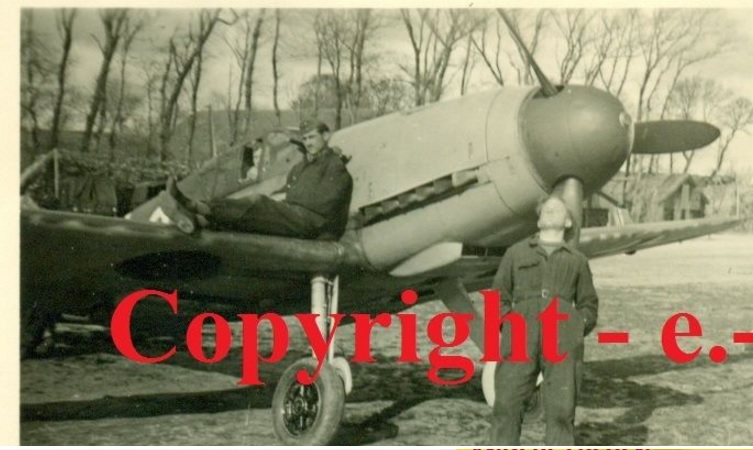
 JG 52 Emil in the hands of the 'black men' under the netting on the Channel coast at Calais Coquelles during the 'Battle of Britain' ('Luftschlacht um England'). Previously published - but this is not Bennemann's 'Black 5'.


Saturday, 27 July 2024

I./JG 52 at Coquelles - unseen Battle of Britain Spitfire crash footage from Wingleader films


During the summer of 1940 a pilot from I Gruppe JG 52 based at Coquelles near Calais filmed the images that follow on his 8mm camera. Depicting as they did the daily routines of a Luftwaffe fighter unit during the Battle of Britain made them fascinating enough. But the Wingleader team were further intrigued by a clip towards the end of the film showing a downed RAF pilot and the smoking wreckage of an RAF aircraft. Chris Goss, owner of the film, had according to the commentary, always assumed that this snippet of film showed a downed machine from 1941 - with the RAF's 'lean-into-France' good numbers of Spitfires and RAF medium bombers were brought down over France. In addition, only four Spitfires put down on French soil during the Battle of Britain, of which three were extensively photographed - no images of the fourth were known. So was this the missing Spitfire R6966 flown by Sgt. Philip Wareing of 616 Sqd downed on 25 August 1940? A single click on the red start button to view here.


Below; A line up of JG 52 Emils seen in Coquelles just outside Calais, the site today of the Tourist traffic waiting areas for Channel tunnel Le Shuttle traffic..note the clock tower of the town hall ( le Beffroi de l’Hôtel de Ville ) on the skyline..click to view large.

Luftwaffe fighter units based on this (open expanse of grass) airfield;  source ” Les pertes de la chasse de jour en France ” by Pierre Watteeuw (Luftwaffe day fighter losses in France)

 – I./JG 52 from 3 August to 31 October 1940

– I./ JG 51 from 9 March to 25 May 1941

– III./ JG 26 from 19 October 1941 to 7 April 1942


..and from the current Peter Petrick archive sale, P/O Roberts 64 Sqd Spitfire belly-landed at Calais-Marck on 15 August 1940 after Luftkampf with fighters of I.(J)/LG 2, one of just four Spitfires to come down over France during the Battle of Britain...


Thursday, 14 March 2024

Oblt. Karl-Heinz Plücker 1./JG 52


Oblt. Karl-Heinz Plücker was a 2./JG 52 pilot although flew as Staffelführer in 1./JG 52 during early 1944. He was KIA on 10 May 1944, hit by anti-aircraft fire at low level 4 km NNE of Grigoriopol,some 130 km NW of Odessa. He had achieved some 42 victories, having returned his first victory on 5 July 1943. He is seen here in a recently published JfV image (Teil 15/II Einsatz im Osten) in front of Bf 109 G-6 'black 1'.


Saturday, 2 September 2023

Ukrainian Air Force 'drone-killer' ace Vadym Vorochylov of the 204th BrTA, call sign "Karaya 1"


Interview extract with Vadym Vorochylov, famed UkAF 'drone-killer' ace of the 204th BrTA (Ukrainian AF Tactical Aviation Brigade). Vadym Oleksandrovych Voroshylov is a Ukrainian fighter pilot and 'Hero of Ukraine' after bringing down at least five Iranian Shahed-136 'suicide-drones' in early October 2022. He took his call sign in honour of JG 52 ace and the most successful fighter pilot all time Erich Hartmann.. 

Below; Maj. Vorochylov seeing in the New Year in front of MiG 29 'blue 43' of the 204th BrTA armed with R-73 and R-27 air-to-air missiles (AA-10 Alamo and AA-11 Archer)


(I): You are active on your Instagram page, you don’t hide your face, people in the streets recognise you and thank you. Do Russians send you threats?

(VV): Not at all. At all! I was very surprised by this. Maybe that’s because their leadership says we don’t have any aircraft and that they destroyed everything right away (smiles)? And they don’t want to say anything about Ukrainian pilots in their information space so that their citizens won’t be surprised?

Some of their media outlets said - I’ll quote them - "A Ukrainian Nazi pilot has been shot down." There was a short video where they mentioned my call sign and talked about Hartmann, who received the Iron Cross from Hitler.

(I): But the propagandists don’t mention that Hartmann was exonerated in the Russian Federation in 1997, and that they admitted unlawfully sentencing him to 10 years in the camps "for war crimes"...

(VV): Yes… The story of my call sign goes way back to 2014, when the Russians launched their propaganda machine and started calling Ukrainians "Nazis". Then my old Instagram account was hacked. I created a new one and was wondering what username to choose. I’m interested in world history and I knew about Hartmann. So I decided to sign it as Karaya. It was mostly a joke precisely because of the Russian propaganda, to make fun of them (laughs). And then it kind of stuck. Everyone knows that Hartmann was a genius pilot. He went through Stalin’s camps, then served in West Germany and even trained American pilots. He said in an interview in his old age that when he was young, he just wanted to fly and did not support the policy of his military and political leadership.

(I): By the way, when I hear the call sign Karaya, I think of it as being very similar to the Ukrainian words ‘kara’, ‘karaty’ [punishment; to punish - ed.] …

(VV): (Laughs). If you look at it like that, it makes more sense [‘Karaya’ is a German love song - ed.]. If you see parallels with Ukrainian, it sounds more relevant (smiles). 

More on Vorochylov on my 'Jet and Prop' blog here

And see the latest issue of Avions magazine issue no. 254 here
Christophe Cony  article  "Vadym Vorochylov, un curieux héros ukrainien"

Full "Ukrainska Pravda" interview with Vadym Vorochylov here

Thursday, 3 August 2023

JG 52 Crimea/Ukraine January 1944 Kriegstagebuch (KTB, war diary) extracts - Jagdfliegerverbände volume Teil 15/II 'Einsatz im Osten'


As far as I know there is no actual JG 52 KTB although there exist various attempts to compile something that looks like one from different sources, most notably at jg52.net. I've compiled what follows using the new Prien/Stemmer/Balke/Bock JfV volume. My copy of JfV Teil 15/II was purchased from jagdgeschwader.net - brilliant service as usual from Buchverlag Rogge. 


KRIEGSTAGEBUCH JG 52 (KTB –War Diary extract)

 
During late 1943 the Germans (and their Romanian allies) withdrew from the Taman peninsula (Kuban bridgehead) while the Soviets mounted two amphibious landings across the Kerch Straits on the eastern coast of the Crimea as a prelude to conducting operations aimed at re-taking the entire Crimea peninsula. The southern, diversionary assault took place around the small town of Eltigen (now part of the city of Kerch) and the northern, main assault landed at Yenikale. During December 1943 the Soviets suceeded in establishing and reinforcing this beach-head and managed to push a few miles inland to the outskirts of Kerch.

During this period at the turn of the year 1943-1944, JG 52 under Kommodore Hrabak was based in the southern sector of the Eastern Front (Luftflotte 4) and came under Deichmann's I./Fl-Korps. Its constituent Gruppen flew  'free hunt' and 'bomber and Stuka escort' sorties. Increasingly they were scrambled to counter enemy ground-attack and bombing raids on their own airfields. 

III./JG 52 was based at Apostolowo on the lower reaches of the Dnieper some 40 kms south-east of Krivoi Rog on the rail line from Krivoi Rog to Saporoshje in southern Ukraine.  I./JG 52 was based at a field strip north of Kirovograd in Malaja Wiska (or 'Malaya Whiskey', southern Ukraine) while II./JG 52 was at Bagerovo, 5 miles west of Kerch under Hptm. Barkhorn. The 'Stukas' of II./SG2 (Fw 190) and III./SG 3 were also here, so within very easy reach of the front-lines. Weather conditions throughout January were unsettled and very changeable.  


Wednesday, 5th January 1944

After returning from a sortie with engine damage following combat with Il 2s, Ltn. Gerhard Schindler, leader of 7. Staffel, crash-landed and turned over his Bf 109 G-6 ‘white 9’ on the strip at Apostolowo. Visibility and field conditions were poor.

Friday, 7th January 1944

Apostolowo had to be evacuated as the tank spearheads of the 2nd Ukrainian Front pushed nearer. III./JG 52 shifted to Malaja Wiska, a field strip (Feldflugplatz) 35 kms north-west of Kirovograd in central-southern Ukraine. Possibly during the ferry flight, 8. Staffel ran into Airacobras around 30 kms south-east of Kirovograd. ‘Black 2’ flown by Uffz.Manfred Maiwald received a radiator hit and dove away trailing a banner of white smoke. His fate is uncertain. In the late morning 9.Staffel’s FhjFw.Herbert Bachnick claimed all five Il 2s shot down (between 11:22 and 11:49) during the first sorties flown over the Kirovograd area. The Staffelkapitän of 8./JG 52 Lt. Friedrich Obleser claimed the sole Airacobra to go down for his 83rd. Lt. Erich Hartmann, leading 9. Staffel, downed a LaGG at 14:20 and and a second five minutes later for victory nos. 161 and 162 in further combat over the Kirovograd region.

Saturday, 8th January 1944

Uffz. Heinz Ewald had been assigned to the Gruppenstab of II./JG 52 during the fall of 1943 and flew many sorties during this period as wingman to the Gruppenkommandeur Hptm. Gerhard Barkhorn. After his 8th victory - a Yak 1 over Bagerovo on an unknown date during January 1944 - Ewald was awarded the Iron Cross II. Class.

Sunday, 9th January 1944

After Russian tanks with infantry had liberated Kirovograd during the course of the day the first tanks were reported approaching German positions at the airfield of Malaja Wiska in the middle of the night. Ground personnel of III. Gruppe were deployed infantry-style to defend the airfield. Oberlt.Max Geissler and Ogefr. Xaver Tafler, both of the Stabskompanie, were killed in action. As many as seven Bf 109s were damaged. The Gruppe shifted to Novo-Krasnoye some 60 km south-west of Kirovograd

Monday, 10th January 1944

II. Gruppe reported 3 total losses. At about 08:00 Uffz. Heinz Janssen, 4. Staffel, was shot down and killed 1 km north of Katerles (ws. 8+ -). Fw. KarI- Heinz Otten, 6. Staffel, was shot down at 09:55 in dogfighting with Russian fighters east of  Cape Tarchan and has been missing since (ge. 4+ -). At about 11:50 Ofw. Karl Dannecker in 'black 9' failed to return after combat in the Bulganak area and was reported missing. 

Tuesday, 11th January 1944

Uffz. Herbert Deicke of 1. Staffel was KIA in combat with four Yak 1 fighters south-west of Bogodarewka. 2. Staffel reported Fhj. Gefr. Siegfried Hoffmann missing in action. He was last seen by comrades south-west of Kirovograd. Ltn. Helmut Lipfert, 6.Staffel leader, shot down a P-39 near Kerch at 11:27 for his 81st victory.

Wednesday, 12 January 1944

Early morning clashes saw elements of all three Staffeln of II./JG 52 in action against Schlachtflieger and their escorts. Contact with the enemy was made at around 06:50 north-east of Yeni-kale (Kerch strait) with a Boston formation escorted by Airacobras. Four victories were claimed – one Boston and one Airacobra by Lt Heinrich Sturm of 4./JG 52 (his 83rd and 84th), a Boston for Lt. Otto Fönnekold of 5.Staffel  (his 99th) and a single Airacobra for Uffz. Friedrich Haas for his fourth at 06:55. As early as 06:20 Uffz. Robert Hahn, 6. Staffel, was shot and wounded over the Cape Tarchan bridgehead. He belly-landed his ‘yellow 7’ on the ‘Hauptverbandsplatz’ (main runway) at Bagerovo where first aid was administered. At 06:50 Uffz. Ludwig Buchheit, 5. Staffel, was wounded west of Bakssy (north-east of Kerch) at the controls of his ‘black 7’ and carried out an emergency landing in German lines.

At 13:20 elements of II. Gruppe were scrambled behind the Kapitan of 6. Staffel (Lt. Helmut Lipfert) to counter an Il-2 formation under fighter escort. Combat was joined at around 13:45 north-west of Yeni-kale – Luftkampf mit vielen Il 2. Two Abschüsse were reported –an Il-2 and an Airacobra – the 100th and 101st claims for Lt. Otto Fönnekold of 5.Staffel .  Obfhr.  Helmut Thomas, 6. Staffel, was shot down and killed in combat at the controls of his ‘yellow 8’ coming down some 4 km north of Kerch.

Thursday 13 January

Despite poor weather conditions II./JG 52 flew escort for Stukas operating over the front in the eastern Crimea. There was little contact with the enemy. Fönnekold claimed a Yak 1 at 07:20 in the vicinity of Yeni-kale (Kerch strait). Similar sorties were flown the next day and the day after with only a handful of encounters.

Saturday, 15th January 1944

Fhj. Fw Peter Düttmann of 5./JG 52 claimed an Il-2 for his 28th (Cape Tarchan). Fhj. Fw. Hermann Wolf (9. Staffel), downed two Airacobras (9:52 and 10:01) for his 51st and  52nd victories..

Sunday, 16. January 1944

Lt. Kurt Klimann, 2. Staffel, failed to return from a sortie. He was last seen by comrades west of in combat with two Airacobras. Chasing an enemy fighter over the front lines his 'black 3' (WNr. 140217) came under heavy anti-aircraft fire south-east of Karlowka.   When Lt. Plücker gave the order to re-assemble, he acknowledged audibly. A short time later, Lt. Klimann could be heard a few more times, but only very weakly. Combats against Soviet fighters, bombers and ground-attack aircraft were widespread west and south-west of Kirovograd as the Soviet army pushed forward and some 16 claims were filed in total - Karl-Heinz Plücker downed two Il-2s, one at 10:22 and a second at 10:45, 18 km south-west of Kirovograd, his 25th and 26th.

At 09:34 Ltn. Franz Schall, 3. Staffel,  downed a  Yak 9 and at around midday returned three more victories – Airacobras at 11:51 and 11:52 and three minutes later an La 5 for his victories 30 – 33. Lt. Johann-Hermann Meier (3.Staffel) downed a Yak-9 at 09:30 and an Airacobra at 11:50 for his victories 74 and 75. He claimed a third for the day at 11:52.

Monday, 17 January 1944

I./JG 52 flew sorties north of Kirovograd, claiming a further ten victories including four R-5s for Ofw. Franz Woidich (3.Staffel) for his victories 63-66.

Thursday, 20 January 1944

Uffz. Alois Seibel, 3. Staffel, killed. When downing a Boston 5 km west of Darjewo his Bf 109 took hits. About 10 minutes later, on the return flight, his machine suddenly exploded.

Sunday, 23 January 1944

II./JG 52 put all available machines in the air on 'free-hunts' and Stuka escort duties. Late the previous evening a strong Soviet landing force had come ashore north of Kerch. Hptm. Gerhard Barkhorn, Kommandeur ll. Gruppe, returned from his 1,000th enemy flight (Feindflug). He was the first fighter pilot to achieve this high number of combat sorties. His three Yak-1 claims on this date took his victory total to 238. His Rottenflieger Uffz. Heinz Ewald filed his 9th claim. Fhj. Fw. Heinz Sachsenberg, 6. Staffel, shot down an Airacobra at 07:25 for his 60th victory.
Elsewhere Lt. Erich Hartmann in combat around Kirovograd downed four LaGGs to take his total to 176. 

Tuesday, 25th January 1944


Continuing sorties flown over the Kerch bridgeheads. Lt.Helmut Lipfert, Kapitän of 6. Staffel, attacked a Boston bomber formation, shooting down one of the escorts - a Yak 1 at 12:27 - and a Boston at 12:40 for his 87th and 88th victories. I. Gruppe flew into Bagerovo to support in the defensive battles over the eastern Crimea.

Thursday, 27th January 1944

Free-hunting and Stuka escort over the front-lines north of Kerch. Lt. Franz Schall, 3. Staffel, flew a ‘free hunt’ with his Rottenflieger, Uffz. Anton Resch, in the Kerch (Kertsch) area. Over Kerch, Luftkampf (air combat) with 6 Airacobras, during which Uffz. Resch was wounded. He pulled off an emergency landing. In a combat over Kolonka, at about 06:45 Uffz. Ludwig Vogel of 5.Staffel was slightly wounded. In mid-afternoon I./JG 52 was forced to evacuate Bagerovo for Grammatikovo.

Friday, 28 January 1944


Award of the German Cross in Gold:

Oblt. Wilhelm Batz, Adju. ll. Gruppe;

Lt. Helmut Lipfert, Kapitän 6. Staffel;

Ofw.Walter Janke, 2. Staffel pilot

5 February 1944

Early February saw poor weather over the Crimea - fog, heavy rainfall and low cloud - with only a handful of sorties flown. On 4 February elements of II./ JG 52 were ordered to the west coast via Grammtikovo-Karankut-Kunan in anticipation of air attacks and some machines flew on to Chersones on the south-east tip of the Crimea in the vicinity of Sevastopol. On this date Fw. Hans Waldmann of 6./JG 52 (temporarily detached as Jagdlehrer –instructor- to Erg. Gruppe Ost) received the Knight's Cross for his 85 Luftsiege. Promoted to Kapitän of 4./JG 52, he accumulated 40 more victories over Soviet aircraft before fighting in June 1944 in Normandy.

On 12 February Einsatzschwerpunkt for II./JG 52 was still the eastern Crimea. Some 19 claims for enemy fighters downed were filed, including the 250th for the Kommandeur.  

In three sorties on February 26 west of Kirovograd, Lt. Erich Hartmann (Kapitän 9./JG 52) claimed 10 victories, including 5 in an 15-minute period around mid-day and his 200th that afternoon. On March 2, he was awarded the Oak Leaves for 202 victories, including some 24 returned over the previous two months.The weather and ground conditions were poor during this period as Kommandeur III./JG 52 Rall recalled;

"..the endless mud and slush settled into the radiator and undercarriage during taxying and takeoff, so that numerous sorties had to be broken off as the landing gear of our Messerschmitts could not be retracted or else coolant temperatures climbed into the red. We tried to keep taxy times to a minimum by sometimes getting airborne directly from our dispersals. The mud meant that fuel tankers couldn't get to the machines which had to be refuelled from drums taken out by horse-drawn carts. From 8 February even tracked vehicles couldn't get through the morass which meant pilots and crews had to struggle up to five kms through the knee-deep mud on foot to get from our accomodation to the aircraft and back ."


Above;   Summer 1944, Kommodore JG 52 Hrabak's Gustav. Note Erla hood and Kommodore chevron(s)+ bar(s)..(old ebay auction. These and others are published in Teil 15/II).

Also on this blog;

Hrabak and Hartman toast Hartmann's 300th
https://falkeeins.blogspot.com/2016/08/late-war-9jg-52-film-footage-hartmanns.html

Compiled from the new Jagdfliegerverbände volume Teil 15/11 'Einsatz im Osten'  1 January -31 December 1944. 


Monday, 5 November 2018

Bf 109 Friedrich JG 52 Schipol pre-Barbarossa - detail close-up walkaround - ebay photo find 294


New Friedrichs for JG 52, possibly II. Gruppe (Balken just visible in lower photo) pre-Barbarossa in the Netherlands, May 1941. No signs of the engine cowl covers which is strange- probably in the paint shop being sprayed yellow overall..


via Marco Meyer at koelsch333 Ebay sales here

Tuesday, 11 April 2017

Staffelkapitän 1./JG 51 Douglas Pitcairn's Emil, Lt. Heinrich Höfemeier JG 51 ace, Erwin Leibold JG 26 ace, JG 51 Wintertarnung, III./JG 2 , I./JG 52 Emil Calais 1940 - ebay photo find #214


Leibold JG 26, JG 51 Wintertarnung, III./JG 2 , I./JG 52 Emil Calais 1940

Below; three views of JG 51 ace Lt. Heinrich Höfemeier via Manuel Rauh's ebay sales here


Oberfeldwebel Heinrich Höfemeier was assigned to 1./JG 51 on 22 March 1941. On 22 June, Höfemeier claimed four Russian SB-2 twin-engined bombers shot down for his first victories on the opening day of Barbarossa. On 13 October, Höfemeier claimed three Russian Il-2 Sturmovik ground-attack aircraft shot down to record his 20th through 22nd victories. By the end of 1941 had 25 victories to his credit. He was awarded the Deutsches Kreuz on 19 March 1942 for 30 victories and the Ritterkreuz on 5 April 1942 for 41 aerial victories and 12 aircraft destroyed on the ground. By January 1943, Höfemeier had 70 victories to his credit and had been promoted to the rank of Leutnant. On 20 March 1943, Höfemeier was transferred to Ergänzungs-Jagdgruppe Ost to undertake a spell of instructing. Höfemeier returned to frontline duty as Staffelkapitän of 3./JG 51 on 2 May 1943. On 10 June he claimed three Il-2 Sturmoviks shot down (71-73). Höfemeier recorded 14 victories in July, including his 80th on 13 July. Höfemeier was shot down and killed in Fw 190 A-4 “Brown 5” (W.Nr. 145 667) by Russian Flak over Karatschew on 7 August 1943. He was credited with 96 victories in some 490 sorties. Below; another view of Höfemeier's Friedrich 'white 6'


Early yellow-cowled JG 51 Friedrich in northern France


A fine image from Manuel Rauh's latest sales - a line-up of 1./JG 51 Emils in northern France during the late summer of 1940, 'white 1' is presumably Staffelkapitän Douglas Pitcairn's machine. On 5 August 1940 Hptm. Pitcairn was injured in Bf 109 E "White 1" after colliding on take-off with Bf 109 E-4 "white 8" (W.Nr. 6266) of Feldwebel Willi Gasthaus also of 1./JG 51 at Pihen, south-west of Calais ('white 8' is just visible in the background below). Pitcairn's aircraft was 100% damaged while that of Gasthaus, who was unharmed, suffered less than 10% damage. There are two photographs of him as well as two of the above accident in the JG 51 photo-history by Stipdonk and Meyer. Note how the hellblau fuselage sides are now overpainted..Heinz Bär flew 'white 13' with the 'chamois' and Mickey Maus emblem. Recalls the photo series in the Karl Ries book!


on offer here

Below;  prominent wild Boar emblem on this I./JG 52 Emil, also northern France during 1940


Below; three images via Michael Meyer's latest sales here depicting the FW 190 A assigned to the 11-victory ace in the Stab I./JG 26 Ofw. Erwin Leibold seen during 1942


Wednesday, 18 May 2016

Hptm. Erich Hartmann - Bf 109 G-6 'Doppelwinkel' Gruppenkommandeur I./JG 53


...details of Hartmann's Bf 109 G-6 W.Nr. unknown, "Schwarzer Doppelwinkel", I./JG 53, Veszprém, Hungary. Picture source BPK Archiv, Heinrich Hoffmann; image is captioned 'Flugeinsatz' (combat sortie) 20 February 1945.

Note the details in this image and in the pretty neat representation below by an unknown 'skinner' - although he has used the 'square' canopy with antenna mast. The 'skinner' has rendered the upper surface camouflage extremely well - it is just possible to make out some details on the photo of the over-sprayed lines on the wings and forward fuselage which just about every modeller and 'artist' (except Claes Sundin; see here; a superlative piece of artwork from his 'Luftwaffe Fighter Aircraft in Profile Vol I ) just seems to ignore...much of this has to be speculative unfortunately, although it is there! Note too the heavy white overspray onto the prop blades (see image below). Claes Sundin also gets the variant correct - Hartmann's Kommandeur machine 'Double Chevron' was a G-6 according to his own logbook..and NOT a G-14. Thanks to Jan Bobek for the pointer to this great image...

other details of note - no antenna mast, the aerial attaches to the fuselage spine just behind the canopy. The DF loop is absent, although its base is visible in the photo top. No ventilation scoop ahead of the windscreen.


there is of course much more on Hartman and his aircraft  - including his final tulip-adorned G-10 - on this blog. See the label links to the right of the screen

Hartmann's JG 52 Bf 109s - Erich Hartmann's last Bf 109 G-10 - Edit October 2015

and my model of Hartmann's I./JG 53 Kommandeur machine is here

Friday, 25 December 2015

JG 52 Emils at Flugplatz Calais Coquelles, summer 1940 Battle of Britain - daily Ebay photo find #152


A line up of JG 52 Emils seen in Coquelles just outside Calais, the site today of the Tourist traffic waiting areas for Channel tunnel Le Shuttle traffic..note the clock tower of the town hall ( le Beffroi de l’Hôtel de Ville ) on the skyline..click to view large.

Luftwaffe fighter units based on this (open expanse of grass) airfield;  source ” Les pertes de la chasse de jour en France ” by Pierre Watteeuw (Luftwaffe day fighter losses in France)

 – I./JG 52 from 3 August to 31 October 1940

– I./ JG 51 from 9 March to 25 May 1941

– III./ JG 26 from 19 October 1941 to 7 April 1942

More early JG 52 images at Manuel Rauh's current ebay.de sales


Friday, 5 June 2015

Das vergessene As - 'The forgotten Ace' by Bernd Barbas' Luftfahrt Verlag Start's Barkhorn biography reviewed here by Tim Wheeldon


Many thanks to Tim Wheeldon for jotting down a few thoughts on the impressive new tome from Start Verlag devoted to the 'second'  - and forgotten - Ace, Gerd Barkhorn.


Whilst there has been much written about the Luftwaffe's other two highest scoring pilots, Erich Hartmann, 352 victories and Gunther Rall, 275 victories, there has been relatively little coverage devoted to Gerhard Barkhorn who, with 301 victories, was the only other member of the exclusive "300 Club". Aptly named "The Forgotten Ace" this book sets out to put this right. Published by Luftfahrtverlag Start - the same people who do the excellent Luftwaffe im Focus series - it appears in the same dual German/English format. In the foreword author Bernd Barbas recalls the origins of the book, which had it's beginnings back in October 1982 after a meeting with Barkhorn himself. Tragically just four months later Barkhorn and his wife were both killed in a car accident. Since the intention had been to record more interviews with Barkhorn the project was abandoned. Luckily, years later,  and after looking through his original material, Barbas decided to take up the project again......


 We now have this marvelous book some thirty years later. The book is replete with photos over its 207 pages, a good few taken by Barkhorn himself and to a large extent previously unpublished. Also published here for the first time are numerous colour slides - some 30 or so - taken by Barkhorn himself. It has to be said that they are high quality images and the publisher's treatment really does them justice - many are printed over a full page as can be seen in the page views presented here. This is most useful if you are a modeller, as the quality of reproduction is such that many many details are revealed that would normally disappear. These rare images are supplemented by Claes Sundin's high quality profile artworks; indeed there are side-views of all the aircraft flown by Barkhorn. In addition there a number of maps distributed through the text showing Barkhorn's airfields and his movements during the war. The book is split into the following sections;

Foreword* The Barkhorn Family*. Flying Training* With JG 2 "Richtofen"-10 January to 31 March 1940* With JG 52 in the West and East, (sub sectioned as follows) - action in the home war zone and on the Western front 1940/41 - with II./JG 52 on the Eastern Front 1941 - operations 1942-43 - acting Gruppenkommandeur of the I. Gruppe - Gruppenkommandeur of II. Gruppe - the war year 1944 - 1945 towards the end* Kommodore of JG 6 "Horst Wessel" * With Jagdverband 44* The postwar period*. In the Bundesluftwaffe*. The accident*. Promotions/Decorations*. Victory list of Gerhard Barkhorn* Sources.


The excellent translation of the text is supported by many eye witness accounts and excerpts from Barkhorn's dairy along with combat reports, all of which make up an easy-to-read book. Even if the Eastern front is not your area of interest, the book looks at every aspect of the ace's life, so Fw 190 Doras and Me 262 jets also feature. Post-war Barkhorn's role in the 1964-65 'Tripartite Squadron' - the evaluation unit that carried out trials of the Hawker Siddeley Kestrel , forerunner to the VTOL Harrier- is also briefly described. Barkhorn also recalls his crash landing on 13 October 1965, when, at the controls of XS 689 code No 9, he cut the throttles too early, with the aircraft still one metre off the ground, wrecking the undercarriage. As he extricated himself from the cockpit he was heard to mutter "..302 ''.. To sum up, well worth investing in just for the quality of the photos of the aircraft and, if you're a modeller, there are some great ideas for dioramas within the pages. Note too that there is a limited edition decal sheet available to purchase from the Start website covering all the aircraft flown by Barkhorn..

Barkhorn's aircraft in more detail on this blog here
http://falkeeins.blogspot.co.uk/2010/07/bf109-g-6-of-hptm-gerhard-barkhorn-jg52.html

Thank you Tim!

So highly recommended indeed - it certainly looks very impressive and the attention lavished on the production by the publisher appears self-evident from Tim's page shots. Do please click on the link to visit the Luftfahrtverlag Start website!


Wednesday, 2 April 2014

new from Jean Barby - Günther Rall's G-2 III./ JG 52 "Black 13"

Click to view large


This is the old Hasegawa kit, with an MDC cockpit finished in Mr Color acrylics, decals from Hasegawa and Aeromaster. Figures are from the now defunct Japanese after-market company Atelier Noix. Jean goes into hospital for an operation in mid-April - we wish Jean all the best for a prompt return to action ! Click on the 'label' link below for more of Jean Barby's fantastic Luftwaffe models...


more on Rall on this blog

http://falkeeins.blogspot.co.uk/2013/11/jg-52-calais-battle-of-britain-gunther.html

http://falkeeins.blogspot.co.uk/2012/11/gunther-ralls-messerschmitt-bf-109-f-4.html