" The Fighter Pilot from Ratibor
Herbert Kutscha Turns 70 " from Jägerblatt (May 1987)
"Der Ratiborer"—the official hometown publication for the city and district of Ratibor** (Upper Silesia) and an independent periodical dedicated to preserving and deepening ties to the homeland—published an extensive tribute in its latest issue to famous aviation pioneers and pilots from the Upper Silesian city of Ratibor. Alongside the former balloonist and airship pilot Dr. Hugo von Abercron and the leader of *Jagdstaffel* Boelcke (and *Pour le Mérite* recipient) Otto Bernert, the article honored an active member of our community: the fighter pilot and Knight's Cross recipient Herbert Kutscha.
We share the pride felt by his fellow natives of Ratibor for a man who distinguished himself in both war and peace; after losing his Upper Silesian homeland, he overcame great difficulties to build a new career in Northern Württemberg, all while remaining steadfastly loyal to our community.
** Now Racibórz in southern Poland, close to the Czech border) the town maintains active ties with Germany today through municipal partnerships, cultural exchanges, and European cooperation, even though its local ethnic German population was largely expelled after World War II
Herbert Kutscha was born on April 24, 1917, in Ratibor. He joined the commercial pilot training school (Verkehrsfliegerschule) as early as 1934 and transferred to the Luftwaffe shortly thereafter. During the Second World War, while serving as a Unteroffizier with II./JG 77, he achieved his first victory on December 14, 1939, over the German Bight. In February 1940, he was transferred to II./ZG 1.
After achieving ten victories with II./SKG 210, he was deployed to Russia, where he enjoyed great success in low-level ground-attack missions. From June 1943, he served as *Staffelkapitän* of 15./JG 3 in Italy, flying missions in 'Ofenrohr' (stove pipe) equipped Gustavs against four-engine bombers. In August 1944 he became Kommandeur of II./JG 3 and in December 1944 was appointed Kommandeur of II./JG 27, a post that he held until February 1945 when he was posted to command III./JG 11. Herbert Kutscha was the recipient of numerous decorations; as a pilot, he was awarded the Knight's Cross on September 24, 1942, while serving on the Eastern Front with 5./ZG 1.
With 47 aerial victories—including 22 four-engine bombers—and numerous ground-attack missions against tanks, locomotives, flak positions etc in some 900 sorties Kutscha settled in West Germany post-war after release from captivity.
As a Staffelkapitän in IV./JG 3, he briefly led the Gruppe in the air during early 1944 after 83-victory ace and Kommandeur Franz Beyer was shot down and killed on 11 February 1944. Kutscha himself was downed barely ten days later on 24 February 1944 in combat with P-47s. Although wounded he baled out of his Bf 109 G-6, WNr. 411048, "yellow 13" (below) over Quakenbrück and was out of action for several months.
1939: Küstenjagdstaffel of II./JG 136 at Jever, equipped with Bf 109 Bs (from left): Merker, Kutscha, Pohl, Heilmayer, Babucke.
Hans Ring was one of the leading Luftwaffe victory claims researchers during the 60s and 70s. This image was taken from a 1961 issue of Jägerblatt, the article was entitled 'Were our victory claims too high?' It shows Ring (standing), and from left, Hans Otto Boehm, Col. Ray Toliver and Ernst Obermaier in Munich in September 1961. Boehm was an early 'President' of the German fighter pilots association (Gemeinschaft der Jagdflieger). He died in 1964. If Ring is still with us then he must almost certainly be in his 90s.
Werner Baake was a long-time Staffelkapitän of 2./NJG 1, the first to down a Mosquito at the controls of a He 219 and apparent victor in some 40 night-time combats. He survived the war as Kommandeur of I./NJG 1, his last claims - three Halifax 'Viermots' - coming on the night of January 5/6, 1945. Post-war he flew airliners for Lufthansa like a number of other nightfighter aces. He died on July 15, 1964 while on a training sortie flying out of Frankfurt. Attempting an aerobatic manoeuvre at the controls of Lufthansa Boeing 720 'D-ABOP' he apparently over-stressed the airframe which broke up in mid-air. Baake plunged to his death with his two crew.
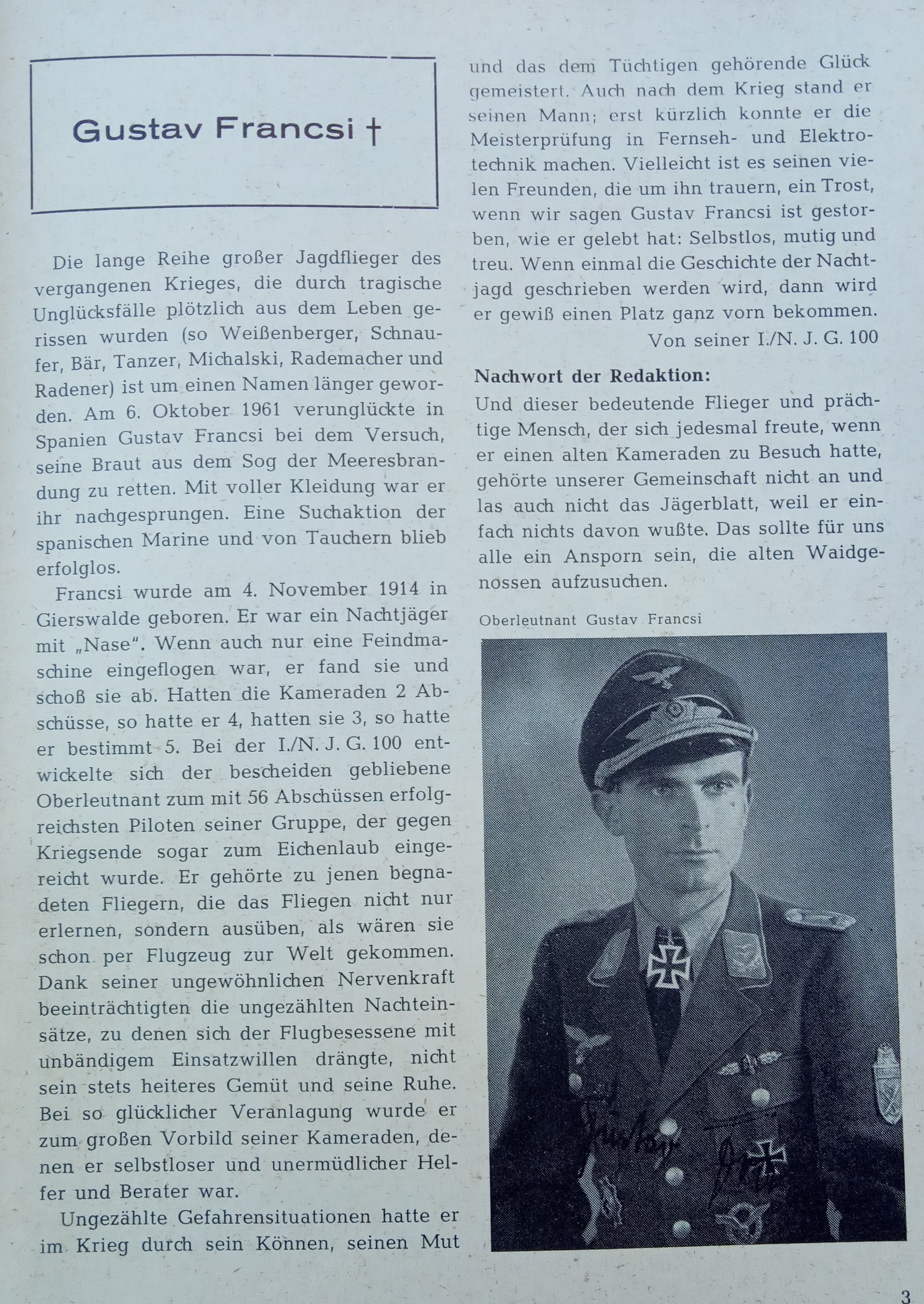
As every enthusiast knows, Marseille died on 30 September 1942 'undefeated' after bailing out of a new Gustav and failing to open his chute after (presumably) striking the tailplane. And we also recently highlighted the death of Gustav Francsi who drowned trying to rescue his wife from the sea.
Another (German) web site recently posted a report on another strange death of a Luftwaffe ace - former Ofw. ace of II./JG 300 Rudolf Zwesken, Zwesken committed suicide on 26 February 1946. In a copy of Zwesken's farewell note posted on jg300.de - apparently written by him but typed up by the Halle Kripo - Zwesken states that his lover Isolde had died during the abortion of what would have presumably been 'his' child. In his 'distress' he had therefore killed himself by sticking his head in her gas oven. However his mistress did not die so there is obviously more to this story. After all, under what circumstances does a man commit suicide because his wife is pregnant? We can 'guess' but prefer not to spell it out here - I'm sure you can work it out.
Surely an even more 'bizarre' death though is that of former 9./JG 3 ace Siegfried Engfer. Engfer had passed 50 victories on 18 September 1942 during the 'drive' for Stalingrad to earn the Ritterkreuz, the same day as his close friend in 8. Staffel Fw.Heinz Kemethmüller. After being seriously injured (Lungenschuß) Engfer (seen left as an Oberleutnant) never returned to the front and survived the war. In April 1946 he boarded a train in Vienna heading for Prague - but never arrived. He presumably left -or jumped from- the train during the journey, probably hoping to cross the 'border' undetected to locate his family in the Eastern territories occupied by the Russians. He was never heard of again. Report from the November 1965 issue of Jägerblatt.As you know a number of aces flew post-war and rejoined the Bundesluftwaffe during the 1950s - Steinhoff, Hartmann, Obleser, Körner, Krupinski, Dahmer to cite just a few. But Waldemar Radener (JG 26, 37 victories) was killed in a training plane in southern Germany in January 1957, Kurt Tanzer (JG 51) crashed in a T-33 fighter over the Balearic Islands in '60. 84-victory ace and former 4./JG 52 RK-holder Werner Quast perished in July 1962 in a helicopter accident - at the time he was a Fluglehrer (instructor) with the Heeresfliegerwaffenschule (army combat aviation - German equivalent of the Army Air Corps training school). Heinz Bär died testing a light aircraft of course. Rudolf Rademacher (JG 54, 97 victories) survived the war only to be killed in a glider crash at Lüneburg on 13 June 1953.
Numerous former aces died in road traffic accidents. Gerhard Michalski was killed in 1946 in a car crash as was his fellow 'Pik As' Herbert Kaminski who died on 16 July 1971 in a car accident in Garmisch-Partenkirchen. Gerhard Barkhorn died tragically from his injuries following a pile-up on the Cologne motorway in 1983. His wife died at the scene. Theo Weissenberger, a 'speed freak', killed himself in 1950 during a car race at the Nürburgring. And finally, George Seckel -an ace in JG 77 who flew with Müncheberg in North Africa and was later Staffelkapitän of 7./JG 77 with around 34 victory claims - bred and exhibited poodles at dog shows postwar. As he was driving to display his poodles at a show on 23 September 1972 he was hit by another vehicle on the motorway and died at the scene. His wife survived her crash injuries, but several of Seckel's dogs escaped the wreckage unhurt - only to be mown down by passing vehicles.
Cover of the April 1962 issue of Jägerblatt above - well-known image - usually incorrectly captioned - showing He 219 A-016, WNr. 190066, RL+AF, serving with NJGr. 10 at Werneuchen during the summer of 1944 engaged in radar trials.
The April 1962 issue of Jägerblatt featured an 'appreciation' of 'Nachtjagd' Ost Experte Gustav Francsi. Francsi drowned on 6 October 1961 in the sea in Spain after jumping in - fully clothed- to try and rescue his wife from an undertow. Strange coincidence with Hans Forke's death (BF to Ludwig Meister) - Forke also drowned during the 60s attempting a sea rescue - in his case his daughter and nephew. Francsi was born on 4 November 1914 in Gierswalde. Francsi was awarded the RK in late October 1944 under Kommandeur Hptm. August Fischer in I./NJG 100 and was the leading night fighter ace in the East with around 50 night-time vics (55-60 'claims', the majority of which were not officially 'confirmed' - sources conflict as to his victory tally). According to Obermaier he flew as a bomber pilot in Norway - this appears to be incorrect. Rather Francsi served as a flight engineer (BM) with KG 40 before training as a pilot during 1941. His success on the Eastern Front in NJG 100 - the only Nachtjagd unit to be based permanently in the East - was a result of close collaboration with the rail-mounted mobile radar units. At least one source claims that Francsi had moved to Kdo Bonow and flew the Arado Ar 234 during April 1945 although his last four claims with NJG 100 were on the nights of 17-18 April and 24-25 April..
"..another name is added to the long list of great fighter pilots [..] suddenly taken from us in tragic accidents...[..] Gustav Francsi died as he had lived - selfless, courageous and loyal. When the history of the German night fighter arm is finally written, then the name of Gustav Francsi will certainly be at the forefront..."
With the recent publication of the last but one volume of Theo Boiten's 'Nachtjagd Combat Archive' ('Eastern Front and Mediterranean', Wingleader - a 'must buy' for Luftwaffe enthusiasts) read the full story of Francsi's career in I./NJG 100 on the Eastern Front.
Also in Jägerblatt, April 1962 (issue No. 4, Vol XI) Heinz J. Nowarra's "Heinkel He 219 - eine vergebene Chance" ( '..a missed opportunity') and Hans Ring's comments on Walther Dahl's 'Rammjäger' ..
Born in Sprottau (now a town in western Poland) on January 30, 1914, Herbert Treppe studied at Breslau university, joining the Marineschule Mürvik in April 1935 where he learned to fly. He studied at the Luftkriegsschule Gatow 1935-36 (note two 's') and received his A/B licences at Celle in September 1936. His 'Lehrlingszeit' concluded with five months blind-flying at the Blindflugschule Wesendorf and subsequently he became an instructor in Brandis. Determined to join a front unit he was posted to KG 26 late in 1940 and according to one source flew in the 'Luftschlacht um England' (Battle of Britain). He flew both day-and-night sorties against land and shipping targets in England and Scotland. On one occasion he succesfully belly-landed his badly shot-up Heinkel He 111 with four wounded crew members in Beauvais after surviving a night-fighter attack. On February 21, 1941 he was forced to ditch in the North Sea/Skagerrack and spent five hours in a dinghy in temperatures well below freezing before being found. He did not return to flying duties until October that year. After a spell as Ic to the Fliegerführer Nord he flew combat against England, Murmansk and in support of the German army in the Far North. He was appointed Staffelkapitän of 13.(Zerstörer)/JG 5 on June 1, 1943. He wrote an account of one of his first sorties leading the Staffel that summer, claiming two Bostons downed for a 'Doublette' - as he put it, ".. not bad for a new boy". There are apparently no corresponding Boston losses in Soviet records.
13.(Z)/JG 5 re-equipped with the Bf 110 G early in 1943. Treppe flew Messerschmitt Bf 110 G-2 "1B+AX" (W. Nr. 120 037) out of Kirkenes during autumn 1943 as illustrated here by Kjetil Åkra in Eduard-Info 2015.
The Zerstörer Staffel was re-named 10./ZG 26 in July 1944. Later in the year Treppe was named as Gruppenkommandeur of IV./ZG 26 (formed during the summer of 1944) and claimed an RAF Coastal Command Liberator on 28 September 1944 timed at 1245 hrs at only 5 metres altitude (over the sea).
IV./ZG 26 became the new II./JG 5 in February 1945 with Treppe as Kommandeur. As related by Jan Bobek in Eduard-Info 2015-10 the newly reformed II. Gruppe was built up from elements of 9., 12., and 16./JG 5, and partly from the Stab IV./ZG 26 and 10./ZG 26. Interestingly the Messerschmitt Bf 110 Gs from the defunct Zerstörerstaffel were divided amongst the three Gruppen of JG 5 with single-engined fighters and were flown up to the end of the war.
While the 'Luftwaffe Officer career summaries' page indicates that Treppe passed away in 1984, Jägerblatt published a 75th birthday profile in the December 1989 issue. At this time Treppe was 'Vorsitzender' of the 'Traditionsverband JG 5'.
Another 'unknown' ace of JG 2 was Gerhard Querengässer who perhaps typified the 'Nachwuchs' of young pilots facing the Allied onslaught in the West leading up to D-Day. He was born 28 September 1921 in Weissen, a small locality near the town of Rudolstadt in Thuringia and his 80th birthday was marked by Jägerblatt in their issue of 5/2001. Having interrupted higher education to enlist in 1940 he arrived in late 1942 at Beaumont-le-roger via the Ergänzungsgruppe in Mont-de-Marsan. He flew as wingman to Eder, then later to Stratmann and Kabbe when 12. Staffel was re-designated 8.Staffel.
His first victory was a B-17 (e.V.) on 30 July, 1943. His second was a P-51 claimed in the Guingamp/Alencon area on 11 July, 1944.
Querengässer twice sustained injuries during 1944. On 23 April 1944 his Gustav collided with the G-6 flown by Oberfähnrich Gert Pudnowski over Creil (north of Paris) as II. Gruppe was scrambled. With his wing torn off in the collision Querengässer was able to bail out with head injuries while his East Prussian comrade Pudnowski was killed. On 26 June over the Normandy Invasionsfront Querengässer was brought down by German anti-aircraft fire in the vicinity of Goussainville/Chantilly but pulled off a gear-up Notlandung. Just a month later he claimed his third victory shooting down an Auster spotter on 26 July in the vicinity of Caen.
His 4th was a P-47 at Monschau on 17 December, 1944. A 5th, a P-38 west of Wetzlar on 25 December, 1944.
With five victories to his credit, Fahnenjunker Feldwebel Querengässer was very much an 'old hare' by the time of the 1945 New Year's Day Bodenplatte raids on Allied airfields. Leading a Schwarm of 8./JG 2 from Nidda in an attack against St. Trond in eastern Belgium Querengässer flew firing passes against P-47s of the 404th FG being refuelled on the southern side of the airfield but was forced to break off after being chased by Mustangs, escaping at low level.
Fhj.-Fw Gerd Querengässer of III./JG 2 with comrades seen (left) on the wing of his G-6 ‘Kanonenboot’ in late 1944. Pilot seated right is Uffz. Reinhold.
Querengässer survived the war and returned to Rudolstadt 'behind the curtain' in the new post-war DDR.
The new profile book from Claes Sundin - with rare Fw 190 cover artwork - has arrived;
- 136 full color pages with 130 aircraft profiles
- Features all-new profiles of single-seat fighter types flown by Luftwaffe Experten
- 140 additional illustrations of unit insignia (Wappen) and personal markings
- Detailed captions for each profile with historical and descriptive information of the pilots and their aircraft
- A pilot and unit index for all Claes' Luftwaffe one-seat fighter artworks published to date
- Exceptional high-quality paper and print quality and glossy hard-bound cover
Click on the low-res image of Claes' profile of Arnulf Gottschall's G-6 below to go directly to the Centura Publishing web site to order the book..
The story of Uffz. Arnulf Gottschall's demise is particularly tragic. During the morning of 19 December 1943 II. Gruppe of JG 27 were scrambled from Wiesbaden-Erbenheim under their Kommandeur Maj. Werner Schroer against unescorted 15th AF four-engine bombers mounting one of the first 15th AF raids on Germany proper. In two waves of some 150 machines, B-17s raided Innsbruck rail yards, while a small force of B-24s targeted Messerschmitt facilities in Augsburg. Uffz. Heinz Schlechter of 5./JG 27 wrote the following account, published in a 1980s issue of Jägerblatt;
"... after an intermediate stop in Ingolstadt our 5. Staffel arrived over Innsbruck at 6,000 meters and from 11:30 we flew a holding pattern waiting for the bombers to appear. We slowly ran low on fuel. After a while the red low-fuel warning light blinked on in the cockpits of several of our Messerschmitts. This obviously gave cause for concern. As we had received no updates on the air situation report (Luftlagemeldung) the sortie was finally called off and we were ordered to land back in Aibling. It was while heading in the direction of Hall im Inntal at lower level that I noticed flak bursts and at around 4,000 meters altitude I caught sight of bombers heading towards us from a westerly direction. Climbing at full power I attempted to close on a Liberator Pulk with my Katschmarek - Uffz. Arnulf Gottschall in his 'black 13' was close on my tail. We opened up at long range, at the same time running into stiff defensive fire. As I broke off I lost sight of Gottschall. A radio call brought no response. Below us the mountains of the Ziller valley in the Austrian Tyrol were shrouded in cloud. My low fuel warning light had also by now lit up on the instrument panel and a second attempt to hit the bombers was out of the question. I managed to land safely in Aibling on my last drops of fuel. However Gottschall failed to return. Some two weeks later we received news that his body had been found up in the mountains on a glacier..."
Gottschall had bailed out successfully and survived the landing. However he had evidently been unable to make his way down from the mountains and died of exposure. He is buried in the military cemetery at Amras near Innsbruck.
And a small correction to Schlechter's account from M-A Haldimann;
".. Further to your latest post, Uffz. Arnulf Gottschall was lost after parachuting from Bf 109 G-6 W.Nr. 160818 "Schwarze 12" and not whilst flying Bf 109 G-6 W.Nr. 440069 "Schwarze 13", shown in Claes's illustration. Bf 109 G-6 W.Nr. 440069 "Schwarze 13" became a total loss as Uffz. Franz Kiekbusch, also from 5./JG 27 had to crash this machine north of SS Schule Hochbrück, owing to engine trouble after taking off 21 February 1944.."
Two views of Theo Blaich and his Messerschmitt Me 108 "Taifun" prior to his departure on his pre-war 'Afrika Rundflug' (which took place during December 1938).
Below, Blaich's Taifun with the Staffelabzeichen of the so-called "Sonderkommando Blaich"probably painted following the raid on Fort Lamy for the purposes of German propaganda.
Theo Blaich was a pre-war adventurer and 'explorer' - a German 'Lawrence of Arabia' - responsible for planning and executing one of the 'longest' bombing raids of the war - the 'spectacular' attack on Fort Lamy (capital N'Djamena in Free French Chad). Often described as a 'feat of arms' ('Husarenstreich' in German) it was, in the view of this blog, a fairly derisory effort mounted by a single He 111 that has been 'sensationalised' ever since, some even comparing it to the Doolittle raid! An 'exploit' perhaps - but one of limited impact as a more 'objective' look at the efforts of the Sonderkommando based on the German and French sources would surely conclude. The ECPA- D in Paris has a large amount of material that can be previewed - over 55 taken by PK reporter Fritz Dettmann on the raid alone..
African explorer and plantation owner, Theodor Blaich was already a civilian pilot and owned his own personal Bf 108 when he enlisted in the Luftwaffe. Serving as a 'technical advisor' to Rommel and his Afrika Korps, Blaich's 'Sonderkommando' was set up to counter the Long Range Desert Group but had so little impact that there has been little or nothing written about it in English. Blaich's sole He 111 was a II./KG 4 machine (WNr. 4145) fitted out with a supplementary fuel tank (normal fuel capacity 4285 litres) enabling the machine to fly a 2500 km round trip carrying a pay load of just sixteen SC 50 bombs. The Fort Lamy raid was launched from Bir Misciuro ('Campo Uno') 600 km south of Hun on 21 January 1942.
Below; Heinkel He 111 mit Staffelabzeichen "Sonderkommando Blaich" and in the background, Blaich's car and Me 108 "Taifun", all featuring the Staffel emblem.
According to a recent video " the raid destroyed all oil stocks and 10 aircraft.." Yet photos of the scenes appear to show plenty of intact oil barrels with the columns of smoke some distance from the photographer. A recent article has an account from one French eye witness describing how base personnel man-handled barrels away from the scene of the fires ....in addition no a/c installations were hit and no aircraft were lost. The official 'bilan' (balance sheet) was 400,000 litres of fuel destroyed while 200,000 litres were saved directly from the fires. In fact according to figures published by Alain Godec, Free French fuel reserves stocked in and around Fort Lamy totalled some 2,500,000 litres!
Left; map of the 'raid' against Fort Lamy flown on 21 January 1942 - from Alain Godec's article.
As the Heinkel turned for home, columns of smoke rose up into the skies and the one imagines the crew looking down on the scenes with something approaching satisfaction. The anti-aircraft defences at Fort Lamy eventually reacted but the Heinkel crew were unaware of any defensive fire. In fact the Germans had been fortunate to 'hit' the target at all - they got lost on the way to Fort Lamy, running into a sandstorm an hour after take off. The meteorologist at Hun (Houn - 60 kms south of Tripoli) - who had forecast fine conditions for the raid - was apparently a British secret agent. Blaich and his crew also got lost on the way back, running out of fuel and eventually having to put down in the desert some 200 kms from Campo Uno. In fact as Mark Felton explains his video (see below) while the Italians' 'path-finding' for the mission was a total failure, they did eventually locate the German raider(s) 'Funkpeilung' from their 3W transmitter in the desert after some five days under 36 C temperatures and rescued them. According to wikipedia, " while the attack on Fort Lamy caused only minor damage to installations and light casualties it did destroy vital fuel supplies. It reduced the supplies for the Free French Forces and the RAF in the region by half (according to Allied sources). The raid also caused the French general Philippe Leclerc to strengthen the anti-aircraft defences at Fort Lamy and to start hit-and-run operations against the Italian forces in Fezzan region.." Yet the raid on Fort Lamy had no bearing on LeClerc's 1942 campaign - which it was intended to hinder - and rather illustrated the Luftwaffe's inability to mount any kind of meaningful strategic operation. Blaich later commanded NSGr.7 (from October 1944 I think) and was awarded the DKiG (German Cross in Gold). There were no awards handed out for the Fort Lamy 'attack'.
The PK reporter Fritz Dettmann who accompanied the raiders also authored the book 'Mein Freund Marseille' - which may go some way to explaining the 'propaganda success' enjoyed subsequently by Blaich. You could possibly describe the raid as a 'feat of arms' ..but hardly a success.
Theo Blaich (seen left) died in 1975. His obituary was published in Jägerblatt and was written by Ed Neumann. There was not much detail on Blaich's life unfortunately - he died aged 75 (born 1900), adventurer and explorer he spent time in his teens flying and travelling, mostly to central America - owned banana plantations in the Cameroons West Africa during the mid to late 20s - on the outbreak of war enlisted in the Luftwaffe with his own aircraft.
On the French side there were claims made about the efficacy (or not) of Fort Lamy's anti-aircraft defences. French writer Alain Godec commented;
".. the officer commanding the guns did not see the German aircraft despite claims that they had clearly identified the aircraft on the approach. One gunner claims that the Bofors guns could not hit the aircraft because it was flying at 3500m (as compared to 1500m in the official report) and even says that the bombing was done North to South. The rumours among the Free French in Chad indicate that the crews were either having a nap or were playing cards, apparently unconcerned given that there were so many aircraft movements. When you look at the picture in Carrell's book depicting at least one bomb exploding with the river Chari in the back-ground you can clearly see that the altitude was not 3500m (beyond Bofors guns range) but much lower. You can also simulate this on Google Earth..."
"..Select N'Djamena and play with the altitude.
One thing I forgot to say is that the aircraft type and nationality was only discovered later on. The report mentions that the bombing "was done at 1235 GMT by a twin-engine bomber camouflaged by large orange and brown stripes without any markings". The nationality of the aircraft was only discovered when the two unexploded bombs were examined and destroyed three days later. In a local Fort-Lamy newspaper, an article reports that "Fort-lamy was bombed by an unknown aircraft and that the bombs were of a German make.."
Below; refuelling Blaich's He 111 at 'Campo Uno' from drums carried by the accompanying Italian SM. 81 'Pipistrello' prior to launching the 21-22 January raid. According to a German-language article on the raid (Flugzeug 5/86), the Italians were to accompany the raiding Heinkel and act as 'pathfinders'. The Heinkel missed Fort Lamy by some 200 kms and only found the target by following the rivers Schari/Lougone. The crew landed in the desert -lost- some 200 kms from Campo Uno on the return leg of the mission. With diminishing water rations the crew were located after some five days in the desert.
Below; Blaich at the controls of a Me 108 having just landed at Campo Uno. Standing alongside him is the Count San Severino, Italian desert 'specialist'..
Above; 'colorized' (?) screen capture from the Mark Felton video below. A single click to view here
" ..Shot-up Me 109 glides back across the Channel - outstanding performance from a German fighter pilot - gliding more than 70 km home..
"..Unteroffizier Hannes, der als Rottenhund eines Schwarms fliegt, wird gleich von zwei englischen Maschinen angegriffen... "
Uffz. Karl Hannes flew during 1939-42 in 5./JG 2 and successfully survived combat on the Westfront during this period. His Staffelbezeichnung was "12". He returned his first victories - downing Spitfires - during September 1940. He was credited with five victories over the RAF. His 5th claim was for a Hurricane, west of Le Touquet during the evening of 17 August 1941.
A PK report dated 23 September 1940 described an incident during a Ju 88 Begleitschutz escort sortie over London flown by the Geschwader Richthofen from their bases in northern France.
Kriegsberichter Gerhard Linke takes up the story .......
"..having over-flown the Channel at 6,000 metres, the formation came under attack from RAF fighters, diving from a favourable position directly out of the sun. Hannes quickly had two on his tail, one of which gave him a long burst of fire into the engine and fuselage from fifty metres. The enemy's shells hit the Me 109 hard, even slamming into the steel plate that protected the pilot's head. A glance at the instrument panel told Hannes he was rapidly losing his coolant and that the engine would likely seize at any moment. He chopped the throttle and his fighter fell away to the left. At that moment the RAF fighter swept past him and attempted to peel off to the right. With his engine still barely turning over, Hannes seized his chance. His 'sick' Me 109 fell in behind the RAF fighter - so long as the engine was running then he was still able to fire his MGs. He cut across the Spitfire's curve - even if he was going to go down he would teach the Englishman a lesson. Barely thirty metres in front of him the Spitfire was framed in his Reflexvisier gunsight. Hannes squeezed the two firing buttons on his control column, unleashing in the same moment the first rounds from his MGs and cannon. Not for an instant had the Englishman expected that the Me 109 would still pose a danger to him. He attempted a split-S away but Hannes was on his tail as both machines fell away through one thousand metres. Time and again his rounds hit the Spitfire's fuselage and then a cannon shell into the engine - the Spitfire was soon trailing a banner of black smoke. Hannes could see flames licking from the cockpit. Der Gegner ist erledigt - his adversary was done for! But now his propeller juddered to a stand, the three blades starkly black against the horizon. 4,800 metres altitude and still 30 kilometres from the Channel which was at least 40 kms wide at this point. Beneath his wings the meadows and fields of the English countryside. Hannes kept his cool, feathered his prop ('Segelstellung') - the positions where the blades gave the least resistance and held the stick gently in his right hand -'keine unbedachte Bewegung darf gemacht werden'...no careless movement could be performed, every metre was precious. It is a strange feeling for a fighter pilot to glide through the air with no engine noise... [..]
As a precaution Hannes jettisoned the canopy in case he had to leave the 109 quickly...[..] Zehn lange Minuten! Ten long minutes! Jetzt kommt der Kanal. At 3,000 metres he glided out over the Channel, the machine slowly losing height - das fliegerische Gefuhl ist jetzt alles....[..] With a slight whistling in the slipstream the Me 109 came in over the French coast at a height of fifty metres. To his right he spotted a freshly mown field and set up for a belly landing. He touched down softly, slid along for ten metres and came to a stand. Hannes sat motionless for a moment. Then rubbing the dust thrown up by the landing from his eyes and face, he slowly unbuckled his belt, pulled himself up out of the seat and climbed down from the cockpit. The aircraft had sustained only slight damage in the landing but Hannes counted over twenty bullet impacts, mostly in the wings and the fuselage. There were just two in the radiator and it was these that had brought him down..[..] .."
The display of airmanship shown by Hannes in downing a Spitfire in his crippled fighter and then gliding it home was second-to-none and won the fulsome praise of his comrades - 'Hannes hat ..[..] eine Leistung vollbracht, die gerade bei seinen Kameraden in der Jagdfliegerei bewundert wird..' His feat was evidence of the 'immense skill' and 'Siegeswillen' or 'will to win' of the men of the German Luftwaffe..
Below; Uffz. Karl Hannes in front of his (presumably) 'red' or 'black 12' of 5./JG 2 - a 'cropped' version of this photo was first published in the April 1977 issue of Jägerblatt.
Above; Karl Hannes was subsequently posted to Erla and served as a factory 'Einflieger' (test pilot) and in the works Jagdstaffel. In this role he would perform more than a few emergency landings..
Below; Hannes seated on the spinner of a crash-landed Gustav coded 'G1'
Below; Hannes flew this modified Messerschmitt Bf 109 G-4 coded "H1" (Hannes, aircraft # 1 ?). The aircraft was written off in a crash landing during 1943. Hannes can be seen near the engine bearer arm, hand resting on one of the cowl MGs..
A 'second' "H1" (?) trialed a system for direct injection of liquid oxygen into the engine turbocharger to significantly improve the rate of climb.
The order for the capitulation of all German armed forces signed a week after the suicide of Adolf Hitler on May 7, 1945 contained a special addendum referring specifically to the Heeresgruppe Kurland and the necessity to implement an evacuation of as many personnel as possible to the West.. The following day, May 8 1945, the Luftwaffe launched a desperate rescue mission to evacuate German wounded and troops from the 'Festung' (the 'fortress' or rather 'pocket', the so-called Kurlandkessel) in Latvia. German forces had been effectively cut off since late 1944 by the Soviet advance. According to the Mark Felton video below, that morning - May 8, 1945 - some 35 Ju 52s flew into Grobina/Grobin in Latvia from Norway to evacuate encircled German troops from the peninsula, intending to fly the wounded troops and men with children back to Germany. Over the Baltic the transports were set upon by Soviet fighters and no fewer than 32 of the Ju 52s were set alight and downed and the mission ended in tragedy and destruction.
Mit Ju 52 aus Windau am 8 Mai 1945
".. on May 8, 1945 at around 15h00 six Ju 52s managed to get airborne from Windau and head back to Germany - Richtung Heimat! The machines were overloaded - carrying at least 30 passengers - and I needed two attempts to get airborne. Near Greifswald my machine took hits from ground fire and was set alight. I managed to make a successful crash-landing but we ended up in Soviet captivity. Did any of the comrades from that flight survive Soviet imprisonment? What became of the other five transports? Does anyone know what happened to pilots Hptm. Brettschneider and Fw. Skripitz? "
Helmut Hemmer in Jägerblatt magazine.
Mark Felton video - a single click to view here
In a 1986 issue of Jägerblatt I./ JG 54 ace Artur Gärtner wrote;
"..I managed to get out of Kurland in a Ju 52 of Transportgeschwader 1. 1.Staffel of I./JG 54 was based in Windau but conditions on the airstrip were so bad that the Fw 190s could not get airborne. We were almost certainly bound for Soviet captivity. We were extremely thankful for the efforts of our fellow airmen in the transport units who dared to undertake those last flights into the pocket - a number of Ju 52 crews lost their lives as a result. The crews that came into Libau could have had little or no idea of the dispositions of Soviet ground forces or even the location of the front lines and many came under heavy ground fire as they flew their landing approach..."
below;
November 1944 on the Feldflugplatz at Skrunda in Kurland - 1. Staffel pilots in front of the A-8 'white 12' flown by Staffelführer Sepp Heinzeller, fifth from the left.
For the fighters of JG 54 there were also dramatic scenes on the last day in the 'Kurlandkessel'.
In an early 1980s issue of Jägerblatt magazine, Fw. Karl Wolf, a former II./JG 54 ground crew member, recalled;
".. in the early hours of the morning of May 8, a friend from my home town, Ogfr. Ernst Eggers of the Luftn-Truppe called me. His unit was stationed with us on the airfield at Cirawa.
" Karl, der Krieg ist aus..! - the war is over .."
I passed the news around to my comrades in our Blockhaus bunker - we were all shocked. What would happen to us now, 1200 kms from home surrounded by the Russians ('der Iwan'). It was around 02:30 when the call went out for the Staffel to assemble at our dispersal on the airfield some 4 kms distant. Transported in trucks, we were to take only what we could carry. Our 'boss' Ritterkreuzträger Oblt. Schleinhege gave out the necessary instructions and delivered a brief pep-talk confirming the war was over. There was a call of 'three cheers for the Fatherland'. At 05:00 the machines were prepared - all equipment such as radios and armament - was removed to save weight and create space. Harnesses were fitted into the fuselage spaces so that three ground crew members could be transported in each Focke Wulf 190. All remaining rations were shared out. By 07:30 the machines were ready. At 07:40 a Soviet recce machine appeared overhead - there was no flak fire and nothing moved on the airfield. A short while later as I was still in the cockpit of 'Black 8' making final checks I saw Herbert Leymann pointing to the sky to the north - it was full of Russian aircraft. Our first thought was that this was an attack on the airfield - we dashed quickly to the slit trenches and took cover as the Russians - Gott sei Dank - plastered the far side of the field. Shortly afterwards 3. Staffel flew in from Windau to make the trip home with us. We were to get airborne at 09:00. Before then several Ju 188 Fernaufklärer landed and parked up alongside the strip adding to the confusion on the small and sandy runway. At 09:00 there was another raid on the field, with no great damage and then finally at 10:00 the signal to get airborne came through ..."..Start frei.." ..I was the last of the four of us to climb into our 'black 8' retracting the footstep and giving the 'OK' signal to our pilot Ofhr. Karl Heber - alles fertig!... "
Uffz.Karl-Heinz Höfer of 6. Staffel was another 'schwarze Mann' in the radio compartment - the so-called 'FuG-Loch'- of a Fw 190, in this particular instance Uffz. Walter's 'Yellow 12', the aircraft taking off from Libau-Nord and landing safely in Flensburg on the morning of May 8.
Below; 6.Staffel sleigh ride in Libau, 1945, Staffelkapitän Hptm. Helmut Wettstein holding the reins, Uffz.Karl-Heinz Höfer under the 'arrow', Fw. Toni Meißner on the Panjepferd.
Oblt. Gerd Thyben, Staffelkapitän of 7./JG 54 recalled the end in Kurland;
".. all sorts of rumours were circulating by the evening of May 7, 1945. When the orders for the Geschwader arrived Hptm. Findeisen, last Gruppenkommandeur of II./JG 54 summoned his Staffelchefs in Libau and informed them of the surrender of all German forces and gave orders that all aircraft be made serviceable and prepared to takeoff. In the early hours of the morning of May 8 I received the Klarmeldungen for my aircraft and Hptm. Findeisen gave us our transfer orders (Verlegungsbefehle). Takeoffs for our departure from the Courland 'fortress' were to get underway from 07:30 in Rotten or Schwarm-sized groups. Airborne that morning we set course for Kiel-holtenau - my Katschmarek Fritze Hangebrauck was tucked in alongside me on my port side. Suddenly I spotted off to the port side in the distance and some 500 meters below us crossing our path on a northerly track a single twin-engined machine...a Soviet Pe-2..."
In a 1976 issue of Jägerblatt magazine a former Luftwaffe Techn. Inspektor based in Libau, Kurland named Wilhelm Uhlshöfer noted;
".. on May 5 I learnt that the fighter units intended to fly back to Schleswig-Holstein. However to carry out this flight each machine would need to be equipped with a 300 ltr Zusatz tank. There were plenty of drop tanks in our store. However we had none of the (hose/rack) connectors - Verbindungsteile - that ran from the tank to the machine. I knew where they had be ordered in from - a depot somewhere between Königsberg and Berlin - but the necessary telegram had to be counter-signed by a General or equivalent rank. No such person was available. I had to employ a certain amount of deceit and cunning to get the order sent- - I forged the signature. Thanks to my underhand action a Ju 52 arrived the following day with the necessary parts, enabling some 127 fighters to fly back to Germany. When I talk to former comrades now we often wonder whether we took advantage unfairly but at the same time we saved many men from Soviet captivity...".
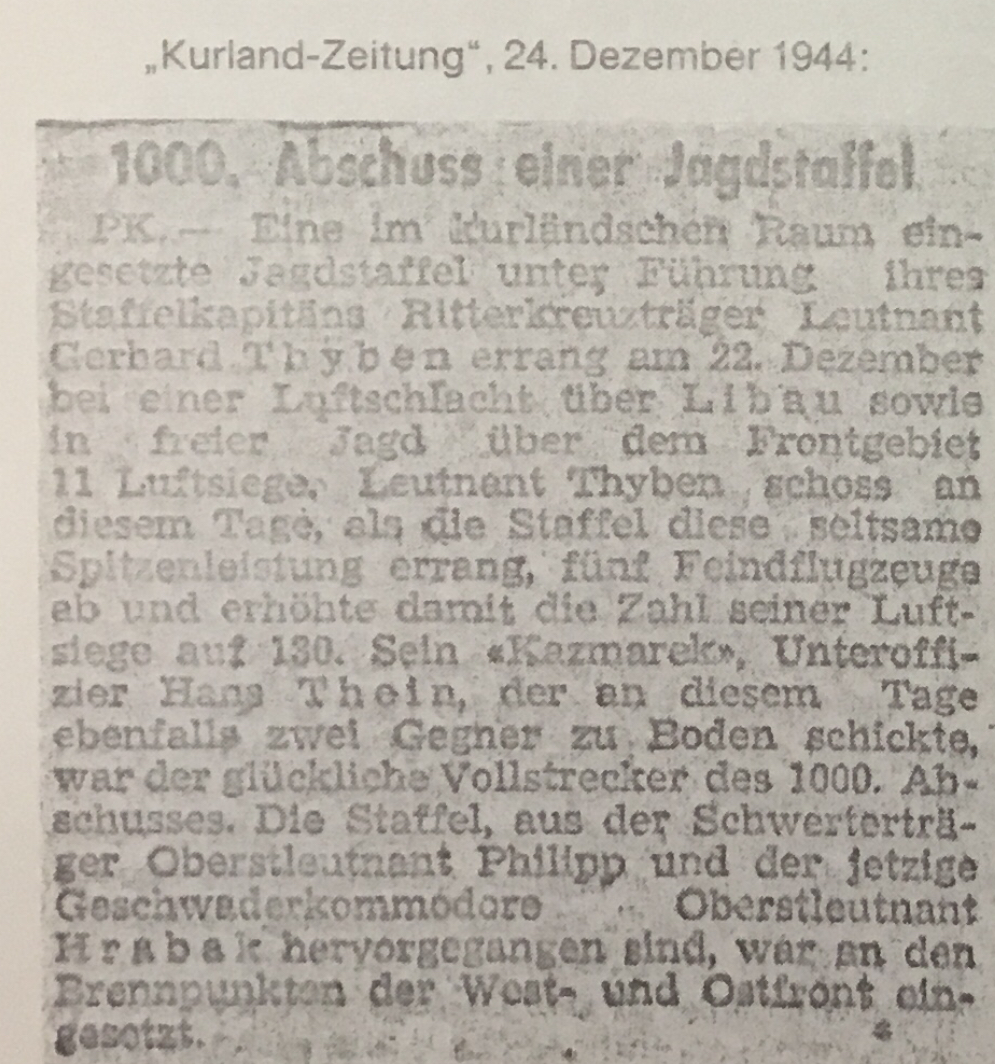
‘Kurland-Zeitung’ report of the 22 December 1944 action over Libau; Thyben returned five victories and his wingman Uffz. Hans Thein the 1000th for the Staffel...
Below;
15 August 1944 in Riga, Kapitän Kittel after another successful mission. (100th victory for 3.Staffel according to some sources..) He would be lost in combat during February 1945, the highest scoring Luftwaffe ace KIA. A piece on Artur Gärtner (left) in Jägerblatt 4/87 cites 14 February 1945 as Kittel's death date (source, Kurowski) as do a number of other sources. The date of Kittel's last clash with Il-2s was most probably 16 February. Gärtner added, "..Als Otto Kittel gefallen war, wurde es für uns dunkel im Kurlandkessel.."
'Happier' times for JG 54. July 1942 in Krasnogvardeisk, Ferntrauung ('distant marriage') of Otto Kittel. This wartime ceremony allowed marriage to be contracted when the fiancé could not take leave. While the soldier signed a document with great pomp and circumstance in front of the Commander of his unit, his fiancée did the same in front of the Bürgemeister in his locality.
Jagdgeschwader 77 is one of the least well –known Luftwaffe fighter units but it was a 'colourful' Geschwader in more ways than one - and not just because of the range of emblems and insignia displayed on the Bf 109s that its pilots flew virtually from first to last. From its rather convoluted early history and diverse origins, JG 77 saw hard-fought action on all fronts (Germany, Norway, the Netherlands, France, Greece, USSR, North Africa, Sicily, Italy, Romania...) and counted among its ranks at one time or another many leading fighter aces (Bär, Gollob, Müncheberg, Ihlefeld, Steinhoff, Reinert...). Unusually its three Gruppen often fought together but in ‘difficult’ theatres, where, heavily out-numbered and with ‘backs to the wall’, it was difficult to build big scores - aside perhaps from Russia during the summer of 1941. Certainly its pilots received fewer awards than any other Jagdgeschwader fighting from first to last – only 27 Ritterkreuze and 7 Oakleaves - and no pilot was decorated twice with high awards while in the unit. As there is very little on JG 77 in English, the unit would make an excellent subject for an Osprey title - but apparently they are not interested. Ask me how I know. One reason the new Casemate ‘Day fighter Aces of the Luftwaffe’ titles include a certain amount of JG 77 material. Otherwise some highlights/extracts of a text I've compiled follow;
On August 25, 1940, I./JG 77 under Hptm. Johannes Janke was ordered to Marquise between Calais and Boulogne - at the height of the Battle of Britain. At Marquise I./JG 77 would be based alongside its former neighbour from the campaign in the West, I.(J)/LG 2, commanded by recent appointee Hptm. Bernhard Mielke. However I./JG 77 lacked the experience acquired by the first Lehrgeschwader Gruppe and their debut in the Battle of Britain would, as a result, prove catastrophic.
below; seen here left Hptm. Johannes Janke, Gkr. I/JG 77 during the Battle of Britain
‘....31 August 1940 was to be a black day for I./JG 77 recently posted to reinforce the Channel front. The Emils had only just moved into Marquise (between Calais and Boulogne-sur-Mer) and were assigned to fly their first sortie – a free hunt – over Kent that morning. The Gruppe was quickly caught up in a wild dogfight with British fighters. Although Lt Herbert Muetherich of 3./JG 77 -a future Knight’s Cross recipient- claimed a Spitfire shot down, 2. Staffel lost their Kapitän, Oblt. Ekkehard Priebe, who was taken captive after being forced to bale out over Ealham. While this in itself was a serious blow, the second sortie of the day, a bomber escort mission, proved to be a total disaster – at 3,000 feet over the Thames estuary a formation of Hurricanes fell on 1. Staffel. Six JG 77 Bf 109s were shot down including the Emil of Fw. Walter Evers, a veteran of the campaign in the West. Among the pilots forced to bale out were the Staffelkapitän, Oblt. Hans-Jurgen Ehrig, and Lt. Jura Petrenko– of Russo-German parentage- who was flying his first combat sortie of the war at the controls of ‘Yellow 4’..”
The Bf 109 E-4, ‘White 13′ of Oblt. Hans-Jurgen Ehrig, Staffelkapitän of 1./JG77, lies crumpled in a field at Gates Farm near Tenterden, Kent on the afternoon of 31st August 1940. Damaged by fighters while over Hornchurch on an escort mission, Ehrig attempted to return to France but, harried by F/Lt. M.L. Robinson of 601 Sqn, he was forced to put his damaged aircraft down and was subsequently taken prisoner. 31 August 1940 was disastrous for JG 77 which, newly introduced to the Battle of Britain, lost five aircraft from 1. Staffel and one from 2. Staffel.
Despite the setbacks endured during the Tunisian campaign in early 1943, the atmosphere could still be cheerful at I./JG 77 as shown in this fine image that featured on the cover of Jägerblatt during 1971;
From left to right: Leutnant Karl Eberle (2./JG 77, 8 victories), Leutnant Armin Köhler (bare-headed future Ritterkreuzträger and Kapitän 2./JG 77), Hauptmann Bär (Kommandeur I./JG 77), Oberleutnant Heinz-Edgar Berres (future Ritterkreuzträger and Kapitän 1./JG 77) and Oberleutnant Ernst Laube (just out of shot, Chef der 3./JG 77, 8 victories).
Cover of Jägerblatt dated June 1957 carrying the news of Heinz Bär's death in a light aircraft accident on 28 April 1957 aged 44 years old. " So muessen wir Abschied nahmen von einem unsere fähigsten Jagdflieger des letzten Krieges'' - We must say farewell to one of our most able fighter pilots of the last war'.
In this image taken (probably) in late 1942 in Sicily, Bär is seen with the lion cub mascot lent by Leipzig Zoo. The emblem under the cockpit of Bär’s I./JG 77 Bf 109 G-2 depicted a lion jumping from the coat of arms of the city of Leipzig, also Bär's Heimatstadt . Part of his Kommandeur 'Winkel Dreieck' is just visible behind Bär's shoulder. The grown animal was returned to its zoo. This is a slightly wider and brighter image than the photo on Page 1277 of the Jagdgeschwader 77 history (Teil 3).
below; 2./JG 77 Bf 109 F-4 'Black 4' assigned to Ofw. Walter Brandt who claimed fourteen victories over Malta and was the leading ace of this campaign..
In his diary, Lt Armin Köhler (3./JG 77) described the first Mediterranean engagement on July 5, 1942;
"Comiso. 15.00 Uhr, erster Einsatz gegen Malta - first sortie to Malta. Life jackets, dinghy and Kanalhosen are handed out - ‘Channel’ trousers for operations over the sea. Mission: escorting Ju 88s, contact at 5,200 meters over our airfield. Participants: I./JG 77 and II./JG 53. Objective: Luqa/Miccaba airfield. A large formation of Bf 109s orbits between 5 and 6.000 meters. “ Da – Land!” Over there, land! The island of Gozo and then further to the south, Malta! Twenty 'Red Indians' are reported at 8,000 meters. The Ju 88s dive on the airfield. The anti-aircraft guns unleash accurate salvos. There's a lot of debris floating around the sky. I am constantly swivelling my neck to watch the sky above my head, especially in the direction of the sun. I'm waiting for the Spitfires to arrive at any minute. And then they are there! Here they come, diving down on us. I manage to briefly get on the tail of one of them but he spots me just as I am about to squeeze the firing button. He manages to take evasive action – eine Abschwung – a Split-S. All of our machines return to base. [...] 18:30 hours, our next sortie. Ju 88s attack Ta Venezia. Several machines return with hits. There are the Spitfires, although there are some Hurricanes and P-40s. We are not used to flying at these sorts of altitudes and it’s having an impact on the machines – my supercharger pressure regulator is faulty. The engines are suffering in the heat…”
Below; Pilots of 8./JG 77, Mizil, Romania, spring 1944. The ace Uffz. Karl-Heinz ‘Pummel' Böttner is in the middle (fourth from the right). Second right is Uffz. Jürgen Kilian.
below; Erich Sommavilla flew with III./JG 77 in Mizil during July 1944
July 22, 1944 saw a repeat of the attack of the week before with approximately four hundred and fifty bombers launched. Four B-24s and one HSS were claimed by III./JG 77 as well as two P-38s. ‘Pummel' Böttner returned his 16th victory – another Liberator- and 8./JG 77 suffered only minor material losses. That day, at least nine B-24s were lost to the combined actions of the fighter force and the Flak arm. It was during this period that 8./JG 77 was taken over by Lt Wilhelm Mockel. Born in 1918 Mockel had spent a number of years as an instructor in training schools. Sent in mid-1944 to I./JG 53 operating in Romania, he was then posted to III./JG 77, a Gruppe short on officers. Mockel may have volunteered for combat but he had no experience of it - unlike the survivors of the African and Italian campaigns, aces such as Hackler or Böttner. July 28, 1944 saw the 15th USAF mount its fourteenth attack on the Romanian oilfields; some 350 bombers were launched, fully intending in this last phase of the assault to deal the final blow to the defense of the oilfields and refineries. Some twenty four-engine bombers were lost, two of which were attributed to Uffz Böttner. But in the course of the fighting 8./JG 77 lost two pilots, both probably reinforcements having arrived in Romania at the beginning of 1944.
On July 31, three hundred and fifty bombers were split between Bucharest and Ploesti. 7./JG 77 was decimated and 8./JG 77 lost three aircraft and one pilot killed. The Kapitän Mockel was wounded and temporarily put out of action (his post would then probably have been taken over by Hackler). Poorly guided from the ground, the Bf 109s were directed towards the escort which was present in much greater numbers, resulting in substantial losses. On August 6, an internal note from the Luftwaffenmission in Romania stated brutally; Romanian airspace can no longer be defended by aircraft because 1°) the enemy is far superior in number; 2°) the German and Romanian fighter pilots no longer have enough experience. Indeed, apart from a few 'old hands', the ranks of III./JG 77 were largely made up of novices. Attacks could only be mounted when certain of having at least a slight tactical advantage. III./JG 77 had thus become no more than an auxiliary force, the defenders relying mainly on the Flak as well as on the units producing smoke to mask the objectives.
G-6 Gustav 'Black 2' flown by Uffz. Jürgen Kilian 8./JG 77
Below;a recent ebay find - a Bf 109 K-4 of III./JG 77 - this is a 12. Staffel machine, 'Blue 3' assigned to Lt. Günther Beine. Beine was posted to III./JG 77 during September 1944. The 'red heart' badge is visible on the cowl..
III./JG 77 received 75 brand new Bf 109 K-4's in November 1944 while based at Neuruppin and a number of images of these machines are known. 'Blue 3' has featured in a recent issue of 'Luftwaffe in Focus' magazine. Note this is not the same 12./JG 77 ‘blue 3’ K-4 featured on page 87 of the Luftwaffe Gallery JG 77 ‘special album’.
" JG 77 Fighting on every Front " is a Luftwaffe Gallery 'Special album' via Erik Mombeeck and still available on his site.
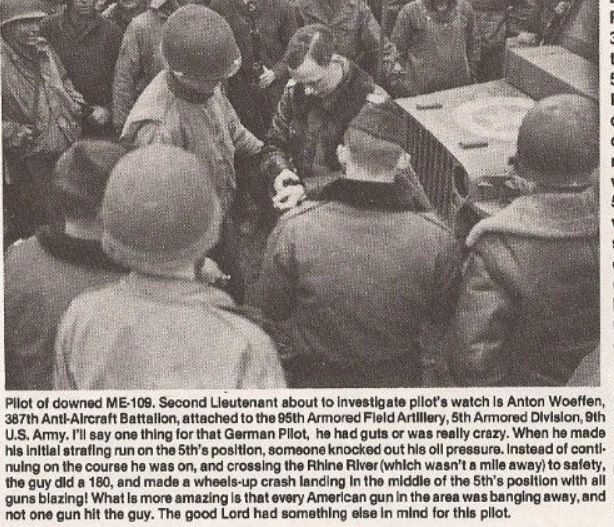
Anton Wöffen's 'yellow 24' a 6./ JG 27 Bf 109 G-10 WNr. 490655 after being shot down on March 11, 1945 at Xanten, on the western bank of the river Rhine close to the Dutch border between Nijmegen and Duisberg. The pilot was taken captive, below.
Above; US signals photo
Wöffen’s memoir ‘Ich war kein Jagdflieger As - Erinnerungen eines unbekannten Jagdfliegers’ ( '..recollections of an unknown fighter pilot' ) was ‘serialised’ in Jägerblatt during 1983 and later translated and published in Finland.
"..it is nearly forty years since I last flew a Bf 109 Gustav ..March 11, 1945. That clear sunny Sunday morning I was tasked as Staffelführer with leading a Schwarm of four 6./JG 27 Bf 109s up from Hopsten near Rheine on a recce sortie in the sector Wesel-Rheinberg-Duisberg where German troops still held a bridgehead on the western bank of the Rhine. There were signs that the Americans were preparing an all-out assault and I had to ascertain more - a somewhat hopeless task. But then at that time so much appeared to be hopeless and pointless. Should we encounter artillery ranging and spotting machines in the air then we were authorised to shoot them down. Such machines were making life very difficult for our troops on the ground. Once airborne we flew at tree-top height in the direction of the river Rhine - skipping over trees, streetlights and houses we had to fly very carefully to avoid contact with obstacles. This was especially the case for those of my comrades flying behind the Verbandsführer (formation leader). Even for myself it was not easy to navigate at such low altitudes. At 500 km/h - the sort of speeds we could attain with full armament in normal flight - you could not see much at all. Moments after arriving over Wesel I spotted an 'Auster' climbing at about 100 meters altitude directly ahead of me. What then followed, happened very quickly.. I flicked up the armament safety catch on the control column for the 2cm cannon and the two cowl MG 131s and pulling up under the enemy machine gave the Auster a burst from all three guns. Suddenly I felt a blow in the engine. The prop continued to spin - but at a much reduced rate of revolutions. Smoke started to seep into the cockpit. I continued to climb hoping to reach a 'safe' altitude to bail out but my speed was decreasing far too quickly. I could see tracers from all sides rising towards me and immediately pushed the nose down. I had arrived directly over the American lines. I could see fire coming from an anti-aircraft battery and, taking aim in so far as I could, gave the Amis on the ground a burst of fire. By now I was approaching the ground and, although the smoke was hampering my efforts, prepared for a crash-landing..I saw high tension wires flitting past the cockpit ..above my head. I pulled back hard on the stick. The machine hit the ground with an almighty crash and bumping and jolting slid along for some distance. Suddenly everything went quiet. I opened the hood and climbed out. I had made a perfect belly landing and had escaped completely unscathed. I had been lucky. Just thirty meters in front of me was a railway embankment which I could just as easily have plowed into. Running towards me from all directions were American soldiers. Standing on the port wing I leaned back into the cockpit and as I started to tear up my map I heard loud shouting behind me..." Hands up!"