Showing posts with label Air War Italy. Show all posts

Tuesday, 28 April 2026

Fw. Albert Ullrich - an ace in 6./JG 77 - archive photo scan #51


Albert Ullrich was born 24 April 1920 in Sandweier (Baden-Württemberg). He enlisted in the Luftwaffe in 1941 and was in various flying schools (Marienbad, Karlsbad, Danzig and Magdeburg) before joining the EJG Süd (Orange). In August 1943 he was posted to 6./JG 77 then based in Italy. The Italian 'change-of-sides' took place shortly thereafter and II./JG 77 took on charge a full complement of Macchi Mc 205 fighters to make up the slow deliveries of Bf 109s that had been briefly interrupted. The Macchi 205 Veltro (or 'Maggie' as Ullrich referred to it in his correspondence..) was a 'more difficult' machine to fly ('schwieriger zu fliegen') and there were several losses - certain manoeuvres had to be flown with more speed and altitude than was usual in the Bf 109.  The 'narrow' cockpit meant that pilots could not fly with German parachute packs and had to use Italian chutes - after one bad incident it was discovered that these had been 'sabotaged' after being 'treated' with acid...

Fw. Albert Ullrich (6./JG 77) in the cockpit of a Macchi 205. Ullrich achieved his first victory  on 11 November 1943 - a B-24.


In his correspondence (dated 1991, letter #7) he described his first victory, achieved at the controls of a Macchi 205, a B-24 downed in PQ 75673 (south of Turin) on 11 November 1943;

"..a Schwarm was scrambled ('Alarmstart') under Lt. Ahlers. We were not in radio contact ('Funkverbindung') as the German sets could not be fitted in the Macchis. When I spotted the enemy aircraft I signalled this to Ahlers with hand gestures - which he appeared not to have understood. I dropped out of our formation and closed on the Viermot alone, setting one engine on fire with my bursts. On my second - and final - pass, the crew bailed out of their machine. Some six or seven men hanging under their chutes. Their Viermot went down in the vicinity of Cuneo. I do not know if the other Staffeln achieved any victories with the "Maggie" but this was the only enemy machine shot down by my 6. Staffel in the 205 .."

American troops entered the Italian capital on 4 June 1944. The next afternoon six 'waves' of B-24s and medium bombers attacked Ferrara, Forlì, and Rimini. The Bf 109s of II./JG 77 engaged them in combat from their airfield in Ferrara and claimed victories. Ullrich was airborne from Poggio-Renatico with his 6./JG 77. He encountered Liberators with fighter escort and downed his third B-24. He landed at 13:40. On 13 June  6./JG 77 was up from Poggio at around 08:20 to intercept more formations of escorted B-24s. Fw. Ullrich claimed his fourth victory against a B-24. His Staffel landed at Lavariano. By evening, the repaired runway at Ferrara allowed the two Staffeln - grounded since the bombing of 5 June - to rejoin 6. Staffel at Poggio Renatico. However, as early as the 16th, fearing a partisan attack, the Bf 109s temporarily left Poggio for Lavariano. This field was better situated for intercepting raids toward Austria. According to his own Flugbuch Ullrich downed his 5th B-24 on 22 June.


An image from Ullrich's album of Staffel comrade Lt. Franz Nägele (6./JG 77), a veteran of Russia and North Africa. Nägele claimed around 17 victories but was killed in combat on 9 June 44 at the controls of his G-6 'yellow 3', possibly this machine displaying the inscription 'Betty'.


On 11 July, during a “free hunt” JG 77 were engaged by Spitfires escorting a force of Marauders heading for a fuel depot in Piacenza. Uffz Richard Kurz (4./JG 77) was wounded at Isola Dovarese. Hampered by a drop tank he was unable to jettison, Ullrich was easy prey for the enemy fighters and had to bail out of his burning machine. Such an ordeal should have earned him two days’ rest, but given the circumstances - his Staffelkapitän Deicke was out of action having been wounded in the foot - Ullrich participated in the next day’s mission. At 09:00 the Bf 109s took off to engage a formation of B-25 Mitchells. Their defensive fire struck Fw Ullrich’s canopy. Wounded in the face and half-blinded, the Feldwebel made a belly landing near Ferrara. Sent to the military hospital, he was sidelined until September. 

A poor quality but rare image from Albert Ullrich's album, presumably showing the ace -given his preference for flying 'yellow 6' - at readiness and studying a map prior to a possible sortie. The engine cowl and wings are still covered ..


below left, long-time Staffelkapitän of 6./JG 77 Hptm. Joachim Deicke 


Ullrich shifted to the Eastern Front with his Staffel early in 1945. By now Staffelkapitän Deicke had been appointed Kommandeur of I./JG 77 and Ullrich was a seasoned ace whose experience was indispensable in 6./JG 77. He shot down his first Soviet fighter, an La-5, on 23 March 1945. He downed two Il-2s on 29 March. Ullrich left 6./JG 77 in April 1945 to be trained on the Me 262 at Lechfeld. He survived a transfer flight to Prague Rusin at the controls of a Me 262 and with a group of comrades 'absconded' in a truck as the Russians approached the city. He surrendered to American forces and was released by the French in 1947.  J. Matthews credits him with 11 'claims', six of these over Italy and five in the 'East' during the last two months of the war.

Ullrich's sorties in the East - he transferred a Bf 109 G coded (presumably) 'yellow 14' from Liegnitz to Bereschau on the afternoon of 27 January 1945 and flew this machine subsequently for the majority of his Feindflüge during February 1945. During March 1945 he flew 'yellow 1'


Ullrich logbook extract covering his last sorties on the Eastern Front through March-April 1945 - he notes a 12th Abschuss ('Abs') flying out of Eckersdorf on 3 April. Figures to the left indicate that his regular machine was '6'. Click on the image to access a larger slightly more legible version...


Saturday, 26 July 2025

Uffz. Hans-Ludwig Schwing, 6./JG 77


The son of a teacher, Hans Schwing was born on 5 Sep 1921 in Friedewald, a municipality in the Hersfeld-Rotenburg district near Bad Hersfeld. He had a younger brother and sister. He learnt to fly gliders in the HJ. He enlisted in the Luftwaffe in 1940. In April 41 he started his ab initio training at Klagenfurt and by November 1942 he was training with JFS 7 in Nancy, France. His unit became 2./JG 107 in January 1943. He went to 1./EJG Süd (in Orange, France) in mid-1943 before being posted to 6./JG 77 in July 1943, to undergo training on the Macchi 205 Veltro fighter - Uffz. Schwing was apparently an Italian speaker. However he was injured in a take-off accident attempting to get airborne with other machines on 20 December 1943 - damages were assessed at 90%. This would be one of the last reported losses of a Macchi 205 in II./JG 77 as 5. and 6. Staffel finally received their Bf 109s barely one week later. Schwing recovered from his injuries and returned to his Staffel but was (most likely) shot down and killed in combat with Spitfires on 18 March 1944 in the vicinity of Cassino. (reported missing when he failed to return from an afternoon sortie over the Nettuno bridgehead/Cassino area) His crashed Bf 109 'yellow 7' was only discovered several days later. He was buried at Fiuggi close to the site of his crash.  His logbook returned to the family lists 739 flights including over 500 at Klagenfurt. Also returned with his effects was a 'blood-encrusted' wallet which he was carrying when he was shot down. This detail was noted in correspondence in 1989 received from his sister, Marga. Schwing's younger brother was also KIA with his Heer unit -  killed in the West in January 1945 (Alsace) when his vehicle hit a mine..


Also on this blog

JG 77 in Italy - September, October 1943


Tuesday, 6 May 2025

new Luftwaffe books (3), DFS 230 combat glider - Eagles of the Luftwaffe 3 (Mortons)


" When it came to daring raids, Germany’s airborne troops had a secret weapon during the Second World War: the DFS 230 combat and assault glider. Successful German attacks at Eben Emael, Corinth, Crete and the raid at Gran Sasso are synonymous with the type – which could carry nine fully-equipped troops, dive towards its target at an angle of 80 degrees and land within 20m of it...".


Arriving on the shelves in WH Smiths in the UK now, the latest title in Mortons' "Eagles of the Luftwaffe" series. A comprehensive history of the DFS 230 and its pilots in action, including Eben Emael, Crete and special ops in North Africa, France, Italy and on the Eastern Front. 

Although it was flown by some of the Third Reich's best aviators, there are few accounts in English that have told the story of the DFS 230 or related something of what it was to fly, fight and die in the first combat glider put into service by the Luftwaffe - until now. The text describes the development of gliding in pre-war Germany and the genesis of the DFS 230 and looks at some of the type's major combat deployments, with chapters devoted to Eben Emael, Corinth, Crete and less well-known theatres such as North Africa. The DFS 230's role in the freeing of Mussolini (Gran Sasso) and the hunt for Tito (Drvar) is also covered in detail, as is its deployment against the French resistance in southern France. The last chapter details DFS 230 missions into Budapest, Breslau and Berlin during April 1945 - one way flights to Hell. The text features newly translated first person accounts and many 'new' photos from private collections. Note that the book is considerably larger than indicated in amazon's blurb - page count is 183 and format size is B5 (19cm x 25cm).

More, including free UK postage from the publisher here

Tuesday, 10 October 2023

JG 77 in Italy, September/October 1943 and the Macchi C 205 in JG 77 service - were there any aces ?


On 3 September 1943, the soldiers of the British XIII Corps mounted amphibious landings on the Italian 'boot' and 'invaded' the Italian mainland. Calabria was only lightly defended and Reggio airfield was quickly captured. This first landing in continental Europe took place in a country seemingly still allied with the Reich. But, since Mussolini's removal from power the new Italian government had been secretly negotiating with the Allies to change sides. The German High Command was not fooled by the friendly protestations of Marshal Badoglio, the new strongman of the Italian regime and were preparing to take control of the country in the event of an Italian U-turn. The location where the Duce was being held had already been identified and plans were being made for his release. This occurred on 12 September - Skorzeny's Gran Sasso 'coup de main'. On this same afternoon of 3 September I./JG 77 and IV./JG 3 intercepted an unescorted formation of B-24s over the sea near the Tremiti islands. Eight bombers were claimed by I./JG 77 (only three were confirmed). Eight B-24s were claimed by JG 3. Nine Liberators from the 98th BG were reported lost over Italy, most likely victims of these clashes.

On 6 September, Uffz Willi Wiemer's 'yellow 4' ( 3./ JG 77) was shot down by a P-38 of the 14th FG escorting Liberators. 7./JG 77 (in Sardinia) also suffered the loss of Lt. Hans Rund, whose G-6 'white 7' exploded in flight. Ofw Eduard Isken who had carried out a test flight in this machine shortly beforehand suspected sabotage. On the 7th, I/JG 77 suffered two serious injuries in a battle with P-38s escorting B-17s. Oblt Gerhard Strasen, Staffelkapitän of 3./JG 77 was shot down in 'yellow 10'. He reported;

"..Our unit was scattered around Foggia and it was from there that we were airborne to intercept the Viermots and their P-38 escorts. On that day, I was acting Kommandeur as Burkhardt was unavailable. In combat with P-38s north of Naples, a bullet went through my leg and I had to parachute out. On the ground, an Army Feldwebel loaded me into a vehicle and took me to a hospital. I was then transferred by medical train to Stuttgart where an amputation was planned. I was categorically opposed to this and was able to save my leg. I was granted a long period of convalescence, during which I got married. I rejoined JG 77 around May 1944 when the unit was fighting in northern Italy..."

In addition to Strasen, another wounded pilot from 3./JG 77 had to bail out, Lt Werner Behrendt. To replace Strasen, Lt Ernst-Wilhelm Reinert left II./JG 77 and became Staffelführer of 3./JG 77.

On 8 September, I./JG 77 and IV./JG 3 carried out their usual missions (reconnaissance and Alarmstart 'scrambles'). In the late afternoon a large fleet was spotted near Naples. But  at 5.00 pm, the Italian surrender was announced by the allied radio, surprising both Italians and to a lesser extent, the Germans. The Italian royal family, still near Rome, had to flee. Many Italian officers did not know what to choose: loyalty to their government or to the German ally. Generalfeldmarschall Albert Kesselring quickly gave the order to neutralise the former ally - Unternehmen 'Achse'. Everywhere, German soldiers disarmed Italian units, which often fell apart and huge amounts of matériel was captured. An Italian naval battlegroup was already at sea - according to some to counter the Allied landings then about to take place at Salerno - but with the news of the 'volte-face', now attempting to make for Malta to surrender to the British. Attacked in the waters of the Gulf of Asinara by 'Fritz X' guided missile carrying Do 217s of KG 100 on 9 September, the Roma, one of the most powerful warships then at sea in the Mediterranean, was struck, split in two and sunk. More than 1,250 men perished.

The US Fifth Army landed at Salerno on 9 September in another huge amphibious operation. I./JG 77 and IV./JG 3 toting Werfer rocket grenade launchers flew strafing sorties over the Salerno landing zones - Fw. Horst Schlick of 1./JG 77 was hit by flak and managed to bail out, coming down unharmed near a main road into Naples. Elsewhere most of III./JG 77 flew out of Sardinia and landed on the Corsican airfield of Ghisonaccia. The Germans immediately disarmed the Italian troops present on this air base and took possession of weapons and equipment. Three days later, the men of "Ubben’s travelling circus" transferred to Casabianda still in Corsica. From there, the Bf 109s flew escort sorties for the ships and transport aircraft (Me 323 and Ju 52 Transporter) evacuating the German troops to the Italian mainland.

On 25 September the G-6 Gustavs of III./JG 77 were in Pise-Metato while using the airfield of Fiano to protect the industrial sector of Bologna. Uffz Karl-Heinz Böttner flew little during this period because he was sent to the Erholungsheim (relaxation and care centre) in Bad Wiessee following malaria attacks. Also there at the same time was his Kapitän Emil Omert who was recuperating following his injury sustained in Sicily.

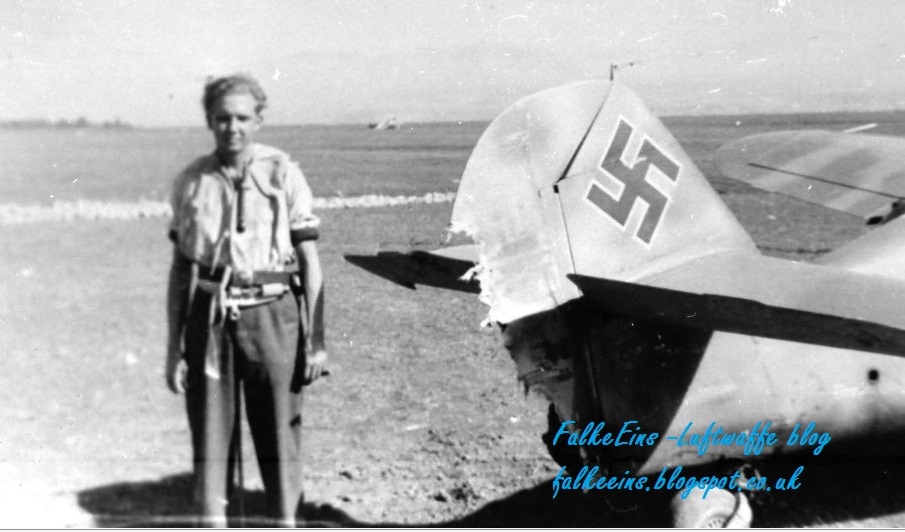
On 20 October, III./JG 77 recorded a total of thirty-two Bf 109 G-6 fighters on strength. Returning to Metato, Uffz Böttner took part in various interceptions of American bombers pounding German positions in northern Italy. On 23 October, around Rome, the rudder of his G-6 was seriously damaged by defensive fire from B-17 Fortresses, but the young pilot was able to return to his aerodrome without too much trouble. (photo below) III./JG 77 was sent to Romania a short while later, I./JG 4 returning from this theatre to take their place in Italy.

The detachment of III./JG 77 in Pisa was also implicated by the Italian 'change-of-sides' on 8 September. Lt. Wolfgang Ernst, Stk of 9./JG 77 remembered;

" I was with a few pilots at Pisa airfield at the time. Our Schwarm was carrying out combined manoeuvres with the Italian navy. We flew over the ships all day long, and we were often invited dine in the evening in full dress. The food was excellent and the wine plentiful. It was all very pleasant. On the morning of the 9th, following the Italian U-turn, I decided to join the Gruppe now in Corsica. We took off and flew over the Italian fleet as it set sail to surrender to the Allies. We strafed some ships, which saddened us: only the day before we had been friends. Later we shot down a small Italian liaison plane over the mainland -flying due south, it was deserting towards the territory held by the Anglo-Saxons..."

Meanwhile II./JG 77 was put to work to disarm their former allies. A transfer to northern Italy had been planned since mid-August.  Overtaken by events the Gruppe had already given up its Gustavs.  Small groups of ground personnel were sent all over Italy to take control of the airfields; as for the pilots, they ferried the captured machines to northern Italy. It was at this point that the decision was taken to re-equip II./JG 77 with some of the captured Italian Macchi Veltro fighters. 


Technicians from the Gruppe were sent to Varese to study the Macchi Veltro. Equipped with a Daimler Benz DB 605 engine, this aircraft seemed adaptable to German standards as mechanic Karl Holland reported;

"..The engines, Daimler-Benz 601s built under licence, posed no major problems. The work of the mechanics was even easier because the amount of room reserved for the engine, auxiliary fittings, oil and coolant circuits was larger than on the Bf 109. As far as armament was concerned, the usual MGs were used, as well as heavy machine guns of a calibre close to 12 mm. No cannon. The pilots found the Macchis lighter but slower than the Bf 109s..."

The C.205 was used briefly by II./JG 77 from late September 1943 to the end of the year before the Gruppe reverted back to the Bf 109 G-6. The war diary of the Stab/JG 77 commented on 21.Nov. 1943 ;

" The machine is fast, and flies well, but has a tendency to lose speed in a sharp curve, and it is easy to get into a spin. Another aspect is the Italian radio. Despite transmitting clearly, the pilots can barely understand what is being said. Finally, refueling and reloading ammunition is very complicated, so restoring operational readiness takes a long time..."

The Kommodore's memories are more categoric; 

 "My JG 77 rarely used captured aircraft, apart from the Mc-205 flown by II./JG 77. It was a vicious machine that easily got into a spin which could be very difficult to get out of. It was used in combat and there were a few victories. (Maj. Johannes Steinhoff, Geschwaderstab JG 77).

Were there any German Macchi aces ? A reply to this question (answer/research) by Georg Morrison; 

" You may be thinking of Oblt. Joachim Deicke, who led the 6./JG 77. His aircraft, "gelbe 1" was a Macchi C.205, WNr.92212. BUT, none of his 18 claims (over 661 missions) were made using a Macchi. Three pilots had died in crashes, usually "pilot error." Uffz. Rudolf Funke was shot down on 1 December 1943 by a P-38 (C.205 "gelbe 4", WNr.92218), but was safe. Another C.205 was damaged in this combat. The last loss of 1943 was on Christmas Eve, engine fire on WNr.92224.

 Another potential candidate for JG 77 ace on the Macchi could have been Lt. Franz Hrdlicka, who led 5./JG 77. He made his 37th claim on 9.November 1943, which was likely in a C.205 - he posed for a photo, seated on the cockpit edge of a dark-finished example..". 

Recommended reading ;

The Luftwaffe in Italy 1943-45 published by Lela Presse, 98 page A-4 softback, some 200 photos/artworks. Only 13 euros. Available from the avions-bateaux.com website. Eight-page PDF extract here


Thursday, 2 February 2023

Oblt. Bruno Kolthoff, Stab I./JG 77


Oblt. Bruno Kolthoff was a pilot in I./JG 77 born on Christmas day 1918 in the town of Weener. In 1939 he was serving in a Flak unit before joining the flying personnel. Trained at Brün (Brno) and Paris (Villacoublay?). His first victory was a Spitfire, claimed on 14 October 1942 flying from Comiso with 1./JG 77 over Malta according to a 'Herz As' claims list. Freytag and Brandt also claimed on that day. By the end of the month I./JG 77 had shifted to Tunisia and at some stage during November 1942 Kolthoff was posted to the Stab I./JG 77 before joining 3./JG 77. Prior to this he had been shot down on November 2, the first day of the British 'Supercharge' offensive (El Alamein) but was able to bail out. 

2 November 1942: Bf 109 G-2/Trop (W.Nr. 10 480) of 1./JG 77 due to enemy fire south of El Daba

In late 1943 he was sometime acting Staffelführer of 2./JG 77 and took over from Oblt Köhler at the end of the year. Now with the rank of Oblt. and serving in the Gruppenstab his next claim - a B-24 at 4,200 metres - was filed on 2 April 1944 over Italy during the interception of a 15th AF raid on Steyr (Austria). On 25 June 1944 he shot down a Spitfire into the sea off Rimini, claiming his second over Italy. After reorganization during early October 1944, he was named Adjutant of I./JG 77 having claimed a P-47 north of Liege on 11 September and a second P-47 on September 28 according to a 'Herz As' claims list. He was shot down just eight days later on October 6, 1944. Airborne in the early afternoon from Babenhausen for a fighter sweep over the Volkel area, Kolthoff was intercepted and shot down by Spitfires near Zand (close to Arnhem) at the controls of his Bf 109 G-14 ('black chevron'  WNr. 460429). The 25-year old did not survive and rests today at Ysselsteyn cemetery in Limburg; grave AD-5-125. He had been officially credited with four victories.

Below;  Oblt. Bruno Kolthoff, on a G-6 Trop possibly in Italy during 1944, possibly a 2. Staffel machine 'black 8'. Note the heavy overspray ahead of the aircraft Kennung where a previous emblem might have appeared....


Also on  this blog;

Wednesday, 31 August 2022

new from Lela Presse - The Luftwaffe in Italy 1943-45


Following on from their recent 'Luftwaffe in Tunisia' (Jean-Louis Roba) and 'Last victory in the Mediterranean' ( Jean-Louis Roba with Chris Shores) Lela Presse have just published their latest 'BATAILLES AÉRIENNES' monograph, 'The Luftwaffe in Italy 1943-45' by Jean-Louis Roba.  Coverage of bomber, fighter, transport and recce units is based on archival documents including POW interrogation reports and features plenty of first-person accounts. French text. Still well worth acquiring at only 13 euros - 96 pages, 150+ photos, profile artworks  - but easy enough to read with, for example, the google translate app on your smartphone..


IV- Transport units 

 In the course of the resupply operations flown into the Tunisian pocket, the German Transportgeschwader (the designation TG had replaced the former KGzbV in April) had suffered terribly. Above all else, there was a shortage of escorts for the Ju 52 and Me 323 transports. On April 22, the ‘infamous’ disaster at Cap Bon took place - fourteen TG 5 Me 323 six-engine behemoths were shot down with their passengers and cargoes. - TG 5 continued to be based on its aerodrome at Pomigliano to supply the islands. One Me 323 pilot, Oblt. Ernst Peter*, recalled: 

 "..After the operations in Tunisia, our unit flew almost daily from Naples-Pomigliano to Sardinia, with the handful of aircraft that remained and those that could be brought to us from Leipheim. For a while we were able to enjoy life. From time to time we would see, far above us, the condensation trails of an enemy reconnaissance plane that had come to watch the area or, sometimes, tight formations of heavily laden bombers arriving from Africa to sow death near the Alps. We could continue on our way because these formations were not at the same altitude as we were and any potential fighter escorts they might have did not care about the transport planes flying at much lower altitudes. It was a nice feeling to be able to fly alone, not having to rely on a fighter escort and only having to rely on yourself. We did not have to endure the attacks on our runways like Cagliari/Elmas, Alghero, Venfiorita/Olbia, Decimomannu, Villacidro or Milis, so it was a good time and, after the costly and hard operations in Africa, almost a relief even though we often had to fly for three hours over a sea stretching as far as the eye could see. We mainly refuelled the 90. (leichte) Division with fuel, Flak equipment, vehicles, ammunition, etc..."

* "..schleppte und flog Giganten"

The strains within the German command

The Bf 109s of the 'Pik As', based in Sicily, were to bear the brunt of the powerful air attacks on the island. On 18 May, suitably escorted four-engine bombers dropped their ordnance on Pantelleria and Trapani. Eight P-38s were claimed but no bombers - a testament to the quality of the escort. On the 19th, the USAAF targeted Trapani and, although six Lightnings and two Curtiss were claimed, again no bombers fell victim to the 'Pik As'. That day, 7./JG 53 lost two of its pilots. On the 20th, Spitbombers from Malta bombed Comiso. And so on... These almost daily attacks gradually wore down the Sicilian defence units. 

 JG 77's first major combat since the evacuation from Africa, however, did not take place until June 18, in the Sardinian sector of Olbia. In support of local Italian units, III./JG 77 faced a large formation of B-25s escorted by P-38s of the 27th, 96th and 318th FS. Two P-38s, three B-25s and a Boston were claimed by the three Staffeln, who seem to have lost no aircraft. 

 The Allies had barely paused after the capture of Tunisia. On the night of 10/11 June, they began their invasion of Europe by landing at Pantelleria. On 12 June, after the small Italian island of Pantelleria, the island of Lampedusa surrendered almost without a fight. 

 Confronted with these rapid Allied actions it was decided to completely overhaul the German command in the Mediterranean;
 -all Wehrmacht units in the south came under the control of Marshal Albert Kesselring hastily appointed OBS Süd (Oberbefehlshaber Süd); 
-Luftflotte 2 was taken over by the energetic Field Marshal Wolfram von Richthofen, cousin of the famous Great War pilot;
 -the bomber units dependent on II. Fliegerkorps were regrouped under the Fernkampfführer Mittelmeer, Oberst Dietrich Peltz. Peltz (who in 1941 had led the dive-bombing school at Foggia) was to attempt to instil the new tactics that had been honed in the West against the UK and to develop various measures such as attacks at low altitude or the movement of units to more distant airfields, in order to reduce the risk of destruction by Allied bombers.

 However, given the large number of units assembled in a restricted space that had now become a front line, the Germans faced serious logistical problems, as Karl Gundelach pointed out; 

 "…In Sicily, it was necessary to find new airfields for the fighter and the Schlacht units. This was difficult because very often all that was available was just farmland. Göring received many complaints from his Kommandeure about the slowness of the Italians to find solutions (...) It was also necessary to reinforce the Flak arm; especially the batteries defending the vital Straits of Messina. (...) It was planned to establish barrage balloon booms here, but the Italians preferred to keep them for their own ports. (…).Aerodromes in Sardinia had to established and air transport to the island stepped up. The Allied air forces then sent their long-range aircraft to disrupt this air traffic, which led to losses. (...) The greatest difficulties were in Calabria, where there was a lack of aerodromes for fighters. The best equipped were in Apulia but they were too far away for the Tagjäger. (...) Following the heavy losses of the Flak in Tunisia and the equipment which had been abandoned there, there was a lack of batteries. Most of them were to be assigned to Sicily but Sardinia needed 15% of the manpower that had been gathered. It was therefore necessary to bring in anti-aircraft units from northern Italy at the risk of undermining the protection of the industrial towns working for the Axis war effort… " 

 These problems undermined local command in the face of a numerically superior enemy. Added to this was Göring's mistrust of the Jafü Sizilien, General Theo Osterkamp, who had been installed in this position by OBS Kesselring. Osterkamp had already been removed from the command of a Geschwader by Göring as early as 1940, the Reichsmarshal considering him too old to exercise such responsibilities.

On June 25, a large formation of B-17s passed north of Sicily to raid Naples. II. and III./JG 53 as well as elements of JG 77 were guided towards the bombers from the ground. II./JG 53 missed its interception while JG 77 could only put up a very brief fight due to lack of fuel. Two B-17s were claimed by two aces of III./JG 53 ( 55th victory for Oblt. Schiess and the 68th for Oblt. Roehrig) but Uffz. Alfred Kowaleswki (9./JG 53) was shot down over the Straits. Two other Fortresses were also downed. Enraged by this 'incompetence', Göring demanded that Inspector of Fighters Galland ensure that one pilot from each Gruppe be brought before a court martial and tried for 'cowardice before the enemy' (Feigheit vor dem Feind)....

Web site of publisher Lela Presse is here

Thursday, 27 January 2022

more SG 4 Fw 190s in Italy


repost from FB of ECPA-D images via Denys Boudard. Pilot identified as Walter Otto Luben of SG 4 (killed in Russia 05/08/1944.) seen at Guidonia Montecelio airfield, near Rome, October 1943.(caption via Nicolas Férard)


Also on this blog;

PK Berichter photos of SG 2 Stukas here 

"Fonds allemand" and the ECPA-D here 

Thursday, 9 April 2020

Studying the Luftwaffe through prisoner interrogation reports (1)


A good friend of  ' FalkeEins - the Luftwaffe blog ' has kindly transferred many archival POW reports which make fascinating reading. No apologies for taking my cue from the equally fascinating TOCH thread "Studying the Luftwaffe through POW interrogation reports "....

The 'problem' with POW interrogation reports is obviously one of 'reliability' - note the 'Preamble ' to the report on page 1 below ;  " all three prisoners arrived with elaborate cock-and-bull stories ". On page 2 there are dubious statements;  referring to the formation of I./JG 4 the report notes that "..it is of interest that all these 'old hands' from JG 77 had at some  time or other served sentences for some military offence" ..or even  " Hptm Hahn had over 900 operational flights to his credit.."

The report featured here chiefly concerns the interrogation of Bf 109 pilots from I./JG 4. During early 1944, I./JG 4 was based in Littorio, southern Italy and operated principally over Monte Cassino and Nettuno during this period. Clashes with Allied fighters were frequent and deadly. During the month I./JG 4 lost seven pilots KIA including Kommandeur Hahn on January 22. Although he managed to bail out he struck the airframe and was unable to deploy his parachute. Hahn was replaced by Hptm. Walter Hoeckner and the unit moved to Frabrica di Roma. February 1944 was no better. Twenty victory claims - including three P-51s on February 8 - for seven pilots KIA and two taken prisoner.

On February 6  I./JG 4 carried out at least two escort missions from Fabrica for SG 4 Fw 190s in the Nettuno region. The first started at 09:20 hours. After completing the escort, the mission turned into a ‘free hunt’ which, it appears, was without incident. The aircraft landed at 10:15 hours. The second mission was, on the contrary, far more eventful. The formation (comprising of at least two Schwärme from 2. and 3. Staffeln) took off at 11:05 hours under the leadership of Hptm. Manfred Spenner. Uffz. Edmund Beuth (decorated with the Iron Cross 1st Class) led the Schwarm from 2. Staffel in his 'black 7'. After escorting the Fw 190s to their objective in the Nettuno area, Hptm. Spenner led his men on a strafing attack in the area of the bay. Shortly afterwards the pilots encountered a ‘Dragonfly’ and Spenner added his 9th 'victory' to his scoreboard. However, flying at low altitude, the aircraft were dangerously exposed to anti-aircraft fire. The Bf 109 G-6s of Uffz. Kurt Leopold ('yellow 2')and Uffz. Edmund Beuth were riddled with shrapnel. Leopold related his story to author Erik Mombeeck; 

“..I was flying on Spenner's left flank when the left hand side of my engine was hit by numerous impacts -anti-aircraft fire! I left the formation and banked into a curve, seeking to put distance between myself and the Nettuno sector quickly. I skimmed the tree tops at nearly 750 kph. Seeing a clear space in the Marais Pontins, I nursed the aircraft down for a belly landing. My aircraft careened as far as a large hole, which brutally brought it to a stand. The nose of the aircraft dug in and for a moment I thought it would turn over. Thankfully it settled on its belly and stopped. I clambered out of the cockpit and looked at the hits that had torn into the metal some 50 cms from the cockpit. I considered myself lucky to have survived unhurt! I quickly moved away from the crash site. After about 50 metres two shots rang out behind me. The bullets whistled over my head. Two warning shots! I flung myself full length on the ground and remained motionless. I slowly turned over onto my back to remove my yellow life jacket. Then I crawled towards a bush where I could hide. However I felt a weapon in my back. I became a prisoner of the Americans... "

" Detailed interrogation report on the two Me 109 fighter pilots and Fw 190 fighter-bomber pilot shot down on the ANZIO front on 6th and 7th Feb. resp " ;


Bottom paragraph below;

 " ..In JG 4 discretion is considered the better part of valour where encounters with Spitfires are concerned., particularly as the Bf 109 G-6 pilots are aware that not only are their opponents superior in number, but possess the better aircraft. Engagements with Spitfires are therefore avoided when possible.. "


Wednesday, 6 February 2019

Bundesarchiv photo report series #3 - Karl Kettelhohn JG 53 Sicily, JG 51 southern Italy


With more and more BA photos released and available to view and reproduce on non-commercial web sites time to continue my series of Bundesarchiv photo finds ; herewith some images from PK reporter Karl Kettelhohn dated 1943 and taken in Sicily/southern Italy.


Bf 109 G-6 W.Nr. unknown "Gelbe 10", 6./JG 53, Comiso, 22 May 1943. Source: Bundesarchiv, PK Ketelhorn, Bild 101I-468-1404-28. II./JG 53 photographed whilst handing over to III. Gruppo Autonomo CT 23 Bf 109 G-6 on that day. Picture published in Roba and Pegg 2004, p. 300.


Bf 109 G-6 W.Nr. unknown "Gelbe 3", 6./JG 53, Comiso, 22 May 1943. Source: Bundesarchiv, PK Karl Ketelhohn


Bf 109 G-6 W.Nr. unknown "Gelbe 1", 6./JG 51, location unknown, southern Italy, summer 1943.


previously in this series;

Gruppenkommandeur I./ JG 53 Jürgen Harder, Italy 1944
http://falkeeins.blogspot.co.uk/2015/09/bundesarchiv-photo-report-series.html


Wolfram Freiherr von Richthofen, Ernst Kupfer, Stukageschwader 2
http://falkeeins.blogspot.co.uk/2016/01/die-wehrmacht-bundesarchiv-collection-1.html

Sunday, 19 March 2017

Fw 190 - White B+I WNr 840203 SKG 10, Italy 1943 -ebay photo find #210

Fw 190 A - White B+I WNr 840203


via Tim De Craene's current Ebay sales here