Showing posts with label Nachtjagd. Show all posts

Friday, 15 May 2026

Nachtjagd Ost - Heinz de Fries " Wir waren Nachtjäger - Kriegserlebnisse der Besatzung de Fries an der Ostfront"


AWP have a new book on Eastern Front night fighters due soon. From the recent posts on the TOCH  forum it seems that not much is generally known about the subject but it is of particular fascination to this blogger and I shall hopefully order the book as soon as it becomes available on the AWP site. (see link, right)

One of the first to present his research on the Eastern Front night fighters of the Luftwaffe was Theo Boiten. Published in 2022, his "Nachtjagd Combat Archive - Eastern Front and The Med" (Red Kite) was 144 pages covering  German night fighter operations on both the Eastern and Mediterranean fronts. 

Theo's book is excellent, ground-breaking. This blogger translated Günther Bertram's recollections for the book. Bertram flew He 111s in KG 4. Here are a couple of paragraphs that did not feature but which explain some of the early ad-hoc beginnings of an Eastern Front night fighter force in the Luftwaffe.

"....I was born on 2 November 1920 in Hamburg. In 1939 I sat my Abitur school leaving certificate and in November 1939 enlisted in the Luftwaffe. After the usual period of induction for new recruits I went to flying school in Guben in January 1940. Flight training for the A+B Scheine took six months to complete. Those cadets displaying officer potential went on to C-Schüle at Lömeritz for a furthur six months training. It was during this period that I was promoted to Leutnant. As I had applied to the bomber arm I completed four weeks blind flying training in Copenhagen before being posted to the large bomber training school at Tutow near Demmin in Mecklenburg. From here I was assigned to KG 4 based at Fassberg, situated between Hamburg and Hannover. This Geschwader was tasked with mining harbours and ports along the British coast. After a further period of blind flying training on the He 111 in France, some thirteen crews were transferred to Riga on the Eastern Front, assigned to fly supply dropping sorties for units encircled on the ground. As these flights were flown at low level there was always a great risk of taking hits from ground fire. After thirteen sorties we were withdrawn to fly mine-laying sorties from Königsberg over the bay of Kronstadt, which was the mission being carried out at that time by our Geschwader. After some twenty sorties the situation on the Eastern Front had become precarious and accordingly our Geschwader was shifted to Sestchinskaya on the central sector of the front in order to support our hard-pressed ground forces. I flew some eighty sorties over this sector. It was at this point that the first steps were taken to establish what would become the so-called Nachtjagdschwärme Ost. A single crew - flying the He 111- was selected from each Kampfgeschwader. A crew was also made available from the Fernaufklärer (long-range reconnaissance) under Oberleutnant Schneeweiss. As the first Schwarm only comprised three machines (two He 111s and a single Ju 88), fuel and munitions replenishment, along with maintenance and servicing requirements for the aircraft were always undertaken at the airfield of whichever larger unit we happened to be operating from. As luck would have it, in Sestchinskaya this happened to be my old unit KG 4, while later in Smolensk we were based on the field used by a Nachtaufklärungsstaffel and later still in Orsha we came under the umbrella of the Fernaufklärungsstaffel, with which our Schwarmführer Oblt. Schneeweiss had previously seen service..."

Bertram's unit was tasked with hunting and engaging the small Russian aircraft, mostly U2 and R5 biplanes, that operated every night supplying partisan groups located behind the front lines. The large and ponderous Heinkel He 111 was hardly suited to this form of aerial interdiction but there were no other available aircraft. While slow, the Russian machines were even slower - they could only manage speeds of between 150-180 kph, while the Heinkel had to maintain 200 kph at least. Bertram's favoured method of attack was to close from astern then sweep past presenting the Bordfunker with the opportunity to unleash a long salvo from his MG. Nor were the Heinkels fitted with AI radar so they could only effectively operate on clear nights. As Bertram put it, '..achieving a downing was always very much down to good fortune..' Later on, an additional MG was mounted in the forward fuselage, operated by the Bordschütze, firing through a side window. This weapon was particularly suited to strafing aircraft on the ground..

Following re-equipment with the Ju 88 the Nachtjagd Ost was put on a more organised footing. NJG 100 was formed at Brjansk from IV./NJG 5 which had shifted to the Russian Front in early 1943. Heinrich Prinz zu Sayn Wittgenstein was appointed Kommandeur of I./NJG 100 during the summer of 1943.

Boiten's book also exploits another unpublished memoir, Heinz de Fries " Wir waren Nachtjäger - Kriegserlebnisse der Besatzung de Fries an der Ostfront"   -    or 'We were night fighters  - war stories of the de Fries crew on the Eastern Front'.

Along with eight other crews, Heinz de Fries and his crew departed Berlin in early November 1943, destination Orscha in the central sector of the Eastern Front. They were posted to NJG 100 where they were assigned to 1. Staffel under Staffelkapitän Hptm. Lechner, ".. ein alter Hase mit 42 Abschüssen.." De Fries had passed through his A/B Schule, the C-Schule, the Blindflugschule and finally the Nachtjagdschule in Lechfeld. At that time de Fries and his crew knew little about the 'Eisenbahnnachtjagd' or 'rail night fighting' - but soon grew to know it well - and appreciate it. 'Mobile' night fighting on the Eastern Front meant living and operating from 'night-fighting trains'. These comprised some 18-20 wagons fitted out with living accommodation - with 'creature comforts' such as hot-water central heating, a 'mess' and a 'wash room' -  a Gefechtsstand, radar tracking stations and anti-aircraft positions. The Eastern front night-fighters moved from airfield to airfield operating more or less independently. They had to be to even hope to cover the vast expanse of the Russian front where there could be little in the way of 'permanent' infrastructure. 

There is more on Eastern Front night fighting in a recent Casemate volume, 'Night Fighter Aces of the Luftwaffe 1943-45' (Roba/Page, Casemate, 2025) which features some decent material on NJG 100, profiles of aces such as Lechner, Scheer, and August Fischer, along with Claes Sundin's artwork. August Fischer was a Staffelkapitän in I./NJG 100 and the last Kommandeur of the Gruppe.

This blogger's "Nachtjagd Ost - Eastern Front night fighters of the Luftwaffe" is a 20-page article in 'Luftwaffe fighters -Combat on all Fronts 2' (Mortons, 2023). Page view shown covers IV./NJG 6, a night fighter Gruppe established to defend the Ploesti oilfields in Romania...


See also "Gustav Francsi: Nightfighter Ace" [leading night fighter ace on the Eastern Front] Axis Wings vol. 2 by Sven Carlsen pages 106-111  


Also on this blog;


Sunday, 24 August 2025

Bf 110 nightfighters in colour -Lt. Herbert Ludwig (Adrian Matthes 'Fliegerschicksale im Landkreis Nürnberger Land 1918-1949')


Lt. Herbert Ludwig was an instructor and one of the leading aces in II./NJG 101 and flew the Bf 110, Do 217 J/N as well as the Ju 88 G. This Bf 110 is coded '9W+BO' and has 10 Abschussbalken on the tail fin - 9 British roundels and 1 Soviet star - and was likely one of Ludwig's machines. Ludwig claimed two RAF Halifax bombers during Allied resupply ops flown over Warsaw in support of the Polish uprising in late August 1944.  Ludwig was officially credited with around 13 kills although in a March 1945 letter to his wife  he mentions that he was getting close to 20. On the night of 16-17 March, 1945, he downed two Lancasters over Nuremberg before his Ju 88 G-6 was set alight (also coded '9W+BO'). He and his crew bailed out with slight injuries. This colourful machine is Profile no. 109 in Claes Sundin's "Luftwaffe Night fighters Profile Book No. 5 ". The 81 'meander' squiggle over the standard greys would be a challenge for any modeller. Screen grabs from the Fritzlar colour footage. 


As a result of his injuries sustained that night over Nuremburg, Ludwig was unable to fly for several weeks. On 4 April 1945, II./NJG 101, which was based in Unterschlauersbach, was disbanded. The three best crews of II./NJG 101 were Ludwig with 13, Rasper with 11 and Dörscheln with 8 kills. These three crews were transferred to IV./NJG 6 (under Kommandeur Hptm. Martin Becker) in Ingolstadt. The remaining personnel of NJG 101 were transferred to ground combat units. From Ingolstadt and Schleissheim, Becker's Gruppe flew night ground-attack sorties against US columns. Ludwig and his crew failed to return from one of these dangerous low-level missions.

Adrian Matthes has researched and written about Ludwig and his crew and their last weeks and published his in-depth research in a book Fliegerschicksale im Landkreis Nürnberger Land 1918-1949 and on the net. Please visit his web-page at the following link.


Also on this blog;

Sunday, 29 June 2025

Casemate Luftwaffe Nightfighter Aces 1940-43 and 1943-45 - reviews of new Luftwaffe books


Some reviews are appearing for the two titles published by Casemate on the Luftwaffe Night Fighter Aces..

Robey Price writes;

".. I really enjoyed Volume 1 of your new series Night Fighter Aces. I did a brief 5 star review on Amazon (USA). Looking forward to the second part.."

Kylie Newton posted a review on Aeroscale;

" I read this over a couple of days and thoroughly enjoyed the book. The text is supported by first person accounts, which are a highlight, some colour profiles, and sidebars / text blocks. The narrative is for the most part near bullet point in style, as it needs to be given the size of the subject and the length of the book..."

James Kelley posted a very complimentary review on the IPMS USA site - slightly gushing it reads as if it has been AI-generated! 

"Night Fighter Aces of the Luftwaffe 1940-1943" stands as a valuable contribution to the understanding of aerial warfare during World War II. It is a must-read for aviation enthusiasts, military history buffs, and anyone interested in the human dimension of conflict..."

Reviewing Volume II '1943-45' Scott van Aken writes;

"..I particularly liked the coverage of night fighting on the eastern front, something we rarely read about. For instance, I was quite unaware that the Luftwaffe operated trains that carried the ground radar equipment. In all, it makes a great addition to the series and is a book that I know you will find of interest..."


Saturday, 15 March 2025

Hptm. Josef 'Jupp' Pützkuhl, Eastern Front nightfighter ace - new Nachtjagd/Luftwaffe aces books from Casemate,


Brief extract from a Jägerblatt article detailing the career of Hptm. Josef' Jupp' Pützkuhl, an Eastern Front nightfighter ace with NJG 100. 


The text describes how a 'wilde Sau' Bf 109 - running out of fuel - landed on top of his Ju 88 at the runway threshold in the darkness as he was waiting to get airborne (lighting extinguished due to prowling Mosquitos). Although apparently uninjured, he was trapped for an hour in his wrecked Ju 88 along with his BF Hänschen Klug  before being extricated. Post-war he served for several years in the Bundeswehr before becoming a film/TV actor! 

 According to Kracker he had one victory in the West, a Lancaster on 14 April, 1943. His first known Soviet victory was an R-5 on the night of 16-17 July, 1943.He claimed a PS-84 on the night of 19-20 July, 1943. The majority of his victories though were claimed during a brief period in June-July 1944, his Staffel detached to operate independently around Pinsk, as detailed in my 'Nachtjagd Ost' article  published in "Luftwaffe fighters -combat on all Fronts 2" (Mortons, 2023). His exploits included six Il-4s near Pinsk on the night of 5-6 July, 1944. An extract from August Fischer's book 'Bis der Wind umsprang';

“..the front moved nearer and nearer.. The advancing Russians were pushing our Würzburg radar trains back to areas from where they had set out when first deployed. Just five days ago, Oblt. Josef Pützkuhl (3./ NJG 100) had flown in from Pinsk..[..]…in only a few nights operations he had downed some twenty enemy aircraft - in one night, six Russian machines had fallen to bursts from his slanting armament (July 5/6, 1944); only Wittgenstein had accomplished a similar feat on the Eastern Front prior to this…”

The last 'kill' in his logbook was an Il-4 10 km E of Warka on the night of 25-26 July, 1944...


New Nachtjagd aces books from Casemate,  Volume I (40-43)  is available now, Vol II (43-45) is due at the end of the month...


Thursday, 23 January 2025

new Luftwaffe books from Casemate - Luftwaffe Night Fighter Aces 1940-43


Two titles written in collaboration with Jean-Louis Roba, artwork by Claes Sundin, plenty of 'new' personal accounts and a selection of rare and 'new' images. From the blurb;

" On 10 May 1940, the Wehrmacht launched its assault on the West. One element of the West’s response was the dispatch of RAF Bomber Command ‘heavy’ bombers at night over German industrial centers. These raids had only limited effectiveness, but the inability of the Luftwaffe to chase down RAF bombers at night so annoyed Wolfgang Falck that it swiftly resulted in the creation of a credible night fighter force.

Initial trials had been flown with Bf 110s at dusk in Denmark in April, and 1. Nachtjagd.Division was founded in the summer of 1940. Its first few months were chaotic, with constant reorganizations of units, and reassignment of aircraft, but soon enough the night fighter arm was achieving steady victories—and losing crews at a similarly steady rate.

Despite the efforts of senior leadership, the Nachtjagd constantly struggled to secure sufficient personnel or aircraft, and would spend most of its life playing catch up—its radar systems regularly outdone by RAF Bomber Command’s jamming capabilities, though the development of Schräge Musik and Wilde Sau did give the Nachtjagd an edge. The first specialist Luftwaffe night fighter—the Heinkel He 219—would be trialed only in 1943.

Fully illustrated, this is a full chronological account of the night fighter units for the first part of World War II, covering major campaigns, the biographies of individual aces, and the details of the technology developed for the Nachtjagd..
."


 Available now from Pen & Sword here

Sunday, 12 January 2025

Flugzeug Classic Jahrbuch 2024 -DFS 230 Gran Sasso


I finally got around to ordering the Flugzeug Classic Jahrbuch 2024 (Geramond, Heft 12). One hundred pages for 13 euros and packed with interesting features; the history of on-board toilets ( seriously..), Peter Cronauer on JG 54 in 1944 (a stalwart of 'Flugzeug Classic', Peter sadly passed away in 2024), stories of the He 59 and the Ju 34, Jagdflieger navigation techniques, the Luftwaffe in Tunisia, the British Me 163 (DH 108) and more..

Two articles caught my eye in particular. The first is an investigation into the circumstances of the crash of a Lufthansa Boeing 720 airliner in the summer of 1964. I've previously mentioned this accident in a post entitled 'The strange post-war deaths of the Luftwaffe aces'.. 

Werner Baake survived the war as Kommandeur of I./NJG 1 and leading ace on the He 219 with around 40 claims. His last three Halifax 'Viermots' were downed on the night of January 5/6, 1945. Post-war he was a blind flying instructor and and had been flying airliners for Lufthansa since 1954 - like a number of other nightfighter aces. His co-pilot on July 15, 1964 was Flugkapitän Hans Zimmermann, also a former Nachtjagd pilot. What the two pilots had planned for their training flight that day though simply beggars belief   - they were going to recreate 'Tex' Johnston's 'famous' barrel-roll' in the B707 prototype in Lufthansa Boeing 720 'D-ABOP'. However the B720 with its MTOW of over 100 tonnes was not quite the same aircraft. Attempting aerobatic manoeuvres ('Kunstflug Figuren') over Ansbach the pilots overstressed the airframe which broke up in mid-air. Transformed into a burning cascading waterfall of fire, Baake plunged to his death with the two crew - he had been on board the airliner as the check-captain!


The second feature of interest "Den 'Duce' im Schlepptau" covers the activities of III./LLG 1 in the lead up to the operation ('Eiche') to 'liberate' Mussolini, then in detention at the Campo Imperatore hotel in the Abruzzo mountains, Gran Sasso, Italy in September 1943. The Gruppe flew Dornier Do-17s, Henschel Hs-126s and Avia B.534s, adapted to tow DFS 230 gliders. This airborne Gruppe was based at Lézignan-Corbières, then at Pratica di Mare (south of Rome). III./LLG 1 (Luftlandegeschwader 1) had been reinforced in April 1943 by four Staffeln and a Stab. The four Staffeln were: 7./LLG1, 8./LLG1, 9./LLG1 and 12./LLG1. On 19 August 1943, 12./LLG1 was transferred to Ottana (Sardinia), then on 11 September 1943 to Pratica di Mare (south of Rome). It was this unit that transported 1./FJR.7 (Fallschirmjäger-Regiment) to Gran Sasso for the ‘liberation’ of Mussolini. This would also have been the same unit that transported German parachutists to Vassieux in the Vercors post D-Day. The article features a neat selection of PK images - although the photo of the Massey-Ferguson tractor seen towing the DFS 230 (below) was taken at an 8./LLG 1 training detachment in Norway (Banak) at around the time of the Mussolini rescue. 


Sunday, 6 October 2024

Hasso von Zieten and crew, II./NJG 101 -archive photo scan #34


Fw. Hasso von Zieten of II./NJG 101 (left) with his crew, BF (radio operator) Hubert Ungerbock and BM (flight mechanic) Fritz Hohensee in front of their Me 110 G nightfighter during conversion training in October 1944.


From Graz, Austria, Von Zieten was a Ju 52 transport pilot before being posted to 5./NJG 101 during April 1944 in Parndorf. From here Nachteinsätze were flown in the Bf 110 G and then the Ju 88 G even during their conversion training which lasted until the end of the year. Shortly before Christmas 1944 Von Zieten and crew were sent to Griesheim (Darmstadt) to fly a sortie during the Bodenplatte operation - possibly a night ground attack sortie on New Years Eve or as 'Lotse' (guide) for the fighter pilots on the morning of 1.1. 45 itself. At least two II./NJG 101 crews were shot down over Belgium. The fledgling nightfighters then returned to Parndorf before being posted to Unterschlauersbach (Nuremberg). From here II./NJG 101 - including the aces Herbert Ludwig, Hans Rasper, etc - continued to fly operational sorties until the end. Most of these were flown as Nachtschlachter against American road columns pressing into southern Germany. 

Hasso & Fritz survived the war. Hasso emigrated to Canada in 1952 and met Fritz again at the 40th Battle of Britain anniversary air show in Toronto, 1980. Von Zieten died in December 1986 aged 71. 

Sunday, 29 September 2024

A modellers guide to the Ju 88 G-6 - John McIllmurray with David E. Brown


I just learnt that John McIllmurray's new e-book on the Ju 88 G-6 is available to purchase and download from KLP Publishing. So that's exactly what I've just done...While I'm not really a big fan of e-books I did purchase KLP's ebook on building the Revell 32nd scale  Me 262 night fighter, which was very well done, and I knew that John and David's publication on the Ju 88 G-6 would be a 'must-buy'!  Small disclaimer here - the Luftwaffe blog provided a big chunk of text for the 'Nachtschlachter' chapter of John and David's ebook.  After all, what 'traditional' publisher in their right mind would produce a 1,031 page volume on a single Luftwaffe night fighter aircraft type in colour?  (not to mention an additional 135 pages of losses, victory claims, plans and artworks in separate files..) And while I probably won't be building a 32nd scale G-6 anytime soon (..although I might feel inspired to try..), I will be studying the 'Crow Collection' Ju 88 G-6 photo archive and the loss and claims lists. And unlike some Ju 88 specialists, John is a draughtsman so his plans and artworks are likely to be spot on. Well done John and David ! And kudos to Del and Paul for making available what must be virtually the entirety of their extensive Ju 88 G-6 photo collections which are mostly scanned in very large, reproduced over the full (screen) page and 'zoomable'. And to Kevin for creating such a professional product, great to look at, easy to purchase and download, just click on the image to go straight to the KLP order page

Price by the way is AUD..not USD...


Also on this blog

Zerstörer- und Nachtjagdverbände book series by Paul Stipdonk & Michael Meyer

Building the Zvezda Ju 88 G-6 in 72nd with AIMS resin 

Hasegawa Junkers Ju 88 G-6 in 72nd


Wednesday, 25 September 2024

Ju 88 G-series nightfighters - Dragon Ju 88 G-6 in 48th by VolkerR


The G-series were the first Ju 88 variants not based on the Ju 88 bomber ‘A’ fuselage. Re-designed and streamlined, the Ju 88 G-series had a new 'nose' and omitted the A-series' Bola ventral defensive gun position and featured a single ‘fish-eye’ armoured defensive weapon mount in the rear cockpit. It was fitted with the enlarged squared-off vertical fin/rudder tail unit/rear fuselage of the Ju 188 (making it slightly longer than the C-series) - this was an attempt to compensate for the increased torque of the BMW 801 D-2 radials which "due to manufacturing difficulties" (Becker, p75) did not rotate in opposing directions. The wing had the extended tips with enlarged ailerons and the tailplanes also had extended tips.  As with the C-series there was no 'standard' armament fit, although the 'G' usually toted a quartet of cannon in a ventral weapons tray.  See John McIllmurray's new 'Modellers guide to the Ju 88 G-6' for discussion and drawings on the location and variations  in the G-6 of the 'Schräge Musik'. The G-6 used the Jumo 213 in-line engine with the characteristic raised supercharger intakes.


Above; Ju 88 G-1 with ventral Waffenbehälter (‘weapons gondola’) toting MG 151/20 cannon. Probably an NJG 2 machine, autumn 1944. Below; another NJG 2 Gustav, note Totenkopf death's head painted on the ventral gondola and open cockpit access hatch. Pilot is Lt. Johannes Strassner..


Below; one of the most modern nightfighters in the Luftwaffe's fleet was this G-6 'C9+AR' (WNr. 623211) used by 21-victory NJG 5 ace Hptm Werner Hopf to desert to Switzerland on the night of 30 April 1945 in a flight from Lübeck-Blankensee to Dübendorf. Note nose-mounted FuG 218 VR  Neptun AI radar and associated tail-warning antenna on the enlarged 'Ju 188' vertical fin..


Above;  the dark camo finish and bomb racks indicate the nature of  Hopf's last sorties around Berlin - night ground attack sorties against Soviet troops. Also on board Hopf's aircraft were two fellow officers, two women and a child. Hopf was a former Staffelkapitän of 8./NJG 5 and had been awarded the DKiG..


Ju 88 G-6 coded 'B4+SA', W.Nr. 623363 of 4./NJG 3 (formerly Nachtjagdstaffel Norwegen) which landed at Bredakra, Sweden on May 8, 1945. The aircraft had been ordered to fly to Kurland from Trondheim and assist in the evacuation of encircled German forces but landed in Sweden. Crew was Hptm. Werner Hüschens and Ofw. Sebastian Falk.  Dragon 48th build of 'B4+SA' by VolkerR. Read his report below.


by VolkerR


" ...This Ju88 G-6 is equipped with FuG 218 which looks quite different from the usual FuG 220. It was quite difficult to scratchbuild the radar antenna. The basic "cross" is from the old Revell Me262 Nightfighter kit. Unfortunately the dipoles could not be used because they are at a different angle. So I tried to scratchbuild the dipoles from metal rod but failed miserably. Then I ordered the Master FuG218 which is perfect, but does not contain the basic "cross". So I drilled tiny holes in the Revell part and it turned out ok. Decals are from the AIMS Ju88 Nightfighter sheet. 'B4+SA' was not equipped with rear warning radar, so I had to extend the rudder (like it was used on the Ju188) with plastic and putty. 'B4+SA' was stationed in Norway and on May 8, 1945 it was ordered to help in the evacuation of German troops from the Kurland pocket. On the flight from Norway the aircraft encountered engine problems and diverted to Sweden (or the crew considered that a better idea). Note the cockpit framing was not RLM 66, but 76. You can also see the type of green overspray over the 76/75 factory paint and the black underside of the starboard wing..."


Also on this blog;


Tuesday, 24 September 2024

Uffz. Heinz Vinke 5./NJG 2 - first 'kill'


A night fighter and his prey. Uffz Heinz Vinke (left) of 5./NJG 2 with his radio operator Uffz Karl Schödel sits proudly on a wing of Whitley Z9280 of 77 Squadron. They shot the aircraft down at 22:58 on 27 February 1942, just north of Driesum (north-east of Leeuwarden). Pilot S/Ldr Leslie H.W. Parkin, co-pilot Sgt Douglas J. Sandin, radio operator st Sgt Wilfred Whittam and tail gunner Sgt Edmund S. Ayton were killed in the crash. Navigator Sgt R.C.S. Hancock managed to save himself with his parachute and ended up in captivity. It was Vinke's first victory. When, on 26 February 1944, during a search for a missing German aircraft off  Dunkirk, Vinke was shot down by two 198 Sqn Typhoons and killed, he had scored a total of 52 night victories. Schödel had already been killed on the night of 17-18 August 1943, when Vinke's Bf 110 was shot down by a Serrate-equipped Beaufighter during an RAF attack on the V-weapons site at Peenemünde. Vinke spent twenty hours adrift in his dinghy. He was the only survivor from his crew.

Friday, 2 August 2024

Bf 110 nightfighters in colour - exhaust flame dampers

Some examples of the heavy flame dampers on Nachtjagd Bf 110s for modellers. I recall reading somewhere that they may have been painted in a special heat resistant (black) paint (?) as at Hendon (below) but one modeller convinced me that there were examples of the flame dampers in light blue-grey with his take on a couple of Eduard Bf 110 builds. Some screen grabs from the Fritzlar colour footage below..


And from Petr Zaras, Schnaufer's Bf 110 G-4 in 72nd from the Eduard Profipack. The Hakenkreuz was presumably obliterated for FB..


Tuesday, 11 June 2024

Peter Petrick repro archive sale - Nachtjagdstaffel Norwegen, JG 300 - ebay photo find #373


many of the repros in the on-going Peter Petrick archive sale are  previously published. Here's a few recent examples of PP auction repros that have been seen before. 


From 'Jet & Prop' issue 4/99, a nice Ju 88 G-1 with the Verbandskennung 'B4+DA' flown by an Ofw. Keilig from the Nachtjagdstaffel Finnland/Norwegen in a feature by Petrick on this unit. This small 'independent' Staffel was assigned to Luftflotte 5 before becoming 4./NJG 3 in 1945. Here the crew are carrying out a pre-flight inspection before a flight to Norway on 7 October 1944. Incorrectly labeled as a 'G-6' on p66 of the 'Jet & Prop' article. Note BMW engines, no Bola and vertical antenna aerials. Not published in the recent 'Axis Wings' feature by Carlsen reprising the 'history' of this same unit. 


 Also published by Peter Petrick in a 'reader's letter' in Jet & Prop 4/99 were these images taken by US personnel at Ainring. I've seen a number of comments online from guys not familiar with these. They show examples of 'Personenabwurfbehälter' (lit, 'people dropping containers ') produced for agent drops by KG 200 as featured in Peter Stahl's 'Geheimgeschwader 200' 


Peter Petrick photo previously published depicting a Bf 109 G-14/AS of the 'Kometen' Staffel - 10. (N)./JG 300.

A paragraph from a piece I compiled for the Eduard Saudämmerung boxing of their wilde Sau late Bf 109 kits;

 " By the late summer of 1944 'wilde Sau' operations were a distant memory for the majority of pilots in JG 300. All night-fighter actvities in the Geschwader had been concentrated in a ‘specialised’ Moskito-hunting Staffel designated 10. (N)/ JG 300. This was the so-called ‘Kometen’ or Comet Staffel, established to combat the almost nightly incursions over Berlin by DH Mosquito bombers of the RAF's LNSF (Light Night Striking Force.). Operating out of Jüterbog, south of Berlin, under Staffelkapitän Hptm. Boettcher, 10. Staffel flew a 'modified' wilde Sau system— guided by two vertical searchlight beams and a ground controller, the unit’s high performance G-14/AS fighters loitered at high altitude (10,000 meters) above the 'corridors' used by the Mosquitoes flying into Berlin.."

Sunday, 2 June 2024

from the Milch papers - Besprechungsnotiz 'single-engine unguided night fighting'


'Top Secret'  - minutes of a meeting held on 27 June 1943 at Obersalzberg in the presence of RM Göring. Maj. Hermann (sic) presented his plan for single-engine unguided night fighting. 

He justified this by explaining that current defensive methods and installations ('..Riegel Aufstellung..') and individual guidance of night fighters ('... die einzelne Nachtjagdflugzeugführung..') held in small 'areas' controlled from the ground were only suitable for countering widely spaced and spread incursions. Where attacks were concentrated in time and space only a fixed number of 'downings' ('..Abschüsse..') were possible....any real concentration of the defensive effort ('..eine wirkliche Schwerpunktbildung der Abwehr..' ) was not possible with the current system..


Monday, 6 February 2023

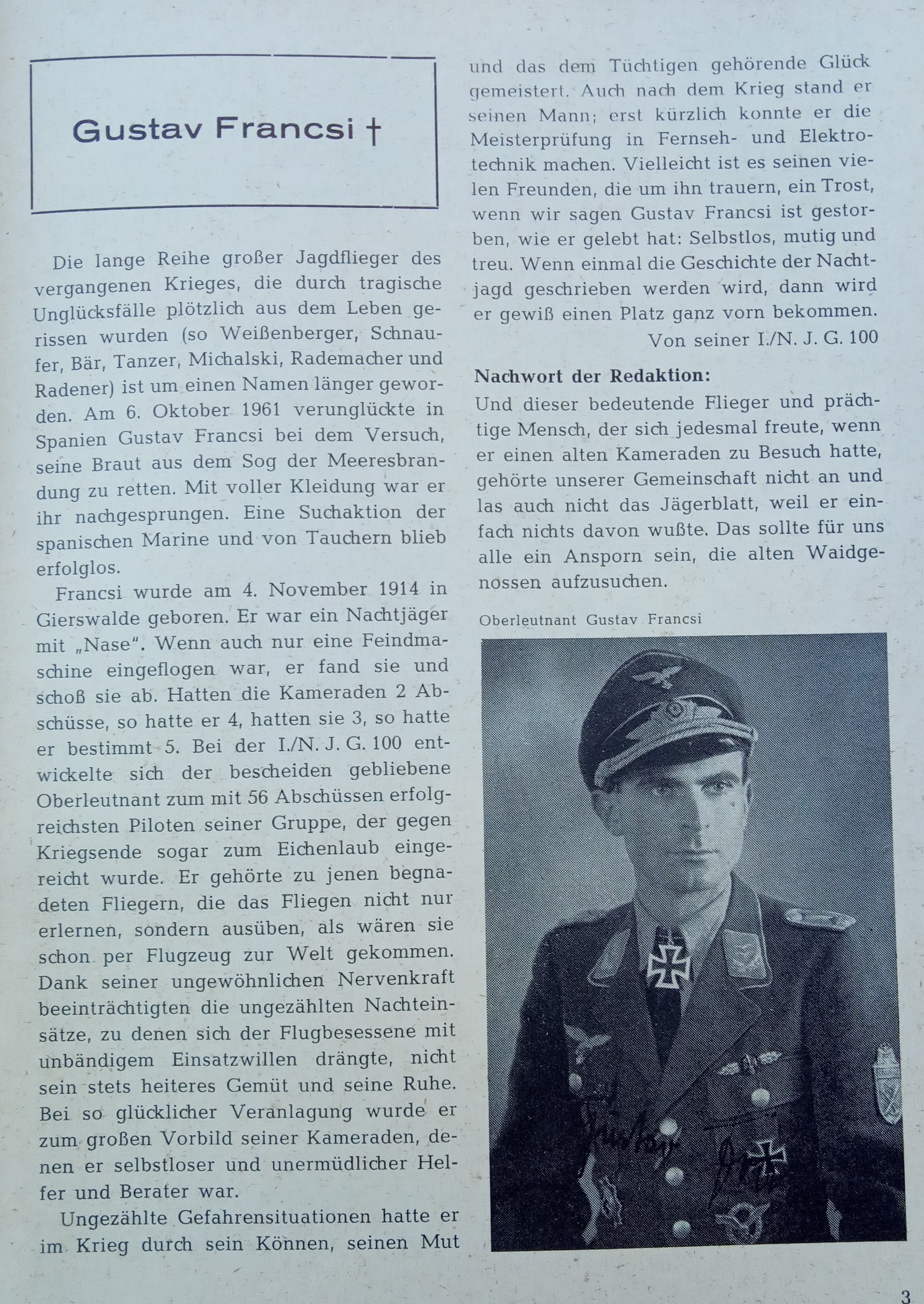
Jägerblatt April 1962 issue - obituary Gustav Francsi I./NJG 100


Cover of the April 1962 issue of Jägerblatt above - well-known image - usually incorrectly captioned - showing He 219 A-016, WNr. 190066, RL+AF, serving with NJGr. 10 at Werneuchen during the summer of 1944 engaged in radar trials. 

The April 1962 issue of  Jägerblatt featured an 'appreciation' of  'Nachtjagd' Ost Experte Gustav Francsi. Francsi drowned on 6 October 1961 in the sea in Spain after jumping in - fully clothed- to try and rescue his wife from an undertow. Strange coincidence with Hans Forke's death (BF to Ludwig Meister) - Forke also drowned during the 60s attempting a sea rescue  - in his case his daughter and nephew. Francsi was born on 4 November 1914 in Gierswalde. Francsi was awarded the RK in late October 1944 under Kommandeur Hptm. August Fischer in I./NJG 100 and was the leading night fighter ace in the East with  around  50 night-time vics (55-60 'claims', the majority of which were not officially 'confirmed' - sources conflict as to his victory tally). According to Obermaier he flew as a bomber pilot in Norway - this appears to be incorrect. Rather Francsi served as a flight engineer (BM) with KG 40 before training as a pilot during 1941.  His success on the Eastern Front  in NJG 100 - the only Nachtjagd unit to be based permanently in the East - was a result of close collaboration with the rail-mounted mobile radar units. At least  one source claims that Francsi had moved to Kdo Bonow and flew the Arado Ar 234 during April 1945 although his last four claims with NJG 100 were on the nights of 17-18 April and 24-25 April..

"..another name is added to the long list of great fighter pilots [..] suddenly taken from us in tragic accidents...[..] Gustav Francsi died as he had lived - selfless, courageous and loyal. When the history of the German night fighter arm is finally written, then the name of Gustav Francsi will certainly be at the forefront..."


With the recent publication of the last but one volume of Theo Boiten's 'Nachtjagd Combat Archive' ('Eastern Front and Mediterranean', Wingleader - a 'must buy' for Luftwaffe enthusiasts) read the full story of Francsi's career in I./NJG 100 on the Eastern Front. 


Also in Jägerblatt, April 1962 (issue No. 4, Vol XI)  Heinz J. Nowarra's  "Heinkel He 219 - eine vergebene Chance" ( '..a missed opportunity') and Hans Ring's comments on Walther Dahl's 'Rammjäger' ..

Friday, 26 August 2022

Dornier Do 17 Kauz nightfighters from Chandos, Airfix/Owl Kauz conversion in 1/72nd scale


Do-17 Z10 "Kauz II" night-fighter with 'Spanner' infrared detection system - I./NJG 2 at Gilze Rijen, Holland 1941.

Since other types were judged unsuitable for the Nachtjagd, the Do 17 and the Ju 88 became the principal long-range 'night fighters' put into service by the Luftwaffe at the end of 1940. At the risk of stating the obvious, the Do 17 and Ju 88 were bombers. They were 'adapted' as 'fighters' as a result of the Luftwaffe's lack of resources. This choice was essentially dictated by their greater endurance which meant they were well-suited to a new tactic - long-range 'intruder' missions over the UK as flown by I./NJG 2.

II./NJG 1 ( established at Amsterdam-Schiphol in June 1940 on the back of IV./NJG 2) was redesignated I./NJG 2 on September 1, 1940. Kammhuber had come up with the tactic of launching its aircraft (twin-engine 'heavy' types) over England to attack the enemy bombers 'at the source' - '..when I have to
destroy a wasps' nest, I don't attack the wasps one by one but wait until they have all returned to the nest to smoke them out'. The idea was probably a good one but its application was piecemeal and enjoyed only partial success..

The Gruppe was led by Major Karl-Heinrich Heyse who had been in charge of II./NJG 1 since July 1, 1940. Heyse, born in 1908, had been an artilleryman before joining the Luftwaffe in 1933. Staffelkapitän in K/88 (bomber Staffel) during the Spanish Civil War, he then flew in the West (1939/1940) with KG 55 before moving to the 'heavy' fighters.

His subordinates were : -1./NJG 2: Oblt. Herbert Bönsch - led the Zerstörerstaffel of KG 30 before commanding 4./NJG 1. His Staffel flew Ju 88 C-1s; -2./NJG 2: Hptm. Rudolf ('Rolf') Jung, ex-Staka of 2./ZG 2. The Staffel was equipped with Do 17 Z-7s and Z-10s and some Ju 88s. -3./NJG 2: Hptm. Karl-Theodor ('Kurt') Hülshoff, ex-Staka of 7./KG 54 and later 6./NJG 1. The Staffel flew Ju 88 C-2s but was still in training at the time and was to be added to the Gruppe shortly.

Two views of Do 17 Z-7 'R4+HK' 2./NJG 2, Gilze Rijen


via Rich Carrick

" The new book from Chandos Publications on the Luftwaffe's Dornier Do 17/215 ‘Kauz’ night fighters in WWII is nearing completion. I have therefore made the book available to pre-order on my website. Please click on the link below. .."


Dornier Do-17 Z-7 Kauz in 1/72nd scale, Airfix/OWL conversion by Jes Touvdal

Wednesday, 3 August 2022

Wartungsarbeit - Bf 110 G "2N + ??" (10.(N)/ZG 1 Lt. Josef Kociok)


 This interesting image shows (presumably) a maintenance task being undertaken on a Bf 110 - but what does it show ?  Attention seems to be focussed on the rear of the machine - master compass calibration or FuG instrument landing test perhaps? 

..No, none of these! Thank you to Alexander S for pointing out that the vehicle in the photo is an oxygen cart - the Sauerstoff-Umfüllgerät 10-50A could be mounted on its own twin-axle 'car' or on a 3-ton truck. The operator is at the Schaltafel or control panel at the rear of the unit which has been backed up to the aircraft.

The machine appears to be a "G" - note 'rounded' enclosed rear cockpit canopy and the MG Z mount apparently minus any armament. As the account below makes clear there would be little call for rearward-firing MGs on an Eastern Front Bf 110 night fighter, if that is what this is. Note the code '2N'  ahead of the Balkenkreuz -   according to Michael Holm's site 10./ZG 1 received the Bf 110 G-2 during the late spring of 1943 prior to the aircraft being 're-assigned' to the 'new'  4. and 5./NJG 200 during the summer of 1943.


More at the kfzderwehrmacht page here

Also on this blog;

Ofw. Josef Kociok 10.(N)/ ZG 1


An excerpt From "Night Witches", by Fergus Mason

" ... On May 9 Kociok shot down three U-2s from another regiment. Then on the night of May 15/16 he encountered the Night Witches. The 46th were out in force that night, to harry the Germans as they fell back on the Taman Peninsula. The deputy regimental commander, former airline pilot Senior Lieutenant Serafina Amosova, was leading a squadron in an attack on one target when the Germans tried to replicate the “Flak circus” tactic that had caused so many problems at Stalingrad. It was less successful this time; in retreat they found it harder to set up the elaborate traps, and the bombers were running at the target one after another. The guns weren’t well enough sited to catch them and the tracers were flying harmlessly wild. Then Amosova saw a trail of sparks race up into the sky and burst in a green flare. Instantly the guns stopped firing. Two miles away and 1,000 feet above, Josef Kociok was orbiting the target zone in a wide circle. Looking out the side window of his Bf 110 G-2 he searched for the tiny shapes of the Soviet bombers in the glow of the swinging searchlights. It was a confusing image, with bomb explosions and curving streams of tracer shells confusing his eyes. Still he watched patiently, until he saw what he was looking for: a line of moving specks, four of them a few hundred meters apart, all heading directly for the target. He opened the throttles and banked, swinging the big fighter round until he was directly ahead of the bombers, then chopped the power and pushed the stick forward. The Bf 110 tipped into a shallow dive. He lowered the flaps to keep the speed down as far as he dared – the Destroyer had a higher stalling speed than even the Bf 109 – and thumbed the transmit button on his radio. He gave the bearing of the incoming bombers then finished with, “Attacking now.” Seconds later the green flare popped open and the guns fell silent. He was clear to make his attack run. Weaving around in the decoy role off to one side of the defenses, Amosova saw the searchlights swing away from her towards the inbound group. It was hard to hold the Kukuruzniks in the beams but enough light was being thrown in their direction that they were suddenly clearly visible. There was no flak though, so they kept going, boring in on their target. The first of them was within yards of the drop point now, already starting to climb to avoid the blast of its own bombs. Then, to her horror, it seemed to stagger in the air as small explosions erupted all over the forward fuselage. Instantly it caught fire and spun out of control as the roar of powerful engines suddenly swelled out of the darkness. The Bf 110 was now hugging the ground, not much higher than the Soviet biplanes flew. As the first bomber blazed up like a candle Kociok pulled back on the stick to leapfrog the falling wreck, then dropped the nose again. The onrushing shape of the second Polikarpov swam into the glowing bars of his sight. His thumb stabbed down on the button, white flames erupted from the nose and the floor vibrated under his feet as the cannons thundered. The second U-2 was snatched aside by the stream of shells and bullets; it, too, erupted into flames and fell towards the steppe. Kociok was already lining up his guns on his next victim. Amosova could only watch in horror as the Messerschmitt skimmed along the line of bombers, blasting them one after another and sending all four crashing down in flames. Around her the other crews were already scattering and heading for home. There was no choice. A one-second burst from a Bf 110’s guns threw out over four pounds of metal and explosives, all travelling at more than twice the speed of sound. It was enough firepower to shatter a U-2 in an instant, and this pilot had the skill to pick off his targets with a single, lethal blast. If they tried to attack again they would be wiped out. Amosova forced her own plane a little lower, practically hiding behind hedges all the way back to the airfield. When Major Bershanskaya heard about the massacre she instantly grounded the regiment for the night; a third of a squadron had been destroyed in a minute, and she wasn’t willing to risk it happening again. Amosova, Popova and the others walked back to their billet in an old school building and sat, weeping, looking at a row of eight empty camp beds...."

(thanks Tim, what happened to the WIP on BM?)

Saturday, 2 April 2022

Bf 110 G night fighter walkaround at the RAF museum (Hendon, London) - comparison with Ju 88 G


There are still a few interesting Luftwaffe aircraft types on display at the RAF museum in Hendon, north London. This was my first visit to this fantastic museum since the dispersal of the very dark 'Battle of Britain' Hall - which is now Hangar 1 and the main entrance.  Whereas types such as the Bf 109 G, Me 262 and Ju 88 have been sent to the museum's Cosford site, Hendon's Messerschmitt Bf 110 G-4 (Werk Nr. 730301) is still on display and can be seen properly! I love the look of the night fighter and the camouflage scheme. The museum's example was surrendered to the Allies in May 1945 at Grove airfield (Denmark) and is probably the most complete Bf 110 anywhere. This particular machine served with I./NJG 3 (3.Staffel) and is fitted with the Lichtenstein SN-2 radar and FuG 220 antenna array. Note contrary to what can be read elsewhere (!) this machine is not fitted with "Schräge Musik" (the upward firing cannon used to attack bombers from below) The rear armament is the type's defensive MG 81 - however two round appertures in the rear canopy glazing are visible either side of the MG 81  - presumably for the SM weapons. This  former NJG 3 machine is also fitted with a ventral bomb rack - most nightfighters in the last months of the war were tasked with ground-attack sorties. I have posted a neat walk-around video at the bottom of this page.


Helmut Bunje provides an operational comparison of the Bf 110 as nightfighter with the Ju 88 in Boiten's 'Night Air War'. He flew both types and achieved downings in both. He achieved his first victory in his 4./NJG 6 Bf 110 G-4 over a Halifax on March 15, 1944. He was still flying with 4./NJG 6 when the Staffel converted to the Ju 88 G-1 and later the G-6 versions in August 1944. In December 1944 Bunje returned his 5th kill, this time over a Lancaster. On February 23, 1945 he claimed three Lancasters and his final two kills were over Lancasters on March 16, 1945 at 3800 metres and 4300 metres south and then north of Schwäbisch Hall. Post-war Bunje trained as an architect and led a successful practise in Hamburg. He passed away in July 2000.

Because the Bf 110 was used in larger numbers for far longer as a night fighter than the Ju 88 the Bf 110 returned a larger number of night victories than the Ju 88. The Bf 110 was smaller and much lighter than the Ju 88 and presumably more difficult to detect when approaching the bomber stream.  The Bf 110's manoeuvrability in an attack on a cork-screwing Lancaster would also be appreciably better.  The Bf 110 had sufficient range - but carried underwing tanks which were difficult to jettison in flight (or not at all according to some sources). The Ju 88 enjoyed better endurance and while it could carry drop tanks being a much bigger airframe all fuel could be carried internally. Speed, performance and armament were comparable but probably better in the Ju 88. Note the four cannon in the nose of the Bf 110. Lower gun ports for the MG 151 are visible while one barrel of a Mk 108 of the asymetrically aligned upper nose cannon is visible. In the Bf 110 the Schrägbewaffnung (slanting armament) where fitted was enclosed with the crew... 


Below; a view of the cockpit/canopy section showing the DF loop antenna and the radio mast. The latter was normally of wood but on this exhibit is a post-war replacement. The DF direction finder is centrally positioned while the mast is offset to port. Antenna extended to the rear tail fin(s) from the mast.  To the right of the MG 81 Zwilling (7.92 mm twin-barelled defensive weapon) a rounded aperture for one of two slanted cannon is visible. Note the Wellenmuster camouflage finish extends over the canopy framing. There are no handgrip panels/stencils in this view of the starboard side of the aircraft. Crew access was always via the port side. The large trailing edge slotted flap extends in a single piece out to the aileron. The red triangular 'Rotring' oil stencil is visible at the oil tank cover aft of the engine. The access panel for the starboard wing fuel tank is indicated by the yellow stencil..  


The Bf 110 was cheaper to build.  The Ju 88 was fitted out with a more modern radar suite -with Naxos and Flensburg- especially for evading Mosquitos and the Ju 88 crew had a decisive advantage with the additional crew member to carry out radar/radio tasks; 

Bunje; "in all important aspects the Ju88 - especially the Ju88 G-6 - was clearly superior to the the Bf 110 G-4.. particularly at altitude."

Bunje goes on to note that the endurance of the Bf 110 G was frequently below operational requirements and that the type was often  " too slow to catch and infiltrate the bomber stream..."  Interestingly he states that   "..jettisoning of the external tanks before combat could be a risky enterprise.." -  while a trigger release mechanism is visible aft of the tank, most sources state that the Bf 110's wing-mounted drop tanks could not be jettisoned in flight. 


Note the 'draggy' exhaust flame dampers that curve up over the wing, except for the starboard inner which vents below the wing to avoid exhaust gases being ingested in the supercharger intake mounted on the upper cowling. Note the VDM prop blades (minus the VDM emblem) have now been correctly repainted in the 'classic' RLM 70 black-green. Note the cooling scoops on either side of the nacelle. Directly below the supercharger intake is a 'window' for a prop pitch control and engine performance instruments. The supercharger intake for the port engine is situated in the port wing leading edge outboard of the engine. A 300 litre drop tank (79 gallons) was carried under each wing.


In general terms performance figures for the Ju88 G-1 were of course higher than those of the Bf 110 G-4. Aders quotes 335 mph at 6000 m (without flame dampers) and goes on to say that this was 31 mph faster than the Bf 110 G-4 since the larger internal fuel capacity avoided the need for the external tanks required by the Bf 110. The Ju88 G-1 used BMW 801 G/H engines 

 Bf 110 G-4 technical data follows;  in the night figher configuration, the flame dampers and ventral racks, in addition to the SN-2 antenna array, impose a considerable drag.


Engines 2 × Daimler-Benz DB 605 B-1 inverted-Vee, rated at 1475 hp each (and displayed alongside the airframe at Hendon)

Length 42 ft 9.75 inch including antenna
Height 13 ft 8.5 inch with the tail up
Empty: 9,920 lbs.

Loaded: 15,430 lbs
Wing Span 53 ft 3.25 inch
Wing Area 413.33 sq ft
Service ceiling 26245 ft
Maximum speed 342 mph at 22900 ft
Cruising speed 317 mph at 19685 ft
Initial climb rate 2,170 ft per min
Range 560 miles typical, 808 miles max
Armament could include the 7.92 mm MG 81z twin-barrel rearward-firing gun in the rear cockpit
but was primarily cannon;

* 2 × 30 mm MK 108  (nose fixed)
* 2 × 20 mm MG 151/20 (nose fixed)
* 2 × 20 mm MG 151/20 or MG FF fixed obliquely forward- and upward-firing in the rear fuselage in stead of the guns in the rear cockpit.

Below;  nose-mounted cannon  - lower oval ports for the Mauser MG 151 and detachable servicing panel. Note the apertures just aft of the lower radar antenna supports. These are the ejection chute openings for the 30mm spent shell cases. The starboard aperture is protected by a small sheet metal guard to prevent shell casings being ingested in the starboard engine - see first photo above for a better view. There was no requirement for this guard for the port engine. The installation of the upper 30 mm cannon was staggered, with the starboard muzzle protruding. Each 30 mm cannon was supplied with 120-135 rounds. They were charged and triggered by compressed air - note the access opening for the Preßluft bottle unit to the right of the lower MGs. The central opening provided air for the cockpit heater. According to some sources (Mackay) this intake fed cooling air into the nose cannon bay in the G-version .. 


Note the lower antennae of the SN-2 air intercept radar with FuG 220 'Hirschgeweih' (Stag antlers) array have been removed. The antennae and extension mounting rods are rounded in profile. 

Ju88 G-1

Engines 2 × BMW 801 D-2 radials of 1,700 hp each
Length (excluding radar) 47 ft 8.5 in, (including SN-2 aerials) 54 ft 1.5 in
Height 15 ft 11 in
Wing Span 65 ft 7.5 in
Wing Area 586.63sq ft
Weights: Empty Equipped 20,020 lb
Maximum Take-off 32,385 lb
Maximum speed 356 mph at 27,890 ft (8,500 m) with SN-2 but no upward-firing guns, 342 mph at same altitude with 'Schräge Musik' installation
Service ceiling 29,000 ft
Normal range 1,553 mls

Armament: Four fixed forward-firing 20mm MG 151 cannon in ventral tray with 200 rounds each and one flexible 13 mm MG 131 machine-gun at rear of cockpit. Optional 'Schräge Musik' installation in upper fuselage with two 20 mm MG151 cannon firing obliquely forward.

Below; former NJG 3 Bf 110 G-4 now sits opposite the Lancaster in Hangar 5 of the RAF Museum's Hendon site, Colindale, north London. 


George Hopp;

" ..The Bf 110 was just too small to carry all the electronics needed for a night fighter to safely exist in the skies over late-war Germany. Gotha had a merry dance in trying to pack into the nose of the Bf 110 the plumbing for the FuG 202, the FuG 220, and for the MK 108s. The crews actually breathed a sigh of relief when it was decided not to install the FuG 350 in the a/c because there was simply not enough room for it -- although 5 prototypes of the installation were installed. And, with the commencement of the Tame Sow type of night fighting in which fighters might have to roam over much of the Reich territories during RAF raids, it became obvious that the endurance of the Bf 110 was insufficient..."

Ultimately it is probably a little pointless to compare the Ju 88 G-6 and the Bf 110 G-4 - there would be no comparison. Although NJG 1 flew the Bf 110 G-4 until the end of the war so presumably favoured this type. The RLM made its own decision on the comparable quality of the two types. In the late summer of 1944, Bf 110 production was curtailed and in November 1944, the Bf 110 'programme' was terminated. This was largely the result of continuing problems with the DB 605 E -planned to replace the DB605 B in the Bf 110 - and the  superiority of the Ju 88.


BMW radial-powered Ju 88 G-1. 


Above;  Bf 110 G-4 '2Z+GB' of 2./NJG 6 flown by Kommodore Oblt. Martin 'Tino' Becker. Based at Neubiberg - from a sequence of photos taken on 18 July 1944. Note flash suppressors on the upper nose cannon.


Below - Bf 110 G-4 with an unusual 'reverse' mottle finish; the Farbton 76 appears haphazardly sprayed over the 74/75. In the second image note the non-standard nose cannon. 


Me 110 G-4 Nachtjäger mit der neusten Lichtenstein Radaranlage SN - 2 mit FUG 220 (Hirschgeweih).