Showing posts with label Ju 87 Stuka. Show all posts

Saturday, 23 November 2024

St.G 2 Ju 87 im Osten, October 1941 - ebay photo find #381


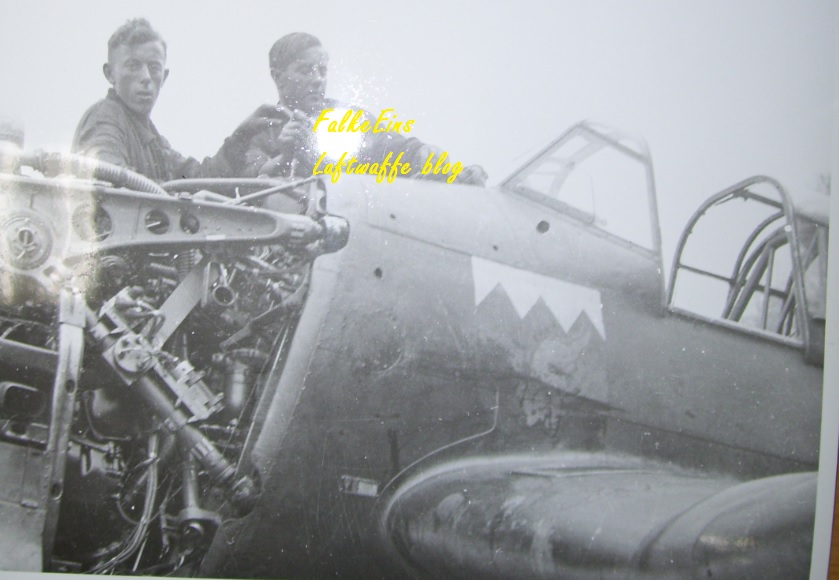
Soldaten des Pz.Rgt.29 bei Junkers Ju 87 "Stuka" mit Truppenkennzeichen der Sturzkampfgeschwader 2 im Osten, 1941. 

 This is 'T6+GT', a 9. Staffel Ju 87 R-2 of III./St.G 2 (WNr. 5780) photographed during the late summer of 1941 following a forced-landing close to the Rollbahn, which occurred on 27 August 1941. The pilot may well have been attempting an emergency landing on the road. The emblem of III Gruppe visible forward of the cockpit was adopted in late 1939. The 'GT' appears on the yellow fuselage band on the port side, the 'G' being outline only. More images of this aircraft were published in the superlative book Stukageschwader 2 'Immelmann' authored by Marc Hazard. (Lela Presse, 2018). Additional caption info via GRM.

Thursday, 31 October 2024

SS Fallschirmjäger Btl. 500 Drvar May 1944, "Rösselsprung" - ebay photo find #380


 "Rösselsprung" was a failed German airborne and ground operation aimed at capturing or killing the Yugoslav Partisan leader Marshal Josip Broz ('Tito') in the Bosnian town of Drvar. Launched on 25 May 1944, the 'airborne' part of the assault was carried out by the SS-FJ battalion 500 - some 340 paratroopers were transported on board 34 DFS 230 gliders, the remainder of the battalion jumping from TG 4 Ju 52 Transporter. Meanwhile the town of Drvar was also bombed by the Luftwaffe. The gliders were towed by Hs 126 and Ju 87 tugs. A number of these images appeared in subsequent German newpaper reports - almost certainly taken by PK Berichter. In the end the operation was a failure - the area was well-defended by strong partisan forces while German intelligence regarding Tito's exact location was faulty. 


This was the image of victory that was publicized. These F-J paras show off their trophies including the flags of the Allied Mission. The rifle of the man in the middle has a grenade launcher on its muzzle.


Friday, 21 June 2024

Stukageschwader 77, summer 1940 - archive photo scan #25


" ..Zwischen den England-Einsätzen in Maltot, Caen. Die Rumpfbombe hängt schon. 1.Staffel St.G. 77..".  Pilot Fw. Knauer (left) and Bordfunker Uffz. Sellhorn.

Ju 87 B of 1./StG 77 bombed up and ready for another sortie against England. From the Sellhorn archive.


"..Wartungsarbeiten an der Ju 87 B bei der 1. Staffel in Maltot.."


Click here for all images scanned/copied exclusively from a number of archives/collections for this blog. Click on the images to view large.

And published in October 2023 and still available from Lela Presse, two volumes entitled "Stukas in the Blitzkrieg" by Marc Hazard. These are 96-page A-4 soft covers filled with artworks and photos. French text. Vol I covers Poland and Scandinavia, while Vol II deals with the campaign in the West, May-June 1940. Only 13 euros per volume. Top quality and recommended by this blog! To order, go here. English spoken.


Saturday, 8 June 2024

Stukageschwader 77 - archive photo scan #21


..a Kette of 1. Staffel of St.G 77 seen over northern France (Caen, Normandy) during late August 1940. New crews being trained in formation flying according to the period caption - 'Staffelausbildung mit neuen Besatzungen..'


Thursday, 14 March 2024

Schlachtgeschwader 3 sortie at Dorpat, Estonia - Bundesarchiv photo report #6


A photo-report at SG 3 from PK Berichter Doege dated 9 March 1944 in Estonia (Dorpat, Estland), Einsatzbesprechung  - pre-sortie briefing (middle, Oberleutnant Hans Töpfer). Another sequence from the same photo report can be found in the ECPA-D files...


March 1944 Estland, Dorpat- Schlachtgeschwader 3. Junkers Ju 87 mit weißem Tarnanstrich auf verschneitem Flugplatz, nach der Landung in Parkposition


Saturday, 16 December 2023

Special Hobby/Academy Junkers Ju 87 G-2 by Giampiero Piva


Special Hobby's re-release of the 1:72nd Academy Junkers Ju 87 G has been given the Giampiero Piva treatment!

 Academy's Ju 87 G-2 is a nice kit, and certainly looks looks impressive in the box with its very crisp, finely engraved panel lines, thin clear parts (two canopies included, one multi-part) and decent detail, especially in the cockpit which includes a nicely rendered radio set. GP has re-worked the model, added the superb Aires resin cockpit and much more detail to the cannon.


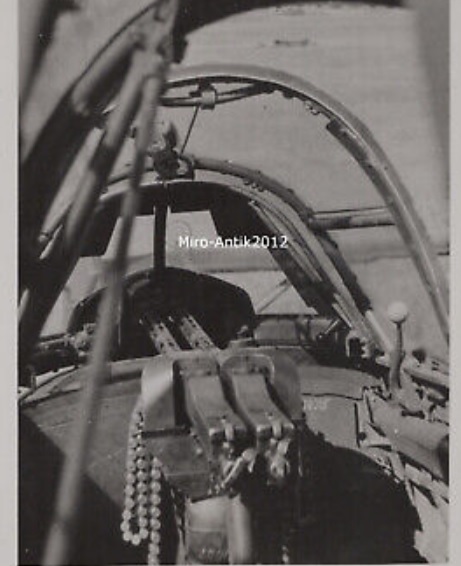
The kit features the longer-span wing and two 37mm anti-tank guns slung under the wings. The underwing 37mm cannon pods are especially well done. As might be expected in this scale, some of the more subtle elements are oversimplified. These include the "Zwilling" twin machine -guns in the rear of the cockpit and the hinge arrangement for the flaps/ailerons.


Subject of the model is a 10.(Pz)/SG 3 'Panzerknacker', as seen operating from Schippenbeil (Poland) or from Jakobstadt (Lithuania) in the winter of 1944. According to Giampiero. "..all my models are brush-painted, which makes my output somewhat slow. I post models made recently but also others made a while ago.."

Thanks to Del (James V. Crow collection) for images of the real machines - which are fairly rare. Note the 'Wolfskopf' emblem on the cowling of 'S7+ET'  (see below)


Ebay sale album depicting  Stukageschwader 3 Junkers Ju 87s, including images of the BK 3.7 anti-tank Panzerknacker Kanonenvogel cannon toting variant. - note unit prefix 'S7' partially visible.


Also on this blog; More on Rudel's Ju 87 Kanonenvogel

Thursday, 30 November 2023

Stuka crews of 10.(St)/LG 1 relax ahead of the attack in the West


A Stuka crew from 10.(St)/LG 1 relaxing by their machine just prior to the Westfeldzug, the campaign in the West. The Ju 87s of IV./LG 1 departed their field near Cologne on 19 May 1940 and headed for Belgium. Their new base was a field strip near Hargimont (Marche). This 10. Staffel machine was Ju 87 B-1 'L1+CU'.


Just one of the many excellent photos published in the latest BA (issue 104) from Lela Presse " Stuka dans la Blitzkrieg " Part II (the  attack in the West. Part I covered Poland and Scandinavia..). BATAILLES AÉRIENNES is the leading French-language quarterly from Lela Presse, in continuous publication since 1997. Features rare first person accounts, rarely seen photos and superlative artwork from Eric Schwartz, still only 13 euros (100 pages, 200 illustrations, 10-15 artworks). Available here

" Here is the second part of our study dedicated to the terrifying weapon -in its day- that was the Stuka. After a successful trial in Poland, the Ju 87 was to prove its worth on the battlefield in the West. As we know, it was a great success. And the Allied anti-aircraft defences of the time were not the equivalent of the German Flak; not to mention the Allied fighters who, although overwhelmed by the scale of the Luftwaffe attacks, were able to score a few successes against the Stuka, successes which already revealed the vulnerability of the dive-bomber. So, no, the Stuka was not a miracle weapon; it was simply a question of making good use of a weapon in a rather favorable context. Mention is often made of the Stuka's siren, which terrorized the population and Allied troops. Certainly, this was the case during certain attacks, and this is essentially what was remembered and, above all, peddled. Nevertheless, numerous photographs show that personnel were happy to get rid of this equipment... whose effectiveness could not have been as radical as later reported...

To this day, the Stuka remains a legendary weapon, inseparable from the 'Blitzkrieg' waged by the 3rd Reich. The author's account shows us that the reality needs to be nuanced, as the losses suffered by Stuka units were not negligible; nor were those suffered by other Luftwaffe units, even in a context of near-total victory..."

Sunday, 30 October 2022

Monday, 1 August 2022

I./SG 1 and the Warsaw uprising (Warschauer Aufstand) - August-September 1944


Today marks 78 years since the Polish Resistance Movement started their uprising in Warsaw on August 1, 1944. The Uprising divides opinion, even among Polish historians. For some, it was a heroic battle for the honour of the nation. For others, it was irresponsible and self-destructive. According to "Germany and the Second World War " "..the uprising seems very ambivalent. It was directed militarily against the Germans, while politically it was an attempt to quash the USSR's attempt to 'sovietise' Poland...". The Polish underground army, Armia Krajowa, was strictly 'anti-Bolshevik', rejecting both Hitler’s regime and Stalin’s rule. Its leaders aimed to liberate the capital with their own hands and so light a beacon for a future sovereign Poland..In the event, the Russian summer offensive had already come to a halt on the outskirts of Warsaw -  the Soviets had out-run their supply lines and exhausted their ground forces. It was at this same moment that the Germans launched a wholly unexpected counter-attack in front of Warsaw. This  turn of events led to disaster for the Polish capital. 

 The Poles began the uprising without any significant logistic reserves, assuming that the fighting would last only about three days (in fact it lasted 63 days), and that on the fourth day the Red Army would march in. At first their calculation seemed to make sense, for on 31 July the seemingly unstoppable Soviet troops had reached Praga, the eastern suburb of Warsaw.  At this the leaders of the uprising decided to start fighting the next day, 1 August. They could not know that the Germans, who seemed already beaten, would then be launching a counter-attack  - the city along with the railyards were of major importance for the Germans. The tank battle before Warsaw, which resulted in the encirclement and destruction of large parts of the Soviet 2nd Armoured Army, began at exactly the same time as the uprising. However, after several Soviet armies had arrived as reinforcements, something happened which the insurgents had expected even less: the Red Army units waited—as the Poles see it—at the gates of Warsaw, without doing anything, until the Germans had defeated the uprising.

Very few air assets from Gen. der Flieger Ritter von Greim's Luftflotte 6 were at hand to help crush the uprising. While some sources describe the resistance as being suppressed by the "might of the Luftwaffe" in reality only a comparative handful of Luftwaffe bombers -elements of one Stuka Gruppe, I./SG 1, and perhaps a second, III./SG 77 - operated over the smoke-shrouded city.  Experience from the Stalingrad disaster in particular had shown that fighting in urban terrain required air elements capable of pin-pointing and knocking out enemy strongpoints. As in Stalingrad though the Stukas were in almost constant action and inflicted great destruction to the city - according to some sources over 1400 sorties were flown and 1500 tons of bombs dropped. Warsaw also saw the combat debut of the hastily-established Sturm-Mörser-Batterie 1000 - their assault mortars (based on the Tiger chassis) fired four 350 kg rocket-projectile type shells an hour, each capable of bringing down a three-storey house. 

  Warsaw Uprising stuka ju-87 bombing Old Town


From mid-August 1944 only a handul of Ju 87s, detached from I./SG 1 and commanded by future RK-winner Oblt. Klussman, stayed in Warsaw flying from Okecie airfield. Lt Heinz Jakubowski of 3./SG 1 flew a number of sorties over the city;

"..The airmen were given copies of city maps on which the targets had to be found. The city was burning everywhere, dense smoke obstructed visibility. Attacks were carried out 'kettenweise' (Kette formation) - no bombs were allowed to fall on our own positions. If this happened the pilot was immediately relieved. These missions were pure madness..."

In the south of the city stood a factory chimney, which the insurgents used as an observation post for their artillery. German guns would be unable to ‘knock out’ the chimney, so knocking it down fell to the Stukas as Jakubowski recalled;

 " making my way to my dispersal I saw a small tracked vehicle pulling a crude wooden sledge with a 1000-kg bomb. 'The 1000 kg bomb is going under the belly of Jaku's Ju,' they said. I turned around and went to the command post...and got confirmation there. Schornstein ‘umlegen’ -"knock down" the chimney. From all sides I received advice on how to proceed. I rummaged in my memory of Stuka school knowledge ('Stuka-Schulekenntnisse') and had tables at hand from somewhere; ..'..the SC 1000 is 2800 mm long, has a diameter of 654 mm and contains 530 kilos of explosives. The circle of destruction is 35 metres, the splinter circle is 360 metres, the depth of the crater is ten metres and the volume of debris ejected is 1000 cubic metres. Then it was time to do the maths: The approach against the wind was possible. The target for the bomb impact was five metres in front of the foot of the chimney, so that the chimney itself would collapse into the bomb crater. So it could work.. I had the fabric cover of the floor window in my Ju removed and the glass pane cleaned. The bomb was loaded in the Junkers (mit Schloss 2000) carrier rack and then myself and the accompanying machines set off. Would I find the chimney at all in all the smoke? Slowly the target came into the ground window ('Bodenfenster'), the chimney stood there like a match! After several small course corrections ...Now! ... with a jerk, the now-lightened machine veered upwards and the bomb fell! A sharp right-left turn to get the smokestack back into view. Where did the bomb go? Straight to Moscow?"

Finally 'Jaku' saw the bomb going down. Would it fall too short? ... A cloud of dirt and debris billowed up from below, a huge cloud of dust that was slowly turning  red. It had to be the bricks of the chimney! In the FT a voice croaked in confirmation: Gratuliere!  -  "Congratulations!"

(to be continued..)

Friday, 18 December 2020

Fw 200 C-4/U1 Fliegerstaffel des Führers Wintertarnung - ebay photo find #341


CE+IB WNr. 0137  was a machine from the Fliegerstaffel des Führers  more colloquially known as the 'FdF' ..Für den Führer ('for the Führer'). Note the emblem applied to the forward fuselage slightly ahead of the canopy - an eagle's head in a circular frame comprising a garland of oakleaves and the initials 'FdF' within the bottom curve of the frame.


The origin of the Fliegerstaffel des Führers dates back to February 1933 when Adolf Hitler directed Lufthansa Flugkapitän Hans Baur, who was already the Führer’s personal pilot, to establish a Regierungsflugdienst (Government Flight Service) at Berlin-Tempelhof with 2 Ju 52/3m  transports. In 1934, and now with 4 Ju 52s on hand, it was officially designated Flugbereitschaft RLM but informally referred to as the Regierungsstaffel. By 31 December 1936 the Regierungsstaffel had grown to 13 Ju 52s, two of which were reserved for Hitler’s use, 3 for General Göring’s use and 7 of the remainder assigned to Hess, Himmler, Rippentrop and several other high officials. The first Fw 200 Condor was delivered to the Staffel in July 1939 and a specially outfitted Condor (D-2600 “Immelmann III”) for Hitler’s use was delivered on 19 October 1939. Through its existence from 1933 to 1945 the Staffel’s sole function was to operate as a private passenger airline for Hitler and the highest ranking personages of the National Socialist regime and foreign heads of state on official visits to the Führer. At no time during its existence did the Staffel belong to the Luftwaffe. Instead, it came directly under the Reichskanzlei and the Führer’s personal military staff. The aircrew personnel and other senior officials were former Deutsche Lufthansa (DLH) employees who held honorary rank in the SS and wore high-ranking SS uniforms. The remaining personnel were a mixture of DLH civilians and after the war began a smattering of carefully selected Luftwaffe personnel. During the early war years Hans Baur created a Staffel emblem that consisted of an eagle’s head with a surrounding oak wreath or crown and the inscription “F.d.F.” The Regierungsstaffel was renamed Fliegerstaffel des Führers on or about 1 September 1939.


F.d F  Fw 200 C-4/U1 code CE+IB WNr.0137


Thursday, 17 December 2020

Jagdflieger Mölders und Beerenbrock, Dieter Pekrun StG 2 -ebay photo find #340


Believe it or not, this image of JG 51 Jagdflieger Mölders und Beerenbrock apparently dating from 1941 and offered for sale by a well-known Ebay repro photo seller went for nearly 500 euros!


Kommodore Mölders with Oblt. Walter Stengel, Staffelkapitän 6./JG 51


Messerschmitt-Me-109-Flugzeug-Pilot-berichtet-vom-erfolgreichen-Feindflug


..newspaper account published in a March 1942 issue of the NS Leipziger Tageszeitung written by Schlachtflieger ace Oblt. Dieter Pekrun relating his shooting-down (by Spitfires!) while piloting a Stab I./StG 2 Stuka on the third day of the Westfeldzug, 12 May 1940 - Pekrun managed to bail out and came down in a field of 'irate' cows at Geetbets, Belgium - behind  the lines. With his BS dead, Pekrun evaded the various search efforts mounted to locate him and returned home some 24 hours after being presumed MIA. Pekrun was awarded the RK in June 1941.