Showing posts with label Transporter. Show all posts

Monday, 28 July 2025

Junkers Ju 90 Paris-Soir newspaper February 1943


A recent discovery in Paris - a front page of the newspaper "France-Soir" from February 1943 featuring a PK image of a Junkers Ju 90. The headline refers to the new law creating the Service du Travail Obligatoire (the STO or 'compulsory labour service') thus dating this newspaper from either the 16th or 17th of February 1943. No date in fact appears on the front page. (well, of course it does, as Nick has pointed out, it's in the box top right! And dated 17 Feb 43) The STO was a continuation of the voluntary 'Releve' - at least 240,000 French workers had gone to Germany voluntarily, including 70,000 women. But Fritz Saukel needed at least another 350,000 French workers to make up for labour shortages in German military production. Henceforth this new Vichy law would ensure that French workers were conscripted and deported in huge numbers to go and work in German factories. The imposition of the STO was one of the factors behind the 'rise' of the French resistance with large groups of young men taking to the 'maquis' to avoid being sent to Germany. Note the headline in the middle top refers to " the continued vain attempts by the Russians to force a break-through  " (..on the southern sector of the Eastern Front...)  - this is a couple of weeks after the destruction of VI Armee at Stalingrad! The article is illustrated with a picture of a Ju 90, which, the caption states, is being used to transport German reinforcements to the front. Interestingly enough I recently came across the PK film series from which this image was extracted in the ECPA-D.  According to their caption this machine was possibly coded 'BG+ ??'. (DAA 2658)


Monday, 25 November 2024

Ju 52 Transporter KG zbV 1 - ebay photo find #382

Crash-landed Ju 52 of KG z.b.V 1 with the Berlin bear as Geschwaderwappen (black on a yellow background). While there seems to be an issue with the starboard motor, the tarpaulin-shrouded engine is a good indication that this machine will be soon returned to service..

" ..eine Ju 52 fliegt nicht alleine..."  Possibly here en route to North Africa via Sicily "1Z+HV" according to the seller. Looks more like Russia. In his memoir (see below) Ju 52 pilot Horst Dinter relates that he flew resupply sorties to Rommel's DAK via Greece and Crete..and the Ju 52 has none of the yellow 'Balkans' scheme. Also is probably coded "1Z+HU".


The best view of the cockpit MG mount that I've been able to locate. An image from Dinter's book. About 18 months ago I was asked for a view of this part by the 'researcher' from a well-known local model kit company. To the disappointment of the guys in our model club, said researcher (hi Luke!)  has subsequently left the company. His replacement has yet to put in an appearance. (not that I particularly want him to...)


Monday, 23 January 2023

Ju 52 Transporter at the Kent Battle of Britain museum, Hawkinge, 21 January 2023


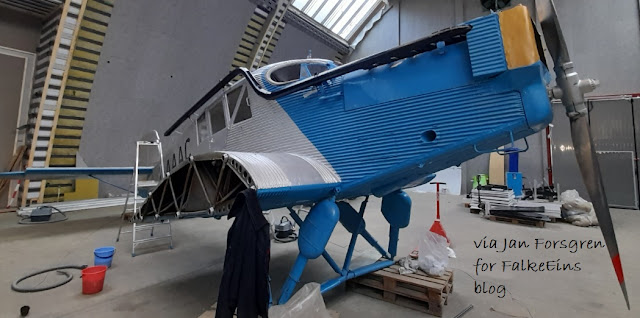
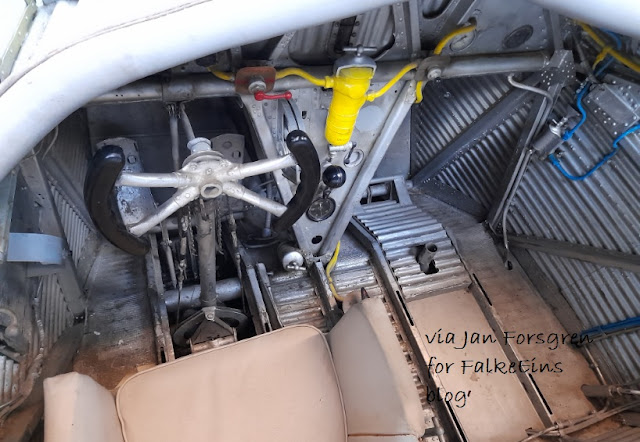
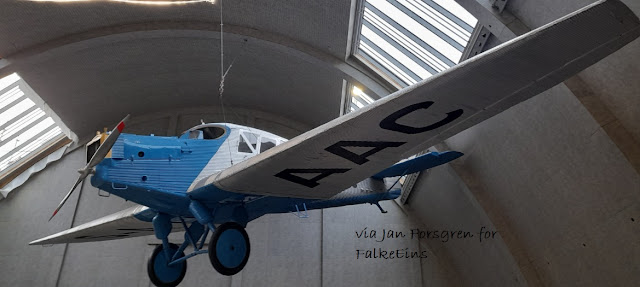
..barely two months ago the RAF Museum's CASA 352 (basically a Spanish-built Junkers Ju 52/3M) was looking immaculate in its hangar at Cosford in its pre-WW II British Airways livery, painted to represent G-AFAP of British Airways Ltd circa. 1939. Now transported half-way across the country it is literally in pieces in the car park at the Hawkinge Battle of Britain museum awaiting a re-spray in a 'spurious' Battle of Britain 'scheme'. Although no transport Gruppen had undergone preparation for the 'planned' Operation Sea Lion, KGzbV1 and KGzbV2 were apparently primed to move to France, should the invasion become a possibility. The team at Hawkinge have around ten weeks to strip the machine down and repaint it prior to the opening of the museum for the summer season.  Not to mention lay some concrete for an outside 'dispersal'. Note the shot of the fuel tanks in the wing - volunteers on duty on Saturday mentioned that these had to be drained prior to the move from Cosford as there was still fuel in the tanks following the tri-motor's flight into Cosford some 30-odd years ago! Smaller parts including cowls, BMW radials, ailerons etc are already in the hangar at the Hawkinge museum where it was planned to apply the first coat of paint on Saturday.

Thursday, 10 November 2022

"To Save an Army - the Stalingrad airlift " by Robert Forsyth - new Luftwaffe book review


 Nearly eighty years ago, on 19 November 1942, the Russians launched a counter-offensive that quickly surrounded the city of Stalingrad, the objective of Hitler's summer 1942 campaign in the East. Trapped inside the resulting 'Kessel' or pocket or were some 300,000 troops of the German 6.Armee and their Allies. Hitler was determined to hold the city and 6. Armee commander Generaloberst Friedrich Paulus waited in vain for a response to his requests for 'freedom of action'. The result was a catastrophe for the Wehrmacht. Just ten weeks later  only 91,000 German troops in the pocket were still alive of which just 6,000 men returned from Soviet captivity. The encirclement force  -'Operation Uranus' - had comprised three complete Soviet armies, the 1st Guard, the 5th Tank and 21st Army. Outnumbered and poorly equipped, the Rumanian 3. Armee which held the German 6. Armee's northern flank managed to hold on for most of that first day before being shattered. The next day a second Soviet Offensive was launched to the south of Stalingrad against the Rumanian 4. Armee. which collapsed. The tips of the two Soviet pincers quickly met at Kalach-on-Don just to the west of Stalingrad sealing the ring. Immediate German preparations for a 'break-out' to the south-west towards 4. Panzerarmee were well underway when the order 'no withdrawal' arrived. To the north-east of the pocket v. Seylich-Kurzbach (CO L1. Armeekorps) had already authorised his divsions to pull back from their well-constructed winter positions.  

While the ground troops fought to 'stabilise' the front - the Russians having been alive to German preparations for withdrawal - German commanders hastily drew up plans to mount an 'airlift'. This 'operation' is the focus of this excellent new account from Robert Forsyth for Osprey. As an 'operation' the story of the airlift has never been 'properly' told in English (Kurowski's 'Luftbrücke Stalingrad' - one of his better works - has not been translated, while both Bergstrom and Hayward focus on the 'Blau' campaign in its entirety). The absence of a 'proper' account in English may be explained by - may even be the result of - viewing the airlift very much as a ‘passive’ operation: that is to say there are no ‘guns blazing’. The much-vaunted 'achievements' of the Luftwaffe fighter aces are only 'represented' at Stalingrad through the efforts of the very small 'airfield protection' unit detached from JG 3 set up at Pitomnik.

Yet, as the author explains in his introduction the story is a 'dynamic' one - the airlift at Stalingrad was played out against a backdrop of appalling weather as the clock ticked down on the poor souls trapped in the ever-shrinking 'pocket' as the airfields at Pitomnik and Gumrak were finally lost, while German commanders vied with each other in ambition, ineptitude ..and recriminations. Wolfram v. Richthofen, the commander of VIII Fliegerkorps - whose diaries and documents form the basis for this book -is particularly dismissive of the 'Sonderstab Milch'- an episode that this reviewer was largely unfamiliar with. Secretary of State GFM Milch was dispatched to Russia in mid-January to 'energise' the airlift but succeeeded only in exasperating the senior commanders - 'too many cooks' - and getting himself seriously injured in a car crash, hit by a Russian locomotive while attempting to drive across a railway line.

The story is also founded to a significant degree on the writings and letters of Martin Fiebig, the Flak general Wolfgang Pickert, the senior Luftwaffe officer in the Kessel awarded the Ritterkreuz for his support of 6.Armee, papers from the Milch Sonderstab, plus the recollections of a senior medical officer of Luftflotte 4, as well as reports prepared by field commanders such as Förster, Kühl and Willers etc. It is a story told very much from the ‘top down’ by the decision-makers rather than from unit-level up. At times they seem almost incapable of processing the magnitude and scale of the task which Hitler had blithely assigned them. Why were combat aircrat able to take off and the transports not? Because the bigger machines had to be dug out of the snowdrifts with winds blowing at 90 km/h and temperatures at -12°C!  Paulus had to dispatch a 'special-envoy' to the 'Wolfschanze' to explain, among other things that the figures for aircraft being declared 'Kesselklar' and 'Einsatzbereit' bore little relation to the numbers of machines flying into the city. Nobody seemed to realise that the daily requirements of bread alone were forty tons!

Earlier in 1942 the 'successful' resupply efforts mounted at Demyansk and Cholm had set 'dangerous precedents' (chapter 2)  and expectations for this type of 'operation'. Encircled German armies had been kept largely resupplied from the air.  But as the author describes, air transport and the resupply of far-flung armies " had become something of a blind spot in Luftwaffe operational thinking". Indeed the Luftwaffe's transport force had no autonomous command and no functional or operational infrastructure. It was an indication of how ill-prepared the Luftwaffe was for war that, in order to optimise usage, the Junkers Ju 52 served both in the air transport and bomber pilot training roles. Blitzkrieg meant short rapid offensives but as the Wehrmacht's campaigns became more drawn out and the Germans suffered their first reverses "the transport side of the system began to break down.." as the allocation of transports to the various Luftflotten became insufficient for the demands placed upon them. To some, the efforts of He 111 bomber crews in dropping containers of bread at Demyansk and Cholm had taken on the appearance of an 'humanitarian relief effort' rather than demonstrating any serious air transport capability. The fact is the Ju 52 transport force did not have enough stowage capacity and was under immense strain - elsewhere the Germans in North Africa were just a few months away from capitulation because of logistics.. Indeed production of the Ju 52 had been cut right back in favour of the development of newer types just at the wrong time- pressing Heinkel bombers into service as transports might boost the numbers of aircraft committed to an operation but not necessarily its effectiveness. Similarly the author makes the point that without their own command even the higest-ranking transport officers were merely the recipient of orders from elsewhere and rarely consulted as to the feasibility of large scale transport operations.

The same scenario was played out over Stalingrad. The aim was to keep 6. Armee functioning as a fighting force - some 500 tons of rations and ammunition were required each day as a minimum.  It was a hopeless task and the Luftwaffe failed disastrously. Even had they succeeded and ever come close to the '500 tons' the author doubts whether the outcome would have been any different. Aircraft were dug up from all sorts of commands and sent east in a completely ad-hoc fashion. In addition to the Ju 52s and He 111 bombers, random types - including training school Ju 86s - were pressed into service as makeshift 'transports'. Major Willers, CO of the adhoc Fw 200 unit detached from KG 40, wrote;

" ..working on the aircraft in snowstorms without any protection was hopeless. On several occasions we had to use the heater carts to thaw out the mechanics who had become frozen to the aircraft with their wrenches in their hands...[..].. it was an extreme process of acclimatisation to go from 20°C in Bordeaux to -30°C in Stalino and Zaporozhye.."

According to the author the Condors were relatively effective at Stalingrad. Used to ranging out over the Atlantic, their crews were skilled in flying and navigating in poor weather and even when over-loaded the competence of the crews in alighting the heavy machines on the snow reduced the potential for damage, despite the fragility of the Condor's landing gear. Ultimately though there were only eighteen of them and Stalino - 500 km from Stalingrad - had no hangars or other infrastructure to accomodate them.

While the Condors were large - the type was essentially a pre-war civil airliner - the Luftwaffe in desperation deployed even larger aircraft. The biggest machine in the Luftwaffe's inventory was the Junkers Ju 290 V1 - an untried type with a wingspan some four metres greater than that of the Fw 200 Condor, capable in theory of flying in ten tons of rations and flying out some 80 wounded men. The Ju 290 was flown into Stalino by Junkers test pilot Flugkapitän Walter Hänig on 28 December. Other 'giants' sent from Germany included some of the most unreliable, accident-prone and downright dangerous aircraft ever conceived by German engineering. Developed as a new-generation strategic bomber with coupled engines, the Heinkel He 177 had been flying - and catching fire and crashing - since 1939. At one point during 1942 there was only one prototype left flying. The first He 177 bomber Gruppe I./FKG 50 (Fernkampf Geschwader) had already declared the type unfit for operations. In Stalino, Willers decribed the type as 'a marvel of technology but it couldn't fly..'

On the ground in the city, rations became increasingly scanty and ammunition scarce. Meanwhile the harsh winter weather was becoming increasingly bitter with heavy snowfalls hampering any movement and many German soldiers continuing to suffer horrendously with wholly indequate equipment and clothing as Adelbert Holl relates in his memoir 'Als Infanterist in Stalingrad'. On the 'best' day of the airlift - 19 December - 147 aircraft flew in barely 230 tonnes. Sausages from horse meat were available but would soon have to be eaten raw. By 27 December a lack of fodder meant that the Futtermeister were slaughtering even the strongest horses. At night supplies were dropped in canisters, but the Russians lit the same beacons as the Germans and most fell in between the lines, always a heavy blow for troops. While news of 'relief' efforts gave new impetus, it snowed heavily thoughout the day on 24 December which those on the ground recognised would surely impede any efforts. Following the fall of Pitomnik, a rag-tag collection of aircrews and aircraft mounted sorties into the much smaller field at Gumrak, although Soviet decoy operations lured many aircraft to their doom. Of course the flights into the pocket were hazardous for the crews. More harrowing perhaps were the scenes that greeted them at the airfields. He 111s of III./KG 55 flew their first sortie into the pocket on 12 January - as the makeshift transports landed, ragged, ghostly figures appeared out of the gloom, stumbling towards the aircraft, desperate either for food or to board the aircraft. As the hatches opened men were kicked or punched away by the crews as the supplies were quickly thrown out into the snow. Shots were fired into the air in an effort to maintain order. Uffz. Michael Deiml, a flight engineer remembered his 198th sortie;

"..although our aircraft had been seriously damaged on the way in - the tail and rear fuselage had been holed by some fifty AA shells - the machine could still fly! The machine was not a transport but a bomber with bomb bays and supplementary fuel tanks in the interior and we could only fly out eight passengers.."

13 January was a disastrous day for the airlift. Soviet aircraft destroyed 29 aircraft on the ground at Pitomnik. Flugkapitän Hänig attempted to get airborne from the field on the return leg of his second supply flight but as the heavy Ju 290 climbed out of the pocket at 00:45 the aircraft reared up - the cockpit having probably taken a direct hit - and crashed back down into the snow, killing the majority of the 75 wounded aboard, along with the crew. A second Ju 290 sent to Stalingrad made its one and only return flight on the same date - the big aircraft proved to be easy prey for Soviet fighters. The experienced pilot, Maj. Hugo Wiskandt, Staffelkapitän of 1./ KG. z.b.V. 172, managed to return the aircraft to Stalino with no fewer than 123 impacts, ending the type's attempts to supply Stalingrad. (Only four Ju 290s were constructed during the first quarter of 1943). Elsewhere the He 177s made their 'inauspicious' debut in the airlift, carrying too small a load and consuming huge amounts of fuel. Of the 30 He 177s that had flown into Zaporozhye-Süd, ten quickly went unserviceable. Fiebig wrote;

" This type of aircraft does not accomplish anything. They only dropped eight 250 kg containers ..[..] consuming 4,000 litres of fuel for their mission.." 

Nor could they land because of the risk of being immobilised in the pocket. The Kommandeur, Maj. Kurt Schede, failed to return from his first mission, flown on 16 January. Similarly, plans to use towed gliders to fly in supplies - the Me 321 Gigant could haul 21 tons - were quickly abandoned as being impractical, especially as there were no suitable towing aircraft available.

At Stalingrad the Luftwaffe "had been assigned a gargantuan, draining, horrific,..[..].. infernal task." While most sources differ here, the Luftwaffe lost very nearly 500 aircraft attempting to keep 6. Armee supplied in Stalingrad, virtually five entire Geschwader, along with 1,000 experienced flying personnel. Towards the end of the airlift, the condition of the surviving troops in the pocket was so poor that supplies dropped were not being picked up. The average daily supply drop was always at least 200 tons below the subsistence level to keep 6.Armee functioning. From disrupted flight training back in the Reich to a virtual pause in the war against Allied shipping in the Bay of Biscay, the failure of the airlift had an impact that was felt far beyond Stalingrad. Citino wrote that the Wehrmacht had 'broken itself' at Stalingrad. The abandonment of 6.Armee had a devastating impact on national morale. And the author makes the point that no 'lessons' were learnt either. The Luftwaffe's Transporter would continue to fly resupply missions into 'fortresses', albeit small-scale - the Crimea, encircled cities in East Prussia, ports on the French Atlantic coast - until May 1945.

"To Save an Army - the Stalingrad airlift " by Robert Forsyth is published today, 10 November, by Osprey. Thanks to Elle at Osprey for an advance copy.  'Aeroplane' magazine's 'Book of the month'.


Also on this blog; 


 Adelbert Holl's memoir 'Als Infanterist in Stalingrad' is still available in translation by this blog writer from Leaping Horseman Books...


Below; rare images probably at Pitomnik airfield during the Stalingrad airlift operations, December 1942. (source, expired ebay auctions) "To save an army" features 60 rare photos and profile artworks..


Thursday, 3 November 2022

" To Save an Army " - the Stalingrad airlift by Robert Forsyth - new Luftwaffe book due soon


Due this month a new-352 page Osprey hardback by leading Luftwaffe and aviation historian Robert Forsyth that tells the full story of the operation mounted by the Luftwaffe to supply the trapped and exhausted German Sixth Army at Stalingrad as the clock ticked down and the pocket tightened in appalling weather.....battling against a lack of transport capability, worsening serviceability and increasing losses the Luftwaffe fought to maintain a determined presence over the ravaged city on the Volga, even when the last desolate fog-bound and snow-swept airfields of the Kessel (pocket) had been lost.

" We learned from Division that the Russians north-west of us had launched an attack against the Rumanians and broken through along a wide front. This was repeated on 20 November in the south. On 21 November the Regiment learned that the enemy spearheads had met near Kalach-on-Don encircling our 6. Armee. Initially it was a shock for all of us. How could something like this happen? Had those at the top fallen asleep? Were there no German units supporting our Allies. We could find no answers to that. I was convinced though that this Kessel (lit, 'cauldron' or pocket) would not last long. Our command was not born yesterday and would soon break the encirclement.."   

Adelbert Holl in 'An Infantryman in Stalingrad' (Leaping Horseman, trans Jason Mark & Neil Page)

" What could the Führer's idea be? 250,000 men are involved here and we cannot sacrifice them just like that because we cannot replace them. What are the Russians going to do with 250,000 men? They will only drive them into death because they can't feed them..... What does the Führer want to prove by the fate of this army? It must have some meaning...."

 Generalleutnant Martin Fiebig, VIII Fliegerkorps commander, in immediate command of the supply operation to Stalingrad. 


When the German Sixth Army found itself fighting for its life at Stalingrad, Hermann Göring's boast that the Luftwaffe transport force could fly in the necessary relief supplies was quickly found to be hollow. That was one reason why elements of KG 40 came to be in the hostile surroundings of Pitomnik -the other was that the Luftwaffe had a chronic shortage of small transport aircraft, let alone large ones. Heinkel He 111 bombers were pressed into a temporary transport role and four-engined types were thrown into the resupply effort even if they could not lift substantial loads. In reality, the daily tonnage required to sustain General von Paulus and his men was far beyond even the extra capacity that the Luftwaffe found.

 Eighteen Fw 200s of 1. and 3./KG 40 flew into Stalino in early January 1943, the unit flying its first operation on 9 January 1943. Given the temporary designation Kampfgruppe zur besonderen Verwendung 200, this force under Maj Hans-Jürgen Williers, flew their first sorties into the Kessel on 9 January, off-loading some 36 tons of supplies and evacuating 156 wounded troops. But Stalino was 500 kms from Stalingrad and the base had no facilities for large four-engine types. Russian pressure was such that the unit soon reverted to air drops by parachute, each Condor carrying four containers under the wings.  

Serviceability of the large aircraft was complicated by the lack of infrastructure and the appalling weather conditions and the type remained a rare sight in the skies over Stalingrad. 

With Stalingrad all but lost to the Germans, KGr.zb.V 200 was transferred to Zaporozhye and in total the Condors flew some 41 resupply sorties before the collapse. In addition they flew 35 transport missions over the Crimea before being withdrawn back to Berlin-Staaken in February. Those aircraft that returned to Germany - nine Fw 200s having been lost in Russia - were amalgamated into a new 8./KG 40 based at Bordeaux-Merignac under Luftflotte 3.


Thursday, 20 January 2022

Junkers F-13 replicas and real examples - RIMOWA first flight - Rückkehr einer Legende – das weltweit erste Passagierflugzeug


Bundesarchiv Bild 102-00007, Berlin, Start eines Junkers-Flugzeuges

F13 taking off from Tempelhof on March 7, 1923 with the Weimar Reichs President Friedrich Ebert on board - Flugzeugreise des Reichspräsidenten zur Leipziger Messe am 7. März 1923 - Start des Flugzeuges mit dem Reichspräsidenten auf dem Tempelhofer Feld. F 13 fy D-190 of Lloyd Ostflug then Junkers Luftverkehrs AG. 

..and nearly one hundred years later..


Back in 2019 the Czech city of Zlín restored and re-opened its memorial to the town's most famous entrepreneur - Tomáš Bata. His footwear business - one of Czechoslovakia's leading exporters - brought prosperity and renown to Zlin. Why is this of interest for aviation enthusiasts? Tomáš Bata was a promoter of Czech aviation and owned and flew a Junkers F13. He made business flights in F13 D-1608 until he and his pilot were killed in a crash on July 12, 1932. A full-size replica of his machine was constructed for the restored museum - it is notable for having been created entirely with a 3D printer! Visitors can marvel at the replica in the new building. 

A number of other replicas of the F13 have been built over recent years. A replica F 13a stood on the apron of the Hugo Junkers hangar at Mönchengladbach Airport for a while and since 2017, a replica of the F 13 has been on display at the Luftfahrttechnisches Museum Rechlin. There is another reproduction in the Junkers Museum Dessau and, since 2019 an F-13 simulator that has been in operation. The Rimowa company built two flying replicas in Switzerland. HB-RIM flew for the first time in 2016 from Dübendorf Airport and HB-RIA followed three years later. 

" ..The project to bring back the Junkers F13 reached an eagerly awaited pinnacle on 15 September, 2016: the official first flight of the replica took place in Dübendorf, Switzerland, almost 100 years after the launch of the ‘mother of all commercial aircraft’. With the take-off, what was constructed under the project name ‘RIMOWA F13’ became a veritable Junkers F13, thereby extending the legacy of the visionary professor Hugo Junkers..."
(Variants of the F13 were built using Mercedes, BMW, Junkers, and Armstrong Siddeley Puma liquid-cooled inline engines, and Gnome-Rhône Jupiter and Pratt and Whitney Hornet air-cooled radial engines. The variants were mostly distinguished by a two letter code, the first letter signifying the airframe and the second the engine eg, Junkers L5-engined variants all had the second letter -e, so type -fe was the long fuselage -f airframe with a L5 engine).
" ..Sie haben die Fliegerei revolutioniert: die weltbekannte „Tante JU“ und die vergessene F13, die „Urmutter“ aller Verkehrsflugzeuge. Im Jahr 1919 begründete die weltweit erste Gesamtmetallmaschine mit dem markanten Riffelblech die moderne Passagierluftfahrt. Bis in die 60er Jahre verband die F13 Menschen und Kontinente. Anfang 2013 erwecken die Mitarbeiter bei Kaelin Aero Technologies, im deutschen Schwarzwald, die Ikone der Luftfahrt zu neuem Leben. Flugzeugstrukturbauer Dominik Kälin rekonstruiert aus dem Material, mit dem Hugo Junkers seine Flugzeuge und Paul Morszeck seine berühmten Rillen-Koffer baute, die F13. Dominik Kälin, Flugzeugstrukturbauer, Kaelin Aero Technologies: „Es ist eigentlich ein physikalisches Grundprinzip, was der Herr Junkers damals genutzt hat und auch der Vater von Dieter Morszeck. Die waren clever. Cleverer als die anderen...“

"..They revolutionised aviation: the world-famous "Auntie Ju" and the forgotten F13, the original "mother" of all commercial aircraft. In 1919, the world's first all-metal aircraft constructed with its distinctive corrugated aluminium alloy (duralumin) sheet established modern passenger aviation. Up until the 1960s, the F13 connected people and continents. In early 2013, the employees at Kaelin Aero Technologies, in the German Black Forest, brought the icon of aviation back to life. Aerostructures engineer Dominik Kälin  built  his F13 from the same metal sheet material that Hugo Junkers used to build his aircraft and Paul Morszeck (Rimova kuggage) his famous grooved suitcases. Dominik Kälin, Kaelin Aero Technologies: "It's actually a basic physical principle that Mr Junkers used back then and also Dieter Morszeck's father. They were clever. Cleverer than the others..."


"...Rückkehr einer Legende – das weltweit erste Passagierflugzeug – die JUNKERS F13 hebt wieder ab. Seit fast 3 Jahren produziert ah-tv eine Dokumentation über den Nachbau der „Mutter“ aller Verkehrsflugzeuge. Kurz vor der Weltpremiere des Erstflugs am 15. September 2016, haben wir den wohl einzigen noch lebenden F13 Zeitzeugen getroffen. Hans-Walter Bender erzählt uns exklusiv von seinem unvergesslichen Erlebnis, als er 1929 als 6jähriger Junge mit seiner Mutter Charlotte einen an einem Rundflug mit der JUNKERS F13 teilnahm. Seine persönlichen Erinnerungen werden wieder lebendig durch historische Filmaufnahmen, (Quelle: Archiv Bernd Junkers) Fotos und das original Flugticket von damals..."

An interview with Hans-Walter Bender - perhaps the last person still alive to have flown in the Junkers F 13 which he did as a six-year old in September 1929..


 Junkers F13 Replica


There are still five original F13s in the world, one in the Deutsches Museum in Munich, one in the Musée de l'Air in Paris, and examples in the museums in Stockholm and Budapest. The fifth W.Nr. 2050, built in 1930, stood for a long time in the Western Canada Aviation Museum in Winnipeg and came to Germany in September 2005. Restored in Hungary, it has been in the Deutsches Technik Museum in Berlin since 2020.

Below; the Junkers F 13 at the National Museum of Science and Technology in Stockholm via Jan Forsgren


Also on this blog;


Sunday, 29 March 2020

Eduard Junkers Ju 52 'Airliner' 1:144 kit in "Where Eagles Dare" scheme custom decals - Luftwaffe models


Model and model photos and custom-made decals via Jasonb13

" ..I have wanted to do this scheme for a while and picked up the Eduard Ju 52 'Airliner' kit in 1:144 scale in December 2017 and finally started it late last year. I got the decals custom made but they got lost in the Christmas post so had to be re-sent, so I only got it finished a couple of days ago.

It's a decent kit, but I had some fit issues, especially with the windows section, as the two strips for the windows are clear (both the windows themselves and the surrounding area) so it's hard to get them flush with the plastic fuselage sides. I also had some issues with the method I tried to use to do the camo, so all in all this isn't as 'smooth' a build as I would have liked! As to the camo scheme (see diagram of camo finish below) I'm pretty sure that it is finished overall white from what I can see from freezing the DVD and also pics online of the Swiss aircraft used. I think it looks like the movie aircraft - and I'm happy enough to have a model of such an iconic aircraft on the shelf - and from such an iconic film!...."

Kit: Eduard Ju-52 'Airliner'
Scale: 1:144
Paint & Weathering: Airbrushed with One Shot Mig Primer and Revell Aqua Colours, Weathered with Oils.
Extras: Bedlam Creations Custom Decals for 'Where Eagles Dare' scheme.


".. the decals were done by Bedlam Creations (https://www.bedlamcreations.com/custom-waterslide-decals/) and the option I went with was the 'Thermal Resin ALPS' 2" x 3" which cost $10 + Shipping. Obviously, depending on the size of the decal sheets you want, it could cost more. I found them very helpful, and even though the original sheet was lost in the post, they reprinted and re-shipped free of charge..."


Below - a single click to view here. The final chase scene from the film "Where Eagles Dare" featuring the all-white Swiss Air Force Junkers Ju 52 rented for the filming. This machine is better known as Ju Air HB-HOT which sadly crashed on 4 August 2018 in Switzerland with the loss of all onboard. The Ju 52 was still in Swiss AF service at the time of filming "Where Eagles Dare" - note the over-painted Swiss AF roundels on the lower wing surfaces! Note too the ex-Swiss AF T-6s masquerading as Messerschmitts in the clip. Starring Richard Burton and Clint Eastwood of course. Filmed on location at Aigen i. Ennstal (military) airfield, Austria.

.


Also on this blog - building the Italeri 72nd scale Ju 52 as the 450 RAAF hack 'Libyan Clipper'
https://falkeeins.blogspot.com/2018/05/building-italeri-ju-52-as-450-raaf.html

Wednesday, 9 May 2018

Building the Italeri Ju 52 as the 450 RAAF transport hack 'Libyan Clipper' using the Ju 52 Xtradecal set


Building the Italeri Ju 52 as the 'Libyan Clipper' operated as a squadron hack by 450 Sq RAAF

Via Tony O'Toole; " I`ve wanted to make a model of this one for years, with its odd titles on either side of the fuselage and now that it has appeared on a recent Xtradecal sheet,....I finally can! .."

According to the ADF Serials website; " This Luftwaffe transport Junkers Ju 52/3m was captured intact by the Australian forces at Ain-El Gazala, Libya, repainted with Royal Australian Air Force roundels and nicknamed "Libyan Clipper". The aircraft was used by 450 Squadron RAAF to transport mail, food supplies and small items from Cairo and back to the front line, doing two or three trips each week. Lord Casey, Governor General of Australia, came in this aircraft to see the men of the squadron. 1943. "


see Tony's comments on the accuracy of the Xtradecal decals 


"personally I wouldn`t bother with the Xtradecals sheet. The only part of it that I used was the Libyan Clipper titles and only the one above the windows went on unmodified,....... the one on the left side was too big, the wrong style and doesn`t fit the area that it should and the letters needed to be cut in half to narrow them down as best I could! Probably better to hand paint the titles or get them custom made from the available photos. Remember that there were other captured Ju 52`s too and the SAAF had a squadron of them plying between the Union and N.Africa.."

. posted by Doug Norrie on TOCH in 2015

"...below are dates for the 'Clipper' as recorded by 450 Sqn RAAF from diaries, logbooks and the ORB, arriving and leaving Gambut, Libya. I have no knowledge that it was 450's aircraft but it was used for ferrying the pilots to Cairo on leave and bringing back beer, developed photographs etc for the sqn in 1942. It was not piloted by the sqn. It mainly flew from Gambut Main to Cairo and back when 239 Wing was there from Feb. to June 1942. After that it is not recorded.

17 Feb. 1942: Arrived at Gambut Main with German prisoners aboard and refuelled by the sqn's ground staff.
23 March 1942: To Gambut Main from Cairo with items for sqn.
6 April 1942: Arrived at Gambut Main.
12 April 1942: Sgt. T.E.N. Crouch (450 Sqn) flew as second pilot to P/O Pearson in the JU 52 ‘Libyan Clipper’ on a flight from Gambut to Cairo on leave. (Courtesy Crouch logbook) (P/O, or Sgt Pearson was being rested from operations from 238 Sqn RAF and became the regular pilot for the 'Libyan Clipper' taking persons on leave)
27 April 1942: Duke of Gloucester and AVM Coningham arrived to visit 239 Wing's sqns at Gambut No.1 Sat.
18 May 1942: Mr R.G. Casey, the newly appointed British Minister of State in the Middle East arrived at Gambut No.1 Sat. to visit 239 Wing.

No other dates after that.

12 April 1942 gives the pilot's name as Pearson.
Could be Sgt P. Pearson RAFVR from 238 Sqn RAF in 1941 and/or P/O P. Pearson RAFVR from 80 Sqn RAF, KIA 29/5/1942. Both sqns with Hurricanes as per Shores et al in 'Mediterranean Air War' Vols 1 and 2.

Butler/'War Prizes' has serial No. as possibly HK919...."


Model by Tony O'Toole