Showing posts with label Pilot training in the Luftwaffe. Show all posts

Saturday, 17 October 2026

The '1927' intake - the final call-up - remembering Fliegerkamerad Rolf Mink


A Memory of Fliegerkamerad Rolf Mink

 
On August 4, 1987, my comrade Rolf Mink would have turned 60. We first met on January 14, 1945, during a train journey from Eschwege to Stolpmünde on the Baltic coast. Several other young people boarded the same train, clinging to the deluded belief that they might one day become fighter pilots. Some were obsessed with flying; others had been shaped by the pitiless experiences of the war’s final months. As children, teenagers, Flakhelfer anti-aircraft auxiliaries, and conscripts in the Reich Labour Service, they had been exposed to the inferno of bombing raids over German cities. They had witnessed burning aircraft and wreckage, human beings turned into living torches, and pilots shot down. They had seen "Lightnings" and "Mustangs" hunting down locomotives—and anything else that moved on the roads or in the fields—with ruthless precision. 

 This was certainly not a time for the romanticized chivalry of champagne-toasting knights. From the admiring gazes cast upon the aviation idols—constantly held up as role models in words and images—there emerged a naive fantasy: that one could, as a fighter pilot, engage these fire-spewing swarms of bombers with a mixture of zeal and hatred. Such calls to action were issued in every conceivable form. Only a few of my comrades were fortunate enough to have realized, as early as 1933—at the age of six—that Hitler’s path would lead only to chaos. Scarcely any of my comrades from the 1927 cohort were ever aware back then that the war had already been lost for Germany since 1941. And for many of my comrades, they had little time left to live. The harsh realities of life for the youth of that era may not fit well into today’s worldview, but they cannot be erased from our history. It was a time when boys of the same age, suffering from severe wounds, would call out for their mothers and for God. And these were the final days of the madness—a time when these boys, often driven by a primal instinct for survival, became unsung heroes.  

 But what about Rolf? Perhaps we had already crossed paths on May 1, 1944, during the aptitude testing for Luftwaffe officer candidates in Bad Blankenburg, Thuringia. For some of the applicants—who had spent months in gruelling service as anti-aircraft auxiliaries—the youthful innocence typical of sixteen- and seventeen-year-olds had already vanished from their faces. The term "assault fighter" (Sturmjäger) began to circulate among the candidates. But by the time they were traveling by freight train in goods wagons from Stolpmünde to Gardelegen, the dream of flying had come to an end. In the former paratrooper training hall in Gardelegen, the full tragedy and the looming sense of hopelessness became starkly apparent. Right next to us youngsters lay or sat numerous "old hands", former airmen, awaiting their final 'missions' —this time as infantrymen for the Luftwaffe. Few of us knew that these final ground operations meant almost certain death.


'Ein Traum!' ; January 1945 on the journey to Stolpmünde young Flakhelfer hoping to complete fighter pilot training.


 A few days later, Rolf became my bunkmate at the Flechum training camp near Haselünne. We were now members of the 2nd Paratrooper Replacement and Training Regiment III, under the immediate command of an Oblt. Schulz and a Lt. Waldier. Often after duty hours, or while lying in the lower bunk of our two-tiered beds, Rolf and I would engage in long conversations. What I learned about the young Rolf during these chats was—and remains to this day—truly fascinating: his father, who had served as a pilot with *Schlachtstaffel 10* (a ground-attack squadron) in 1917–1918 and was later shot down and killed in 1944 while ferrying a Morane aircraft, had introduced his son to the secrets of flight at an early age. By the time he was four or five, Rolf was already accompanying his father in powered aircraft; by seven, he was flying in gliders. At the age of eleven, while at the Harsberg gliding school, Rolf earned the "B" badge—represented by two wings—and shortly thereafter, the "C" badge. He had already passed his "A" badge examination at the age of nine. Back then, in 1939, Rolf was considered the youngest glider pilot in Germany—and, indeed, the world. It was often quite an amusing sight to watch little Rolf climb into a glider, wearing a crash helmet that was far too big for him, along with his parachute. "He always had to look up to tall people, yet they, in turn, would usually gaze down at the little fellow with genuine admiration." He had come to know all the great figures of aviation—from the unforgettable 'father of the Rhön' [gliding movement], Ursinus, to the virtuoso of the skies, Wolf Hirth. For Rolf, 'flying' had become a word that pointed toward the future. He dreamed of becoming a fighter pilot. Whether this had also been his ambition during peacetime, I never learned.

 The final days of my former comrade Rolf’s life unfolded like a time-lapse film, and his death confirmed his own dark premonitions. Sometime in March 1945, our company arrived in Holland. The days that followed were defined by the roar of V-1 flying bombs and the hissing of V-2 rockets, accompanied by the incessant clanking of enemy tank tracks. Our company was decimated; we were ordered to make our way—in small groups—toward the Teutoburg Forest. From there, or so the word went, a great counteroffensive would be launched, utilizing the new 'wonder weapons'…

 At some point, in some place—quietly and without a word of farewell—the paths of Rolf and myself diverged. 

 1939 on the Wasserkuppe: Wolf Hirth with Rolf Mink—the youngest glider pilot in the world, having earned his "C" badge at the age of eleven. 


 On April 8, 1945, at 2:00 p.m., Rolf Mink was wounded by a gunshot to the abdomen near Recke, by the Mittelland Canal—on home soil. On April 11, 1945, at 12:30 pm., he passed away from his severe wounds. A written record states: "His mortal remains were laid to rest that same day at 4:00 p.m. with military honours. The body bears an unmarked identification tag and the Segelfliegerabzeichen (glider pilots badge) featuring three swallows." Rolf was not yet 18 years old. 

 by Wolfgang Koch in Jägerblatt 5/87

Monday, 9 September 2024

Le Fana latest issue Sept 2024 - Luftwaffe pilot training in south-western France (excavating an Emil)


by Gilles Collaveri

"...31 January 1944, Pau, south-west France. Friedrich Kisslinger climbed into the cockpit of a Messerschmitt 109 E coded ‘red 5', an E-3 built by Erla in April 1940, from a batch of 500 constructed between August 1939 and April 1940. According to German archives, it had already been damaged twice, the first time on 29 August 1942, when it sustained 35% damages in northern France, and a second time on 25 March 1943, again at 35%, at La Rochelle Laleu airport [when a plane was damaged, the Luftwaffe recorded the degree of destruction. Thus 100% meant total loss]. Friedrich Kisslinger was 21 years old and had followed the standard curriculum by learning to fly gliders before arriving in Pau. On 31 January he got airborne. Once at altitude, he somehow lost control of his aircraft and was unable to stabilise it. When he finally bailed out he was too low. He was killed on impact with the ground, and his plane crashed nearby. How did the young Friedrich Kisslinger find himself in 1944 in south-west France? Quite simply because in 1943 and 1944, Tarbes, Pau and Toulouse were three major Luftwaffe training bases. These airfields were far from the front line and enjoyed decent weather, ideal for training young pilots. Jagdgeschwader 101 and the Jagdgruppe Ost, Süd and West were based here. Formed at the end of 1942, JG 101 was based in Pau, Tarbes and Ossun, while JGr. West and Ost were based in Cazaux, Biarritz, Toulouse, Mont de-Marsan and Landes-de-Bussac. These training units sometimes opposed Allied raids. On 5 March 1944, for example, Chuck Yeager's P-51 B was shot down by Irmfried Klötz, a young pilot from JGr. West flying the Fw 190..." 

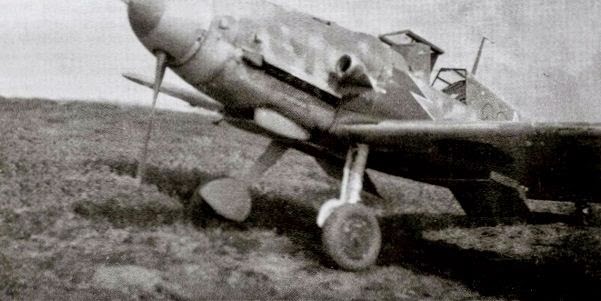
So-called 'Idiotenbock' Emil trainer with 'fixed' landing gear and wing-tip 'stabilisers'  -   from reading the piece it is not clear if they were flown like this - that seems unlikely. These 'skids' were more likely designed as an aid to 'rough-field' taxiing. 


 After a long investigation and thanks to local eye witness accounts, Gilles Collaveri's association "Aérocherche" located the field where Friedrich Kisslinger's Me 109 crashed. Parts of the aircraft were uncovered, albeit damaged where the field had been ploughed. Nonetheless, one oil temperature gauge plate had miraculously remained intact because it was folded in half, protecting the inscriptions. It confirmed that the 'aviation archaeologists' of  'Aerocherche' were looking at the remains of an Emil. Numerous parts gradually came to light: equipment components, a fragment of an instrument panel counter, ammunition cases of different calibre: cannon and machine guns. Some of them still showed traces of green camouflage paint. In the spirit of respect and remembrance the pilot's family was located near Munich, more specifically the pilot's nephew, who shared the same first and last name as his uncle. He expressed a strong desire to visit the site of his uncle's crash. More than 70 years after the accident, Friedrich Kisslinger arrived from Germany with his son to visit the crash site of his uncle's Me 109 ‘red 5’. 

See Friedrich Kisslinger's visit towards the end of Gilles 20-minute film on Vimeo here

Parts of this article were previously posted on line at the Aérocherche FB page here


Friday, 9 October 2020

La Luftwaffe en France 1939-1945, tome 1 (Arès, 2020)


Jean-Louis ROBA has just published his latest hardback, book 1 of two to cover the history of the Luftwaffe in France during the Second World War. My pre-ordered copy arrived yesterday from French publisher Arès - better 'known' apparently for their histories of French military units. This fine A-4 hardback is jam-packed with photos and data - nearly 600 images according to the publisher's blurb. The author's approach to his subject matter is geographical, chronological and global. The almost two hundred pages of text are abundantly (!) illustrated with pictures taken by the veterans themselves, providing an almost 'intimate' view of life for operational and training units stationed on French soil, in many instances far removed from the usual propaganda clichés (men of JG 2 buying crabs in Morlaix, an excursion to Mont St. Michel etc etc). There are of course multiple views of aircraft and 'personalities'. Side-bars and text boxes (blue background) include DFS 230 and Gotha Go 232 training operations from Valence, the He 111 Z of the LLG, profiles of Harlinghausen, Sperrle and the commanders of 1. and 2. Fallschirmjäger Divisionen and even 'Lion cubs in the Luftwaffe ' or 'Göring in Paris'. Unusually for this type of work and because they are so numerous and spread throughout the volume, there is an 'index of side-bars' alongside a 'conventional' list of contents - although in the typical French format this appears at the rear of the book.

This first volume covers the first half of the war, from the Phoney War to the invasion of the 'zone libre' or the 'unoccupied territory'. Individual chapters cover the fighting during operations in the West in May and June 1940, the Battle of Britain, the defense of French airspace against the RAF's 'non-Stop' offensive incursions, the organisation of Luftflotte 3 after Luftflotte 2's deployment towards the USSR, the protection of Operation Donnerkeil and the reaction to the raid on Dieppe.


Chapter I covers pre-war Franco-German relations in the aeronautical field while chapter 2 is devoted to the 'Phoney War' including a full list of Luftwaffe losses over the border areas during this period.  Chapter 3 is a daily 'diary' of the Westfeldzug combats over France principally from the view of the St.G and KG committed in operations. Aerial activity did not cease in the intermediate period between the battles of 1940 and the intensification of the Allied bombing of Germany. Chapter 4 is entitled ' the first year in France' and there are four pages devoted to the dispositions of Luftflotten 2 and 3 with side-bars devoted to the 'Nahaufklärungsgruppen' and the establishment of the air-sea rescue service (Seenot). There is a fascinating overview of the aerodromes and installations exploited and occupied by the Luftwaffe  including graveyards and their often elaborately 'decorated' honour cemeteries (pages 102-104) or Ehrenfriedhöfe. The text does not just focus on airborne units. Ground units, anti-aircraft (Flak) and parachute (Fallschirmjäger) units as well as the various administrative entities are also featured. Luftnachrichten Schule 4 is covered on one page (radio operators school). Chapter VI covers a whole range of training units including the FFS pilot training schools, the Dewoitine D.520-equipped JFS 5 at Villacoublay and the Fiat Cr.42 -equipped JG 107 at Toul. There are 'annexes' that detail JFS 5 losses and two pages of Flak claims along the Channel coast for 1941.


Activities at Pau, Blagnac, Cazaux. Rennes, Istres etc etc along with other 'secondary' airfields feature, with first-person accounts detailing daily life (if you can handle the French text..). 

Mechanic Heinz Zimmer recalled; " ..in December 1940 I left Germany for the first time in my life and was sent to France in Cognac. I was assigned as a mechanic to the Ergänzungsstaffel 26, the operational training unit of JG 26, commanded by Oblt. Freiherr Hubertus von Holthey, a Baron. I arrived with a group of mechanics from Merseburg. We were billeted in a college. We worked on the Bf 109 Emil and Friedrich. The winter of 40/41 was very wet. The runway wasn't very good either. The Bf 109 was difficult to manoeuvre during take-off and landing. There were many accidents due to these factors. Nevertheless, as mechanics, we had many compensations in France. The climate was milder than in Central Europe and we ate much better. Eggs for breakfast but too often goulash the rest of the time.."

 The Ergänzungsgruppen established throughout France are covered in some detail. At the beginning of 1942, all the Ergänzungsgruppen subordinate to the Jagdgeschwader were disbanded and divided into four large school units, the EJG Süd, West, Ost and Nord. They were primarily established in the South of France, where the climate was more favourable for training (this was at a time and in a sector where British intrusions were very rare). Heinz Zimmer was posted to Cazaux, one of the airfields of the EJG Ost; " ..I found the climate quite debilitating. We were bored. There was no food to buy in the area and the only recreation was going to the beach at Pilloy-sur-Mer near Arcachon. In the spring of 1943, we were moved to Landes de Bussac (Ste Marie). I had barely arrived when I ran into ... Hermann Graf who recognized me, his former mechanic. He ran the school and I was delighted to run into him again. Apart from this excellent surprise, life remained the same. The track was sandy and many machines were damaged. At that time we received a visit from General Adolf Galland.."

 Another mechanic Uffz. Philip Schmelzer had re-trained to fly the Bf 110 and then moved to fighters. In May 1943 he was posted to Toulouse-Blagnac; "We arrived in Blagnac. There were only pilots in our group, since we were going to be re-trained on single-seaters. At the school we were introduced to Heinz Bär, who had been withdrawn from a front unit because of his differences with Hermann Göring after the fall of Africa. We were first trained on the Bf 109. But we had been told so many bad things about this aircraft (it was hard to fly, it's undercarriage was fragile, visibility was poor...) that we were somewhat terrified when we took the controls. Accidents were commonplace. Graf then brought us together and calmed us down by taking the drama out of this plane. After his explanations, things went much better. We then passed out on the FW 190 and I very much appreciated this machine".        

 Below;

 a veteran of 1940, Oberfeldwebel Herbert Kaiser flew with III./JG 77. In late January 1943, he had been evacuated from Tunsia and sent as an instructor to the Er. JGr. Süd in Marseille. On March 14, 1943, at Marignane airfield, he was awarded the Knight's Cross for his 54 victories by the school's commander, Oberstleutnant Alfred Müller, a former Great War pilot. Kaiser returned to JG 77 and then JG 1, surviving the war with 68 victories to his credit. On the left is Oberleutnant Erwin Clausen, a JG 77 comrade also attached to the school as an instructor.  Clausen was KIA as Kommandeur I./JG 11.


There are a number of colour profile artworks distributed throughout the book (by Jean-Marie Guillou) but the content is so dense I almost failed to notice them on initial perusal. Images of period documents (and the odd newspaper report) that add so much visual interest and additional data are dotted throughout the text. And I have not yet mentioned chapters covering night fighters and the 'invasion' of the southern zone following 'Torch'. While there is a large range of material featured, the author is at pains to point out that this work is 'merely' a synthesis of the variety of subject matter that could have been included in a more 'exhaustive' work, but I have to say he has done a fabulous job with the material he has presented. The lay-out is a little 'crowded' even so and some of the images are just a little on the small side since there are so many of them. I would have liked to have seen some details of aircraft production too since a number of types went straight into Luftwaffe service from French factories - although there is some detail in the photo captions perhaps this is for part two. The text makes clear that increasingly hard-pressed resources were spread ever more thinly over larger and larger territorial areas, forcing the staffs to make choices and the hard-pressed personnel to perform  with sometimes very limited or obsolescent means. Overall though any comments or criticisms of mine are pretty minor-league and it is impossible to do justice to the book in a short review.. Congratulations to the author. If you have any interest in the history of the Luftwaffe then this work devoted to the daily life of Luftwaffe units in France is highly recommended. Hopefully Part 2 will be with us some time next year!

Below;

Hermann Göring  seemed to enjoy visiting Paris and France rather more than his Führer who preferred Rome according to most accounts. Contrary to popular opinion Göring did not visit France just to acquire artworks. Here he is seen arriving in Buc to visit 1.(F)/123 on 15 August 1941 with Barbarossa in full swing. The descent from his Fw 200 was probably a little awkward. Later in the year he met Petain at Saint-Florentin and also visited Dieppe following the abortive Canadian landing in August 1942.


Published during September 2020. Publisher's website for ordering and more page views is here

Format 215 x 305 mm - Bound, hardcover, 196 pages, 600 photos, 7 color artworks. French text

Friday, 8 January 2016

Pilot training in the Luftwaffe - flight discipline, pilot culture and the development of procedures and check lists - "Why Air Forces Fail " (2)


“Mister Steinhoff, you might be a hero but your instrument flying is lousy!”

 (US instructor to Oberst Johannes Steinhoff -176 aerial victories - after a jet training sortie post-war)

The Germans have a reputation for being orderly and efficient in everything they do. In reality they were/are probably very far from this idealised image. (2015's VW scandal and Merkel's recent decision making in the current European migrant crisis are good and very recent examples of this 'indiscipline' !) This is especially true of flight training and attitudes to flying in the war-time Luftwaffe. Although the Germans started the war with a cadre of well-trained, even experienced pilots, training was to become " the Luftwaffe's greatest failure.." (James S. Corum in 'Why Air Forces fail' p219) In general terms it is probably true to say that the majority of Luftwaffe pilots were technically rather poorer than their counterparts in other air forces, certainly in comparison with USAF, RAF and even Soviet pilots the longer the war continued. As the war progressed the large disparity in training time between Allied and German schools grew - Corum goes so far to state that by 1944 ..." replacement pilots in the Luftwaffe were so poorly trained they did not need Allied fighters to bring them down in large numbers.. " ('Why Air Forces Fail' p221).  Inexperienced or poorly trained pilots could not cope with engine failures, rough field takeoffs or landings, bad weather or heavy cloud cover..

The problem with pilot training in the Luftwaffe from the outset was linked to that of culture and discipline. Two studies look at aspects of indiscipline in flight training and pilot culture in the wartime Luftwaffe. Ernst Stilla's PhD doctoral thesis on the "Luftwaffe in the battle for air supremacy over Europe" looks at the factors in the defeat of the Luftwaffe in the defensive battles in the West and over Germany, with particular consideration given to research and production, technical development and " human factors", such as pilot training. Elsewhere US academic Roger Bohn's study 'Not flying by the book' looks at the adoption of better flying methods and procedures, especially check-lists during WWII and post-war up to the adoption of the Standard Flying Procedure system and is a very useful read for non-linguists as it exploits parts of Stilla's dissertation. The 'human factor' in flying is of course an important cause in accidents - the wartime Luftwaffe lost literally thousands of aircraft through non-combat causes. In February 1944 alone over one thousand Luftwaffe aircraft were lost in accidents, a good proportion of which were " considered due to inadequate training.." (Boog quoted in Isby 'The decisive duel'  p361)..

Faced with the development of increasingly more complex aircraft during WW II and the training of huge numbers of new pilots to fly them, some air forces recognised that standardised procedures and check-lists had to be drawn-up to maintain and increase military effectiveness. Few air forces though did this. The Luftwaffe certainly did not, and the 'culture' of this organisation simply would not have allowed it - quite the opposite. Accidents and surviving them were almost a badge of honour for the pilots. This had little to do with the intensity of the war in the air - Werner Mölders noted as early as 1935 in his diary that there were very many accidents due to lack of discipline, and Galland's biographers noted that accidents among the 'macho' German fighter jocks were a daily occurrence in 1938.

Pre-war, in Spain, and during the early years of WW II, the Luftwaffe was heavily dominated by individualistic fighter pilots. While experienced pilots valued their 'autonomy', free of the constraints of 'rigid discipline' and had developed their own 'flight craft' and decision-making skills to fall back on, newer pilots did not have this luxury.  Accidents " were common and accepted .. there were few procedures, no checklists and little written documentation.." (Roger Bohn -see below) Gunther Rall's account of converting onto the Luftwaffe's standard fighter - the Messerschmitt Bf 109-  is revealing - while he had almost 200 hours of flight time,  he was operating without any checklist, not even a simple memorised checklist as used in the RAF. The Bf 109 may have been one of the best fighter aircraft in the world in 1940, but it was a pretty unforgiving machine;

" ...its spindly narrow-track undercarriage is actually much too weak to cope with the enormous torque, rate of yaw, and turbulence of the airscrew. Take-off accidents are therefore commonplace, not just in the training schools, but also among front-line units... And once in the air the pilot still has his hands more than full: the undercarriage must be retracted...before a certain airspeed is reached, engine and propeller have to be set manually to cruise, the flaps cranked up by a large hand-wheel....and the now tail-heavy bird....trimmed for level flight..... [A few moments later].... frantically carrying out in reverse order everything that they had somehow successfully managed to do at take-off. It is advisable under such circumstances not to mix up, let alone forget, any of the actions described above, for the Messerschmitt is no docile carthorse, but a highly-strung thoroughbred. If the propeller pitch is not reduced in time, any attempt to go round again will end in a crash beyond the airfield perimeter. If the undercarriage has not been lowered, because the pilot has never before needed to lower an undercarriage in his life, he'll at least get down on the field, but in a resounding belly-landing .... But even then the Messerschmitt still has a few more tricks up its sleeve. If the stick is not held firmly back after touchdown, or if the pilot tramps a little too heavily on the brakes, a somersault is almost inevitable...."

It is striking to note that high accident rates in the Luftwaffe were mostly not the result of combat. In his study Ernst Stilla (see below) quotes Milch who - in early 1943 - complained to the leadership about 'declining aviation discipline' and highlighted loss rates during transfer (long-distance change of base) flights, which had risen to some 20% damaged or destroyed (during the period May-September 1942). In comparison overall American losses during transport flights from the US across the Atlantic Ocean in September 1944 - a journey of several thousand kilometres - were just six aircraft out some 1,200!

In retrospect, the situation cried out for checklists and standardised procedures but Luftwaffe commanders saw little or no use for such developments - one Luftwaffe General, Walther Wever, had famously died in 1936 piloting his own aircraft, having forgotten to remove the external gust locks. The Wever crash was the putative spur to the USAF’s invention of aviation checklists. But this crucial aspect in the management of technological change in aviation was entirely neglected by the Luftwaffe. The 'technology' was not even "classified" and could have been copied easily. In the US, 'Life' Magazine ran an article on the B-17 checklist in 1942, and by the mid-war years American aircraft shot down over Germany carried checklists in various formats.

One important area where the Luftwaffe also and critically failed to adopt 'best practise' was in the area of instrument training. The Luftwaffe was primarily a "fair-weather" air force in 1940, and it remained such throughout the war. Only the desperate expedient of putting bomber pilots trained on instruments into fighters from spring 1943 - the so-called wilde Sau fighters - enabled the Luftwaffe to deploy fighter aircraft to intercept bombers in bad weather. The day fighter arm was troubled by bad weather through the war. As General der Jagdflieger this was one of Adolf  Galland's biggest mistakes according to Caldwell;

 " ..he did not realise the need for instrument training for single-engine day fighter pilots until it was too late. His attitude was typical of the macho prewar  fighter jock. Fight over the Reich? Against planes that fly in clouds? What nonsense! "

This was an area where Luftwaffe pilots were at a severe disadvantage as the air war intensified as Steinhoff pointed out;

  “..very frequently fighting took place over long distances above cloud cover, and the completely disoriented fighters had to go below the deck and attempt to land wherever they could. Together with insufficient navigational aids, this resulted in many additional losses and a wide scattering of our aircraft. "

By late 1943 the Luftwaffe had lost most of its original complement of pilots. In the first six months of 1943, Germany lost 1,100 fighter pilots, which was about 60% of the number at the start of the year. It lost another 15 percent in each of July and August. It is interesting to note that of the 100+ Luftwaffe 'aces' credited with over 100 victories during WW II only eight of them started their flying career after 1942. The high pilot losses had two disastrous effects. First, even if they had been well trained, newer pilots were inexperienced and inevitably sustained more accidents and combat casualties than the pilots they replaced. Aside from the fact that the Luftwaffe's leadership expected every campaign to be a short one and for many of them stripped training schools of experienced instructors, pilot training programmes in the Luftwaffe were heavily curtailed. Already in early 1944, the Luftwaffe fighter pilot training was shortened to an average of 160 flight hours. A few weeks later, it was further shortened to only 112 hours. Finally, in the spring of 1944, the B flight schools were disbanded, and the pilots were sent into first-line service directly after A schools. The condition for the A2 flight certificate included a basic training of sixty training flights with a total of 15 flight hours. Meanwhile, the average USAAF or RAF fighter pilot's training consisted of 225 flight hours. German survival rates correspondingly reached a nadir. During the first five months of 1944 Luftwaffe fighter units underwent a complete turnover of pilots so that the German achievements in production during 1944 were entirely hollow.

As Bob Goebel pointed out in his memoir 'Mustang Ace', all fighter pilots - certainly all US P-51 pilots - could probably fly well. But while only relatively few could shoot well, in the Luftwaffe, Nachwuchs or new growth pilots-at the controls of their high-powered and heavily armed Bf 109s-could do neither. In his two volume history of the leading Luftwaffe Defence of the Reich fighter Geschwader JG 300, Jean-Yves Lorant noted that " ..the average life expectancy of a JG 300 pilot for the last year of the war amounted to just 11 hours of flying - barely four sorties..including check and ferry flights.." So while there was almost no fuel for training, there were plenty of aircraft, so the Luftwaffe kept sending pilots up to be slaughtered. Bohn argues that better training procedures could have prevented many deaths and at the very least would have facilitated the rapid training of large numbers of new pilots. In the end, improvisation and then desperation dominated. The ideological image of the fanatical fighter - which led to the creation of 'specialist' ramming units - had increasingly overtaken professional capabilities and skills. Little thought was given to the pilots' lives.

With the post-war establishment of the Bundesluftwaffe ,German vets were sceptical and ambivalent towards American training procedures, once again highlighting the war-time Luftwaffe's indifference to training and accidents; despite good language training, the German pilots had difficulty adapting to American  training procedures -  learning by rote, repetition, and precise implementation of standard check lists. This was in stark contrast to the experiences of the German veterans. The longer the war had lasted,the shorter and less professional the German pilot training had become. Shortages of fuel due to bombing and Soviet recapture of oil fields also forced reductions in flight training hours with dramatic consequences.
Günther Rall gives a balanced evaluation, writing many years after his retraining.Here is his colourful comparison of checklists with Catholic religious rituals.

" ...Then, on 19 Sept 1956, I am at last once again strapped into a proper aircraft: a North American T-6.... And on my knees, for the first time in my flying career, I have a check-list. On this the Americans have set down, step by step, every action that has to be taken to get the T-6 into the air and then back down again. The list is arranged in handy sections and anyone who doesn't carry out all the moves and checks in exactly the right sequence is automatically flunked, despite the fact that he might be a hundred times more efficient by doing things in his own individual way. Procedures and checks do for US pilot training what the rosary and litany do  for the devout Catholic -- more in fact: if employed with sufficient ardor, both will get you into heaven, but only the former will return you to earth afterwards. It takes some little while before I learn to appreciate the benefits of this system that at first sight seems so rigid and stupid. Anyone who knows his procedures and has the acronyms in his head to call them up, can hardly go wrong even in the most difficult situations..."

..and that last sentence is -in a nutshell- why there is a Standard Flying Procedure today....

Sources for this blog post;

James S. Corum in " Why Air Forces Fail - The defeat of the Luftwaffe 1935-45 "

Ernst Stilla's PhD doctoral thesis on the "Luftwaffe in the battle for air supremacy over Europe" is entitled Die Luftwaffe im Kampf um die Luftherrschaft. Entscheidende Einflussgrößen bei der Niederlage der Luftwaffe im Abwehrkampf im Westen und über Deutschland im Zweiten Weltkrieg unter besonderer Berücksichtigung der Faktoren „Luftrüstung“, „Forschung und Entwicklung“ und „Human Ressourcen“ and is available as a PDF download from the University of Bonn's website here
http://hss.ulb.uni-bonn.de/2005/0581/0581.htm

US academic Roger Bohn's study 'Not flying by the book' on the implementation of check lists and procedures in the world's air forces

https://art2science.files.wordpress.com/2013/07/standard-proced-adoption-bohn-2013.pdf#page=80

Friday, 29 May 2015

photo album JG 107 Nancy - Ochey - pilot training in the Luftwaffe Ebay photo find #118


currently at 116 euros with nine days left ....click to view the full image large

" after the campaign in Russia and being wounded for a third time with a spell in the field hospital in Siedlce (Poland),  convalescence. Then to flight training-  'Fliegerei' ....here I am in my first flight suit.."


Below; C 445 A/B 3 Guben


scenes from I./ JG 107 in Nancy-Ochey


Below; " he wasn't the only one..but he was one of my best friends.."


"... after a mid-air collision.."


" ..This B-17 - the so-called 'Flying Fortress '- was shot down near Nancy and made an emergency landing. It was repaired and made flight worthy on the airfield. But we are so tiny next to these machines and it takes a brave pilot to take them on in combat.."


Werner Seiffert, KIA 25 August 1944


" ..April/May/June 1944 at Marseille-Marignac - the Yanks often come down the Rhone valley and we fly our first sorties as fighter pilots. I'm still in training, but now as an instructor (Fluglehrer) ..here I am climbing out of my crate....the nasty number '7' ..."


On offer here

Thursday, 27 November 2014

an ace of I./ JG 26 Lt Karl Willius, Do 17 of KG 76, Ju 52 in the Demyansk pocket ebay photo find # 103


current sales from ebay.de seller iq152 here

Below; an ace of I./ JG 26, Karl 'Charly' Willius. His aircraft - probably FW 190 A-3 'Yellow 5' (WNr. 5227 - ?) is displaying under the cockpit the flags of the nations against which he has flown ; the Netherlands, Belgium, France, probably followed by the 'Union Jack' of the UK and the hammer and sickle of the Soviet Union (?) In late January 1943, I./JG 26 was moved to the northern Front in the East in an exchange with III./JG 54. The 'Schlageter' appear to have welcomed this shift with a certain relief - they no doubt imagined that pickings might be easier on the Eastern Front and their chances of suvival, when faced with a perceived weaker enemy, commensurably improved.. In addition they were to convert on to the latest FW 190 A-4 and FW 190 A-5 sub-types. These aircraft were marked up with a wide yellow theatre band around the rear fuselage. Willius flying with 3./JG 26 retained his preferred number 'Yellow 5' in the East. He already had a certain amount experience flying in Russia, having flown extensively in combat with JG 51 before moving back to the Western Front during August 1941.

Hospitalised in Louvain, Belgium with a short illness during November 1943, Willius married his nurse and his wife later gave birth to a baby girl. As Staffelführer with the rank of Leutnant in 2./JG 26, Willius was shot down by P-47s on 8 April 1944 while combatting a USAAF raid over Holland and listed as missing. He would be awarded a posthumous Ritterkreuz for his 50 victories including 11 four-engine bombers (his last a B-24 on the 8 April raid). His body, still at the controls of his Fw 190 A-8 'Black 5' (WNr. 170 009), was discovered in the Zuider Zee on 23 October 1967!


Above, Do 17 crash-landed during the campaign in the West - emblem of KG 76 on the nose. Below; Stuka of III./ StG 1


 Above; JG 5 Emil and Beute Fokker T-8


Ju 52 in Greece - inscription on reverse reads "..before take off for Crete..". Picture dated 1942


Unidentified machine with Kommandeur chevrons


More from Michael Meyer;


above; Ju 52/3m "GA+WW" of 4./KGrzbV 900 in Roslawl during February 1942 prior to flying into the Demyansk Kessel (pocket). The crew of pilot Jürgen Pfau is seen shovelling snow away from the machine. Below; another Ju 52/3m of 4./KGrzbV 900 "GA+WW" assigned to Fw. Kramer also in Roslawl in February before flying into the pocket.


Pilot Fw. Becker hugging the ground (im Tiefflug) en route into the Demyansk pocket at the controls of Ju 52/3m "CH+HY" of 4./KGrzbV 900 during March 1942.


Michael Meyer's current Ebay sales are here

.. an interesting Gustav apparently on the strength of IV./ JG 51 but featuring the JG 2 Adlerflügel or 'exhaust eagle' from the previous post - evidently a machine previously assigned to JG 2 (posted by 'Laco Pilot' on the Bf 109 FB page)


and finally today a few from Marko Auer's current sales, link below;

emergency landing at sea off the coast of Norway


and below, three views of a Klemm KL 35 trainer from the Flugzeugführerschule  FFS A/B 9 in Grottkau..


 Marko Auer's Ebay sales are here

Saturday, 15 November 2014

P-51 Mustang 'T9 +HK' Wanderzirkus Rosarius, JG 1 Husum 1944


" ..The day was rounded off with a demonstration of captured American aircraft, in particular a P-51 Mustang. It was stressed that our Bf 109s and Fw 190s were generally superior to this type. We soon realised on our first combat sortie that this statement was not entirely accurate....”  Uffz. Kurt Scherer II./JG 4


In 1943, Hauptmann 'Ted' Rosarius was tasked with forming a Versuchsstaffel of captured enemy aircraft that would serve to familiarise pilots of the Reichsverteidigung (Defence of the Reich) with the strengths and weaknesses of Allied fighter aircraft. This unit, 2.Staffel of the Versuchsverband Oberkommando der Luftwaffe (Trials and Research Unit of the Luftwaffe High command) received all captured aircraft. Once flown and tested, they toured frontline fighter units. This unusual formation became known as the Wanderzirkus Rosarius (Rosarius' travelling circus). Thanks to the 'Rosarius Circus', German pilots had the opportunity to take a closer look at their principal opponents and hopefully gain better knowledge of the equipment pitted against them.

The increasingly difficult tactical situation the Luftwaffe was experiencing during 1944 meant that demonstrating and carrying out what would be known today as 'dissimilar combat training' had become a necessity.  Fighter pilots tend to fly mock aerial combats against their own - men trained in the same fashion and flying the same aircraft. Such training, while useful, cannot replace actual combat experience. In his memoir, Walther Dahl wrote of the ever decreasing number of experienced pilots in the Luftwaffe ;

 "...despite the successes we had enjoyed over the course of our recent sorties, a number of gaps had started to appear in our ranks. Seasoned Staffelkapitäne, experienced Schwarmführer, Leutnante, Feldwebeln and Unteroffiziere - pilots who were the backbone of our unit - had all been posted missing in action . Men such as Oblt. Hirschfeld of 6./JG 300 who was lost in combat on 28 July 1944 and posthumously awarded the Knight's Cross. There were plenty of new young replacements, all volunteering to fly with the Sturmgruppe but virtually none with any front-line experience. Despite the constraints on time, fuel and aircraft availability, it was down to us to complete the training of these youngsters, to " fly them in " under operational conditions as it were..."

 (translation by this blog author)

 The lack of experience of the younger pilots could be partly compensated for by the demonstrations of the Rosarius Circus - the unit toured the airfields defending the Reiche demonstrating how enemy aircraft performed and how they could be beaten or countered.

The fact that Rosarius' Circus was composed of not only different models, but foreign models - with no spare parts supply to speak of - meant that maintaining the aircraft in 'service' must have been a mechanical and logistical nightmare. However, the unit seemed to maintain a decent readiness record, good enough to allow it to fulfill its mission. While Dahl and JG 300 were based at Wörishofen airfield, they were visited by the 'Circus';

 "...one morning enemy fighters such as P-51s, P-47s, Lightnings along with the heavy bomber types, could be seen peacefully arrayed alongside our own machines, when their appearance over the field would normally have provoked anything but a friendly reaction.. formation leaders (Verbandsführer) were given the possibility of flying these machines in mock combat and thus becoming more closely acquainted with their characteristics, a factor that was not to be under-estimated in air combat with our opponents. Following this session, flight leaders would hold a series of training lectures with their men and were able to pass on recommendations from their own observations and experience at the controls of these aircraft..".


 A B-17 was also used on such tours to show the Luftwaffe's pilots what the aircraft's strength were, and, more to the point, what its weaknesses were. By studying what the defensive guns' firing arcs were, where the armour and fuel tanks were located, German pilots gained invaluable knowledge.

 The 'new' image show-cased here depicts P-51 B Mustang 'T9+ HK' parked on Husum airfield during late 1944. Pilots and personnel of JG 1 crowd around the machine. 

Ideally, pilots would have been able to test all of the aircraft flown in by the Circus. However, submitting fragile and rare aircraft to inexperienced pilots was not always a practical option; equally, unseasoned pilots would not have been able to judge the aircraft as quickly and efficiently as the more experienced fliers.

  The 'Zirkus' may have partially compensated for the Luftwaffe's increasing technical, tactical and "human" inferiority. However, the tide of the air war had already turned.

Wednesday, 18 June 2014

captured Fw 190 and 37mm cannon-equipped Ju 87 G photographed at Flensburg during May 1945, Luftwaffe trainers Bücker Bü 181, 131 - daily Luftwaffe Ebay find #86


currently on offer via airpics Ebay sales - another view of  a well-known captured Fw 190 previously identified elsewhere as FW 190 A-8 '1 + -', possibly of II./J.G. 1, Skrydstrup, Denmark, and 37mm cannon-equipped Ju 87 G photographed at Flensburg during May 1945, a rare FAGr. 5 Ju 290  A-7 and another Eastern Front Arado 232


http://www.ebay.de/itm/Foto-Flugzeug-42387-/201109094241?pt=Militaria&hash=item2ed3093f61&autorefresh=true

http://www.ebay.de/itm/Foto-Flugzeug-Airplane-Me-110-mit-Kennung-Tarnanstrich-2-WK-H290-/360900687437?pt=Militaria&hash=item54075b764d


Flugzeug Bü 181 mit Wappen der FFDS A 9 Grottkau im Frühjahr 1944 on Michael Meyer's current sales


Above, instructor and student in the cockpit of a Bü 181 of the FFDS A 9 Grottkau in early 1944. In the cockpit, Fluglehrer Uffz. Meyer and on the right Flugschüler Friedhelm Krägeloh.

Bü 181 WNr.126 mit Wappen der LKS 7 in Tulln 1943


 Bü 131 "PU+AC" mit Wappen der LKS 7 in Tulln 1943.


Bü 131 D-2 "BX+AL" WNR.4202 of the Flugzeugführerdoppelschule A 9 FFDS A 9 Grottkau, early 1944.

http://www.ebay.de/itm/4x-Foto-photo-Flugzeug-plane-air-craft-Kennung-Staffel-Wappen-Windmuhle-maling-/261497330751?pt=Militaria&hash=item3ce2749c3f


Fw 189 on Patrick Ott's Ebay sales

http://www.ebay.de/itm/141321495300?ssPageName=STRK:MEBIDX:IT&_trksid=p3984.m1426.l2649