Showing posts with label JG 300. Show all posts

Wednesday, 17 December 2025

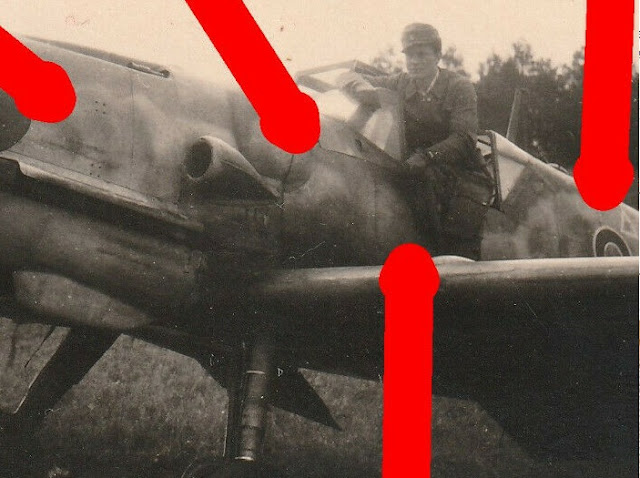
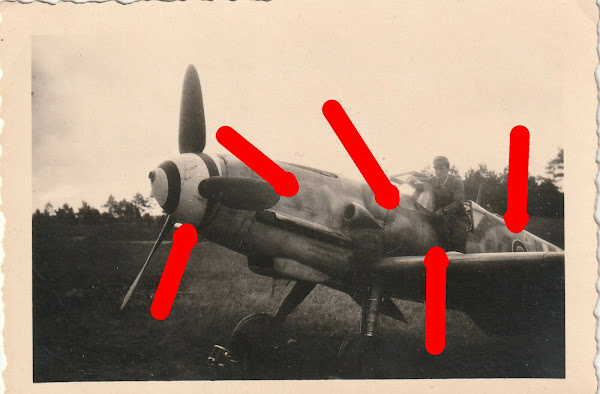
Eduard 1:72 Bf 109 G-10 JG 300 - Michel Wilhelme


"..The 156th is finished. Another Eduard Bf 109 in 1:72 (Royal Class box set). Always perfect, I never tire of these Eduard kits, there are always lots of cool schemes for them too. This latest model is a G-10 belonging to JG 300 and found outside a hangar in Prague. The camouflage is rather different from what we're used to seeing. It's a late-war scheme where it was better to have dark colours so as not to be seen by Allied fighters. The paint is either AK, Mig or Vallejo, which in my opinion are the best colours..."  Michel Wilhelme
 

Elements of JG 300 flew into Prague-Gbell during the period 03-05 May 1945 having been ordered there from Salzberg Ainring. This is one of their machines from 11. Staffel (blue-white-blue bands) seen after arrival in Prague. No other JGs were ordered to Prague -there was a TG in Rusin and an SG Gruppe somewhere north of Prague. The last situation report from Luftflotte 6 dated 7 May 45 confirmed the 'transfer'...as for the Staffel number, it should be green although Eduard's 'yellow 7' looks quite 'green'! Note III. and IV. Gruppen of JG 300 did not use a Gruppe marking aft of the cross..

"...It is difficult to establish an exhaustive list of all JG 300 pilots who managed to fly to Prag-Gbell, then Saaz and finally Eger. Among those who reached Prag were Lt. Meichsner, Kapitän of 11./JG 300, as well as Feldwebeln Hans Gerich and Günther Borchert of the same Staffel, and Lt. Reinhardt Weiss of 12./JG 300; in II. Gruppe, Gruppenkommandeur Oblt. Waldemar Radener and Ofw. Fred Dohms (8./JG 300). IV. Gruppe was better represented, at least five pilots reaching Prag, including Oblt. Heinz Förster (Staffelkapitän 13./JG 300), Fw. Hermann Berdelmann and Uffz. Eugen Maier (14./JG 300), as well as Fw. Walter Ehmer (16./JG 300). Two IV./JG 300 pilots, Lt. Burger and Ofw. Gräfner (13. Staffel), died in the street fighting in the Czech capital, most probably during the afternoon of 4 May 1945..." 

Friday, 8 August 2025

Uffz. Josef Stenner of 14./JG 300 - archive photo scan #39


Little is known about Uffz. Josef Stenner of 14./JG 300 – here seated on his Bf 109 G-10 during March 1945. He survived the war despite volunteering for the Sonderkommando Elbe ramming mission. He had arrived in JG 300 via JG 76 and having been shot down and wounded in combat on 11 September near Kassel Waldau in Bf 109 G-6 WNr. 412 406.

Friday, 1 August 2025

Fw 190 D-9 in JG 300 (part 2)


Apparently Burkhard Otto of jg300.de believes my accounts of the Dora-9 in JG 300 are 'fakes'. Despite the fact that they were first published in 2003 and based on material in the Lorant/Goyat history of the Geschwader! 

Incidentally I do have a copy of Hubert Engst's (unpublished) 'memoir' written during 1966 for East German magazine 'Aero Sport'. In it he describes seeing "our last three Langnasen" getting airborne from Holzkirchen (a JG 300 airfield in southern Germany) for a transfer flight to Ainring during the last days of April 1945. He then 'spoils' it somewhat by referring to these 'long noses' as Ta 152s  - which is obviously incorrect..

So just for Burkhard Otto, here's part 2 of the "Dora-9 in JG 300" Extract from the Lorant/Goyat history of JG 300 (my translation). 


Major Rall’s Geschwaderstab of JG 300 underwent re-equipment with the Fw 190 D-9 from 21 April 1945. Two days later, four Focke-Wulf 190 D-9 Langnasen destined for II./JG 300 came into land at Holzkirchen. These aircraft, delivered with no spare parts, were powered by in-line Jumo 213 supercharged engines able to develop 1,900 hp rather than the 1,650 hp of the standard Jumo 213 at altitude. But it was at sea level that its performance was astonishing; with the methanol-water boost activated the speed of this thoroughbred was within a hairs breadth of 730 kph! Two of these superb aircraft apiece were allocated to the Gruppenstab and 7. Staffel. The fact that these aircraft were becoming available now just as Germany was sinking into chaos served only to reinforce a feeling of bitterness among the pilots. For want of sufficient fuel reserves, training flights in these “long-noses” were limited to a few circuits of the airfield for a handful of pilots selected by Oblt. Radener. The pilots of the Stab/JG 300 were often assigned to fly sorties with II./JG 300 according to requirements. One of these pilots was Uffz. Günter Ritzka, who recalled:

 "..I had already had an opportunity to fly the Fw 190 D-9 before being assigned to Jagdgeschwader 300; I was probably the only Stab pilot familiar with the aircraft. During the last days of the war, I was detailed to ferry one of these Dora-9s from Altenburg to Zwickau. The machine had no armament. Shortly before reaching Zwickau, I came under fire, probably put up by our own flak whose crews were doubtless unfamiliar with the new fighter’s silhouette. As I overflew Zwickau, I could see that the airfield had been hit by a heavy air raid. Landing there was out of the question. I turned back to Altenburg and again came under heavy flak fire at the same location as on the inbound flight. I then realized that the front line had moved up considerably, which was obviously something that they were not aware of back in Altenburg… Suddenly, just as I had left the danger zone, my aircraft was caught in a burst of tracer fire which this time was zipping past me in the horizontal plane! I opened the throttle wide and hugging the ground tore back to Altenburg. I could see that I had been hit as oil was spattered all over my windscreen. I managed to put down at Altenburg with no further problems and taxied to the edge of the airfield. I clambered down from the cockpit and surveyed the undersides of the aircraft and counted five impacts. Just as I was assessing the damage, the air raid warning siren began to wail. I ran to the nearest foxhole. Two or three Thunderbolts flew two firing passes machine-gunning my Dora-9. It is entirely possible that the new Kommodore, Major Rall, flew the Fw 190 D-9. However I do not have any actual recollection of him doing so .."

Part 1 of Fw 190 D-9 in JG 300 is here

Saturday, 24 May 2025

Fw 190 D-9 in JG 300 (1)


from an article compiled by this blog writer for Scale Aircraft Modelling back in 2003. Artwork by Mark Rolfe.

Stab./JG 300 D-9 seen in Prague post-war. The last Kommodore of JG 300 was Günther Rall - his Geschwaderstab may have taken on charge some D-9s in April 1945 but it is not known if Rall himself ever flew a combat sortie in the D-9.

Click on the images to read the captions


Note 'RLM 83' is now considered by some experts to have been a 'maritime blue' - that '83' was a 'green' is/was a widely held assumption possibly originating in the 1980s in the work of Thomas Hitchcock. According to Kiroff there are different 'distinct 'recipes' for Farbton 81 and 82 - and only one for '83'  - others consider blue '83' to have been a 'test' colour for over-water ops, with only limited 'documentary evidence' restricted to a handful of Ju 88 units operating in the Med. More on this shortly....


Also on this blog;

Last sorties of JG 300, April 1945


Saturday, 25 January 2025

Eduard Bf 109 G-6 as Kurt Gabler's 8./JG 300 'Moskito-chaser' - Osprey Combat units 'wilde Sau' by Streetly - a 1 star review!


 Here's a great looking interpretation of Kurt Gabler's 8./JG 300 'Moskito-chaser' in 72nd scale!

" my first completion for 2025, wrapping up the 1/72 Eduard Bf-109 G-6. So impressed with this kit, but found room for some extra detailing with the cockpit, wheel wells and wheels, prop/spinner and aileron mass balances from the Brassin sets. The kit canopy was replaced with a Falcon vac-form, added the Fine Molds brass pitot and the seat belts were scratchbuilt using an old Model Technolgies buckle set. I have tried to follow some of the conventional wisdom that this Mosquito-Jager flown by Kurt Gabler of JG 300, had its fuselage paint removed, leaving a heavily worn natural metal finish. To try to capture this, the fuselage was covered with oxidised pieces of aluminium foil (mainly Reynolds wrap), then painted RLM 75 and gently sanded off with 4000 grit and steel wool to leave the worn finish and paint remnants in corners, around the panel lines and rivets, which was the effect I was looking for. The photos probably exaggerate it in the close up shots, but I am quite happy with the effect in real life. MRP and SMS paints were used with some very subtle oil paint weathering on the painted surfaces added and oil paint washes. The decals are from the EagleCals set, however, I also added the scribble on the rudder using a home made decal. Cannot praise this kit more, it’s a great model to build and I feel it really captures the look and sit of a 109..." Paul from 'Glossy Kits' on FB..


Below; the original Gabler 'red 8' pic here published over two full pages in a two-part feature I compiled for the now defunct 'Model Aircraft' magazine which appeared in the June and July 2014 issues. Entitled "Wilde Sau und Moskito Jagd" the 6000 word article featured the recollections of JG 302, NJGr.10 and NJG 11 pilots Fritz Gniffke and Walter Schermutzki over 12 pages in the two issues with some great artwork by Anders Hjortsberg. 


Gabler flew both day and night sorties. For his account of downing the first Mosquito to be shot down over Berlin see the Casemate 'Day Fighter Aces' volume.. 


Osprey have a new title 'Wilde Sau' title in their combat units series (Streetly, 2024) by Martin Streetly but Gabler is not even mentioned. Nor are other JG 300 wilde Sau aces such as Wischnewski - while pilots that never flew 'wilde Sau' (eg the WWI vet Lindenberger) are featured in the 'Pilot bios' section...according to the publisher's blurb ".. first-hand accounts of Wilde Sau missions are brought to life through archival photographs and newly commissioned artworks of some of the most iconic German fighters of World War 2.."  Er...no, not really! The text is simply a list of missions flown and unit strength returns. There are no descriptions of the combats - not one. Of the "up to 30 original colour artworks" according to the back-cover blurb, only a rather measly 21 feature aircraft here. Of course, these are top quality - but all machines illustrated have been done just as well many times before. Nothing new. In fact you do get the impression that the blurb was written for the book Osprey hoped they were going to get - but didn't.  Photo content is very indifferent. I counted just 10 photos showing Bf 109s and 12 images of Fw 190s, along with 5 of Me 262s. The chapter entitled "Postscript" starts on page 35. Chapter 5, "Technology" lists all variants of Bf 109 and Fw 190, although many of them had nothing to do with wilde Sau - no Fw 190 A-8 or A-9 ever flew 'wilde Sau'. As an Osprey book addict, I was not at all impressed with this volume. Where are the interesting anecdotes and rare insights into the world of the late-war Luftwaffe? Where are the translated extracts from memoirs long out of print and never printed in English? Not here that's for sure. Not a volume I will return to....


Saturday, 15 June 2024

wilde Sau Gustav - ebay photo find # 374


Possibly one of the most interesting schemes to have been seen on a III./ JG 300 wilde Sau nightfighter. This III./ JG 11 Gustav 'white 1' flown by the StaKa of 7. Staffel - with its black/white undersurfaces and white tail - was one of those loaned by III./ JG 11 to the new III./JG 300 at Oldenburg during late 1943 for wilde Sau sorties. The Staffelkapitän 7./ JG 11 was Hugo Frey - there were 18 Abschussbalken on its white empennage at the time of the image. Not 'new' by any means - similar images were also published of course in the Prien/Rodeike history of JG 1/JG 11 and came from the personal album of 7./JG 11 pilot Zick. Last seen on ebay in 2016 and sold then for hundreds of euros! oh dear...

Wednesday, 26 July 2023

Walter Dahl's "Rammjäger" - reviewed by Hans Ring in Jägerblatt April 1962 issue


"..IMHO one of the problems with Dahl of course is all his 'invented' victories - he received the Eichenlaub in March 1945 for 92 vics (or similar IIRC..) and yet ended the war barely two months later with the always-quoted figure of 128 !! Even though he wasn't in a combat unit any longer by that stage and hadn't been since the previous December...apparently it was Dahl's wife who actually wrote/compiled his memoir (Dahl was too busy with right-wing politics to write it himself) and that the figure of 128 is pure invention.."

" Most of those pilots from every country had unconfirmed kills, cross claims, and others that simply survived. I don't understand the point in vilifying Dahl. Instead of dragging some guy's name through the dirt, why don't we just accept that in the heat of battle, miles above the earth, and 70-years later, neither us nor they had a complete picture of what was going on?.." 

Two contrasting views on Walter Dahl's combat record. Most sources quote 128 victories. Of course Walter Dahl wrote a memoir - 'Rammjäger'- which only really covers the defence of the Reich. Unusually for a Luftwaffe fighter leader it has never been translated into English. Of course biographies vary in accuracy and in general terms are often 'unreliable' when it comes to dates and exact events. 'Rammjäger' is certainly not one of those "Flugbuch" type biographies to start with. But this is Walter Dahl - last Luftwaffe 'General of fighters' (or 'Inspekteur der Tagjäger') and according to some, leading four-engine bomber 'killer' and leading Mustang 'killer'. Also according to some, the leading Luftwaffe ace of 1945 with somewhere approaching 49 claims. So why is there no English translation of his book? What is the problem? 

Well, firstly, for 1945 Dahl was not flying with a 'regular' unit!  

.." I was trying to find information about the exact date when Walter Dahl joined EJG 2 but was unable to do so. Also I was unable to find dates for his 9+ victories with EJG 2. I was assuming that more information should be known as Walter Dahl survived the war? "

Dahl's book 'Rammjäger' does not mention service with EJG 2 at all, except to state that on 27 March 1945 -Dahl's birthday-  he, and Oberst Gollob were flying in an Si 204 D to visit Heinz Bär at his jet-training EJG 2 in Lechfeld, when they were spotted by a pair of P-51s, and through Gollob's inspired flying managed to elude them. In the afternoon Dahl test-flew a Me 262 and ran into some P-47s  strafing the airfield, and he shot down two of them for his 102nd and 103rd victories. Then he says that by 4 April he had his 110th victory, but no further mention of EJG 2. Dahl also writes that he finished the war with 128 victories - a figure quoted in just about every biography of the man written since - in other words he scored nearly 20 victories in just over 3 weeks even though he wasn't flying on operations! (he mentions only undertaking a number of Erkundungsflüge - eg 24 April -which resulted in combat) I think we can conclude that a large number of these later victories were 'imaginary'.... 

" ..could or would the Inspector of Dayfighters during the last months of the Reich want to fly a lot of sorties ? Could an aggressive pilot of Dahl's standing continue operational flying if he wanted to, especially during the final months? I think he could..."

Fair enough. Only, these so-called victories were witnessed by another pilot and long-term wingman ..who was flying in another outfit at the time!  

The (grossly inflated) figures for victories claimed and listed in Dahl's book were easily disproved even in 1962! Highlighting the missions of August 15, 1944, Dahl reports 102 victories for the Luftwaffe. The actual OKW daily report published the following day quoted just 29 including 27 Viermots. 

Noted Luftwaffe historian and claims 'specialist' Hans Ring reviewed Dahl's memoir in the April 1962 issue of Jägerblatt.

Ring writes; 

'according to a diary in our possession, II./JG 300 managed only a handful of victories for a small number of losses on August 15. Dahl however states that the Sturmgruppe Bretschneider downed 36 Viermots....'  

and concluded as follows;

" ..So anerkennenswert es gewesen wäre, einem breiten Publikum einmal nicht romanhaft den Abwehrkampf unserer Jagdwaffe fortzustellen, mehr Verantwortungsbewusstsein vor der Beweiskraft präziser Personen-, Zeit-, und Zahlenangaben hätte man erwarten dürfen. Wie soll man Vertrauen auf die Richtigkeit der übrigen dargestellten Ereignisse haben, wenn mann wiederholt auf grosse Unrichtigkeiten stösst. Vielleicht sind wir etwas zu feinfühlig wenn uns ausserdem an diesem Buch seine Tendenz stört, jene Mischung aus 'Und -wir-haben-doch- gesiegt" Selbstbespiegelung und - wir können es nicht anders nennen -infantiler Idealisierung..."

 "...as commendable as it would have been to present the defensive struggles of our fighter arm to a broad public in a way that was not so novelistic, the reader should certainly have expected a greater sense of responsibility before the evidential value of precise first person, chronological and numerical data. How can  the reader have any confidence in the accuracy of the other events described when one repeatedly encounters major inaccuracies? [..] Perhaps we are reacting a little over-sensitively if we are also disturbed by the 'tendency' of this book, that mixture of 'and-yet-we-were-victorious' self-absorption and - we can't call it anything else - infantile idealisation..."

..or, in summary;  'romanhaft' 'grosse Unrichtigkeiten' 'infantil'  - novelistic, major inaccuracies and infantile !

Not surprising then that the last Luftwafe General of fighters never had his memoir translated into English.


Please take the survey!

Sunday, 2 October 2022

'Bastard Flugzeuge' - Erla Bf 109 G-10 JG 300


From 1942 production of the Me 109 Gustav took place at three main plants - Erla-Maschinenwerke in Leipzig, Wiener Neustädter Flugzeugwerke and Messerschmitt GmbH in Regensburg – and ran to a total of 16 series in 82 different designs. A rationalisation 'programme' had become absolutely necessary as well over 1,000 changes had been incorporated into the drawings. (quoted in Schmoll, 'Me 109 - Produktion und Einsatz') As a result major difficulties had arisen during repairs and the replacement of parts. In addition to the new DB engines with their larger superchargers and power boosting (the 'stop-gap' AS and the 605 D) a range of actions were introduced to improve 'commonality'. At the same time changes to the fuselage structure were introduced primarily to reduce drag and increase speed; eg the engine cowl covers were thickened by some 70 mm which enabled the elimination of the typical MG cowl ‘bulges’, the canopy was streamlined aerodynamically and pilot visibility improved (simplified canopy framing and mountings). Increased stability in the takeoff and landing runs was possible through bigger wheels, a lengthened tail wheel and a larger fin and rudder, the so-called ‘aufgestocktes Seitenleitwerk’. And so on. 

Conceived as part of this 'programme', the G-10 was a 'new' light, fast fighter, powered by the DB 605 D adapted for B4 fuel with MW 50 power boosting. (Subsequent versions used C-3 fuel with MW 50). The Methanol/Water Sondernotleistung (special emergency power) injection was an aid to more effective combustion or 'wet' power. Author Schmoll states that the G-10 was the "..fastest variant of the Bf 109-series to see service, capable of 700 km/h at 7,500 m.." Intended to enter series production alongside the K-4 - bringing the Gustav-series up to K-series standard -  deliveries of the G-10 actually started later than the K-4.

 Distinguishing features include the refined 'elliptical' cowl shape over the MG 131s as seen on the G-6/AS. Independent of the engine variant fitted, Erla G-10 production (WNr in the 150-152 000 and 490-491 000 range) is (easily) identifiable by the asymetric cowl shape (designated 'Type 110' by Mermet) with the 'elliptical' or curved MG breech bulge only featuring on the starboard side.  The 'Type 100' cowling  with the Ballungen (elipse, plural) on both sides featured on WNF and Mtt Regensburg production and those airframes recycled from G-6s  (eg, WNr. 130 000, 610 000 and 613 000). The DB 605 D featured a larger oil tank and a relocated oil filler hatch as one of the key ID features - due to the greater volume of oil (60 iso 45 litres) an oil cooler of larger surface area  (wider and shallower) was present. Even though the small "chin" bulges were not  a feature of the 'Type 110' cowl or required by the DB 605 D engine, these are present on the 'Type 100' cowl - probably in an attempt to increase 'commonality' with other variants then in series production.  (see diagram below, from Mermet, 'Bf 109 G-1 to K-4, a guide to engines and fittings')


Below; pilots of 2./JG 300 including Uffz. Hans Dahmen (right) on the cowl of a recently delivered Erla G-10 in late 1944 - note the absence of lower cowl 'chin' bulges. The fairing in front of the windscreen is rectangular and not the 'scallop-shaped' elliptical fairing on the starboard side of the cowl/fuselage.  As the Russians arrived at the Oder during January 1945, I.Gruppe moved from Borkheide to Liegnitz in the 'East'..


Below; late-war Erla Bf 109 G-10 in overall dark green as seen in service with I./JG 300. (Anders Hjortsberg artwork) A good view of the rectangular cowl section (just in front of the windscreen) being removed with what may be an Erla WNr. (?50719) visible.....


On the starboard side of the 'Type 110 cowl' the hatch for the cold weather starter is repositioned much higher up on the cowl (appears lower near the exhaust stack on the G-14). Other features of the G-10 include the tall tail with trim tabs and enlarged fairings on the wing to accomodate the bigger main wheels - and of course the 'Vollsichthaube', the 'clear vision' canopy minus the heavy framing. Note the absence of an antenna mast - replaced by the under-wing whip aerial - another 'streamlining' measure on late-war Bf 109 production.  

There are really no hard and fast rules with late-war 109s of course -  early Regensburg G-10 production featured the original G-6 wing with the smaller main wheels and upper wing 'tear-drop' bulges and according to some (eg Wolowski) early Erla G-10s - possibly as many as fifty examples - received the AS engine with the bigger deep radiators and lower cowling bumps. These were from the first production batch, WNr. 490 000. These may have been designated G-10/AS  (see JfV Teil 13/IV pages 27 and 28). Erla referred to them as 'Bastard Flugzeuge'.

The concept of a G-10/AS usually provokes a comment or two. The 'true' 109-experts will deny that the Bf 109 G-10/AS even existed. Several units nonetheless reported Bf 109 G-10/AS machines in their loss returns - in particular JG 300 - and, as far as is known, mostly in the Erla 490 000 WerkNr. range.. 

17 Dec 44 - Lt. Köhler, Otto  - 10./JG 300 Bf 109 G-10/ASM, WNr. 490291 'White 1', combat with P-51, 100%.

24 Dec 44 - Lt. Kampf, Werner - 10./JG 300 Bf 109 G-10/ASM WNr. 490299 ''white 11', combat bei Erfurt, 100%

(Some would say DB 605 AS powered Bf 109 G-10s were simply designated as Bf 109 G-10)

According to Mermet's first book around 4,500 G-10s were built, of which 3,500 were either re-cycled Gustav airframes, or Gustav airframes that received the 605 D engine while in production!  Figures that proved to be wildly inaccurate...

Schmoll quotes the following figures for G-10 production;

Erla - 1,534  G-10 (November 44- Feb 45, including 916 G-10/R6 with the Patin PKS 12 Kurssteuerung 'automatic pilot')

Mtt Regensburg - 116 G-10  (October 44 -Jan 45)

WNF -  approx 360 G-10/U4  (Mk 108 30mm cannon +MGs, only built by WNF during January -Feb 45)

A further 518 G-10s were constructed during March 1945 by Erla and WNF before production ended.

Below; Me 109 G-10/U4 of II./JG 52, WNr probably in the 611 000 range (WNF production) at Neubiberg after surrender. An enlargement from the negative via James V.Crow collection. Click for a full-screen view.


AZ 'Erla' Bf 109 G-10 by Jan Pavlik


Below; Bf 109 G-10 W.Nr. unknown. Note port side 'elliptical bulge'.  "Yellow 11" is a machine that belonged to III./JG 4 seen after Jüterbog-Damm (?) fell to the Soviets in late April 1945. Large wheel bulges, small tail wheel, JG 4 crest on cowl. III. Gruppe Balken, yellow rudder ...


Incidentally, Vladimir Sandtner's 109 - extensively photographed at Falconara, Italy after the pilot deserted during April 1945 - is NOT a G-10, although identified as such by many including Ritger in his "Messerschmitt 109 F-K Variants". Aside from the fact that the Allied Intelligence report states "G-14"  the starboard view shows the repositioned cws aperture. More on this blog at the link...

also on this blog;


Friday, 18 February 2022

Gfr. Hans Dahmen 2./JG 300 Bf 109 G-6 - Ebay photo find #353


I./JG 300 Bf 109 G-6 seen at Bad Wörishofen, photo dated August 10, 1944. The inscription on the reverse of the photo - 'in friendship, from Hans, Bad Wörishofen, August 1944' - suggests that the pilot seated on the cockpit was one of Kommandeur Hptm. Stamp's 2. Staffel teenagers, 19-year old Gfr. Hans “Hänschen” Dahmen.. Dahmen's 'regular' machine was 'red 2'. Current bid is over 330 euros with two days to go, no doubt some 'mad Frenchie' keeping the bidding high. 

Edit- final selling price was a frankly quite mind-boggling 1,561 euros.....


Dahmen downed a bomber on 18 July 1944 and two more 15th AF Viermots fell to his fire on 25 July over Linz. He registered hits on a third B-24 during this action for an endgültige Vernichtung. Dahmen's Kaczmarek was Uffz. Wolfgang Hundsdörfer. Both Dahmen and Hundsdörfer brought down B-17s on August 22 raiding refineries in Austria but I./JG 300 ran into 31st and 52nd FG Mustangs. Gfr. Hans Dahmen was brought down near Raab. Some Hungarian villagers found him staggering along a track, blinded by blood pouring from numerous facial wounds. The windscreen of Dahmen’s Bf 109 G 6 had been shattered by several impacts, the shards ripping into the young pilot’s face and eyes.

Uffz. Dahmen was KIA flying against Soviet spearheads on the Eastern Front on February 3, 1945, his G-10 'red 14' brought down by anti-aircraft fire as recalled by Lt. “Timo” Schenk; 

" ..The Rotte Hundsdörfer- Dahmen was hunting over the Warthe, to the east of Göritz. Hans Dahmen, usually very cagey and wily, was flying as number 2 just behind Hundsdörfer, when they roared over a column of refugees. They hauled around at low altitude and straightened out flying parallel to the road.Suddenly the canvas awnings of two trucks fell away. Soviet anti-aircraft cannon mounted on the trucks opened up with a wall of fire. Although the fusillade missed Hundsdörfer’s Messerschmitt, shells slammed into the second. Hans Dahmen’s 109 went down out of control and crashed in flames..."

Photo portrait of Dahmen sold for 89 euros.


Wednesday, 15 September 2021

1./JG 300 Bf 109 G-6 wilde Sau -1:72nd scale AZ Bf 109 - Luftwaffe models


" I keep going back to the 1:72nd scale AZ Bf 109s ...and then reality hits home.." - Part III


In 72nd scale from the " 500 pcs only" Limited Edition AZ JG 300 wilde Sau kit. Actually, the fit of parts on this boxing was much better than early editions of this kit. Finished in Xtracolor enamels, Farbton 74 Graugrün, Farbton 75 Grauviolett and Farbton 76 Lichtblau. Often noted as being the aircraft of Fhj.-Uffz. Otto Leisner, August 1944, Bad Wörishofen.. 


Elsewhere on this blog


Saturday, 7 November 2020

Jagdgruppe Herrmann (?) Bf 109 G-6 - ebay photo find #337


currently on offer and advertised by the seller as JG 3 in France..

Note the lower fuselage blind-landing antenna......


..and the Blendschutzliste flame damper above the exhaust stack and the whistle on the first ejector stub. Wilde Sau Bf 109s were armed with the MG 151 cannon in the wing pods as here....


Final selling price for the first image was well over 1000 euros


Wednesday, 30 September 2020

Alte Adler - Great War pilots in the WWII Luftwaffe


There were a number of notable 'alte Adler' who flew combat in WWI and who then went on to serve  in the WW II Luftwaffe- aviators such as Mix, Osterkamp, Loerzer, von Greim, von Schleich, Hasso von Wedel, Vollbracht, Frommherz, Huth, Hammes etc etc. But while most of these men flew in the new Luftwaffe either pre-war or during the early years of WWII very few achieved any great 'success' in the air - over the preceding 25 years advances in aeronautics and the mental and physical requirements of flying had grown exponentially. And during the summer of 1940 a number of more 'senior' commanders were removed from their posts by Göring to be replaced with younger more dynamic men. However a few names do stand out - in this blog post we look briefly at the careers of some of the more notable 'alte Adler'; Alexander von Winterfeldt, Hans Krug and Alfred Lindenberger.

Alexander von Winterfeldt was born in Berlin on 30 October 1898. He was the younger brother of Rudolf, eldest son of Detlof von Winterfeldt and Marianne née Freeia von Rotenhan. Born into a family with a strong tradition of high-ranking military service and related to the German nobility, Alexander was named after Prince Alexander of Prussia, a cousin of the Kaiser. His grandfather had served at court as Prince Alexander’s aide-de-camp.

He served as an infantryman, then flew fighters during WWI . In August 1918 he had been posted to Jasta 20 - 'Jasta Busse', deployed since January 1917 above Belgian Flanders. In August 1918, the unit was based in Menin (Menen) near Courtrai and was commanded by an ace, Leutnant Joachim von Busse, then credited with half a dozen victories
.
A brief translated extract from von Winterfeldt's memoir, a 64-page unpublished manuscript entitled "Meine Erlebnisse in den Kriegsjahren 1916 - 1919";

 "..I wrote to you when I shot down my first victim. Yesterday I achieved my second aerial victory. With five Fokkers, we attacked a dozen Sopwith Camels, a dangerous single-seater opponent. My comrades engaged the enemy, killed one, and then disappeared. I stayed with the Sopwiths because I wasn’t going to leave without having at least taken them on. I was flying in all directions as they were all trying to bring me down. I took about twenty impacts in my machine but was able to down one of the Camels in flames. The English are no laughing matter but the German fighters are formidable in combat. Every day a dozen Englishmen are shot down by our pilots. But here we no longer have proper accommodation which is a real burden and we fly constantly – many sorties per day. We are now in Wingene near Ghent. We are like flying gypsies. Many of our Ketten however are totally annihilated and our losses are heavy. But at home it appears that things are even worse as those returning from leave tell us. So I feel much better at the front. Brother Rudolf is not far from here. He is fighting in Flanders as a battalion commander. "

Alexander’s father was one of the plenipotentiaries that assembled at Compiegne to sign the 11 November 1918 armistice. However like many of the Kaiser’s officers he refused to accept, even passively, the drastic conditions imposed on his country. Little is known about his activities during the inter-war period, aside from a long voyage to China on a sales trip for the Henschel firm. Called up as a 'reserve officer' on the outbreak of WWII he flew with JG 2 in the Westfeldzug (campaign in the West, 1940) aged 42 years old. He was subsequently appointed Kommandeur of III./JG 77 for Barbarossa. Russia took a toll on his health and he was repatriated home. Promoted to Oberstleutnant, he was sent to Austria to command a training school, JFS 4 in Wien-Schwechat (Vienna) but on 16 May 1942, Alexander von Winterfeldt perished in the crash of his Bf 109 E near the airfield. He was buried with military honours on 20 May 1942. Alexander von Winterfeldt was credited with four air victories in 1918, a further nine during 1940/1941 and fifteen aircraft destroyed on the ground. Of the three von Winterfeldt brothers only Rudolf survived the war – younger brother Kurt was killed serving with an armoured unit in Poland during February 1945.


On February 9, 1986, Richard Kraut celebrated his 91st birthday. As a Leutnant he had been posted to Jasta 4 on August 3, 1918. He subsequently served with JG 2 and JG 54 in the WWII Luftwaffe and was one of the last surviving Richthofener or "Eisgrauen" ( a term that denoted membership of the Jagdgeschwader Freiherr von Richthofen during the period 1917-1918..).


On February 6, 1986 Fritz Fromme (left) celebrated his 90th birthday as one of the last surviving WWI aviators at that time. Born in Dusseldorf in 1896 he underwent pilot training in Johannisthal in late 1915 and then trained on fighters. In March 1917 he served with Fliegerabteilung  A265 based near the French town of Laon. During the inter-war period he was a Fluglehrer and sports flyer. With the occupation of the Rhineland in 1936 he joined the Luftwaffe and was posted to JG 26 and from May 1941 commanded the Ergänzungsgruppe of JG 26 until he entered American captivity at the end of the war. He never flew again - quoted in the German fighter pilots magazine  Jägerblatt he stated;

 " ...after two eye and two hip operations, two crashes and two World Wars I've had my fill.."


A 1983 issue of Jägerblatt featured the career of former Jagdstaffel 18 ace Paul Strähle. He returned 14 victories under Htpm. Berthold before being appointed to command Jagdstaffel 57 towards the end of the war. In the interwar period he founded his own air transport business 'Luftverkehr Strähle' before the monopoly of such activities was turned over to Lufthansa. He then set up in business taking aerial photographs until such activity was banned by the authorities in 1938. During WWII he 'continued' this specialism serving as a 'reserve' officer in the reconnaissance arm - Luftaufklärung.

 Lt. Hans Krug of 5./JG 26 had served as an airman in the Royal Bavarian Air Service during WWI. He later flew as a volunteer in the Spanish Civil War and achieved nine confirmed victories during World War II. His last victory was Fairey Battle of No. 142 Sq. RAF claimed on August 23, 1940 in the evening near Boulogne. Six British crews were tasked with attacking the E-Boots. Two were shot down by German fighters and two made an emergency landing in England. The fighters from JG 3 and JG 26 claimed six victories.


Born in Nürtingen, south-east of Stuttgart, in April 1897 Alfred Lindenberger served initially during WWI in the Württemburger infantry regiment 119. He had achieved three 'kills' as an observer/air gunner in Flieger Abteilung 234 before pilot training during early 1918 and joining Jasta 'Boelcke' where in a matter of months he went on to become an ace. With the formation of the 'new' Luftwaffe in the 1930s he served as a flying instructor. During early 1944 he applied to fly in the defense of the Reich. Given that his superiors had already removed a number of 'old hands' from combat commands, it seems unusual to find a veteran of his age being allowed to fly combat. In the end Lindenberger - known as 'the Kaiser' to his new comrades - flew his first combat sortie at  the controls of a Fw 190 during September 1944 in II./JG 300. Some sources state that Lindenberger flew with IV.(Sturm)/ JG 3, or that he assumed command of II.(Sturm)/JG 300 during the summer of 1944 - he did not in any practical sense. JG 300 of course was no longer a 'wilde Sau' unit by June 1944 and through the summer of 1944 operated heavily armed and armoured single-engine fighters against US bomber streams in the Sturmgruppe role.  Lindenberger claimed two Viermots before his 'blue 17' was shot down over Halberstadt on 28 September 1944. He parachuted to safety and was back in the cockpit to return two more claims against the bombers on 17 December. JG 300 shifted to the Eastern Front in late January 1945. Lindenberger flew his first 'ground-attack' sortie against Soviet troops east of the Oder on 24 January 1945. II./JG 300 had flown east on 23 January arriving at Schönfeld-Seifersdorf. Lindenberger flew his last sortie of the war on 2 April 1945 - probably as wingman to Bauer, who filed his last claim that day - but was forced to make a crash-landing gear up at Löbnitz.

Much more on Lindenberger's story in issue 232 of 'Avions' magazine..

Below;
Lindenberger as Rumpler gunner/observer in FA 234 with ace pilot Vzfw. Karl Jentsch. Jentsch published his memoir 'Jagdflieger im Feuer' in 1937.


Saturday, 23 March 2019

Building the Focke Wulf Fw 190 - Model Aircraft magazine Extra!


new from Model Aircraft magazine

"....The Focke-Wulf Fw 190 is generally viewed as a far superior fighter than the much more famous Messerschmitt Bf 109 - and for good reason. This highly adaptable aircraft served in an enormous variety of roles, including fighter, night-fighter, fighter-bomber/ ground attack, reconnaissance and torpedo bomber throughout much of the Second World War. It initially appeared as an interim fighter designed to complement the Bf 109 and the first production model, the Fw 190A-1 was deployed on occupation duties in France in the summer of 1941, from where it could threaten the British Isles. The sheer number and variety of model kits of the Fw 190 makes this one of the most popular aircraft in various scales. This new book in the Model Aircraft Extra series from MA Publications brings you a guide to modelling some of the variants of this aircraft using some of the best model kits currently available, and some of the best model makers around. 13 build projects will be included, in a ‘how-to’ format, and herald the start of a fantastic modelling guide series from MA Publications, the new name in scale modelling..."


go to modelaircraftmag.com
and seen on Jay Blakemore's FB page, possibly a contributor to the volume..

".. Apparently my Fw 190 post goes against FB standards and has been removed. So I apologise to all those of you who have been offended by my models .."

6./JG 300 Uffz. Paul Lixfeld's 'yellow 12'  "Muschi" by Jay Blakemore

message to Jay - perhaps FB know what that lovely German word "Muschi" as seen on Lixfeld's machine really means ..just don't put the word into google if easily offended! Back in late 1944 I'm assuming 'Muschi' was just as slightly risqué as it is today  - possibly even indecent and liable to shock, especially by being sexually suggestive. Just the sort of thing you'd expect a 19-year old fighter pilot to have on his mind - that or alcohol. Of course Lixfeld may have simply liked cats -after all it was not uncommon for Luftwaffe fighter pilots to immortalise their pets on their aircraft, even cats eg 'Pikus'. Try the link below for a photo compilation of Luftwaffe pets...

https://falkeeins.blogspot.com/2018/07/more-luftwaffe-pets-dackel-staffel-jg-5.html


Sunday, 10 March 2019

Fw 190 JG 1, JG 300 -ebay photo find #311


A Fieseler-built A-7 or A-8, 19 victory markings on the rudder, all victims in the West...but who did it 'belong' to? IIRC this must be Rüdiger von Kirchmayr's machine (.. one of them..) He was Staffelkapitän 5./JG 1 during April-May 1944. Kirchmayr made three claims (vics 17-19) on the ill-fated 29 April 1944 raid. He moved to the Stabsstaffel II./JG 1 in July 1944.

Some knowledgeable enthusiasts have suggested that this may be Lt. Otto Bach's aircraft (Staffelführer 7./JG 1). But see the Prien/Rodeike JG 1 history Band 3. Bach was KIA on 26 November 1944 clipping trees and crashing to his death in 'yellow 15' during a low-level tree-top chase by Mustangs in the vicinity of  Rochau near Stendal (Baumberührung beim Tiefflug..) He 'may' have returned 25 victories - Jochen Prien writes;  " ..the exact number of victories returned by Bach is unknown. We do know that his total on 29 May 1944 was sixteen, that he had been awarded the DK in Gold and was in line to receive the RK. However it is not known how and when -between 29 May and the date of his death- he could have returned nine additional victories, since he made no claims during the period of the 'invasion' in Normandy and that following this period II./JG 1 was removed from the front for rest and refit.."

From an expired ebay auction

Focke Wulf Fw 190 A-8, W.Nr 171501 that probably belonged to II./JG 300. It features a three-colour fuselage band. The Kennziffer is barely visible here but according to John Manrho who apparently owns the 'original' this was 'yellow 7'. It was produced by Focke Wulf in Cottbus around July to August 1944.


Below; Fw 190 A-7 W.Nr. 340281 from JG 300 reported burnt out at Ainring, 12 May 1945. The dark grey around the forward part of the cowl is an indicator of late-war JG 300 Fw 190s. Source: Michael Balss's loss list.


..and another superb model from Jiří Lenert


Saturday, 17 November 2018

Herbert Huppertz, Josef Puchinger JG 2 September 1943


Following my post on Herbert Huppertz (see below) two correspondents have already taken the trouble to contact the Luftwaffe blog.  Thank you!


 " Dear Neil, ... please find attached another image of Herbert Huppertz, taken in September 1943 by PK-photographer Harry Gehm with Oblt. Werner standing on the right hand side, apparently a non-flying officer. This photo is part of an impressive PK-series which is currently on auction at Ratisbon’s for a starting bid of € 10 K, also comprising substantial photo and Propaganda text material covering Army units in Russia in 1942/43 and a couple of shots showing a/c and pilots of I./SKG 10 and III./JG 3 in Normandy in June 1944, although unfortunately only one well known image of a Bf 109 G-6 from III./JG 3. The JG 2 lot comprises some 20 very nice and mostly unknown shots of Fw 190s from Stab I./JG 2 with numerals between „20“ and „26“ as well as some images from III./JG 2, among them two well known shots of Wurmheller and his Fw 190 with the victory tally on the rudder. Another sequence shows Egon Mayer inspecting a downed B-17; some of these images can be found in Paul Müngersdorff’s album. Also part of this lot are several contact stripes containing negative size images, including some very interesting ones but it’s difficult to come to reasonable results from them. I have attached one sample for you to see what I mean...."


..and another correspondent writes;

   " .. finally, after a long wait, a photo of Hptm.Josef Puchinger. Puchinger was posted MIA on 17 December 1944 over Upper Silesia as a member of the Stab IV./JG 300. He was likely shot down at the controls of Bf 109 G-14/AS 'blue 3' countering a 15th AF raid on the Blechhammer and Odertal petroleum refineries in the vicinity of Breslau. He is still listed as missing. This photo where he is in the life jacket I have had for a long time, but it was not certain he was the only person mentioned, that he was an unknown Leutnant...."