Showing posts with label Heinkel He 219. Show all posts

Thursday, 27 June 2024

Heinkel He 219 detail images by Mike Milbourne


NASM He 219 detail images posted by Mike Milbourne on FB and available to 'share', so re-posted here so that they can be easily located when I need them for my ZM build. FB is great ..but just try looking for something specific at a later date. All He 219 images on this blog can be easily located in one place at the link below...


All He 219 images on this blog are here;

https://falkeeins.blogspot.com/search/label/Heinkel%20He%20219


Friday, 25 March 2022

Captured enemy aircraft at the Farnborough exhibition October/November 1945 - Heinkel He 219


Open to the public in October and November 1945 the RAF displayed its captured Luftwaffe aircraft and many British prototypes then undergoing evaluation during late 1945. Inspired by an article in the September 2010 issue of Aeroplane magazine here are some period images of the exhibition and some excerpts from Flight's coverage of November 1945, taken from the apparently now defunct flightglobal pdf archive! Click on the image above to get in a little closer....


Back row left to right: Ju 290, Ju 52/3, Ju 352, a Fw 200 and a Do 17. A Ju 88 Mistel combination can just be discerned right at the back. In the second row are the following;  Si 204, Ju 88 G, Fi 103 manned V-1, Ju 388, He 219. Third row: Me 410 (maybe 210...), Bf 110 G, Do 335 B (probably the B-12 trainer), Ta 152, Fw 190 A, Ar 234, and Me 262. Final row: Supermarine Spiteful, Martin-Baker MB 5, Blackburn Firebrand, Bristol Brigand, Fairey Firefly, Fairey Spearfish, Meteor and a couple of late-mark Spitfire tails.


Saturday, 5 February 2022

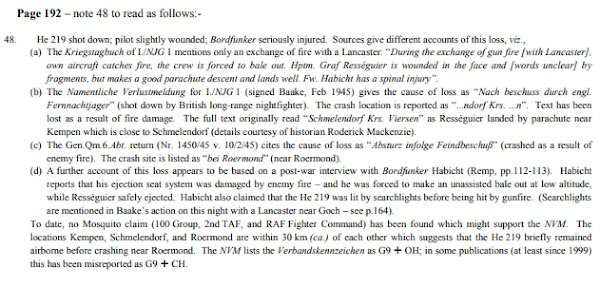
He 219 crew use of ejection seats - the loss of WNr.290070 on the night of 3-4 February 1945


".. A survey of the period July 1943 to the end of hostilities shows that at least 24 airmen successfully ejected from the He 219. This figure is somewhat conservative, and it is possible that as many as 32 airmen successfully ejected.." 

The following text amendments forwarded by author Ron Ferguson concern the loss of WNr. 290070 on the night of 3-4 February 1945. Pilot Hptm Rességuier de Miremont was hit by return fire from a Lancaster and bailed out safely near Roermond


Sunday, 9 August 2020

The Heinkel He 219: An Illustrated History of the Third Reich’s Dedicated Home-Defence Nightfighter - new Luftwaffe books


The Heinkel He 219: An Illustrated History of the Third Reich’s Dedicated Home-Defence Nightfighter
(Air Research Publications - 6 July 2020)
by R Francis Ferguson
236 pages w/ 227 photos, 19 colour images, 47 diagrams and maps, 14 tables
Large format A-4 hardback w/ dustjacket
£ 49.95

from the blurb..

" ..The He 219 was in many respects unique. It was the world’s first series-built aircraft to be fitted as standard with an ejection seat – and not just one seat, but two. It was also unique in that it was designed and built as a dedicated nightfighter for home-defence duties. This came at a time when the prevailing military mind-set was almost exclusively fixed on the offensive role of aircraft. And, because of this mind-set, the He 219 was plagued by uncertainties that affected production and development. The He 219 was also unique for its tricycle undercarriage which came at a time when tail-draggers were common. Sometimes likened to a praying mantis, the very look of the He 219 with its nose-mounted dipoles gave just a small hint of its fearsome reputation in the night air war over continental Europe. In May 1940 RAF Bomber Command took the decision to go over to the strategic night bombing of Germany. The later introduction of four-engined heavies, the Stirling, Halifax and Lancaster, into Bomber Command operations saw an increase in the frequency and intensity of bombing raids. The Heinkel He 219 with its heavy firepower was quickly rushed into frontline service but like so many weapons of the time it came too late, and in insufficient numbers, to change the course of the conflict."


Since the announcement of Ron Ferguson's newest ‘baby’ the amount of searches arriving at this blog for ‘Ron Ferguson He 219 book’ is around 50-100 individual visitors per day..which is good going. I've been blogging 'Ron Ferguson He 219' since each 'edition' has appeared, and being a ‘google’ blog I’m near the top of most search results. This latest work is possibly the most accomplished work ever published by Air Research/Wingleader and at some 160,000 words and around 230 photos one of the most comprehensive. It is the product of a lifetime interest in the subject - and extensive research spanning more than a decade. Ron published his first 'research paper' on the He 219 in 2012 and has not stopped accumulating data and photos. At that time a number of readers suggested that he should have written the definitive history of the type but having attempted a an-depth analysis - with corrections - on all the books published hitherto on the subject Ron knew that there was much more knowledge to be acquired on this unique machine and its introduction into service. The Research Paper was a “… first step in setting right the historical record” - a first step only.

However, publication of the Research Paper brought forth new photos, documents and information. This ultimately developed into this new work, which gives the reader a comprehensive and highly detailed study of the Heinkel He 219.

Subtitled an 'Illustrated history' the new work seems to me to be as complete a technical and operational history as anyone is likely to produce - especially with regard to the amount of photos, the most complete archive published thus far. One thing that struck me reading Ron's 'Introduction' - the amount of contributors to this project constitutes practically the entire air warfare/Luftwaffe enthusiast research fraternity including Beale, Coates, Nielinger, Creek, Boiten. Luminaries such as Lutz and Crow have between them contributed a large percentage of all known images of the type, while two gentlemen in particular contributed enormously to the new book: Dr Volker Koos and Thomas H Hitchcock. The latter, a Massachusetts-based researcher and author, is well known to Luftwaffe enthusiasts and researchers through his many publications of the 1970-90s. Dr Volker Koos is a Rostock-based researcher and Heinkel expert, who has written many books on Heinkel including 'Ernst Heinkel - vom Doppeldecker zum Strahltriebwerk', and 'Ernst Heinkel Flugzeugwerke 1933-1945'. Both provided many pages of material and photo-images - all of which formed a solid foundation for the new book..

The 'heart' of the book, especially perhaps if you have the three previous monographs in your library is the 'new' chapter, pages 101-180, which covers combat and service history. Entitled the " He 219 in service May 43-May 45" this includes BF and FF accounts (Bordfunker = radio operator, FF= Flugzeugfuehrer or pilot). The term 'densely written' comes to mind, reflecting the amount of detail and description employed. The author does not gloss over the problems experienced on the type as with any new machine entering front-line service - after a combat debut in early June 1943 that resulted in five claims for Lancasters shot down I./NJG 1 still had only three serviceable machines on strength by late December 1943. On page 109 the author looks at the work of the 'Heinkel Technical field Service Unit' at Venlo and considers the many (many, many..) problems affecting He 219 serviceability. The type's difficulties were 'political' as well. Throughout Junkers were pushing hard to have the type replaced with their multi-role Ju 388. As late as June 1944 Heinkel is having to stress that his machine is some 30 km/h faster - on the same engines -than the Ju 388 and is the only dedicated Mosquito-hunter (Moskito-Jagd) in the Luftwaffe's inventory. In January  1944 Kommandeur I./NJG 1 Manfred Meurer had been killed at the controls of a He 219 - the second CO to lose his life in the machine. Serviceability does not seem to have improved greatly during the whole of 1944. Ron has also done much additional work on the Commonwealth Mosquito and bomber pilots that encountered the He 219 in action and has included their reports. In total some 150 Allied machines were claimed by He 219 pilots ( but only ten Mosquitos), over 100 He 219s were lost of a production run of some 270 machines and the ejection seats were used on as many as 25 occasions! Indeed the 'new' chapter on German ejection seat development has far more detail than previously published (with accounts from the Erprobungsspringer or 'test  jumper' or parachutist). Chapter 3 (pages 58-93) assesses the 38 Versuchs or test/trial aircraft. The highest V number was V41. (not 76 as reported elsewhere). The chapter on 'Design, Development and Production' features some ten pages of detail period photographs. Pages 202- 216 are devoted to coverage of the British and US He 219s with just a single page devoted to the Smithsonian restoration which was largely covered in the Kagero monograph. Over pages 224-236 there are some 465 detailed 'End notes'..

Ron writes;

"..the new book has really taken off. The first 300 copies sold out within 3-4 days. I haven't actually seen a copy yet, so I'm still looking forward to seeing the finished product. It's like waiting for Santa Claus! The Research Paper was about 60,000 words. This latest work is about 160,000 words, so it's a major step-up. The Research Paper is still quite useful, but this latest work goes to a whole new level and corrects the 2-3 errors/misunderstandings in the Research Paper. I greatly enjoyed researching and writing the new book. More than seven years in the making..."


"Heinkel He 219: An Illustrated History of the Third Reich’s Dedicated Home-Defence Nightfighter" is distributed exclusively by Wing Leader.
Sample pages at their website here

Below;

telegram from Kammhuber 'General der Nachtjagd' to Heinkel relating the successful combat debut  ( ".. erstmalig zum Scharfeinsatz..") of the He 219 on the night of 11-12 June 1943 by Maj. Werner Steib, Kommandeur of I./NJG 1 and reporting the loss of the machine ( He 219 V9) after a heavy (crash) landing. Kammhuber urges Heinkel to speed up the rate of deliveries of the type that has just proved its worth in combat with the enemy by all means possible..


Above; post-war at Freeman field, He 219 A-0 WNr. 210903 - the figure '15' on the prop blades refers to the aircraft's loading position on HMS Reaper for the journey to the US.

And just a quick mention that Chandos has a publication on the He 219 slated for "early 2021". According to Rich Carrick's statement on this  project, his will be the "ultimate reference on the type", always assuming it even appears next year.  ".. I cannot wait to give you more details but for now the authors are busy working on the book!"

Ron Ferguson's title on the other hand is now published, it's a 'Limited Edition' so if you have any interest at all in the subject I'd respectfully suggest getting one while you can.  The author is donating his royalties to The Smith Family, a charitable institution in Australia that provides for disadvantaged children.

Wednesday, 6 August 2014

NASM’s Heinkel He-219 and Horten flying wing Restoration Update


The restoration crew at the Paul E. Garber Restoration Facility in Silver Hill, Maryland has finished their work repairing the wings for the museum’s unique Heinkel He-219 A-2 Uhu, Wk.Nr.290202. In mid-July, the team prepared the freshly repainted wings for shipment to the Udvar-Hazy Center in Chantilly, Virginia. For the first time in years, they took the long-hidden 63′ span airfoil outside, mounted to its massive custom steel frame, and rotated the whole assembly 90 degrees, until it lay in a more natural, horizontal configuration. It is now more or less ready for loading onto a flat-bed truck for the forty mile journey to its final home.


Elsewhere the centre section of the Smithsonian National Air and Space Museum's unique Horten H IX V3 is being prepared for transport to their Steven F. Udvar-Hazy Center. This radical-looking, flying wing is the prototype for what would have been the formidable Horten Ho-229 jet fighter with the Luftwaffe had WWII lasted much longer. Only one of the prototypes flew, and it crashed, but the Horten brother’s had proven the basic concept with smaller, but similarly-shaped gliders, so it really was only a matter of time and resources before the jet-powered variant could have been perfected for combat. NASM’s example is the last of her breed. American forces captured her in the closing days of the war, and shipped her back to the US for evaluation. The aircraft is based upon a steel frame, but the exterior cladding is mostly plywood, which is in quite poor condition with significant de-lamination in places.


NASM’s Heinkel He-219 Restoration Update

NASMs Horton flying wing restoration update via Warbirds News


via Chris Simmonds @  German Airplanes of the Second World War

Tuesday, 5 March 2013

One million page views since September 2009, Günther Josten Fw 190 Dora ace, Fw. Bernhard Kunze JG 1


A statistical milestone for the Luftwaffe blog - today the Luftwaffe blog passes one million page views over 423 published posts since September 2009 (the page counter below lagging a month or two behind the actual figure..) Being a 'google' blog helps of course - this blog is listed for the majority of 'Luftwaffe' searches on the first two or three pages, certainly well ahead of most similarly titled forum threads. Incidentally, these pages undergo constant revision, addition and correction, so check back often. Thanks to all correspondents and readers.

 Correspondents such as Kurt Braatz of 296 Verlag, who, when I stated a while ago that " some sources give Kommandeur IV./JG 51 Oblt. Günther Josten seven victories on one sortie at the controls of a Fw 190 Dora..." kindly sent through the following extract from Josten's book 'Gefechtsbericht' (lit. combat report, better translated as 'war diary')

"25. April 1945. Inzwischen haben wir einige 190 D-9 bekommen und gewaltig abgeschossen. Ofw. Marquardt bei der Überführung vier Jak-3. Ich selbst stelle am 25. 04. einen neuen Tagesrekord auf. Beim ersten Einsatz mit drei D-9 schoß ich eine Jak-3 und drei Il-2 ab. Beim nächsten Einsatz flog Ofw. Rauch mit mir. Wir waren nur in der Rotte und schossen neun Russen ab. Ich selbst fünf. Zuerst trafen wir 50 Boston und 30 Airacobra. Jeder schoß eine Airacobra ab, dann ich eine Boston, anschließend noch eine. Darauf kamen 20 Il-2 und 30 Jak-3. Rauch erledigte zwei Jak-3 und ich zwei Il-2. Damit hatte ich in zwei Einsätzen neun Luftsiege. Am folgenden Tag kam noch eine Jak-3 hinzu. Somit steht meine Abschußzahl auf 178."

" 25 April 1945. Meanwhile we had taken on charge several Fw 190 D-9 fighters and shot down a lot of enemy planes with them. Just ferrying his machine in Ofw. Marquardt accounted for four Yak-3 fighters alone. On the 25th I achieved a new record for D-9 victories in a single day. On the first sortie I shot down a single Yak 3 and three Il-2s. On the next sortie I was accompanied by Ofw. Rauch. We flew together as a Rotte and downed nine Reds. I got five of them. We firstly ran into 50 Bostons and 30 Airacobras. We both shot down an Airacobra and then I got a Boston and then another to finish. Then we encountered 20 Il-2s and 30 Yak 3s. Rauch finished off two Yak 3s while I shot down two Il-2s for a total of nine victories in two sorties. The following day I added a further Yak 3 to my tally to bring my total number of aerial victories to 178.."

Or readers such as Falk Boersch. Back in February 2010 I posted a small piece on the subject of JG 1 Fw 190 checker cowl colours here and recently received the following commentary from Falk  at http://www.bernhard-kunze.de/index.htm

".....Hello, I´m very thankful to read your statement on your blog regarding your thoughts on JG 1 checker cowl colours with which I fully agree ! I´m the nephew of Fw. Bernhard Kunze (Fw 190 A5 -White 1, WN 410055) and I maintain a web site devoted to Bernhard Kunze's life . I have researched the circumstances and details of Bernhard´s fatal crash at the controls of his 2./ JG1 FW 190 A6 (Black 1, WN 550884) on 5 January 1944 close to Bergisch-Gladbach, Germany. One thing I've come across very often is the very inconsistent discussion of the checkerboard colour of the fighters he piloted. Corrections of the sometimes wrong published profiles of Bernhard´s 190-checkerbord-colours are really needed. In writing to all the relevant publishers I have attempted to get the truth published - but a pity without success. Everyone should know - as you state - that black/white is correct - there were no black/yellow chequers on Kunze's machines. There were no exceptions at any time - all the different Staffeln of JG1 were painted the same identical black/white colour combination irrespective of the Staffel or Staffel Kennung on every ..."


Or correspondents such as Ron Ferguson and his publisher Wing Leader. A big thank you to Ron and Simon for the surprise that dropped into my mail box recently - a lovely hard bound edition of the Heinkel He 219 Research paper - apparently one of only 40 printed ! The Heinkel He 219 Research paper has of course been covered extensively on this blog...

http://falkeeins.blogspot.co.uk/2011/11/he-219-research-paper-2nd-edition-by.html

http://falkeeins.blogspot.co.uk/2012/10/the-heinkel-he-219-research-paper.html

 here's a quick peak at the hard back edition - the regular edition is available at the link above..


..and to conclude today's post, one or two Ebay sales currently on-going, just listed are these 'new' views of the-then leading Jagdwaffe ace Hermann Graf in Bordeaux, February 1943...

http://www.ebay.de/itm/Fotos-Luftwaffe-Focke-Wulf-Fw-190-Jagdflieger-Graf-Besuch-in-Bordeaux-1943-/200903240966?pt=Militaria&hash=item2ec6c42d06#ht_2809wt_1164


More on Graf's Jagdgruppe Ost Fw 190s at the following link

http://falkeeins.blogspot.co.uk/2010/04/hermann-graf-and-his-jgr-ost-focke-wulf.html

or this image of future JG 27 ace Karl-Heinz Bendert in a JG 26 Emil with raven emblem via

http://cgi.ebay.co.uk/ws/eBayISAPI.dll?ViewItem&item=380592283685&ssPageName=ADME:B:SS:GB:1123


Wednesday, 7 November 2012

New Revell 1:32nd scale He 219 - a work in progress by Ian Ogilvie


Iain Ogilvie's 1:32nd scale Revell He 111 is one of the most popular posts here on the Luftwaffe blog.  A 32 SIG stalwart, Iain has just started his build of the brand new Revell He 219...

"..Thanks to  some time off work this week I've decided to crack on with the UHU. This will be a pretty-well out of box build with the aim of keeping things simple and making some progress. For the purposes of this exercise I'll be going into 'assembler of kits' mode as opposed to the usual AMS induced 'stress bunny'. Taking a leaf out of those pesky armour modellers approaches to assembly I'm going for a lot of sub assemblies - in fact that's today's focus - so that I can then have a sanding binge all at once at some point. I have to say that whilst the kit looks superb - and is remarkable value - the instructions let it down a little!


Starting with the wings - read the instructions carefully if you want to drop the flaps as there are sections that need removing! The flap areas have inserts that provide detail for the dropped flaps - as well as strength to the assembled wings. Don't know if anyone read a thread on another forum about a fatal flaw? Yes - there has to be one doesn't there!  


Actually not too bad - but the shape of the prop blades near their roots is incorrect - too dished and not blending in the blades with the round root section smoothly enough.

Cockpit decals and general painting done  - now needs some silver details, a dry brush and paint chipping before gloss varnish, wash, mat varnish. Shouldn't take that long - just waiting for decal setting solution to dry.


Follow Iain's continuing build on britmodeller.com


Good Heinkel He 219 reference and images - including an in-depth look at Ron Ferguson's He 219 research paper published in hardback book form by Red Kite/Wing Leader - can be found on this blog at the page link below


http://falkeeins.blogspot.co.uk/2011/11/he-219-research-paper-2nd-edition-by.html 


Wednesday, 3 October 2012

The Heinkel He 219 - a research paper


As regular readers of this blog will know Australian historian Ron Ferguson has focused his attention on the He 219 for many years. His self-published research papers will soon be available in updated form as a fully-fledged book, produced to dispel the many myths that surround one of the Luftwaffe's most advanced night fighters. I featured the 2nd edition on the blog at the following link

http://falkeeins.blogspot.co.uk/2011/11/he-219-research-paper-2nd-edition-by.html

This new, revisited, expanded and updated volume from Simon Parry's team is a scholarly work that probes some lesser-known aspects in great detail and is not an entry-level general history of the He219. It lists and corrects the many errors found in earlier books, including the much more recent Kagero Monograph, as well as providing new and definitive information.


Chapters include: 

The Numbers – Production and Werknummern 
The Ejection Seat
 Versuchs Machines
 The Jets 
The RLM 22 Schwarz Camouflage Scheme 
Engine Air Intakes (Shape)
 He 219 Publications – List of Suggested Corrections

 Appendix 1 – Chronicle of Meetings (Generalfeldmarschall Erhard Milch) Appendix 2 – He 219 Versuchs Machines Appendix 3 – He 219 Werknummern and Stammkennzeichen Appendix 4 – He 219 Victory Claims Appendix 5 – He 219 Losses Appendix 6 – He 219s taken to the UK and USA in 1945 


"....Hello Neil,


This is to advise you of the release of my new book on the Heinkel He 219.The book will be available 7th October on the Wing Leader website - http://www.wingleader.co.uk/product-p/he219rp.htm

The attached PDFs will give you some info on the contents - more appears on the Wing Leader website. This will be my final "He 219 Research Paper" - there are no plans for a 4th Edition. For those planning on building Revell's soon to be released 1/32nd scale model kit of the He 219, I'm sure the Research Paper will be an invaluable tool in obtaining historical accuracy to the subject. Sales of the book will help a good cause - any royalties I might be entitled to will go to charity for homeless kids - so please tell your friends.With my sincere thanks to you for your support and most welcome encouragement.  Neil, I can't thank you enough for the kind words you've posted on your FalkeEins blog - these have certainly stirred up world-wide interest in the Research Paper (please keep it up).


Ron Ferguson
...."

My pleasure Ron !

Wednesday, 1 August 2012

new Luftwaffe books - Jagdwaffe emblems, David Isby's 'The Decisive Duel', Me 262 bomber and recce units Osprey, Valiant Wings Heinkel He 219 Uhu 'Airframe Album'


There has never been any doubt that the fighter arm was pivotal in introduction of the unit emblems with the Luftwaffe. Since, however, the Luftwaffe developed no classification system to register or even monitor its emblems, the emblem motifs and the motivations behind their introduction were to a great degree lost following the collapse of the Third Reich. The Emblems of Jagdwaffe 1936-1945: A More Complete History by Sinisa Sestanovic offers a plausible theory on the emblems' motifs and origins, and establishes the existence of some previously unknown emblems. The centrepiece of the book is the artwork of more than 300 emblems restored to their former glory, a step beyond Karl Ries's groundbreaking design from the 1960s. The said artwork is complemented by 27 photographs and 12 scale-drawings that illustrate the emblem positions on the fighter aircraft in use by the Jagdwaffe between 1936 and 1945. The book is aimed at the enthusiasts and serious researchers alike. Self published, approx 280 large format pages 

http://www.amazon.co.uk/dp/1439286450/ref=rdr_ext_tmb


Chris Simmonds writes;

"..I have personally checked a number of the book's emblem artwork against known and clear emblem photographs and can only applaud Sestanovic for his unswerving accuracy and attention to detail. His artwork is both clear and of a size at least three times bigger then that of the artwork in Ketley's new book "Luftwaffe Emblems". For scale modellers this, I am sure, will be big bonus. Lastly, at the end the book is a welcome selection of very clear and well produced period images of aircraft carrying some of the emblems previously discussed.
Highlights for me must be probably the best and fullest pre-war selection of emblems published so far. Second must be potted history of each unit and it's relation to past units and its subsequent evolution, whilst this information is available elsewhere such as Holm's website, having it in conjunction with the emblem is very helpful when trying to identify the unit of an image. Lastly must be the emblem artwork themselves easily the most accurate of any Luftwaffe book publish before or present..."

Read the full review at amazon.co.uk


Got my copy today. Let's face it, anything Me 262-related with the names Forsyth and Creek plastered over the cover is an essential purchase. While I don't really care for the Osprey format - the pics are especially small and dark here - I have to say that Jim Laurier's photo-realistic artwork is superb! In addition this volume presents the best English-language coverage of KG 51's jet operations I've read anywhere. Other units covered include  Sonderkommando Braunegg, NAG 1 and NAG 6.  Sources include Jan Horn's magisterial 'Das Flurschaden Geschwader' and Nick Beale's account of KG 51's early disastrous Western Front deployments as featured on http://www.ghostbombers.com

Chapter headings; 1/ 'That Answers the Fuhrer's Question...'; 2/ Kommando Schenk; 3/ Hitting Back; 4/ High-Speed intelligence; 5/ Bodenplatte To the Banks of the Rhine; 6/ Too little, Too Late

An appendix covers 'Unit Structure and Bases - Me262 Operational Period Mid-1944 to May 1945' and the heart of the work is the fantastic fully annotated colour plate section by Jim Laurier.

Chris Simmonds writes; Anything by these two authors has to be taken seriously, and this is no different. All late war Luftwaffe enthusiasts will enjoy this book which features the misguided attempts to use the Me 262 as a bomber and the superb effective reconnaissance machine it also became. I have given five stars because the content is so well written, the profiles very well done. But I dislike all the Osprey books for their pathetically small format which result in small photos and cramped pages.."

http://www.amazon.co.uk/Bomber-Reconnaissance-Osprey-Combat-Aircraft/dp/1849087490/ref=sr_1_1?s=books&ie=UTF8&qid=1343836430&sr=1-1


A 'dual biography' of two of the most significant fighter aircraft in the history of aviation. Isby's latest is a very worthwhile work that considers both the technology and the people and the interaction of the two. The book traces the story of the Spitfire and the Me 109 from their origins through the race to get them into service and the early decisive battles of WWII to their final combats over the Middle East in 1948-49. First deployed in anger over Spain during the Civil War the Me 109 enjoyed the early advantageIn many respects the technology on both sides was on a par during the early years of this story - the Emil and the Spitfire I were pretty evenly matched. But the men and the organisations, and, above all, the regimes, were different and eventually a 'technology gap' did appear  - the two stage supercharged Spit IX was - all else being equal - superior to the two speed supercharged German Gustav variant of the Bf 109 and the author explains how and why this was so. This is important for Isby's story because, as he explains, when the Spitfire finally achieved the upper hand over the 109 the Luftwaffe leadership were too incompetent, to in thrall to the leader's will, to act. The regime had largely through force of circumstance placed their hopes in new technologies that ultimately offered too few qualitative enhancements to overcome quantative differences. And while much of the 109's story is told by the 'charismatic' Fighter General or high-ranking ace, the author is aware that to fall back, for example, on Galland's memoirs, is too convenient, too much of the 'blame' is heaped on Göring, the story is too 'pat' and has suffered from too many re-tellings. So some of the Bf 109 story is told from the view point of the 16-year old forced labourer selected from among Auschwitz inmates for the Messerschmitt production line. Detailed and full of interesting facts; plenty of German-language source material has been consulted and exploited so you know that this is not some cheap catch-all rewrite of old texts but a serious mature work  - and one full of interesting facts; I for one did not know that Erhard Milch had a teenage daughter who had Downs Syndrome- Milch's 'motivation' is not just about personal enrichment or German success but to some extent simply keeping his daughter alive. The balance of the book is skewed towards the Battle of Britain of course, some 200 pages whereas only 10 are devoted to the war in the Mediterranean which is where - in addition to the Eastern Front- the Luftwaffe had most of its forces between 1941-44. Recommended.

Visit author David Isby's web site for more on this book and some interesting resources

http://spitfirevsbf109.com/

Coming soon from Valiant Wings


Airframe Album No.1: The Heinkel He 219 'Uhu'
by Richard A. Franks
The first title in a new Airframe Album series (coming August 2012) will cover the Luftwaffe's ultimate nightfighter, the He 219 'Uhu':

  • Period diagrams
  • Data from flight manuals and spare parts catalogue
  • Walkaround images
  • A wealth of pictures of the recently restored NASM example before, during and after restoration
  • 3D isometric views of all variants by Jacek Jackiewicz
  • Colour profiles and camouflage detail by by Richard Caruana
  • 100 pages
  • Publication in advance of the Revell and Zoukei-Mura 1/32 scale kit releases