Showing posts with label Beute types. Show all posts

Monday, 1 September 2025

Fw 190 coded 'JFE' , Bf 108 PS-T


According to the Robinson/Derry "Flightcraft" book on the Fw 190 (to which this blogger largely contributed) this is Fw 190 F-8, WNr 933849, which was found abandoned on a Luftwaffe airfield and appropriated by W/Cdr James Francis ‘Stocky’ Edwards, RCAF, 127 Wing, in late 1944/early 1945. The story goes that W/Cdr Edwards spotted the Fw 190 in an adjacent field while returning from a sortie during the Allied advance through Belgium and the Netherlands and had it transported to the base where the Wing was operating from which, according to the photo’s original caption was Soltau, Germany, but may possibly have been B.58 Melsbroek or B.56 Evere in Belgium. All the aircraft’s Luftwaffe markings were overpainted and RAF roundels and fin flashes applied, as were the Wing Commander’s initials ‘JFE’. Apparently, the aircraft was unofficially flown several times, although its ultimate fate is uncertain. The Messerschmitt Bf 108 in the background also carries RAF markings and the initials ‘PST’ of fellow Canadian, Group Captain Percival Stanley ‘Stan’ Turner, who oversaw the conversion of 127 Wing on to ground attack duties and flew with the Wing on several missions. (Courtesy of Carl Vincent)


Friday, 17 January 2025

Sergent-chef Denys Boudard - Bücker Bü 131 D Jungmann 'GD+EG'


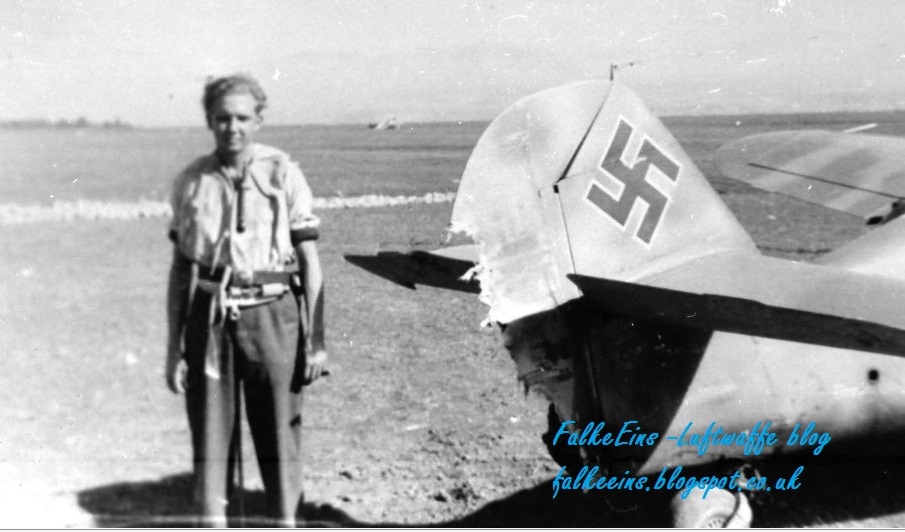
Denys Boudard was another courageous Frenchman who managed to get to England and join the RAF after the fall of France. On 29 April 1941, Boudard and a fellow countryman, Jean Hébert, had dressed in dark-coloured overalls to resemble German mechanics and walked onto the huge Caen-Carpiquet Luftwaffe airfield, which was, according to one source, home to nearly 400 Luftwaffe machines at that time. The two former Armée de l'Air pilots planned to steal an aircraft and fly it to England. 

From the site of the Prefet du Calvados; 

 "..The two men attempted their exploit on 29 April 1941. It was raining. They slipped on the airfield at Caen-Carpiquet wearing black overalls, as worn by German mechanics, and entered a hangar, where Bücker Jungmann WNr. 4477 coded 'GD+EG' was parked. (The aircraft belonged to the Luftdienstkommando Westfrankreich.) Just as they were about to start the engine, German officers passed in front of the hangar. The two friends opened the cowl cover and plunged their hands into the engine. The Germans move on. Then two French workers stopped in front of the hangar door. When at last the coast was clear, the Germans returned. Disciplined, they stopped to let the plane pass in front of them before taking off. Jean Hébert flew the small liaison machine low over the SNCF station and waggled his wings, a sign agreed with a friend, an SNCF inspector. This was the signal that letters written by the two friends to their families could be posted. After an hour's flight the two former Armée de l'Air pilots arrived over the English coastline, flying over Bournemouth's main street and sounding the warning siren. Shortly afterwards, two fighters patrolled overhead, but did not spot the small biplane. Boudard and Hébert looked for an airfield and landed their plane in Christchurch, where they parked it in front of a hangar. Surrounded by British soldiers, they declared ‘we are French’. After several hours of interrogation, they reached London and were presented to Winston Churchill with Mrs Churchill acting as interpreter..." 

According to Chris Thomas; " the poor visibility that day probably saved their lives. Following the coast to look for an airfield, they had started on a second circuit of the Isle of Wight before they realised it was an island! They eventually landed at Christchurch.." 

It was a Sunday and visibility was presumably much better on the English side of the Channel - the two Frenchmen (Boudard left, Hébert right) were surprised to find the RAF were playing cricket on the airfield..


Fast forward three years- Jean Hébert had been sadly KIA during 1943, but on 18 June 1944 Sergent-chef Denys Boudard was filmed preparing to fly to Normandy in his 340 Sqn Spitfire IX at Merston. The IWM film was shot by the RAF FPU to celebrate Denys Boudard's return to France. He was later the first Allied pilot to land at the recaptured Carpiquet airfield - the same field from which he had stolen his Bücker Jungmann three years previously. 


The Jungmann was allocated serial DR 626, dismantled and sent to London for War Weapons Week display, still in its Luftwaffe markings. It returned to Christchurch on 13 June. However the machine had been damaged by souvenir hunters and was later struck off charge (November 1941) It is not known if it was ever repainted in RAF colours - the likelihood is that at some stage between May and November 1941 it probably was...


Also on this blog;

Tuesday, 10 October 2023

JG 77 in Italy, September/October 1943 and the Macchi C 205 in JG 77 service - were there any aces ?


On 3 September 1943, the soldiers of the British XIII Corps mounted amphibious landings on the Italian 'boot' and 'invaded' the Italian mainland. Calabria was only lightly defended and Reggio airfield was quickly captured. This first landing in continental Europe took place in a country seemingly still allied with the Reich. But, since Mussolini's removal from power the new Italian government had been secretly negotiating with the Allies to change sides. The German High Command was not fooled by the friendly protestations of Marshal Badoglio, the new strongman of the Italian regime and were preparing to take control of the country in the event of an Italian U-turn. The location where the Duce was being held had already been identified and plans were being made for his release. This occurred on 12 September - Skorzeny's Gran Sasso 'coup de main'. On this same afternoon of 3 September I./JG 77 and IV./JG 3 intercepted an unescorted formation of B-24s over the sea near the Tremiti islands. Eight bombers were claimed by I./JG 77 (only three were confirmed). Eight B-24s were claimed by JG 3. Nine Liberators from the 98th BG were reported lost over Italy, most likely victims of these clashes.

On 6 September, Uffz Willi Wiemer's 'yellow 4' ( 3./ JG 77) was shot down by a P-38 of the 14th FG escorting Liberators. 7./JG 77 (in Sardinia) also suffered the loss of Lt. Hans Rund, whose G-6 'white 7' exploded in flight. Ofw Eduard Isken who had carried out a test flight in this machine shortly beforehand suspected sabotage. On the 7th, I/JG 77 suffered two serious injuries in a battle with P-38s escorting B-17s. Oblt Gerhard Strasen, Staffelkapitän of 3./JG 77 was shot down in 'yellow 10'. He reported;

"..Our unit was scattered around Foggia and it was from there that we were airborne to intercept the Viermots and their P-38 escorts. On that day, I was acting Kommandeur as Burkhardt was unavailable. In combat with P-38s north of Naples, a bullet went through my leg and I had to parachute out. On the ground, an Army Feldwebel loaded me into a vehicle and took me to a hospital. I was then transferred by medical train to Stuttgart where an amputation was planned. I was categorically opposed to this and was able to save my leg. I was granted a long period of convalescence, during which I got married. I rejoined JG 77 around May 1944 when the unit was fighting in northern Italy..."

In addition to Strasen, another wounded pilot from 3./JG 77 had to bail out, Lt Werner Behrendt. To replace Strasen, Lt Ernst-Wilhelm Reinert left II./JG 77 and became Staffelführer of 3./JG 77.

On 8 September, I./JG 77 and IV./JG 3 carried out their usual missions (reconnaissance and Alarmstart 'scrambles'). In the late afternoon a large fleet was spotted near Naples. But  at 5.00 pm, the Italian surrender was announced by the allied radio, surprising both Italians and to a lesser extent, the Germans. The Italian royal family, still near Rome, had to flee. Many Italian officers did not know what to choose: loyalty to their government or to the German ally. Generalfeldmarschall Albert Kesselring quickly gave the order to neutralise the former ally - Unternehmen 'Achse'. Everywhere, German soldiers disarmed Italian units, which often fell apart and huge amounts of matériel was captured. An Italian naval battlegroup was already at sea - according to some to counter the Allied landings then about to take place at Salerno - but with the news of the 'volte-face', now attempting to make for Malta to surrender to the British. Attacked in the waters of the Gulf of Asinara by 'Fritz X' guided missile carrying Do 217s of KG 100 on 9 September, the Roma, one of the most powerful warships then at sea in the Mediterranean, was struck, split in two and sunk. More than 1,250 men perished.

The US Fifth Army landed at Salerno on 9 September in another huge amphibious operation. I./JG 77 and IV./JG 3 toting Werfer rocket grenade launchers flew strafing sorties over the Salerno landing zones - Fw. Horst Schlick of 1./JG 77 was hit by flak and managed to bail out, coming down unharmed near a main road into Naples. Elsewhere most of III./JG 77 flew out of Sardinia and landed on the Corsican airfield of Ghisonaccia. The Germans immediately disarmed the Italian troops present on this air base and took possession of weapons and equipment. Three days later, the men of "Ubben’s travelling circus" transferred to Casabianda still in Corsica. From there, the Bf 109s flew escort sorties for the ships and transport aircraft (Me 323 and Ju 52 Transporter) evacuating the German troops to the Italian mainland.

On 25 September the G-6 Gustavs of III./JG 77 were in Pise-Metato while using the airfield of Fiano to protect the industrial sector of Bologna. Uffz Karl-Heinz Böttner flew little during this period because he was sent to the Erholungsheim (relaxation and care centre) in Bad Wiessee following malaria attacks. Also there at the same time was his Kapitän Emil Omert who was recuperating following his injury sustained in Sicily.

On 20 October, III./JG 77 recorded a total of thirty-two Bf 109 G-6 fighters on strength. Returning to Metato, Uffz Böttner took part in various interceptions of American bombers pounding German positions in northern Italy. On 23 October, around Rome, the rudder of his G-6 was seriously damaged by defensive fire from B-17 Fortresses, but the young pilot was able to return to his aerodrome without too much trouble. (photo below) III./JG 77 was sent to Romania a short while later, I./JG 4 returning from this theatre to take their place in Italy.

The detachment of III./JG 77 in Pisa was also implicated by the Italian 'change-of-sides' on 8 September. Lt. Wolfgang Ernst, Stk of 9./JG 77 remembered;

" I was with a few pilots at Pisa airfield at the time. Our Schwarm was carrying out combined manoeuvres with the Italian navy. We flew over the ships all day long, and we were often invited dine in the evening in full dress. The food was excellent and the wine plentiful. It was all very pleasant. On the morning of the 9th, following the Italian U-turn, I decided to join the Gruppe now in Corsica. We took off and flew over the Italian fleet as it set sail to surrender to the Allies. We strafed some ships, which saddened us: only the day before we had been friends. Later we shot down a small Italian liaison plane over the mainland -flying due south, it was deserting towards the territory held by the Anglo-Saxons..."

Meanwhile II./JG 77 was put to work to disarm their former allies. A transfer to northern Italy had been planned since mid-August.  Overtaken by events the Gruppe had already given up its Gustavs.  Small groups of ground personnel were sent all over Italy to take control of the airfields; as for the pilots, they ferried the captured machines to northern Italy. It was at this point that the decision was taken to re-equip II./JG 77 with some of the captured Italian Macchi Veltro fighters. 


Technicians from the Gruppe were sent to Varese to study the Macchi Veltro. Equipped with a Daimler Benz DB 605 engine, this aircraft seemed adaptable to German standards as mechanic Karl Holland reported;

"..The engines, Daimler-Benz 601s built under licence, posed no major problems. The work of the mechanics was even easier because the amount of room reserved for the engine, auxiliary fittings, oil and coolant circuits was larger than on the Bf 109. As far as armament was concerned, the usual MGs were used, as well as heavy machine guns of a calibre close to 12 mm. No cannon. The pilots found the Macchis lighter but slower than the Bf 109s..."

The C.205 was used briefly by II./JG 77 from late September 1943 to the end of the year before the Gruppe reverted back to the Bf 109 G-6. The war diary of the Stab/JG 77 commented on 21.Nov. 1943 ;

" The machine is fast, and flies well, but has a tendency to lose speed in a sharp curve, and it is easy to get into a spin. Another aspect is the Italian radio. Despite transmitting clearly, the pilots can barely understand what is being said. Finally, refueling and reloading ammunition is very complicated, so restoring operational readiness takes a long time..."

The Kommodore's memories are more categoric; 

 "My JG 77 rarely used captured aircraft, apart from the Mc-205 flown by II./JG 77. It was a vicious machine that easily got into a spin which could be very difficult to get out of. It was used in combat and there were a few victories. (Maj. Johannes Steinhoff, Geschwaderstab JG 77).

Were there any German Macchi aces ? A reply to this question (answer/research) by Georg Morrison

" You may be thinking of Oblt. Joachim Deicke, who led the 6./JG 77. His aircraft, "gelbe 1" was a Macchi C.205, WNr.92212. BUT, none of his 18 claims (over 661 missions) were made using a Macchi. Three pilots had died in crashes, usually "pilot error." Uffz. Rudolf Funke was shot down on 1 December 1943 by a P-38 (C.205 "gelbe 4", WNr.92218), but was safe. Another C.205 was damaged in this combat. The last loss of 1943 was on Christmas Eve, engine fire on WNr.92224.

 Another potential candidate for JG 77 ace on the Macchi could have been Lt. Franz Hrdlicka, who led 5./JG 77. He made his 37th claim on 9.November 1943, which was likely in a C.205 - he posed for a photo, seated on the cockpit edge of a dark-finished example..". 

Recommended reading ;

The Luftwaffe in Italy 1943-45 published by Lela Presse, 98 page A-4 softback, some 200 photos/artworks. Only 13 euros. Available from the avions-bateaux.com website. Eight-page PDF extract here


Friday, 11 August 2023

Beute Flugzeuge - Czech Aero 101, Caudron C.445 Goéland - ebay photo find #362


Above; Czech Aero 101
Below; franz. Beute Flugzeug Caudron C.445 Goéland (Innenraum Cockpit)


Below;   C.445 "TE+WC" was no 945/9681 which left the factory on 17 January 1943 for the Luftwaffe to serve with FFS A2. On 16 April 1944 this machine made an emergency landing near Luxeuil after coming under attack by Allied fighters - damages assessed at 40%. It was repaired and reported at Toulouse in December 1945 and served with GC I/3 from January to March 1946. It was destroyed in a takeoff accident at Friedrichshafen on 17 March 1946. 


According to F. Picard in his 1976 book "L'Epopée de Renault" the Germans discovered some 75 part-constructed C.445 Goélands at Issy les Moulineaux in June 1940 and subsequently requested that these be completed and handed over to the Luftwaffe as 'war booty'. In view of the fact that all these machines were part of a French government order and had been already partly paid for, the directors of Caudron requested an order to this effect from the Vichy authorities enabling an 'official' restarting of the production line.  In the end Vichy 'ordered' and financed the completion of construction on these 75 aircraft, took delivery of them and then handed them over to the German authorities. The first C.445 completed for the Germans was no. 253 delivered to the Luftwaffe on 6 September 1940.  Johannes Kaufmann;

".. we liked flying the C.445 and we had good 'specialists' on hand to give advice. It was a nice machine and featured one innovation - the radio compass.."

It is an indisputable fact that French industry was responsible for training hundreds of German fighter and bomber pilots and radio operators - also leaving German industry free to produce those more 'important' types. In total some 515 C.445s were constructed for the Luftwaffe from new. In late 1942 those C.445s still in the former 'zone libre' were shared out with the Italians. Heinz J. Nowarra;

 ".. During 1942-44 when I worked for Junkers at their factories throughout central Germany I often saw C.445 Goélands in the air, most notably over Nietleben (Halle) where there was a radio operators' training school. The C5 FFS pilots school at Neubrandenburg also used the type. The aircraft also served for liaison and communication flights. The ace Marseille's outfit  -I./JG 27 - had at least one of them in North Africa. The Goéland was also employed as an air-sea rescure type. "SK+XM" was used by III./JG 2 while 'CD+YF' flew the commanders of L.fl. 2 to Italy.." 

from Cortet and Espérou in "Le Caudron Goéland"  - the first aircraft monograph from Lela Presse (undated)


Also on this blog; 

More C.445 reference for the RS models kit here


Wednesday, 25 May 2022

Painting a captured 'Wulf' - upper wing pattern on the Farnborough Ta 152 H


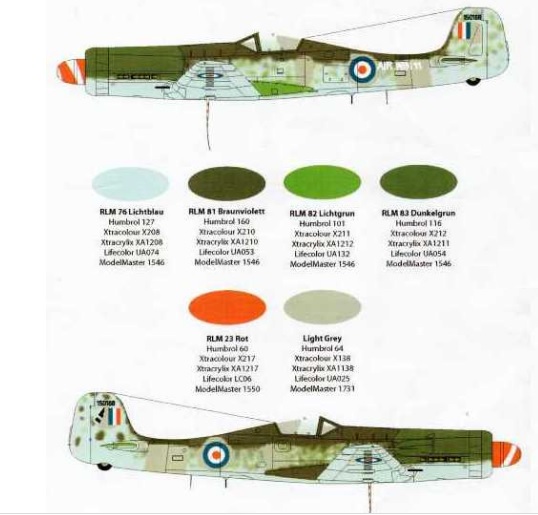
Hobbyboss 2000 have recently re-released the Dragon Ta 152 48th kit. One of the decal options is  'green 9' as seen at the 'Farnborough' captured enemy aircraft exhibition of November 1945. Some 'painting notes' for Ta 152 H-1 WNr. 150 168.  'Green 9' was found at Leck (Schleswig Holstein) and transferred to Farnborough in August 1945. Seen here with Kennung over-painted  with RAF roundels (along with a red spinner)  and JG 301 fuselage bands in RAF medium sea grey (probably) at the Farnborough exhibition later during the year. Note WNr. 150168 at the top of the tail.

Looking through the reference pictures available it is immediately obvious that there are very few views of this machine at Farnborough taken from the port side. There appears to be a difference between the port side which has a very clean demarcation around the engine cowlings and the starboard which appears softer and a little lower (i.e. below the lower edge of the access panel immediately in front of the windscreen).  The Jumo 213E-1 power egg also appears to be a solid colour, probably Dunkelgrün (Dark Green) RLM 83. On the starboard side of the cowling, the exhaust gases were blown down under the supercharger inlet, absent of course on the port side.  


WNr. 150167 showing the partial NMF lowersurfaces


Colour instructions from a Freightdog decals set (low-res image for information) This is FD's interpretation as they think the aircraft looked at the Farnborough display. FD's interpretation of the colours and pattern seems very close to the Hobby 2000 scheme. Note no NMF on the underside although this was a feature of the finish..


Below; closer view of the starboard wing pattern


Friday, 25 March 2022

Captured enemy aircraft at the Farnborough exhibition October/November 1945 - Heinkel He 219


Open to the public in October and November 1945 the RAF displayed its captured Luftwaffe aircraft and many British prototypes then undergoing evaluation during late 1945. Inspired by an article in the September 2010 issue of Aeroplane magazine here are some period images of the exhibition and some excerpts from Flight's coverage of November 1945, taken from the apparently now defunct flightglobal pdf archive! Click on the image above to get in a little closer....


Back row left to right: Ju 290, Ju 52/3, Ju 352, a Fw 200 and a Do 17. A Ju 88 Mistel combination can just be discerned right at the back. In the second row are the following;  Si 204, Ju 88 G, Fi 103 manned V-1, Ju 388, He 219. Third row: Me 410 (maybe 210...), Bf 110 G, Do 335 B (probably the B-12 trainer), Ta 152, Fw 190 A, Ar 234, and Me 262. Final row: Supermarine Spiteful, Martin-Baker MB 5, Blackburn Firebrand, Bristol Brigand, Fairey Firefly, Fairey Spearfish, Meteor and a couple of late-mark Spitfire tails.


Wednesday, 8 April 2020

French use of Luftwaffe aircraft - Ju 88 in French service

Seen on eBay offered by a seller with a huge ‘archive’. These images show a Junkers Ju 88 G-6 used for ramjet propulsion tests and appear to be images from Pierre Dumollard’s « Junkers Ju 88 et 188 Français » as seen at the CEV (Centre d’Essais en Vol or Flight Test Centre) at Melun Villaroche during the early 1950s. Ju 88 G-6 s/n 3 made some 200 flights with the ARS 600 ram jets before being retired in 1955, including the ’accidental’ flight no. 6 - following a fault with his oxygen supply the pilot put the aircraft into a dive and reached a speed of Mach 0.7 (around 840 km/h). During 1953 André Turcat - future Concorde test pilot - also flew this aircraft at Mach 0.7 at 10,000 mètres altitude; according to author Dumollard, «  the limits of the Ju 88s performance had been reached » ! The type was replaced by a Gloster Meteor NF.11 which had the advantage of using the same fuel as the ramjet.

By the time it was retired from service the French had utilised the Ju 88 for nearly twice as long as the Germans and compared it very favorably with similar types such as the B-26 - the Ju 88 had a " shorter take off run, higher top speed , better rate of climb and could carry a bigger load for a similar range.."


More Ju 88 and Ju 188 in French service on this blog here

Monday, 30 April 2018

Focke-Wulf Fw 190 Raketenwerfer, Caudron C 445 Goéland - ebay photo find #250


Late variant Focke-Wulf Fw 190 of JG 6 according to the seller, seen in Königsberg on Defence of the Reich duties. Note the underwing 21 cm Raketenwerfer rocket grenade launcher. On offer here


The Caudron C 445 Goéland was an important school and training type in the inventory of the Luftwaffe with over 750 new-build machines seeing service in the Luftwaffe in additional to those Beute machines captured with the fall of France. The type was the most-produced aircraft type in French factories during the German occupation. Even heavy Allied bombing raids on the Caudron-Renault Courbevoie factory and the Renault works at Billancourt in the suburbs of Paris during September 1943 which resulted in large loss of life could not stop the flow of Goélands to the Luftwaffe. Between 1936 and 1948 over 1400 examples were constructed and large numbers saw service with Air France and Lufthansa.


Thursday, 1 March 2018

Bf 109 G-6 W.Nr. 15 270, formerly "gelbe 14", 6./JG 53, VX 101 captured Luftwaffe in colour


Bf 109 G-6 W.Nr. 15 270, formerly "gelbe 14", 6./JG 53, captured at Comiso, Sicily, summer 1943. Sent to RAF Collyweston, 4 February 1944 and flown as VX 101. Seen here on a tour of US fighter bases in East Anglia during the spring of 1944. Note finish was the standard RAF temperate day scheme of green and grey.  Lower surfaces were yellow - see colour images below


Flyable enemy aircraft were repainted in standard RAF upper surface colours as seen here on the Bf 109 VX101.

The Ju 88 is either A-5 EE205 or HM509 probably HM509, ex M2+MK. Both VX 101 and HM 509 were written off on 19 May 1944


Saturday, 16 December 2017

Fokker T.VIII seaplane in Luftwaffe service - ebay photo find #232


three excellent views of the rare Fokker T. VIII in Luftwaffe service, here coded 'D1' of the Seeaufklärungsgruppe 126


The Fokker T.VIII-W was a twin-float twin-engined torpedo bomber and reconnaissance sea plane   designed in 1937 for the Dutch Naval Air Service (Marine Luchtvaardienst, or MLD) which saw service in small numbers in both the Luftwaffe and the RAF during 1940. By the time of the German invasion of the Low Countries in May 1940 eleven had been delivered to the MLD and others were in various stages of construction on the Fokker production line. 
These aircraft were eventually completed - despite a shortage of suitable propellers -although the Fokker works were largely given over to repair work on Ju 52s and DFS 230 glider construction. The T.VIII were known as T8W in the limited Luftwaffe service. The Finns had placed an order for two machines. In November 1940 it was reported that WNr. 5636 was damaged in a storm., dismantled and temporarily parked. WNr. 5637 underwent engine modifications.
The Luftwaffe ended up with twenty-five T.VIIIs, which they used on anti-shipping and reconnaissance patrols and for air-sea rescue over the North Sea and Mediterranean. 

17.06.41 RM 6/191  - repainting of captured aircraft. According to decision of the F.L. Fü.Stab, aircraft of the type Fokker T.8-W are to be finished on the lower surfaces in yellow only.

On 28 June 1941 1./KüFlSt 706 had four Fokker T.8 floatplanes on strength.

05.08.41  1/KüFlSt 706 rejected Fokker T.8-W for frontline use. The aircraft were then 'offered' to Seeaufklärungsgruppe 126. All Fokker T.8s in supply and at 1./706, 8 in total, were assigned to 1./126 in Athens-Skaramanga.

A number of serviceable T.VIIIs escaped to France on the German invasion before eventually crossing the Channel where they equipped No.320 (Dutch) Squadron of Coastal Command.