Showing posts with label JG 27. Show all posts

Thursday, 20 November 2025

Gustav in Greece - JG 27 at Athens Kalamaki - Bundesarchiv photo report #11


More reference for the new Airfix Bf 109 G-6. These Bundesarchiv images were published in the Prien/Rodeike/Stemmer history of III. and IV./JG 27.

Bf 109 G-6 W.Nr. unknown "white 8", 10./JG 27. The Bundesarchiv caption states Crete, image dated 13 August 1943. Maintenance - Wartungsarbeit. PK Luftflotte Südost.


Bf 109 G-6/R6 "Rote ?", 11./JG 27, Kalamaki, 13 August 1943. From left to right are Fw Ernst Hackl, Oblt. Ernst-Georg Altnorthoff, Oblt. Alfred Burk and Uffz. Rudolf Philipp.


The four pilots now seen with Kommodore JG 27 Maj. Gustav Rödel wearing his RK mit Eichenlaub in front of and then seated under the wing of this G-6 'Kanonenboot'. Below; Maj. Rödel is holding out his cup.

Monday, 10 November 2025

JG 27 Bf 109 G-6/AS - archive photo scan series #45


A line-up of Bf 109 G-6/AS fighters of 5./JG 27 seen in early summer 1944 at Fels am Wagram. ‘Black 14’ has the WNr. 412x29 (‘x’ is probably an '8' or even a '3'). The finish comprises an unusual 'snake' mottle along the fuselage sides extending to below the exhaust stacks. Note the curved 'shield' above the exhaust stack on the port side of the engine - designed primarily to prevent hot gases from being ingested into the supercharger intake, a feature of most Gustavs. Click on the image to view large..'Black 14' is illustrated by Claes Sundin in his 'Luftwaffe Fighter aircraft - Profile book no. 12'


Leaving Wiesbaden at the end of May 1944 for Unterschlauersbach (near Munich)  II./JG 27 was briefly subordinated to the JG z.b.V before going to Eisenstadt for rest and refit on 3 June. Just three days later D-Day brought this period to a swift end and the Gruppe was sent to Fels am Wagram as part of a Sammelgruppe for Western front fighter and fighter pilot replacements. A host of new machines was assigned to the Gruppe including their first G-6/AS fighters, with which they were due to be re-equipped. This period came to an end on 1 July. Assigned to 8 JD the Gruppe was scrambled against 15th AF raids heading for the south of the Reich and Hungary on no fewer than 13 occasions during the month and on a further four days was directed against 8th AF incursions over the Reich. During July the Gruppe claimed five bombers shot down for the loss of 33 Bf 109s - 19 pilots were killed and 7 wounded. A further (approx) 20 Messerschmitts were lost in accidents! 

" ..after one month of operations following refit [during the summer of 1944], combat readiness [of II./JG 27] had already shrunk to Staffel strength level.." 

(adapted from Jochen Prien's JfV Teil 13/V p283-284)

Sunday, 5 October 2025

Uffz. Karl Schmitz, 6./JG 27 -archive photo scan #40


Uffz. Karl Schmitz of 6.Staffel JG 27 is seen here on the presentation of an EK II for his first victory, a B-17 downed over Nancy during the Schweinfurt-Regensburg raid on 14 October 1943. Wearing the award, Schmitz poses proudly for photos in front of his Bf 109 G-6 ‘yellow 4’. 

After shifting back to Germany from Italy in late July 1943, the Gustavs of II./JG 27 were based in Wiesbaden but from early September regularly flew out to their 'advanced' airfield at St. Dizier (north-eastern France, west of Strasbourg) when put on alert to counter USAAF raids. According to Schmitz - who flew as Rottenflieger to Oblt. Kientsch - 6. Staffel claimed 14 victories during their brief spell on mainland Italy, 13 of which were 'credited' to Kientsch.....


For personal accounts and more images from Karl Schmitz see my 16-page feature "JG 27 in the defence of the Reich" published in "Luftwaffe Fighters - Combat on all Fronts" Vol 2

Saturday, 27 September 2025

PK photographer Hebenstreit (part 1 JG 27) - Bundesarchiv photo report #10


PK photographer Hebenstreit is probably responsible for several of the most-published Bundesarchiv photos ever. Like the shot above, Bild 101I-662-6659-37, here enlarged and cropped to show a slightly different view with a little more of the detail. Click once on the image to view in full-screen mode. Note Bundesarchiv images may be reproduced on non-commercial sites such as this one under a creative commons licence. The 'official' caption reads;

 "Jagdflugzeug Messerschmitt Me 109 G-6 des Jagdgeschwader 27 (I./JG 27; Maschine von Gruppenkommandeur Major Ludwig Franzisket ?) mit zwei MG 151/20 unter den Tragflächen im Flug; ca. Februar/März 1944.." 

It may be that this image dates from September-October 1943 when  I./JG 27 was on 'defence of the Reich' duties involved in defending Austria (the so-called 'Ostmark') from Fels am Wagram. Franzisket was credited with two Fortresses on the 14 October Schweinfurt raid. Always interesting to look at some of the other less well-known images in his various film strips. 


Above; this image is probably not one of Hebenstreit's but shows Gustav 'gun-boats' probably at Fels. Note the long antenna mast and absence of DF loop..


For more see my 16-page feature "JG 27 in the defence of the Reich" in "Luftwaffe Fighters - Combat on all Fronts" Vol 2

Wednesday, 31 July 2024

Oblt. Werner Schroer Bf 109 G-2 - more ebay senselessness #378


So Oliver has gone on holiday and the Petrick archive sale is paused. Time for one particular buyer (no, not me!) to reflect perhaps..The image below apparently sold for well over 200 euros.  Published more than once, a Rotte of 8./JG 27 including Werner Schroer's G-2 trop 'Red 1' . See for example, pages 217-220 of Jochen Prien's  III & IV./JG 27. This image and the series taken on the same occasion are of course available at the Bundesarchiv; in other words the 'lucky' buyer could quite easily have purchased the whole series for a handful of euros. Not 238 !!


Wednesday, 3 April 2024

Caudron CR. 714 in the Battle for France - GC 1/145 ('Les Polonais de Varsovie')


..the following is based on Grzegorz Slizewski's book  "The Lost Hopes - Polish fighters over France " with some important corrections and additional material from Comas/Ledet 'The Caudron Fighters' published by Lela Presse and the highly recommended book "Les aviateurs polonais en France" (B. Belcarz, Artipresse).

On 17 February 1940 French Air Minister Guy La Chambre signed an agreement with Polish General Sikorsky to establish a Polish fighter Group comprising two escadrilles in the Armee de l'Air. This would naturally be established from the DIAP (Depot d'instruction de l'Aviation Polonaise - Polish air training centre) then based in Lyon. On the opening day of the German offensive in the West, 10 May, the Poles of CG 1/145 were in Lyon with just a handful of Ms 406s and CR. 714s.  'Defence flights' for the city were quickly formed and the aircraft relocated to Mions outside Lyons - from where the air raid warnings sounded from the city could just about be heard (radios were defective). Eager to fight with whatever types the French could supply, the Poles had been accumulating training time on the CR. 714 even before the 'official' establishment of the first 'French' Polish fighter squadron. The first Caudrons arrived at Lyon-Bron during March 1940. But it was not originally envisaged that they would be deployed in combat. The French knew full well that the light-weight Caudron powered by its small Renault engine would be severely outclassed by Luftwaffe types, so had used the type as a cheap 'training' machine. But in the end there were no other types available in numbers. By 21 May some 16 machines had been taken on strength and the Groupe had relocated to Villacoublay, south of Paris (part of the 23rd Groupement de chassse) and close to the Caudron factory at Guyancourt for further deliveries. The French Minister of Air, Guy La Chambre, inspected GC 1/145 ('Les Polonais de Varsovie') on 25 May. The aircraft were being delivered straight from the production line and presented a litany of defects forcing the minister to  suspend all flying on the "Cyclone". He was told about the aircraft's poor climb rate, a weak landing gear and its faulty lowering mechanism, as well as an imperfect propeller pitch-changing device, engine cowling 'ballooning' during dives and unreliable dashboard instruments. While the Minister's reaction was perhaps the proper one, it served to deprive the Polish pilots in France of the only aircraft available to them. The French Air Ministry had originally ordered the Armee de l'Air to equip the Poles with the Bloch 152, aircraft which were not available. Despite Polish pilots having more hours on the Ms 406 they were not offered these aircraft either far less the D.520 - types for which they were probably not considered 'suitable'. The very next day, they elected to continue flying the defective Caudrons. On 2 June the squadron moved to the airfield at Dreux, some 30 km west of Paris. There were no facilities on the field and it was not until the ground echelon arrived that the aircraft could be dispersed and carefully camouflaged around the airfield. Two days later, the Poles finally received the long-awaited radios. Up to that point, they scrambled at the signal of an automobile horn. To beef up GC II/10, on 5 June the squadron was ordered to patrol in the Rouen area. This was done by Flight "B". Half an hour later, Flight "A" was moved to Bretingy-sur-Orge, south of Paris, with the task of defending the French capitol. The next day, the squadron was charged with the same duties.

In the evening of June 6, the squadron was attached to the 42eme Groupement de Chasse, defending a sector of the Seine Valley between Vernon and Meulan.

Two three-aircraft reconnaissance flights on the route Meulan-Magny-en-Vexin-Fleury-sur-Andelle-Vernon and along the Seine were the squadron's only activity on 7 June. The next day found the squadron with twenty-one serviceable aircraft. The remaining thirteen required much attention from the ground crews. Some were being generally checked after forced landings, while multiple tasks were performed on others; changing a stabilizer or rudder, replacing Plexiglas in a cockpit, a carburettor, parts of an electrical installation, and so on. That day "A" Flight was assigned to GC II/10. At 15:54 a section of five aircraft, led by kpt. Wczelik, took off to patrol over the Vernon-Meulan area. South of Rouen, the Poles attacked a group of about twenty Messerschmit 110 Cs of III./ ZG 26 escorting a group of Stukas. After several months of inaction the Poles were spoiling for a fight. They landed at 17:10. Officers Wczelik and Czerwinski claimed victories, but none of the other pilots saw the enemy aircraft crash. Commander Kepinski recognized only one of them as probable but soon after, around the area of that clash, the wreck of a single Me-110 was found, all five Polish pilots receiving a victory share as was usual French practise.


 por. Tadeusz Czerwinski  kpt. Wczelik, ppor. Aleksy Zukowski, ppor. Jerzy Godlewski and kpr. Piotr Zaniewski were credited with one Bf 110 each - for one aircraft shot down.  Belcarz points out that the only Bf 110 losses were over the German-Swiss border zone while in Comas/Ledet one notable French historian argues that the German loss does not appear in most recognised sources (including Vasco and Cornwell) since it was not reported until later in the year. The squadron suffered no losses, but most of the aircraft were shot-up and temporarily unserviceable.

At Bernay, on 9 June the squadron joined up with Flight "B", to fly a sweep at full strength over the front-line area. Eighteen aircraft took off at 2:30 p.m. Led by maj. Kepinski were Commandant de Marmier, kpt. Laguna, kpt. Wczelik,por. Zdzislaw Zadrozinski, por. Jan Obuchowski, por. Julian Kowalski, ppor. Czeslaw Glowczynski, ppor. Jerzy Czerniak, ppor. Lech Lachowicki-Czechowicz,ppor. Jerzy Godlewski, ppor. Bronislaw Skibinski, sierz. Jan Palak, plut. Andrzej Niewiara, plut. Mieczyslaw Parafinski and kpr. Edward Uchto. Over Vernon, the squadron attacked an enemy formation of about 50 Dornier Do 17s escorted by about 20 Bf 109s. Due to  radio malfunction the attack was poorly coordinated.

 Czeslaw Glowczynski recalled;

 ".. My radio didn't work so I wasn't aware of any warnings. I soon noticed a group of about 30 Bf 109s, some 3,000 feet below. Since our leader didn't react. I come close to him and waggled my wings. I pointed down; he nodded to indicate that he had seen them and continued straight and level. I gave him a sign that I would attack. I thought that at least a part of our group would follow me in this attack, but I found myself alone, with the exception of my wingman, ppr. Czerniak. Our position was advantageous since we attacked from above, with the sun behind us. At top speed, I swept down on the rearmost Bf 109. The swiftness of my attack caused the whole German formation to break up. One of them went down steeply, smoking heavily. Immediately, I went after another one, which, after few bursts, crashed in a forest south of Rouen. I was then shot at from behind. Several bullets came near my head and shattered my instrument panel. I managed to force land on a front-line strip at Evreux. Czerniak got one Bf 109 as well, and he landed with me. It took the whole evening to fix my machine and I returned to the unit the next day.."

 Jerzy Czerniak recalled;

 "... The weather was beautiful and flying in the direction of our assigned zone of operation, we were climbing slowly. At 12 or 15 thousand, we started to look for game. For over thirty minutes, the flight was uneventful, and looking at Czeslaw, I could tell that he was greatly disappointed that there were no Huns around. That's when I saw aluminium flashes  glinting below us. I gave Czeslaw a sign, and we altered our course a little to put the sun directly behind us. Next, Czeslaw dived and I followed him, releasing the safety catch on my armament in case there was a scrap. And there was  one. We closed on the Messerschmitts and Czeslaw coolly positioned himself right behind one of them and opened fire. Others maneuvered themselves behind Czeslaw who continued spraying his wiggling victim. All this time, I flew behind my colleague, observing the scene. One Messerschmitt started to shoot at him and that's when I intervened. I jumped at the German and gave him a burst right in the cockpit. He must have got it since he flipped over, going down. I served him another portion and stayed with him till he crashed into a French farmer's yard.."

(p55 Comas/Ledet - The Caudron fighters)

 Ppor. Glowczynski was credited with one Bf 109 destroyed and one damaged, while ppor. Czerniak got one Bf 109 destroyed. Plut. Parafinski also scored, destroying a Bf 109, while kpt. Wczelik and sierz. Markiewicz shared one Dornier 17 destroyed. Two planes crashed south of Andelys and others near Louviers. This time, the squadron suffered a loss of three pilots. Killed in action were por. Obuchowski, ppor. Lachowicki-Czechowicz and kpr. Uchto. por. Kowalski was slighty wounded, while ppor. Godlewski force landed at Villacoblay. The rest of the pilots landed at 3:50 p.m. A few aircraft were unserviceable. Godlewski tried to join his unit on a new plane but nose-dived during the takeoff. He come out of the accident unscathed, but couldn't catch up with the squadron. The Poles clashed with the Emils of II./JG 27 (some sources state III./JG 26). The pilots from this unit claimed three Moranes shot down. Credited with victories were: Gruppenkomandeur Hauptmann Werner Andres, Feldwebel Karl Witzel and Feldwebel Karl-Heinz Bendert. In reality, the Luftwaffe lost three Bf 109s. Leutnant Hans Bosch ( Hptm. Andres wingman ) and Feldwebel Karl-Heinz Kranich become POWs. Leutnant Hermann Kugler went missing. Slightly wounded, Hptm. Andres force landed near Creil...

Below;  when CG 1/145 evacuated the airfield at Dreux they left behind some fifteen Caudrons. The reverse of the image below - an expired Ebay.de auction - is captioned, 'Dreux 22 July 1940'. Compare with the image on page 180 of  "Les aviateurs polonais en France" (B. Belcarz, Artipresse). First machine visible "1" is the aircraft assigned to plut. Markiewicz.


Above; reproduced on p55 of the Comas/Ledet title and p181 of the Belcarz ' Les aviateurs polonais en France', three 2e escadrille machines at Dreux on 22 June 'white 10 and 'white 13' with 'white 7' in the background. 'White 13' was flown by the future 56th FG ace Boleslaw Gladych. 

1/145 pilots had 12 victories 'officially' confirmed (Bf 110s, Do 17s and four Bf 109s) for the loss of 3 Caudron pilots KIA. Ppor. Jerzy Godlewski -officially MIA- reached England and joined 72 Sqd


"The Caudron fighters - the Cr. 714 and variants" authored by Matthieu Comas and Michel Ledet 


"Les aviateurs polonais en France" (B. Belcarz, Artipresse).


And a rare page-view look into the huge Belcarz book on the Cr. 714 "Cyclone" - details of the cockpit/instrument panel


Dr Belcarz founder of Stratus and Mushroom recently succumbed to cancer RIP


Wednesday, 6 March 2024

III./JG 27 ace Erbo Graf von Kageneck, pilot profile in "Luftwaffe Fighters - Combat on all Fronts", published in 2023


 In early 2023 - ie last year - Mortons published "Luftwaffe Fighters - Combat on all Fronts 2". I wrote a number of ace pilot 'profiles' for this 130-page A-4 softback (£9.99) including a 7-page (A-4) 3,500 word feature on III./JG 27 ace Erbo Graf von Kageneck, which exploited, for the first time in English, his letters written at the front to his parents at home.  And also featured a neat selection of photos. Erbo was downed on December 24, 1941 by RAF fighters and subsequently died of his injuries (early 1942). One of Erbo's (four) brothers, August von Kageneck, who lived in Paris post-war - and was interviewed by a friend of this blog - wrote a French-language account of Erbo's life ('Erbo- pilote de chasse') and established that his brother was shot down by Commonwealth ace Clive Caldwell. Translated extracts from August von Kageneck's biography of his brother and the interview that he gave also appear in the Mortons piece. In English. Published in early 2023. Last year, just in case there is any doubt. Not 2024. 


" Erbo, Graf von Kageneck became an ace during the Battle of Britain and as Kapitän of 9./JG 27 made a name for himself over Malta in 1941. He was awarded the Ritterkreuz and the Eichenlaub for his successes during Barbarossa. Recalled to the Mediterranean, Erbo ran into his old RAF opponents but was shot down and seriously injured in December 1941. Transferred to hospital in Italy via Athens, he died in Naples on February 12, 1942..."

Von Kageneck’s force-landed Emil ‘Yellow 1’, August 20, 1941. The Staffel number is painted on the engine cowl while the rear fuselage displays a wide yellow band. The rudder scoreboard now displays 45 victory bars. His 45th had been achieved on August 16, 1941.


Luftwaffe Fighters - Combat on all Fronts 2  - available from Mortons here or read some of the cracking reviews on amazon. I've no idea who the 'alte Adler' is but I'd like to thank him here! Will there be a No. 3? Well its written ..but there are one or two other projects coming up first....


Friday, 10 February 2023

Hans-Joachim Marseille 3./JG 27 'gelbe 14' WNr. 8693, February 1942 - Hasegawa 1:48


..the best known and documented machine of one of the best known Ritterkreuzträger of the Luftwaffe, Marseille flew this 3./JG 27 F-4/Trop 'ge 14 +' WNr. 8693 during February 1942. An Erla-built machine that likely arrived in North Africa during January 1942. In fact Marseille was on home leave that month and may well have ferried it back on his return to the front. He flew it consistently during February 1942 and gained victories 37 through 52. Another Hasegawa 48th Friedrich finished as per the detailed description and photographic references in the indispensible Air Power Editions volume on Marseille's machines published in 2007 and compiled by James Kitchens and John Beaman. 


 - standard F-4/ Trop
- no armour glass windscreen
- deeper 'G' style oil cooler
- flat plate head armour with no curved section
- both upper wing Balkenkreuze had flaked
- no white wingtips -upper or lower- and no whitewall tyres
- solid white spinner and oil tank section
- rudder repainted in a dark colour. Possibly red-brown primer (possibly red, possibly dark green)
- open-style 'figure '4' and standard factory-applied tropical scheme of sandgelb 79 over 78


Also on this blog; Staffelkapitän Grislawski JGr. 50 Bf 109 G-6

Tuesday, 31 January 2023

Erla production 'saw-tooth' wing camouflage pattern


First completion of 2023, another of the 'old' new-tool Eduard Bf 109s, this time in the markings of 11./JG 27 ace Bartels. IV./JG 27 were at Kalamaki, Greece in the autumn of 1943 and intervened over Kos and Leros during October as German forces pushed out the British from these Dodecanese islands following the Italian 'change-of-sides'. J-L Roba recently produced a comprehensive monograph on these combats published by Lela Presse and reviewed on this blog.

Note alongside the finished model my 72nd Academy G-6 in the 'same' scheme. As usual the mottling is a pretty rough 'approximation' given that the real machine is only 'partially' covered photographically. As SAM editor Gary Hatcher remarked a while ago, how can Luftwaffe modellers be satisfied knowing that their mottling is always so 'hit and miss'? I suppose he may have a point - all of the known images of this machine show the port side. Not one shows the starboard side AFAIK. A feature of some Erla-Leipzig 1943 production, the upper surface 'saw-tooth' pattern was less problematic and 're-created' here easily enough with a P-Mask mask. The underwing 'R6' MG 151 cannon gondola have been opened up to display the Eduard resin cannon...I asked profile artist Anders Hjortsberg to comment on the 'saw-tooth' finish;

" ....In mid 1943 an Erla built 109 would certainly have the sawtooth pattern. I'm not sure when it was first applied but I think I've seen Friedrichs with it as well. It was used well into 1944. As to why, I don't know, there's no official document showing anything about it. The document that laid down the rules for the pattern used by WNF and Erla did mention a 10 cm transition between colours in the pattern though. WNF used what I believe was the intended effect, i.e a blurred demarcation that comes naturally when painting free hand with a spray gun. Erla wanted to use some sort of template for the pattern and so they cut a saw tooth template to fulfill the order of a 10 cm transition. That's just my theory though, there's no confirming this. Looking at the crude "Spotted mottle" on Erla aircraft is another hint that they didn't want to work as much free hand as WNF and Mtt Regensburg. It was only in the 46x.xxx series that a softer mottle started to appear and the wing pattern got changed as well, more conforming to the WNF style although an interim pattern can be seen where there's a free hand pattern painted clumsily to resemble the saw tooth pattern..."


below;  Bartel's 'Red 13' showing a partial view of the starboard wing with the 'saw-tooth' demarcation circled in red.


A better view of the 'saw-tooth' scheme - including on the tailplanes  - on a JG 53 Gustav found abandoned in Italy.


Monday, 22 August 2022

"nach stolzem Erfolg, vom Schicksal ereilt.." Erbo Graf von Kageneck, Staffelkapitän 9./JG 27 - ebay photo find #356


.." After proud successes, overtaken by fate.."  

Rudder scoreboard of III./JG 27 StaKa Erbo Graf von Kageneck on the award of his RK, late August 1941. Von Kageneck was shot down on December 24, 1941 by RAF fighters and subsequently died of his injuries (early 1942). One of Erbo's (four) brothers, August von Kageneck stated in his French-language account that the ace was shot down by 112 Sqn's Clive Caldwell..
" ...On August 1, III./JG 27 moved to Soltsy, located west of Lake Ilmen. From this airfield, the Gruppe fought over the combat areas near Staraya Russa, south of Lake Ilmen, and Veliky Novgorod which is north of Lake Ilmen. On August 10, Kageneck claimed a SB-3 bomber shot down. He became an "ace-in-a-day" on 14 August, claiming his 39th to 43rd Abschüsse, an I-16 and four ‘DB-3s’ in the vicinity of Novgorod. On 20 August, Kageneck was hit in combat and made a forced landing in his Bf 109 E-4 (WNr. 1326) near Chudovo (Tchoudovo) – he had logged his 300th combat mission in this aircraft (below, wreath '300'). The next day, his Ritterkreuz was confirmed, the same day as his 48th victory, an Il-2 north of Staraya Russa...."


Below;  - the same machine. Von Kageneck’s force-landed E-7 (WNr. 1326) ‘Yellow 1’, August 20, 1941. The Staffel number is painted on the engine cowl (see image above) while the rear fuselage displays a wide yellow band. The rudder scoreboard now displays 45 victory bars. His 45th had been achieved on August 16, 1941...

Saturday, 6 November 2021

New release from Claes Sundin - Luftwaffe Fighters in profile - Book 11 (Uffz. Heinz Schlechter of 5./JG 27 - " I lost my wingman over the Austrian Tyrol " )


The new profile book from Claes Sundin - with rare Fw 190 cover artwork - has arrived;

- 136 full color pages with 130 aircraft profiles
- Features all-new profiles of single-seat fighter types flown by Luftwaffe Experten
- 140 additional illustrations of unit insignia (Wappen) and personal markings
- Detailed captions for each profile with historical and descriptive information of the pilots and their aircraft
- A pilot and unit index for all Claes' Luftwaffe one-seat fighter artworks published to date
- Exceptional high-quality paper and print quality and glossy hard-bound cover


Click on the low-res image of Claes' profile of Arnulf Gottschall's G-6 below to go directly to the Centura Publishing web site to order the book..


The story of Uffz. Arnulf  Gottschall's demise is particularly tragic. During the morning of 19 December 1943 II. Gruppe of JG 27 were scrambled from Wiesbaden-Erbenheim under their Kommandeur Maj. Werner Schroer against unescorted 15th AF four-engine bombers mounting one of the first 15th AF raids on Germany proper. In two waves of some 150 machines, B-17s raided Innsbruck rail yards, while a small force of B-24s targeted Messerschmitt facilities in Augsburg. Uffz. Heinz Schlechter of 5./JG 27 wrote the following account, published in a 1980s issue of Jägerblatt;

 "... after an intermediate stop in Ingolstadt our 5. Staffel arrived over Innsbruck at 6,000 meters and from 11:30 we flew a holding pattern waiting for the bombers to appear. We slowly ran low on fuel. After a while the red low-fuel warning light blinked on in the cockpits of several of our Messerschmitts. This obviously gave cause for concern. As we had received no updates on the air situation report (Luftlagemeldung) the sortie was finally called off and we were ordered to land back in Aibling. It was while heading in the direction of Hall im Inntal at lower level that I noticed flak bursts and at around 4,000 meters altitude I caught sight of bombers heading towards us from a westerly direction. Climbing at full power I attempted to close on a Liberator Pulk with my Katschmarek - Uffz. Arnulf Gottschall in his 'black 13' was close on my tail. We opened up at long range, at the same time running into stiff defensive fire. As I broke off I lost sight of Gottschall. A radio call brought no response. Below us the mountains of the Ziller valley in the Austrian Tyrol were shrouded in cloud. My low fuel warning light had also by now lit up on the instrument panel and a second attempt to hit the bombers was out of the question. I managed to land safely in Aibling on my last drops of fuel. However Gottschall failed to return. Some two weeks later we received news that his body had been found up in the mountains on a glacier..."

 Gottschall had bailed out successfully and survived the landing. However he had evidently been unable to make his way down from the mountains and died of exposure. He is buried in the military cemetery at Amras near Innsbruck.


And a small correction to Schlechter's account from M-A Haldimann;
 
".. Further to your latest post, Uffz. Arnulf Gottschall was lost after parachuting from Bf 109 G-6 W.Nr. 160818 "Schwarze 12" and not whilst flying Bf 109 G-6 W.Nr. 440069 "Schwarze 13", shown in Claes's illustration. Bf 109 G-6 W.Nr. 440069 "Schwarze 13" became a total loss as Uffz. Franz Kiekbusch, also from 5./JG 27 had to crash this machine north of SS Schule Hochbrück, owing to engine trouble after taking off 21 February 1944.." 

Monday, 25 May 2020

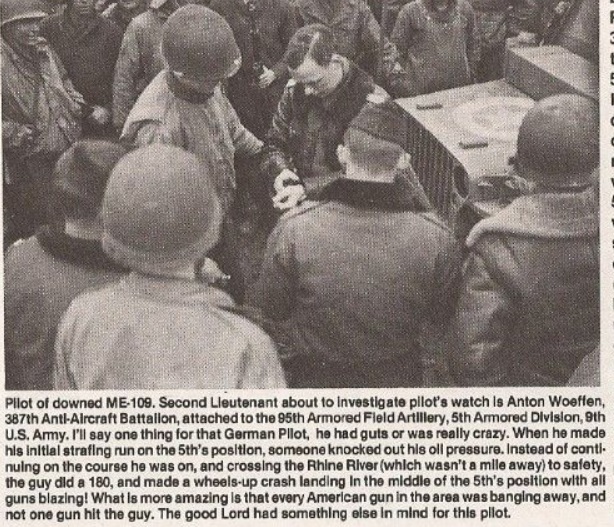
Vom Feindflug nicht zurückgekehrt - Anton Wöffen 6./JG 27 11 March 1945, Jägerblatt, April 1983/November 1987 issues


Anton Wöffen's 'yellow 24' a 6./ JG 27 Bf 109 G-10 WNr. 490655 after being shot down on March 11, 1945 at Xanten, on the western bank of the river Rhine close to the Dutch border between Nijmegen and Duisberg. The pilot was taken captive, below.


Above; US signals photo 

Wöffen’s memoir ‘Ich war kein Jagdflieger As - Erinnerungen eines unbekannten Jagdfliegers’  ( '..recollections of an unknown fighter pilot' ) was ‘serialised’ in Jägerblatt during 1983 and later translated and published in Finland.

"..it is nearly forty years since I last flew a Bf 109 Gustav ..March 11, 1945. That clear sunny Sunday morning I was tasked as Staffelführer with leading a Schwarm of four 6./JG 27 Bf 109s up from Hopsten near Rheine on a recce sortie in the sector Wesel-Rheinberg-Duisberg where German troops still held a bridgehead on the western bank of the Rhine. There were signs that the Americans were preparing an all-out assault and I had to ascertain more  - a somewhat hopeless task. But then at that time so much appeared to be hopeless and pointless. Should we encounter artillery ranging and spotting machines in the air then we were authorised to shoot them down. Such machines were making life very difficult for our troops on the ground. Once airborne we flew at tree-top height in the direction of the river Rhine - skipping over trees, streetlights and houses we had to fly very carefully to avoid contact with obstacles. This was especially the case for those of my comrades flying behind the Verbandsführer  (formation leader). Even for myself it was not easy to navigate at such low altitudes. At 500 km/h  - the sort of speeds we could attain with full armament in normal flight - you could not see much at all. Moments after arriving over Wesel I spotted an 'Auster' climbing at about 100 meters altitude directly ahead of me. What then followed, happened very quickly.. I flicked up the armament safety catch on the control column for the 2cm cannon and the two cowl MG 131s and pulling up under the enemy machine gave the Auster a burst from all three guns. Suddenly I felt a blow in the engine. The prop continued to spin  -  but at a much reduced rate of revolutions. Smoke started to seep into the cockpit. I continued to climb hoping to reach a 'safe' altitude to bail out but my speed was decreasing far too quickly. I could see tracers from all sides rising towards me and immediately pushed the nose down. I had arrived directly over the American lines. I could see fire coming from an anti-aircraft battery and, taking aim in so far as I could, gave the Amis on the ground a burst of fire. By now I was approaching the ground and, although the smoke was hampering my efforts, prepared for a crash-landing..I saw high tension wires flitting past the cockpit ..above my head. I pulled back hard on the stick. The machine hit the ground with an almighty crash and bumping and jolting slid along for some distance. Suddenly everything went quiet. I opened the hood and climbed out. I had made a perfect belly landing and had escaped completely unscathed. I had been lucky. Just thirty meters in front of me was a railway embankment which I could just as easily have plowed into. Running towards me from all directions were American soldiers. Standing on the port wing I leaned back into the cockpit and as I started to tear up my map I heard loud shouting behind me..." Hands up!"


Sunday, 8 March 2020

Hptm. Fritz Keller Bf 109 G-6 Kanonenboot, Gruppenkommandeur II./JG 27 ? Werner Schroer's 100th


G-6 'Kanonen-boot' W.Nr. unknown, in front of a Stabs machine of II./JG 27, Wiesbaden Erbenheim, early 1944. Identified as "schwarzer Doppelwinkel", belonging to Gkr. Hptm. Fritz Keller..


Standing in front of this machine are Ofw. Müller and Fw. Blume. Source: Collection Hans Eberhard Blume via Boiten and Bowman 2001, p. 91. Thanks to Sinisa and Marc for heads-up and caption. Also published in the Prien/Rodeike/Stemmer history of II./ JG 27, page 396. A cheap 'repro' currently on offer here

"...Fritz Keller is an interesting pilot. Having claimed his first victory on 5th June 1940 (a GC II/7 D.520, claimed as a MS 406), his last was claimed in December 1944. Quite a long career, all things considered...."

Perhaps not Keller's machine though, or even the Gkr's as only part of a single chevron is visible. Maj. Werner Schroer was Gkr. II./JG 27 until mid-March 1944 when he left the unit for III./JG 54. He was of course a 100 victory ace and Eichenlaub holder at the time (awarded after his 84th), so his pilots were very likely to want to be photographed in front of his machine - even more so if he was leaving the unit.  See the photo series in Prien II./JG 27 (p424), dated March 3, 1944, depicting Schroer with a celebratory garland marked '100'. However some sources indicate that March 3 was the date Schroer filed his 99th claim and victories 99-102 were not returned until May with III./JG 54. (a P-51 and two B-17s on May 24)

Fritz Keller himself had been away from the front for nearly two years - from April 42 to late Jan 44 - following a so-called Führeranlass after the deaths of his two brothers in Russia. (Prien, II./JG 27 quoting from Keller in 97).  Keller had six victory claims up to April 1942. He volunteered to return to active service and pestered Galland to get back to JG 27. (Prien, p362) He flew his first (training) sortie in II. Gruppe on March 15, 1944. He subsequently claimed a number of Viermots but was shot down on December 17, 1944 and hospitalised for several months before returning to head up II. Gruppe from the ground.

Ofw. Müller (above, left) was KIA on the big USAAF raid over central Germany that was mounted on 16 August 1944. He was lost after combat in G-6/AS 'white 9' WNr. 412 556 in 7./JG 27.

Below; another view in Wiesbaden-Erbenheim of Ofw. Alfred Müller, seen here wearing what may have been a 'liberated' USAF flight jacket and Fw. Hans-Eberhard Blume in front of II./JG 27 G-6 Gustavs


.." some vintage photos may suffer due to quality of originals. Copyright may apply..." says this Ebay seller who has multiple copies (!) of this rather pixelated image for sale here

Sunday, 9 February 2020

'Edu' Neumann, Gruppenkommandeur of I./JG 27, Eduard Friedrich


"...Here is my Eduard Bf 109 F4. I didn't fancy the schemes in the boxing I had so raided the spare decal box and made a JG 27 machine as seen in the "Africa" combo boxing, complete with the attractive yellow nose. I could have gone with Marseille's machine, maybe next time! Gunze and Tamiya exterior with Vallejo interior details. There is a fair bit of tonal variation on the wings and fuselage as I lightened/darkened various panels to break up the monotone RLM79 finish. There is some restrained chipping with a silver pencil. Tyres flatted and pitot replaced with hollow tube. Everything hanging down. The spinner is held on with magnets. I found it centres more precisely that way and can be easily removed for transport to shows. Amazingly it even spins. A joy to build notwithstanding the cockpit is pretty busy and a bit of a tight fit here and there, especially the instrument panel. Keep 'em coming Eduard..."

Rick 'gryphon28'


'Edu' Neumann, Gruppenkommandeur of I./JG 27 returning from a combat sortie, a scene depicted on the cover of a recent issue of ‘Avions’ magazine. Somewhat surprisingly (perhaps) for the Kommandeur I./JG 27 (subsequently Kommodore) most of his ‘kills’ - after a couple in Spain - were returned over southern England during the Battle of Britain. A more or less 'factory fresh' Bf 109 F-4 (note armoured windscreen) would suggest that the photo was taken in September/October 1941.