Showing posts with label Fw 190 Dora. Show all posts

Sunday, 12 October 2025

Doras of Jagdgeschwader 6 on the Eastern Front - archive photo scan #43


Brand-new Dora-9s as delivered to JG 6 early in 1945.  These machines seen in Welzow are still in their factory finish. Previously published in Rodeike's 'Jagdflugzeug 190'


Below; two views of the new Kommodore of JG 6 seen in early February 1945 after a Werkstattflug test flight in one of the unit's new Doras. Just below the canopy note the stencil for the MW 50 tank. Early Doras fitted with the 'stock' Jumo 213 A engine did not provide much of a performance improvement over the Fw 190 A-8 and were fitted with MW 50 boost tanks. Availability of supplies of methanol were erratic, so a "Ladedruckssteigerungs¬Rustsatz" modification was put in hand. As the name suggests this allowed higher manifold pressure and enabled an increase in power output from 1750 to 1900 hp without an additional boosting agent such as the MW or the GM-1 kit. 


If, by late April 1945, Berlin was on the verge of capitulation, in south-eastern Germany and parts of Austria and Czechoslovakia, there were still large German formations continuing to resist the Soviet 4th and 1st Ukrainian Fronts. On or around April 20, the Dora-9s of II./JG 6 flew into Kummer am See in northern Bohemia, Czechoslovakia – part of the so-called and hastily thrown-together ‘Gefechtsverband Rudel’. Rudel, the ‘famous’ Stuka ace recalled his return to a front command and a sortie in the new Dora following his leg amputation;

“ ..Shortly before I take off Fridolin rings up and tells me to fly straight to the Sudetenland; he is just on the point of moving the unit to Kummer am-See near Niemes. In the aircraft at first I feel very strange, but I am soon back in my element. Steering is complicated by the fact that I can use only one foot on the rudder-bar. I can exert no pressure on the right because I have not yet got an artificial limb ..[..], So an hour and a half later I land on my new airfield at Kummer.. our airfield lies amid magnificent scenery between two spurs of the Sudeten mountains surrounded by forest with good-sized lakes near by and at Kummer itself a lovely forest-girt tarn. On the other side of the Sudeten mountains it is still foggy and as we cannot go out on a sortie I take up a FW 190 D 9 and give an exhibition of low and high flying acrobatics. That genius, Lt. Klatzschner, my engineer officer, has already readjusted the foot brakes, which are indispensable for this fast aircraft, so that they can be operated by hand. As I come down to land all the men are gesticulating violently and pointing up into the sky. I look up and through the gaps in the ragged cloud cover I can see American fighters and Jabos, Mustangs and Thunderbolts circling above…..[..] .Fresh weather reports from the Gorlitz-Bautzen area forecast a gradual clearing-up of the weather, so we take off. The Soviets have by-passed Gorlitz and pushed on beyond Bautzen, which is encircled with its German garrison, in the hope of reaching Dresden by way of Bischofswerda to effect the collapse of Field Marshal Schoerner's front..”

Their Doras loaded with AB 250 Abwurfbehälter the pilots of II./JG 6 flew ground-attack and strafing sorties against these Soviet spearheads pressing north along the Bautzen-Königswartha-Hoyerswerda road between Görlitz and Dresden.

According to Rudel’s account, Bautzen was ‘relieved’ and a large number of vehicles and tanks destroyed. The logbooks of two surviving Fw 190 D-9 pilots allow a glimpse at some of the last-ditch sorties flown. Just after mid-day on Tuesday 24 April Tuesday Fw. Karl ‘Charly’ Hoffmann was up from Kummer am See (Niemes-Süd) in his ‘black 4’ and claimed four Soviet trucks destroyed before landing safely at 13:30. His comrade, Ofw. Herrmann ‘Hermy’ Härtel of 7./JG 6, was airborne at 15:20, returning to Kummer at 16:15 having again accounted for four trucks as noted in his Flugbuch. Härtel had flown over one hundred combat sorties since 1940 and had claimed his first victories just days earlier, downing two Yak fighters on April 17.

The following day Soviet forces reached the Elbe at Torgau (Saxony) where they linked up with American forces. The Doras of II./JG 6 continued to fly defensive sorties. Fw. Hoffmann was airborne at the controls of ‘black 2’ in the sector Sagan-Cottbus. Flying Fw 190 D-9 ‘Langnase’ ‘black 8’ Härtel was up from Kummer am See but landed late in the afternoon in Görlitz. Despite adverse weather conditions that hampered flying activity during early May, Ofw. Härtel noted several further sorties in his log book. On May 5 he flew a combat mission from the Feldflugplatz (field strip) of Alt-Chemnitz - some five days after Hitler’s suicide. On May 8 both pilots flew west into Halle-Nietleben and American captivity, probably the last flights undertaken by the Fw 190 D-9.

Tuesday, 16 September 2025

Karl-Heinz Ossenkopf I./JG 26 Dora-9 pilot, April 1945


 Both 'Avions' and 'Aeroplane' are running the same feature in their current issues - Holger Ziehm's interview with K-H Ossenkopf. Ziehm is a former Bundesluftwaffe F-4 pilot while Ossenkop arrived at the front following the D-Day landings and saw combat with the latest and best Allied fighters at the controls of his I./JG 26 Fw 190 D-9. He even managed several victories until he was shot down and hospitalised by an RAF 80 Sqd Tempest on 17 April 1945. 

Both the 'Avions' and 'Aeroplane' magazines feature Fw 190 D-9s on their covers and fairly random and well-known images of Doras inside to illustrate their lay-outs. The less said about the 'Aeroplane' cover illustration the better. As Keith put it;

"..why am I looking at a hideous Typhoon/Tempest mash-up? Why has the production team let this through the net? The fuselage is flat sided behind the cockpit which is wrong and the wings are definitely Typhoon, why? It seems such a shame to tarnish what is still a leading publication for aviation history.."

Not to mention the poor translation; ".. D-9 in the end times." (!!)

Meanwhile Graham Boak noted on britmodeller;

" I looked at the Fw 190 (on the cover of 'Aeroplane') and noticed that it had a decent representation of a late-war finish, and I hauled out my JAPO books to check. However the pilot's favourite "Black 8" was a very early one, but written off in a forced landing. He replaced it with another Black 8, no details given, but when shot down was flying a (presumably) 'Black 2' (ie, a replacement 2. Staffel machine) The artwork shows a Black 8..."..

The 'Avions' cover on the other hand features an Eric Schwartz profile described as depicting K-H Ossenkop's regular machine during the period February-March 1945, a 'black 8' W.Nr 210968 of 2./JG 26. 

Ossenkop describes the events of 17 April 1945 when he was shot down over Lake Schwerin. 

" ..my wingman Uffz. Karl Fröb was sticking close to me. My 'black 8' was not available that morning so I had been assigned 'white 2', a replacement crate, but something of a lame duck. [..] I closed on the Spitfire, one of the latest, most powerful models, most probably with a well-trained and experienced pilot at the controls. He hadn't seen me. I checked my rear, then opened up. Pieces of debris flew off the enemy aircraft, he rolled over and dove. I could see a banner of smoke streaming from him so knew that he was probably on fire. I had no time to watch his fate - enemy fighters were now on our tails. We dove into the mist just above the surface of the  lake. Visibility was poor but at least we had escaped the Spitfires. Then, in a split second, I saw a fountain of water erupt from the lake. My inexperienced wingman [Fröb] had just gone straight in!..."

Attempting then to rejoin Oblt. Dortenmann who was leading a formation over Lubeck, Ossenkop ran into some aggressively flown 80 Sqn Tempests. It would be his last action of the war. Ossenkop was forced to bail out and was injured colliding with the tail of his Dora. So according to Ziehm, Ossenkop was shot down in 'white 2' (sic!) on 17/4/45. 'Black 8' WNr. 210968, the pilot's usual a/c, was u/s.. but was nonetheless lost on that same sortie with Uffz. Karl Fröb at the controls! Elsewhere Caldwell doesn't have any details on Ossenkop's loss at all, while he confirms that Fröb, flying as Ossenkop's wingman, was downed in 'black 8' - which Ossenkop himself states was u/s. Something doesn't add up!  Answers on a post card please..


Friday, 1 August 2025

Fw 190 D-9 in JG 300 (part 2)


Apparently Burkhard Otto of jg300.de believes my accounts of the Dora-9 in JG 300 are 'fakes'. Despite the fact that they were first published in 2003 and based on material in the Lorant/Goyat history of the Geschwader! 

Incidentally I do have a copy of Hubert Engst's (unpublished) 'memoir' written during 1966 for East German magazine 'Aero Sport'. In it he describes seeing "our last three Langnasen" getting airborne from Holzkirchen (a JG 300 airfield in southern Germany) for a transfer flight to Ainring during the last days of April 1945. He then 'spoils' it somewhat by referring to these 'long noses' as Ta 152s  - which is obviously incorrect..

So just for Burkhard Otto, here's part 2 of the "Dora-9 in JG 300" Extract from the Lorant/Goyat history of JG 300 (my translation). 


Major Rall’s Geschwaderstab of JG 300 underwent re-equipment with the Fw 190 D-9 from 21 April 1945. Two days later, four Focke-Wulf 190 D-9 Langnasen destined for II./JG 300 came into land at Holzkirchen. These aircraft, delivered with no spare parts, were powered by in-line Jumo 213 supercharged engines able to develop 1,900 hp rather than the 1,650 hp of the standard Jumo 213 at altitude. But it was at sea level that its performance was astonishing; with the methanol-water boost activated the speed of this thoroughbred was within a hairs breadth of 730 kph! Two of these superb aircraft apiece were allocated to the Gruppenstab and 7. Staffel. The fact that these aircraft were becoming available now just as Germany was sinking into chaos served only to reinforce a feeling of bitterness among the pilots. For want of sufficient fuel reserves, training flights in these “long-noses” were limited to a few circuits of the airfield for a handful of pilots selected by Oblt. Radener. The pilots of the Stab/JG 300 were often assigned to fly sorties with II./JG 300 according to requirements. One of these pilots was Uffz. Günter Ritzka, who recalled:

 "..I had already had an opportunity to fly the Fw 190 D-9 before being assigned to Jagdgeschwader 300; I was probably the only Stab pilot familiar with the aircraft. During the last days of the war, I was detailed to ferry one of these Dora-9s from Altenburg to Zwickau. The machine had no armament. Shortly before reaching Zwickau, I came under fire, probably put up by our own flak whose crews were doubtless unfamiliar with the new fighter’s silhouette. As I overflew Zwickau, I could see that the airfield had been hit by a heavy air raid. Landing there was out of the question. I turned back to Altenburg and again came under heavy flak fire at the same location as on the inbound flight. I then realized that the front line had moved up considerably, which was obviously something that they were not aware of back in Altenburg… Suddenly, just as I had left the danger zone, my aircraft was caught in a burst of tracer fire which this time was zipping past me in the horizontal plane! I opened the throttle wide and hugging the ground tore back to Altenburg. I could see that I had been hit as oil was spattered all over my windscreen. I managed to put down at Altenburg with no further problems and taxied to the edge of the airfield. I clambered down from the cockpit and surveyed the undersides of the aircraft and counted five impacts. Just as I was assessing the damage, the air raid warning siren began to wail. I ran to the nearest foxhole. Two or three Thunderbolts flew two firing passes machine-gunning my Dora-9. It is entirely possible that the new Kommodore, Major Rall, flew the Fw 190 D-9. However I do not have any actual recollection of him doing so .."

Part 1 of Fw 190 D-9 in JG 300 is here

Saturday, 24 May 2025

Fw 190 D-9 in JG 300 (1)


from an article compiled by this blog writer for Scale Aircraft Modelling back in 2003. Artwork by Mark Rolfe.

Stab./JG 300 D-9 seen in Prague post-war. The last Kommodore of JG 300 was Günther Rall - his Geschwaderstab may have taken on charge some D-9s in April 1945 but it is not known if Rall himself ever flew a combat sortie in the D-9.

Click on the images to read the captions


Note 'RLM 83' is now considered by some experts to have been a 'maritime blue' - that '83' was a 'green' is/was a widely held assumption possibly originating in the 1980s in the work of Thomas Hitchcock. According to Kiroff there are different 'distinct 'recipes' for Farbton 81 and 82 - and only one for '83'  - others consider blue '83' to have been a 'test' colour for over-water ops, with only limited 'documentary evidence' restricted to a handful of Ju 88 units operating in the Med. More on this shortly....


Also on this blog;

Last sorties of JG 300, April 1945


Tuesday, 16 July 2024

Fw 190 Dora 9 'blue 12' by 'kov1985'


Fw 190 D-9 "Blue 12" WNr. 500570 of II./JG 6 surrendered to elements of the U.S. 10th Photo Reconnaissance Group at Fürth, near Nürnberg on 8 May 1945

" ..This one is finally off my bench after a few months of work, my rendition of the 'famous' “blue 12” which surrendered at Fürth in May 1945. I used the Hasegawa 1/32 Dora -9 with Quickboost cowling, spinner and prop, Quinta studio cockpit interior, Hgw seatbelts, eduard brassin flaps, 1 Man Army stencil masks. Some small bits I took some artistic license, but I’ll get into that later...".


"..there are plenty of pics of this aircraft that are available, as well as a few that come with the Eaglecals decal set. However I’m less impressed with the Eaglecals set as I intended to only use the serial number, the “E9”, and the “12”. However for some reason, the “1” is smaller than the “2” in the 12. It makes no sense why they’ve done that as every photo I’ve seen of the thing doesn’t show this. Hence I made my own mask for that by painstakingly drawing and cutting it out of paper, tracing onto masking sheet and cutting that out. To make things worse I botched its placement on first go and had to use the mask 3 times…"

"..The colours of blue 12? Experts on the subject lean towards the top of the wings being 77/81, or 76/81, however in my honest opinion that may have well been the case for later Mimetall machines. My theory is that early ones such as 570 here had the standard grey wings, which were then painted 81 on the underside, either by factory or at unit level until Mimetall found their “groove” and painted the whole thing in 81 etc. My source for this theory being machine 581 (only a few airframes from blue 12) clearly having the grey tops, but notice landing gear doors being that dark colour still indicating to me RLM 81, which can clearly be seen also on the famous colour photo of blue 12.."


Thanks to Casey for his superb model images!

Tuesday, 18 June 2024

Dora-9 im Einsatz - Fw 190 D-9 in service with III./JG 54 -ebay photo find #375


The dispersal of the Peter Petrick archive continues apace via Oliver Rogge's ebay auction pages (Kurmark Antik). While published in many books that feature the D-9 (since Lorant's 'Focke Wulf Fw 190' first appeared in the early 1980s) this selection features one or two 'new' images. Two of my purchases from Oliver's offers have just arrived and they are pretty decent quality - in fact I'm told they are prints from Ungar's original negatives.

The Fw 190 D-9 entered service with III. Gruppe of JG 54 'Grünherz' during October 1944 at Achmer (12. Staffel) and Hesepe (9. Staffel), where they were deployed to cover Me 262 Kommando Nowotny 'Turbos'. While the first Doras in service undoubtedly piqued the interest of their pilots, according to Fw. Fritz Ungar of 9./ JG 54,  the sole reason for this picture series was to record the Staffel fox terrier mascot 'Struppi' for posterity. There is unfortunately no complete view of either "White 2" or "White 3". "White 2" was WNr. 210015 which was lost over Hesepe on 15 October 1944 after being shot down by 83FS T'bolts. Lt. Fritz Bartak  was wounded but managed to bail out.


Below; another view of 'Struppi', this time in the cockpit of  9./JG 54's 'white 3' with Fritz Ungar. "White 3" was the eighth series production machine (Wnr. 210008). Note the reinforcing strip required by the installation of the Jumo 213 to the 190 fuselage.


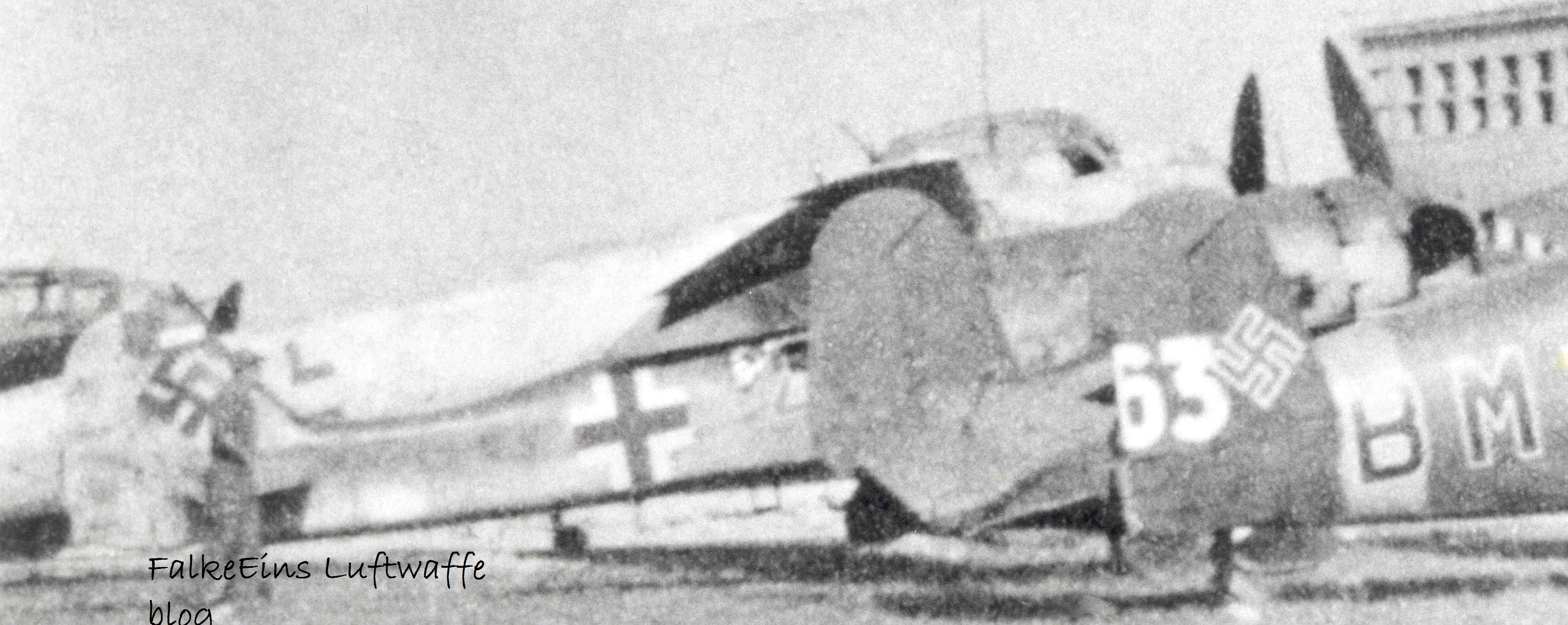
'Struppi'  enjoying the attention of the mechanics of 9./JG 54 perched on the horizontal stabiliser of  "White 3". Note the jack/support under the rear fuselage keeping the tail wheel just off the ground.  The aircraft finish again appears highly polished. Note that 'white 2' and 'white 3' have different style fuselage Balkenkreuze..


Saturday, 6 April 2024

JG 2 Doras in action 23-25 March 1945 - death of the Kommandeur


Fourteen Doras from I./JG 2 were airborne from Zellhausen at 07:00 to attack the US pontoon bridge and the bridgehead across the Rhine at Oppenheim, west of Darmstadt (in the Mainz-Bingen district of Rhineland-Palatinate). Bombs  were released on the river before the Doras were intercepted by US fighters. Fw Erich Söldner (below) failed to return but had in fact landed at Gotha. Söldner had claimed his first victory on 3 March 1944, downing a 15th AF B-17 during a raid on Rome. 


The remaining pilots including three members of the Gruppenstab (Kommandeur Hrdlicka, Oblt Willi Kohlstrunk and Uffz. Horst Buttgereit) all returned to Nidda. Ogfr. Max Wojacek (below)  also managed to evade the US fighters and landed at Nidda. 

" ..a thick layer of oil started to spray over my windscreen and soon the airframe was covered."


Around ten III./JG 2 Fw 190 Doras were airborne from Babenhausen early on the morning of 23 March. They were attacked by 368th FG P-47s who claimed two, one coming down in the river Rhine and the other managing to put down in a field alongside the river. Fhr. Karl Belsen of 10./JG 2 made an emergency landing five kms north of Oppenheim. He recalled;

" ..our target was the American pontoon bridge thrown over the Rhine at Oppenheim. We over-flew the Rhine at low level south of the town before turning back on an easterly heading. Shortly before dropping our ordnance we pulled up to around 200 m to fuse the bombs. It was at that moment that my engine was hit by small arms fire from the ground. It stopped right over the river. Attempts to re-start it were in vain.I more or less 'glided' across the river and managed to put down in the first field. As the machine slid along the ground I suddenly remembered that I had failed to jettison the bomb. As the aircraft came to a stand I quickly jumped out of the cockpit out onto the wing - the bomb had been torn off its rack and lay some 200-300m away. It was at that moment that it exploded! I was still on the wing - breathing a huge sigh of relief  - when I came under rifle fire from a Volkssturm militia-man on the nearby river bank. He must have taken me for an American but heard me screaming insults at him in German because he soon lowered his weapon. I set off to return back to Babenhausen, a journey which involved several detours. It was while I was waiting for a bus in Heidelberg that I was approached by two men in black leather overcoats who asked me to follow them. After showing me their Gestapo badges they asked to see my Soldbuch - I handed them my Frontflugausweis ( a 'safe conduct' pass for front-line service pilots) which I took out of my brown leather tunic. But they were not at all interested in this. I started to explain that flying with a combat fighter unit I was expressly forbidden from carrying personal documents on sorties, except for the one that I had just shown them and that they must have known this. At that point they became a little more conciliatory. Apparently an RAF bomber had come down in the area over night and some members of the crew had not yet been caught. Their boss -who had noticed me waiting at the bus stop from his office - had assumed I must have been one of them on the run. In the end I got back to my Gruppe about five days later.." ***


At 11:00 the 'Richthofen' were in the air again - at least 18 Doras flew the sortie directed at American vehicle convoys and road traffic on the Oppenheim-Gross Gerau road south of Mainz. A number of Doras carrried bombs while the remainder of the force flew as top cover. After only some 15 minutes in the air they ran into 354th FG P-51s north-east of Hanau.  The American pilots filed some ten claims, including three for Maj. George Lamb. Almost certainly one of his victims was Oblt. Willi Kohlstrunk (left), a former KG 3 bomber pilot who had lost a leg in a bad crash in 1940. Flying a D-9 marked with the Stab 'chevron vertical bar' Kohlstrunk was hit over Kohden near Bad Salzhausen. With his D-9 in flames, he managed to jump clear but hit the airframe and sustained another serious leg injury. At least seven Fw 190 D-9s failed to return. ..[Incorrect: this figure does not correspond with 'official' Verlustmeldungen. The most likely scenario is that several of these would have put down elsewhere..] Those survivors that did arrive back in Zellhausen found that the last surviving group of I./JG 2 pilots had already evacuated the airfield and shifted to Ziegenhain, near Kassel, some 160 kms to the north.


The following day, 24 March, was notable for the launch of the Operation 'Varsity' Rhine crossings. This was the largest airborne operation (against a single objective) of the war and was supported by bombing raids on German airfields all over western and central Germany.  JG 2 put another eight Doras in the air to attack the bridgehead at Oppenheim but the Fw 190s were forced to jettison their ordnance before reaching their target. Some 113 B-17s raided Ziegenhain at around 17h00. 

On 25 March  around 15 Doras of I. and II./JG 2 were in the air from 06:00. Once again the target was the bridge at Oppenheim.  Ogfr. Max Wojacek reported difficulties with his aircraft as a jet of engine oil started to spray over his windscreen and soon covered the airframe.  Unwilling to break radio silence  he indicated to formation leader Hrdlicka his intention to turn back by waggling his wings. Hrdlicka had nodded his assent. Wojacek proceded to carry out an emergency landing on the airfield at Giessen, side-slipping down to maintain some 'forward' visibility before straightening out for a 'three-pointer' at the last moment. 


The return home proved fatal for a number of Dora pilots including the Kommandeur of I./JG 2. Hptm. Franz Hrdlicka and his wingman Uffz. Horst Buttgereit were both shot down by enemy fighters. According to the letter of condolence that was sent to Hrdlicka's brother, both pilots were attempting to reach Nidda. Buttgereit's sister - having fled her home in East Prussia ahead of the Russians and made her way to Leipzig - did not learn of her brother's death in combat until 1952. Both Hrdlicka and Buttgereit were buried in Nidda. Ofhr. Gerhard Frisch (2./JG 2) heard the warning calls from the airfield - 'Lucie Anton am eigenen Gartenzaun' - and Hrdlicka's voice over the radio but had already been hit by a burst of fire that left his cockpit filling with smoke.  [IncorrectLucie Anton is code for LAndung..the phrase heard was 'Indianer am eigenen Gartenzaun'..or 'enemy fighters over own airfield' ] Jettisoning the canopy to clear the smoke he saw that he was 'surrounded by five or six' Mustangs - it was time to jump. He made the mistake of pulling the ripcord almost immediately and during his long descent he was circled by P-51s. One American pilot even waved a greeting at him. It was Frisch's last sortie with the 'Richthofen' - he had already been posted for Me 262 jet training at Lechfeld.   

Karl Belsen's war ended on 31 March during a sortie over the front - described by one of his comrades as 'a personal initiative' - after he collided with a P-47 that he had opened fire on near Bad Hersfeld (Eisenach). He managed to jump clear, albeit injured.. Max Wojacek flew his last sortie on 7 April - he would be shot down in flames by P-51s over Querfurt. He managed to bail out and was taken to the local hospital with serious burns.

(*** Holger Nauroth's version of Belsen's account differs in areas of detail from that published in 'Dans le Ciel de France' Vol 6. Mombeeck's account contains a number of errors. Thanks to Jochen for corrections and more detail. )

Also on this blog;

Tuesday, 20 December 2022

out now, Aérojournal issue 91 - " Focke Wulf 190 Long Nez - Doras au combat"


Recent issues of Yannis Khadari's bi-monthly magazine under the direction of Yann Mahé continue to evoke the spirit of CJE with plenty of good Luftwaffe content as ever; the Richthofen over Dieppe, I./NJG 2 over Britain (by J-L Roba), little-known Luftwaffe aces in the Battle of Britain (by Philippe Saintes). 

Just published in the latest Aérojournal (issue 91) ..twenty pages of rare accounts and images compiled by this blog writer devoted to the Fw 190 D-9/11 and Ta 152 in combat, including newly translated diary/logbook entries from JG 51, JG 301 and JG 6. I've also managed to incorporate some of Werner Molge's lengthy contributions in Jägerblatt during the 1980s which don't appear in D.Caldwell's various JG 26 texts.  French text.


"....If the Focke Wulf 190 A (Anton) was – to coin a phrase – the ugly duckling, then the Fw 190 D (Dora) was the graceful swan. The re-designed nose – to accommodate a Jumo in-line engine – and the lengthened rear fuselage gave the Dora an elegance that was far removed from the pugnacious, snub-nosed Anton. Built in large numbers from late August 1944 the Dora was one of the best fighters of the war – on paper. The fact that the type accounted for less than one hundred Allied aircraft shot down in its entire career is indicative of the overwhelming aerial supremacy of the Allies by late 1944. It also highlights the evolving role of what was initially conceived as a stop-gap high altitude fighter to combat the Allied bomber fleets but was increasingly deployed as a fast ground strafing light bomber – another ‘miracle’ weapon that contributed little more than the virtually obsolescent Messerschmitts and Focke Wulfs it was designed to supercede..."

The superlative cover artwork is by Antonis Karidis and depicts Fw. Wolfgang Polster at the controls of his 11./JG 26 'yellow 10' (WNr. 500603) being caught landing at Plantlünne on 24 February 1945 by Fl. Lt. David Fairbanks in his 274 Sqd Tempest V coded JJ-F. Polster was Fairbanks 11th victim but survived this downing and the war. 


" On or around April 20, 1945 the Dora-9s of II./JG 6 flew into Kummer am See in northern Bohemia, Czechoslovakia – part of the so-called and hastily thrown-together ‘Gefechtsverband Rudel’. Rudel, the ‘famous’ Stuka ace recalled his return to a front command and a sortie in the new Dora following his leg amputation...."

Having used the service a number of times now I can confirm that back issues of Aérojournal are speedily and professionally shipped via http://caraktere.com    (cost 8 euros). Stocked in the UK by the Aviation and Military book Centre 

Saturday, 29 October 2022

Focke Wulf Fw 190 D-11 Platzschutzstaffel - IBG Models latest release and an updated list of documented airframes

The latest IBG models 72nd scale Fw 190 Doras are released  - the new box features two kits including options to build a rare Dora variant, the D-11.


The D-11 variant of the Focke-Wulf 190 was designed as an interceptor fighter, incorporating many of the features found on the Ta 152.  Developed around the A-8 airframe, the D-11 was powered by a new MW- 50 boosted 35-litre Jumo 213 F inverted V 12 engine rated at 2060 hp for take-off. The sturdier mountings for this powerful engine resulted in a slight bulging of the previously smooth contours of the engine cowling.  Armament was also changed from the D-9; the two cowl-mounted MG 131 machine guns were deleted which made for a refined upper cowl shape. The 20-mm MG 151/20s in the wing roots were retained. The enlarged Ta 152-type supercharger intake on the starboard side of the cowling and the VS 10 paddle-bladed propeller assembly were further characteristics of this sub-type. In addition a 30-mm MK 108 cannon could be installed in each of the outer wing stations, the new spinner also being prepared for the later installation of a further MK 108 or MG 151 firing through the engine camshaft. 

Two rare views of Fw 190 D-11 'Red 4' WNr. 220010  - as featured in the new IBG Models Dora box art - from the well-known München-Riem control tower line-up . 'Red 4' featured the "Der nachste Herr die selbe Dame!" slogan. 


There are only seven (maybe eight) known/documented Fw 190 D-11 aircraft out of some twenty produced. These were manufactured exclusively at the Focke Wulf Sorau factory in the WNr. 220 series and are listed here below in chronological Werknummer order from those known. In the final weeks of the war these machines were gathered together in southern Germany in the Verbandsführerschule General der Jagdflieger (VFS-GdJ – a training school for unit leaders) although the reasons for this are unclear. It has been suggested that as all other units using Doras were front-line there were only limited possibilities to work on these new machines and given their limited number they were assembled in a non-combat unit where Focke-Wulf technicians could spend time on their maintenance and testing. When the VFS-GdJ was finally disbanded these machines were assigned to other units, most notably JV 44, JGr 10 and JG 101. 2./JGr 10 Dora-11’s were equipped with R4M rocket launching rails under the wings in place of the outer wing cannon. JG 101 did not use its Doras in action prior to its disbandment under Kommandeur Maj. Hans Knauth on April 16, 1945.

220000, White Chevron 53, VFS-GdJ, Bad Wörishofen
220009, White Double Chevron, VFS-GdJ, Bad Wörishofen
220010, White Chevron 58, VFS-GdJ, 'Red 4', JV 44, Munich-Riem
220011, White Chevron 57, VFS-GdJ, Bad Wörishofen, 
22001?  White Chevron 57  R4Ms  at Schongau JG 101 ("Does this machine have any correlation with WNr 220011  found less than 30 kms away? ")
220012, White Double Chevron + Bar, VFS-GdJ, Salzburg-Maxglan, pos. Major Günther Rall
220013, White Chevron ??, VFS-GdJ, 'Red 2', JV 44, found at Bad Aibling  (JV 44 crest but no inscription)
220014, White Chevron 61, VFS-GdJ, Bad Wörishofen

(with thanks to David E. Brown)

also on this blog;


An extensive Fw 190 Dora feature by this blog writer is published in the next issue (No. 91) of Aerojournal magazine with new personal accounts and rare images. (French language text)

D-11 WNr. 220011, White Chevron 57, VFS-GdJ, Bad Wörishofen


Saturday, 17 September 2022

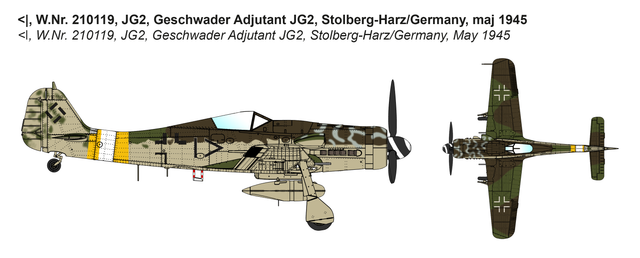
Dora-9 "White 12" 5./JG 301 - IBG 'Mimetall' Dora new Luftwaffe models


 Found and photographed by US forces at Bad Langensalza, this image of 5./JG 301's 'White 12' is an enlargement that I attempted from the rather poor-quality original print lent to me by the late James V. Crow. WNr 500408 was one of 70 machines from Mimetall's second production batch produced in the period December 1944-January 1945. A red II. Gruppe bar is visible over the red/yellow fuselage bands. 'White 12' is one of the markings options in the latest boxings (Mimetall) of the new IBG Dora-9.
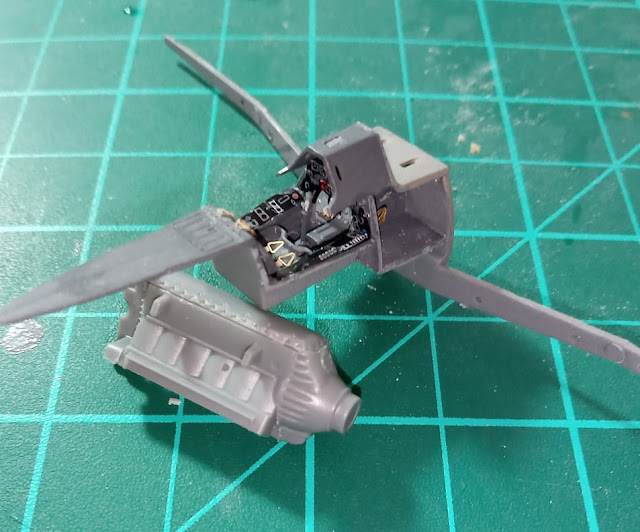


Finish (JAPO) is 81/82 uppers (brown/light green), pale 'sky' green undersides except 76 rudder. Underside of wing 81 gear covers and leading edge to about half span, ailerons 76, remainder bare metal or (Crandall) 82/83 uppers, pale 'sky' green undersides, underside of wing 75 gear covers and leading edge to main spar line, ailerons 76, remainder bare metal.  
IBG appear to have opted for the JAPO colour scheme (although a starboard photo view shows the gear covers do not appear to be 'dark' and are simply in shadow, so most likely in the 'standard' lower surface colour)


Also on this blog;

IBG Models Fw 190 D-9 'Cottbus production' finished!

II./JG 301 Dora-9s at readiness


Sunday, 6 March 2022

Building the new IBG Models Fw 190 Dora 9 (Early Production Cottbus) - new Luftwaffe models


Finished my first of the lovely 72nd scale IBG Doras (Cottbus 'early'). Totally hassle-free build, loads of detail and neat options! 

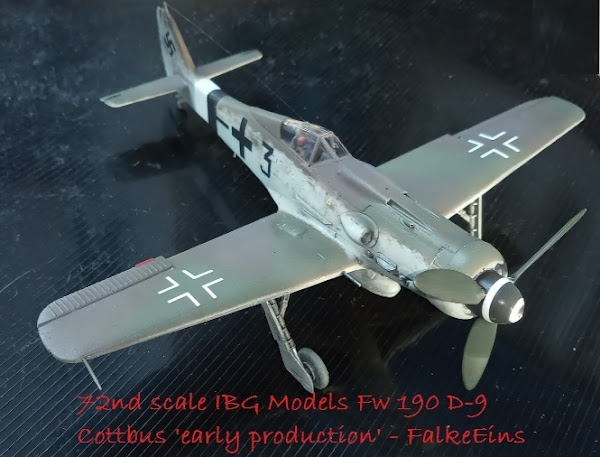
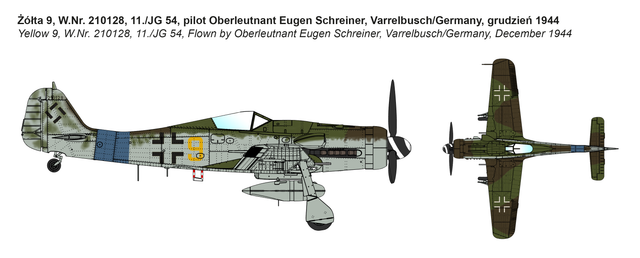
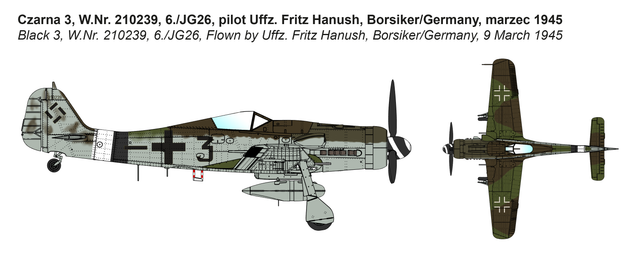
Finished in one of the kit markings options, Fw 190 D-9 "black 3" WNr 210239 flown by Uffz. Fritz Hanusch, 6./JG 26, shot down on 7 March 1945 by the 366th FG and crash landed at Börsiker, Wesel. 


 Part 1 of my build is here

 Part 2 of my build is here


Sunday, 20 February 2022

Building the new IBG Models Fw 190 Dora 9 (Early Production Cottbus) - Part 1 (build review)


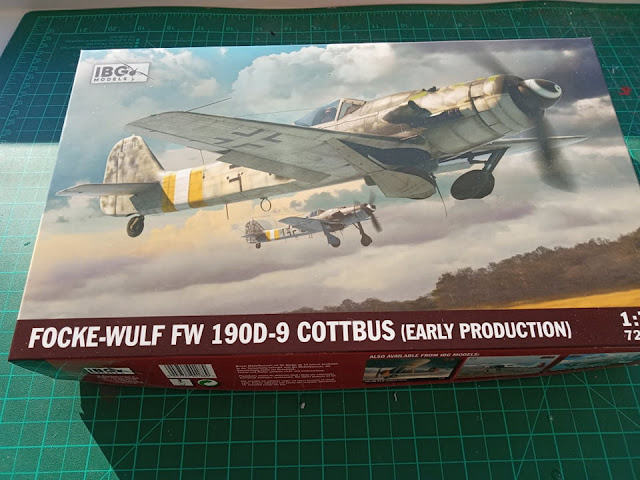
A few years ago there was some talk of Eduard 're-inventing' the 72nd scale scene and while their Spitfires, Fw 190s and Bf 110s were good, IBG models with their PZL series and now their new Dora family really seem to have taken up the '72nd scale' baton in a big way. I was keen to see how well this one would go together - the in-box appraisal elsewhere on this blog really got the juices flowing. 

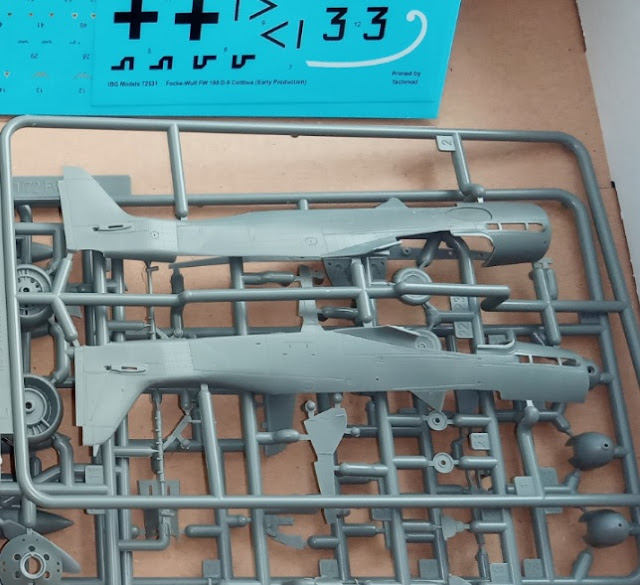
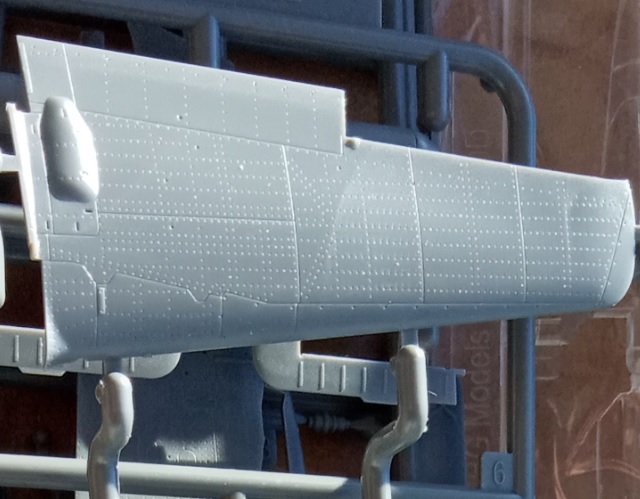
First up, note the incredible 'finesse' with which the parts are molded. The fuselage halves especially are the thinnest I've ever seen on a 72nd scale kit. 


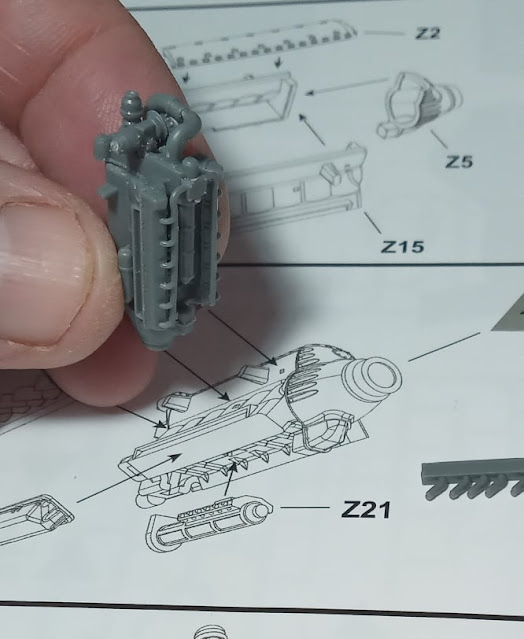
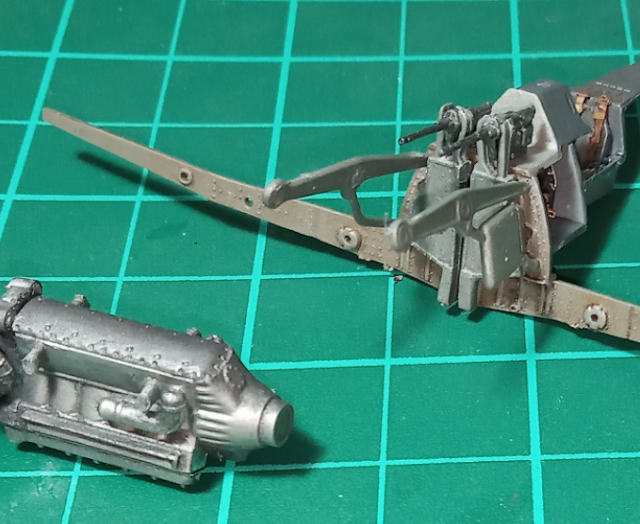
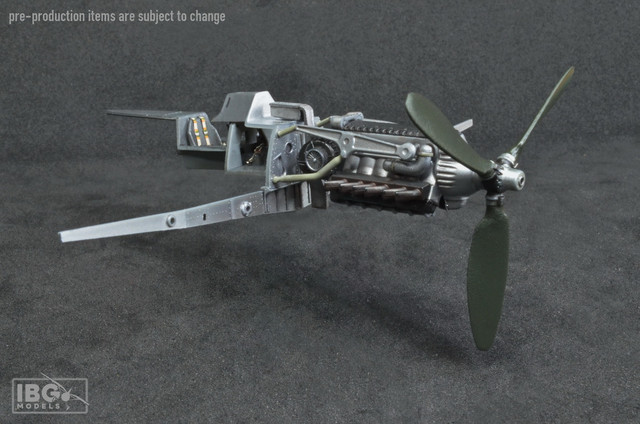
Eleven -part Jumo engine in 72nd scale - some 48th scale Doras don't feature this level of detail. Some 48th Doras don't even have engines or open wheel wells. A fair proportion of this detail will be visible through the open wheel wells.

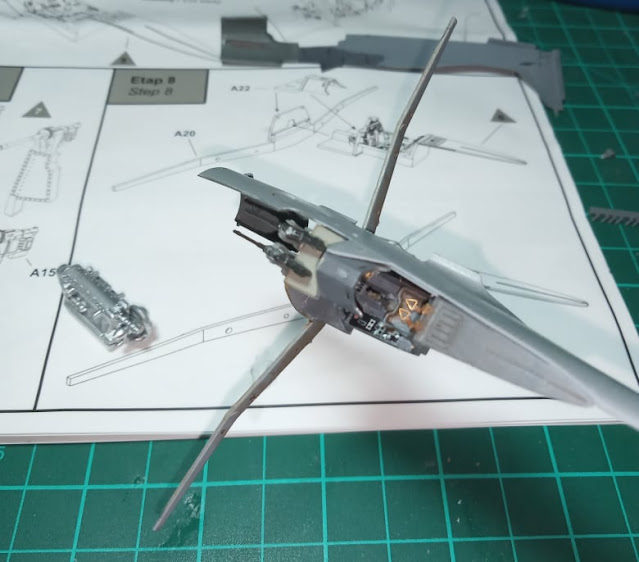
Cockpit assembly is straight-forward, includes decals and etch for belts, pedals etc. The decals don't settle down well over the molded console/instrument panel detail. Note the opened coaming hand-holds - as molded. 


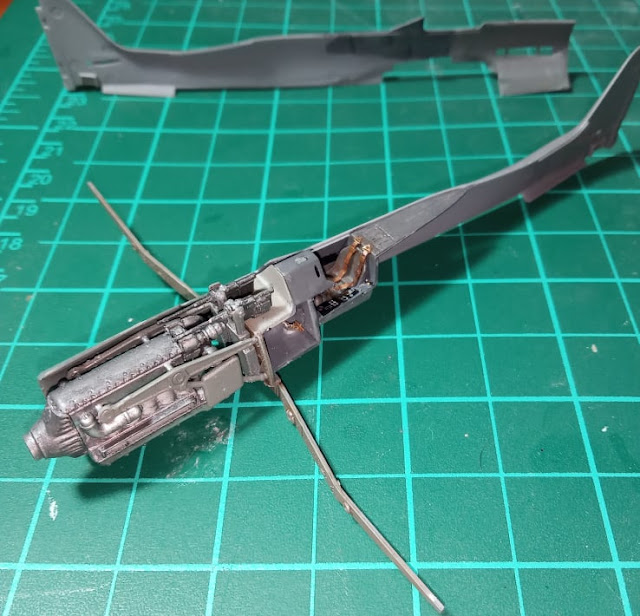
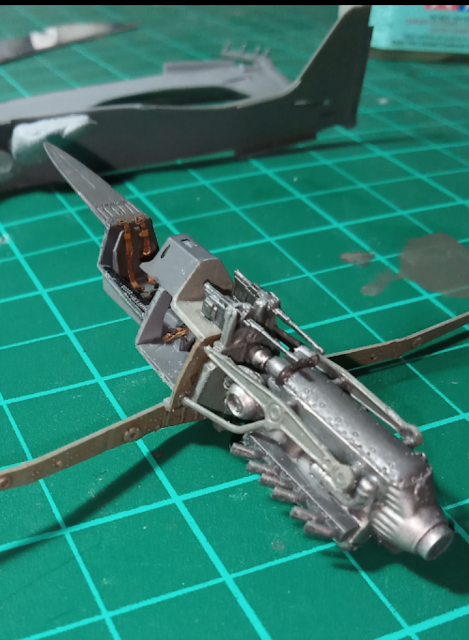
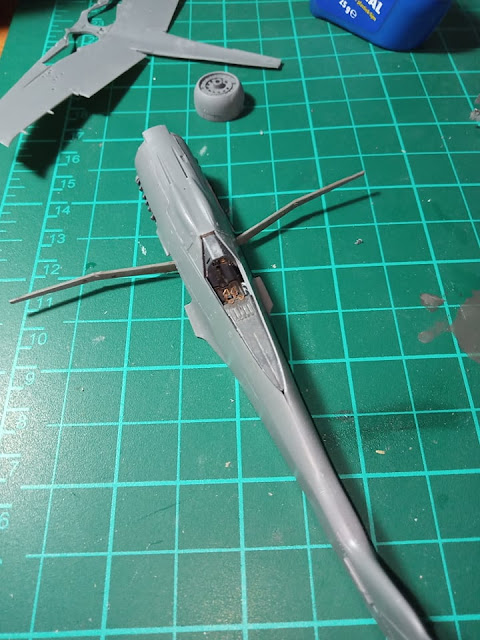
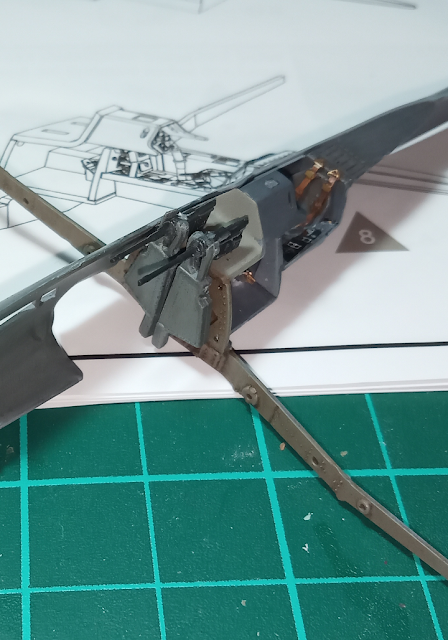
Both cockpit and engine are assembed together with the upper cowl MGs and inserted between the fuselage halves. I deviated a little from the assembly instructions by securing the engine bearer arms first before adding the engine. Location of the exhaust ejector stubs is a little vague (and they are incorrectly numbered too). 


The engine firewall is nicely detailed too although mostly hidden behind the MG magazines. This part makes up the rear wall of the undercarriage well.


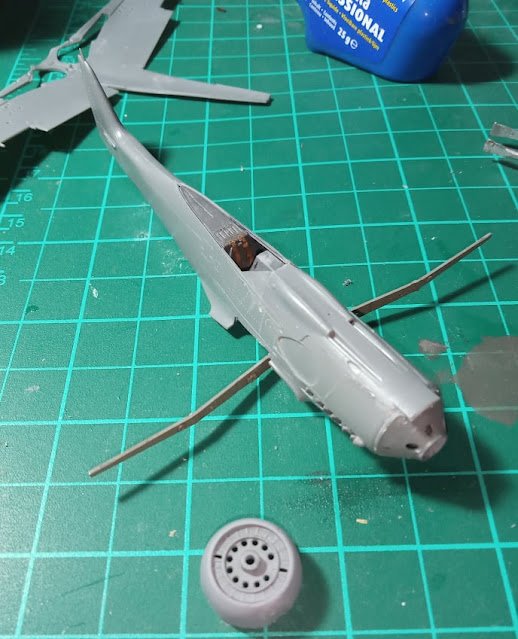
I must admit that I was a little worried about the whole assembly fitting into the fuselage halves - the new tool Airfix 48th Mustang is a bit tricky in this respect too - but there were no problems with this kit and the exhaust ejector stubs lined up easily enough too. Level of detail for a 72nd kit is impressive - it looks tricky but goes together pretty well.  


Below; fuselage halves together with no issues and the lower wing section test fitted - stages 1-11 out the 22 build stages now completed so I'm approximately half-way through the build. Note the very restrained surface detailing- apparently the rivets and panel lines are a 'deal-breaker' according to some. Which is ridiculous. They certainly don't worry me. In fact the fuselage 'strengthening strips' - barely discernable here - should be a little more prominent in my view and I will probably add some plastic card strips to replicate this..


Wednesday, 12 January 2022

new-tool 1:72nd IBG Models Fw 190 Dora is here ! in-box review - Luftwaffe models


"...I hope that the final kit will be as good as 1/72 Eduard FW-190 A and F kits ! .."

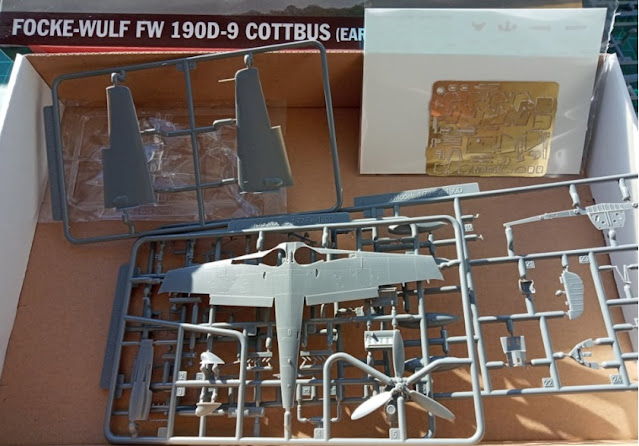
The first new-tool IBG Models Fw 190 Dora-9 has arrived. The D-15 is released as well. I assume the D-11/13 is due later. A quick look at what's in the box. 


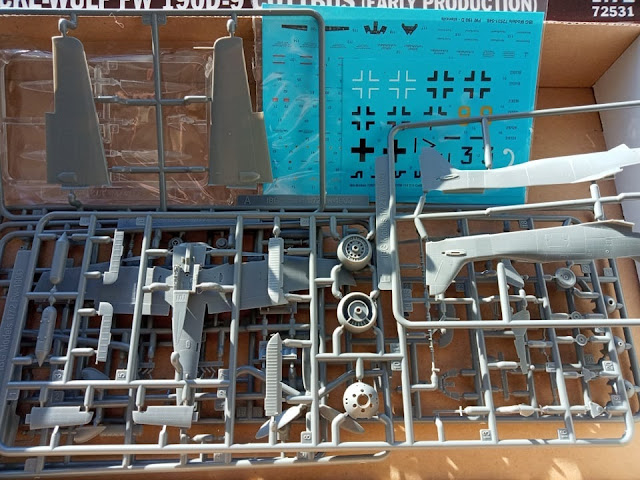
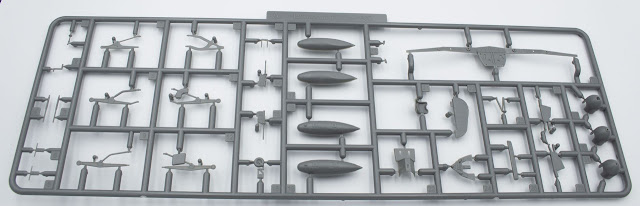
First look in the box. The sheet of photo-etch is bagged with the decal sheet and not visible here. First thing to catch my eye  - a “cigar” drop tank is in the box, relatively common on Doras but not previously kitted before, below left. Two more drop tanks provided as well.
 

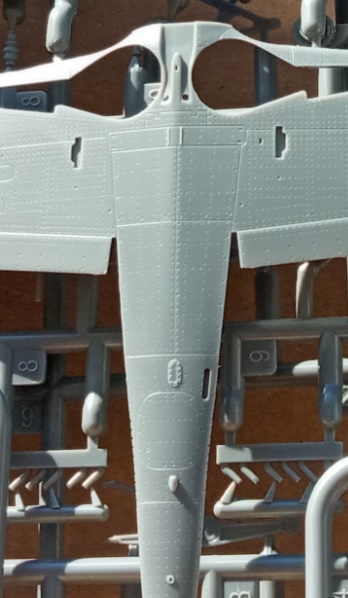
 Surface detail (panel/rivets) is superbly done. 


Ailerons, horizontal stabs and rudder are separate parts


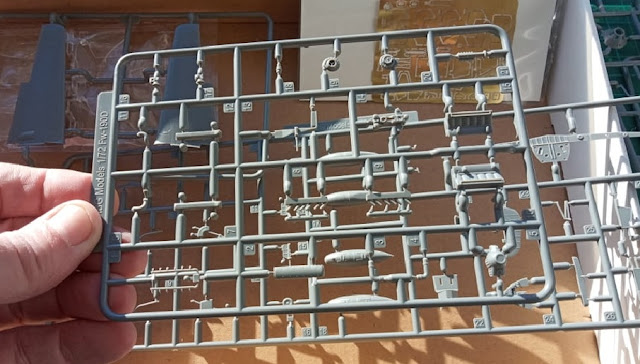
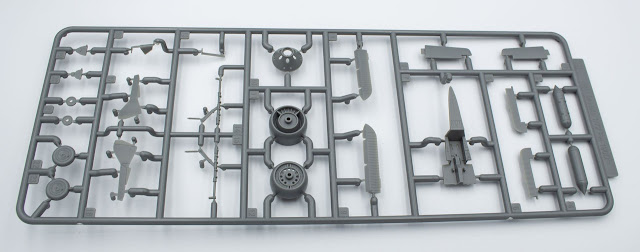
Jumo 213 engine sprue. the D-15 box features a neat DB 603. There is no provision for displaying the engine, although the 'essential' fittings can be seen through the open undercarriage bay. In theory the upper cowl could be left 'unglued'... 


Engine firewall is moulded integrally with the rear wall of the undercarriage bays (below right), engine bearer arms and upper cowl MGs and magazines, Frame A.


Above, DB 603 in the D-15 box. Supersonic 26 on BM - "One of those kits that make you feel like the gap between the detail level of 1/48 and 1/72 kits is evaporating. Seriously, that looks almost as nice as the 1/48 Eduard D-9 I'm currently building!.." 


Etch sheet includes rudder pedals, belts/harness, a stencil for scribing additional surface details, torpedo fins (D-15 box) and parts for fabricating the wing MG magazines. 


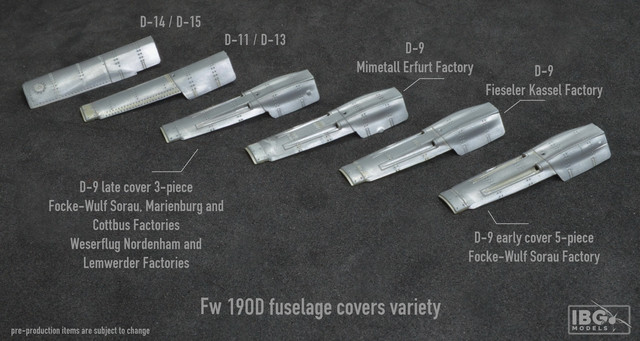
This kit is notable for the meticulous research/degree of detail that IBG have put into it. Early five piece upper cowl cover in the D-9 (early) box. D-11/D-13 and D-14/D-15 refined upper cowl in the D-15 box.


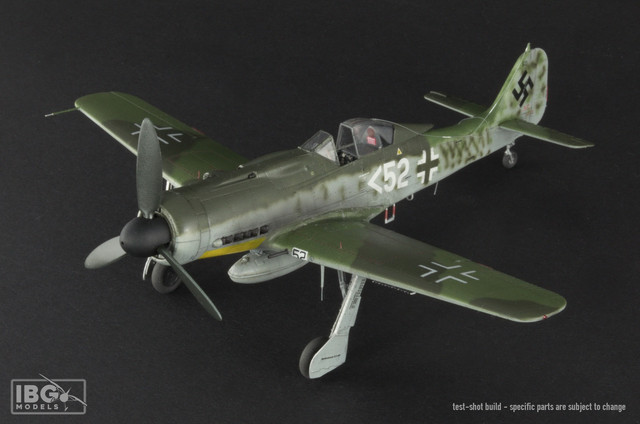
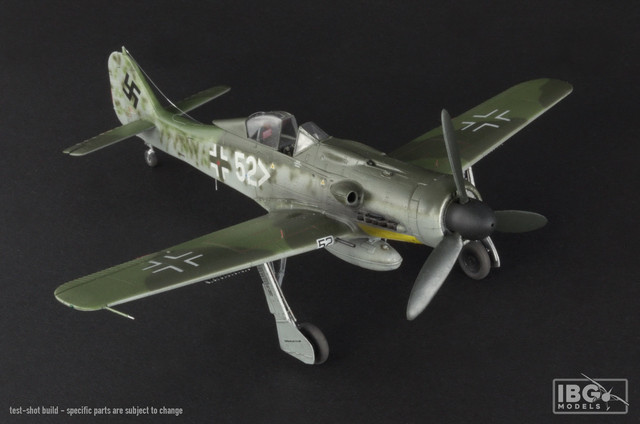
IBG Models 1/72 Fw 190 D-9 - a test shot build. Painting scheme will appear in a future box..

My finished build can be seen here


" The Fw 190D model family from IBG Models in 1/72 scale will include various versions of the aircraft, from the D-9 to the D-15, taking into account the differences resulting from the dispersion of production and the intense involvement of subcontractors. For better orientation in the subject, we have prepared a pdf document in which the differences between the individual machines are presented..."

http://www.ibgmodels.com/resources/Fw190Dvar.pdf