Showing posts with label Battle of Britain. Show all posts

Saturday, 4 October 2025

" Die England-Einsätze " - Oblt. Theo Rossiwall 5./ZG 26


Extracted from a period 'booklet' published in late 1941 ("our third Christmas at the front") for members of 5./ZG 26 and apparently written/compiled by the Staffelkapitän of 5./ZG 26 Hptm. Rossiwall and individually signed by him. I was given this on a trip to Belgium a few years ago. Rossiwall's introduction alludes to the fact that ZG 26 had by this stage of the war shot down over 700 enemy aircraft and destroyed around 1,000 on the ground and the last sentence of his diary text concludes " [..].. the end of the huge campaign in the East is slowly drawing near.."


Die England-Einsätze

 ".. the period of missions against England ('England-Einsätze'began in mid-August 1940. For obvious reasons I can't go into as much detail as I have done on the campaigns already concluded. Looking back on it though everyone says that it was the best time in terms of combat ("..so sagt jeder, dass es kämpferisch die schönste Zeit war..") We shifted from Crécy to St.Omer and found ourselves assigned the best accommodation in a small farmhouse with running water and electricity. We later moved to St. Aubin near Lisieux were we were put up in a villa with a bathroom and warm running water. In total we flew 45 missions over England, firstly against London and targets in the vicinity of the capital - usually from our Absprungshafen or 'jump-off' airfield at Théville - and then against towns along the south coast, penetrating inland as far as Yeovil and Bristol.  

The Staffel was extremely fortunate
(..' Die Staffel war ausgesprochen vom Glück begünstigt..'). We shot down twenty enemy aircraft - all fighters - for the loss of just a single crew. Although this one hit us hard - Ofw. Rochel and his BF Uffz. Schöffler failed to return from an 'enemy flight' on 2 September (Feindflug or sortie). It was not until 24 September that we were enormously relieved to hear that they were both uninjured in British captivity. Uffz. Franke with his radio operator Uffz. Hübner were assigned to 6. Staffel the unit they were flying with when they were shot down on 30 August. We learnt on 13 September that they too were in British hands..attempting to put down on one engine on 2 September Fw. Müller crashed from a height of 10 metres and flipped over on his back. He himself was able to return to the Staffel in December but his Funker Uffz. Gröhl was badly injured and as I write this is still undergoing hospital treatment. On 23 August we lost Oblt. Niebuhr who was posted to take charge of 4. Staffel. He took Uffz. Thiessen with him. On 31 August Uffz. Lohoff - BF in Uffz. Leinfelder's crew - was slightly injured and hospitalised in Brussels. On 29 September Oblt. Hubel took over the leadership of 4. Staffel with his BF Uffz. Schrodt following the death of  Oblt. Niebuhr ( shot down and KIA on 27 September in Bf 110 '3U+IM' with his BF Thiessen near Arne, Dorset) Oblt. Ihrcke was transferred to 6. Staffel... "


ZG 26 Kommodore was Oberst Huth up to 31 August 1940, succeeded from 01 September by Oberstleutnant Johannes Shalk. ZG 26’s I Gruppe was commanded by Hptm. Wilhelm Makrocki through the Battle of Britain. Awarded the RK in October 1940 he was shot down on 21 May 1941 off the coast of Crete during the operation to take the island - 'Merkur'. Hptm Ralph von Rettberg headed II Gruppe during the Battle of Britain. Rettberg was awarded the RK on the eve of Barbarossa on June 14, 1941.

In addition to these aces, ZG 26’s line-up included several among the Staffelkapitäne: Hptm Wilhelm Spies (RK also on 14 June, 1941) of 1./ZG 26 later Kommandeur I./ZG 26, Oberleutnant Johannes Kiel of 4./ ZG 26 and Oblt Theodore Rossiwall of 5./ZG 26 who had replaced Hptm. d'Elsa badly wounded on 18 May. 


Above; Hptm. Makrocki with RK awarded 6 October 1940. 

A 'souvenir' photo of flying personnel and ground-crew of I./ZG 26 taken in northern France (St. Omer) probably just prior to the Battle of Britain during June. Makrocki's Bf 110 with Kommandeur chevrons is the backdrop. 


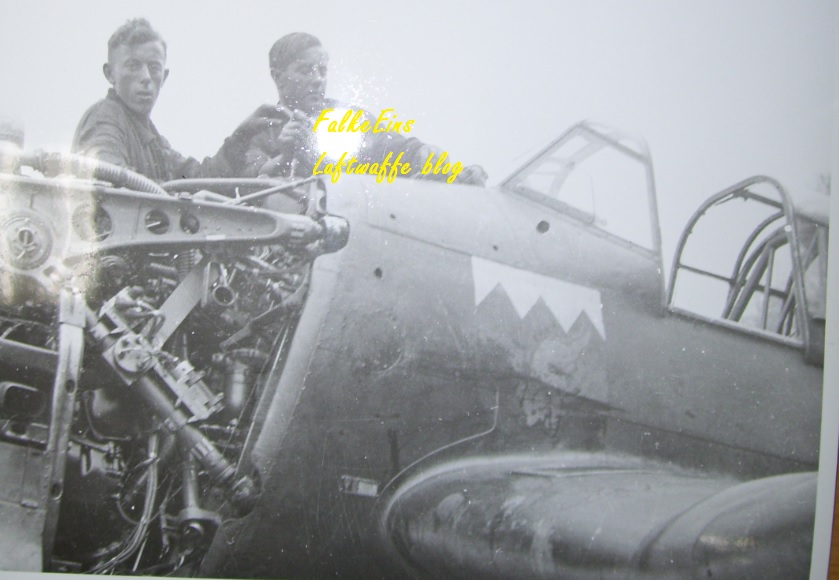
Frankreich-West.- Zerstörergeschwader 26, Oberleutnant Theodor Rossiwall am Cockpit seiner Messerschmitt Me 110 (BA Bild 101I-341-0496-33)


Bottom left;  portrait in Rossiwall's booklet of Oblt. Sophus Baagoe who claimed two Spitfires off Dover on 14 July and two more on 18 August ('the hardest day') and made further Spitfire claims on 11,12 and 13 September with 8./ZG 26. At the time of his death - just prior to the landings on Crete - he was flying with 5./ZG 26 and with around 14 claims was one of the leading Zerstörer pilots. His BF Ofw. Daniel Becker is lower right.

Friday, 19 September 2025

Battle of Britain Capel-le-Ferne Memorial flypast, 19 September 2025, John Vasco's Zerstörer at the Battle of Britain museum 27 September 2025


The flypast at the Capel-le-Ferne National Memorial to the Few for Battle of Britain Day - 15 September - was postponed last weekend due to the unseasonal high winds over southern England.  Yesterday though was sunny and warm and the BBMF managed to put up three Spitfires and a Hurricane for a tour of some Battle of Britain landmark sites in Kent including Manston and Capel.  The Griffon PR Spit displayed over the Memorial on the cliff-top between Folkestone and Dover. Pictures by John Frackleton.


Meanwhile a few miles away at the Kent Battle of Britain museum in Hawkinge - which houses the most important collection of airframes and artefacts from the Battle of Britain - Pen & Sword author Andy Singleton has recently launched his new book on modelling Battle of Britain fighters. Andy has published a number of modelling 'how-to' manuals for Pen & Sword and builds models for a living, so this volume is well worth looking at.


Also taking place at the Battle of Britain museum next week (27 September) is the 'official' launch of the new Vasco/Cornwell volume on the Me 110 in 1940.

" Zerstörer: The Combat History of the Me 110 in 1940" is published by Wingleader. Authored by John Vasco & Peter Cornwell this extensively revised and re-worked reissue of the earlier 'classic' has 300 pages with around 500 photos and will be available in hardback at £55..


Also on this blog;

Sir Hugh Dowding bust unveiled at the Capel Battle of Britain Memorial

September 15 Battle of Britain Day - German fighter pilots and the 'myth'

'The story behind the book' - an interview with leading Battle of Britain author John Vasco


Wednesday, 17 September 2025

new-tool Spitfire Mk I & II from IBG Models


IBG Models have a new-tool 72nd scale Spitfire series underway. This blog has reviewed their IAR 80/81 series and built the Gotha 242 and Fw 190 D-9 - great kits, loads of detail with plenty of internal and external options and more importantly, the fit is always good for such relatively 'complex' kits...

Click on the image to go straight to the IBG site where you can download the instructions and see the 10 markings options in the first 'black box' release  


pics by 'dixieflyer'

Squadron Leader Hilary Richard Lionel “Robin” Hood's 41 Sqd Spitfire EB-R for 'Robin'. Operational over Dunkirk from Hornchurch, Hood downed a Do 17 on 1 June by diving at it head-on, despite being effectively unarmed having run out of ammunition. He claimed a 109 and a Ju 87 on 29 July but on 5 September he collided with another aircraft while attacking a Dornier and crashed into the Channel. He is still listed as missing, one of some 179 RAF pilots who were lost and whose bodies were never recovered.


Below; some of the 'bonus' markings in the new IBG Models 'Black Box' Spitfire I & II kit include two 92 Sqd schemes from May 1940 and a 65 Sqd machine from Manston as seen in late July 1940.  The replica Spitfire at the Capel-le-Ferne 'National memorial to the Few' on the cliffs between Folkestone and Dover has been refurbished (following storm damage) in a Manston 65 Sqd scheme..


Thursday, 13 March 2025

Hptm. Rolf Pingel's Emil - Gruppenkommandeur I./JG 26, November 1940


Hasegawa Me 109 E - is there an easier build out there? Not sure I'm 100 % convinced by the shape of the nose. Decals from Kagero. Pingel's Emil was photographed at Audembert on the Channel coast as the ace returned from a sortie on a grey, drab day during November 1940. The rudder 'scoreboard' shows 17 Abschussbalken. The fuselage sides are now heavily over-painted, although the machine still has large areas of yellow.  I used Xtracolor enamels. Note the campaign flags along the cockpit sill. 


Pictures of Pingel's Emil have previously appeared in a Kagero monograph and were originally sourced from the Deutsches Technik museum in Berlin. Note he is wearing his RK awarded on 14 September for 15 victories.


also on this blog;

Hptm. Helmut Bennemann's Emil I./JG 52


Wednesday, 12 February 2025

II./JG 3 over Canterbury on 26 August 1940


" At 11.30am on Monday August 26, 1940, a large raid, including 12 Dornier Do 17’s and 40 Heinkel He 111’s, escorted by over 80 Messerschmitt Bf 109’s and Messerschmitt Bf 110’s approached Dover. While around 70 Hurricanes and Spitfires fought the Heinkels and their escorts, from Dungeness to Maidstone, the Boulton Paul Defiants of No.264 Squadron were directed alone onto the Do 17s, in the vicinity of Herne Bay. As they attacked the bombers from below, the Bf 109s immediately dived to protect the Do 17s..." (Hawkinge Battle of Britain museum FB page)

Among the Me 109 escorts over the coasts of north Kent was II./JG 3. Uffz Willy Finke of 4. Staffel JG 3 pressed home an attack on a Defiant but was spotted by P/O Kenneth Marston of No.56 Sqd. Marston opened up from close range (70 yards) sending Finke's Me 109 E-4 down. Finke crashed on the Chislet Marshes, south of Grays Farm near Reculver at around 12:30. In fact Finke was Marston's second Emil that morning - he had already also shot down Uffz. Fritz Buchner of 6./JG 3. Most sources have Buchner coming down in the sea (see below). Posted missing over the Thames estuary on 26 August 1940, Buchner's fate was only confirmed 44 years later when his Emil was excavated at Westgate on the north Kent coast..

"..During 1984, this crash site was the subject of a major excavation. The main wreckage was discovered at a considerable depth (between 35 and 40ft) and within the compacted tail section and cockpit were found the remains of the pilot. Evidence from the excavation, in the form of Uffz. collar tabs found on the uniform, an embroidered handkerchief with the initials "FB", a lucky charm and serial plates indicating the identity of the aircraft, seemed to provide compelling proof that the pilot was Unteroffizier Fritz Buchner, who had been officially listed as missing 44 years previously. However, it took a further two years for British and German authorities to agree on his identity. He was finally laid to rest, in the presence of surviving members of his family, with full military honours in the German War Cemetery at Cannock Chase on the 8th May, 1987.."   (dunkirk1940.org)

 Now that certain relics of Buchner's E-1 have been given to my local museum I was asked if I knew anything about his machine. The quick answer was not a lot! The loss listing does not reveal much about his Bf 109 aside from the variant and Werknummer. No Kennung given. Extract from the now-digitised Bundesarchiv "GQM Verluste und Unfälle" file RL 2- III/1574-75 covering the period Jun 40-Jan 41. See line 11. (Click to view full screen)


From the Breuer/Waiss " Heinz Sannemann -Ein Jagdfliegerleben in Berichten, Dokumenten, Fotos" (Helios, 2018)

 " Flug 924 am 26.08.1940. Start mit Bf 109 um 12:25 Uhr in Wierre au Bois. Landung um 13:50 Uhr in Wierre au Bois, 'Begleitung Do 17 Sauterborg, Defiant abgeschossen.."

On 26 August 1940, II./JG 3 were up from Wierre au Bois (12 km south-west of Boulogne on the Channel coast) to escort bombers raiding London. Gruppe TO Lt. Heinz Sannemann flying as Rottenflieger to the Kommandeur recorded in his 'Gefechtsbericht' that he shot an RAF fighter off the tail of his Kommandeur as the latter was downing a Defiant. It was Sannemann's second victory claim. A trail of white smoke streamed out behind the British fighter as it dove away heading back over the Kent coast. In a letter to his wife sent the next day, Sannemann wrote;

" Gestern haben wir über der Themsemündung eine Mords-Luftschlacht gehabt. Berstende Maschinen, Rauchsäulen und Fallschirme über Fallschirme!. Es is schon schoen, nur die armen Bomber sind dabei zu bedauern. Die müssten alle das EK I haben. Wir waren schon wieder in unserem Wigwam!  " 

.." Yesterday we had a hell of an air battle over the Thames estuary. Exploding machines, columns of smoke and parachutes upon parachutes! Everything's fine now, but the poor bombers are having a hard time. They must have all earned the EK I. We were already back in our wigwam!.."  (pilots accomodation 'Villa Wigwam' in Le Touquet that Sannemann shared with von Werra, until 5 September of course..)

After the chaos of the clash over the north Kent coast/Canterbury area that morning Sannemann spent the afternoon paddling a dinghy in the canal in Le Touquet and swimming with Simba the lion cub. Pfundig! ..just great!

Thursday, 15 August 2024

JG 52 Emil - archive photo scan #30


 JG 52 Emil in the hands of the 'black men' under the netting on the Channel coast at Calais Coquelles during the 'Battle of Britain' ('Luftschlacht um England'). Previously published - but this is not Bennemann's 'Black 5'.


Saturday, 27 July 2024

I./JG 52 at Coquelles - unseen Battle of Britain Spitfire crash footage from Wingleader films


During the summer of 1940 a pilot from I Gruppe JG 52 based at Coquelles near Calais filmed the images that follow on his 8mm camera. Depicting as they did the daily routines of a Luftwaffe fighter unit during the Battle of Britain made them fascinating enough. But the Wingleader team were further intrigued by a clip towards the end of the film showing a downed RAF pilot and the smoking wreckage of an RAF aircraft. Chris Goss, owner of the film, had according to the commentary, always assumed that this snippet of film showed a downed machine from 1941 - with the RAF's 'lean-into-France' good numbers of Spitfires and RAF medium bombers were brought down over France. In addition, only four Spitfires put down on French soil during the Battle of Britain, of which three were extensively photographed - no images of the fourth were known. So was this the missing Spitfire R6966 flown by Sgt. Philip Wareing of 616 Sqd downed on 25 August 1940? A single click on the red start button to view here.


Below; A line up of JG 52 Emils seen in Coquelles just outside Calais, the site today of the Tourist traffic waiting areas for Channel tunnel Le Shuttle traffic..note the clock tower of the town hall ( le Beffroi de l’Hôtel de Ville ) on the skyline..click to view large.

Luftwaffe fighter units based on this (open expanse of grass) airfield;  source ” Les pertes de la chasse de jour en France ” by Pierre Watteeuw (Luftwaffe day fighter losses in France)

 – I./JG 52 from 3 August to 31 October 1940

– I./ JG 51 from 9 March to 25 May 1941

– III./ JG 26 from 19 October 1941 to 7 April 1942


..and from the current Peter Petrick archive sale, P/O Roberts 64 Sqd Spitfire belly-landed at Calais-Marck on 15 August 1940 after Luftkampf with fighters of I.(J)/LG 2, one of just four Spitfires to come down over France during the Battle of Britain...


Friday, 21 June 2024

Stukageschwader 77, summer 1940 - archive photo scan #25


" ..Zwischen den England-Einsätzen in Maltot, Caen. Die Rumpfbombe hängt schon. 1.Staffel St.G. 77..".  Pilot Fw. Knauer (left) and Bordfunker Uffz. Sellhorn.

Ju 87 B of 1./StG 77 bombed up and ready for another sortie against England. From the Sellhorn archive.


"..Wartungsarbeiten an der Ju 87 B bei der 1. Staffel in Maltot.."


Click here for all images scanned/copied exclusively from a number of archives/collections for this blog. Click on the images to view large.

And published in October 2023 and still available from Lela Presse, two volumes entitled "Stukas in the Blitzkrieg" by Marc Hazard. These are 96-page A-4 soft covers filled with artworks and photos. French text. Vol I covers Poland and Scandinavia, while Vol II deals with the campaign in the West, May-June 1940. Only 13 euros per volume. Top quality and recommended by this blog! To order, go here. English spoken.


Friday, 16 September 2022

September 15 'Battle of Britain' day - the German fighter pilots and the 'myth'


Living in the shadow of the 'Battle of Britain' memorial to the 'Few' at Capel-le-Ferne on the white cliffs between Folkestone and Dover with the sound of Merlin engines almost constantly overhead at certain times of the year, I am reminded that 'Battle of Britain Day' (as September 15 is known in the UK)  has come and gone once again. 

According to some, the Luftwaffe was 'ill-prepared' for the fight over England. One fact not often acknowledged here, is the 'mauling' and subsequent losses that the Luftwaffe had sustained over France, so that the Luftwaffe's early forays over England in late July 1940 amounted to no more than an attempt to exert some 'political' pressure on those who might have been prepared to sue for peace in the UK. Göring's losses over France amounted to over 1,000 aircraft and trained crews according to which source you care to read.

(The latest 'official' score for 'la chasse' - the French fighter arm- according to the Service Historique de la Défense or SHD is around 650 Luftwaffe aircraft shot down during the Westfeldzug or 'campaign in the West'. Aircrew losses may have been as high as 3,000 men according to some sources. Infrastructure along the Channel coast had largely been wrecked. Hence the two month 'pause' before setting out to subdue England in earnest).

By mid-September the Luftwaffe could in theory claimed to have won the Battle - at least 'statistically’. However, men and machines were being worn down relentlessly, while the numbers of carefully husbanded RAF fighters were increasing. Losses on the scale being sustained by the Luftwaffe risked jeopardizing the planned assault on the Soviet Union. Hitler was probably already looking to 'shut-down' operations over the UK. But until the British government surrendered – an unlikely scenario- the Luftwaffe continued to lose men and machines to little purpose. As the summer wore on these factors all contributed to mounting cases of what was becoming termed Kanalkrankheit – Channel Sickness – better known now as combat fatigue. As Ulrich Steinhilper noted;

“Although most of us were still not outwardly showing major signs of nerves, by late August arguments were becoming more frequent, tempers frayed quicker…The strain of unrelenting front-line flying was beginning to show.”

And it was during September that the Luftwaffe turned its attentions towards London. This change of tactic played into the hands of the defenders - the RAF was able to concentrate its defensive force around the capital while the Bf 109s' limited endurance was again a factor. On September 7, the first day of raids on London, the Germans overwhelmed the defences. Fighter Command lost 33 aircraft. On the German side, a dozen bombers were lost as well as 15 Bf 109s and 10 Bf 110s. On the 8th, the Luftwaffe could not repeat its previous day's effort and the RAF had a breathing space. On the 9th, orders were given to bomb the capital by day and by night. Two major raids took place in the afternoon, but here the Luftwaffe could no longer saturate the defence - the '1000' bombers of the official history were never more than 400 and on only two dates could the Luftwaffe put more than 300 in the air. On September 9, some 23 RAF fighters were downed by Bf 109s. The Staffelkapitän 4./JG 53 Oblt.Günther Schulze-Blanck who had led the Staffel during August was killed in a dogfight over Hastings. He had returned six victories. His body washed up on a French beach some two weeks later.

There was by now perhaps, a growing realization that the fighter pilots had been assigned an impossible task. Equipping one third of the fighter force with bombs served little purpose. Lt. Jules Meimberg of 4./JG 2;

“..It was not until today that I grasped just how big a city London is. Brussels, Paris, even Berlin are tiny in comparison. What sort of effect could we hope to achieve with a few hundred bombs on a metropolis like this, aside from inflicting a few scratches..?”
 
On September 11, the fighting was particularly costly with the Luftwaffe claiming 67 fighters, while RAF Fighter Command claimed 89 German aircraft. Actual losses however amounted to 30 RAF fighters and 27 Luftwaffe machines - 11 bombers, 8 Bf 110s and about 8 Bf 109s including the machine flown by a certain Fhr. Hans-Joachim Marseille (1./LG 2) who managed to return to Wissant to crash-land his machine, 75% destroyed.

On September 15, the weather cleared and the Luftwaffe prepared for their “Final Blow” against England. This was to be the test of strength for Göring’s Luftwaffe and Dowding’s refreshed and reinforced Fighter Command. During the day’s prolonged and bitter fighting the Luftwaffe would lose 6% of their committed forces - 57 aircraft - their highest percentage loss rate during the entire Battle. Fighter Command’s losses were half of those on the German side, i.e. the rates of the Adlertag of 13 August. For the OKW, it now appeared that in major offensives, the RAF was always able to pull out the stops. Many more weeks would be required to destroy the RAF, a realisation that led to another review of tactics - attacks on airfields and factories with bomb-carrying Me 109 Jabos became more frequent. This 'Jabo' offensive - while far from decisive - was a much more effective use of the Luftwaffe fighters than the hated bomber escort duties. On October 5, for example, waves of Messerschmitt 109s (possibly as many as one hundred fighters), of which around thirty were toting ordnance, headed for Southampton and London. Fighter Command was no longer to be directed exclusively against German bombers - the Spitfires and Hurricanes were free to engage the Messerschmitts. But for the RAF, it did not necessarily have to 'win' the battle - simply not 'lose' it.. Ulrich Steinhilper, on the other hand, shot down over England at the end of October, was mentally and physically at the end of his tether.

“There is no doubt in my mind,” he says, “that the RAF broke the back and the spirit of the Luftwaffe during the Battle of Britain.”.

And on the basis that you don't always know that something is there unless you are reminded of it occasionally here is a piece on this blog published by the UK's 'Guardian' newspaper back in the year 2000 which discusses the German view of the 'Battle of Britain'..

Sunday, 3 July 2022

"Rote Ringe" - Red Bands on JG 53 Pik As Emils during the Battle of Britain


JG 53 Pik As included among its pilot roster a good share of  noteworthy 'personalities' many of whom were promoted and decorated during the summer of 1940.  However there would be no awards for the Kommodore of the Geschwader. The 38-year old von Cramon-Taubadel flew in the Battle of Britain, claiming only his second victory on 27 September 1940, a Hurricane near Dungeness. It was during this period that Göring started to replace the older Kommodores with younger up-and-coming aces. JG 53 was no exception, the Kommandeur of II./JG 53 Maj. von Maltzahn taking over from von Cramon-Taubadel on 30 September 1940. At some point during this period  it is reported that Göring  ordered the covering-up of the unit's well-known Pik As 'Ace of Spades' emblem. It was to be replaced with a red cowl band.  The precise reasons for this remain unknown. 


Back in 1980 (in one of his first published pieces) Jochen Prien listed some of the JG 53 machines that wore 'rote Ringe' and examined several theories as to the significance of the marking - for example, they were perhaps a marking to facilitate reformation in the air  ('Orientierungshilfe') or denoted aircraft fitted with Jabo bomb racks. Having been compiled forty years ago his listing of Emils featuring a red cowl band is incomplete but worth reproducing here  ("Rote Ringe"  - Luftfahrt International, 1980/11).


Jochen Prien concluded that the most likely theory is that the 'red rings' identified machines flown by the Staffel leader and Schwarmführer -  the Emils flown by Ohly, Rupp, Mayer and Walter Fiel  fulfilled this category. Bf 109 E-4 "white 1" of 4./JG 53  - the mount of the Staffelkapitän Oblt.Günther Schulze-Blanck - also featured the ‘red ring’. Note that the machine flown by the Kommodore displayed the red stripe - see von Cramon-Taubadel's Emil below  - the Kommodore was of course the leader of the Geschwaderstabschwarm.

Below;

Emil flown by the Kommodore Maj.von Cramon seen after his landing accident at Rennes on August 18, 1940. The engine cowl - right foreground - features the red stripe that replaced the Pik As emblem. The machine has a collapsed starboard gear leg and is being lifted by an ex-RAF Coles crane. Note the bars of the Stab marking are set below the centreline of the Balkenkreuz


Below; Hans-Karl Mayer's Emil seen during October at Etaples;  Kommandeur I./JG 53 from 01 September, previously Staffelkapitän - leader of the 1st Schwarm in the Staffel -  Jabo rack, red cowl ring. 


A number of Emils lost over England displayed the red band -  commencing on 16 August 1940 when Fw. Christian Hansen of 2./JG 53 crash-landed his E-4 at Godshill on the Isle of Wight. This was followed by the loss of the 6. Staffel machine flown by Hptm. Alois Maculan (August 25 near Weymouth). The last 'red ring' was noted on November 2 (Fw. Xavier Ray's 8./JG 53 machine). 


also on this blog;


III./JG 53 Emils seen after the restoration of the ‘Ace of Spades’ badge in November 1940. Note the over-painted Hakenkreuz on the tail-fin in the image below left .....


Saturday, 7 May 2022

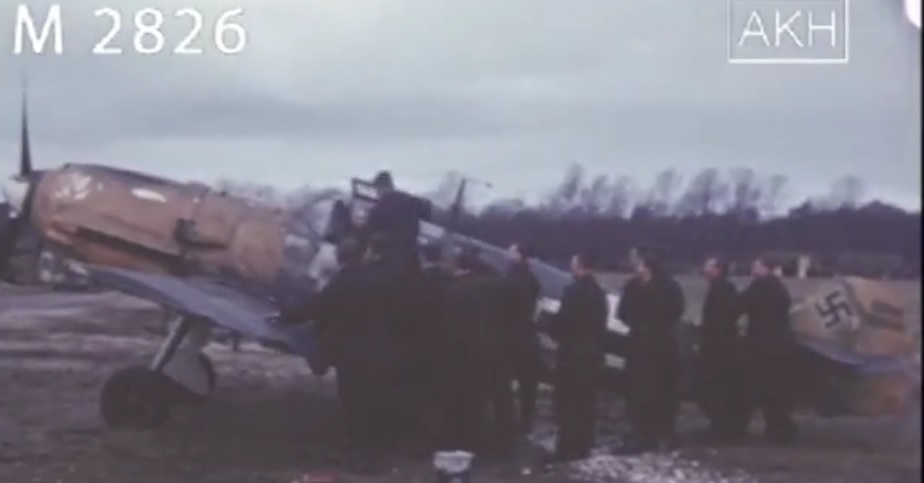
Battle of Britain Emil in colour - future 9./JG 3 Staffelkapitän Viktor Bauer's 'yellow 7' III./JG 3 Desvres late 1940


Film 2826 from the Agentur Karl Höffkes film archive features colour material depicting JG 3. The following stills are reproduced here with the kind permission of Karl Höffkes and feature "gelbe 7", the usual machine of the future Staffelkapitän 9./JG 3, Oblt. Viktor Bauer seen wearing a life jacket alongside his Emil speaking to a group.


 III./JG 3 was based at Desvres from Aug 8 1940 to Feb 16, 1941. The yellow rudders and full yellow noses would date this footage to between late October 1940 and Feb 1941. "Schwarze 5" of 8./JG 3 appears briefly in the background and was the machine of Oblt. Franz Beyer.


 " ..The camouflage appears to be in the new greys RLM 74/75 or the famous "mixed greys" - these aircraft do not seem to be in 02/71. Also, if you freeze the shot of the tail of "gelbe 7", you can see that the Hakenkreuz has been masked and a new, lighter shade of 65 (or 76?) has been applied to the airframe... the deeper blue of the original 65 is still visible between the arms of the Hakenkreuz.. The shiny finish on these aircraft is particularly noteworthy- these were well cared for..."

Note this colour section of the footage opens with the this Emil below taxying in.  Either a 'yellow 2' or 'yellow 7' again - note the two rows of Abschussbalken on the rudder. Bauer did not return his third until November. There are not many BoB candidates for this sort of victory total.. any candidates @G.R. Morrison ?


Thanks to GRM and L. Ritger for the captions


Thursday, 26 August 2021

Ofw. Lorenz Dessoy II./JG 2


Uffz. Lorenz Dessoy joined 4./JG 2 during the Battle of Britain. He was flying as Rottenführer to Gefr. Rudi Miese on the sortie on 15 November 1940 over Portsmouth/Selsey Bill when the latter was shot down badly injured and hospitalised at Littlehampton near Brighton. According to Meimberg's memoir, there were some surreal moments during the sorties over England; 'Assi' Hahn ordering the Staffel to form up closely since '..it would make a very nice photo, knowing full well that none of us had a camera' or getting out his harmonica after combat over England and ordering Dessoy to accompany him over the FT; " Dessoy, ein Lied !" Dessoy sung all the way home while we joined in.."

Dessoy was shot down in his F-2 over the sea during the second 'Circus' flown by the RAF on 21 June 1941 but was fished out by the Seenot off  the coast of Treport. Some two years later Dessoy was still flying combat with JG 2. Lt. Christoph Dezius reported; " when I joined the 'Richthofen' during April 1943 having finished my training with the Erg. Jagdgruppe West, the most experienced pilots were tasked with perfecting our skills. Aside from Goltzsch and our Staffelkapitän, our Staffel included another veteran of the Luftschlacht over England, Ofw. Lorenz Dessoy. It was these pilots who taught us the essential manoeuvres for air combat and we flew so many training sorties that the aircraft became extensions of ourselves. I generally flew with Dessoy during this period." 

Three years after joining JG 2 Dessoy claimed his first victory in combat with 7./JG 2 on 3 October 1943! Dessoy's victim was a Spitfire shot down that evening over La Haye-St-Romain during the course of a raid on the airfield at Beauvais. During the same sortie Huppertz claimed his 50th and Bühligen his 80th! Dessoy's second success in combat was a 9th AF B-26 south of Amiens during the afternoon of 25 March 1944. He flew sorties over the 'Invasionsfront'  during June 1944. On 17 June his 'Hundert-neun' was shot down by P-47s in the vicinity of Bayeux but was he able to bail out more or less unscathed. 

However, just two months before war's end, Dessoy was killed in an accident on 20 March 1945. He is seen here as an Unteroffizier alongside his II./JG 2 Emil...


More JG 2 pilots profiled on this blog 


Monday, 16 August 2021

Uffz. Karl Hannes 5./JG 2 and Erla factory Einflieger


" ..Shot-up Me 109 glides back across the Channel - outstanding performance from a German fighter pilot - gliding more than 70 km home..  

"..Unteroffizier Hannes, der als Rottenhund eines Schwarms fliegt, wird gleich von zwei englischen Maschinen angegriffen... "


Uffz. Karl Hannes flew during 1939-42 in 5./JG 2 and successfully survived combat on the Westfront during this period. His Staffelbezeichnung was "12".  He returned his first victories - downing Spitfires - during September 1940. He was credited with five victories over the RAF. His 5th claim was for a Hurricane, west of Le Touquet during the evening of 17 August 1941. 

A PK report dated 23 September 1940 described an incident during a Ju 88 Begleitschutz escort sortie over London flown by the Geschwader Richthofen from their bases in northern France.

Kriegsberichter Gerhard Linke takes up the story .......

"..having over-flown the Channel at 6,000 metres, the formation came under attack from RAF fighters, diving from a favourable position directly out of the sun. Hannes quickly had two on his tail, one of which gave him a long burst of fire into the engine and fuselage from fifty metres. The enemy's shells hit the Me 109 hard, even slamming into the steel plate that protected the pilot's head. A glance at the instrument panel told Hannes he was rapidly losing his coolant and that the engine would likely seize at any moment. He chopped the throttle and his fighter fell away to the left. At that moment the RAF fighter swept past him and attempted to peel off to the right. With his engine still barely turning over, Hannes seized his chance. His 'sick' Me 109 fell in behind the RAF fighter - so long as the engine was running then he was still able to fire his MGs.  He cut across the Spitfire's curve - even if he was going to go down he would teach the Englishman a lesson. Barely thirty metres in front of him the Spitfire was framed in his Reflexvisier gunsight. Hannes squeezed the two firing buttons on his control column, unleashing in the same moment the first rounds from his MGs and cannon. Not for an instant had the Englishman expected that the Me 109 would still pose a danger to him. He attempted a split-S away but Hannes was on his tail as both machines fell away through one thousand metres. Time and again his rounds hit the Spitfire's fuselage and then a cannon shell into the engine - the Spitfire was soon trailing a banner of black smoke. Hannes could see flames licking from the cockpit. Der Gegner ist erledigt - his adversary was done for! But now his propeller juddered to a stand, the three blades starkly black against the horizon. 4,800 metres altitude and still 30 kilometres from the Channel which was at least 40 kms wide at this point. Beneath his wings the meadows and fields of the English countryside. Hannes kept his cool, feathered his prop ('Segelstellung') - the positions where the blades gave the least resistance and held the stick gently in his right hand -'keine unbedachte Bewegung darf gemacht werden'...no careless movement could be performed, every metre was precious. It is a strange feeling for a fighter pilot to glide through the air with no engine noise... [..]   

As a precaution Hannes jettisoned the canopy in case he had to leave the 109 quickly...[..]  Zehn lange Minuten! Ten long minutes! Jetzt kommt der Kanal. At 3,000 metres he glided out over the Channel, the machine slowly losing height  - das fliegerische Gefuhl ist jetzt alles....[..] With a slight whistling in the slipstream the Me 109 came in over the French coast at a height of fifty metres. To his right he spotted a freshly mown field and set up for a belly landing. He touched down softly,  slid along for  ten metres  and came to a stand. Hannes sat motionless for a moment. Then rubbing the dust thrown up by the landing from his eyes and face, he slowly unbuckled his belt, pulled himself up out of the seat and climbed down from the cockpit. The aircraft had sustained only slight damage in the landing but Hannes counted over twenty bullet impacts, mostly in the wings and the fuselage. There were just two in the radiator and it was these that had brought him down..[..]  .."

The display of airmanship shown by Hannes in downing a Spitfire in his crippled fighter and then gliding it home was second-to-none and won the fulsome praise of his comrades - 'Hannes hat ..[..] eine Leistung vollbracht, die gerade bei seinen Kameraden in der Jagdfliegerei bewundert wird..' His feat was evidence of the 'immense skill' and 'Siegeswillen' or 'will to win' of the men of the German Luftwaffe..

Below; Uffz. Karl Hannes in front of his (presumably) 'red' or 'black 12' of 5./JG 2 - a 'cropped' version of this photo was first published in the April 1977 issue of Jägerblatt.


Above; Karl Hannes was subsequently posted to Erla and served as a factory 'Einflieger' (test pilot) and in the works Jagdstaffel.  In this role he would perform more than a few emergency landings..

Below; Hannes seated on the spinner of a crash-landed Gustav coded 'G1'


Below; Hannes flew this modified Messerschmitt Bf 109 G-4 coded "H1" (Hannes, aircraft # 1 ?). The aircraft was written off in a crash landing during 1943. Hannes can be seen near the engine bearer arm, hand resting on one of the cowl MGs..


A 'second' "H1" (?) trialed a system for direct injection of liquid oxygen into the engine turbocharger to significantly improve the rate of climb.