Showing posts with label Luftwaffe over the Mediterranean. Show all posts

Monday, 22 July 2024

Arado Ar 196 in the harbour at Kos -archive photo scan #26


Arado Ar 196 in the harbour at Kos town, on the Aegean island of Kos. The Neratzia castle ramparts are visible in the background. The Bundesarchiv image is dated October 1943, shortly after the island was 'captured' following the Italian change-of-sides.  Bottom, a modern image by way of comparison.


A reminder that BATAILLES AÉRIENNES N°100 covering the air battles over and around Kos and Leros entitled " La dernière victoire de la Luftwaffe en Méditerranée - Les combats du Dodécanèse (Sept-Nov. 1943)" by Shores and Roba is still available from the Lela Presse website here 


Monday, 17 June 2024

Lehrgeschwader 1 Junkers Ju 88 - archive photo scan #23


During May 1941, Gruppen of LG 1 were supporting the DAK in north Africa and then flying against shipping around Crete. During this period they were based in Krumovo, Bulgaria and then Eleusis, Greece.  'L1+AH' was lost on August 5, 1941 over Egypt. Note the yellow rudder and the 1000 kg bombs, almost certainly destined to be dropped on shipping. Click on the image to view in 'wide-screen' mode.

Loss data via Peter Taghon's LG 1 history;

1./LG 1. Ju 88 A-5 'L1+AH' (WNr 6220). 100%. Combat over Ismaïlia. Fw Erich Mager (FF), Fw Otto Mann (B), Fw Robert Daig (BF) and Ofw Fritz Kitzelmann (M) killed.


Tuesday, 10 October 2023

JG 77 in Italy, September/October 1943 and the Macchi C 205 in JG 77 service - were there any aces ?


On 3 September 1943, the soldiers of the British XIII Corps mounted amphibious landings on the Italian 'boot' and 'invaded' the Italian mainland. Calabria was only lightly defended and Reggio airfield was quickly captured. This first landing in continental Europe took place in a country seemingly still allied with the Reich. But, since Mussolini's removal from power the new Italian government had been secretly negotiating with the Allies to change sides. The German High Command was not fooled by the friendly protestations of Marshal Badoglio, the new strongman of the Italian regime and were preparing to take control of the country in the event of an Italian U-turn. The location where the Duce was being held had already been identified and plans were being made for his release. This occurred on 12 September - Skorzeny's Gran Sasso 'coup de main'. On this same afternoon of 3 September I./JG 77 and IV./JG 3 intercepted an unescorted formation of B-24s over the sea near the Tremiti islands. Eight bombers were claimed by I./JG 77 (only three were confirmed). Eight B-24s were claimed by JG 3. Nine Liberators from the 98th BG were reported lost over Italy, most likely victims of these clashes.

On 6 September, Uffz Willi Wiemer's 'yellow 4' ( 3./ JG 77) was shot down by a P-38 of the 14th FG escorting Liberators. 7./JG 77 (in Sardinia) also suffered the loss of Lt. Hans Rund, whose G-6 'white 7' exploded in flight. Ofw Eduard Isken who had carried out a test flight in this machine shortly beforehand suspected sabotage. On the 7th, I/JG 77 suffered two serious injuries in a battle with P-38s escorting B-17s. Oblt Gerhard Strasen, Staffelkapitän of 3./JG 77 was shot down in 'yellow 10'. He reported;

"..Our unit was scattered around Foggia and it was from there that we were airborne to intercept the Viermots and their P-38 escorts. On that day, I was acting Kommandeur as Burkhardt was unavailable. In combat with P-38s north of Naples, a bullet went through my leg and I had to parachute out. On the ground, an Army Feldwebel loaded me into a vehicle and took me to a hospital. I was then transferred by medical train to Stuttgart where an amputation was planned. I was categorically opposed to this and was able to save my leg. I was granted a long period of convalescence, during which I got married. I rejoined JG 77 around May 1944 when the unit was fighting in northern Italy..."

In addition to Strasen, another wounded pilot from 3./JG 77 had to bail out, Lt Werner Behrendt. To replace Strasen, Lt Ernst-Wilhelm Reinert left II./JG 77 and became Staffelführer of 3./JG 77.

On 8 September, I./JG 77 and IV./JG 3 carried out their usual missions (reconnaissance and Alarmstart 'scrambles'). In the late afternoon a large fleet was spotted near Naples. But  at 5.00 pm, the Italian surrender was announced by the allied radio, surprising both Italians and to a lesser extent, the Germans. The Italian royal family, still near Rome, had to flee. Many Italian officers did not know what to choose: loyalty to their government or to the German ally. Generalfeldmarschall Albert Kesselring quickly gave the order to neutralise the former ally - Unternehmen 'Achse'. Everywhere, German soldiers disarmed Italian units, which often fell apart and huge amounts of matériel was captured. An Italian naval battlegroup was already at sea - according to some to counter the Allied landings then about to take place at Salerno - but with the news of the 'volte-face', now attempting to make for Malta to surrender to the British. Attacked in the waters of the Gulf of Asinara by 'Fritz X' guided missile carrying Do 217s of KG 100 on 9 September, the Roma, one of the most powerful warships then at sea in the Mediterranean, was struck, split in two and sunk. More than 1,250 men perished.

The US Fifth Army landed at Salerno on 9 September in another huge amphibious operation. I./JG 77 and IV./JG 3 toting Werfer rocket grenade launchers flew strafing sorties over the Salerno landing zones - Fw. Horst Schlick of 1./JG 77 was hit by flak and managed to bail out, coming down unharmed near a main road into Naples. Elsewhere most of III./JG 77 flew out of Sardinia and landed on the Corsican airfield of Ghisonaccia. The Germans immediately disarmed the Italian troops present on this air base and took possession of weapons and equipment. Three days later, the men of "Ubben’s travelling circus" transferred to Casabianda still in Corsica. From there, the Bf 109s flew escort sorties for the ships and transport aircraft (Me 323 and Ju 52 Transporter) evacuating the German troops to the Italian mainland.

On 25 September the G-6 Gustavs of III./JG 77 were in Pise-Metato while using the airfield of Fiano to protect the industrial sector of Bologna. Uffz Karl-Heinz Böttner flew little during this period because he was sent to the Erholungsheim (relaxation and care centre) in Bad Wiessee following malaria attacks. Also there at the same time was his Kapitän Emil Omert who was recuperating following his injury sustained in Sicily.

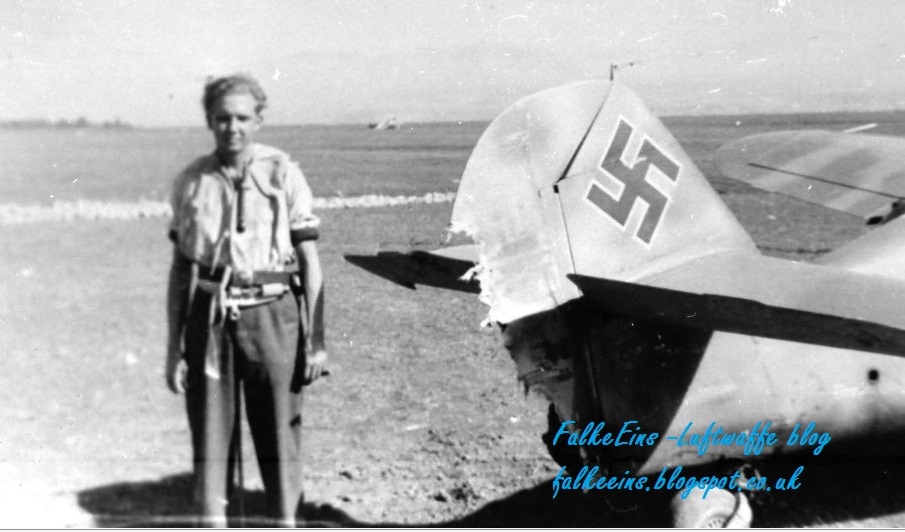
On 20 October, III./JG 77 recorded a total of thirty-two Bf 109 G-6 fighters on strength. Returning to Metato, Uffz Böttner took part in various interceptions of American bombers pounding German positions in northern Italy. On 23 October, around Rome, the rudder of his G-6 was seriously damaged by defensive fire from B-17 Fortresses, but the young pilot was able to return to his aerodrome without too much trouble. (photo below) III./JG 77 was sent to Romania a short while later, I./JG 4 returning from this theatre to take their place in Italy.

The detachment of III./JG 77 in Pisa was also implicated by the Italian 'change-of-sides' on 8 September. Lt. Wolfgang Ernst, Stk of 9./JG 77 remembered;

" I was with a few pilots at Pisa airfield at the time. Our Schwarm was carrying out combined manoeuvres with the Italian navy. We flew over the ships all day long, and we were often invited dine in the evening in full dress. The food was excellent and the wine plentiful. It was all very pleasant. On the morning of the 9th, following the Italian U-turn, I decided to join the Gruppe now in Corsica. We took off and flew over the Italian fleet as it set sail to surrender to the Allies. We strafed some ships, which saddened us: only the day before we had been friends. Later we shot down a small Italian liaison plane over the mainland -flying due south, it was deserting towards the territory held by the Anglo-Saxons..."

Meanwhile II./JG 77 was put to work to disarm their former allies. A transfer to northern Italy had been planned since mid-August.  Overtaken by events the Gruppe had already given up its Gustavs.  Small groups of ground personnel were sent all over Italy to take control of the airfields; as for the pilots, they ferried the captured machines to northern Italy. It was at this point that the decision was taken to re-equip II./JG 77 with some of the captured Italian Macchi Veltro fighters. 


Technicians from the Gruppe were sent to Varese to study the Macchi Veltro. Equipped with a Daimler Benz DB 605 engine, this aircraft seemed adaptable to German standards as mechanic Karl Holland reported;

"..The engines, Daimler-Benz 601s built under licence, posed no major problems. The work of the mechanics was even easier because the amount of room reserved for the engine, auxiliary fittings, oil and coolant circuits was larger than on the Bf 109. As far as armament was concerned, the usual MGs were used, as well as heavy machine guns of a calibre close to 12 mm. No cannon. The pilots found the Macchis lighter but slower than the Bf 109s..."

The C.205 was used briefly by II./JG 77 from late September 1943 to the end of the year before the Gruppe reverted back to the Bf 109 G-6. The war diary of the Stab/JG 77 commented on 21.Nov. 1943 ;

" The machine is fast, and flies well, but has a tendency to lose speed in a sharp curve, and it is easy to get into a spin. Another aspect is the Italian radio. Despite transmitting clearly, the pilots can barely understand what is being said. Finally, refueling and reloading ammunition is very complicated, so restoring operational readiness takes a long time..."

The Kommodore's memories are more categoric; 

 "My JG 77 rarely used captured aircraft, apart from the Mc-205 flown by II./JG 77. It was a vicious machine that easily got into a spin which could be very difficult to get out of. It was used in combat and there were a few victories. (Maj. Johannes Steinhoff, Geschwaderstab JG 77).

Were there any German Macchi aces ? A reply to this question (answer/research) by Georg Morrison

" You may be thinking of Oblt. Joachim Deicke, who led the 6./JG 77. His aircraft, "gelbe 1" was a Macchi C.205, WNr.92212. BUT, none of his 18 claims (over 661 missions) were made using a Macchi. Three pilots had died in crashes, usually "pilot error." Uffz. Rudolf Funke was shot down on 1 December 1943 by a P-38 (C.205 "gelbe 4", WNr.92218), but was safe. Another C.205 was damaged in this combat. The last loss of 1943 was on Christmas Eve, engine fire on WNr.92224.

 Another potential candidate for JG 77 ace on the Macchi could have been Lt. Franz Hrdlicka, who led 5./JG 77. He made his 37th claim on 9.November 1943, which was likely in a C.205 - he posed for a photo, seated on the cockpit edge of a dark-finished example..". 

Recommended reading ;

The Luftwaffe in Italy 1943-45 published by Lela Presse, 98 page A-4 softback, some 200 photos/artworks. Only 13 euros. Available from the avions-bateaux.com website. Eight-page PDF extract here


Tuesday, 7 March 2023

'A fighter pilot's bold feat' - Siegfried Lemke claims March 19, 1944


During January 1944 I./JG 2 was hastily dispatched to the Mediterranean Front, deployed to counter  15th USAAF bombing raids. Following the Allied landings at Anzio Italy, the Gruppe was scrambled on 27 January over the Toulon-Hyeres region in the south of France against an incoming fighter sweep by 52nd FG Spitfires airborne from Calvi in northern Corsica. Four of these were claimed, three of them by Fj-Ofw. Lemke, 1./JG 2 Staffelführer.

On 25 February 1944, I. and 4./JG 2 moved from the south of France to the banks of Lake Trasimeno in northern Italy. Lemke distinguished himself during his unit's short two month stay in northern Italy, being credited with eighteen victories. He was awarded the Ehrenpokal in March 1944, the DKiG in April followed by the Ritterkreuz in June.

On 19 March Lemke - by now with the rank of Leutnant - repeated his feat of 27 January. According to an article in an issue of Frontzeitung "Luftflotte Süd" the date March 19, 1944 is an odyssey in itself in the career of the ace of 1./JG 2. His exploits - including the downing of three more 52nd FG Spitfires - featured in a PK war correspondent's report. Lemke came down at sea, spent some time in his dinghy, then elected to swim ashore - spending five or six hours in the water - at least! En route he swam past his one of downed US opponents who was in his dinghy. Lemke carried on swimming and reached the shore. He then walked to the nearest fishing village and apparently passed out from fatigue,. When he came to, he commandeered a boat, rowed back out to sea to rescue the US aviator still in his dinghy.. (!!) 

A feat that borders on the miraculous and I'm guessing that  Shores and co. left this episode out of their 'Mediterranean air war' account because there is probably no way of verifying any of it..

Lemke was subsequently 'interviewed' by a war correspondent and this rare personal account has been translated by Nick Beale - see link below.  " - Leutnant Lemke tells how after three victories in one day, he was shot down over the sea, swam ashore and still took an enemy pilot captive .."

Lemke's claims for March 19, 1944
 
34th claim
19.3.44/0750
Spitfire
5km W of Moltalto di Castro

35th and 36th claims
19.3.44/0953 and 1002
Spitfire
20km W of Tarquinia/20km W of Moltalto di Castro

Two Spitfires from 52nd FG lost this date, while a third was damaged: EF703/VF-Q of Lt. Robert C Boyd, EE858/VF-E of Capt. Eugene C Steinbrenner and Lt. Charles E DeVoe was WIA (damaged)

The full story of the deployment of I./JG 2 over Italy during early 1944 is told by Nick Beale on his Ghost Bombers site here

Lemke's own account of his March 19 feats as told to a war reporter translated by Nick Beale here

Also on this blog; 


Siegfrie Lemke's award of the Ritterkreuz, June 1944

Saturday, 3 September 2022

Mission to Valetta, April 12, 1942 - 4./LG 1


Extracted from the book: Die Geschichte des Lehrgeschwaders 1 (vol I) by Peter Taghon. A French edition is also published by Lela Presse and both volumes are still available from their web site at a very affordable price, see link below.

(The following account has been prepared from the original German-language edition and, probably for reasons of space, does not appear in the French edition. Translation by FalkeEins. Note this is NOT the translation that was posted on a certain FB page - that had one or two 'problems'!).

Mission to Valetta, April 12, 1942 - 4./LG 1

In accordance with II. Fliegerkorps orders, II./LG 1 were to attack at 10:30 and 16:00 those remaining harbour facilities - 19, 33 and 34 -  that had not been destroyed in the port area of Malta's capital. That morning several II.Gruppe crews also bombed Ta Kali and Luqa airfields, accounting for several Hurricanes and also a few Wellingtons destroyed. During the raid on Valetta, 4. Staffel lost Ofw. Waldemar Kremin’s  Ju 88 A-4, 'L1 + GM', which was hit by flak and crashed. The crew remains missing. Only the body of the BO (observer), Uffz. Karl-Schleiermacher, was recovered. Uffz. Walter Malzahn recalled;


"..We were flying in Kette formation. Oblt. Sy was leading and flying just off to our right was Ofw. Kremin. Approaching Valetta harbour the welcome we received was extremely unpleasant. There was no longer any blocking fire or fire directed by sighting or listening devices. This was targeted and very accurate. It really was a devilish surprise.

An accurate drop of our ordnance in the teeth of this level of defensive fire would be practically impossible. There were shells bursting right in front of us, close around the cockpit. Even above the roar of the engines you could hear the sharp, hard crash of shells exploding. It stank of sulphur.

I had my hand on the cabin roof escape hatch and would've jumped if I'd heard any clattering of shell splinters. But there were none. Even today I don't know why we weren't hit. Perhaps the shells had not been constructed to fragment or shatter?"

"Oblt. Sy flew the usual defensive manoeuvres so as not to give the heavy flak an easy target to aim at. I was both shocked and amazed to see that Ofw. Kremin stubbornly held his course straight and level. This lasted a matter of seconds - then he took a direct hit. His Ju was thrown up on to its port wing tip and appeared to veer in a kind of knife-edge slice towards our tail. I screamed at Sy to take evasive action so that Kremin's stricken Ju didn't take us down with him.. The manoeuvre was successful, but it was a very close call.

Kremin's Ju slid close by our tailplane and went straight down, a thick plume of black smoke like a comet in its wake. I was able to follow the trail almost to the point of impact. It was a spine-chilling scenario.  A thought flashed through my mind -  " that is how it will end for you too!"

" Despite this downing there was no let up from the anti-aircraft fire. I yelled: "Flakwaltzer!" Sy reacted immediately and let his Ju dance, almost aerobatically.  The main thing was the teamwork with Oblt. Sy had saved our lives. Once again we made it home without a scratch...."

 At 17:00 the Gruppe launched another raid on Malta. When the formation found itself over the target at 18:00, the Fliegerkorps changed the orders: the remaining targets 19, 28, 29 and 32 were to be bombed. And so it was that the crew of Oblt.-Erwin Sy attacked a food storage depot in Valetta. Oblt. Eilert Rogge's crew bombed a gas storage tank. The mission ended at around 18:40..


More on Peter Taghon's superlative two-volume history of Lehrgeschwader 1 including pdf extracts from both volumes at the French publisher's web site here


A selection of Ju 88s in the Med from the imagesdefensegouv.fr searchable database, (ECPA-D on-line photo archive) where these images are already on-line, in low-res and can be down-loaded for 'personal' use which means effectively they are 'public domain'. Reproduction here would probably be considered as 'educational' and fulfill 'fair-use' criteria. 


II./LG 1 Ju 88s in Greece (Crete)


Below; at Kastelli airfield, a Junkers Ju-88 D of Aufklärungsgruppe 123  has had its fuel tank removed for maintenance and/or repair.


I./LG 1 Ju 88 probably on Crete - click to view full screen


Wednesday, 31 August 2022

new from Lela Presse - The Luftwaffe in Italy 1943-45


Following on from their recent 'Luftwaffe in Tunisia' (Jean-Louis Roba) and 'Last victory in the Mediterranean' ( Jean-Louis Roba with Chris Shores) Lela Presse have just published their latest 'BATAILLES AÉRIENNES' monograph, 'The Luftwaffe in Italy 1943-45' by Jean-Louis Roba.  Coverage of bomber, fighter, transport and recce units is based on archival documents including POW interrogation reports and features plenty of first-person accounts. French text. Still well worth acquiring at only 13 euros - 96 pages, 150+ photos, profile artworks  - but easy enough to read with, for example, the google translate app on your smartphone..


IV- Transport units 

 In the course of the resupply operations flown into the Tunisian pocket, the German Transportgeschwader (the designation TG had replaced the former KGzbV in April) had suffered terribly. Above all else, there was a shortage of escorts for the Ju 52 and Me 323 transports. On April 22, the ‘infamous’ disaster at Cap Bon took place - fourteen TG 5 Me 323 six-engine behemoths were shot down with their passengers and cargoes. - TG 5 continued to be based on its aerodrome at Pomigliano to supply the islands. One Me 323 pilot, Oblt. Ernst Peter*, recalled: 

 "..After the operations in Tunisia, our unit flew almost daily from Naples-Pomigliano to Sardinia, with the handful of aircraft that remained and those that could be brought to us from Leipheim. For a while we were able to enjoy life. From time to time we would see, far above us, the condensation trails of an enemy reconnaissance plane that had come to watch the area or, sometimes, tight formations of heavily laden bombers arriving from Africa to sow death near the Alps. We could continue on our way because these formations were not at the same altitude as we were and any potential fighter escorts they might have did not care about the transport planes flying at much lower altitudes. It was a nice feeling to be able to fly alone, not having to rely on a fighter escort and only having to rely on yourself. We did not have to endure the attacks on our runways like Cagliari/Elmas, Alghero, Venfiorita/Olbia, Decimomannu, Villacidro or Milis, so it was a good time and, after the costly and hard operations in Africa, almost a relief even though we often had to fly for three hours over a sea stretching as far as the eye could see. We mainly refuelled the 90. (leichte) Division with fuel, Flak equipment, vehicles, ammunition, etc..."

* "..schleppte und flog Giganten"

The strains within the German command

The Bf 109s of the 'Pik As', based in Sicily, were to bear the brunt of the powerful air attacks on the island. On 18 May, suitably escorted four-engine bombers dropped their ordnance on Pantelleria and Trapani. Eight P-38s were claimed but no bombers - a testament to the quality of the escort. On the 19th, the USAAF targeted Trapani and, although six Lightnings and two Curtiss were claimed, again no bombers fell victim to the 'Pik As'. That day, 7./JG 53 lost two of its pilots. On the 20th, Spitbombers from Malta bombed Comiso. And so on... These almost daily attacks gradually wore down the Sicilian defence units. 

 JG 77's first major combat since the evacuation from Africa, however, did not take place until June 18, in the Sardinian sector of Olbia. In support of local Italian units, III./JG 77 faced a large formation of B-25s escorted by P-38s of the 27th, 96th and 318th FS. Two P-38s, three B-25s and a Boston were claimed by the three Staffeln, who seem to have lost no aircraft. 

 The Allies had barely paused after the capture of Tunisia. On the night of 10/11 June, they began their invasion of Europe by landing at Pantelleria. On 12 June, after the small Italian island of Pantelleria, the island of Lampedusa surrendered almost without a fight. 

 Confronted with these rapid Allied actions it was decided to completely overhaul the German command in the Mediterranean;
 -all Wehrmacht units in the south came under the control of Marshal Albert Kesselring hastily appointed OBS Süd (Oberbefehlshaber Süd); 
-Luftflotte 2 was taken over by the energetic Field Marshal Wolfram von Richthofen, cousin of the famous Great War pilot;
 -the bomber units dependent on II. Fliegerkorps were regrouped under the Fernkampfführer Mittelmeer, Oberst Dietrich Peltz. Peltz (who in 1941 had led the dive-bombing school at Foggia) was to attempt to instil the new tactics that had been honed in the West against the UK and to develop various measures such as attacks at low altitude or the movement of units to more distant airfields, in order to reduce the risk of destruction by Allied bombers.

 However, given the large number of units assembled in a restricted space that had now become a front line, the Germans faced serious logistical problems, as Karl Gundelach pointed out; 

 "…In Sicily, it was necessary to find new airfields for the fighter and the Schlacht units. This was difficult because very often all that was available was just farmland. Göring received many complaints from his Kommandeure about the slowness of the Italians to find solutions (...) It was also necessary to reinforce the Flak arm; especially the batteries defending the vital Straits of Messina. (...) It was planned to establish barrage balloon booms here, but the Italians preferred to keep them for their own ports. (…).Aerodromes in Sardinia had to established and air transport to the island stepped up. The Allied air forces then sent their long-range aircraft to disrupt this air traffic, which led to losses. (...) The greatest difficulties were in Calabria, where there was a lack of aerodromes for fighters. The best equipped were in Apulia but they were too far away for the Tagjäger. (...) Following the heavy losses of the Flak in Tunisia and the equipment which had been abandoned there, there was a lack of batteries. Most of them were to be assigned to Sicily but Sardinia needed 15% of the manpower that had been gathered. It was therefore necessary to bring in anti-aircraft units from northern Italy at the risk of undermining the protection of the industrial towns working for the Axis war effort… " 

 These problems undermined local command in the face of a numerically superior enemy. Added to this was Göring's mistrust of the Jafü Sizilien, General Theo Osterkamp, who had been installed in this position by OBS Kesselring. Osterkamp had already been removed from the command of a Geschwader by Göring as early as 1940, the Reichsmarshal considering him too old to exercise such responsibilities.

On June 25, a large formation of B-17s passed north of Sicily to raid Naples. II. and III./JG 53 as well as elements of JG 77 were guided towards the bombers from the ground. II./JG 53 missed its interception while JG 77 could only put up a very brief fight due to lack of fuel. Two B-17s were claimed by two aces of III./JG 53 ( 55th victory for Oblt. Schiess and the 68th for Oblt. Roehrig) but Uffz. Alfred Kowaleswki (9./JG 53) was shot down over the Straits. Two other Fortresses were also downed. Enraged by this 'incompetence', Göring demanded that Inspector of Fighters Galland ensure that one pilot from each Gruppe be brought before a court martial and tried for 'cowardice before the enemy' (Feigheit vor dem Feind)....

Web site of publisher Lela Presse is here

Sunday, 29 May 2022

BATAILLES AÉRIENNES No. 100 - Last victory of the Luftwaffe in the Med, September- November 1943


Issue No. 100 of the French quarterly "Air Battles" (Lela Presse) covers the combats over Kos and Leros in the eastern Aegean (Dodecanese) during September-November 1943 following the Italian change-of-sides, 100 A-4 glossy pages, 190 photos, 20 artworks, 13 euros.

"...September 1943. As the fate of the war increasingly turned against the Axis, the Italian government made a secret agreement with the Allies to exit the conflict. British Prime Minister Winston Churchill saw this as the perfect opportunity to trigger the 'Accolade' Plan, the capture of the Dodecanese islands. By doing so, he hoped to bring neutral Turkey into the Allied camp while launching a major offensive through the Balkans, the 'soft underbelly of Europe'. But Churchill was not followed in this by his American ally and, contrary to his hopes, the Wehrmacht quickly took control of Rhodes, the most important island in the eastern Dodecanese. Despite this setback, British units were committed to an offensive that was badly launched from the start (some authors have spoken of 'Churchill's folly'). Although caught unprepared, the Wehrmacht scraped together various adhoc units, rushing a number of Luftwaffe Gruppen and an airborne regiment to the Aegean to effectively 'replay' the 'Merkur' operation of May 1941 (the capture of Crete): the Germans dominated the skies while the British were the masters of the sea. During October-November 1943 in two quick but costly landings, the islands of Kos and Leros were taken back from the British. This was the last great victory of the Wehrmacht with the surrender in the field of a British army and the capture of its general. A military episode too often ignored by historians and chroniclers despite its important underlying political aspects...."


The Allied 'invasion' of Italy had led to this country dropping out of the war during September 1943. On the mainland the Germans were simply able to 'occupy' the country with the large numbers of German troops already present. Elsewhere in the eastern Mediterranean Italian possessions garrisoned by the Italian army were at risk of seizure by Allied troops. In the race to occupy the Dodecanese and neighbouring islands, the Wehrmacht undertook a series of air-sea landings, something not normally associated with the Wehrmacht. German infantry carried out beach assaults and, unusually, Fallschirmjäger were deployed in their intended role as paratroopers, more than two years after sustaining heavy losses in Crete. The Luftwaffe had airfields on Rhodes and Crete but the only Allied-occupied territory with a suitable landing ground was Kos, defended in the air by SAAF Spitfires. On October 3, 1943 the Germans opened a direct assault on the islands of Kos and Leros; operations 'Polar Bear' and 'Typhoon'. Luftwaffe bombers - Ju 88s of ZG 26 and Stukas of Kuhlmey's St.G 3- and the Bf 109s of III and IV./JG 27 inflicted heavy casualties. This was arguably the last effective offensive mounted by the Luftwaffe and the full story is related by Jean-Louis Roba in the 100th issue of the Lela Presse Batailles Aeriennes. 

As M.Roba told Pierre Komidis he has been researching this little-known area of the war in Europe and the Mediterranean for over forty years - his self-published "The Germans in the Aegean 1941-45" (Vol I) was written and researched during the late 1970s-1980s and inspired after viewing the classic Werner Herzog film 'Lebenszeichen' ('Signs of Life'). 'Lebenszeichen' described the lives of three German soldiers after a paratrooper wounded on Crete is evacuated to Kos. Herzog filmed on the island of Kos before the era of mass-tourism.

".. A brief search made me realize that no one had written a book on the everyday life in the Aegean during the German occupation 1941-45. After the conquest of Crete by German airborne forces - none were landed by sea - this sector of the Mediterranean fell into the most complete oblivion. During a period of ten years I gathered a lot of information on Greece during the Second World War and I had to restrict this study to the islands of the Aegean Sea occupied by German troops. The title is indeed the perfect summary of the contents of the book..."


Dornier Do 24 T (WNr. 071) VH+SK on the strength of 7. Seenotstaffel during October 1943

Uffz. Karl-Heinz Lüdtke of 7. Seenotstaffel;

"...after Italy had deserted the Axis, the Greek islands held by the Italian army, supported by British soldiers, had to be reconquered. 7. Seenotstaffel from Athens was ordered to provide Dornier 24s to transport infantrymen to these islands. One morning, we (Ofw. Lange's crew) were woken up with an order to go directly to Staffel HQ. We were not staying in the barracks but in a small villa in the vicinity. So we had a short walk to cover. We set off as quickly as possible without knowing what was expected of us. Certainly an alert that was obviously urgent. When we arrived at the seaplane base, we noticed the presence of infantrymen sitting all over the central square. We were to learn later that these were the famous Brandenbürger, the "Reich Commandos". Our curiosity was totally aroused. We were soon to be told by the StaKa that our good friends, the Italians, were tired of the war and had gone over to the enemy. We were going to have to reconquer the islands occupied by the 'Macaroni'. Hence the soldiers in front of the buildings. Everything happened very quickly, no time to procrastinate! Lightly  equipped and with their weapons, the Brandenbürger boarded our Do 24. They were given life jackets (we did not fly without them). Our chief cook also wanted to come along, because he was desperate to bring back a pig to improve our rations! The island we were assigned did not have an important garrison and the twenty to twenty-five men on board would be sufficient to retake it. We landed very close to the shore. Was the enemy still sleeping? In any case, we disembarked the soldiers without being fired on and then set off again back to Phaleros. There, as soon as we arrived, we received orders to leave immediately for the island.  Amazingly the operation had taken only a short time. By noon, we were already in the air, all surprised by this unexpected speed. When we landed and approached the beach, we discovered about twenty British soldiers flanked by Brandenbürger. And our head cook? He was very disappointed not to have found a pig on the island and, instead of bringing back the extra food, we carried the twenty enemy soldiers who were sent to a prison camp. Most of the Italian POWs sided with us and became Hiwis (Hilfswillige or auxiliaries). The islands were then to be held by the soldiers of the disciplinary battalion N° 999...."

As in Norway and around Crete at the end of May 1941, the Ju 87s of St.G 3 had a field day attacking ships or ground positions on the islands of Cos and Leros. The 22-year old Friedrich Eisenbach of I. Gruppe made eleven war flights over Kos, attacking a convoy of cruisers and two RN destroyers on October 7 west of Rhodes  - HMS Penelope was seriously damaged by a force of 39 Stukas and 35 Ju 88s (II./KG 6, II./KG 51 and LG 1 along with He 111s of KG 100). Over the following days XIIth AF B-24s and B-25s escorted by P-38s bombed Rhodes, Eleusis and Crete and were caught up in combat with III. and IV./JG 27. Eight P-38s were claimed on October 8, including three by Fw. Bartels, while on October 9, I./St.G 3 sunk HMS Panther and inflicted heavy damage on HMS Carlisle..

After Kos had fallen to the Germans on 4 October, the Luftwaffe concentrated on the fortified island of Leros, the 'Malta of the Aegean'. Eisenbach flew eight sorties against this island in support of German airborne forces - some of the Stuka sorties flown from Megara were up to four hours long. The British and their new Italian allies fought desperately but this last allied bridgehead had to capitulate on 16 November after five days of fierce fighting. Late in the day, the USAAF supported its British 'ally' by bombing airfields on the mainland. P-38 Lightnings (with sufficient range) of the 37th FS (14 FG) from Africa had even surprised a Ju 87 formation on a mission over the Aegean on 9 October - Major William Leverette claimed seven St.G 3 Ju 87 Doras downed - among those KIA was the StaKa of 5./St.G 3 Hptm. Peter van Heydebrandt. But this limited support could not prevent disaster, the fighting in the Dodecanese constituting one of the last victories of the Wehrmacht. Having championed an invasion of southern Europe through the Balkans as a means of shortening the war, the loss of the Dodecanese was a defeat for Churchill. While even British authors consider the Aegean adventure as 'Churchill's folly', it is quite possible that his vision of an assault through Europe's 'soft underbelly' could have enjoyed more success than the 'American' invasion of mainland Italy - a country with a mountainous spine that was easy to defend and which the Allies only took at tremendous cost....

More details and a pdf extract on the Lela Presse site here

Thursday, 26 May 2022

more Bf 109 Aufklärer - 4.(H)/12 in Tunisia January -April 1943


Bf 109 G-2 of 4.(H)/12 seen on Sicily after departing Tunisia during April-May 1943. To view a larger version of this photo click on the image. 


In January 1943, a weakened 4.(H)/12 were resting at Bir Dufan before the Bf 109s of the Staffel were deployed to Tunisia to operate in the 'pocket' alongside those of 2.(H)/14 which had recently returned to Africa. On January 20th, at Bir el Ghnem, a 'Friedrich' had to be scrapped. Three days later, a further two Bf 109s (which were to be part of a rear commando left near Tripoli) were also destroyed. Two wounded were then reported during landing accidents in Zuara and Gabes. On February 9, Ofw Hönig was injured when his aircraft hit an obstacle in Gabes. It was 80% destroyed and this was the last mention of a Bf 109 F-4 in the Staffel. On February 20, Oblt Gerhard Wernicke was reported MIA, hit by ground fire and forced to make an emergency landing south-west of Zarzis. He was flying 'black 14' WNr. 10764  - one of the first Bf 109 G-2s to be transferred to the unit to replace the unit's Friedrichs. Wernicke, a former observer with 2.(H)/14 transferred to 4.(H)/12 and then turned pilot, managed to evade capture and returned to the unit on foot. Two more 'Gustavs' were damaged on landing at Hadjeb el Aioln on the same day, a ferry flight disrupted by bad weather. On 21 February, in a G-2, Fw Josef Harl was hit by flak at  Ben Gardane (near Medenine) and went into captivity. 

On 24 February, Kapitän Schneider left his post to lead a training unit, 4/Nahaufklärungsgeschwader 102 and then II./NAG 102. His successor was Hptm Rolf Sauer, a veteran who had been shot down south of Arrancy on May 13, 1940 by GC I/5 while flying a 3.(F)/Aufkl.Gr. 22 Dornier Do 17 P.  He had been taken captive but was freed when France fell and, in 1943, was assigned to the Nahaufklärung. On March 10 Fw Werner Schmidt was shot down near Gafsa by three Spitfires of N° 601 Sq. Schmidt was killed and this victory was attributed to P/O Baxter and Sgt Steele. On March 17, a G-2 was destroyed after an emergency landing due to enemy fire, the pilot was unharmed. 


During these risky missions in Tunisian skies, 4.(H)/12 were not 'clay pigeons'. Uffz Friedrich Stannek (left) was the ace of the Staffel, claiming at least six enemy machines downed during this campaign. Lt. Karl-Otto Holzapfel, who knew him, said; "We didn't like flying with Stannek. He was far too much of a Draufgänger. He often came back with a victory... but without his Kaczmarek".  Stannek claimed his 7th on May 23, a P-38 shot down 50 km south-west of  Cap Spartivento. Stannek was awarded the RK late in 1943 and was killed in a crash on October 25, 1944. 


 On March 19, Uffz Antonius Uhler flying Bf 109 G-2 'black 6' WNr. 10672 was hit by flak near Gafsa. He jumped and was captured. 4.(H)/12 had apparently reached the end of the line. In early April, two or three of its G-2s were destroyed at La Fauconnerie and Bir el Djem. (April 9,1943: Bf 109 G-2 W.Nr. 13899 was destroyed by German troops at Fl.Pl. Bir el-Djem). The last recorded loss for 4.(H)/12 in Tunisia was Bf 109 G-2 WNr. 10837, bombed at Sainte-Marie du Zît on April 12. The Staffel evacuated to Sicily and thereafter back to mainland Italy, missing the last of the fighting in the Tunisia and the surrender of the Panzerarmee Afrika in May 1943.


Below;  'white 6' a G-4 of 4./(H)/12 (note prancing horse cowl emblem) on Sicily. 4.(H)/12 was incorporated into the 'new' NAG 11 during October 1943, being re-designated 2./NAG 11.


Also on this blog;


The full story of battlefield recce Staffel 4.(H)/12  - from the Hs 126 to the Bf 109 Gustav, 1939 -1943 - is told by Jean-Louis Roba in the latest issue of 'Avions' magazine (Lela Presse). More details and a pdf extract here 


Sunday, 14 June 2015

Ju 88 squiggle camo/Mäandertarnung, Italy 1943-4 KG 54, KG 76, KG 77


Junkers Ju 88, Italy 1943-4 Mäandertarnung (squiggle camo) 


Aviano, Italy according to the seller. Colours 'expert' David E. Brown has suggested that this machine might be Ju 88 A-4 “B3+BR” of 7./KG 54 given the style of the aircraft’s code, camouflage, and very small size fuselage Balkenkreuz. The latter is apparently rare on Ju 88s. 

Elements of at least five Ju 88 bomber units were stationed in Italy around the summer of 1943 as KG 76 pilot Joachim Siebers recalled in Smith and Gallaspy's " Luftwaffe Camouflage and Markings 1935-45" Vol.3 (Kookaburra, 1977). Some of these machines were also supplied from Munich direct to the front line, pre-painted in a new over-water test scheme of 'maritime blue' - a royal blue now thought to have been '83'  (although could have been RLM 24?) uppersurfaces with RLM 76 Wellenmuster pattern superimposed. Possible Geschwader codes could be "3Z", "F1" or "L1" or even "B3". However the white theatre band seems to have been a feature of KG 77 machines..


"F1+DP" of 6./KG 76, captioned " March 1944 - Italy"


Junkers Ju 88, Italy 1944 Mäandertarnung (squiggle camo) - click to view large


Ju 88s of KG 77 on this blog
http://falkeeins.blogspot.co.uk/2013/11/ju-88-torpedobomber-im-mittelmeerraum.html

http://falkeeins.blogspot.co.uk/2011/11/diving-luftwaffe-wrecks-in-med-junkers.html

http://falkeeins.blogspot.co.uk/2015/04/junkers-ju-88-3zer-kg77-besatzung-nach.html