Showing posts with label JG 2. Show all posts

Monday, 22 June 2026

Storming the bombers - Egon Mayer's first 'frontal' attack, 23 November 1942


The air war in the West and over the Reich determined the fate of the Luftwaffe - with a higher percentage of casualties to participants than in the East, it was by far the most costly theatre for the Luftwaffe. And the Allies for that matter. The USAAF lost over 79,000 airmen between 1942-1945 and the RAF lost over 8,000 aircraft in the period 1939-1945 resulting in similar numbers of air crew killed. Over 60% of these losses were attributed to enemy fighters, both day and night respectively. The USAF lost over 8,000 bombers from November 1942 to May 1945 with German fighter pilots shooting down over 6,000 American and 7,000 RAF bombers, at a cost of 150,000 Allied airmen combined. The Germans themselves lost almost 20,000 fighter and 'destroyer' crews men and pilots, more than half killed fighting against the heavy bombers and their fighter escorts on the Western Front. Attacking a bomber formation was dangerous. Initial encounters with US bombers flying by day during mid-late 1942 were inconclusive, but the Germans quickly grew to realise that the American four-engine bombers with their heavy defensive armament - well able to absorb punishment especially when flying in their mutually protective ‘combat boxes’ - were tough opponents.  

Egon Mayer scored his first heavy bomber kills as Gruppenkommandeur of III./JG 2 on 23 November  1942 - this may well have been his first such encounter with the '4-mot. Kampfflugzeuge' or “Viermots.” Having been appointed Gkr. at the start of that month, Mayer - known as a conscientious, studious and pragmatic fighter pilot and leader - had studied tactics and angles of attack to develop procedures against the 'Viermots' - most notably the B-17.  Other pilots in his unit had been doing likewise - Jules Meimberg recalled in his memoir;

“ we sought out as much information on these machines as we could find..first flight in 1935, steadily upgraded and improved..three revolving turrets, eight heavy machine guns for defence..and only one point of weakness – the cockpit. Whereas Mayer wanted to launch attacks from all directions simultaneously to disperse the defensive fire, I argued that head-on – hitting the B-17s where their defensive fire was at its weakest - was the only certain way to bring a Fortress down..”  

US bombers were increasingly penetrating the airspace of western and northern France. Mayer's Gruppe was specifically tasked with defending the U-boat bases in Brittany.  While JG 2 was not scrambled on the 9 October 1942 attack on the 'Lille industrial area', this was the first raid for which the US VIII BC managed to assemble over 100 bombers. However events elsewhere (North Africa) meant that it would be another six months before such a large force could be put together again over Western Europe. 

On 7 November, some 34 B-17s and B-24s raided Brest. Oblt. Bruno Stolle claimed one B-24, the first of this type shot down by the Richthofen Geschwader. St. Nazaire was the target of 36 bombers on 23 November 1942. Mayer led off 7. and 9./ JG 2 from Vannes at around 12:00 mid-day. 

As the Fw 190s sighted the bomber formation, Mayer made a rapid assessment of the situation and elected to attack the bomber formation 'head-on'. Climbing almost a mile above and three miles ahead of the formation, he turned and started  a shallow diving attack from the front. Receiving light defensive fire he held his approach for several seconds, focusing his aim on the port engines.  Perhaps less than thirty feet above the bomber 'box' he veered away as the target headed to earth. He repeated this pass on a second B-17. Fifty calibre rounds pounded his armor plate around his cockpit and according to one account, damaged two cylinders in his engine. Pulling up and gaining altitude, he then closed on a box of B-24s, an attack timed at  14:00.  By this stage he was probably almost out of ammunition and running low on fuel. Mayer decided to return to base. While he claimed two B-17s and a B-24 on 23 November 1942 (his victories 52-55) and brought back a relatively unscathed aircraft, no B-24s were lost. Four B-17s in total did fail to return - two credited to Mayer, one for Uffz. Friedrich May of 8./JG 2 and the fourth was credited to Oblt. Siegfried Schnell, StaKa of 9./JG 2, his 72nd victory. Mayer's 7. Staffel wingman Uffz. Theo Angele was the only loss suffered by III./JG 2- Angele's Fw 190 A-4 was hit by the bombers' defensive fire and went down into the sea. Angele's body was later washed up on the coast.

General der Jagdflieger Galland was quick to praise Mayer's initiative against the Viermots on 23 November 1942. In a message sent to all units  (below, dated 14 December and received at I./JG 54 on 13 January 1943) he urged all formation leaders to adopt this frontal attack method where possible in order to increase the 'lethality' of the German fighters and overwhelm the bomber formations. 

RL 10/291 contains a combat report 'Erfahrungsbericht' (a  'retour d'experience' written for the JG 54 pilots shifting  to the Western Front) which indicates that Mayer almost certainly employed the new frontal attack method for the first time during this raid. The traditional attack from the rear had proved risky, with attacking fighters likely sustaining many hits from the defensive fire of a typical staggered trail formation. 


 There were of course several 'negatives' to the frontal pass - attacking from head-on gave the German fighter pilot only a few seconds to line up, aim, fire and either pull up or dive away after a closing speed of 500 mph or more. Few German pilots could do this, which was considered an acquired skill and required steely nerves. Those who did master this method risked collision and damage or destruction once they pulled up, or in most cases rolled into a 'split-S' manoeuvre and dove away following the attack. On the other hand, only the top turret twin fifties on the B-17 F models could engage the incoming aircraft, reducing exposure to the numbers of guns in a formation until the fighter passed underneath or overhead. But by then the German was too fast for the ball turret to track and engage. Waist gunners had to be cautious in firing for fear of hitting the bomber on their flank. But the frontal pass directly concentrated fire on the most vulnerable part of the bomber - the cockpit. In response to this new method of German attack, the Americans introduced new models - the B-17 G and B-24 H both incorporated the forward firing “chin” mounted twin fifty calibre machine guns to defend against the head-on attack. This soon led to the exclusive use of the more heavily armed Fw 190s to attack the bombers, leaving the Messerschmitts to engage the American escort fighters.


Below; Oblt. Egon Mayer (fifth left) with his 7. Staffel seen in Poix during October 1942. Uffz. Theo Angele KIA on the 23 November raid is fourth right.


These developments deterred all but the most dedicated and efficient bomber 'killers'. Those aces who 'specialised' in the frontal attack simply changed their angle of attack, above the chin turret guns’ elevation, rolling over exposing the undersides of their Fw-190s, where the armor plating absorbed the impact of the enemy rounds. Most of the German fighter pilots who amassed many bomber kills paid a heavy price and fought a long war. For example, Georg-Peter Eder was shot down on multiple occasions and wounded numerous times. He had three kills confirmed after colliding with his targets, surviving the crash and being thrown from the wreckage, the last being in a Me-262 jet, breaking both legs in January 1945, ending his war. Anton Hackl was shot down eight times and also wounded on four occasions, including a collision. Eder was not that an unusual case. Most of Germany’s pilots were shot down and often wounded several times. Returning to combat was expected unless the loss of sight, a limb or other crippling injury was the result. The fortunate few became instructors until they healed, passing on their knowledge to the next group of future fighter pilots. This protection was far less available in the front of a formation, and an attack described by Heinz Knoke shows how on the job training often developed a better result, but was a much more difficult and dangerous proposition: 

“We draw closer to the bomber formation…I can distinguish the individual enemy aircraft now. Most of them are Liberators….They look as if their fat bellies are pregnant with bombs. I pick one of them as my target…I shall make a frontal attack. The Yank is focused in my sights. He grows rapidly larger. I reach the firing buttons on the stick. Tracers come whizzing past my head. They have opened up on me! Fire! I press both buttons, but my aim is poor. I can see only a few hits register in the right wing. I almost scrape the fat belly as I dive past. Then I am caught in the slipstream, buffeted so violently that for a moment I wonder if my tail plane has been shot away. I climb up steeply and break away to the left. Tracers pursue me, unpleasantly close. “Damn all this metal in the air! Three hundred heavy bombers carry a total of 4,800 super heavy machine guns. Even is only one in ten has a chance to fire that still means we run into quite a barrage. I come in for a second frontal attack, this time from a little below. As I swing round I turn my head. Flames are spreading along the bottom of the fuselage of my Liberator. It sheers away from the formation in a wide sweep to the right. “Twice more I come in to attack, this time diving from above the tail. I am met by heavy defensive fire. My plane shudders under the recoil from the cannon and two 13 mm guns. I watch my cannon shell bursts rake along the top of the fuselage and right wing, and then I hang on to the stick with both hands. Fire spreads along the right wing. The inside engine stops. Suddenly the wing breaks off altogether. The body of the stricken monster plunges vertically, spinning into the depths. A long black trail of smoke marks its descent. “One of the crew attempts to bail out. But his parachute is in flames. Poor devil! The body somersaults and falls to the ground like a stone. At an altitude of 3,000 feet there is a tremendous explosion, which causes the spinning fuselage to disintegrate. Fragments of blazing wreckage land on a farm 200 or 300 yards from the Zwischenahn Airfield, and the exploding fuel tank sets the farm buildings on fire.”

Also on this blog;


Tuesday, 2 June 2026

Wurmheller receives the DKiG - Bundesarchiv photo find#14


This brief report by PK Brütting consists of just three images entitled 'Frankreich.- Feldflugplatz. Auszeichnung eines Piloten'. (A field strip in France - a pilot is presented with an award). These show Oesau pinning a DKiG to the tunic of JG 2 ace Wurmheller who received the Deutsches Kreuz in Gold (German Cross in Gold) on 21 August 1942. He was awarded this 'honour'  - the 'Spiegelei' or 'fried egg'- just days after the actions over Dieppe where he supposedly shot down 7 opponents with a broken leg!  At the time he was an Oberfeldwebel. He would soon be promoted to Leutnant and be nominated for the Eichenlaub. He is seen here in front of 'yellow 3' of III./JG 2.


Also on this blog

Friday, 22 May 2026

Fw 190 Jabos - archive photo scan #52


Two armourers preparing to mount an SC 250 bomb on the belly rack of Fw 190 A-2/U1 WNr. 2081, ‘Blue 3’ of 10.(Jabo)/JG 2 at Saint-André-de-l’Eure in the summer of 1942.


Below; III./SKG 10 Fw 190 A-4 in Tunisia, La Fauconnerie, March-April 1943. Gruppenkommandeur was Oblt. Fritz Schröter. Schröter departed the front early in April to get married. His A-4 (WNr. 0142327) displaying command chevrons was lost on 8 April, shot down by ground fire with Gruppe Ia (operations officer) Lt. Clemens Graf von und zu Westerholt und Gysenberg at the controls.


An Fw 190 F-8 of III./SG 3 takes off on a mission from Tilsit airfield in July 1944.  The gear retraction sequence is underway. Note the yellow wingtips. The SC 250 bomb is fitted with a steel 'tip' to prevent it from ricocheting on impact. (ECPAD - PK Doege)

Sunday, 15 June 2025

Lt. Georg-Peter Eder JG 2


Lt. Eder (4th left) with 7. Staffel pilots (JG 2) in January 1943. Uffz. Otto Kleinert is far right. Eder's usual machine was 'white 4'.

Georg-Peter “Schorsch” Eder was born on 8 March 1921 at Oberdachstetten, a town some 50 kms west of Nuremberg. In October 1938 he joined the Luftwaffe. At the beginning of April 1939 he enrolled in the aviation academy at Berlin-Gatow. A year later he he achieved his pilot's license and was sent to training school at Werneuchen. He flew his first combat mission with 1./JG 51 on 1 September 1940 and flew with this unit for the remainder of the Battle of Britain. In May 1941 he joined 4./JG 51 and it was with this Staffel that he shot down his first aircraft, an RAF Spitfire, on 7 May.  Eder downed two Russian aircraft on 22 June 1941, the opening day of Barbarossa. On 24 July 1941, he was shot down and wounded. On 22 August, Eder collided with a Ju 52 transport aircraft on the ground at Ponjatowska in his Bf 109 F-2 (W.Nr. 9184). He was hospitalised with a head injury. He had recorded 10 victories at this time. On recovery from his injuries, Eder was sent as a flight instructor to Jagdfliegerschule 2 based at Zerbst arriving there on 1 November 1941. Eder was transferred to 7./JG 2 based in France in late November 1942..

 "I learnt that I was posted to 7.Staffel of JG 2 in Vannes commanded by my old friend Erich Hohagen. The next morning I 'discovered' the Fw 190 and spent virtually the entire day in the air getting to grips with the controls and exploring its performance. We flew a number of different types of formation exercise, always pushing the aircraft to its limits. 7.Staffel was a unit mostly composed of aces with scores that largely exceeded those of the other Staffeln. It wasn't easy to integrate a group of this quality..." **

On 30 December 40 B-17s raided Lorient. Mayer was airborne from Vannes with three pilots of his Stab " with the firm intention of putting into practise for the first time a tactic that he had been rehearsing for several weeks - the head-on attack to take advantage of the relatively weak defensive fire in the B-17 F.  In February 1943 Eder was appointed Staffelkapitän of a new 12./JG 2. On 28 March he downed a B-17, but his engine was shot up and he was injured when his Bf 109 G-4 (W.Nr. 14 998) somersaulted upon landing at Beaumont. 

According to the caption on the reverse of the image below, Eder's "blaue 1" Bf 109 G-4/R6 WNr.14988 overturned on landing following combat with B-17s. He was helped off the field by his comrades..


With his engine on fire after combat with B-17s Eder was preparing to bail out at 200m when he realised that his chute had been damaged. With his cockpit filling with smoke his 109 flipped over on rolling out of his landing. (note the considerable differences with Crandall's caption in his 'Fighters..' book. The date is incorrect).


 Eder continued to score steadily, downing his 20th victim on 29 May 1943. After claiming a P-47 and  a B-17 Herausschuss on 30 July his scoreboard had reached 31 victories. On 5 September 1943, Eder was named Staffelkapitän of 5./JG 2. He continued to sortie against US bomber formations. On 5 November, Eder was again forced to bail out of his Bf 109 G-6 (W.Nr. 20 733) and was again injured. In March 1944 Oblt. Eder was transferred to 6./JG 1. He baled out of his Fw 190 A-7 (W.Nr. 430 645) “yellow 4” following combat with a USAAF P-47 fighter near Göttingen on 19 April. On 8 May, he downed a B-24 but he was also hit and had to make an emergency landing in Fw 190 A-8 (WNr 170071) “yellow 4” at Vechta. On 29 May, after shooting down a B-17, his Fw 190 A-8 (W.Nr. 730 386) "red 24" collided with a Siebel during landing in Cottbus but Eder escaped unhurt. By the end of May he had a total of 49 confirmed victories. As the Kommandeur of II./JG 1 he saw action over Normandy following the Allied 'invasion'. On 21 June 1944 he recorded his 50th victory and on 24 June received the Ritterkreuz. On 11 August 1944 Eder took command of 6./JG 26. As Allied spearheads closed on the river Seine, Eder's Staffel was sent out on road convoy strafing missions. In an attack on Allied armour near Dreux on 17 August, Eder shot down a Spitfire at low altitude; according to his own account the enemy fighter came down between two M-4 Sherman tanks, destroying them both. A short while later he shot down a second Spitfire, which crashed on a third tank, setting it on fire. He was credited with three Sherman tanks destroyed. On 4 September Eder (now Hptm.) was appointed Kommandeur of II./JG 26, the day after the unit's previous Kommandeur Hptm. Emil Lang (173 victories, RK-EL) was downed by USAAF Thunderbolts over St Trond, Belgium. In September Eder was transfered to Erprobungskommando 262 (later Kommando Nowotny) where he was appointed Staffelkapitän of 1./Kdo Nowotny. On 19 November, Kommando Nowotny became JG 7 and Eder was appointed to lead 9./JG 7 flying the Me 262 jet fighter in combat with considerable success. Some sources claim that during the Ardennes offensive, Eder destroyed some 40 P-47s on the ground! He had been awarded the Eichenlaub (Nr 663) on the 25 November 1944 for 60 victories. On 22 January he was shot down near Parchim by USAAF P-51s and P-38s while preparing to land. He broke both his legs and spent the rest of the war in hospital at Wismar and, later, Bad Weissee where he was captured by US Army troops.  In total he flew 572 combat missions of which 150 were with the Me 262. On the Eastern Front he scored 10 victories and on the Western Front 68, of which  as many as 36 were four-engined bombers. With the Me 262 he scored at least 24 victories (most of these of course were unconfirmed). He was perhaps one of the leading scorers against US bombers, although Eder himself was downed on multiple occasions, bailing out 9 times. He was wounded 14 times.

**('Dans le Ciel de France' Vol 3)

Saturday, 31 May 2025

'Assi' Hahn's Friedrich -archive photo scan #37


#37 in this on-going scan series - this one from the Voss JG 2 'archive' ..

The Gruppenkommandeur of III./JG 2, Hptm. Hans Hahn returned his 40th, 41st and 42nd victories on 12 August 1941 - two Spitfires shortly before 13h00 over Cap Gris-Nez, just south of Calais, apparently followed by a third six hours later near Ramsgate. These Abschüsse earned him the Eichenlaub. On 27 September 1941, Hahn claimed his 46th victory (Rudorffer in charge of 6. Staffel got his 40th). Here Hahn's erster Wart has just added the additional victory marking on the rudder. Hahn achieved his 50th on 13 October 1941. He was not the leading scorer in the Geschwader as Schnell had 54 at the time..

Saturday, 22 February 2025

Fw. Kurt Knappe - first Abschuss in the West


An 'unexpurgated' view of Fw. Kurt Knappe's rudder scoreboard on his Fw 190 A-4 WNr. 2413 from the ECPA-D file DAA 2693 - recently posted elsewhere without commentary. Knappe arrived in the West at III./JG 2 with 51 Eastern Front 'red star' victory markings on his rudder. This image was taken on the occasion of his first 'kill' in the West - his 52nd - marked with what appears to be an RAF 'roundel' visible here (bottom row) but which is in fact an American 'star'. This first victory with 7. Staffel was achieved on 30 December 1942 -a USAF B-17- shot down over the sea during a 1st Bomb Wing raid comprising some 40 B-17s on the U-boat pens at Lorient. B-17 'kills' were soon represented with a double-bar with US star superimposed on JG 2 rudder scoreboards. Knappe was posted to the West in late 1942 along with another JG 51 ace - Erich Hohagen - to 'beef up' 7./JG 2 who had lost Oblt. Egon Mayer following Mayer's appointment as Kommandeur of III./JG 2. Mayer replaced 'Assi' Hahn who departed for JG 54 in the East on 1 November 1942.


The 8th USAF's raid on the U-boat pens at Lorient on Wednesday 30 December 1942 - the 27th mission of this fledgling force- was significant in the story of the Fw 190-equipped III./ JG 2. Kommandeur Mayer and his Stab along with nine Fw 190s from 7. Staffel were airborne from Vannes to counter the incursion. Mayer was determined to carry out a new tactic that he had been considering over the previous weeks - the frontal attack, hitting the B-17s where their defensive fire was at its weakest. Flying alongside Knappe that morning was another ace encountering four-engine bombers for the first time - Lt. Georg-Peter Eder.
 

Wednesday, 19 February 2025

Oblt Albrecht Bellstedt - a novice Fw 190 pilot in III./JG 2 ..and an ace in V./KG 40


For a brief period during September and October 1944 the 22-year-old Albrecht Bellstedt from Bremen was Staffelkapitän of 9. /JG 2. He had been posted to the newly reconstituted III./JG 2 – sent to Königsberg/Neumark (Poland) for rest and refit after heavy losses in Normandy. Here he converted onto the Fw 190 and was appointed to lead 9. Staffel on 17 September 1944. But Bellstedt flew just a handful of sorties in the Fw 190 - he would be shot down and killed over the Rhineland/Palatinate on 21 October 1944 in combat with US fighters.

But Bellstedt was no novice aviator - in fact he was a leading fighter ace on the Ju 88 C-6. He had made his ‘name’ with V./KG 40 and during the course of 1943 had claimed around 10 aircraft downed over the Bay of Biscay. His most ‘notorious’ victory (participation) was returned on 1 June 1943 - a KLM DC-3 flying civilians between Lisbon and Whitchurch, Bristol in England. Seventeen passengers including women and children and the famous American film star Leslie Howard were killed. The Ju 88 crews were apparently not aware this was a regular 'civilian' service - it would perhaps have been a better option to escort the DC-3 into a French airfield.

 Below; 500th Feindflug in 14./KG 40,  - Obslt Kurt Necesany (left) and Albrecht Bellstedt, 21 May 1943.


Bellstedt’s 14./KG 40 was re-designated I./ZG 1 in October 1943. The ace flew his last sortie over the Bay of Biscay on 16 May 1944. With the Allied landings in Normandy on 6 June I./ZG 1 along with III./ZG 1 was hastily deployed to fly strafing attacks against the beaches, for which neither the aircraft nor the crews were prepared. Losses were heavy. In the space of just four days, 33 ZG 1 airmen were killed, three captured and five wounded. Among those killed were Oblt. Ulrich Hansen (Gruppenadjutant III./ZG 1), Lt. Kurt Löw (Staffelführer 7./ZG 1) and Lt. Knut Gmelin (Staffelführer  1./ZG 1). Bellstedt flew his fourth and last mission over Normandy on 10 June 1944. He was fortunate that for the rest of the month I./ZG 1 was withdrawn from the front and Bellstedt recorded seven so-called Bandbekämpfung or ‘anti-partisan’ missions against the Resistance in southern France. His last flight of the month took place on 30 June 1944. It was his 116th Feindflug.

The date 5 August 1944 marked the end of I./ZG 1. With its disbandment,its members were posted to other units. Until then, Bellstedt had only flown the Ju 88 and was now sent to Königsberg to retrain on the Fw 190. On 17 September 1944 he began flying fighter missions as the Staffelkapitän of 9. / Jagdgeschwader 2. Mombeeck published a poor quality image of Bellstedt and his new Staffel in his JG 2 history (volume 6). It is presumed that he did not survive his third mission after clashing with US fighters. He may have fallen victim to the 365th or the 368th Fighter Group. His Fw 190 crashed in the Limburg-Montabaur area (north-west of Frankfurt). Still only 22 years old, he was buried in Neuwied. To paraphrase Chris Goss, his 'successes', just like those of many of his pilot comrades in V./KG 40, have mostly been forgotten. 

Friday, 24 January 2025

JG 2 Friedrich 'Notlandung Cherbourg' - ebay photo find #384


..and the seller also states 'Wick 1940'.  So probably not Cherbourg either - III./JG 2 was mostly based at St.Pol/Brias during the summer and autumn of 1941.

This yellow-nosed  7.Staffel JG 2 Bf 109 F-2 'white 10' with (barely visible and rare for a Friedrich) 'top hat' or Zylinderhut emblem on the cowl appears to have made a wheels-up landing and slid off the end of the field during the late summer of 1941 - or perhaps the gear has collapsed after the machine has run over the slight embankment around the perimeter. Certainly the prop does not appear to have been damaged. Subsequent images show the aircraft back on its gear and being pushed around the perimeter road. The focus of attention though in the picture below is not on the aircraft but on something in the road behind it - has the aircraft hit something? There certainly seems to be some damage on the spinner. Note (presumably) the pilot near the tailplane (in life jacket) and the onlooker behind him wearing a black beret. 7. Staffel gave up their Friedrichs in May 1942 to convert to the Fw 190. Kapitän during this period was Oblt. Egon Mayer.


also on this blog

III./JG 2 convert onto the Fw 190 May-June 1942 - 7. Staffel Kapitän Oblt. Egon Mayer.

Saturday, 6 April 2024

JG 2 Doras in action 23-25 March 1945 - death of the Kommandeur


Fourteen Doras from I./JG 2 were airborne from Zellhausen at 07:00 to attack the US pontoon bridge and the bridgehead across the Rhine at Oppenheim, west of Darmstadt (in the Mainz-Bingen district of Rhineland-Palatinate). Bombs  were released on the river before the Doras were intercepted by US fighters. Fw Erich Söldner (below) failed to return but had in fact landed at Gotha. Söldner had claimed his first victory on 3 March 1944, downing a 15th AF B-17 during a raid on Rome. 


The remaining pilots including three members of the Gruppenstab (Kommandeur Hrdlicka, Oblt Willi Kohlstrunk and Uffz. Horst Buttgereit) all returned to Nidda. Ogfr. Max Wojacek (below)  also managed to evade the US fighters and landed at Nidda. 

" ..a thick layer of oil started to spray over my windscreen and soon the airframe was covered."


Around ten III./JG 2 Fw 190 Doras were airborne from Babenhausen early on the morning of 23 March. They were attacked by 368th FG P-47s who claimed two, one coming down in the river Rhine and the other managing to put down in a field alongside the river. Fhr. Karl Belsen of 10./JG 2 made an emergency landing five kms north of Oppenheim. He recalled;

" ..our target was the American pontoon bridge thrown over the Rhine at Oppenheim. We over-flew the Rhine at low level south of the town before turning back on an easterly heading. Shortly before dropping our ordnance we pulled up to around 200 m to fuse the bombs. It was at that moment that my engine was hit by small arms fire from the ground. It stopped right over the river. Attempts to re-start it were in vain.I more or less 'glided' across the river and managed to put down in the first field. As the machine slid along the ground I suddenly remembered that I had failed to jettison the bomb. As the aircraft came to a stand I quickly jumped out of the cockpit out onto the wing - the bomb had been torn off its rack and lay some 200-300m away. It was at that moment that it exploded! I was still on the wing - breathing a huge sigh of relief  - when I came under rifle fire from a Volkssturm militia-man on the nearby river bank. He must have taken me for an American but heard me screaming insults at him in German because he soon lowered his weapon. I set off to return back to Babenhausen, a journey which involved several detours. It was while I was waiting for a bus in Heidelberg that I was approached by two men in black leather overcoats who asked me to follow them. After showing me their Gestapo badges they asked to see my Soldbuch - I handed them my Frontflugausweis ( a 'safe conduct' pass for front-line service pilots) which I took out of my brown leather tunic. But they were not at all interested in this. I started to explain that flying with a combat fighter unit I was expressly forbidden from carrying personal documents on sorties, except for the one that I had just shown them and that they must have known this. At that point they became a little more conciliatory. Apparently an RAF bomber had come down in the area over night and some members of the crew had not yet been caught. Their boss -who had noticed me waiting at the bus stop from his office - had assumed I must have been one of them on the run. In the end I got back to my Gruppe about five days later.." ***


At 11:00 the 'Richthofen' were in the air again - at least 18 Doras flew the sortie directed at American vehicle convoys and road traffic on the Oppenheim-Gross Gerau road south of Mainz. A number of Doras carrried bombs while the remainder of the force flew as top cover. After only some 15 minutes in the air they ran into 354th FG P-51s north-east of Hanau.  The American pilots filed some ten claims, including three for Maj. George Lamb. Almost certainly one of his victims was Oblt. Willi Kohlstrunk (left), a former KG 3 bomber pilot who had lost a leg in a bad crash in 1940. Flying a D-9 marked with the Stab 'chevron vertical bar' Kohlstrunk was hit over Kohden near Bad Salzhausen. With his D-9 in flames, he managed to jump clear but hit the airframe and sustained another serious leg injury. At least seven Fw 190 D-9s failed to return. ..[Incorrect: this figure does not correspond with 'official' Verlustmeldungen. The most likely scenario is that several of these would have put down elsewhere..] Those survivors that did arrive back in Zellhausen found that the last surviving group of I./JG 2 pilots had already evacuated the airfield and shifted to Ziegenhain, near Kassel, some 160 kms to the north.


The following day, 24 March, was notable for the launch of the Operation 'Varsity' Rhine crossings. This was the largest airborne operation (against a single objective) of the war and was supported by bombing raids on German airfields all over western and central Germany.  JG 2 put another eight Doras in the air to attack the bridgehead at Oppenheim but the Fw 190s were forced to jettison their ordnance before reaching their target. Some 113 B-17s raided Ziegenhain at around 17h00. 

On 25 March  around 15 Doras of I. and II./JG 2 were in the air from 06:00. Once again the target was the bridge at Oppenheim.  Ogfr. Max Wojacek reported difficulties with his aircraft as a jet of engine oil started to spray over his windscreen and soon covered the airframe.  Unwilling to break radio silence  he indicated to formation leader Hrdlicka his intention to turn back by waggling his wings. Hrdlicka had nodded his assent. Wojacek proceded to carry out an emergency landing on the airfield at Giessen, side-slipping down to maintain some 'forward' visibility before straightening out for a 'three-pointer' at the last moment. 


The return home proved fatal for a number of Dora pilots including the Kommandeur of I./JG 2. Hptm. Franz Hrdlicka and his wingman Uffz. Horst Buttgereit were both shot down by enemy fighters. According to the letter of condolence that was sent to Hrdlicka's brother, both pilots were attempting to reach Nidda. Buttgereit's sister - having fled her home in East Prussia ahead of the Russians and made her way to Leipzig - did not learn of her brother's death in combat until 1952. Both Hrdlicka and Buttgereit were buried in Nidda. Ofhr. Gerhard Frisch (2./JG 2) heard the warning calls from the airfield - 'Lucie Anton am eigenen Gartenzaun' - and Hrdlicka's voice over the radio but had already been hit by a burst of fire that left his cockpit filling with smoke.  [IncorrectLucie Anton is code for LAndung..the phrase heard was 'Indianer am eigenen Gartenzaun'..or 'enemy fighters over own airfield' ] Jettisoning the canopy to clear the smoke he saw that he was 'surrounded by five or six' Mustangs - it was time to jump. He made the mistake of pulling the ripcord almost immediately and during his long descent he was circled by P-51s. One American pilot even waved a greeting at him. It was Frisch's last sortie with the 'Richthofen' - he had already been posted for Me 262 jet training at Lechfeld.   

Karl Belsen's war ended on 31 March during a sortie over the front - described by one of his comrades as 'a personal initiative' - after he collided with a P-47 that he had opened fire on near Bad Hersfeld (Eisenach). He managed to jump clear, albeit injured.. Max Wojacek flew his last sortie on 7 April - he would be shot down in flames by P-51s over Querfurt. He managed to bail out and was taken to the local hospital with serious burns.

(*** Holger Nauroth's version of Belsen's account differs in areas of detail from that published in 'Dans le Ciel de France' Vol 6. Mombeeck's account contains a number of errors. Thanks to Jochen for corrections and more detail. )

Also on this blog;

Sunday, 3 March 2024

more JG 2 Fw 190s - archive photo scan #16


 I pointed out in this post that sometimes even scanning from the negative does not help a lot as the quality of the original image can still be very poor. Here's a good example. These images - from a JG 2  album and recently scanned from the negative strip - are only worth viewing thanks to the 'enhancement' work done post-scan by Delmar....thanks! 

Not much information on these although that  'white 3' is an A-6 - note outer wing MG 151s and under-wing cartridge chutes. These aircraft also feature the JG 2 'eagle-wing'. These images are previously unpublished.


Below; 1./JG 2 pilot Uffz. Erich Söldner claimed his first victory in action against  a 15th AF B-17 raid on Rome on 3 March 1944. He downed one of the P-47 escorts near the town of Tuscania (north of Rome). His third victory was an RAF Typhoon near Argentan on 17 August 1944. The image above may also show Söldner.


More on I./JG 2's defensive actions on the Mediterranean Front during early 1944 here 

Also on this blog;

Tuesday, 28 November 2023

Eduard 1/72 Bf 109 F by Roy Sutherland


"...my little 109 F-2/4 is finished! This is my fourth completion for the year and a personal record for me. I'm pretty pleased about that and intend to maintain this pace or better for 2024. Many years ago, once the decals were on, it was a short dash to the finish line. These days, it just marks the start of the third chapter of the build. Weathering and paint effects take me many hours of careful work. Every small part also has to be finished to match. After the panel wash is completed, the model was given a coat of Galleria satin (a mix of their flat and gloss). I've grown to like and trust this stuff. Generously thinned with Mr. Levelling Thinner, it sprays well and dries to a nice speckle free, tough finish that is a good base for weathering fluids.

Weathering was done with a wide array of materials including AK filters , Tamiya panel accents, pencil, airbrushing of exhaust, water color pencils, spit, finger oil and graphite powder. Chipping was done with a silver Prismacolor pencil, and kept to a minimum, as these aircraft were extremely well maintained at this point of the war. The cockpit hood and antenna mast were drilled and pinned as I hate breaking off and losing parts with just a casual touch. Not easy to do in 1/72. Rigging was made with Uschi .003" rigging thread.


Overall, I'd say this is an excellent kit. Its typical Eduard, in that its fussy in places and things like the separate gun troughs are quite tricky to fit just right. With a little care, they install cleanly and look great. The beefed up landing gear mounts are a big improvement, though I had to do some tweaking as the glue set to get them to align in all 3 axis. I could see building more 109s from Eduard as they release more variants, but for now, I have many other subjects vying for my attention. Back to the Sea Fury, now that everything is put away and the bench cleaned up! BTW. I finished the 109F on Friday night around midnight and took it to the IPMS Fremont show the next morning. It took a first in it's category. Fun show with lots of nice models. Happy modelling! Roy.... "
Friday, 24 November 2023

Oblt. Armin Faber, Stab III./ JG 2 - was he 'disorientated', did he get 'lost' or did he just 'defect' ?


Is there anybody visiting this blog who isn't familiar with the different versions of the Armin Faber 'story' and how the British were 'gifted' a brand new example of the Fw 190 on 23 June 1942. The unlucky pilot was Oblt. Armin Faber who after shooting down Sgt. František Trejtnar over the Bristol - and not the English - Channel, apparently became disorientated and by mistake landed his machine at RAF Pembrey in south Wales. Observers on the ground could not believe their eyes as Faber did three victory rolls, lowered the Focke-Wulf's undercarriage while inverted and following a quick half-roll made a perfect landing into British hands...or so the story goes.

That evening elements of III./JG 2 - 7. and 9. Staffel  - were at three-minute readiness and playing handball at their dispersal at 'Maupertus' - according to Faber's interrogation report. They were ordered up to intercept the RAF's Perranporth and Exeter Wings (312 and 313 Sqds led by W/Cmdr Vasatko) flying escort for six Bostons on a RAMROD raid on Morlaix airfield. In the fighting Oberleutnant Egon Mayer, Staffekapitän of 7./Jagdgeschwader 2, claimed his 47th and 48th victories. Elsewhere the 26-year old Oblt. Armin Faber - III. Gruppe Adjutant and former instructor at Werneuchen with around 1,000 hours in his logbook - was flying on his 18th combat sortie. He had got airborne some three minutes late after a fellow pilot returned with engine problems..and 90 minutes later touched down at RAF Pembrey, apparently 'lost' and running out of fuel. Fellow pilot Uffz. Willi Reuschling had already shot down a Whirlwind and a Hudson before he collided with Vasatko's Spitfire and was also taken captive that evening. When he heard of Faber's landing he reputedly said, " that is the sort of bloody stupid thing he would do..!".

Philip Hawes on his YT channel 'Caliban Rising' has done a good job of explaining the Armin Faber story on his YT channel using primary sources such as the pilot's own interrogation report.

"..In this video, I delve into the remarkable incident of JG 2 pilot Armin Faber, who unexpectedly landed his Focke-Wulf FW 190 in Pembrey, Wales AKA the "Pembrey Incident". But the story you know might not be the whole truth.

I'll begin by exploring the popular narrative: a daring pilot, a dramatic chase, and a landing that handed the Allies a priceless war asset. But, as I dig deeper, I uncover a more complex and compelling version of events.

Relying on primary sources and a personal conversation with a close friend of Armin Faber, I challenge long-standing assumptions to reveal a narrative steeped in historical accuracy yet overlooked by many.

So, come along as I debunk myths, present facts, and add a touch of my own brand of humor to this puzzling tale. Get ready to see this WWII enigma through a new lens in an academically sound yet engaging format. It's time to rethink what we thought we knew about the Pembrey incident!.."

A single click to view here


Tuesday, 7 March 2023

'A fighter pilot's bold feat' - Siegfried Lemke claims March 19, 1944


During January 1944 I./JG 2 was hastily dispatched to the Mediterranean Front, deployed to counter  15th USAAF bombing raids. Following the Allied landings at Anzio Italy, the Gruppe was scrambled on 27 January over the Toulon-Hyeres region in the south of France against an incoming fighter sweep by 52nd FG Spitfires airborne from Calvi in northern Corsica. Four of these were claimed, three of them by Fj-Ofw. Lemke, 1./JG 2 Staffelführer.

On 25 February 1944, I. and 4./JG 2 moved from the south of France to the banks of Lake Trasimeno in northern Italy. Lemke distinguished himself during his unit's short two month stay in northern Italy, being credited with eighteen victories. He was awarded the Ehrenpokal in March 1944, the DKiG in April followed by the Ritterkreuz in June.

On 19 March Lemke - by now with the rank of Leutnant - repeated his feat of 27 January. According to an article in an issue of Frontzeitung "Luftflotte Süd" the date March 19, 1944 is an odyssey in itself in the career of the ace of 1./JG 2. His exploits - including the downing of three more 52nd FG Spitfires - featured in a PK war correspondent's report. Lemke came down at sea, spent some time in his dinghy, then elected to swim ashore - spending five or six hours in the water - at least! En route he swam past his one of downed US opponents who was in his dinghy. Lemke carried on swimming and reached the shore. He then walked to the nearest fishing village and apparently passed out from fatigue,. When he came to, he commandeered a boat, rowed back out to sea to rescue the US aviator still in his dinghy.. (!!) 

A feat that borders on the miraculous and I'm guessing that  Shores and co. left this episode out of their 'Mediterranean air war' account because there is probably no way of verifying any of it..

Lemke was subsequently 'interviewed' by a war correspondent and this rare personal account has been translated by Nick Beale - see link below.  " - Leutnant Lemke tells how after three victories in one day, he was shot down over the sea, swam ashore and still took an enemy pilot captive .."
Lemke's claims for March 19, 1944
 
34th claim
19.3.44/0750
Spitfire
5km W of Moltalto di Castro

35th and 36th claims
19.3.44/0953 and 1002
Spitfire
20km W of Tarquinia/20km W of Moltalto di Castro

Two Spitfires from 52nd FG lost this date, while a third was damaged: EF703/VF-Q of Lt. Robert C Boyd, EE858/VF-E of Capt. Eugene C Steinbrenner and Lt. Charles E DeVoe was WIA (damaged)

The full story of the deployment of I./JG 2 over Italy during early 1944 is told by Nick Beale on his Ghost Bombers site here

Lemke's own account of his March 19 feats as told to a war reporter translated by Nick Beale here

Also on this blog; 


Siegfrie Lemke's award of the Ritterkreuz, June 1944

Saturday, 8 October 2022

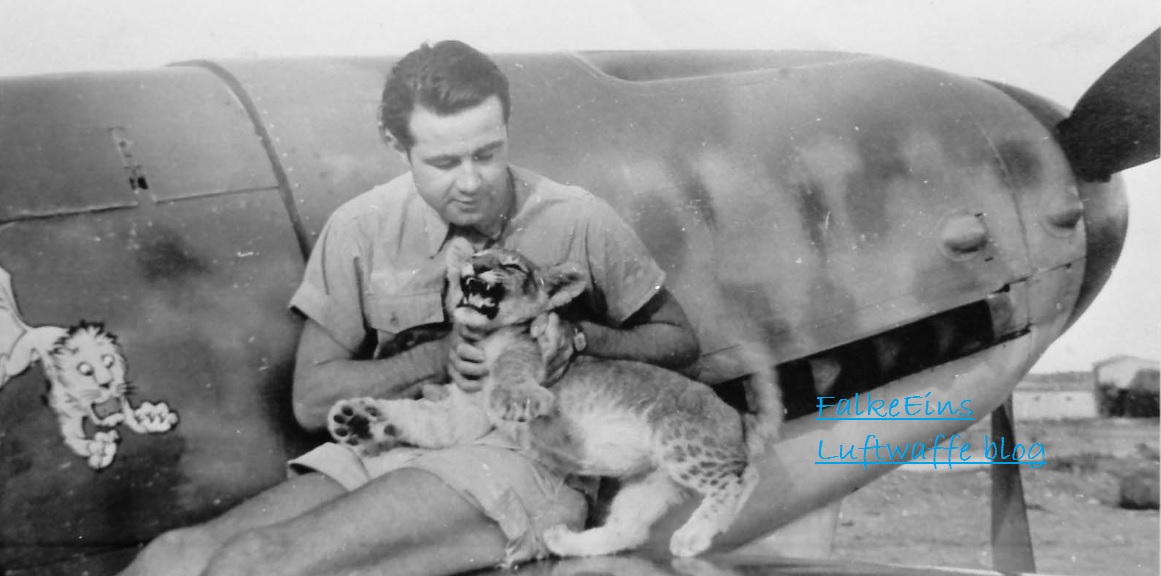
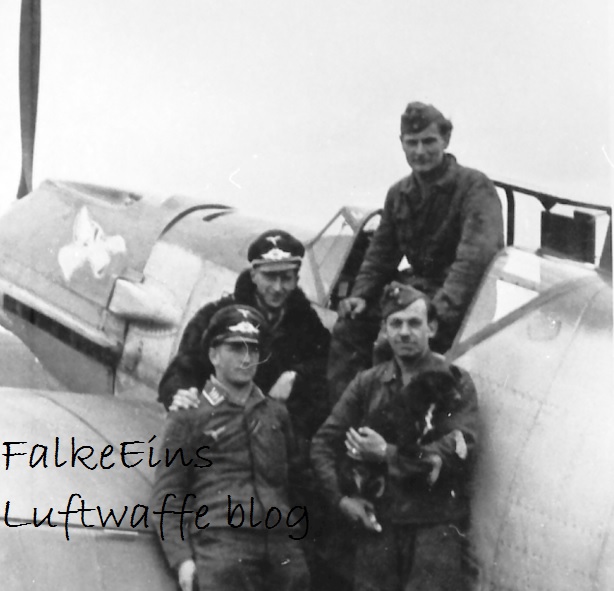
Yet more Luftwaffe pets .....Oblt. Georg Schirmböck, 4./JG 77, Hptm. Alexander von Winterfeldt, 3./JG 2


 Oblt. Georg Schirmböck joined the Luftwaffe at the end of 1936. In 1939 he was posted to II./ JG 77 (5./JG 77 and 4./JG 77). In May 1941 he flew as Stafü of 5./JG 77 before moving to the Stab. Seen here in France, the Emil appears to have the 4. Staffel 'Sensenmann'  -  death riding the scythe - emblem under the cockpit. Schirmböck survived the war, credited with 3 vics ..


'fliegende Holzschuh' emblem on the yellow cowl of this 7./JG 54 Emil


Bundesarchiv caption reads ;

"..Sowjetunion-Mitte.- Ritterkreuzträger Heinz Frank (links) mit Hund auf seinem Flugzeug Messerschmitt Me 109.."


Sowjetunion-Nord (Eismeer).- Hauptmann Horst Carganico (mit Ritterkreuz) vor Jagdflugzeug Messerschmitt Bf 109; Hund (Schnauzer auf dem Flugzeug); PK Luftflotte 5. During 1940 Carganico served as Adjutant to the Gkr. II./JG 77 Hentschel throughout the deployment of this Gruppe in Norway.


two more from III./JG 2;


Note the fox cub on the (unknown) pilot's shoulder. Click on this image to view in full screen!

Below; seen here on the left, Hptm. Alexander von Winterfeldt of 3./JG 2 is in discussion with fellow pilots Pflanz (dark glasses) and Strümpell following a sortie flown from Signy-le-Petit, France during May 1940. On May 20, 1940 3./JG 2 claimed eight LeO 451 bombers shot down, one being credited to Great War aviator von Winterfeldt. Staffelhund is ‘Cognac’ the terrier.


4./JG 26 Emil also in France at the end of the Westfeldzug. 


below; from the wartime publication "Schwert am Himmel" (Heinz Orlovius, 1940)


Below;  Dr Adolf Rossbach was flight surgeon with JG 53 on Sicily. He is seen here seated on Heinz Bär's I./JG 77 Bf 109 G-2 at Comiso during 1942. 


Below;  Ofw. Stefan Litjens, 4./JG 53, Sicily, in October 1942. He had been seriously injured in combat in late 1941, losing an eye. Despite his vision impairment he returned to combat and flew missions over Malta from Sicily before the unit was transferred to Tunisia. Here he claimed eight Allied aircraft shot down and flew many ground attack missions. Litjens was awarded the Ritterkreuz on 21 June 1943 for 32 victories.


Above; Oblt. Werner Gayko - Staffelkapitän 9./JG 5, Herdla, 1945 - Gayko survived the war credited with 13 victories. Born in May 1923 in Wehlau (East Prussia) he arrived in Petsamo at III./JG 5 during the autumn of 1943. Appointed Staffelkapitän 9./JG 5 during 1944 he led the Staffel through until the end of the war and is mentioned on numerous occasions in Girbig's history of the unit. During February 1945 he was shot down off the coast of Norway, ditching his Fw 190 before being eventually rescued by Norwegian fishermen. Postwar he joined the Bundeswehr, retiring in 1982. He passed away in October 1994.


Also on this blog; 

 more Luftwaffe pets!

Friday, 16 September 2022

September 15 'Battle of Britain' day - the German fighter pilots and the 'myth'


Living in the shadow of the 'Battle of Britain' memorial to the 'Few' at Capel-le-Ferne on the white cliffs between Folkestone and Dover with the sound of Merlin engines almost constantly overhead at certain times of the year, I am reminded that 'Battle of Britain Day' (as September 15 is known in the UK)  has come and gone once again. 

According to some, the Luftwaffe was 'ill-prepared' for the fight over England. One fact not often acknowledged here, is the 'mauling' and subsequent losses that the Luftwaffe had sustained over France, so that the Luftwaffe's early forays over England in late July 1940 amounted to no more than an attempt to exert some 'political' pressure on those who might have been prepared to sue for peace in the UK. Göring's losses over France amounted to over 1,000 aircraft and trained crews according to which source you care to read.

(The latest 'official' score for 'la chasse' - the French fighter arm- according to the Service Historique de la Défense or SHD is around 650 Luftwaffe aircraft shot down during the Westfeldzug or 'campaign in the West'. Aircrew losses may have been as high as 3,000 men according to some sources. Infrastructure along the Channel coast had largely been wrecked. Hence the two month 'pause' before setting out to subdue England in earnest).

By mid-September the Luftwaffe could in theory claimed to have won the Battle - at least 'statistically’. However, men and machines were being worn down relentlessly, while the numbers of carefully husbanded RAF fighters were increasing. Losses on the scale being sustained by the Luftwaffe risked jeopardizing the planned assault on the Soviet Union. Hitler was probably already looking to 'shut-down' operations over the UK. But until the British government surrendered – an unlikely scenario- the Luftwaffe continued to lose men and machines to little purpose. As the summer wore on these factors all contributed to mounting cases of what was becoming termed Kanalkrankheit – Channel Sickness – better known now as combat fatigue. As Ulrich Steinhilper noted;

“Although most of us were still not outwardly showing major signs of nerves, by late August arguments were becoming more frequent, tempers frayed quicker…The strain of unrelenting front-line flying was beginning to show.”

And it was during September that the Luftwaffe turned its attentions towards London. This change of tactic played into the hands of the defenders - the RAF was able to concentrate its defensive force around the capital while the Bf 109s' limited endurance was again a factor. On September 7, the first day of raids on London, the Germans overwhelmed the defences. Fighter Command lost 33 aircraft. On the German side, a dozen bombers were lost as well as 15 Bf 109s and 10 Bf 110s. On the 8th, the Luftwaffe could not repeat its previous day's effort and the RAF had a breathing space. On the 9th, orders were given to bomb the capital by day and by night. Two major raids took place in the afternoon, but here the Luftwaffe could no longer saturate the defence - the '1000' bombers of the official history were never more than 400 and on only two dates could the Luftwaffe put more than 300 in the air. On September 9, some 23 RAF fighters were downed by Bf 109s. The Staffelkapitän 4./JG 53 Oblt.Günther Schulze-Blanck who had led the Staffel during August was killed in a dogfight over Hastings. He had returned six victories. His body washed up on a French beach some two weeks later.

There was by now perhaps, a growing realization that the fighter pilots had been assigned an impossible task. Equipping one third of the fighter force with bombs served little purpose. Lt. Jules Meimberg of 4./JG 2;

“..It was not until today that I grasped just how big a city London is. Brussels, Paris, even Berlin are tiny in comparison. What sort of effect could we hope to achieve with a few hundred bombs on a metropolis like this, aside from inflicting a few scratches..?”
 
On September 11, the fighting was particularly costly with the Luftwaffe claiming 67 fighters, while RAF Fighter Command claimed 89 German aircraft. Actual losses however amounted to 30 RAF fighters and 27 Luftwaffe machines - 11 bombers, 8 Bf 110s and about 8 Bf 109s including the machine flown by a certain Fhr. Hans-Joachim Marseille (1./LG 2) who managed to return to Wissant to crash-land his machine, 75% destroyed.

On September 15, the weather cleared and the Luftwaffe prepared for their “Final Blow” against England. This was to be the test of strength for Göring’s Luftwaffe and Dowding’s refreshed and reinforced Fighter Command. During the day’s prolonged and bitter fighting the Luftwaffe would lose 6% of their committed forces - 57 aircraft - their highest percentage loss rate during the entire Battle. Fighter Command’s losses were half of those on the German side, i.e. the rates of the Adlertag of 13 August. For the OKW, it now appeared that in major offensives, the RAF was always able to pull out the stops. Many more weeks would be required to destroy the RAF, a realisation that led to another review of tactics - attacks on airfields and factories with bomb-carrying Me 109 Jabos became more frequent. This 'Jabo' offensive - while far from decisive - was a much more effective use of the Luftwaffe fighters than the hated bomber escort duties. On October 5, for example, waves of Messerschmitt 109s (possibly as many as one hundred fighters), of which around thirty were toting ordnance, headed for Southampton and London. Fighter Command was no longer to be directed exclusively against German bombers - the Spitfires and Hurricanes were free to engage the Messerschmitts. But for the RAF, it did not necessarily have to 'win' the battle - simply not 'lose' it.. Ulrich Steinhilper, on the other hand, shot down over England at the end of October, was mentally and physically at the end of his tether.

“There is no doubt in my mind,” he says, “that the RAF broke the back and the spirit of the Luftwaffe during the Battle of Britain.”.

And on the basis that you don't always know that something is there unless you are reminded of it occasionally here is a piece on this blog published by the UK's 'Guardian' newspaper back in the year 2000 which discusses the German view of the 'Battle of Britain'..

Sunday, 11 September 2022

Fhj.-Fw Gerhard Querengässer, 8./JG 2


Another 'unknown' ace of JG 2 was Gerhard Querengässer who perhaps typified the 'Nachwuchs' of young pilots facing the Allied onslaught in the West leading up to D-Day. He was born 28 September 1921 in Weissen, a small locality near the town of Rudolstadt in Thuringia and his 80th birthday was marked by Jägerblatt in their issue of 5/2001. Having interrupted higher education to enlist in 1940 he arrived in late 1942 at Beaumont-le-roger via the Ergänzungsgruppe in Mont-de-Marsan. He flew as wingman to Eder, then later to Stratmann and Kabbe when 12. Staffel was re-designated 8.Staffel.

His first victory was a B-17 (e.V.) on 30 July, 1943. His second was a P-51 claimed in the Guingamp/Alencon area on 11 July, 1944.

Querengässer twice sustained injuries during 1944. On 23 April 1944 his Gustav collided with the G-6 flown by Oberfähnrich  Gert Pudnowski over Creil (north of Paris) as II. Gruppe was scrambled. With his wing torn off in the collision Querengässer was able to bail out with head injuries while his East Prussian comrade Pudnowski was killed. On 26 June over the Normandy Invasionsfront Querengässer was brought down by German anti-aircraft fire in the vicinity of  Goussainville/Chantilly but pulled off a  gear-up Notlandung. Just a month later he claimed his third victory shooting down an Auster spotter on 26 July in the vicinity of Caen.

 His 4th was a P-47 at Monschau on 17 December, 1944. A 5th, a P-38 west of Wetzlar on 25 December, 1944.

With five victories to his credit, Fahnenjunker Feldwebel Querengässer was very much an 'old hare' by the time of the 1945 New Year's Day Bodenplatte raids on Allied airfields. Leading a Schwarm of 8./JG 2 from Nidda in an attack against St. Trond in eastern Belgium Querengässer flew firing passes against P-47s of the 404th FG  being refuelled on the southern side of the airfield but was forced to break off after being chased by Mustangs, escaping at low level.

Fhj.-Fw Gerd Querengässer of III./JG 2 with comrades seen (left) on the wing of his G-6 ‘Kanonenboot’ in late 1944. Pilot seated right is Uffz. Reinhold.


Querengässer survived the war and returned to Rudolstadt 'behind the curtain' in the new post-war DDR.

also on this blog;


Thursday, 3 February 2022

Fw 190 A-6 2./JG 2 Lt Detlef Großfuß


During the first half of 1943 2./JG 2 based in northern France at Triqueville found itself in almost constant action facing up to Allied incursions. Losses were heavy -  in May and June, the Staffel lost 7 pilots (6 killed and seriously injured) for "only" two victories. On the afternoon of 15 May 1943 Staffelführer Hannig was downed by Spitfires after claiming his 98th. The new Kapitän was Oblt. Karl Haberland, returning to the front after a serious injury received with JG 3 on May 17, 1940. Shortly afterwards the Staffel moved to Tours to be trained as night fighters and in August the pilots received the Blindflug Schein III. On August 9, 2./JG 2 were airborne on their first night interception sortie but as Ofw. Josef Bigge wrote, "..the radio and navigation communication worked perfectly but, although I flew about for 45 minutes, I could not locate the enemy. I landed at 1:20." 

 One of the 'best' pilots of 2./JG 2 was Lt. Detlef Grossfuss. Of the 19 night victories claimed by 2./JG 2 before the end of the year (11 Halifax, 5 Lancasters, 1 Stirling, 1 B-17 and 1 unidentified four-engined aircraft) no fewer than 7 fell to the guns of Grossfuss.

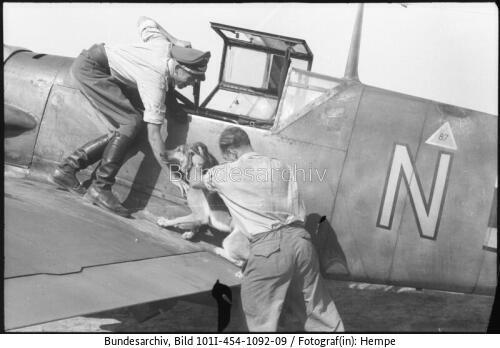
Below; Großfuß with EK I and 'black 13' repainted in 76 overall for 2./JG 2 night sorties, northern France summer 1943. 

Bundesarchiv caption   "..Frankreich.- Pilot Detlef Grossfuss mit Orden (Eisernes Kreuz) vor Flugzeug Focke-Wulf Fw-190 A-6 2./JG 2 stehend, auf der Tragfläche ein Hund; Luftflotte 3..."


Also on this blog;

'Black 14' from 2./JG 2 in overall hell-blau-grau 76 finish 


More on 2./JG 2 during the spring of 1943 under the one-legged Oblt. Karl Haberland on this blog at the link below

http://falkeeins.blogspot.co.uk/2017/01/2jg-2-richthofen-oblt-karl-haberland-fw.html