Showing posts with label My book reviews. Show all posts

Wednesday, 17 December 2025

new Luftwaffe books - JfV 16/I, 'Flieger Asse' and 'Foto Archiv' from Geramond, 'Das Lehrgeschwader 1' Start Verlag


The latest (huge) volume in Rogge Buchverlag's Jagdfliegerverbände series (JfV)  - Teil 16/I - has recently landed! This is the first volume of the Prien team's coverage of 1945- entitled 'Einsatz an allen Fronten 1945' this is a no doubt comprehensive account of the Luftwaffe's fighter force during the first three months of 1945. Although it is almost impossible to 'read' and 'review' and do a meaningful write-up, if you have any interest in the late-war Luftwaffe at all, then you will know to add this to your library. A friend told me he made a decision years ago not to collect this series given his lack of room at home - now some 30-odd volumes later with space on bookshelves shrinking- there are just two more volumes to come. 

Teil 16 Teilband I is a daily chronicle of January-March 1945 covering all Luftwaffe Tagjagd day fighter units in action on both East and West fronts (including Norway) detailed over some 650 pages -  Tagjagdverbände of the Lw.- Kdo. West, Luftflotte Reich (including JG 7 and JG 400) and Luftflotten 1, 6 and 4 covering JGs 51,52 and 54 as well as L.fl 5 (Norwegen). On 1 January 1945 the Luftwaffe still had around 2,200 fighters in service, of which approx 1,500 were listed as serviceable, while there were nearly 3,000 pilots trained and available to man them. Of these organisations Lw.-Kdo West could field over 800 fighters even after the heavy losses of late December 1944 attempting to cover the Ardennes offensive - some 56% of the entire force. Luftflotte Reich comprising mostly JG 300 and JG 301 along with the jet and rocket fighters had at least 300 operational machines, while just 15% of the Luftwaffe's fighter force - barely 300 fighters -were based on the Eastern Front covering a huge area from Courland in the north to Hungary in the south. Lfl 5 had over 100 fighters available. It was proposed to 'bulk' up each Geschwader with a V. Gruppe made up of the EJG auxiliary training unit resources but this did not take place.

While the authors have managed to assemble nearly 300 photo images to illustrate this volume, other scarce 'material' also features. For example, the RLM-Abschussfilme - that had enabled a more or less comprehensive compilation of victory claims in previous volumes -  are non-existent for 1945, with only material for JGs 26 and 27 available to compensate for the lack of films. The authors point out that although there may still be 'gaps' in the claims lists - data for the area covered by Luftflotte 4 in early January is described as 'fragmentary' -  much of what has previously been published has been fully revised and augmented; where this has been done it is footnoted - there are well over 3,000 of these to complement the text! The day-by-day chronicle of the activities of the individual Gruppen is compiled from a host of disparate war diaries (eg KTB Lfl.6), Luftlageberichte, flight logs, strength and loss returns (GQM Verlustmeldungen) and reports, along with ULTRA intercepts; eg an ULTRA report dated 4 January 1945 details that II. and IV. Gruppen of EJG 1 were ordered to send four pilots with at least 10 hours on the Bf 109 to Brandenburg-Briest and Parchim to act as 'targets' for the Me 262s of I and III./JG 7. Details of aircraft abandoned, sabotaged and written off as airfields were evacuated are almost completely absent from German records. Fighter production (including repair) and deliveries (by unit) are covered for all types, including the new variants of the Fw 190 - the D-11 and D-13. There are images and details of a G-6 prototype fitted with wing-mounted Mk 108 cannon (also seen recently on-line from the Petrick archive) and a brutal assessment of the He 162 - it may have been built with non-strategic materials and only used one jet engine, but it could not be flown like any 'conventional' fighter and it consequently killed far more of its own pilots than it did the enemies'. Deliveries for all fighter types in the period covered by this volume amounted to some 6,600 aircraft. With the works at Sorau falling to the Soviets on 13 February 1945 the total of Ta 152s actually built and delivered amounted to just 48 machines of which at least 14 were destroyed on the ground during a strafing attack on Neuhausen, near Cottbus, on 16 January 1945.

The text opens with a statistical reassessment of the 'Bodenplatte' attacks on Allied airfields in the West - over 900 Luftwaffe aircraft took part (perhaps as many as 1,035 according to the OKW KTB). At least 750 of these were fighters. Losses were horrendous - as many as 214 pilots KIA or taken captive, 267 aircraft lost and a further 112 damaged for some 500 Allied aircraft destroyed on the ground. Is it worth pointing out that few of these new Luftwaffe pilots stood no chance of inflicting comparable losses in the air?  And contrary to common belief only a very small percentage of those German aircraft shot down fell to their own anti-aircraft fire. But few Allied airmen were killed while their machines could soon be replaced so the entire enterprise was a 'Fehlschlag'. Countless lives might have been saved had the Luftwaffe fighter forces simply been disbanded at this stage of the war. Since Normandy, air warfare had increasingly turned into a "Materialschlacht". As a postscript (p643-646) a fascinating Lfl.Kdo 6 document considers the pros and cons of a 'Bodenplatte Ost' fighter attack on Eastern Front airfields ahead of the Soviet onslaught about to be launched from the bridgeheads north of Warsaw, but was rejected for the same reasons that nullified the effort in the West at such cost.. 

During early January poor weather in the East saw most activity over the area of Lfl. 4 (Hungary) with II./JG 51 and II./JG 52 active to the north-west of Budapest while on the Western front huge 8th USAAF raids continued virtually unopposed.  Losses continued to accumulate even where no combat  was flown - poor weather, inadequate training levels, rough field strips, Soviet ground fire etc could  bring down as many German Jagdflieger as enemy fighters! While aware of preparations in the East for the forthcoming Soviet onslaught, details of the paltry fuel stocks from the Luftflotten KTBs this early in the year make it clear that this factor alone would hamper any prospect of decisive or effective 'resistance'. 

Elsewhere as the Soviets tank divisions started to roll through the so-called Generalgouvernement (former Poland) from 12 January some western-based fighter units began their move to the Eastern Front ( eg JG 77 on 17 January). III./JG 51 was particularly active over East Prussian airspace. At this time orders were transmitted to 'remove' one Gruppe from each JG and to convert them to so-called 'Ruhe- or 'rest' -Gruppen' to create a 'ready reserve' to be maintained at full strength, but by early March 1945 shortages both of personnel and fuel led to numerous unit disbandments. One of these was IV./JG 301, a new fighter unit that in actual fact only flew one combat mission in the defence of the Reich (02 March) losing 14 aircraft. Some 130 of the best pilots in the disbanded Gruppen went to the jet units JG 7 and KG (J) 54 for re-training. The huge US 8th AF raid carried out on 02 March was virtually the last 8th USAF bombing raid that was defended by the Jagdwaffe over the Reich - henceforward most of their efforts would be spent countering the Allied Tactical Air forces..

In the East by mid-March the Soviets were just 15 miles or so south of Danzig and despite the poor weather the Luftwaffe was facing literally thousands of Soviet fighter and bomber incursions - 2,100 in the area of Lfl. 6 and around 1,150 in the area of Lw.Kdo Ostpreussen during 9 March alone, to take one day by way of example. To counter, the KTB of Lfl. 6 mentions just 172 fighter sorties for 26 victory claims in addition to 116 Schlachtflieger sorties. There were also over 50 recce sorties flown. There were in all probability attempting to establish where the front lines actually were. Some 60 sorties were flown as escort for Schlacht aircraft, as well as strafing and bombing missions in small numbers around Stettin and Kolberg. By 24 March - date of the Allied Rhine crossings - German defences in the West were totally ineffectual - not a single German fighter managed to intervene during the crossings in the vicinity of Wesel (p578). On the Allied side over 1,300 gliders and 4,600 other aircraft had been assembled.

As usual in this huge series of books there are numerous photographic highlights - despite the fact that PK images for this period are virtually non-existent. Among these are a selection of images of the Me 109 K-4s of JG 11 (from the Schalk album in the Archive of Modern Conflict) which are superb and mostly very large and very clear. Some were taken as late as mid-March on the airfield at Strausberg, east of Berlin with snow on the ground. As G.d.Jagdflieger, GenLt. Galland's visit to I./JG 300 at Borkheide on 16 January 1945 which was briefly covered in the JG 300 history (Lorant/Goyat) features on pages 110-111 with both 'new' and larger images and there is another image of 'Timo' Schenk's 'red 5''(p397).The Fw 190 'black 3' of II./JG 76 (p212) in white is unusual. The four 11./JG 3 Bf 109 K-4 images (p484-485) are 'new' as well, as are the images of the 'dump' of I. and IV./JG 51 wrecks left at Danzig-Langfuhr (p562-563) in March 1945.

The reader will be particularly impressed with Ulf Balke's maps - the first of these appears on p28 "Tagjagdverbände of Luftflotte Reich, January 1945" followed by similar maps for Lw.Kdo West, and the Eastern Front Luftflotten 6 during January 1945. These are repeated for the month of March 1945. 

With only two more books to go in the series you are unlikely to want to start collecting them all now but if - like many enthusiasts- you are particularly interested in the late-war period this is one volume you cannot miss. For ordering and a full list of contents go to the Rogge Verlag website at http://jagdgeschwader.net

Below; Ofhr Peter Esser entered the Luftwaffe in late 1942. After being trained in JG 107 and 2./EJG Ost, he joined 7./JG 77 during August 1944. During September, he was transferred to 2./JG 53, ending the war in 6./JG 52. He is seen here at Vesprem, Hungary on 18 March 1945 after an afternoon sortie during which he claimed a P-51 south-east of the airfield. Note the 'tulip' decoration on the yellow nose of this G-14..


A glimpse of a 'White 1' flown by Paul Schalk of 5./JG 11 from the latest Prien team 'Jagdfliegerverbände der Deutschen Luftwaffe Teil 16/1'. According to the caption this machine is a G-14/AS but others have identified it as an Erla-built G-10. See the latest Anders Hjortsberg artwork here

Two recent 'FlugzeugClassic' 'Extra' titles from the team behind Geramond's monthly magazine. 'Flieger Asse' ( 'Air Aces') features a selection of lengthy extracts from the published works of 296 Verlag who are now sadly defunct. I don't have all of their titles by any means so this compilation is very timely, possibly the last chance to become acquainted with some of these books which will undoubtedly become rather rare, most notably Roderich Cesscotti's (KG 30, KG 100, JG 301) memoir 'Langstreckenflug'. 'Foto Archiv' appears to be a selection of the 'Foto album' pages from the magazine 'FlugzeugClassic' there's not an awful lot of text in this one, just 100 pages of rare images from the personal albums of bomber and fighter pilots, maintenance 'black-men' and similar as previously published in the 'Foto album' pages of the monthly magazine. If you've not seen 'FlugzeugClassic' before most of these images will be new to you. My particular favourites concern Gerd Neuhaus who was a Ju 88 nightfighter pilot in NJG 4 before volunteering for II./JG 4. Both of these Geramond monographs can be purchased via amazon.co.uk for around £12 which is a bargain.


The new title from Start/Urbanke is published. "Das Lehrgeschwader 1 -  Mediterranean deployment  1941-42 in rare colour images"

 " ..Christmas came a little early this year. Thanks to my wonderful (and most importantly, partner in crime) wife, I received the long-awaited Start Verlag volume on the LG 1. It's an excellent volume, packed with beautiful colour images, accompanied by a comprehensive text, maps, and beautiful color profiles by Simon Schatz. The final section is also very interesting, with biographies of the war correspondents who took the photos, people about whom little or nothing is generally known. It would be wonderful to have a similar volume covering the years 1943-44 in the near future; who knows! Highly recommended!.."  Giampiero Piva


And a quick mention for 'Defenders of the Reich', Robert Forsyth's latest hardback for Osprey, recently reviewed by Victoria Taylor in the Daily Telegraph.

Saturday, 25 October 2025

new Luftwaffe books - AXIS WINGS Volume 3 is here!


Volume 3 of the best Luftwaffe review/journal in the market is now on sale. Thick card covers, 184 large format pages on quality paper with a host of fascinating photos, artworks and articles from acknowledged Luftwaffe experts, attractively designed and laid out by Mark Nelson, who has his own Battle of Britain Me 109 feature in this issue. I won't list all the contents as I'm slowly working my way through the publication but some highlights;

-Tim Oliver presents a detailed biography over 20 pages of Hs 129 pilot Franz Birnbaum.

-Nick Beale with a diary record of a Ju 87 Nachtschlachter crew during the last months of the war on the Eastern Front.

-Chris Goss on KG 2 Me 410 ops over England.

-Sven Carlsen looks at KG 1 He 177s on the Eastern Front.

There are 12 lengthy articles in total plus 'Photo album', 'Reader feedback' and 'Axis library book review' pages. I'm looking forward to reading the Reggiane RE. 2000 feature (Mikael Olrog) - lets have more Italian fighters please, say, the G.50 in Finnish service, CR. 42 etc etc. For modellers planning to build a He 111 you need to read Alexander Steenbeck's feature on He 111 paint schemes.. The more 'technical' features in this issue cover anti-shipping radar (Martin Streetly and Andrey Kuznetsov) and Fw 190 high altitude fighters (Dietmar Hermann) while there is a comprehensive account by the editor of the activities of the 'Enemy Aircraft Servicing and Storage Unit' during 1945-46 which details a whole raft of flights and transfers undertaken by Luftwaffe aircraft - in particular of the 66 Ju 52s - that were flown to the UK after the war!

Given the amount of 'content' in Axis Wings it is excellent value and a 'must-have' for Luftwaffe enthusiasts. The text is always interesting, the photos of high quality and reproduced large, and the articles feature excellent maps, diagrams, Flugbuch and document extracts where appropriate with lots of informative captions. The colour profiles are superlative and feature 'cutaway' views of fuselage/cockpit area details where these would otherwise be obscured by wings/engines. Issue No. 4 of Axis Wings is in preparation. Issues 1-3 are still available via the Chandos website, following a limited reprint of Volume 1 along with a 'bundle' offer for all three.

To quote my friend Mike, this series is becoming a great source of knowledge for those of us that don't know everything already.

Don't miss them!


Go directly to the Chandos Publications website here


Friday, 24 October 2025

new Luftwaffe books - Claes Sundin Luftwaffe fighters Profile book No. 15


New from Claes Sundin - Luftwaffe fighter aircraft Profile book No. 15

A limited-edition 'special'  (only 200 copies printed) which brings together all of the Eastern Front profile artworks produced by Claes to his best standards including some 30 brand new profile subjects prepared especially for this volume. This comprehensive collection of German fighter aircraft from the Eastern Front - some 230 machines illustrated including new Doras and KG(J) machines - will provide readers with an understanding and appreciation of how Luftwaffe fighter pilots - not necessarily all decorated aces by any means - responded to the evolution of aerial combat during the period 1941–1945, from the early days of Operation Barbarossa to the unconditional surrender in May 1945. Notes on colours and camo application for individual aircraft written by David E. Brown. Claes intends to produce similar limited editions in the future devoted to particular theatres and operations such as 'Fighters defending the West' or 'Luftwaffe fighters in the Mediterranean theatre' etc. The book is produced to the same landscape format as previous titles, presenting one profile per page, after an introductory text. As usual all the artworks are created after careful study of all available photographic evidence.

" ..Once again, Claes returns with a superb book. But this time, it's also larger in size, making it even more superb. Magnificent profiles and longer and more interesting texts. This new book dedicated to the Eastern Front should be the start of a mini-series of books dedicated to the different fronts, allowing us to learn about these aircraft from a different perspective. In short, a must-have without a doubt. Always waiting for the next one. Kudos to Claes..."


Stocked by the Lela Presse bookshop in the EU. 
Or from Claes directly. Not on his Centura website. Go here


Tuesday, 7 October 2025

more Zerstörer - new Luftwaffe books

Volume 5 of the Paul Stipdonk/Michael Meyer ZG/NJG series is now published in hardback by JAPO. Click on the cover image to go to the JAPO web site for a contents listing and sample pages. Another 304-page book of Zerstörer, this volume is devoted primarily to III./ZG 26, ZG 52, V./KG 40 and ZG 76 and features around 600 photos, the majority processed by the authors from the original negatives and reproduced in high quality by JAPO. The text comprises outline histories of each individual Staffel and StaKa with loss details where known.


Vols 1-4 of this series were previewed on this blog here

A few examples of each of these volumes are still available from the authors at this link, while in the US you can still get these from ebay seller 'Luftdad'. 

 Elsewhere the current issue of "Flypast" has published a review by Andy Thomas of Book 2 of the Casemate Illustrated two-volume set on the NJG aces

And a comment from a blog reader just received;

".. Just received the night fighters book - very nicely done! Actually a few pics I have not seen before, including that He 219 pic and several others. Only criticism was on page 20 where Hajo Herrmann was listed as one of 4 KIA. Great personal accounts of mission action and using Claes Sundin as the profile artist is top notch... "

Monday, 28 July 2025

Walter Waiss seven-volume history of KG 27 Boelcke (Helios)


German publisher Helios are another niche publisher that have recently become defunct which may explain why Rich Carrick at Chandos was asking for 'opinions' on their Walter Waiss KG 27 book series (seven volumes!)  with a view to possibly doing some or all in English. The views of all respondents were pretty mixed  - some thought them 'exceptional', others were less keen. My own view - " I have some of the KG 27 books. They comprise a 50-60 page text section with lots of 'unknown' personal accounts, I keep meaning to post a few on my blog and a couple of hundred pages of unfortunately largely uninteresting photos showing wrecks, training group photos, well-known landmarks from the French campaign etc At best you'll get a couple of worthwhile volumes out of them I'd imagine..."

Note the random page views that follow are taken from Volume VI covering 1944 and illustrate these points - pics from Barbarossa, buildings, populace and wrecks..

Losses are laid out in large clunky tables but the text pages do feature interesting accounts..


Wednesday, 11 June 2025

"Eagle Days - Life and death for the Luftwaffe in the Battle of Britain" by Victoria Taylor - a review [edit: 27/10/25]


I've got hold of a copy of the book. I didn't really want to read it  - the publisher's dreadful 'hype' was rather off-putting, almost 'belittling' of all the authors that have gone before (in the words of one Battle of Britain expert..) and I instinctively knew that I wasn't going to like it. But I'm enjoying it - sort of. She can write. As some have pointed out, the author - Victoria Taylor - is a 'professional' historian so be warned, this is not just another re-telling of the Battle of Britain. But then nor is it what it claims to be. The first 90 pages or so cover the Westfeldzug (campaign in the West) while by page 260 the author has already moved on to cover the night 'Blitz' while chapter 15 'Dante's Inferno' takes us into 1941, R.V. Jones and X-Verfahren territory. A fairly well-trodden path. This, according to the author, is the Battle of Britain petering out on the German side, with the propaganda emphasis increasingly focusing on the forthcoming war against Bolshevism as a means of distracting attention from the failure of the Luftwaffe over England!

The publisher has made all sorts of claims for this work - revelatory, deeply researched, the Luftwaffe 'with the varnish stripped away'.. You can probably guess what's coming. 

The book according to its author is not about the 'cartoonish' Luftwaffe that we are apparently all familiar with, presumably from the movie 'The Battle of Britain' - which Taylor actually spends a couple of pages psycho-analysing. Briefly put, it would appear that nowadays we all think of the men of the Luftwaffe as being mostly 'honourable opponents' and 'worthy foes' - who suffered and died as did our own brave RAF heroes. This is largely the influence of people like Galland and movies like 'The Battle of Britain'. 

The reality - according to Taylor - is that in some instances the men of the Luftwaffe were hard-bitten Nazis, some of whom relished anti-semitic violence; '..the chivalrous fighter pilots did not cancel out the small pool of ruthless killers who already lurked in all branches of the Luftwaffe by the summer of 1940..' 

Some Luftwaffe men such as Lehweß-Litzmann  - former Kommodore of KG 3 who went over to the Soviets and held key positions in the post-war East German (DDR) state airline Interflug - flew his first sorties over England during late 1940 and had already been disgusted at the treatment meted out to Jews and civilians and not just in Poland. The author goes so far as to state that '[..] the German 'knights of the air' should not be detached from the crimes that the regime committed..' The problem here of course is that the Battle of Britain was not the 'ideological' war that characterised the fighting in the East, although according to Taylor it very much was....in fact page 325 is an account of a Luftwaffe pilot roped into a bit of mass-killing - pre-Battle of Britain. Perhaps shocking to the general reader, although apparently not a new account by any means. The 'problem' here of course is that this has little to do with the Battle of Britain as such..although the author strives hard to show us that it does.

So what is Victoria Taylor's goal in compiling this book in the way that she has?  Apparently to 'remind' us that the Luftwaffe crews were not brave 'ordinary men'  - the myth of 'just like us' - but ideologically driven and intent on furthering a tyrannical dictator's ambitions of conquest. The lengthy chapters covering the fighting in Poland, Noway and France don't so much set the stage for the Battle of Britain as ram home what 'nasty' people the German Wehrmacht actually were. 

Unfortunately for the reader looking for a 're-telling' of the Battle of Britain from the German side - which is after all what the title is selling - the author's attempts to drive home this point leads her to wander way 'off subject' in places; from medical experiments on political prisoners to the beginnings of mass murder etc etc. Taylor's book is not an 'unbiased' account of the Battle of Britain as per the title - according to Taylor the German term 'Luftschlacht um England' (lit. 'air assault against England') covers the period after France and all the way to Barbarossa. Just for good measure she includes an account from a Luftwaffe bombing raid that took place in 1944! By now the reader is starting to wonder whether the author ever managed to point out the 'distinction' to the publisher because the blurb - indeed the jacket text - quite clearly states 'Battle of Britain'. But Taylor's account only partly focuses on key engagements during the period July-September 1940 and there is, for example, no assessment of the strengths and weaknesses of the combatants for the period in question. As Ben Dunnell pointed out in his (largely complimentary) review, this is not a 'who shot down who' book - it certainly does not focus on the 'hyper-minutiae' of the battle as the author rather disparagingly puts it. But some of this 'focus' might well have seen the author avoid some of the factual errors that crop up in her account. There are lengthy digressions that take in the 'views' of the German media - heavily controlled by the Propaganda Ministry so I'm struggling to understand the value of these - and personal accounts from the home front that have little or no connection to the Battle of Britain. Thinking about the author's 'goal' in writing the book the way she did, it is evident she gives no-one on the German side the chance to present their mostly well-known (post-war) accounts or even lets those directly involved speak (for the most part) preferring period diaries and letters from interested 'bystanders'..

Victoria Taylor is a 'new' young 'professional' historian, too young to have interviewed any veterans on the German side. Some 'amateurs' have been researching and writing about the Luftwaffe and interviewing veterans for many years. Taylor - and her publisher - seem wholly unaware of some areas of research and of some of the experienced authors out there in the Luftwaffe enthusiast fraternity. How can you write a book about the Battle of Britain without referencing Erik Mombeek's history of Jagdgeschwader 2? Or quoting from Jules Meimberg's memoir? And while a few of her passages are based on Bungay and Goss, there are far more footnotes referencing those well-known Battle of Britain 'specialists' Dildy and Crickmore. None acknowledging the work of John Vasco for example. As a result her book is far too 'lop-sided'.  But then I guess you can ignore the 'historiography' of the battle if you want to focus on medical experiments carried out on Jews and prisoners for the benefit of German airmen - post-Battle of Britain! (p332-333). And 'depart' from the 'myth' of the clean Luftwaffe. The author claims at one point to have 're-written' the Luftwaffe back into the Battle of Britain, which is ludicrous. At best, 70% of this book pertains to the title, the rest is discourse to prove the point being rather clumsily made. And, as another commentator has suggested, regardless of Taylor's credentials, her book could well have been more accurately entitled 'A random essay about the early years of WWII, including brief mentions of the Battle of Britain'. In fact while the publisher would never have gone for it, many of the criticisms about Taylor's work - and there have been plenty as a quick read through some of the reviews on Amazon reveal - might easily have been deflected with this more 'accurate' title. 

Also on this blog;


Sunday, 11 May 2025

new Luftwaffe books (4) - AÉROJOURNAL HS N°50, LA KG 26 "LÖWENGESCHWADER"


Caraktere are back in action after their recent 'difficulties' - a new 'special issue' devoted to KG 26, the Luftwaffe's anti-shipping Geschwader is just published. For just 15 euros (more expensive outside the EU) this 120-page publication ( 150 photos, 20 profile artworks) written by a good friend of this blog, Bernard Roland, tells the (relatively unknown) story of the Löwengeschwader.

Contents:
- Creation of the ‘Löwengeschwader’ and the pre-war period
- From Poland to France: the time of lightning victories
- KG 26 during the Battle of Britain and the Blitz
- 1941-42: on all fronts!
- Late 1942 - Early 1944: Operations in the Mediterranean
- Facing the landings!
- The last months of the ‘Löwengeschwader'
- Conclusion and appendix


Go here to order      AÉROJOURNAL HS N°50 - LA KG 26 "LÖWENGESCHWADER"

Also on this blog;

An interview with Alexander Steenbeck, author of a comprehensive German-language history of KG 26

Wednesday, 23 April 2025

New Luftwaffe books (2) KG 40 'world in a ring' Geschwader history by Chris Goss - Chandos Publications


To quote Chris Clifford writing on 'Key Model World', "..if you've ever read anything on KG 40 chances are it was penned by Chris Goss ". From 1997's 'Bloody Biscay' to both Classic 'Sea Eagles' volume to Osprey's Fw 200 and Do 217 units, all of this KG 40 material has now been packed into a hefty new 312-page hardback from Chandos. 

This is another beautiful unit history from them - as my friend Simon put it, ' a very high quality product indeed and a standout unit history. I found the appendices worth their weight in gold alone. Author Chris Goss has detailed every single combat loss, major damage or accident in the war in intricate detail -over 1000 aircraft alone. Anyway, well done Chris and Rich - worth every little penny and then some.."

A little 'late' perhaps to be 'reviewing' this book - there are literally only a few dozen copies left of the initial 800 print run. Nearly all gone within one month of going on sale. And Chandos doesn't reprint - or at least not until a sufficient number of requests have been received to make it worth their while. (info courtesy of Chandos owner R. Carrick)

Aside from a top-notch product, you have to remember that the subject of the book, KG 40, was a particularly unique Geschwader in the history of the Luftwaffe; a maritime multi-role strike wing that flew reconnaissance, conventional and guided bombing missions along with maritime strike/fighter sorties across its FIVE Gruppen.  KG 40..

- was the only formation to operate five different types of aircraft operationally.
- was the only unit flying the Fw 200 Condor in anger - a pre-war civil airliner that should have been retired in 1942.
- was a rare unit to put the He 177 into service, a type that took three years to reach the front-line to then be withdrawn after less than one year on operations.
- deployed the Do 217 in II./KG 40 on the 'Baedeker Blitz' over the UK during 1942
- operated the Ju 88 C (and 'R') variants in the day fighter role.

Author Chris Goss writes in his postscript;

" ..there is no longer anyone alive who flew in KG 40 but it is my hope that this volume serves as a lasting tribute to the many who fought and died in this Geschwader.." Job done.


Also on this blog;


Overall  (including props, radial engine fans) blue-grey low-viz Do 217 E in II./KG 40 during 1942


Wednesday, 9 April 2025

new Luftwaffe books (1) - Zerstörergeschwader 76 - History of the German Luftwaffe unit 1939 - 1945 - edited 06/05 20h00 CET


Peter Kassak has released his new 'print-on-demand' title 

 "..I am very excited to announce that the ZG 76 book is available for ordering. Here is a short blurb: Zerstörergeschwader 76 - History of the German Luftwaffe unit 1939 - 1945 by Peter Kaššák and Marek Žatkovič. Soft cover, 414 pages (80 grams coated paper) printed in color (however, most of the photos are B/W). Maps, appendices (losses, victories, COs, bases) and 46 color profiles (sample below). Price: 60 EUR.."

 Available at lulu.com at this link

"..Zerstörergeschwader 76 had two eras of its existence. The first installment was active from the first days of WWII until 1941. A description of this very combat-active and successful episode of the unit history is published as the first part of this book. The second installment, which is a matter of the second part of this book, was active from autumn 1943 until early 1945. It has been a long time since. Many men in the unit also had active duties linked to other units, and it is hard to trace all of the facts. But what was available to us from the known sources, is compiled in the text on the following pages. We believe that this work may be considered as a decent tribute to all men of the ZG 76, and we hope it can be a starting point for other researchers in, if not broadening this work, then just bringing more information and facts about partial events involving ZG 76...


a review from Giampiero Piva

"..This month I had to decide whether to buy the Chandos KG 40 volume or Peter Kassak's ZG 76 and my choice was the latter. Let’s say right away that from a historiographical point of view it’s a magnificent work, accurate in detail and accompanied by numerous images. If we look at it from a modeller's viewpoint, I would say that the photo quality is not always the best (maybe it depends on the type of paper used) and a good number of them are in quite small format. However the color profiles are good..[..].... Considering that the authors certainly didn't start with the idea of producing a work for modellers, we're 'settled' to have in our hands one of the best texts on the history of a Luftwaffe unit published in the last 10-20 years..."


(A final word - this book is a print-on-demand service with printers on each continent (Asia, Australia, UK, France, and three locations in the USA), the delivery and postal costs are as low as possible, and the book is dispatched from the nearest location to the purchaser.)


Peter Kassak's other books via lulu.com are available here

Thursday, 10 November 2022

"To Save an Army - the Stalingrad airlift " by Robert Forsyth - new Luftwaffe book review


 Nearly eighty years ago, on 19 November 1942, the Russians launched a counter-offensive that quickly surrounded the city of Stalingrad, the objective of Hitler's summer 1942 campaign in the East. Trapped inside the resulting 'Kessel' or pocket or were some 300,000 troops of the German 6.Armee and their Allies. Hitler was determined to hold the city and 6. Armee commander Generaloberst Friedrich Paulus waited in vain for a response to his requests for 'freedom of action'. The result was a catastrophe for the Wehrmacht. Just ten weeks later  only 91,000 German troops in the pocket were still alive of which just 6,000 men returned from Soviet captivity. The encirclement force  -'Operation Uranus' - had comprised three complete Soviet armies, the 1st Guard, the 5th Tank and 21st Army. Outnumbered and poorly equipped, the Rumanian 3. Armee which held the German 6. Armee's northern flank managed to hold on for most of that first day before being shattered. The next day a second Soviet Offensive was launched to the south of Stalingrad against the Rumanian 4. Armee. which collapsed. The tips of the two Soviet pincers quickly met at Kalach-on-Don just to the west of Stalingrad sealing the ring. Immediate German preparations for a 'break-out' to the south-west towards 4. Panzerarmee were well underway when the order 'no withdrawal' arrived. To the north-east of the pocket v. Seylich-Kurzbach (CO L1. Armeekorps) had already authorised his divsions to pull back from their well-constructed winter positions.  

While the ground troops fought to 'stabilise' the front - the Russians having been alive to German preparations for withdrawal - German commanders hastily drew up plans to mount an 'airlift'. This 'operation' is the focus of this excellent new account from Robert Forsyth for Osprey. As an 'operation' the story of the airlift has never been 'properly' told in English (Kurowski's 'Luftbrücke Stalingrad' - one of his better works - has not been translated, while both Bergstrom and Hayward focus on the 'Blau' campaign in its entirety). The absence of a 'proper' account in English may be explained by - may even be the result of - viewing the airlift very much as a ‘passive’ operation: that is to say there are no ‘guns blazing’. The much-vaunted 'achievements' of the Luftwaffe fighter aces are only 'represented' at Stalingrad through the efforts of the very small 'airfield protection' unit detached from JG 3 set up at Pitomnik.

Yet, as the author explains in his introduction the story is a 'dynamic' one - the airlift at Stalingrad was played out against a backdrop of appalling weather as the clock ticked down on the poor souls trapped in the ever-shrinking 'pocket' as the airfields at Pitomnik and Gumrak were finally lost, while German commanders vied with each other in ambition, ineptitude ..and recriminations. Wolfram v. Richthofen, the commander of VIII Fliegerkorps - whose diaries and documents form the basis for this book -is particularly dismissive of the 'Sonderstab Milch'- an episode that this reviewer was largely unfamiliar with. Secretary of State GFM Milch was dispatched to Russia in mid-January to 'energise' the airlift but succeeeded only in exasperating the senior commanders - 'too many cooks' - and getting himself seriously injured in a car crash, hit by a Russian locomotive while attempting to drive across a railway line.

The story is also founded to a significant degree on the writings and letters of Martin Fiebig, the Flak general Wolfgang Pickert, the senior Luftwaffe officer in the Kessel awarded the Ritterkreuz for his support of 6.Armee, papers from the Milch Sonderstab, plus the recollections of a senior medical officer of Luftflotte 4, as well as reports prepared by field commanders such as Förster, Kühl and Willers etc. It is a story told very much from the ‘top down’ by the decision-makers rather than from unit-level up. At times they seem almost incapable of processing the magnitude and scale of the task which Hitler had blithely assigned them. Why were combat aircrat able to take off and the transports not? Because the bigger machines had to be dug out of the snowdrifts with winds blowing at 90 km/h and temperatures at -12°C!  Paulus had to dispatch a 'special-envoy' to the 'Wolfschanze' to explain, among other things that the figures for aircraft being declared 'Kesselklar' and 'Einsatzbereit' bore little relation to the numbers of machines flying into the city. Nobody seemed to realise that the daily requirements of bread alone were forty tons!

Earlier in 1942 the 'successful' resupply efforts mounted at Demyansk and Cholm had set 'dangerous precedents' (chapter 2)  and expectations for this type of 'operation'. Encircled German armies had been kept largely resupplied from the air.  But as the author describes, air transport and the resupply of far-flung armies " had become something of a blind spot in Luftwaffe operational thinking". Indeed the Luftwaffe's transport force had no autonomous command and no functional or operational infrastructure. It was an indication of how ill-prepared the Luftwaffe was for war that, in order to optimise usage, the Junkers Ju 52 served both in the air transport and bomber pilot training roles. Blitzkrieg meant short rapid offensives but as the Wehrmacht's campaigns became more drawn out and the Germans suffered their first reverses "the transport side of the system began to break down.." as the allocation of transports to the various Luftflotten became insufficient for the demands placed upon them. To some, the efforts of He 111 bomber crews in dropping containers of bread at Demyansk and Cholm had taken on the appearance of an 'humanitarian relief effort' rather than demonstrating any serious air transport capability. The fact is the Ju 52 transport force did not have enough stowage capacity and was under immense strain - elsewhere the Germans in North Africa were just a few months away from capitulation because of logistics.. Indeed production of the Ju 52 had been cut right back in favour of the development of newer types just at the wrong time- pressing Heinkel bombers into service as transports might boost the numbers of aircraft committed to an operation but not necessarily its effectiveness. Similarly the author makes the point that without their own command even the higest-ranking transport officers were merely the recipient of orders from elsewhere and rarely consulted as to the feasibility of large scale transport operations.

The same scenario was played out over Stalingrad. The aim was to keep 6. Armee functioning as a fighting force - some 500 tons of rations and ammunition were required each day as a minimum.  It was a hopeless task and the Luftwaffe failed disastrously. Even had they succeeded and ever come close to the '500 tons' the author doubts whether the outcome would have been any different. Aircraft were dug up from all sorts of commands and sent east in a completely ad-hoc fashion. In addition to the Ju 52s and He 111 bombers, random types - including training school Ju 86s - were pressed into service as makeshift 'transports'. Major Willers, CO of the adhoc Fw 200 unit detached from KG 40, wrote;

" ..working on the aircraft in snowstorms without any protection was hopeless. On several occasions we had to use the heater carts to thaw out the mechanics who had become frozen to the aircraft with their wrenches in their hands...[..].. it was an extreme process of acclimatisation to go from 20°C in Bordeaux to -30°C in Stalino and Zaporozhye.."

According to the author the Condors were relatively effective at Stalingrad. Used to ranging out over the Atlantic, their crews were skilled in flying and navigating in poor weather and even when over-loaded the competence of the crews in alighting the heavy machines on the snow reduced the potential for damage, despite the fragility of the Condor's landing gear. Ultimately though there were only eighteen of them and Stalino - 500 km from Stalingrad - had no hangars or other infrastructure to accomodate them.

While the Condors were large - the type was essentially a pre-war civil airliner - the Luftwaffe in desperation deployed even larger aircraft. The biggest machine in the Luftwaffe's inventory was the Junkers Ju 290 V1 - an untried type with a wingspan some four metres greater than that of the Fw 200 Condor, capable in theory of flying in ten tons of rations and flying out some 80 wounded men. The Ju 290 was flown into Stalino by Junkers test pilot Flugkapitän Walter Hänig on 28 December. Other 'giants' sent from Germany included some of the most unreliable, accident-prone and downright dangerous aircraft ever conceived by German engineering. Developed as a new-generation strategic bomber with coupled engines, the Heinkel He 177 had been flying - and catching fire and crashing - since 1939. At one point during 1942 there was only one prototype left flying. The first He 177 bomber Gruppe I./FKG 50 (Fernkampf Geschwader) had already declared the type unfit for operations. In Stalino, Willers decribed the type as 'a marvel of technology but it couldn't fly..'

On the ground in the city, rations became increasingly scanty and ammunition scarce. Meanwhile the harsh winter weather was becoming increasingly bitter with heavy snowfalls hampering any movement and many German soldiers continuing to suffer horrendously with wholly indequate equipment and clothing as Adelbert Holl relates in his memoir 'Als Infanterist in Stalingrad'. On the 'best' day of the airlift - 19 December - 147 aircraft flew in barely 230 tonnes. Sausages from horse meat were available but would soon have to be eaten raw. By 27 December a lack of fodder meant that the Futtermeister were slaughtering even the strongest horses. At night supplies were dropped in canisters, but the Russians lit the same beacons as the Germans and most fell in between the lines, always a heavy blow for troops. While news of 'relief' efforts gave new impetus, it snowed heavily thoughout the day on 24 December which those on the ground recognised would surely impede any efforts. Following the fall of Pitomnik, a rag-tag collection of aircrews and aircraft mounted sorties into the much smaller field at Gumrak, although Soviet decoy operations lured many aircraft to their doom. Of course the flights into the pocket were hazardous for the crews. More harrowing perhaps were the scenes that greeted them at the airfields. He 111s of III./KG 55 flew their first sortie into the pocket on 12 January - as the makeshift transports landed, ragged, ghostly figures appeared out of the gloom, stumbling towards the aircraft, desperate either for food or to board the aircraft. As the hatches opened men were kicked or punched away by the crews as the supplies were quickly thrown out into the snow. Shots were fired into the air in an effort to maintain order. Uffz. Michael Deiml, a flight engineer remembered his 198th sortie;

"..although our aircraft had been seriously damaged on the way in - the tail and rear fuselage had been holed by some fifty AA shells - the machine could still fly! The machine was not a transport but a bomber with bomb bays and supplementary fuel tanks in the interior and we could only fly out eight passengers.."

13 January was a disastrous day for the airlift. Soviet aircraft destroyed 29 aircraft on the ground at Pitomnik. Flugkapitän Hänig attempted to get airborne from the field on the return leg of his second supply flight but as the heavy Ju 290 climbed out of the pocket at 00:45 the aircraft reared up - the cockpit having probably taken a direct hit - and crashed back down into the snow, killing the majority of the 75 wounded aboard, along with the crew. A second Ju 290 sent to Stalingrad made its one and only return flight on the same date - the big aircraft proved to be easy prey for Soviet fighters. The experienced pilot, Maj. Hugo Wiskandt, Staffelkapitän of 1./ KG. z.b.V. 172, managed to return the aircraft to Stalino with no fewer than 123 impacts, ending the type's attempts to supply Stalingrad. (Only four Ju 290s were constructed during the first quarter of 1943). Elsewhere the He 177s made their 'inauspicious' debut in the airlift, carrying too small a load and consuming huge amounts of fuel. Of the 30 He 177s that had flown into Zaporozhye-Süd, ten quickly went unserviceable. Fiebig wrote;

" This type of aircraft does not accomplish anything. They only dropped eight 250 kg containers ..[..] consuming 4,000 litres of fuel for their mission..

Nor could they land because of the risk of being immobilised in the pocket. The Kommandeur, Maj. Kurt Schede, failed to return from his first mission, flown on 16 January. Similarly, plans to use towed gliders to fly in supplies - the Me 321 Gigant could haul 21 tons - were quickly abandoned as being impractical, especially as there were no suitable towing aircraft available.

At Stalingrad the Luftwaffe "had been assigned a gargantuan, draining, horrific,..[..].. infernal task." While most sources differ here, the Luftwaffe lost very nearly 500 aircraft attempting to keep 6. Armee supplied in Stalingrad, virtually five entire Geschwader, along with 1,000 experienced flying personnel. Towards the end of the airlift, the condition of the surviving troops in the pocket was so poor that supplies dropped were not being picked up. The average daily supply drop was always at least 200 tons below the subsistence level to keep 6.Armee functioning. From disrupted flight training back in the Reich to a virtual pause in the war against Allied shipping in the Bay of Biscay, the failure of the airlift had an impact that was felt far beyond Stalingrad. Citino wrote that the Wehrmacht had 'broken itself' at Stalingrad. The abandonment of 6.Armee had a devastating impact on national morale. And the author makes the point that no 'lessons' were learnt either. The Luftwaffe's Transporter would continue to fly resupply missions into 'fortresses', albeit small-scale - the Crimea, encircled cities in East Prussia, ports on the French Atlantic coast - until May 1945.

"To Save an Army - the Stalingrad airlift " by Robert Forsyth is published today, 10 November, by Osprey. Thanks to Elle at Osprey for an advance copy.  'Aeroplane' magazine's 'Book of the month'.


Also on this blog; 


 Adelbert Holl's memoir 'Als Infanterist in Stalingrad' is still available in translation by this blog writer from Leaping Horseman Books...


Below; rare images probably at Pitomnik airfield during the Stalingrad airlift operations, December 1942. (source, expired ebay auctions) "To save an army" features 60 rare photos and profile artworks..


Wednesday, 26 January 2022

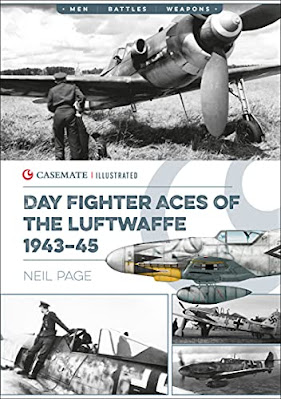
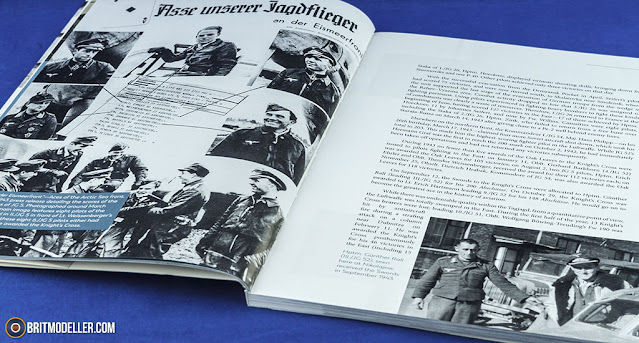
" Day fighter Aces of the Luftwaffe 1943-45 " and "Luftwaffe Victory Markings" - Casemate Publishing


" As an Osprey book addict, I was quite impressed with this volume. The focus is less on detailed encyclopedic knowledge and more on interesting anecdotes and rare insights into the world of the late luftwaffe. There are excerpts from memoirs long out of print and never printed in English, which are, to my knowledge, impossible to find anywhere else. I enjoyed the small handful of beautifully illustrated aircraft profiles and the attendant descriptions of the stories behind the aircraft.

As someone who collects books of this type, I'd say this is one of the best. A volume I return to again and again. Do get the printed version instead of the kindle version though. With the best will in the world, the formatting of this book does *not* lend itself to a kindle's screen, and you will just get frustrated with it..."

Review by Wolfgang Mercer
 

Go to Britmodeller's review pages for a comprehensive look at both "Day fighter Aces of the Luftwaffe" volumes. Coverage on those units not covered by Osprey - JG 4, JG 11, JG 77 and JG 300...  


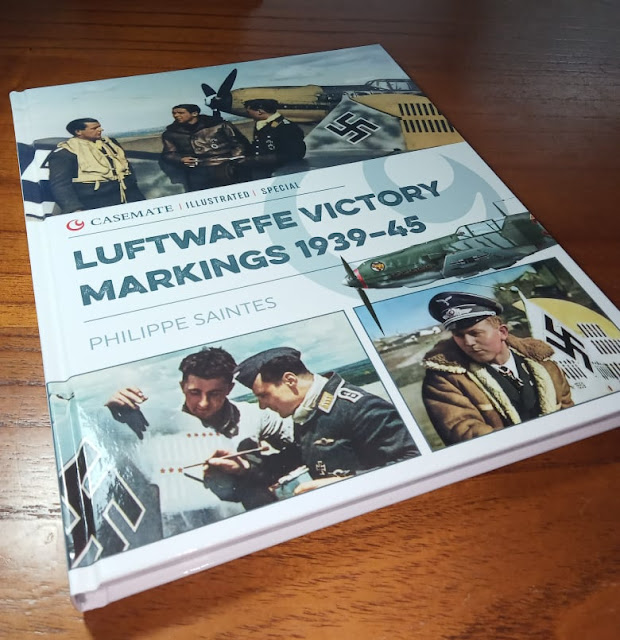
New from Casemate for January 2022  - " Luftwaffe Victory Markings 1939-45 "

• Detailed overview of how Luftwaffe pilots recorded their victories on their aircraft.
• Packed with nearly 200 photos and detailed artworks over 192 large-format glossy pages
• Great resource for modelers. 

This new book by noted Luftwaffe writer Philippe Saintes (author of the two volume history of JG 54 published by Lela Presse) provides an overview of the victory markings painted on the fins and rudders of a selection of notable German day fighter and night fighter aces between 1939 and 1945 and demonstrates how these were applied and how each individual aircraft tailfin or rudder tells a unique story. Features some of the most emblematic fighter pilots of the Luftwaffe and their aircraft, such as Wilhelm Balthasar, Joachim Müncheberg, Kurt "Kuddel” Ubben, Felix-Maria Brandis, "Fiffi" Stahlschmidt and Nachtjagd aces Martin Drewes, Egmont zur Lippe-Weissenfeld and Ludwig Meister.


Monday, 5 September 2016

Luftwaffe book review; 'The Junkers Ju 52 Story' by Jan Forsgren (Fonthill Media, 2016)


Although indelibly associated with Lufthansa and the Luftwaffe, the Junkers Ju 52 served in numerous air forces worldwide for several decades, so there are many books (more than twenty) dedicated to various aspects of its history. This new book by Jan Forsgren and published by Fonthill Media provides a competent and wide-ranging general history along with possibly unique and detailed coverage of foreign civilian and military use, foreign production and preserved aircraft. Read more below..


Jan Forsgren’s ‘The Junkers Ju 52 Story’ provides a thoroughly comprehensive general history and overview of the Ju 52/3m from its first flight flight in 1930 as a single-engined transport for small freight carriers up to the present day as ‘film star’ and museum exhibit.

The last of Hugo Junkers corrugated metal-skinned types the rugged 'Tante Ju' could trace its origins back to the Junkers J1 attack aircraft of WWI and the revolutionary Junkers F.13 single-engined low-winged transport that first flew in 1919; the genesis of modern air transport.

Most though will know it as the mainstay of the Luftwaffe transport fleet during WWII, but as Jan Forsgren points out in this new 256-page hardback history of the type the Ju 52 actually served far longer with the French Armée de l’Air as the AAC 1 Toucan. And while most will be familiar with the Ju 52 from the opening scenes of the 1968 classic WWII adventure movie 'Where Eagles Dare' that particular ‘film star’ was a Swiss Air Force machine delivered in 1939 and not retired until 1982! ‘The Junkers Ju 52 Story’ takes us to all five Continents with chapters detailing a host of civilian airlines and military operators – nearly fifty of them - including the UK with the pre-war British Airways and Australia. The ‘journey’ takes in the desolate fog-bound snow-swept airstrips of Pitomnik and Gumrak in Stalingrad (medi-vac, resupply) the high green valleys of North Vietnam (paratroop drop and level bomber), the fetid jungles of the Amazonian rain forests (medi-vac) during the small Latin-American wars of the 1930s and the deserts of North Africa during the mid-1950s. At least four Allied air forces had the type in their inventories post-war including the South African Air Force. The ‘high-profile’ Lufthansa and Luftwaffe use of the Ju 52 are covered in separate chapters, while French and Spanish production and use – mostly ignored in English-language publications on the type – receive good coverage here.


Designed and built by the Junkers Aircraft Company of Dessau the Ju 52 left the drawing board as a single-engined all-metal transport featuring load-sustaining corrugated skinning, WNr. 4001 taking to the air for the first time on 13 October 1930. The second Ju 52, D -2133 (WNr 4002) - fitted with floats and powered by a single 750 hp Armstrong Whitworth Leopard - was tested at Travemünde in August 1931. It was quickly evident that a single engine left the type severely underpowered. The three-engined Ju 52/3m first flew in April 1932 and was subsequently delivered to customer airlines and air forces worldwide- over fifty of them. Some of the first examples went to the Colombian Air Force ( Wnr. 4010-4012). Four of these were still in service in 1943 and even as late as 1966 one was still flying in Bogota. A trio of Ju 52/3ms, originally delivered to the Swiss Air Force in 1939 were not officially retired until 1982!

Before the unveiling of Goring’s new Luftwaffe, the Ju 52/3m was produced principally as an 18-seat airliner, some 80 of the type serving with Lufthansa flying from Germany on routes in Europe, Asia and South America.Elsewhere in South America, Ju 52s were purchased by Syndicato Condor, a Lufthansa offshoot with a particularly large network across Brazil, Peru and Bolivia. The company operated some sixteen Ju 52s, but was disbanded under US pressure during 1941 on the pretext that the Ju 52s could potentially be used to ‘bomb the US’ - a 'ploy' to restrict the activities of a successful ‘competitor’ while expanding their own markets.

Back in Germany a bomber version was quickly produced for Goering's 'new' Luftwaffe and the Ju 52 underwent its baptism of fire during the Spanish Civil War, participating in the bombing of Guernica. By the time of the invasion of Poland more than 500 Ju 52 Transporters were in service with the Luftwaffe. Used extensively on every front during WWII the Ju 52/3m fulfilled a multitude of roles. I was surprised to learn that exact production figures are unknown – estimates put total production of the type at some 5,000 aircraft, with about 2,000 delivered prior to September 1939.

Some have said that the Ju 52's 'star' shone brightest in adversity. Forsgren doesn't. Even the successful invasion of Crete saw horrendous losses. Although a safe and reliable transport the Ju 52 was of course slow and cumbersome, and, as disaster after disaster befell the Germans during WWII - Stalingrad, the resupply and evacuation of the Axis armies from Tunisia - literally hundreds of Ju 52s were shot down by marauding Soviet and Allied fighters. Palm Sunday 18 April 1943 has entered aviation history as a ‘black’ day for Axis transports – over 50 Ju 52s downed.

And, as described by the historian of JG 27, the carnage was not limited to one sortie;

" ..As usual the Ju 52s - despite all warnings and past experience - flew in a very open formation so that it was quite impossible to provide satisfactory cover. Suddenly about 80 fighters came diving down guns blazing. While the Bf 109s were engaged in combat the others swooped on the Jus and shot them down one after the other. The transports were flying too low to permit evasive action. According to British reports 15 Ju 52s were destroyed on Monday 19 April following the destruction of over 50 transports the previous day, 40 on 10 April, and 31 on 11 April. These were nothing short of massacres. With tanks exploding the helpless Ju 52s plunged like blazing torches into the water to sink like stones or they crashed on the Tunisian coast.."

Jan Forsgren’s authoritative and wide-ranging text covers all Ju 52 variants – illustrated with some 150 photos including 44 in colour - and includes chapters on projected replacements and survivors with appendices listing the extensive French and Spanish production. A major variant was the floatplane version (Wasser). Ju 52 seaplanes saw widespread use in the maritime environment of Scandinavia pre-war and then played a key role in Hitler’s conquest of the region in 1940. Following the fall of Stalingrad some twenty Ju 52s used in the abortive resupply operation were immediately fitted with floats and sent to the Black Sea to be grouped in a new Lufttransportstaffel under Maj Hannibal Gude- Kapitän of 8. Seenotstaffel. Operating in and out of the Kuban bridgehead only one loss was recorded, on 23 March 1943.


Ju 52 floatplanes were still flying in the frozen polar Far North in late 1944 with Transportgeschwader 20 (resupply and maritime rescue). A deserting 2./TG 20 crew reported that the unit still had eight Ju 52 (See) floaplanes on strength in October 1944. The main mission of this Staffel was transporting supplies and spares out of Trondheim to remote points with a single aircraft detached to Horten (Oslo) for air-sea rescue duties. The deserters – who ran out of fuel and put down in the sea some 30 miles off the coast of Aberdeen - also noted that lack of fuel had curtailed operations out of Trondheim in the three weeks that they had been stationed there.

Unlike more ‘glamorous’ German types, post-war the Ju 52 continued to fly and serve. In 1945 one of the quickest and cheapest ways of re-establishing the French Air Force (Armée de l'Air) was to put the Ju 52 straight back into service and re-open production lines. The former Amiot factories in the Paris suburb of Colombes that had produced some 320 Ju 52s for the Germans under Vichy were re-named the Atelier Aéronautiques de Colombes (AAC) and continued to turn out ‘La Julie’ under the designation AAC 1 Toucan. The first post-war Groupe de Transport GT 3/15 was formed at Le Bourget on 1 February 1945 and the type served principally with GT 1/64 Béarn, GT 2/60 Franche-Comté and GT 3/64 Tonkin playing a major role in French Indochine (Vietnam) as a transport, level bomber, medi-vac and paratroop transport type - exactly as it had in the Luftwaffe. The AAC 1 flew its last sortie in Vietnam in February 1953 before debuting in another theatre and another war entirely – Algeria.

My thanks to Leon Venter for typing out the chapter headings below;

 The Junkers Flugzeug-und Motorenwerke AG and its Predecessors (2 pages)
A Shift to Civilian Transport Aeroplanes (8 pages)
Technical Description (3 pages)
Ju 52/3m Airliner Operations in Germany (6 pages)
Lufthansa Around the World (2 pages)
Ju52/3m Production in Germany (4 pages)
Foreign Production (15 pages
Into Luftwaffe Service (4 pages)
Other Duties (4 pages)
Blitzkrieg (3 pages)
Operations (6 pages)
Stalingrad (3 pages)
North African Defeat (4 pages)
On the Retreat (2 pages)
Final Defeat (4 pages)
Civilian Operators (56 pages)
Military Operators (41 pages)
Preserved Junkers Ju 52/3ms (36 pages)
Appendix I: Lufthansa Ju 52/3ms (6 pages)
Appendix II: Luftwaffe Ju 52/3m Transport Units, 1939-1943 (3 pages)
Appendix III: Luftwaffe Ju 52/3m Transport Units, May 1943-February 1945 (1 page)
Appendix IV: AAC.1 Production List (15 pages)
Appendix V: CASA 352 Production List (5 pages)
Endnotes (2 pages)
Bibliography (2 pages)
Index (2 pages)

Read Leon's full review of 'The Ju 52 Story' at the Luftwaffe Research Group here


The following stills are not in Jan  Forsgren's book and are used here to illustrate the blog text. They appear in footage on reel 488 of the Agentur Karl Höffkes film archive AKH and are reproduced here with the kind permission of Karl Höffkes.


Sunday, 30 January 2011

Kecay-FW-190 in Foreign Service (Captured Butcherbirds Vol II)


Kecay-FW-190 in Foreign Service (Vol II)


Superbly done monograph replete with photos and artwork of the FW-190 flying "under various flags". Text in English. Soft cover, 100 pages. If this is anything like Kecay's first Fw 190 volume then this is a 'must-have'  - but beware, opening the book as in the photos here may possibly result in the soft cover/binding falling apart over time. A little cheaper than the incredibly expensive Vol I....but recommended without hesitation !
Publisher: Kecay (Poland 2011)


More on the crash of the French NC 900 depicted above on this blog at the following page