Showing posts with label Fw 190 F-8. Show all posts

Saturday, 5 September 2026

Ewald Janssen, Stab I./SG 4 - 300th combat sortie - Bundesarchiv photo report #15


..somewhere on the northern sector of the Eastern Front, early summer 1944 – a PK reporter captures some shots marking the 300th combat sortie flown by pilot Maj. Ewald Janssen, seen here climbing down from his (presumably) 'green 2',  a Focke-Wulf Fw 190 F-8 of the Stab I./SG 4, Luftflotte 1.

Janssen was an original member of JG Herrmann, joining the 'experimental' wilde Sau  night fighters (Nachtjagdversuchskommando) from the Stuka arm. He went on to briefly command I./JG 300 during the summer of 1943 before being appointed to head up JG 302 until early 1944. He had been awarded the DKiG with St.G 2 and received the RK in October 1944 as Kommodore of SG 4.  According to De Zeng/Stankey he was later relieved of his command due to the poor performance of his Geschwader during the Ardennes Offensive/Battle of the Bulge. He does not get a mention in Robert Forsyth's latest title 'Fw 190 Schlacht units'. He survived the war and died in Brazil in 1985.


Monday, 10 August 2026

Fw 190 Schlachtflieger an der Ostfront - SG 77, April 1945


A chapter in Jens Bechler's book 'Aufschlagbrand' (Volume I) kindly sent to me by Davy McKee focuses on some of the events of April 1945 around Dresden when the 'close-support' Schlachtflieger of SG 77 sustained heavy loses as its Fw 190 F-8s - some toting Panzerblitz anti-tank rockets - and Ju 87 Gs were heavily engaged in ground-attack missions against Soviet forces while USAF P-51s were overhead almost constantly. 


Fw 190 F-8 of I./SG 77 in Alteno, February 1945


Although the month of April 1945 opened with a period of poor weather that largely grounded Allied air forces, the end of the war was fast approaching. Luftwaffe pilot and aircraft losses were increasing from day to day. This was especially true of those ground-attack units flying almost constant operations against Soviet ground forces. One of these units was SG 77- in a four-day period in mid-April 1945 SG 77 lost a 'one hundred-kill' ace and three Ritterkreuz holders. 

Through early February SG 77 was based at Kamenz and Cottbus. From mid-February to early March I. Gruppe of SG 77 shifted to Alteno, while II. Gruppe moved to Gahro on 18 February. Takeoffs were among the most tricky of operations for these Gruppen operating so close to the front with 'swarms' of Allied fighters overhead almost continually. There was literally nowhere to hide.

One pilot Fw Ernst Kelle recalled;

" ..according to my notes, we were in Cottbus from 10 February to 10 April. We were in constant action along the Bóbr (river flowing through the north of the Czech Republic and the south-west of Poland) and around Kustrin. I remember that on the morning of 2 April my room mate Horst Görtler (RK 30 March  1945) was feeling unwell with stomach problems (Magenbeschwerden) and asked me to stand in for him at cockpit readiness. Just the day before his machine  - Kennzeichen 'E' - had taken some flak hits (Flakbeschuss) but the holes had been riveted up overnight. Almost as soon as I had strapped into the Fw red and green flares were fired off  - the signal for 'Alarmstart' (scramble!). Two of us got airborne immediately - as I selected gear up and flaps in we were directed over the radio towards two La-5s south of Cottbus. I was in my third curving turn to the right when I suddenly realised that the rudder was not responding to the stick. I recall that I bailed out with the machine already on its back  - which was not easy. Hanging under the chute I came under ground fire - probably Volkssturm. The next morning I discovered bruises on my neck and thigh - I had opened the chute rather too early. In addition I was in uniform and in the rush had not put on my leather flying suit (Lederkombi). Once on the ground I made my way to the crash site of my machine..."

The Fw 190 had come down in a field close to the airfield narrowly missing a house whose occupants had been sitting down to breakfast.  On 6 April the Panzerjägerstaffel of SG 77 moved to Kamenz under their new RKträger Lt. Max Diepold. Diepold's Stukas now entered the fighting on the Oder. 

Horst Görtler and Max Diepold were the last two RK recipients in SG 77, awarded 30 March 1945, at Cottbus by Gen. d. Flieger Seidemann. Diepold's 10.(Pz.)/SG 77 was heavily committed around Bautzen. Görtler was a Soviet POW until the spring of 1947 when he was released due to illness. He was killed in a flying accident in October 1956.


The front moved ever closer. On 11 April Russian tank spearheads reached Forst despite the efforts of SG 77. It was on this date that SG 77 lost their Austrian RK-holder Hptm. Anton Andorfer. As he is still MIA it is presumed that he was downed by Soviet anti-aircraft fire somewhere along the Autobahn between Liegnitz and Forst. Of the nine Fw 190s airborne only one returned to Alteno.  Returning to Kamenz from a combat sortie on 13 April Uffz. Heinz Kroll crash-landed his machine on the airfield and sustained serious injuries. He was extricated from the wreckage before the machine exploded. With spinal injuries and a broken nose the young pilot was evacuated to a hospital in Karlsbad. His war was over.

On 16 April the Red Army launched the final battle of WWII on German soil - the assault on Berlin from the Oder and Neisse rivers. A dull rumbling disturbed the peace and quiet on SG 77's airfields. The Tagesmeldung from Heeresgruppe Mitte on 16 April reported the massive Soviet artillery bombardment targeting German defensive positions, particularly on the Seelow Heights, the last major defensive line east of Berlin. Thousands of guns, rockets, and Katyusha launchers fired simultaneously, creating one of the most intense barrages of the war.


(Map by Lonio17 / Orionist  under Creative Commons. Note Dresden/Kamenz/Bautzen at bottom centre with Cottbus/Forst/Gubin further north)


On 17 April, at Kamenz, Gruppenkommandeur III./SG 77 Studemann gave his orders to the individual Staffelkapitäne - all Staffeln were to get airborne. Pilots were already strapped in at cockpit readiness - for many it would be their last flight..A formation of 55th Fighter Group P-51s spotted the Fw 190s of 7. and 8. Staffeln getting airborne from the grass field - and the killing began. The Americans claimed ten Fw 190s downed and a further five damaged.At the controls of his Fw 190 F-8 'Black 9 +' Staffelkapitän 8./SG 77 August Lambert jettisoned his ordnance but in a running dogfight failed to evade his attackers. He was shot down near Hoyerswerda (north of Bautzen). He had achieved his 100th (aerial) victory earlier in the month. Lost with him was another leading SG 77 RK-bearer and Schlachtflieger - Lt. Gerd Bauer. He along with several others were killed in the dogfight 1 km north-west of Kukau near Kamenz. The crash site of Fw. Wolfram Szymanski (7. Staffel) was excavated near Kamenz-Thonberg in 2007 - the force of the 'Aufschlagbrand' was such that wreckage was found scattered over a 300-metre wide area. 9. Staffel pilot Ortwin Pech recalled;

" .. I flew three sorties on 17 April. The 'circus' started in the early hours. I was assigned to the Alarmschwarm and was scrambled when the first American fighter formation was reported on approach - 18 Thunderbolts. Wild dog-fighting was soon underway. I chased a P-47 to the east of Dresden before my effective fire forced the pilot to bail out. I returned to Kamenz bathed in sweat. But there was little respite. We were in the air again just before mid-day to strafe Russian tanks near Tschiwitz. then P-51s attacked the field. We looked on helplessly as the 'Scheiben Schiessen' (lit.'turkey shoot') ran its course. Among the comrades brought down were the two RK-holders Lambert and Bauer. We were ordered up again that evening to attack Russian road columns near Trebendorf. By the time I later fell into my 'cot' I was exhausted.. Not a day that I would easily forget.."

Franz Kugler, Gruppenadjutant in I./SG 77 later wrote to Lambert's widow; 

" ..shortly before the last Russian offensive the Geschwader moved to Kamenz north-east of Dresden. We were under threat from our enemies both in the East and the West. 17 April was a 'black day'.  The Americans were overhead from the early hours. Your husband - having already shot down over one hundred enemy aircraft - was leading the 'Alarmschwarm' and was again keenly awaiting the signal to takeoff. Heavy fighting was soon underway both over and around the airfield and your husband met a 'heroes death' ('Heldentod') - he had suffered a fatal head injury, which we assume occurred during these combats. We had lost an adored comrade and brave Staffelkapitän..."

On the following day, 18 April, SG 77 lost another Ritterkreuzträger. Hptm. Hans-Joachim Brand was Kommandeur I./SG 77. His Fw 190 was hit by Soviet flak in a dive and crashed at low altitude between Cottbus and Guben, in the Niederlausitz. Brand was a Battle of Britain Stuka veteran and had flown over 950 sorties including about 150 in the Fw 190. 


According to one eye-witness account Brand was shot and killed while hanging under his chute. Uffz. Ewald Bauer remembered;

".. In the period we were at Alteno on 18 April the Kommandeur was shot down. I remember it well as we were all horrified and furious when those pilots that landed back reported that they had seen Brand jump clear of his machine only to then come under Russian ground fire as he hung under his chute.."

Uffz. Robert Mewis later wrote to Brand's widow;

".. we had been ordered to wipe out a Soviet motorised column with our bombs. A heavy curtain of fire attempted to keep us at some distance from our target. Your husband was leading our formation and launched into a long diving attack heading from East to West. I was some 200m behind him in the Rotte. As we pulled out of our dives we were in the zone covered by the light flak and your husband's Fw 190 received several hits at around 400m altitude and a heavy plume of smoke soon developed. He jettisoned his canopy. At that moment his machine started to break up, the fuselage splitting apart behind the cockpit. The Fw 190 instantly rolled onto its back and went into a spin before plummeting earthwards in flames. Your husband managed to fall away at about 300 metres. Because of the heavy ground fire I was unable to pinpoint where he came down. But I did see the chute open correctly - and it was undamaged. It was heading for some woods about 4 km from our target.."

Author and crash-archaeologist Bechler spend twelve months searching for a possible crash site without result. Brand is still listed as missing on German soil. 

Uffz. Ortwin Pech almost met a similar fate. Attacking Soviet armour around Horlitza his Fw 190 took hits from anti-aircraft fire. His engine stopped with Kamenz in sight, forcing to take to his chute. He landed safely while the Fw 190 went down on the edge of the airfield. Not so fortunate were Lt. Reinhard Berbig and Uffz. Richard Linders whose machines collided and crashed, killing both pilots. Despite their high losses SG 77 claimed some 20 Soviet tanks destroyed on 18 April and other vehicles damaged. Just a day or so later tank spearheads had reached the outskirts of Kamenz. Bernhard Ellwanger recalled;

" during the night of 19-20 April the Russians had almost reached the airfield. Some time between 02:00 and 03:00 their first shells came down amongst our barrack buildings. We cleared out in a hurry and ran to our dispersals. Enemy fire continued. Three small reconnaissance patrols were sent out to scout the enemy's position and strength. Only two of them returned. Our ground crews slipped away under cover of darkness, while the pilots remained close to their machines. However heavy ground mist put paid to any early takeoffs. Only a small strip of marshland separated us from the enemy and we could clearly hear the engine noise of their vehicles. At around 06:00 our first machines managed to get airborne and immediately ran into the enemy. Other Fw 190s followed suit. Our maintenance hangars were already ablaze and we started to fear for our aircraft. When at around 09:00 our Stabsschwarm was finally ordered to get airborne the airfield was undergoing almost constant shelling. We set off straight across the field, so to speak, right through exploding shells, yet all four machines made it out unscathed. We could even see Russian tanks maneuvering around the burning hangars. At nearby Grossenhain we landed to refuel but as this base was under almost constant American Jabo attack we did not hang around and were soon airborne again. We flew past the destroyed city of Dresden into the Czech lands, where we landed in Pardubice.."


Thursday, 18 November 2021

Fw 190 F-8 Kommandeur II./SG 3 model by Pedro Rocha featuring Exito Decals.


Model of Maj. Theo Nordmann's Kommandeur II./SG 3 Fw 190 F-8 by Pedro Rocha  using Exito Decals 'Luftwaffe  Ground Attackers' decal sheet as illustrated by Janusz Swaitlon and based on the rare photo reproduced here..

 Note the diving crow emblem used by I./StG 1 and II./StG 3 that became I./SG 1 and II./SG 3 in October 43 and then converted to Fw 190 respectively around Dec 44 and June 44.


Also on this blog;

Decals still available at the Exito site here

Sunday, 23 August 2020

SG 2 pilot Feldwebel Eugen Lörcher's last flight, 8 May 1945


With the end in sight a number of Luftwaffe pilots fighting on the Eastern Front elected to flee westwards and travel home in their own machines - the highly decorated Oberst  Hans Ulrich Rudel who set off for Kitzingen in his Ju 87 is a prime example. Other pilots also took advantage of the opportunity to travel home with their machines. One of them was Feldwebel Eugen Lörcher from Altenstadt, who brought his bride with him in the 'luggage compartment' in the rear fuselage of his 5./SG 2 Fw 190 F-8 "black 3" (note - the radio compartment emptied of the kit).  Eugen Lörcher's headstone in the Altenstädter cemetery - he passed away on 1 June 2014 - is adorned with an aircraft motif and recalls the adventure that the pilot himself staged on May 8, 1945.

 "When he was still alive, we celebrated this date every year," according to his son, the Geislingen dentist Dr. Klaus-Michael Lörcher, who related the dramatic story to the local Geislingen newspaper. According to his own account, his father took off from the Kummer am See airfield near Böhmisch Leipa in the Czech Republic on 8 May 1945 at the controls of his FW 190 heading west. Rudel had issued the order to the pilots of Schlachtgeschwader 2 Immelmann to fly their machines to Kitzingen and to belly land them on the airfield. But Lörcher and his comrade Paul from Ulm wanted to get closer to home. Their brides, who were also at the Czech airfield at that time, were quickly packed into the 'luggage compartments'. The planes were full. Shortly after 5 p.m., the low level flight went along the Sudeten towards Nuremberg. There the two pilots came under anti-aircraft fire. While buddy Paul turned towards Nuremberg along the Danube, in order to arrive at Ulm, Eugen Lörcher oriented himself by the double-track railway line Nuremberg-Stuttgart. Even at no more than tree-top height he was always afraid of being much too high. "I thought I was already frustrated," he wrote in his post-war account. But then he saw the Hohenstaufen in front of him, flew along the Albtrauf in a left turn and pulled up the plane over the Helfenstein to look for a landing ground.

"At that moment my buddy Paul was rushing through under me," he recalled. He briefly waggled his wings in farewell, then headed for Aufhausen via the Schildwacht. On a large field between Türkheim and Aufhausen Eugen Lörcher set up for a gear-up landing, putting the machine down near the radar station. Pilot and bride scrambled out of the machine and made their way on foot to Eugen Lörcher's parents' house in Kantstraße 32 in Geislingen. This finally brought the war to an end for the pilot.

 Feldwebel Eugen Lörcher in front of his FW 190 F-8 "Schwarze 3" 1944 in the East (an der Ostfront). Mit dieser Maschine flog er am 8. Mai 1945 in die Heimat nach Aufhausen.


Adapted from Rahnefeld, M. (2015) ‘SO GESEHEN: Kriegsende mit Bauchlandung’,
https://www.swp.de/suedwesten/staedte/geislingen/so-gesehen_-kriegsende-mit-bauchlandung-19004741.html

Friday, 12 June 2020

Lajos Vargha, Hungarian Fw 190 F-8 pilot, 1944.


Lajos Vargha, Hungarian Fw 190 F-8 pilot, 1944.


Friday, 9 November 2018

Ritterkreuzträger Ernst-Christian Reusch Fw 190 F-8 Kommandeur II./SG 1 -ebay photo find #296


Several 'undoctored' images from the Ritterkreuzträger II./ SG 1 Ernst-Christian Reusch photo series last seen one year ago on ebay. The F-8 of the Kommandeur was 'double chevron A' (small letter'A' just visible in the small chevron) with wing-racks faired over, universal wing (outer wing cannon bulges, no outer wing armament fitted). A single click on the image to view LARGE.


More 'new' and informal images on offer here. Reusch on the right in the second and third photos below.


Sunday, 24 December 2017

Major Ritterkreuzträger Kdr. II./SG 1 Ernst-Christian Reusch -ebay photo find #234. Fw 190 F-8 ace Schlachtflieger

amazing photo series currently on offer from an album in the family of Ritterkreuzträger Ernst-Christian Reusch.


Above; according to the seller the snapshot above shows Maj. Otto Ernst on the left and Ernst-Christian Reusch on the right, both leading personalities in II.St.G 1 mit der Führung der Geschäfte beauftragt (m.d.F.d.G.b.)

Career bios via the invaluable de Zeng/Stankey Luftwaffe Officer career summaries resource at ww2.dk

ERNST, Otto. (DOB: 05.02.10). (DKG). 01.12.39 Hptm., in St.G. 51. 09.41 Hptm., appt Kdr. Stukavorschule 2 (to c.02.42). 01.04.42 promo to Maj. 01.03.43 Maj., awarded Ehrenpokal. 08.43 Maj., appt Kdr. II./St.G. 1 (to 13.10.43 WIA). 31.08.43 Maj., awarded DKG, II./St.G. 1. 18.10.43 Maj., appt Kdr. II./SG 1? (to ?).

 REUSCH, Ernst-Christian. (DOB: 10.09.16 in Wiesbaden). (R, DKG). 09.39 in St.G. 1. 04.02.42 Oblt., awarded DKG, II./St.G. 1. 01.11.42 promo to Hptm. 03.11.42 awarded Ritterkreuz on basis of recommendation made while Staka 5./St.G.1 21.10.43 appt Geschw. Adj. and Ia of SG 1. 01.05.44 Hptm., appt Kdr. II./SG 1 (to 21.01.45 WIA). 01.11.44 promo to Maj.
Reusch was severely injured during a forced landing following engine failure of his Fw 190 F-8 shot down S of Mohrungen. †26.01.45 in a hospital in Danzig of his wounds. Buried at Rahmel, near Gdingen. Credited with 765 combat sorties.
Seen again below, right


A number of views of Reusch in his Fw 190 F-8 Kommandeur machine 'double chevron A' with wing-racks faired over, universal wing (outer wing cannon bulges, no outer wing armament fitted.


Wednesday, 2 December 2015

CJE tire sa révérence - Aérojournal 'special issue' Fw 190 Jabos


New in French newsagents and hypermarkets - a top quality 'special' monograph devoted to Fw 190 Jabos from Christian-Jacques Ehrengardt (French-language text) which includes many previously unseen archive images from the ECPA-D in Paris.


The Aérojournal Facebook page recently announced founding editor Christian-Jacques Ehrengardt's impending 'retirement' here

The first Aérojournal magazine appeared in 1972, a 24-page quarterly on sale at a few select retailers in Paris. Back then Chris was one of the first to publish German photos from the ECPA-D archive in Paris. He wrote, produced and distributed the magazine virtually single-handed. His early titles featured 'specials' devoted to exotica such as Luftwaffe aces. Some twenty issues later, family and work concerns put a stop to the production of Aérojournal until 1996, when the title was resurrected as a 'real' bimonthly title available in newsagents throughout France. Some 48 issues were published - along with eleven 'special' issues before the 'Clostermann' legal case all but finished off the title. Then followed six issues of 'Dogfight' before Caraktère Editions exhumed the title and 'demumified' (in his own words) the founding editor for a fourth No. 1 of Aérojournal!

The current issue - No. 50.- is the 124th to carry the title 'Aérojournal' - and features plenty of Luftwaffe content including a 26-page feature on Luftwaffe heavy weapons written by Arno Dill (Jean-Bernard Frappé)


HS no. 19 from Aérojournal - a combat history of the Fw 190 A


A word of praise here too for the magnificent Jean-Marie Guillou artwork. Worth the price of admission alone


CJE's latest and possibly  last  work, the Aérojournal 'Hors-Série' devoted to Fw 190 Jabos currently on French newsstands - the second of two special issues on the Fw 190 - continues in the vein of the first German-oriented issues of Aérojournal with a marvellous selection of French archive images of Eastern Front Schlacht Fw 190s. These - for the most part unseen - ECPA-D images still have the ability to surprise and delight and are of a quality which you just don't see in your average UK, US or even German-language titles. So thanks for that CJE - best of luck for the future and any Luftwaffe enthusiasts reading this should go here to order their copy


Sunday, 16 June 2013

Captured Butcherbirds - Fw 190 F-8 "JFE " May 1945 - edited January 2017


Fw 190 F-8, WNr. unknown, captured by the British according to 'Captured Butcherbirds' on a Deutsche Lufthansa assembly line at Travemuende and test-flown during May 1945. It was eventually marked 'JFE', the initials of the CO of 127 Wing, Wing Commander J.F. Edwards


..and received recently from Dave Fleming;

"I don't think that is JFE, as in addition to a few differences in markings etc, those pics originate in an album from a South African pilot attached to 3 SAAF.."

A stunning album and thanks for the corection Dave!

http://saafww2photographs.yolasite.com/cecil-golding-1.php

Friday, 11 May 2012

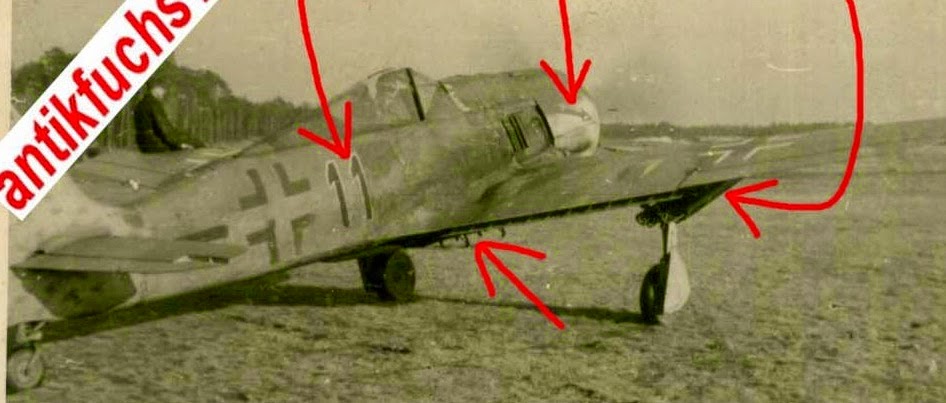
Focke Wulf 190 units with Panzerschreck - rare images of Fw 190s of 5./ SG 77


I was only discussing the subject of II. Gruppe SG 77 Panzerschreck toting Fw 190s with Jes Touvdal recently - here is his completed model for the recent BM Fw 190 group build. We concluded that there were only a couple of known (poor quality) partial photographic images of these machines, attributed to 5./SG 77 at Pardubice - in the JAPO 'Air War over Czech territory 1945' book.


Via John Manhro " Note the arrow motif on the cowling, blown hood of the F-8 and the II.Gruppe Balken. As the pictures show clearly the II. Gruppe bar and the "11" and "2" are black (imho) than I think we can say these are indeed 5./SG 77 aircraft. Staffel colour of 6./SG 2 = yellow and 4./SG 3 = probably white. The colour of 5./SG 77 was in my opinion black.."


Comment from John Manhro on TOCH posted on 12 May 2012;

" I did a check in Lfl. 6 documents all the way up to late March 1945. Early February 1945 the following units flew with Panzerschreck;
8./SG 1, 6./SG 2, 4./SG 3, 5./SG 77 (Pz.Schreck) -  (indeed there is also one report that says 6./SG 3 had Pz.Schreck but it does not list 4./SG 3 also, maybe a typo?)

The following units had Panzerblitz;

III./SG 4 (all three Staffeln), 13.(Pz)/SG 151, 1.(Pz)/SG 9 (Pz.Blitz). It seems that II./SG 151 had mainly Pz.Blitz but also a few Pz.Schreck Fw 190. Early Feb 1945 also 3.(Pz)/SG 9 was transferring to Pz.Blitz (completed mid March). This was followed in early March 1945 with transferring first 3./SG 1, 9./SG 77 & 6./SG 1 to Pz. Blitz. planned to be followed by 3./SG 77, 3./SG 4, 3./SG 3 & 6./SG 4. Need to check more files if that was completed too. 


Jes fabricated his Panzerschreck 1 parts from scratch, using some plastic tubing and plastic card, based on the diagrams in the JAPO Fw 190 A-G book as reference.

Kora models have produced resin detail Panzerschreck II parts (model photos courtesy Jes Touvdal)


More on Jes Touvdal's Luftwaffe fighters model collection

http://falkeeins.blogspot.co.uk/2011/06/jes-touvdal-luftwaffe-model-collection.html

Sunday, 18 July 2010

SG 2 Fw190 camouflage and markings - Luftwaffe colour, new-tool Revell Fw 190 F-8 in 32nd


According to their 'About' page Critical Past.com is one of the "largest online collections of historic, royalty-free film footage and still images in the world" - here are some stills from footage in their archive taken at Ansbach or Herzogenaurach of two SG 2 Fw 190s being examined by eager GIs.
The stills appear to show a FW 190 F-8 (note the underwing racks on 'chevron green 2') and a Fw 190 A-8 (MG151 in outboard wing stations) - "Green 2" is Wnr. 588453 and the machine is finished in Darkgreen (82), Grauviolett (75) and Light blue (76). The second machine "yellow 8" appears to be finished in dark green (82) and braunviolett (81). The yellow nose band identifies these aircraft as being from I./SG 2 under Luftflotte 4 command, possibly the only Fw190 units with the yellow nose band. The other Gruppen of SG 2 were under Luftflotte 6 and thus had no yellow nose band. Even so these machines appear to be displaying a II. Gruppe bar aft of the fuselage Balkenkreuz.