Showing posts with label Air battles over Normandy. Show all posts

Sunday, 25 September 2022

GFM Rommel an der Kanalküste, Vendeville, January 1944


..some screen grabs from Wochenschau film footage showing Rommel (CO Heeresgruppe B ) and entourage visiting a fighter Gruppe somewhere in northern France  some time ahead of the Allied D-Day landings...


..given that GFM Rommel is accompanied (right) by Kommodore Obstlt. Priller (JG 26) it would not be unreasonable to assume that this must be Abbeville and JG 26 (III./Gruppe flew 109s) some time in the weeks leading up to D-Day. 

This would appear not to be the case. The original PK Berichter caption states 'bei Lille' and is dated January 4, 1944. On this date JG 26 had no Messerschmitt Gruppe in France, III./JG 26 being based at Mönchengladbach under Lw.-Befh. Mitte, while I./JG 3 was based at Denain and Vendeville (Lille). On January 9, 1944 I./JG 3 and III./JG 26 swapped bases with III./JG 26 returning to its Geschwader. Therefore when the photos and the Wochenschau-film were taken on or before January 4 the only Bf 109 Gruppe at Vendeville was I./JG 3. 

 In the picture below a badge on the cowling of the Gustav - the JG 3 Udet badge - appears to have been over-painted. Pilot and ground crew stand to attention as the party walks down the taxiway. The G-6 in the background (left) is 'white 15'  (..of I./JG 3. Note absence of Gruppe Balken aft of the fuselage cross) 


..Rommel's party makes its way into a hangar - where Priller shows Rommel (one of ) his  Fw 190 A-8  'Jutta' - not a 'black 13' as the Kommodore chevron is just visible. Note also the area of the pilot's hand-hold on the windscreen coaming  which appears to have either been damaged or 'cut-out' - or maybe a fault on the film. I have no idea what this is, although  regular blog reader Stephen F. suggested that it might be some sort of improved gun sight....


Also on this blog;

Priller's 'Jutta' - Focke Wulf Fw 190 A-8 'Black 13'


Wednesday, 26 January 2022

Another bail-out for Sepp! - Wurmheller in Normandy


1944 saw huge losses among the Luftwaffe's aces especially in the fighting with the Allied air forces covering the Normandy landings. Wurmheller had been appointed Kommandeur III./ JG 2 following the loss of his friend Huppertz (70 victories - KIA on June 8, 1944). Six days later, a war correspondent reported on Wurmheller's difficult fighting…


"It's around 5:00 in the morning. The fighter pilots are getting ready for a new mission against the beachhead off the Orne estuary, when the door of the Geschwader command post opens. A slender fighter pilot limping and leaning on a cane enters the room. Hptm. Wurmheller has returned from a sortie and straight away reports his 97th air victory, a victory returned in almost dramatic circumstances. [...]

What the 27-year old from the town of Schliersee in Upper Bavaria  - Staffelkapitän and holder of the Oak Leaves - has just been through and overcome, well, that's what you would expect from 'Sepp' Wurmheller! This son of a miner, an apprentice since he was seventeen years old before he devoted himself body and soul to gliding, now ranks first among fighter pilots in terms of the number of victories over the Anglo-Americans, opponents far superior to the Russians in terms of flying quality, among others. Thus the term "Kanaljäger" (Channel Fighter) combines his skills in piloting, courage and bravery. [...]

Engaged at the head of his squadron at 5:00 am against the beachhead in the Orne estuary, Wurmheller had been able to place two direct hits on landing craft. His fellow squadron member, Lt R., had destroyed an enemy tank. They had returned to the base before taking off again as quickly as possible to attack landing ships.

On the third mission of the day, as Wurmheller was on his return flight, he came across an Anglo-American flight formation composed of Thunderbolts and Mustangs. An unequal balance of power left little chance for our men, but true to his motto "Rangehen und sauber draufhalten", Wurmheller flew towards the enemies and shot down a Mustang.

However, his Focke-Wulf was also hit: shrapnel from explosive shells tearing through the canopy and injuring the pilot in the chin. There was no other way out but to evacuate the aircraft - at barely100m altitude! It was almost a miracle that the silk had time to unfold. The impact with the ground was very hard because of this and the pilot suffered a badly sprained foot.

French civilians who witnessed the combat ran to help him and gave him the best possible care, which clearly indicates a complete change in the attitude of a large fringe of the French population towards the Anglo-Americans: these presumed liberators, with their merciless bombardments and the brutal terror they inflict have destroyed a multitude of homes and meted out new painful sacrifices. They want to make France a new battlefield.

With their region transformed into rubble and ruins by Allied bombers, the locals had welcomed the first Anglo-American prisoners with threatening fists and hostile cries. They approached our compatriot with the words "Comrade - Sick" and treated him as if he were one of their own, using in particular a pair of tweezers to remove the shards.

Wurmheller was driven to a Flak position where he was immediately provided with a car that took him back to his airfield.

His slight wounds will not keep him down for long and he will soon be able to abandon his crutch and resume fighting......"


Wurmheller was KIA on June 22, 1944. His scoreboard showed some 102 claims. He left a widow and a baby daughter Helga.


Wednesday, 14 November 2018

Herbert Huppertz JG 2 6-8 June 1944, Jean-Bernard Frappé's revised "La Luftwaffe face au débarquement " published by Heimdal


from the publisher's blurb - a Luftwaffe blog translation

" ....More often than not nowadays it is a celluloid version of history that determines how we may perceive real events! Who has not seen the now-famous scene from Darryl F. Zanuck's film "The Longest Day", when two Luftwaffe fighters, alone and confronted with a huge Allied naval and air armada, came in low for a brief firing pass along Sword Beach, leaving several hundred startled Tommys as dumbfounded as they were amazed, before heading back home eastwards unscathed to their base north of Paris. For many years this enduring image has helped to condition the idea that the Luftwaffe was particularly absent from the skies of Normandy on 6 June 1944 when the liberation of France and the annihilation of the armies of the Third Reich were at stake....

In 1999 Heimdal published a superlative history compiled by Jean-Bernard Frappé -"La Luftwaffe face au débarquement "- detailing the actions of the Jagdwaffe in the skies of Normandy and the Ile de France region around Paris and then again in Provence, after the Allied landings on the Mediterranean coast. With a wealth of detail and photos the book presented an exhaustive panorama of events. And while compared to the 15,000 sorties flown by American and British aircraft during D-day itself, the Luftwaffe had only been able to organize a little over 300, four days later no fewer than 1,300 Luftwaffe machines, including nearly 500 fighters belonging to some 20 fighter Gruppen were able to mount combat sorties. With the Wehrmacht in headlong retreat the largest number of Luftwaffe fighter sorties on the Normandie front was recorded on 20 August with 580 Focke Wulf 190 A and Messerschmitt 109 Gustavs present. Fighting against overwhelming odds of 10 to 1, German fighter pilots paid a heavy price in blood for their interventions - more than a thousand of them were shot down over the course of many hundreds of air battles against USAF Mustangs and Thunderbolts and RAF Typhoons and Spitfires. In return for these terrible losses, these same German pilots carried out their duties to the limits of physical and mental endurance - more than 1200 claims for victories were filed between June 6 and August 31, testifying to their determination and courage.

The success of the first edition of  Jean-Bernard Frappé's tome "La Luftwaffe face au débarquement " - June 6, 1944 to August 31, 1944 - found a ready readership and nowadays has become difficult to find at a sensible price. Therefore, some twenty years after the first printing Heimdal Editions have chosen to offer to a new generation of readers, a revised, corrected and expanded reissue, with extensive photo coverage - some images previously unpublished-  enriched with dozens of colour profiles representing the Focke Wulfs and Messerschmitt 109s that saw action during that terrible summer of 1944....."


Kommandeur III./JG 2 at the time of the Normandy 'invasion' this is Herbert Huppertz on the left. Photos of this pilot appear to be quite rare aside from the usual RK portrait. To the right is Josef Puchinger. Note Huppertz is wearing the officers Fliegermütze or side cap, known more colloquially as the Jaegerschliff ...


Hptm. Herbert Huppertz was Gkr. III./JG 2 on 6 June 1944. He was one of those veterans that David Clark in his history of the Normandy air battles "Angels eight" qualified as a 'super-ace'. Having claimed his first victory, a Spitfire, over Dunkirk on 28 May 1940 with 6./JG 51 his victory total at the start of June 1944 was around 70 confirmed.

Below; Huppertz (right) with JG 51 on the Channel coast.."..am Kanal gegen England "


 At noon on 6 June 1944, Obstlt. Kurt Bühligen (who scored his 100th victory on 7 June 1944) and Huppertz participated when 29 Fw 190 attacked at least 24 Thunderbolts (of US 365 FG) and Typhoons (of RAF 183 Sqn). The Germans claimed to have shot down six Allied fighters - including two Typhoons in less than two minutes by Huppertz - for a single loss. Actual Allied losses in this engagement were five (two P-47s, three Typhoons). (Clark, “Angels Eight”, p. 42.) That same evening, Huppertz caught eight Typhoons of 164 Sqn and shot one down, with F/O Roberts KIA. (David Clark, CD “Daily Data tables of the Normandy Air War Diary”, 6 June 1944.)

In the course of another sortie late on 6 June, Huppertz engaged the numerically superior formations of Allied aircraft which by that time filled the skies in the area (on 6 June 1944, the USAAF and RAF conducted 14,674 sorties over the Normandy area - against only 319 Luftwaffe sorties). During this single mission, Huppertz was entangled in combat with several Allied fighter units, involving both Mustangs and Thunderbolts, but in spite of the odds he claimed a Mustang and a Thunderbolt. David Clark has identified the former as one of the 352nd FG’s losses.

Huppertz thus returned five victories in a single day, 6 June 1944.

8 June 1944 was a black day for III./JG 2. At around 0915 the Gruppe was airborne with around ten machines and were engaged by Mustangs and possibly Thunderbolts around Caen. Hptm. Wurmheller claimed one Mustang, while three Fw 190s were shot down - two of the JG 2 pilots were killed  - including Gruppenkommandeur Huppertz. The WASt. loss report gives the time of this action as 10:30.

 (JfV Teil 13/III Einsatz im Westen 1.1 bis 30.9.1944 Prien/Stemmer/Bock)

Also on this blog;

Seine bridgehead 22 August 1944 - the Jagdwaffe vs. US anti-aircraft artillery at Mantes
SKG 10 - first Luftwaffe unit in action on D-Day
Two pilots in Normandy - Hans-Ulrich Jung III./JG 3
Priller's Jutta - Fw 190 A-8 'black 13'

Tuesday, 21 August 2018

JG 5 Reichsverteidigung Staffelkapitän Lt. Paul Weitzberg KIA 2 November 1944


I recently came across two surprising comments on two different threads concerning JG 5 on the TOCH forum;

firstly; that Peter Schmoll's latest book 'Me 109 Production und Einsatz' 'erroneously' depicts a Gustav in JG 5 markings overflying a German town as the jacket illustration, and, secondly, that three JG 5 pilots were KIA over Holland on 15 August 1944 including Lt. Paul Weitzberg of II./JG 5  (thread here)

 Established in January 1942, II./JG 5 was a successful Gruppe in the Eismeer Geschwader fighting in the Far North. Among several ace pilots that had flown with this unit were Major Horst Carganico, Major Heinrich Ehrler, Ofw. Rudolf Müller and Oblt. Hans Döbrich…

However, with an 'invasion' of the Continent looming and the Reich being pounded almost daily by huge bombing raids, the Gruppe -along with I./JG 5 - transferred in late May 1944 from the Artic Circle to southern Germany. Here they re-equipped with new Bf 109 G-6 fighters. In June 1944, both Gruppen were sent to France to oppose the Allied landings in Normandy, I./JG 5 flying out of Herzogenaurach during 6 June. II./JG 5 was still in Gardelegen re-equipping and did not fly to France until mid-June.  (cf. Jochen Prien, JfV 13/III)

Elements of Hptm. Theo Weißenberger's I./JG 5 arrived on the 'Invasion' Front at Montdidier in the vicinity of the French capital on 6 June while Weißenberger himself and the rest of his Gruppe clashed with P-47s coming into Montdidier on 7 June. I./JG 5 also saw combat over Beauvais that same day and in total Weißenberger claimed five victories. He filed a further three claims the following day. In the Bundesarchiv image below he is seen on 8 June 1944 being interviewed by a Kriegsberichter. In the background, left, is Oblt. Lothar Gerlach, Staffelkapitän of 1./JG 5. Weißenberger went on to return his 199th and 200th victories on 25 July and with some 25 victories was easily the most successful Jagdwaffe pilot over Normandy - although a number of his 'invasion victories' cannot be confirmed from Allied records.

Eichenlaubträger Hauptmann Weißenberger, Gruppenkommandeur in einem Jagdgeschwader bei einer Nachbesprechung. Prop.-Kp. Lw.KBZ 15 Film-Nr.: 8279/10 Bildberichter: Schödl 4.10.44


Both Gruppen of JG 5 fell back to the Reich in late July. II./JG 5 occupied a number of airfields through this period, moving from Herzogenaurach, Salzwedel, Werl, Sachau and Rheinsdorf before finally arriving at Finsterwalde. During August 1944 combat over the Reich was particularly murderous for II./JG 5 - some seventeen II./JG 5 pilots were killed in combat with  four-engine bombers, one of the bleakest months in the unit's history. However Lt. Paul Weitzberg was not one of them.. in the image below taken during August 1944 Lt. Paul Weitzberg, Stk. 5./JG 5 was photographed in front of the Me 109 G-6 "gelbe 1" assigned to his friend Staffelkapitän 4./JG 5 Oblt. Günther Schwanecke...


16 October 1944 was the last day the unit fought under the designation "II./JG 5"- two pilots were killed, a single pilot was wounded and no less than sixteen aircraft were lost. Four days later an order emanating from Luftflotte Reich re-designated II./JG 5 as IV./JG 4. The Gruppe, still at Finsterwalde, was organised as follows;

 IV./JG 4 (ex-II./JG 5): Hptm. Franz Wienhusen,

13./JG 4 (ex-5./JG 5): Lt. Paul Weitzberg,
14./JG 4 (ex-6./JG 5): Lt. Ernst Scheufele,
15./JG 4 (ex-4./JG 5): Oblt. Lothar Wolff,
16./JG 4 (ex-8./JG 5): Oblt. Hans Schleef.

Staffelkapitän of 5./JG 5 since 1942, Hptm. Franz Wienhusen had spent several months at Lamsdorf in Upper Silesia as an instructor before being appointed to command II./JG 5 in September 1944. He had achieved around twelve victories in air combat.

 Lt. Paul Weitzberg had been posted to 4./JG 5 when the unit was still in Norway during 1943 before succeeding Hptm. Franz Wienhusen at the head of 5. Staffel during the spring of 1944. Among his pilots was the experienced Ofw. Hermann Holtkötter who had flown for a long period with I./JG 5 prior to moving to 5./JG 5.

 Leutnant Ernst Scheufele had joined 12./JG 5 as early as 1 July 1942 and had seen almost constant front line action ever since. Posted to II./JG 5 on 1 October 1943, he had been appointed to command 6./JG 5 on 15 March 1944 - his experience and length of service meant that he was regularly called upon to replace the Kommandeur in the air. Scheufele had tallied eighteen victories, including a Thunderbolt and a number of four-engine bombers. Among his pilots were Fw. Erhardt Mecke and Uffz. Berthold Klaus, both of whom had achieved around ten victories.

 Oblt. Lothar Wolff was an experienced Zerstörer pilot. Gruppenadjudant in IV./KG 40 since 1943, he had fought most notably in the bloody clashes over Normandy before undergoing a single-engine fighter conversion course.Officially he had tallied four victories - two Wellingtons, one B-17 and a single B-24- which he had achieved at the controls of a Ju 88. He had been posted to II./JG 5 at Finsterwalde just in time to undergo his baptism of fire at the controls of a Bf 109 during the bitter battles of 16 October. Among his experienced pilots was Uffz. Hubert Schubert.

 Oblt. Hans Schleef was one of the seven Ritterkreuzträger to serve with JG 4. He had received the award on 9 May 1942 for the 41 victories he had achieved while serving with 7./JG 3- during this period he had been shot down behind the front but had managed to return to German lines some four days later. Schleef had subsequently been appointed to command 8./JG 5 on 21 July 44. At the time IV/JG 4 was stood up, he had downed some 97 enemy aircraft.

"... Finsterwalde - 2 November 1944. Weather conditions were poor. The cloud ceiling was at 800 metres. The Gruppe was put on thirty-minute readiness. After about an hour's waiting an 'Alarmstart' was suddenly ordered - the signal flare shot up from the operations building - scramble! The four machines of our Staffel were led off by our Kapitän, Lt. Weitzberg - heading due west. We hadn't been in the air for very long - no more than about fifteen minutes - when we came across the first Pulk of bombers at around 4,000 metres altitude. I waded in to set up for a head on attack on a box of six B-17 G Fortresses, squeezing off the first bursts from about 400 metres. It was then that I realised that I was all on my own and could only imagine that my comrades had been caught up in a tussle with Mustangs somewhere behind me. As I hurtled in towards the bombers I now bore the brunt of their defensive fire - a number of hits slammed into my 109 - in particular the oil tank was perforated and great gobs of the viscous liquid coated the canopy severely restricting my forward vision. Thick bitter smoke seeped into the cockpit and then suddenly flames erupted from the engine cowl and the engine seized. I quickly jettisoned the canopy, which flew free. I tore off my flying helmet and prepared to jump. At this point I noticed that the chute which lay in the seat-pan appeared to have been damaged which made me think twice about bailing out- I elected to try and glide down for a crash landing. Pointing the nose down into the cloud layer I soon had ground visibility and headed for a field running alongside a village. By now flames were whipping around the cockpit but I successfully guided the 109 down for an emergency landing and managed to scramble clear of the blazing machine. I ran clear in the direction of the village. Suddenly I heard a shout behind me - "Halt- stehen bleiben!". A bicycle-mounted police man had a pistol trained on me - as I was covered in oil and my face was charred by second degree burns I suppose he may have taken me for a black American. My life jacket also concealed the rank insignia on my uniform. I was marched into the village at gun-point - my eyes had closed up with the burns - before I managed to persuade my 'captor' that I was in fact a German pilot - I was then taken to hospital in Dessau .."
(Uffz. Friedrich Zenk, 13./JG 4)

Four IV./JG 4 pilots were shot down and killed during this sortie on 2 November 1944 - among their number was the Kapitän of 13. Staffel, Lt. Paul Weitzberg. Weitzberg fell to a Mustang while he was lining up to come in for an emergency landing at Zerbst.

Just six Bf 109s of IV./JG 4 managed to return to Finsterwalde. Both here and at Welzow, there was deep dismay at the outcome - each of the Gruppen had lost a Staffelkapitän. Hptm. Erich Jugel would be succceeeded by Oblt. Werner Vorberg, while Lt. Paul Weitzberg was briefly replaced by his friend Oblt. Günther Schwanecke until the latter was posted to a Gruppenführer training course. Lt. Josef Kunz was appointed Kapitän of 13. Staffel on 10 November. He had recently completed the Verbandsführerlehrgang - formation leaders training course - at Königsberg/Neumark and had been a member of III./JG 5 since the Gruppe had been set up in June 1942.

- Note the account of the sortie flown on 2 November is a translated extract from Erik Mombeek's "Storming the bombers" Volume II  (translation by this blog author). 
- Image of Weitzberg via Peter Neuwerth and his excellent site devoted to JG 5 and JG 7 here
- Jochen Prien's Jagdfliegerverbände series including the latest tome, Teil 13/ III, is available via jagdgeschwader.net here

Monday, 8 May 2017

Leutnant Siegfried Lemke 1./JG 2 mit Ritterkreuz, June 1944


".. For a long time I have been trying to find photographs or details of the FW-190 flown by Fw. Siegfried Lemke of I./JG 2 in September 1943. I've posted to all the Luftwaffe forums and basically drawn a blank. Little known about him and very few photographs, none that I have found showing his aircraft other than one from 1944 with him standing beside the rudder of a FW-190 showing his scoreboard at the time. However, looking at Luftwaffe records, for a number of the victories he claimed in September 1943 it shows his unit details as 2 I/JG 2. He was appointed Staffelfuhrer in I./JG 2 in early September 1943. Lacking details of exactly what aircraft he did fly, other than in all probability a FW-190 A5 or FW-190 A6 at that time, can anyone tell me what the unit markings were for 2./JG 2 in September 1943? The camouflage seems fairly standard from the photos, profiles and descriptions, it is mainly the unit markings that have me stumped. So what colour used for markings, etcetera. Was it typical for different roles to have a defined or different number of marking applied eg for Staffelfuhrer? I am trying to build a representative FW-190 to provide the other half of the story of a RAF Mustang Mk.IA that was shot down by Lemke in September 1943. The Mustang Mk.IA pilot who was shot down is a friend of mine and this is a part of the closure process after all these years -the story of the Luftwaffe pilot who shot him down and resulted in him being a PoW in Stalag Luft III for the remainder of the war ". (Colin Ford)

 Colin's question concerns what many researchers would like to know: details of Siegfried Lemke's particular machines. Unfortunately, there's a reason his searches have drawn a blank - the details are not yet known.

Below; Lemke, 7th from the left in this line-up of 1./JG 2.  Identified from the left are; unknown, Fw. Rhode, Lt. Karl Reiss, Lt. Horst Zettel, Lt. Joseph Wurmheller, Oblt. Hans-Jürgen Hepe, Uffz. Siegfried Lemke, Fw. Willi Morzinnek ?, unk, unk, Uffz. Hans Lohkamp. From a page devoted to Hans Lohkamp, link below.


" 14. Juni 1944 Leutnant Lemke, Flugzeugführer im Jagdgeschwader Richthofen, 23 Jahre alt, erhielt dieser Tage an der Invasionsfront nach seinem 45. Luftsieg das Ritterkreuz verliehen..."

OKW annoucement dated 14 June 1944, confirming the award of the RK to the 23 year old ace of 1./JG 2 after his 45th victory (sic). Below; Lemke congratulated by Hohagen.


At the time of the D-Day landings Lemke was Staffelführer in 1./JG 2 (page 16 Frappé, " La Luftwaffe face au débarquement allié ") Lemke claimed three victories on 7 June 1944 taking his score to 43. He was awarded the RK on 11 June (see BA photo above) for 44 victories. The well-known images of him alongside his Fw 190 A-7 WNr. 430674 show his rudder marked with 48 victories. This is the only machine of Lemke's that can be identified with certainty - but it was lost on 14 June 1944, near Evreux, possibly following a combat with Typhoons of which he claimed one.  This machine may have featured a white number of 1./JG 2, but it is always possible that he was flying an aircraft from another Staffel.  Whilst the exact details of his 14 June bail-out are unknown (Frappé), there are no WAsT details because he was not killed or badly wounded.  The following day, Lemke claimed two Spitfires, one east of Evreux.  (pages 18-19 Frappé " La Luftwaffe face au débarquement allié "). Few JG 2 pilots survived the war, and putting together a detailed bio is near enough impossible. It is not known if  Lemke's logbook has survived.  Lemke himself survived the war and died in the mid 1990's.

Lohkamp page KIA 29 May 1943
http://www.absa3945.com/29%20mai%201943/Hans%20Lohkamp/hans_lohkamp.html

Monday, 12 December 2016

Two pilots in the summer of 1944 in France Bf 109 G-6/AS - last edit November 2018 Lt. Hans-Ulrich Jung of III./JG 3


..And a request from Dr. Jochen Prien for a blog reader to identify these two pilots seen during the summer of 1944 in France; may be these two men have been the subject of another thread somewhere else before - apparently on-one seems to know their identity.


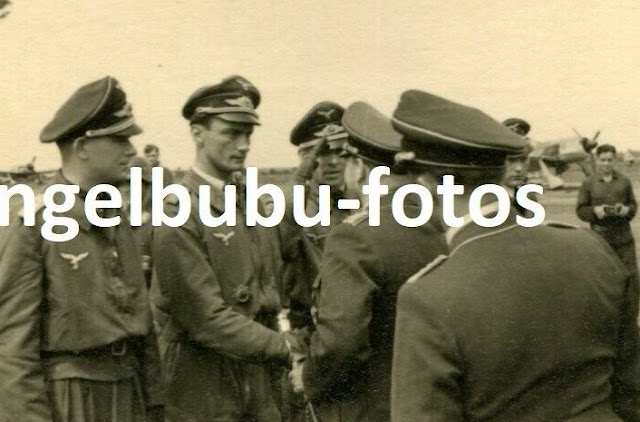
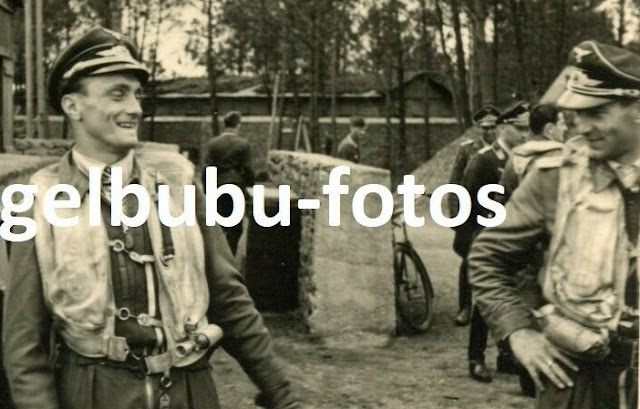
We can see a Leutnant wearing a German Cross in Gold (DKiG) and an Oberfeldwebel decorated with an Iron Cross 1st Class. Does anybody know who these two pilots are ?  The photos are part of a series of PK-photos taken in France now held by the Bundesarchiv. Several photos from this series showing a Bf 109 G-6/AS and a Bf 109 G-6/Bf 109 G-14 have been published many times over. But as far as I know they have so far eluded positive identification.

It is difficult to believe that no one out there would know at least the Leutnant with the DKiG as there were comparatively few Luftwaffe pilots of that calibre still around in France in the summer of 1944 - as Dick Clark states in his Normandy air war history ('Angels Eight'), "..there were the 'super aces' and then there were the rest.."

Edit - Lt. Hans-Ulrich Jung of III./JG 3 is the DKiG winner. Two pages of photos of Jung feature in the new book 'Heinz Sannemann -ein Jagdfliegerleben' published by Helios in May 2018. He came from IV.(Sturm)/JG 3 and was posted to III./JG 3 apparently when the Sturmgruppe left France after only a couple of days in June 1944.

 Looking at the other images from this BA-film is just as frustrating – there are a couple of photos showing a very dark Bf 109 G-6/AS almost II./JG 11 style with the fuselage Balkenkreuz and numeral almost completely over-sprayed, with our Leutnant sitting in the cockpit or on the cockpit sill in some of them, then you can see him in the cockpit of what looks like a freshly allocated Bf 109 G-6 or G-14 wearing the usual three-greys scheme and a white numeral, this a/c also shown from various angles. Click to view large


Then there are a number of images showing various Bf 109 G-6/14s taxiing on a large grass field, one a “black 2”, which offer no clue as to their unit. Many of the images from this Bundesarchiv series have appeared in various publications over the years with no positive unit identification, let alone a pilot name. By way of elimination the only units that come to mind are II./JG 11 (because of the G-6/AS), I./JG 5 or possibly a recce-unit such as (F)/123 or NAG 13.


Over to you the reader - any information gratefully received at falkeeins at aol dot com

Sunday, 27 March 2016

Giant Wuerzburg Würzburg Riesen Pas de Calais -secret D-Day intelligence plans photo recce archive found


"...A Top Secret 'how to' guide to the Normandy invasion that was found at a French flea market has emerged for sale after 72 years.

 The fascinating archive of black and white reconnaissance photos and incredibly-detailed intelligence documents show the extensive research that went into ensuring D-Day was a success.

 The snaps include one of German troops scattering across a beach as a low-level RAF aircraft sweeps by to capture the plethora of anti-landing obstacles. Other documents included detailed intelligence reports on German munitions such as this floating mine containing 'poured TNT' Other high-resolution images show the famous coastline with key cliff-top targets that had to be destroyed either before or on D-Day itself.


above; Cap Blanc Nez, south of Calais. Note the obelisk erected in 1922 on top of the cliff to honour 'the glorious cooperation and frank comradeship of the French and British Navies during the Great War' and the 'target'  - the 'Giant Wuerzburg'


 There are not only aerial snaps of the installations but also images taken at wave-height from the view of the invasion fleet and detailed plans of each target. For example, for a strategic German semaphore station at Cap D'Antifer on the eastern end of the invasion beaches there is an overhead photo, a side-on image and the plans for it. Another target highlighted in the photos in an anti-aircraft battery next to Arromanches, which was in the middle of the Gold Beach sector. In the top right hand corner of each photo is a number assigned for each target.

The photos were taken by spy planes up to a year before D-Day on June 6, 1944 and captured locations in Normandy and the Pas-de-Calais region in order to keep the Germans guessing as to where the real invasion would be. The archive that has now come to light also includes incredibly-detailed intelligence reports, right down to the infra-red equipment fitted on German Panther tanks. There are plans for German mines so the invasion fleet knew what to look out for as well as the national markings for Allied aircraft to help avoid friendly-fire incidents...."

Full archive is to be sold by C & T Auctions, Ashford, Kent

via the Dail Mail, read the full article here


Close-up views of the Würzburg Riesen and bottom, video of the preserved Würzburg on the French coast at Douvres-la-Délivrande

Douvres-la-Délivrande was the site of an important German air-detection radar installation, part of the strategic Atlantic Wall defences. Completed in the autumn of 1943, the station was split into two zones by the road from Douvres to Bény-sur-Mer; and heavily fortified with bunkers, machineguns and minefields. The Northern zone held a large Siemens 'Wasserman' long-range radar and associated structures. The larger Southern zone had two intermediate-range Freya and two short-range Würzburg Riese radars; as well as command and infirmary bunkers, garages and artillery placements. Some 230 Luftwaffe personnel were based at the station, including electricians, engineers and 36 air controllers. At 11 pm on the night of 5/6 June 1944, the Allies launched intensive jamming of radar frequencies which blinded the entire German radar network from Cherbourg to Le Havre. On the morning of the 6th (D-Day) the antennas at Douvres-la-Délivrande were rendered inoperative by Allied naval artillery bombardment. Canadian troops who had landed nearby on 'Juno Beach' isolated the station but the Germans successfully defended it for 12 days, awaiting a counter-attack by Panzers; on one occasion it was resupplied with food via a nocturnal paradrop mission from Mont-de-Marsan. Main article: Battle of Douvres Radar Station. On 17 June, a massive offensive by the British 41 Commando, Royal Marines - preceded by an artillery bombardment and supported by mine-clearing and anti-bunker tanks of 79th Armoured Division - secured the surrender of the garrison.

The radar site at Douvres-la-Délivrande is now home to a museum, with two of the bunkers housing displays about the evolution and role of radar. The museum also maintains a rare preserved example of the 'Würzburg' radar antenna.


Saturday, 20 February 2016

a collection of "classic" German-language Luftwaffe books for sale - Siegfried Radtke's KG 54 Chronik " Von der Ju 52 zur Me 262 " (Schild Verlag)


..well-known ebayer Rich Carrick has a nice selection of German language titles on offer in a 'private' sale. Thanks to Rich I have just acquired Siegfried Radtke's KG 54 Chronik " Von der Ju 52 zur Me 262 " (Schild Verlag).


Uffz. Siegfried Radtke was a Beobachter in 9./KG 54. Flying out of Decimomannu, Sardinia, Radtke and his crew were injured on 5 June 1943 when they were forced to bale out of Ju 88 B3+CT WNr 142481 in darkness after a long night sortie over North Africa which saw them returning on one engine before finally running out of fuel. Radtke himself appears in the photo at the top of page 186. On page 216 he describes a bombing sortie flown by his crew in Ju 88 B3+IT on the night of 26-27 July 1944 from Soesterberg over Giberville south-east of Caen in Normandy. Attacked by night fighters and then hit by anti-aircraft fire over the target area, the port wing of the Junkers was quickly ablaze. Although the blaze took hold and burned vigorously the port wing tanks were full, so, according to the author. " there was little danger of an explosion..". The crew elected to fly on and put down at the nearest 'friendly' airfield which was Le Culot where they carried out a successful belly landing at 03:00. The aircraft (which appears as 'JT' in Radtke's loss lists, W.Nr unknown) sustained 60% damages..

" ..in seconds we had scrambled clear of the machine and with the fire brigade and ambulance in attendance our "IT" disappeared under a mountain of foam. Suddenly all the lights on the airfield were extinguished. There was a sound of engines. Our 'colleagues from the other side' had arrived on the scene - too late! Then we heard voices calling out; " ..where is the crew? " By the light of a pocket lamp (torch) we were met by the Kommodore of KG 30, Obstl. Freiherr von Gravenreuth. Later back in the ops building he said ; " Mensch ..goddamn boys you were lucky there! Two nights ago another Ju 88 came in ablaze, attempted what you've just done ..and exploded 100 meters above the field! " We swallowed hard and toasted our Geburtstag ('birthday'). Later we set out  by train via Brussels and Rotterdam and eventually arrived back at Soesterberg where we were warmly welcomed home.."


Rich has a lot of other nice and often hard-to-find Luftwaffe books for sale too; Kock's NJG 6 book and Peter Achs' Fw 191 title to mention just a couple.. You can contact Rich via the **** or the Luftwaffe SIG on Facebook. Visit these sites to see the full range of books available in Rich's private sale..


A blog post devoted to rare Luftwaffe books on Ebay

Sunday, 10 August 2014

Priller's 'Jutta' - Focke Wulf Fw 190 A-8 'Black 13'


No captions necessary ! Super Jan Malý artwork reproduced with permission.  Lovely clear shot of Priller at the controls of 'Black 13'. Thanks to Jean-Yves Lorant for the photo print..click to view large..


Wednesday, 3 October 2012

I./SKG 10 - first Luftwaffe unit in action on D-Day - Wolfgang Zebrowski SKG 10 memoir " Nachts über den Wolken " ( By night above the clouds..)


 There has been surprisingly wide coverage in British newspapers over the past few days on the location and retrieval of wreckage from a 97 Squadron Lancaster found in Normandy, France. The aircraft and her crew were downed on D-Day 6 June 1944 and have been missing in action ever since (although there is some doubt about this - see link below).  A link to the Daily Mail's report and photo coverage appears below. In the meantime I have compiled a brief account of what is known from the German side;


"....They set off in the early hours of D-Day, never to return. The crew of the Lancaster bomber – among the most highly decorated in the RAF – were all killed when their plane was shot down by a German aircraft over Normandy. Their remains have never been found. Now, 68 years later, thanks to the chance discovery of a gold ring, the mystery has been solved......"


Above; Fw 190 G-8s or G-3s of 1. Staffel SKG 10 under the trees at Tours-West during June 1944. 'White 9' was lost with Fw. Nikolaus at the controls on the night of  4-5 July, shot down during an attack against Allied shipping..

While strictly speaking I./SKG 10 was not a fighter or even a night fighter unit, the Fw 190 G-3s and G-8s of the Gruppe were the first Luftwaffe 'fighters' in action over Normandy on 6 June 1944. Gruppenkommandeur  I./SKG 10 was Major Kurt Dahlmann, an experienced officer and pilot who had started his career four years previously with III./KG 4 and who had flown some 160 bombing sorties over England and the Mediterranean prior to being posted to Schnellkampfgeschwader 10 during June 1943. He had been warned early on during the night of 5-6 June that heavy gliders were reported landing in the vicinity of St.Lô and that British parachutists were being landed at Ouistreham, on the Caen canal at the mouth of the Orne. He had immediately ordered a recce as described by Oberfähnrich Wolfgang Zebrowski of 2. Staffel in his post-war memoir entitled   " Nachts über den Wolken " ( By night above the clouds..);

" ..all serviceable aircraft were immediately ordered up to combat transport gliders and tug aircraft reported over Saint-Lô (sic). The night was still dark and visibility rather poor as we took off again (Zebrowski had just landed back safely from an over night bombing raid against the city and port of Portsmouth on the south coast of England..). As we reached the target area I scoured the night sky looking for tell-tale flashes of light from machine-gun fire, constantly changing direction and heading, jinking back and forth - there was no sign whatsoever of any gliders. As my fuel started to run low I turned back and headed for Evreux. We were rather downcast by this lack of success - none of us had seen anything of the enemy.."

It was still dark as another alert came into Gruppe HQ - Allied bombers were reported to be pounding the coast between Carentan and Caen. On this occasion Gkr. Dahlmann instructed the Staffelkapitän of  3./SKG 10, Hauptmann Helmut Eberspacher, to lead four Fw 190s and head out over the sector. Two hours later the four pilots had landed back at Evreux having achieved the first German aerial successes of D-Day - intercepting a formation of Lancasters, four of the RAF four-engined bombers had been shot down, timed at 05:01 to 05:04, the first falling over Isigny and the others towards Carentan, the chase apparently taking place on a westerly heading. Three Lancasters were claimed shot down by Eberspacher himself, the fourth falling to Fw. Eisele.

Gkr. Dahlmann would receive the Ritterkreuz (Knights Cross of the Iron Cross) on 11 June 1944 for the performance of his Gruppe over Normandy following D-Day while Eberspacher was awarded his Ritterkreuz on 24 January 1945 for his performance and successes on 170 Jabo missions on the Western Front. He flew sorties during the Ardennes (Bulge) offensive and against the Remagen bridges and survived the war with some seven victories in total.

Below; pilots of 3./SKG 10 with Staffelkapitän Hptm. Helmut Eberspacher on the far right


http://www.dailymail.co.uk/news/article-2211250/Wreckage-Lancaster-bomber-crashed-D-Day-killing-crew-identified.html#ixzz28EvJdx7G 

Note that elsewhere -  the Key Aviation forum - the recovery of wreckage from this crash site has raised a number of questions pertaining to the remains of the crew. Nor does it appear that this was the first dig at this crash site..

Friday, 3 February 2012

demise of the Luftwaffe blog ?, Lt. Karl-Heinz Kempf, JG 26 at Villacoublay June 1944

Thank you for all the kind comments received during the blog’s recent hiatus. I pulled the plug a bit too rapidly perhaps. The ‘end’ of the blog resulted in a bit of fevered speculation on at least one forum - funny how people immediately jump to the worst possible conclusions. As you can see I decided in the end to ‘restore’ this blog, partly to demonstrate to some that Google have not shut this site down for any particular issues, especially of copyright, far from it. Anyway, I'll live with it for a few days and see how I feel. I’m afraid the ‘Luftwaffe blog’ had/has become too much like hard work to be honest. I recognise that there is no way I can really continue to keep doing up-dates of reasonable 'quality' with my 'schedule'; having finished translations of Erik Mombeeck’s JG 4 Vol II and JG 2 Vol II (not yet published) I need a break but I’m still mid-way through a number of other planned publications for various German, Belgian and French authors and with invitations to contribute to two new series on the table currently! One friend recently asserted that I am “the victim of my own expertise”. You are too kind David!

There are obvious problems with regularly up-dating a blog like this. You create something half-decent and it begins to consume all your time and people expect more. Visitor numbers were/are quite impressive, I think, for a private blog, with upwards of 1,200 page views per day. The other (paper) projects demand increasing amounts of attention too. It is always nice to be asked to contribute and difficult to say no, even when it’s Kagero and the half-baked Polish/English text is all but incomprehensible. (Luckily they have upped the quality in leaps and bounds and in Thomasz Szlagor they have a very competent English/Polish writer and researcher). My feeling right now is that this blog will not be updated quite so frequently. Then when time permits I hope to be in a better position to consider again providing more regular updates. Creativity - and energy - ebbs and flows, and right now I'm in an ebb phase with the blog. And besides there are other Luftwaffe blogs and sites out there - see my links and support my friends!

 I am fortunate to have a number of expert friends and fellow enthusiasts to provide material. Chief among these is French researcher/author Jean-Yves Lorant, author of the two volume history of JG 300 (Eagle Editions) and of a ground-breaking study of the Focke Wulf 190 back in 1981 published by Docavia in France (co-author Jean-Bernard Frappé). This was Jean-Yves’ first work, written in the late 1970’s when he was still a teenager. Nowadays he manages the French armed forces photo archive at the Service Historique de la Défense (over 6 million items) from a huge office (big enough to display a genuine Fw 190 propeller) in the opulent surroundings of the château de Vincennes, Paris. A visit there was the highlight of a trip to Paris a few years ago. Jean-Yves was in touch following my recent posting of III./JG 26 Gustavs taxying out and lining up for take-off in front of the ‘Guynemeyer’ hangar at Villacoublay during June 1944. This image was just one of a much longer sequence which featured 9. and 2. Staffel ace Lt. Karl-Heinz Kempf, which Jean-Yves very kindly offered for publication here.


As there is very little information about Kempf on the Net or in books and even fewer images, I am not going to reproduce Jean-Yves' high-res TIFF files here for the usual reasons, but have decided to post some low-res photocopies. Kempf was a former Green Heart Geschwader pilot with some 60 victories over the course of approx 400 sorties by the time of the Normandy Invasion. The pictures show Kempf clambering over a Gustav at Villacoublay during June 1944, possibly ‘white 9’.


He was a rare holder of the Ritterkreuz in JG 26, awarded in Russia during 1942. Kempf survived the hard air combats over the Normandy Invasionsraum and filed a number of additional claims. He was shot down and killed on 3 September 1944 at the controls of a Fw 190 A-8 ‘Black 9’, caught by 55th FG P-51s while taking off with 2. Staffel from Grimbergen, Belgium. (details in Mr Caldwell's "JG 26 War Diary") This flight had been planned as a relatively straight forward ferry flight back to Germany. Kempf’s death was over-shadowed that same day by that of another leading former JG 54 ace and the 170+ victory ace and Kommandeur of II./JG 26, Hptm. Emil Lang.


Friday, 5 March 2010

Lt. Wolfgang Fischer I./JG2

Grub Street are publishing Wolfgang Fischer's memoir (translated by John Weal). A few years ago I translated an extract from Fischer's memoir which appeared in the Kagero monograph series on the Fw 190. Fischer was a pilot in I./JG2 at the time of the Normandy landings in June 1944 but he had in fact volunteered for service within weeks of war being declared. Over the course of the following years leading up to D-Day he was given a succession of postings; long-range recce unit, a decoder in a met office in occupied France; bomber Geschwader, flying instructor before being posted to the Richthofen Geschwader in Italy, from where he was shot down in his FW 190 by Mustangs en route to Normandy. By now a Leutnant, he survived to fly offensive rocket attacks over Gold Beach on D-Day, only to be shot down again on D + 1. He was taken captive and sent first to a hospital in the UK, then into captivity in the USA. He was finally repatriated in April 1946. His description of all these events is entertaining and well-written, ranging from comic to tragic.

On 6 June the Allied air forces flew 14,674 combat sorties in support of the D-day landings, while the Luftwaffe managed just 319.

I./JG 2 was nearest fighter Gruppe to the Allied beachheads based in Cormeilles-en-Vexin sixty km from the coast.

Lt Wolfgang Fischer of 3./JG 2 described the sortie he flew;

" we were woken at 04h30 and taken to the airfield from the hotels in the town (Nancy) where we were quartered. We were airborne a short while later and flew to Creil (north of Paris) at around 05h00 to have our Fw 190s fitted with underwing rocket launchers. We took off again at 09h30 to strafe shipping off 'Gold' beach. There was 7/10 cloud cover as we overflew the Seine estuary, which allowed us to close on our targets and launch our rockets. We could see a huge number of enemy fighters orbiting over the landing beaches. My rockets probably scored a direct hit on a "Victory" class troop landing vessel...we fled the scene and returned to Chamant near Senlis (south of Creil )after this sortie.."


JG 2 clashed with Allied aircraft towards middday. At 11.57 Kommodore JG 2 Major Bühligen shot down a P-47 near the Orne estuary. A major battle took place in the afternoon, when ground attack Typhoons were encountered near Caen. Four of them fell in a few minutes' fight. Two more Typhoons were brought down by evening. Lt. Fischer continued;


"..there were no further sorties that afternoon and the pilots of I./JG 2 spent the afternoon bathing at the swimming pool in Senlis.. a joint sortie with III./JG 2 was organised for the early evening against gliders on the ground near the Orne estuary under Gruppenkommandeur III./JG2 Hptm. Huppertz who landed at our field with five machines at 19h30..as we aproached Bernay we spotted a formation of a least twelve (335th FS/4th FG ) Mustangs strafing German infantry near a bridge over the Risle...using the evening mist and setting sun for cover we climbed to 1200m to take up a position for a classic bounce..the ensuing combat lasted just minutes as we were each able to select a target before diving down on them… 8 P-51s were shot down with no losses on our side !.."..


JG 2 was the principal Luftwaffe unit in action against overwhelming Allied air power on June 6. Overall, the unit shot down eighteen Allied aircraft (the entire Luftwaffe claiming 24 on that day), JG 2's most successful day in the entire campaign in Normandy. Kommandeur Hptm. Huppertz reported five claims before crashing to his death south of Caen just two days later shot down by a P-47. His replacement was another veteran, Hptm. Josef "Sepp" Wurmheller. He was shot down and killed barely two weeks later. Lt Fischer himself was shot down by flak the following morning over the beaches, bailed out unharmed and was taken prisoner

Wednesday, 16 September 2009

Willi Unger IV./JG 3 - Fw 190 Sturmbock


 IV./JG 3 - Fw  190 Sturmbock deployed briefly to Normandy with the 'Krebs' rocket launcher