Showing posts with label Courland. Show all posts

Monday, 1 January 2024

Kurt Pflugbeil, General der Flieger, Oberbefehlshaber Luftflotte 1


Reading through the list of the approximately 7300 Knight's Cross winners, you soon notice quite a few Ritterkreuzträger-Familien or 'families' where the Knight's Cross is represented more than once. For example, the following pairs of brothers from the individual branches of the Wehrmacht: Heer: Georg and Philipp Freiherr von Boeselager, Luftwaffe: Adolf and Wilhelm Ferdinand Galland, Kriegsmarine: Gerd and Reinhard Suhren, Waffen-SS: Boris and Hugo Krass. However, there are also brothers who did not earn their Knight's Cross in the same branch of the Wehrmacht. These include Generalleutnant des Heeres Johann Pflugbeil (1882-1951) and his younger brother Kurt Pflugbeil (1890-1955), who ended the war as General der Flieger and Oberbefehlshaber Luftflotte 1 - Commander-in-Chief of air fleet 1. The following write-up of Pflugbeil's career is now the most comprehensive and easily accessible on the internet.

The Pflugbeil brothers were born in Hütten near Königstein in Saxony as sons of a sawmill owner. After attending school, the younger Pflugbeil brother joined the Saxon 10th Infantry Regiment No. 134 in Plauen as a Fahnenjunker (ensign) on 1 April 1910. Here, after attending war school, the high school graduate was promoted to Leutnant on 23 November 1911. As a platoon leader, World War I began for Lt.Pflugbeil and his regiment on 2 August 1914. As early as 1915 he applied for a transfer to the Fliegertruppe, which was granted at the end of 1915. From then on, he was mostly deployed as a fighter pilot and observer during the war. In the process, he earned the reputation of being "invulnerable" and finally returned home as a highly decorated flight officer. Among other things, he was also awarded the second-highest Prussian war medal for officers after the Pour le Mérite, the Ritterkreuz mit Schwertern zum Königlichen Hausorden von Hohenzollern (Knight's Cross with Swords of the Royal House Order of Hohenzollern). Kurt Pflugbeil ended the war in November 1918 with the rank of Hauptmann.

Postwar the Germans were forbidden warplanes by the Treaty of Versailles of 1919. Hptm. Pflugbeil therefore returned to his first branch of the service, the infantry. Via the Grenzjägerregiment Zeithain and the Vorläufige Reichswehr, he finally joined the 11th (Saxon) Infantry Regiment on 1 April 1921, whose 1st and 2nd companies stationed in Freiberg/Saxony were official "Traditionsträger" (tradition forebears) of Pflugbeil's former IR (Infantry Regiment) 134. For five years - from 1921 to 1926 - Pflugbeil was the Chef der 1. Kompanie of IR 11 until 1926, when he was able to to refresh his flying knowledge and experience by taking part in longer training courses at the Reichswehr's secret flying training centre at the Soviet airfield in Lipetsk. During this time, he was appointed as a Rittmeister in the 11th (Prussian) Rifle Corps, which was spread over three Silesian garrisons.

With his promotion to Major on 1 November 1931, Kurt Pflugbeil - by now forty-one years old - was appointed Kommandeur of the 2nd Prussian Fahrabteilung, which was located with two 'eskadrons' each in Altdamm/Pomerania and in Rendsburg/Schleswig-Holstein. The plans prepared by the Reichswehr Ministry for a possible re-formation of the German air forces after the abolition of the restrictions imposed by the Treaty of Versailles envisaged this Fahrabteilung as the parent unit of future flying formations and, in particular, as a personnel reserve for the training of radio operators and aerial gunners. In fact, from 1933 onwards, Major Pflugbeil's Fahrabteilung 2, initially formed covertly from many individual components, was 'unofficially' run as the "Fliegerersatzabteilung" in the Luftwaffe.

In 1934/35, the experienced World War I Kampfflieger served as "Director of the High Altitude Flight Centre of the German Aeronautical Weather Service" in Lechfeld/Bavaria, a cover name for the first Kampffliegerschule of the future Luftwaffe. Hitler's decree on 26 February 1935 unmasked the "Reichsluftwaffe" with effect from 1 March 1935 and made it an independent part of the Wehrmacht alongside the Reichsheer and the Reichsmarine. Pflugbeil then transferred to the RLM (Reich's Air Ministry) in Berlin as Inspector of Kampfflieger.

On mobilization for the attack on Poland in early September 1939, Major General Pflugbeil was initially appointed commander of Luftgaustab z.b.V.* 16. After the French campaign in the summer of 1940, he then became Commanding General and Commander in the Luftgau Belgium and Northern France on August 1, 1940. Here his main task was to organize the future air defense of this area and to prepare the ground organization for the air forces to be deployed against England. He then took a leading part in operations against England himself, after he had been promoted to Generalleutnant  on 1 September 1940, succeeding General der Flieger Alfred Keller as commanding general of 
IV. Fliegerkorps, which was under the command of Luftflotte 3 led by Generalfeldmarschall Sperrle. Among his units were Lehrgeschwader 1 (equipped with the Ju 88 medium bomber), Kampfgeschwader (KG) 27 (with the He 111, the Luftwaffe's standard bomber) and Stuka-Geschwader 3 (Ju 87). When the war against the Soviet Union (Unternehmen "Barbarossa") began on June 22, 1941, Pflugbeil's IV Fliegerkorps, together with Ritter von Greim's V Fliegerkorps formed Luftflotte 4, deployed in the southern section of the Eastern Front under Generaloberst Alexander Löhr (1885-1947), former Chief of the Austrian Air Force.

The achievements of Pflugbeil's IV Fliegerkorps during the first months of the campaign in the East received official recognition on 5 October 1941 with the award of the Knight's Cross. On 31 October 1941 Pflugbeil was mentioned by name for the first time in the report of the OKW (Wehrmacht High Command). This mention was to be followed by three more in the next few years. With his appointment as commander-in-chief of Luftflotte 1 in the summer of 1943 as successor to General Günther Korten, who had been appointed chief of staff of the Luftwaffe, the career of General der Flieger (since 1 February, 1942) Pflugbeil reached its high point. He remained at this post practically until the end of the war, even as Luftflotte 1, deployed throughout in the northern section of the Eastern Front, was renamed "Luftwaffenkommando Kurland".

On 28 April1944 General Pflugbeil was the 562nd soldier of the German Wehrmacht to be awarded the Oak Leaves to the Knight's Cross - on 11 April 1944 the OKW report stated that his air fleet had played an outstanding part in the success of the defensive battle south of Pleskau near Lake Peipus. About four months later, Pflugbeil's brother Johann received the Knight's Cross as Lieutenant General of the Army and combat commander of Mitau.

The  defensive battles of the Kurlandfront  were General der Flieger Kurt Pflugbeil's last wartime missions. Events at the turn of the year 1944/45 were described in the OKW report of 1 January1945 as follows;

"... In eleven days of heavy fighting ... Army units, Waffen SS and Latvian SS volunteers, excellently supported by flying units and anti-aircraft units of the Luftwaffe under the leadership of their commander-in-chief, General der Flieger Pflugbeil, defeated the onslaught of 46 rifle divisions and 22 tank and assault gun units. Thanks to the high performance of leadership and troops, the front in Courland remained firmly in our own hands, except for insignificant losses in terrain."

Relentless Soviet offensives in Courland (the sixth was launched on 16 March 1945) gradually resulted in a considerable reduction in the number of sorties flown by the defending fighters of JG 54 given the general shortages of fuel and machines in the ever-shrinking pocket. Their primary mission was as escort for the rocket-toting Fw 190 ground-attack machines operated by SG 3 against Soviet armour. Only then were ‘free hunts’ against the Soviet medium bombers authorised. Oblt. Gerd Thyben, Staffelkapitän of 7./JG 54 remembered;

“..Fuel for the Heeresgruppe Kurland – and thus our fighters – came to us, if at all, by sea. ‘Papi’ Kurt Pflugbeil of Luftflotte Kurland only occasionally ordered sorties and then only with the orders ‘ An die bomber!’

Below; Two Ritterkreuzträger photographed at Cirava, Courland during March 1945 having just received their decorations from 'Papi' Kurt Pflugbeil (right). Staffelkapitän 8./JG 54 Lt. Hermann Schleinhege (left) with his  comrade Lt. Hugo Broch.


Pflugbeil's organisational talents could not of course avert final defeat but did enable him to send home large numbers of the Luftwaffe soldiers under his command before the official surrender. As the Red Army closed on Windau, where the " Befehlshaber der Luftwaffenkommando Kurland " (commander of the Kurland Air Force Command) had his headquarters, he himself declined to use the He 111 available to him to return west and entered Soviet captivity. After months of imprisonment in Moscow and Ivanovo, he was sentenced to twenty-five years hard labour on 8 June, 1950. Seriously ill, the now almost sixty-four-year-old general was released early on 5 January 1954. He survived the return home only by seventeen months. Kurt Pflugbeil died on 31 May 1955 in  hospital near Göttingen..

( A detailed account of JG 54's flight out of Courland appears in this blogger's "Luftwaffe Fighters -Combat on all Fronts" Volume I) 

Sunday, 4 September 2022

Correspondence from JG 54 Fw 190 pilot Karl Bytomski (dated 26 March 1998) and the death of Otto Kittel


" ....I completed my pilot training in Châteauroux, France during the summer of 1943. But following a crash I was hospitalised for a year. I was making a turn in the circuit when I hit two telephone masts running along a road. My aircraft went straight down, chopping through seven trees along the way. Both my wings were torn off and my engine ended up some eighty metres away. I was catapulted out of the cockpit still strapped to my seat and hit the ground in a field. I suffered many fractures. Two Frenchmen carried me to a farm. I woke up with a farm girl lifting my head and giving me sips of brandy.

My first sortie in JG 54 took place on  July 30, 1944. On August 7, I shot down my first Il-2 (near Jakobstadt-Nirzi). On October 27, I shot down a second Il-2 near Skrunda. On October 30, it was a Pe-2. On 17 November, I finished off a Jak 9 near Windau.

In the East we lived in tents. Food supplies were always adequate and our aircraft were excellent. The only disaster for us was the meagre supply of fuel. It meant that we could not support our ground troops sufficiently and only took off to counter the opposing bombers. And that was usually with only one Rotte. From sunrise to sunset, one Rotte was on alert, its two pilots being relieved every two hours. During an alert, we had to be in the air within sixty seconds.

On  February 16, 1945, we took off in Schwarm formation to conduct a free hunt over the Dschukste sector. In bad weather we started a low-level fight with twenty-three Il-2s escorted by fighters. My Rottenführer was Oblt Kittel. Shortly before the fight, Kittel's aircraft went off at an angle of 30 to 35 degrees and hit the ground. I suspect he must have been hit fatally by flak.

During my short flying career I made seven belly landings and bailed out twice. On one occasion, during a landing, my aircraft caught fire due to a broken fuel line. I was travelling at 160 km/h and chose to jump. It was a mad decision - more of a reflex action: jump or burn. As luck would have it, I was lucky to escape with a simple leg injury.

When I reflect back I can only say that I was very lucky in my life. In fact, I should never have been a fighter pilot at all. My reaction times were pretty slow and I had difficulties with orientation and my sense of direction. In flying school, I was only passed out with a grade 5. I was known in the unit for rarely being able to locate the airfield. Luckily, whenever I was late back, signal flares would be fired off which would guide me back home......"   

Karl Bytomski


Karl Bytomski's Rottenführer Otto Kittel (at head of table) and the men of his Staffel enjoy the traditional, classic 'Kaffee und Kuchen' in the field..


correspondence from Karl Bytomski courtesy J-L Roba/Philippe Saintes. The superb photo-laden two-volume history of JG 54 authored by Philippe is still available from the Lela Presse website in their 'unit history' series. PDF extracts can be downloaded. 

also on this blog;

Last flight of the Luftwaffe -  JG 54's evacuation from Courland here

Monday, 24 August 2020

"Unser letzter Flug .." Kurland evacuation - last flight of the Luftwaffe, May 1945


The order for the capitulation of all German armed forces signed a week after the suicide of Adolf Hitler on May 7, 1945 contained a special addendum referring specifically to the Heeresgruppe Kurland and the necessity to implement an evacuation of as many personnel as possible to the West.. The following day,  May 8 1945, the Luftwaffe launched a desperate rescue mission to evacuate German wounded and troops from the 'Festung'  (the 'fortress' or rather 'pocket', the so-called Kurlandkessel) in Latvia. German forces had been effectively cut off since late 1944 by the Soviet advance. According to the Mark Felton video below, that morning - May 8, 1945 - some 35 Ju 52s flew into Grobina/Grobin in Latvia from Norway to evacuate encircled German troops from the peninsula, intending to fly the wounded troops and men with children back to Germany. Over the Baltic the transports were set upon by Soviet fighters and no fewer than 32 of the Ju 52s were set alight and downed and the mission ended in tragedy and destruction.

Mit Ju 52 aus Windau am 8 Mai 1945

".. on May 8, 1945 at around 15h00 six Ju 52s managed to get airborne from Windau and head back to Germany - Richtung Heimat! The machines were overloaded - carrying at least 30 passengers - and I needed two attempts to get airborne. Near Greifswald my machine took hits from ground fire and was set alight. I managed to make a successful crash-landing but we ended up in Soviet captivity. Did any of the comrades from that flight survive Soviet imprisonment? What became of the other five transports? Does anyone know what happened to pilots Hptm. Brettschneider and Fw. Skripitz? "

Helmut Hemmer in  Jägerblatt  magazine.

Mark Felton video -  a single click to view here


In a 1986 issue of  Jägerblatt  I./ JG 54 ace Artur Gärtner wrote;

"..I managed to get out of Kurland in a Ju 52 of Transportgeschwader 1. 1.Staffel of I./JG 54 was based in Windau but conditions on the airstrip were so bad that the Fw 190s could not get airborne. We were almost certainly bound for Soviet captivity. We were extremely thankful for the efforts of our fellow airmen in the transport units who dared to undertake those last flights into the pocket - a number of Ju 52 crews lost their lives as a result. The crews that came into Libau could have had little or no idea of the dispositions of Soviet ground forces or even the location of the front lines and many came under heavy ground fire as they flew their landing approach..."

below;

November 1944 on the Feldflugplatz at Skrunda in Kurland - 1. Staffel pilots in front of the A-8 'white 12' flown by Staffelführer Sepp Heinzeller, fifth from the left.


For the fighters of JG 54 there were also dramatic scenes on the last day in the 'Kurlandkessel'.

In an early 1980s issue of Jägerblatt magazine, Fw. Karl Wolf,  a former II./JG 54 ground crew member, recalled;

".. in the early hours of the morning of May 8, a friend from my home town, Ogfr. Ernst Eggers of the Luftn-Truppe called me. His unit was stationed with us on the airfield at Cirawa.

" Karl, der Krieg ist aus..! - the war is over .."

I passed the news around to my comrades in our Blockhaus bunker - we were all shocked. What would happen to us now, 1200 kms from home surrounded by the Russians ('der Iwan'). It was around 02:30 when the call went out for the Staffel to assemble at our dispersal on the airfield some 4 kms distant. Transported in trucks, we were to take only what we could carry. Our 'boss' Ritterkreuzträger Oblt. Schleinhege gave out the necessary instructions and delivered a brief pep-talk confirming the war was over. There was a call of 'three cheers for the Fatherland'. At 05:00 the machines were prepared - all equipment such as radios and armament - was removed to save weight and create space. Harnesses were fitted into the fuselage spaces so that three ground crew members could be transported in each Focke Wulf 190. All remaining rations were shared out. By 07:30 the machines were ready. At 07:40 a Soviet recce machine appeared overhead - there was no flak fire and nothing moved on the airfield. A short while later as I was still in the cockpit of 'Black 8' making final checks I saw Herbert Leymann pointing to the sky to the north - it was full of Russian aircraft. Our first thought was that this was an attack on the airfield - we dashed quickly to the slit trenches and took cover as the Russians - Gott sei Dank - plastered the far side of the field. Shortly afterwards 3. Staffel flew in from Windau to make the trip home with us. We were to get airborne at 09:00. Before then several Ju 188 Fernaufklärer landed and parked up alongside the strip adding to the confusion on the small and sandy runway. At 09:00 there was another raid on the field, with no great damage and then finally at 10:00 the signal to get airborne came through ..."..Start frei.." ..I was the last of the four of us to climb into our 'black 8' retracting the footstep and giving the 'OK' signal to our pilot Ofhr. Karl Heber -  alles fertig!... "

Uffz.Karl-Heinz Höfer of 6. Staffel was another 'schwarze Mann' in the radio compartment - the so-called 'FuG-Loch'- of a Fw 190, in this particular instance Uffz. Walter's 'Yellow 12', the aircraft taking off from Libau-Nord and landing safely in Flensburg on the morning of May 8.

Below; 6.Staffel sleigh ride in Libau, 1945, Staffelkapitän Hptm. Helmut Wettstein holding the reins, Uffz.Karl-Heinz Höfer under the 'arrow', Fw. Toni Meißner on the Panjepferd.


Oblt. Gerd Thyben, Staffelkapitän of 7./JG 54 recalled the end in Kurland;

".. all sorts of rumours were circulating by the evening of May 7, 1945. When the orders for the Geschwader arrived Hptm. Findeisen, last Gruppenkommandeur of II./JG 54 summoned his Staffelchefs in Libau and informed them of the surrender of all German forces and gave orders that all aircraft be made serviceable and prepared to takeoff.  In the early hours of the morning of May 8 I received the Klarmeldungen for my aircraft and Hptm. Findeisen gave us our transfer orders (Verlegungsbefehle). Takeoffs for our departure from the Courland 'fortress' were to get underway from 07:30 in Rotten or Schwarm-sized groups. Airborne that morning we set course for Kiel-holtenau  - my Katschmarek Fritze Hangebrauck was tucked in alongside me on my port side. Suddenly I spotted off to the port side in the distance and some 500 meters below us crossing our path on a northerly track a single twin-engined machine...a Soviet Pe-2..."

In a 1976 issue of Jägerblatt magazine a former Luftwaffe Techn. Inspektor based in Libau, Kurland named Wilhelm Uhlshöfer noted;

".. on May 5 I learnt that the fighter units intended to fly back to Schleswig-Holstein. However to carry out this flight each machine would need to be equipped with a 300 ltr Zusatz tank. There were plenty of drop tanks in our store. However we had none of the (hose/rack) connectors - Verbindungsteile - that ran from the tank to the machine. I knew where they had be ordered in from - a depot somewhere between Königsberg and Berlin - but the necessary telegram had to be counter-signed by a General or equivalent rank. No such person was available. I had to employ a certain amount of deceit and cunning  to get the order sent- - I forged the signature. Thanks to my underhand action a Ju 52 arrived the following day with the necessary parts, enabling some 127 fighters to fly back to Germany. When I talk to former comrades now we often wonder whether we took advantage unfairly but at the same time we saved many men from Soviet captivity...".

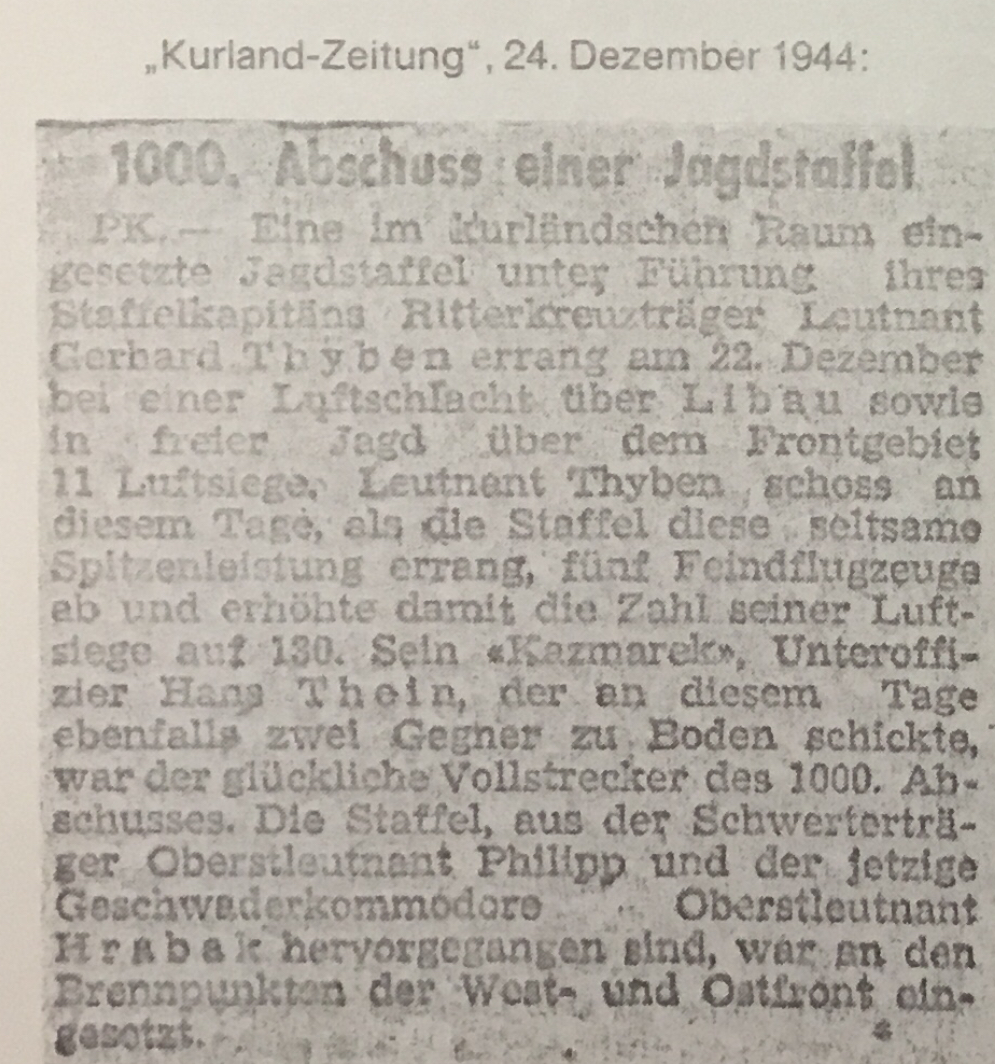
‘Kurland-Zeitung’ report of the 22 December 1944 action over Libau; Thyben returned five victories and his wingman Uffz. Hans Thein the 1000th for the Staffel...


Below;

15 August 1944 in Riga, Kapitän Kittel after another successful mission. (100th victory for 3.Staffel according to some sources..) He would be lost in combat during February 1945, the highest scoring Luftwaffe ace KIA. A piece on Artur Gärtner (left) in Jägerblatt 4/87 cites 14 February 1945 as Kittel's death date (source, Kurowski) as do a number of other sources. The date of Kittel's last clash with Il-2s was most probably 16 February.  Gärtner added, "..Als Otto Kittel gefallen war, wurde es für uns dunkel im Kurlandkessel.."


'Happier' times for JG 54. July 1942 in Krasnogvardeisk, Ferntrauung ('distant marriage') of Otto Kittel. This wartime ceremony allowed marriage to be contracted when the fiancé could not take leave. While the soldier signed a document with great pomp and circumstance in front of the Commander of his unit, his fiancée did the same in front of the Bürgemeister in his locality.