Showing posts with label Ta 152. Show all posts

Tuesday, 14 April 2026

Jens Bechler 'Aufschlagbrand' - Ta 152, Alteno


Wartime crash researcher Jens Bechler has published three volumes in his 'Aufschlagbrand' series. The term 'Aufschlagbrand' (lit. 'impact fire') generally refers to two distinct aspects. On the one hand, it describes the moment when, typically as a result of enemy fire, an aircraft hits the ground and bursts into flames. Otherwise, it refers to the cause of death for pilots and crews involved in such accidents. The term was used extensively by the Luftwaffe in corresponding reports and loss lists. Author Bechler, based in Dresden, was the founder of the organisation 'Vermisstenforschung' devoted to wartime crash-site investigations. In his book(s) and work at crash sites, Bechler strives to elucidate the fates of those aviators 'killed in action' in the last few months of the war as the Soviets closed in on Dresden.

Bechler's 'Aufschlagbrand Band I'- first published in 2009 and reprinted last year - published a 'new' and particularly rare image of the well-known JG 301 Ta 152 line-up photographed at Alteno (near Dresden) in February 1945.  


 The airfield at Alteno - developed by the Russians post-war with the construction of a concrete runway - lies some 70 miles north of Dresden and south-west of the Focke Wulf production plant at Cottbus.  Unfortunately there are no credits and no information about the image in the book. Or anywhere else for that matter. The publisher Flugbücher Verlag in Pirna, on the Elbe river near Dresden, does not appear to be a going concern. I have attempted to contact the author himself but with no result. As for the image - well, the book has little or no Ta 152 content either!  Thanks to Gunter Lauser for pointing out that Bechler has produced three volumes of 'Aufschlagbrand' - that all look quite similar. 


Wednesday, 25 May 2022

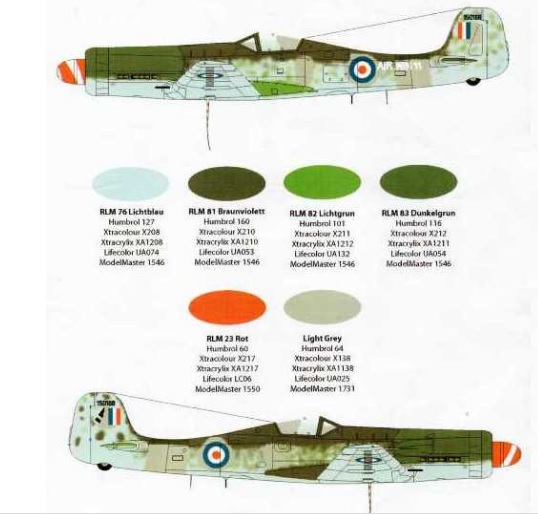
Painting a captured 'Wulf' - upper wing pattern on the Farnborough Ta 152 H


Hobbyboss 2000 have recently re-released the Dragon Ta 152 48th kit. One of the decal options is  'green 9' as seen at the 'Farnborough' captured enemy aircraft exhibition of November 1945. Some 'painting notes' for Ta 152 H-1 WNr. 150 168.  'Green 9' was found at Leck (Schleswig Holstein) and transferred to Farnborough in August 1945. Seen here with Kennung over-painted  with RAF roundels (along with a red spinner)  and JG 301 fuselage bands in RAF medium sea grey (probably) at the Farnborough exhibition later during the year. Note WNr. 150168 at the top of the tail.

Looking through the reference pictures available it is immediately obvious that there are very few views of this machine at Farnborough taken from the port side. There appears to be a difference between the port side which has a very clean demarcation around the engine cowlings and the starboard which appears softer and a little lower (i.e. below the lower edge of the access panel immediately in front of the windscreen).  The Jumo 213E-1 power egg also appears to be a solid colour, probably Dunkelgrün (Dark Green) RLM 83. On the starboard side of the cowling, the exhaust gases were blown down under the supercharger inlet, absent of course on the port side.  


WNr. 150167 showing the partial NMF lowersurfaces


Colour instructions from a Freightdog decals set (low-res image for information) This is FD's interpretation as they think the aircraft looked at the Farnborough display. FD's interpretation of the colours and pattern seems very close to the Hobby 2000 scheme. Note no NMF on the underside although this was a feature of the finish..


Below; closer view of the starboard wing pattern


Tuesday, 15 December 2020

Attack on Neuhausen, 16 January 1945 - fourteen Ta 152 fighters destroyed on the ground


Report on the Tiefangriff  (ground strafing attack) flown against Neuhausen  (12:03 to 12:35) on 16 January 1945.

Number and type of enemy aircraft: " several Mustangs and Lightnings " 

"The airfield was overflown at 500m from west to east - no firing. The field was then strafed from the north-east and south-west at heights down to 3 meters above the ground. The attack comprised four waves of around ten machines against the aircraft camouflaged around the outside of the field and parked up at the dispersals in the woods...."

"..14 Ta 152s were destroyed. Because of their large wingspan the Ta 152s could not be parked up in the normal fighter pens (Abstellboxen). 1 FW 190 was also destroyed and 1 Ta 152 was 30% damaged.." 

" the large number of finished machines on the site at Neuhausen can be explained by two 'special' additional checks  ('zwei Sonderprüfaktionen' ) having to be carried out on the aircraft after production and acceptance .....which require a certain time and are necessary for reasons of flight safety...

Posted by Jørn Junker


Blown-up Ta 152 V18/U2 W.Nr. 0040 "CF+OY", Fl.Pl. Reinsehlen, Germany, April 1945.
repost from the Luftwaffe Fliegerhorste FB page

Friday, 8 April 2016

latest Kagero monograph Focke Wulf Ta 152 - Ta 152 combat record, JG 301 Reschke, Loos


a rather slim volume of barely 80 A-4 softback pages from the most prolific Luftwaffe author, Marek Murawski, this new Kagero monograph frankly offers little or nothing new - aside from some large-scale pull-out plans and a handful of 3D views of on-board equipment. Most of the text is devoted to Fw 190 high altitude fighter prototypes from the V13, V15 to the V18. The brief operational history of the type has probably already appeared in Kagero's Air Miniatures title devoted to JG 301. At least there is no artwork - or even mention - of the ridiculous all-red machine that has appeared in other publications. Both this particular machine and the combat record of the Ta 152 have been the subject of some discussion on this blog - see links below..

A while ago I was contacted by a blog reader who added the following about Loos' victories in the Ta 152;

" .. the copy of Loos' Flugbuch that I have shows clearly that he had four victories in his Ta 152 – if they are correct, who knows. Nevertheless they appear to have been confirmed by the Geschwader-Adjutant on 07.05.1945. There must be gaps in his Flugbuch – I find it strange that he start into a combat flight with a completely new machine, the Ta 152, without any training-flight before? Not even a short “Platzrunde” took place when he took off in “green 3” on 20.04.1945. The flights with victories were on 24., 25. and 30.04.1945. On 24.04. he claimed two Laag 9 (near Berlin), on 25.04 one Laag 9 (near Nauen) and on 30.04. one Laag 9 (near Berlin) again. All flights took place from Neustadt-Gleve.."

More on Loos' Flugbuch and his Ta 152 victories on this blog here
A 'personal' view on the 'mythical' all-red Ta 152 on this blog here


Der ehm. Pilot Willi Reschke erzählt von seinen Erlebnissen mit der " Ta 152 ". Insbesondere schildert er seinen Luftkampf am 14. April 1945 mit einer Tempest...

Tom Muller interview with former JG 301 Ta 152 pilot Willi Reschke, paying particular attention to his 14 April 1945 dogfight against an RAF Tempest


Tuesday, 3 April 2012

new Luftwaffe books from 296 Verlag - Roderich Cescotti memoir "Langstreckenflug’ (Long distance flight)

 As the generation that fought WWII slowly passes, veterans continue to write and publish their memoirs and some of those who have largely remained silent up to now are finally setting down their accounts before the day of reckoning. 296 Verlag is one of those publishers still prepared to bring these memoirs to print. In the case of Roderich Cescotti this must have been an  easy decision.

"Chess", as he was known to friends and comrades, has some truly unique tales to tell. Having flown Heinkel He 111 bombers with KG 26 during the Battle of Britain, he ended the war as a Gruppenkommandeur in JG 301 flying the Focke Wulf Ta 152. In the years between he flew torpedo bombers against Artic convoys and long range reconnaissance sorties as far as the coasts of Greenland. In January 1943 he flew re-supply sorties into the besieged city of Stalingrad and was almost certainly one of the last pilots to drop supplies for the doomed 6. Armee. After this experience he was posted as Technischer Offizier to KG 100, and flew sorties with some of the first radio-guided anti-shipping missiles. He participated in bombing sorties against the Allied invasion fleet off the coast of Normandy at the controls of what he describes as the Luftwaffe's best pre-1945 bomber, the sleek and fast Dornier 217 M-11 and also flew the Luftwaffe's biggest - and some would say, least successful bomber - the Heinkel He 177. During the final months of WWII he was appointed Kommandeur of II./JG 301, and flew the fastest piston-engine fighter of the war - the Ta 152. Taken captive by the British, he trained as a translator and gained experience at the controls of British types such as the Mosquito. He was one of the first ex-Luftwaffe pilots to qualify post-war on jets for the new Bundesluftwaffe passing out at the Flugzeugführerschule B in Fürstenfeldbruck in 1956. In the early 60s he was appointed CO of AG Aufklärungsgeschwader 52 flying the Republic Thunderstreak and RF-104. He retired in 1980 with the rank of Generalmajor with some 4,000 hours and over thirty aircraft types in his logbook.


According to publisher Kurt Braatz, Cescotti's memoir is a no-holds-barred and vividly written tale of derring-do, featuring much first-hand detail of Battle of Britain operations, the maritime air-war and the defence of the Reich - names such as Steinhoff, Rall, Wolfgang Falck, Julius Meimberg and Walter Wolfrum feature throughout its pages.

You can read extracts from and even order Roderich Cescotti's memoir entitled "Langstreckenflug’ (Long distance or perhaps more colloquially 'long haul flight') now at http://www.neunundzwanzigsechs.de/

With the permission of the publisher I have translated an extract from "Langstreckenflug" here

Tuesday, 27 March 2012

Luftwaffe modelling - Franck Oudin Zoukei Moura Ta 152

I expect you are all familiar with the work of master Swiss modeller Franck Oudin, especially as Franck's work is regularly published in Tamiya Model Magazine and elsewhere. Here is his recently completed Zoukei Moura Ta 152 covered elsewhere on this blog.

" Hello Neil, here are some views of my Ta 152H-0. I hope that you like it, cheers Franck ."

Click on the images for a closer view. More on the Zoukei Moura Ta 152 elsewhere on this blog
http://falkeeins.blogspot.co.uk/2010/10/132-focke-wulf-ta-152-h-1-zoukei-mura.html


Thursday, 19 May 2011

Late-war variant Fw 190 Dora with Ta 152 tail (Eduard kit Fw 190 D-9 Late ProfiPACK)


Eduard's latest release features another boxing of their very nice 1/48 scale Dora kit - a late-war variant fitted with the wider broad chord Ta 152 empennage. The kit itself is nicely reviewed on britmodeller here. The article excerpt below neatly illustrates the two types of Dora tail alongside each other (Fw 190/Ta 152 Aircraft in Detail by Neil Page in SAM 27/12) and the lower photo depicts the Eduard tails as published on their Facebook page.


 Like other German late-war fighter aircraft, production of the Fw 190 Dora variants was largely dispersed with major aircraft components being brought together and mated up at a final assembly location. The majority of these components were painted to varying degrees prior to delivery resulting in the 'pieced together' appearance of many Fw 190 Dora camouflage schemes. Various attempts were made to 'standardise' the production effort - one such was the planned introduction on the later Dora variants of the broad chord tail built for the Ta 152. And while these airframes may appear to be 'hybrids' the so-called Einheitsheck or 'uniform tail' ( see Rodeike) was designed, firstly, to be constructed from non-strategic materials (wood) and, secondly, to fit all the later planned Doras (D-12, D-13, D-14 up to the D-15). However the fascination with the variant resides in the fact that only two examples have been documented photographically, whether as new or replacement items is unknown. From Jim Crow's collection, the first photograph to appear ( in Monogram Close-up No. 10, but subsequently in multiple sources, including Hildebrandt 'Broken Eagles', Aero Detail Fw 190 D, German Aircraft Interiors by Merrick, 'Greenhearts'  by Urbanke and so on and so forth.. )  showed the wrecked and burnt-out tail fin of WNr. 500645 (clearly visible). According to authors Smith and Creek the photo appeared to depict     "... the remains of what might be a Fw 190 D-15. WNr. 500645 would suggest the type is a Fw 190 D-9 but the revised fin seems incompatible with this series. However the new fin was to be standard on the Fw 190 D-15.."  German authors Griehl and Dressel also agree in their Fw 190/Ta 152 book published in 1997 that this is   "... the wreck of a Fw 190 D-15 discovered close to the Czech border. Despite the Werknummer the empennage differs considerably from that of a Dora-9 ". Dietmar Herrmann in his 'Focke Wulf Ta 152' volume identifies the broad chord tail fin of WNr. 500645 as belonging to " Ta 152 C WNr 500645 "  - with no further commentary. Peter Rodeike - author of the Focke Wulf 190 'bible' - goes further in his Jagdflugzeug 190 book (P.404); " the so-called Einheitsheck or 'uniform tail' was planned for the Dora from the spring of 1945 and designed for series production of the Ta 152..it can be seen that the yellow/white/yellow fuselage tail bands of JG 2 are also visible .." W.Nr. 500645 was most recently illustrated as 'black 6' from III./JG 2  (Crandall Fw 190 Dora, Vol I) although this profile is speculative and apparently not based on any documentary evidence- although now featured on a least one after-market decal sheet and as an option in this Eduard boxing. The single 'known' photograph was allegedly published in a Dutch monograph in the 1970's but surprisingly not a single example has yet surfaced anywhere (?)

 
Urbanke's 'Greenhearts' volume was perhaps the first to publish pictures of what was identified as 'brown 4' of 7./JG 26, WNr. 500647 and photographed by a Canadian soldier at Hustedt airfield near Celle. Again the photographs appear to show a Dora-9 fitted with the wide tail and given that the two Werknummern are so close together, this according to author and publisher " demonstrates that a small number of of Fw 190 Doras were constructed with the Ta 152 tail ".


This aircraft is the box-top subject of the new Eduard Dora - 'brown 4' WNr. 500647 of JG 26. A third photograph of this machine was published in Hideki Noro's 'LO+ST' photo album of captured and abandoned Luftwaffe aircraft - interestingly this 'new' photo, along with the previously published pics of this aircraft, again fails to show a complete view of the tail unit, leading some to suggest in a debate on one forum that 500647 does " not have a Ta 152 tail..." (see P282 Crandall Vol II -while the broader tail fin appears to be present the top of the fin itself is nonetheless cropped out so it is not possible to confirm absolutely the absence of the typical pointed Dora aerial mast ). However it is now generally assumed that other Doras in the WNr. 500600 range were fitted with the same broad Ta 152 tail and are mostly covered here on Eduard's decal options.

There are a number of 'blanks' in the history of the Dora - such as the 'operations' of Kampfgeschwader units re-organised and re-equipped with fighters in the last months of the war. These so-called Kampfgeschwader (Jagd) or KG (J) units - the designation reflecting their conversion to the fighter or Jagd role - presumably did only relatively limited flying due to difficulties in obaining fuel. In SAM 27/12 Dora/Ta 152 'Aircraft in Profile' (February 2006) article a third candidate Dora with Ta 152 tail was illustrated speculatively - a 9./KG(J) 27 machine 'yellow 6' featuring green/white rear fuselage band checks. Noted Luftwaffe colours researcher David E. Brown first wrote about KG(J) Doras, specifically "ge.6 + I" of 9./KG(J) 27, way back in July 2000 - 11 years ago. His commentary and a profile by Claes Sundin were posted on Claes' website at that time. As recently as 2008 the existence of these Doras was being questioned by one prominent Dora Experte - however with the passage of time more KG(J) 27 aircraft have surfaced, the majority wearing the green/white Karobands, which rather vindicates David E. Brown's research. Interestingly - giving previously expressed doubts - a KG(J) 27 green/white tailband on a Dora fuselage is shown on page 337 / Vol. 2 of the Crandall Dora book. Also worth pointing out that the white/green fuselage checks have been seen photographically on this unit's Antons, which presumably accounts for this shift - although no artwork. Some 'speculative' machines are more valid than others it would appear.
  
'Yellow 6' was identified from loss reports as WNr. 500641, subsequently revised as WNr. 500648, just one number above the JG 26 machine. III./KG 27(J) lost two Doras in action on 1 April 1945, one of which was the aforementioned 'yellow 6'. And although the profile is speculative, this aircraft was likely finished in the typical Mimetall scheme - fuselage sides in the green-blue variation of 76, fuselage spine and engine cowling in 81 Braunviolett, fuselage underside natural metal from the wheel well back to the fuselage insert, wing leading edges and the front underwing panel probably 75 Mittelgrau with the control surfaces in 76. Note that these later Doras were more often than not fitted with the re-designed centreline weapons rack - the ETC 504 was a simplified carrier featuring a much smaller mounting and fairing.


Wednesday, 22 December 2010

1/32 Zoukei Mura Focke Wulf Ta 152 (2)

First built-up example I've seen of this kit, courtesy Dave/Sandy. Very impressive work and a lovely atmospheric diorama shot ! First posted on http://www.britmodeller.com/   and reposted here with Dave's kind permission.

Dave's full build review (5,000 words and over 100 images) is available on Geoff Coughlin's Scale Modelling Now subscription site. http://www.scalemodellingnow.com/


Elsewhere James Kelly has been wrestling with this kit and looks to have highlighted a possible "problem" with the nose area and in particular the flattened section of the cooling louvre on top of the cowl. Or at least on the NASM example this area (ringed) is flatter while the cowl cover is more tapered from the windscreen than it appears in the kit.


That said David Francis has made a superlative job of his build in the current (January 2011) issue of SAMI. Cleverly perhaps though he has chosen to finish his model minus the upper engine cowl cover. 


NASM copyright image of the Garber Ta 152 nose

More of what's in the box and a partial build of the internal components, cockpit and engine
http://falkeeins.blogspot.com/2010/10/132-focke-wulf-ta-152-h-1-zoukei-mura.html

Saturday, 30 October 2010

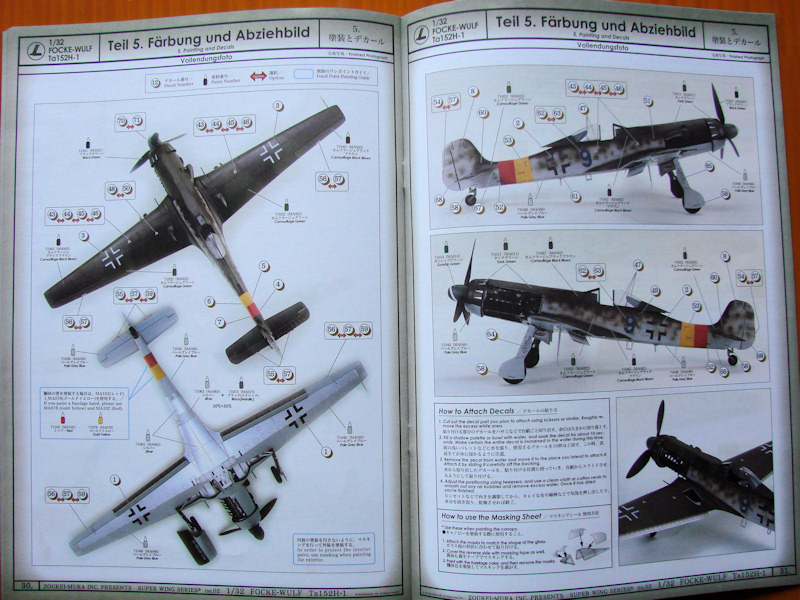
1/32 Focke Wulf Ta 152 H-1 Zoukei-Mura kit

Super wings Series Ta 152 has arrived !

"..Furthermore, I want a “plastic model” worth dreaming about, one where you can finish construction using the same process as if you were building the real aircraft!
I wonder exactly how much time has passed by since I embraced this longing.
Through the act of construction, it's possible to study the airframe structure, and understand the configuration and workings of various parts as they're being assembled. It's also possible to understand what kind of uses and tactics the strongest reciprocating engine fighter was designed, manufactured, and deployed for, simply from the equipped weapons.
Why the engine, the cockpit, the landing gear and the propeller took the forms that they did, why it was implemented in the season that it was, why it vanished so quietly. The time for these dreams of mine to be realized has finally arrived.

The time has finally come for all of the yearning feeling that has been poured into Tank's 152, all of the burning longing, to be fulfilled..."


Model build by Manu Pernes on britmodeller

For more on this kit, some completed examples and Ta152 reference on this blog go  here

Tuesday, 27 April 2010

Towards perfection ? the Focke Wulf (Tank) Ta 152 (Reschke, Cescotti, Keil, Aufhammer) - last edit March 2016

Fighter ace Walter Nowotny taking a close look at one of the Höhenjäger test beds. The Fw 190 V32 ‘GH+KV’ was designed as a DB 603 S-1 powered high altitude fighter and was one of Tank’s many projects powered by the big 445-litre DB 603 engine-even though the official view favoured the Junkers 213. Note the four-bladed propeller and pressurized cockpit. This machine would later be re-built as a Ta 152 prototype.


The Ta 152 had its origins in the long and complex list of experimental Fw 190 sub-types testing power plants, injection methods, supercharging, and aerodynamic properties in the high altitude fighter programme. There were two principal design avenues. The first of these was the Ta 152 C – essentially a FW-190D with the Daimler-Benz DB-603LA engine and 30 mm Mk.108 cannon - and the Ta 152 H high-altitude fighter, powered by the Junkers Jumo 213 E and featuring the long-spanned high aspect ratio wing.

There were many technical challenges to overcome in designing a fighter that would likely see combat at altitudes about one-third higher than either the Bf 109 or Fw 190 types already in production. But unlike the BV 155, a highly experimental, flying test-bed, in the end Tank's design simply joined a powerful engine, already proven in the Fw 190 D, to an existing airframe tweaked to perform at higher altitudes and slender high aspect ratio wings. The result was an aircraft faster and more manoeuvrable than the P-51 and the P-47.. The H model of the Ta 152 credited with a maximum speed of 472 mph at 41,000 ft, came close to the limits of what was possible using a piston engine.

The first Ta 152 series aircraft to leave the production line at Cottbus were a batch of 20 pre-production Ta 152 H-0s, which were delivered in October and November 1944 to Erprobungskommando Ta 152, commanded by Hptm. Bruno Stolle and based at Rechlin. This unit was responsible for service testing the new fighter although the pressure of events and the soundness of the design led Stolle to recommend a rapid introduction into service.


 It was not until late January 1945 that the first Jagdwaffe service pilots set eyes on the new Ta 152 fighter as related by JG 301 pilot Willi Reschke ;

“ On 23 January 1945 on orders from the OKL (Oberkommando der Luftwaffe) Jagdgruppe III./JG 301 was temporarily taken off operations and designated an Einsatzerprobungsverband, a combat test unit. We were to re-equip with the Ta 152 – something we’d long given up hoping for. In the early hours of 27 January we pilots were taken by truck to the Neuhausen aircraft plant near Cottbus with orders to ferry the new Höhenjäger to Alteno. Arriving at the airfield we were confronted with our first sight of the Ta 152 H-1, which with its enormous wingspan and lengthened engine cowl hardly looked like a fighter aircraft at all. With feelings of unease we walked around the machines drawn up in three rows (twelve aircraft in total). Technicians were on hand to answer our queries. After a talk on the technical aspects of the machines that lasted barely 30 minutes, we took the aircraft on charge.. I got airborne at 11:08..”

This is the only known photo of operational Ta 152s pictured here after their arrival at Alteno on 27 January 1945. Note that although the Ta 152s were attached to the GeschwaderStab and only delivered to III./JG 301 they are displaying a horizontal bar - probably yellow – over the rear fuselage bands. The second aircraft in the line-up may or may not be 'Yellow 1'.


Roderich Cescotti – a former He 177 pilot – served as Technical Officer with JG 301;

“ I flew a number of sorties on 4 and 7 April 1945 in the Ta 152 H-0 and H-1. The Jumo 213E’s three-stage supercharger and the long wingspan meant that the aircraft was highly manoeuvrable at both low and high altitudes up to 14,000 metres, an unheard of performance for a service machine at the time. We were clearly superior to the RAF Tempest as I witnessed when three Ta 152s of the Stab engaged the British machines on 14 April 1945 in a dogfight over Neustadt-Glewe…”

The pilots of III./JG 301 were eager to fly the new fighter in combat. A first combat sortie was flown on 8 February but did not result in contact with the enemy. The nearby city of Dresden had been pounded to destruction during the night and early morning of 14 February 1945 by RAF Bomber Command and the US 8th Air Force but III./JG 301 had been forced to stay on the ground even though the explosions detonating in the city could be heard on the field at Alteno. On 18 February the Stabstaffel shifted to Sachau, west of Berlin in order to exploit the possibilities for combat over the Hauptstadt and on 21 February encountered US bombers for the first time. During the ensuing combats, Oberfeldwebel Josef Keil flying "Green 3" claimed a B-17 shot down at 16:30 over Berlin. On 1 March Keil flew a sortie in the Kommodore's "Green 1" and claimed a P-51 over the same sector.


The first combat sortie flown by a mixed force of Ta 152 Hs and Fw 190 As of III./JG 301 had taken place on 2 March 1945. That day a powerful 8th Air Force formation of some 1200 bombers screened by over 700 fighters was dispatched to Böhlen, Magdeburg and Ruhland. Airborne from Sachau behind Verbandsführer (formation leader) Oberleutnant Stahl, some twelve Ta 152s climbed away southwards and prepared to do battle with the Mustang escort screening the bombers heading for the Bohlen chemical plant near Leuna. The sortie ended in disaster when the Ta 152s were engaged. Willi Reschke reported;

“ We reached grid square ‘Heinrich-Caesar’ now flying at an altitude of more than 8,000 meters and closed to formate with a Gruppe of Bf 109s that were wearing yellow and red fuselage bands. We could barely believe our eyes when, moments later, the first tracers split the air around us as Uffz. ’Bubi’ Blum’s Ta 152 came under attack. The 109s had opened up on us ! We could hardly return fire on Kameraden from our own Jagdgeschwader and the sortie ended in a complete debacle ”.

While the agility and superior performance of the Ta 152 allowed them to evade all of the "attackers", the chance to join combat with the P-51s was lost. In the event this sortie was one of the last to see large numbers of German fighters in the air in defence of the Reich. Thereafter most sorties flown were Jabo or Tiefangriffe, ground strafing on both Eastern and Western Fronts..

10 April 1945. It was already after 19:00 that evening when four Ta 152 H-1s of the Stab, led by the Kommodore, climbed away from Sachau on a patrol over the Braunschweig (Brunswick) area. 'Jupp' Keil takes up the story;

" We had reached an altitude of 10,000 meters when I sighted a group of Thunderbolts below us heading in the direction of the setting sun. They hadn't seen us. I immediately tightened up on Oberstleutnant Aufhammer's machine and with hand gestures - in order not to betray our presence by breaking radio silence - pointed out the enemy machines below us. The Kommodore initially appeared not to have understod what I was trying to tell him, forcing me to edge in even closer to him. This time he got the message. However his reaction was not at all what I expected. Gesticulating just as vigorously as I had, the 'boss' made it quite plain that if I wanted to go down after the P-47s then I was on my own. I quickly made my mind up and throwing my "Green 3" into a dive, plummeted earthwards at high speed to come in behind the P-47s ... I had been spotted, since the enemy fighters immediately went into a defensive circle. Closing at a great rate of knots I managed to line one of them up in the sight and squeezed off a brief burst from my three cannon. It appeared that my salvo had struck home. Before the P-47s had the chance to react, I had pulled the stick back and eased up into a long climbing curve to altitude. Two minutes later I had caught up my Kameraden with another probable kill to add to my tally..."

The final victims falling to the guns of the Ta 152 were Russian Yak-9s during the final days of battle around Berlin on April 30, 1945. Most Ta 152 Hs, however, were destroyed on the ground by Allied air attacks while awaiting delivery. A few Ta 152 Hs were allocated to the Mistel program. According to some sources, approximately 150 Ta 152 H-1 fighters were manufactured between January 1, 1945 and the arrival of Soviet forces at the Cottbus assembly plant although there is little firm information on numbers produced. Dietmar Harmann has listed Werknummern from 150-001 to 150-040 and 150-167 to 150-169 for a total of 43 aircraft. There is no information on WNr. -041 to -166. Some claim all 169 machines were constructed.

Just how good was the Ta 152 ?

With its scintillating performance, numbers of high performance Allied fighters fell to its guns in the final weeks of the war. The only recorded encounter with P-51s - other than Keil's claim above - is the incident noted by Kurt Tank himself, who had a narrow escape while flying one of his Ta 152Hs towards the end of 1944. Flying from Langenhagen near Hannover to attend a meeting at the Focke-Wulf plant in Cottbus his Ta 152 was apparently jumped by four Mustangs. According to his own account Tank activated his MW 50 boost, opened the throttle wide, and so the story goes, quickly left the Mustangs far behind in a cloud of blue smoke. It is of course worth pointing out that no one apparently witnessed this incident, either German or American. Respected 8th Fighter Command historian Danny Morris could not locate any USAAF report on it, and such an incident would surely have warranted such a report.

The successful combats against RAF Tempests referred to above by Cescotti took place at low altitude, and according to Reschke's account the Tempest pilot made several mistakes (relative to the Ta) which he was able to capitalise on. It is worth pointing out again that the Ta pilot knew exactly what to expect from the Tempest, while the Ta 152 was frankly an unknown quantity to the Tempest pilot. Then of course there is Walter Loos statement that he never downed an enemy aircraft while flying the Ta 152 in direct contradiction to Reschke's account as related in interview to Jean-Yves Lorant.

Until enemy pilots had some reasonable knowlege about the strengths and weaknesses of the Ta, combat reports of its "superiority" are questionable at best. While there may have been no more than 55 operational Ta 152's, there were never more than about 24 serviceable at one time. And they flew comparitively few sorties, perhaps a total of 500 or so, quite likely fewer. Until an aircraft has been in combat long enough for the enemy to have a reasonable idea of what they are facing, there is always an advantage to flying a new high performance fighter - it's an unknown quantity and the enemy pilots do not know what to expect from it. And although ultimately designed for high altitude combat, very few missions of this sort were ever flown.


....and as postscript, a brief note on Jerry Crandall's all-red Ta 152 "story.."

 Crandall posting on britmodeller; "...Both Oberstleutnant Auffhammer and Generalmajor a.D. Roderich Cescotti were highly regarded officers and command pilots and had no reason to make up a story regarding the short flight of the orange-red Ta 152. The complete story is told in our Ta 152 book and in volume 1 Dora book. The flight is recorded in Cescotti's Flugbuch documenting the date, time and destination plus indicating he flew his "Green 1" Dora 9 as escort. During one of our interviews Cescotti was very adamant about the exact color of the Ta 152 as technical officer he oversaw the mixing of color and painting of the Ta 152. I even took varying shades of orange-red painted on 1/72 Ta 152 models and he had no hesitation picking the color. During the 25 minute flight he explained he flew all around his boss's aircraft above, below and along side this unusually colorful machine. In the meeting with the Focke-Wulf engineers, Auffhammer made it clear in no uncertain terms that he was very unhappy with the nagging technical problems and slow delivery of the promised Ta 152s. The discussion became so heated Cescotti felt uncomfortable and quietly slipped away. When asked about Willi Reshke's comments about the this flight Cescotti replied; "We regarded Willi very highly for his dedication and ability we needed more like him, however looking at his Flugbuch he was not present that day we took the orange-red Ta 152 to Rechlin..."

So Crandall's evidence for the red/orange Ta 152 is the recollections (and signed 2001 statement) of Obslt. Auffhammer and Hptm. Cescotti, one stating that he flew it, the other that he escorted it. How much weight one gives to that evidence, or to Willi Reschke's subsequent rebuttal, is, I guess, up to the individual. Personally I discount it totally and utterly. Given the only barely superficial resemblance of the Ta 152 to a Fw 190 D, viewed at any distance, the 'precaution' of painting it overall -red seems overly elaborate in the extreme! But it's impossible to disprove something that didn't occur and for which the only 'evidence' has been 'produced' by the 'participants' themselves. Of course it's difficult to state that without inferring that some-one involved with the story and the artwork is "lying" and that would be a step too far. Possibly. Nor is it something that Cescotti and Aufhammer could simply have been mistaken about. As I say the more you think about it, it still seems a ridiculous way of protecting a Ta 152 on a 25 minute flight. No, I prefer to think that this was two elderly German gents way of simply having a little fun with this "Ami" colors 'expert'...the idea that they even 'picked-out' the 'right' shade of red, well, I'm not the only Luftwaffe enthusiast to find that quite hilarious!  And why suddenly should this artwork/profile be taken at face value for Crandall when he of all people would discount it without photographic evidence. A leading Luftwaffe author of my acquaintance - published by Crandall's Eagle Editions -laughed out loud when he first heard the story and saw the 'artwork'...oh and the new Kagero monograph on the Focke Wulf Ta 152 doesn't even mention the story, far less 'illustrate' it...so kudos to them!

Also on this blog; Walter Loos successful Ta 152 pilot JG 301 and Sturmjäger JG 300 - the case of the 'smoking' log book here