Showing posts with label Jagdfliegerverbände series. Show all posts

Monday, 10 November 2025

JG 27 Bf 109 G-6/AS - archive photo scan series #45


A line-up of Bf 109 G-6/AS fighters of 5./JG 27 seen in early summer 1944 at Fels am Wagram. ‘Black 14’ has the WNr. 412x29 (‘x’ is probably an '8' or even a '3'). The finish comprises an unusual 'snake' mottle along the fuselage sides extending to below the exhaust stacks. Note the curved 'shield' above the exhaust stack on the port side of the engine - designed primarily to prevent hot gases from being ingested into the supercharger intake, a feature of most Gustavs. Click on the image to view large..'Black 14' is illustrated by Claes Sundin in his 'Luftwaffe Fighter aircraft - Profile book no. 12'


Leaving Wiesbaden at the end of May 1944 for Unterschlauersbach (near Munich)  II./JG 27 was briefly subordinated to the JG z.b.V before going to Eisenstadt for rest and refit on 3 June. Just three days later D-Day brought this period to a swift end and the Gruppe was sent to Fels am Wagram as part of a Sammelgruppe for Western front fighter and fighter pilot replacements. A host of new machines was assigned to the Gruppe including their first G-6/AS fighters, with which they were due to be re-equipped. This period came to an end on 1 July. Assigned to 8 JD the Gruppe was scrambled against 15th AF raids heading for the south of the Reich and Hungary on no fewer than 13 occasions during the month and on a further four days was directed against 8th AF incursions over the Reich. During July the Gruppe claimed five bombers shot down for the loss of 33 Bf 109s - 19 pilots were killed and 7 wounded. A further (approx) 20 Messerschmitts were lost in accidents! 

" ..after one month of operations following refit [during the summer of 1944], combat readiness [of II./JG 27] had already shrunk to Staffel strength level.." 

(adapted from Jochen Prien's JfV Teil 13/V p283-284)

Sunday, 7 September 2025

JG 77 Herz As in the 'East', January -February 1945 (Bf 109 K-4)

From the Luftflotte 6 KTB, 25 January 1945


.. a partial listing of just some of the units transferred to and/or already operating on the 'Eastern Front' in late January 1945 included the three Gruppen of JG 77...


Below; Uffz. Alfred Nitsch - former recce pilot and instructor - in the cockpit of his 12./JG 77 'blue 3' at Neuruppin, late October 1944. The aircraft is K-4 WNr. 330177 which was lost during the Ardennes campaign on 23 December at Houverath with Fw. Hans Rossner at the controls. Note the 'Deutsche Luftwaffe' armband over Nitsch's flying suit, worn to identify the wearer as a Luftwaffe pilot to German civilians. The antenna mast is visible on the folding hood section, a feature of an early series machine.  Previously published on the cover of 'Avions' magazine No. 243 - the first part of an extensive three-part feature on the Bf 109 K-4 in combat. (This issue was 'notable' in the long history of 'Avions' magazine for the being the first to feature the same aircraft type on consecutive magazine covers, in this instance a Bf 109 K-4 of III./JG 77).


The last fortnight of 1944 operating over the Ardennes and western Germany were some of the hardest days yet endured by the men of JG 77 -  there was hardly a single sortie flown that was not marked by heavy losses. In total that short period saw 26 pilots killed, 13 seriously injured and one taken captive and around 80 Messerschmitts lost! No fewer than 26 of these were III. Gruppe Bf 109 K-4s. Among the losses were the Gruppenkommandeur of I./JG 77 Hptm. Lothar Baumann, the Staffelkapitän of 2./JG 77 Oblt. Iring Englisch (replaced by Lt. Ulrich Peiper), and 133-victory ace and Geschwaderkommodore Maj. Johannes Wiese. Ordered up by Galland on the morning of 25 December, and heading north-west over the Ruhr at 8,700m, Wiese and what was left of his Stabsschwarm (Fw. Hansch) failed to rendezvous with I./JG 77 over Duisberg and found themselves caught up with 401 Sqd Spitfires over Euskirchen;

" ...Flying at about 8700 m over Duisberg, I saw the Rhine in front of me and a little behind me - flying from west to east - enemy fighters. After a brief wing waggle, I immediately made a steep turn to the left towards their formation and, as I started the attack, I recognised further aircraft, now clearly identified as Spitfires, above, below and beside me. In the course of the ensuing sharp turn, I had difficulty jettisoning my drop tank. Behind me I saw a machine burning brightly. This was probably Fw. Hansch's aircraft. Despite all my evasive manoeuvres I came under repeated attack from all sides, received hits in the engine, a hit in the cabin and felt several impacts in the fuselage and tail. I had thrown the machine into such wild manoeuvres that it was now out of control. With the cockpit icing up and the engine smoking and losing power, I decided to parachute clear.." 

Hansch had been quickly shot down and killed. Wiese bailed out but his chute failed to correctly deploy and the Kommodore was badly injured in the heavy landing.. On 31 December one of the last 'veterans' of 11./JG 77, Fw Karl-Heinz Böttner, led a recce Rotte in the direction of Münster. Both Böttner (Bf 109 K-4 'yellow 2', injured) and his wingman Lt. Gerhard Eck (Bf 109 K-4 'yellow 12', killed) were shot down by Spitfires..

On 1 January JG 77 flew the Bodenplatte mission  against Allied air bases in Belgium (mostly) -  JG 77 took part in a futile 'raid' on the airfield at Deurne (Antwerp). Kapitän of 11./JG 77 and leading III. Gruppe on the operation against Deurne  in his Bf 109 K-4 "yellow 10", ace 'Heinz' Hackler was hit by anti-aircraft fire and failed to return. Johann Twietmeyer at the controls of his K-4 'red 7' was hit by ground-fire while strafing an American road column during the raid. He made a forced landing in a field (Rosendaal) and escaped unhurt. Although ‘Bodenplatte’ was an abject failure for JG 77, taken as a whole the operation nevertheless put a brake on Allied air attacks in the early days of 1945. JG 77 took advantage of the situation to organise ferry flights of Bf 109s from factories. On 2 January, two I./JG 77 pilots were killed during these delivery flights. At the end of the first week of January, support operations over the Ardennes resumed. By this time, the German offensive in the Ardennes was in its final days.

14 January 1945 saw major battles in the air over the south-eastern corner of Germany. I. and II./JG 77 operated primarily to counter Allied ‘Jabos’ around Bastogne and St. Vith. While I./JG 77 suffered two fatalities over Münster/Düsseldorf, II./JG 77 had six killed and four wounded including Uffz. Fritz Giere who was forced to bail out of his G-10 in the region of Hamm (presumably Hamm am Rhein, a municipality south of Darmstadt). According to the loss listing Giere was shot up under his chute and came down in the Rhine and drowned. A Spitfire and a Beaufighter were claimed by II./JG 77.

On 15 January I./JG 77 received orders to transfer to the East, under new Kommodore Maj. Erich Leie - previously Kommandeur of I./JG 2 and high-scoring ace with JG 51 in the East (117 claims by October 1944). Below; part of a photo-set to mark the award of Leie's RK (21 victories) taken on August 1, 1941.


The stragglers reached Ohlau on 18 January (today Olawa in south-west Poland) some 25 kms south-east of Breslau (Wroclaw). Recently appointed Kommandeur of I./JG 77 was 15-victory ace and former Staffelkapitän of 6./JG 77, Hptm. Joachim Deicke. Kommandeur of II./JG 77 was Maj. Siegfried Freytag and III. Gruppe was led by Hptm. Armin Köhler. As with all the other fighter Geschwader hurriedly transferred to the East, the three Gruppen would be tasked with Straßenjagd - strafing road columns. (according to Lft 6 figures over 4,000 sorties were flown by fighter Gruppen in the East  during January 1945 - for just 134 victories, which suggests that either combat was avoided or the Soviets were not flying much in the poor weather or both. Either way, not an indicator of 'air superiority'. See Prien JG 77 Teil 4, p2280 )

 The last JG 77 pilot lost in the West during January was Gefr. Hans Körner who was killed in the crash of his G-14 'blue 9' on 24 January near Gütersloh (Verl) during the transfer flight.(shot down according to one source)

The situation on the 'Eastern Front' was catastrophic. The pilots of JG 77 flew several sorties per day, with the futile aim of slowing the Soviet advance. Casualties, mainly due to the Red Army's solid anti-aircraft fire, were severe and the incomplete official lists for this period give only a small idea of the scale of the losses. Nevertheless, although the Soviet air force enjoyed numerical superiority equal to that of the Western Allies, a handful of German aces continued to add to their scoreboards - undoubtedly due to the fact that the Soviet Boston and Pe-2 medium bombers were, for example, less ‘sophisticated’ than the B-24s and B-17s of the US bomber formations and the Soviet pilots less well trained (even if they were more of a handful than those encountered during ‘Barbarossa’).

On 30 January, Lt Walter Wildenauer (11./JG 77), who had already been shot down and wounded on 23 December, disappeared during the strafing of an anti-aircraft position in the Ratibor region. Lt Gerhard Staroste, a veteran of 2./JG 77, was wounded. The next day, Fw Gerd Lenke (3./JG 77) disappeared south-west of Gleiwitz (now Gliwice); the same fate befell Uffz Walter Wawoczny (12./JG 77) and three pilots from II/JG 77. The losses were not only the result of enemy action. On 31 January, Uffz. Gerhard Letzbor (8./JG 77) took off from Beneschau. The three Staffeln were set up in a triangle at the edge of the runway. In the event of the entire Gruppe being ordered up they were supposed to taxi out in turn. The signal was given too early for 6./JG 77, who started up the engines of their Bf 109s and began to move out onto the strip. Meanwhile the hapless 8. Staffel pilot had only just lined up at the threshold. Moments later Letzbor's G-10 ploughed into another Bf 109 in the middle of the runway. (Zusammenstoß Start)  The injured pilot was evacuated to a hospital in Prague, where he was later captured by Soviet troops. By late January I./JG 77 was split between Beneschau and Prerau. II./JG 77 was in Beneschau (today Benešov, a town in the Central Bohemian Region of the Czech Republic). III./JG 77 was in Proßnitz, some 200 kilometres east of Prague.

 According to Uffz Bartholomäi (8./JG 77) the mood among some JG 77 pilots was relatively upbeat, despite the atmosphere of defeat, fear and gloom;

 '..contacts with the Czech people were excellent. I stayed with locals in Buslawitz, near our Beneschau airfield. Food and drink were plentiful. Although it may seem surprising at the moment, our morale was high, as was our spirit of comradeship. We continued to believe in final victory against all odds. I did relatively little ground strafing, most of our missions were free hunting and escorting bombers or fighter-bombers (including Rudel's unit). In our spare time, we played cards, listened to music or wrote letters to our families '. 

Even so, Bartholomäi was shot down three times in the East. He had to parachute once and made one belly-landing at Beneschau, getting clear of his Bf 109 just before it exploded. 


Also on this blog;


As usual, thanks to Jochen Prien and team for presenting all the data featured in posts like these in their Jagdfliegerverbände series, most notably here in JfV 13/VI 'Einsatz in der Reichsverteidigung und im Westen' and the forthcoming Teil 16/I 'Einsatz an allen Fronten', the first of two volumes to cover 1945. The JfV series is available directly from the publisher at jagdgeschwader.net

Thursday, 3 August 2023

JG 52 Crimea/Ukraine January 1944 Kriegstagebuch (KTB, war diary) extracts - Jagdfliegerverbände volume Teil 15/II 'Einsatz im Osten'


As far as I know there is no actual JG 52 KTB although there exist various attempts to compile something that looks like one from different sources, most notably at jg52.net. I've compiled what follows using the new Prien/Stemmer/Balke/Bock JfV volume. My copy of JfV Teil 15/II was purchased from jagdgeschwader.net - brilliant service as usual from Buchverlag Rogge. 


KRIEGSTAGEBUCH JG 52 (KTB –War Diary extract)

 
During late 1943 the Germans (and their Romanian allies) withdrew from the Taman peninsula (Kuban bridgehead) while the Soviets mounted two amphibious landings across the Kerch Straits on the eastern coast of the Crimea as a prelude to conducting operations aimed at re-taking the entire Crimea peninsula. The southern, diversionary assault took place around the small town of Eltigen (now part of the city of Kerch) and the northern, main assault landed at Yenikale. During December 1943 the Soviets suceeded in establishing and reinforcing this beach-head and managed to push a few miles inland to the outskirts of Kerch.

During this period at the turn of the year 1943-1944, JG 52 under Kommodore Hrabak was based in the southern sector of the Eastern Front (Luftflotte 4) and came under Deichmann's I./Fl-Korps. Its constituent Gruppen flew  'free hunt' and 'bomber and Stuka escort' sorties. Increasingly they were scrambled to counter enemy ground-attack and bombing raids on their own airfields. 

III./JG 52 was based at Apostolowo on the lower reaches of the Dnieper some 40 kms south-east of Krivoi Rog on the rail line from Krivoi Rog to Saporoshje in southern Ukraine.  I./JG 52 was based at a field strip north of Kirovograd in Malaja Wiska (or 'Malaya Whiskey', southern Ukraine) while II./JG 52 was at Bagerovo, 5 miles west of Kerch under Hptm. Barkhorn. The 'Stukas' of II./SG2 (Fw 190) and III./SG 3 were also here, so within very easy reach of the front-lines. Weather conditions throughout January were unsettled and very changeable.  


Wednesday, 5th January 1944

After returning from a sortie with engine damage following combat with Il 2s, Ltn. Gerhard Schindler, leader of 7. Staffel, crash-landed and turned over his Bf 109 G-6 ‘white 9’ on the strip at Apostolowo. Visibility and field conditions were poor.

Friday, 7th January 1944

Apostolowo had to be evacuated as the tank spearheads of the 2nd Ukrainian Front pushed nearer. III./JG 52 shifted to Malaja Wiska, a field strip (Feldflugplatz) 35 kms north-west of Kirovograd in central-southern Ukraine. Possibly during the ferry flight, 8. Staffel ran into Airacobras around 30 kms south-east of Kirovograd. ‘Black 2’ flown by Uffz.Manfred Maiwald received a radiator hit and dove away trailing a banner of white smoke. His fate is uncertain. In the late morning 9.Staffel’s FhjFw.Herbert Bachnick claimed all five Il 2s shot down (between 11:22 and 11:49) during the first sorties flown over the Kirovograd area. The Staffelkapitän of 8./JG 52 Lt. Friedrich Obleser claimed the sole Airacobra to go down for his 83rd. Lt. Erich Hartmann, leading 9. Staffel, downed a LaGG at 14:20 and and a second five minutes later for victory nos. 161 and 162 in further combat over the Kirovograd region.

Saturday, 8th January 1944

Uffz. Heinz Ewald had been assigned to the Gruppenstab of II./JG 52 during the fall of 1943 and flew many sorties during this period as wingman to the Gruppenkommandeur Hptm. Gerhard Barkhorn. After his 8th victory - a Yak 1 over Bagerovo on an unknown date during January 1944 - Ewald was awarded the Iron Cross II. Class.

Sunday, 9th January 1944

After Russian tanks with infantry had liberated Kirovograd during the course of the day the first tanks were reported approaching German positions at the airfield of Malaja Wiska in the middle of the night. Ground personnel of III. Gruppe were deployed infantry-style to defend the airfield. Oberlt.Max Geissler and Ogefr. Xaver Tafler, both of the Stabskompanie, were killed in action. As many as seven Bf 109s were damaged. The Gruppe shifted to Novo-Krasnoye some 60 km south-west of Kirovograd

Monday, 10th January 1944

II. Gruppe reported 3 total losses. At about 08:00 Uffz. Heinz Janssen, 4. Staffel, was shot down and killed 1 km north of Katerles (ws. 8+ -). Fw. KarI- Heinz Otten, 6. Staffel, was shot down at 09:55 in dogfighting with Russian fighters east of  Cape Tarchan and has been missing since (ge. 4+ -). At about 11:50 Ofw. Karl Dannecker in 'black 9' failed to return after combat in the Bulganak area and was reported missing. 

Tuesday, 11th January 1944

Uffz. Herbert Deicke of 1. Staffel was KIA in combat with four Yak 1 fighters south-west of Bogodarewka. 2. Staffel reported Fhj. Gefr. Siegfried Hoffmann missing in action. He was last seen by comrades south-west of Kirovograd. Ltn. Helmut Lipfert, 6.Staffel leader, shot down a P-39 near Kerch at 11:27 for his 81st victory.

Wednesday, 12 January 1944

Early morning clashes saw elements of all three Staffeln of II./JG 52 in action against Schlachtflieger and their escorts. Contact with the enemy was made at around 06:50 north-east of Yeni-kale (Kerch strait) with a Boston formation escorted by Airacobras. Four victories were claimed – one Boston and one Airacobra by Lt Heinrich Sturm of 4./JG 52 (his 83rd and 84th), a Boston for Lt. Otto Fönnekold of 5.Staffel  (his 99th) and a single Airacobra for Uffz. Friedrich Haas for his fourth at 06:55. As early as 06:20 Uffz. Robert Hahn, 6. Staffel, was shot and wounded over the Cape Tarchan bridgehead. He belly-landed his ‘yellow 7’ on the ‘Hauptverbandsplatz’ (main runway) at Bagerovo where first aid was administered. At 06:50 Uffz. Ludwig Buchheit, 5. Staffel, was wounded west of Bakssy (north-east of Kerch) at the controls of his ‘black 7’ and carried out an emergency landing in German lines.

At 13:20 elements of II. Gruppe were scrambled behind the Kapitan of 6. Staffel (Lt. Helmut Lipfert) to counter an Il-2 formation under fighter escort. Combat was joined at around 13:45 north-west of Yeni-kale – Luftkampf mit vielen Il 2. Two Abschüsse were reported –an Il-2 and an Airacobra – the 100th and 101st claims for Lt. Otto Fönnekold of 5.Staffel .  Obfhr.  Helmut Thomas, 6. Staffel, was shot down and killed in combat at the controls of his ‘yellow 8’ coming down some 4 km north of Kerch.

Thursday 13 January

Despite poor weather conditions II./JG 52 flew escort for Stukas operating over the front in the eastern Crimea. There was little contact with the enemy. Fönnekold claimed a Yak 1 at 07:20 in the vicinity of Yeni-kale (Kerch strait). Similar sorties were flown the next day and the day after with only a handful of encounters.

Saturday, 15th January 1944

Fhj. Fw Peter Düttmann of 5./JG 52 claimed an Il-2 for his 28th (Cape Tarchan). Fhj. Fw. Hermann Wolf (9. Staffel), downed two Airacobras (9:52 and 10:01) for his 51st and  52nd victories..

Sunday, 16. January 1944

Lt. Kurt Klimann, 2. Staffel, failed to return from a sortie. He was last seen by comrades west of in combat with two Airacobras. Chasing an enemy fighter over the front lines his 'black 3' (WNr. 140217) came under heavy anti-aircraft fire south-east of Karlowka.   When Lt. Plücker gave the order to re-assemble, he acknowledged audibly. A short time later, Lt. Klimann could be heard a few more times, but only very weakly. Combats against Soviet fighters, bombers and ground-attack aircraft were widespread west and south-west of Kirovograd as the Soviet army pushed forward and some 16 claims were filed in total - Karl-Heinz Plücker downed two Il-2s, one at 10:22 and a second at 10:45, 18 km south-west of Kirovograd, his 25th and 26th.

At 09:34 Ltn. Franz Schall, 3. Staffel,  downed a  Yak 9 and at around midday returned three more victories – Airacobras at 11:51 and 11:52 and three minutes later an La 5 for his victories 30 – 33. Lt. Johann-Hermann Meier (3.Staffel) downed a Yak-9 at 09:30 and an Airacobra at 11:50 for his victories 74 and 75. He claimed a third for the day at 11:52.

Monday, 17 January 1944

I./JG 52 flew sorties north of Kirovograd, claiming a further ten victories including four R-5s for Ofw. Franz Woidich (3.Staffel) for his victories 63-66.

Thursday, 20 January 1944

Uffz. Alois Seibel, 3. Staffel, killed. When downing a Boston 5 km west of Darjewo his Bf 109 took hits. About 10 minutes later, on the return flight, his machine suddenly exploded.

Sunday, 23 January 1944

II./JG 52 put all available machines in the air on 'free-hunts' and Stuka escort duties. Late the previous evening a strong Soviet landing force had come ashore north of Kerch. Hptm. Gerhard Barkhorn, Kommandeur ll. Gruppe, returned from his 1,000th enemy flight (Feindflug). He was the first fighter pilot to achieve this high number of combat sorties. His three Yak-1 claims on this date took his victory total to 238. His Rottenflieger Uffz. Heinz Ewald filed his 9th claim. Fhj. Fw. Heinz Sachsenberg, 6. Staffel, shot down an Airacobra at 07:25 for his 60th victory.
Elsewhere Lt. Erich Hartmann in combat around Kirovograd downed four LaGGs to take his total to 176. 

Tuesday, 25th January 1944


Continuing sorties flown over the Kerch bridgeheads. Lt.Helmut Lipfert, Kapitän of 6. Staffel, attacked a Boston bomber formation, shooting down one of the escorts - a Yak 1 at 12:27 - and a Boston at 12:40 for his 87th and 88th victories. I. Gruppe flew into Bagerovo to support in the defensive battles over the eastern Crimea.

Thursday, 27th January 1944

Free-hunting and Stuka escort over the front-lines north of Kerch. Lt. Franz Schall, 3. Staffel, flew a ‘free hunt’ with his Rottenflieger, Uffz. Anton Resch, in the Kerch (Kertsch) area. Over Kerch, Luftkampf (air combat) with 6 Airacobras, during which Uffz. Resch was wounded. He pulled off an emergency landing. In a combat over Kolonka, at about 06:45 Uffz. Ludwig Vogel of 5.Staffel was slightly wounded. In mid-afternoon I./JG 52 was forced to evacuate Bagerovo for Grammatikovo.

Friday, 28 January 1944


Award of the German Cross in Gold:

Oblt. Wilhelm Batz, Adju. ll. Gruppe;

Lt. Helmut Lipfert, Kapitän 6. Staffel;

Ofw.Walter Janke, 2. Staffel pilot

5 February 1944

Early February saw poor weather over the Crimea - fog, heavy rainfall and low cloud - with only a handful of sorties flown. On 4 February elements of II./ JG 52 were ordered to the west coast via Grammtikovo-Karankut-Kunan in anticipation of air attacks and some machines flew on to Chersones on the south-east tip of the Crimea in the vicinity of Sevastopol. On this date Fw. Hans Waldmann of 6./JG 52 (temporarily detached as Jagdlehrer –instructor- to Erg. Gruppe Ost) received the Knight's Cross for his 85 Luftsiege. Promoted to Kapitän of 4./JG 52, he accumulated 40 more victories over Soviet aircraft before fighting in June 1944 in Normandy.

On 12 February Einsatzschwerpunkt for II./JG 52 was still the eastern Crimea. Some 19 claims for enemy fighters downed were filed, including the 250th for the Kommandeur.  

In three sorties on February 26 west of Kirovograd, Lt. Erich Hartmann (Kapitän 9./JG 52) claimed 10 victories, including 5 in an 15-minute period around mid-day and his 200th that afternoon. On March 2, he was awarded the Oak Leaves for 202 victories, including some 24 returned over the previous two months.The weather and ground conditions were poor during this period as Kommandeur III./JG 52 Rall recalled;

"..the endless mud and slush settled into the radiator and undercarriage during taxying and takeoff, so that numerous sorties had to be broken off as the landing gear of our Messerschmitts could not be retracted or else coolant temperatures climbed into the red. We tried to keep taxy times to a minimum by sometimes getting airborne directly from our dispersals. The mud meant that fuel tankers couldn't get to the machines which had to be refuelled from drums taken out by horse-drawn carts. From 8 February even tracked vehicles couldn't get through the morass which meant pilots and crews had to struggle up to five kms through the knee-deep mud on foot to get from our accomodation to the aircraft and back ."


Above;   Summer 1944, Kommodore JG 52 Hrabak's Gustav. Note Erla hood and Kommodore chevron(s)+ bar(s)..(old ebay auction. These and others are published in Teil 15/II).

Also on this blog;

Hrabak and Hartman toast Hartmann's 300th
https://falkeeins.blogspot.com/2016/08/late-war-9jg-52-film-footage-hartmanns.html

Compiled from the new Jagdfliegerverbände volume Teil 15/11 'Einsatz im Osten'  1 January -31 December 1944. 


Saturday, 18 March 2023

JG 11 Fw 190 'low-viz' camouflage schemes

On page 38 of his book 'Frontal durch die Bomberpulks' Fritz Engau (I./JG 11) writes;

"...When I arrived at I./JG 11 in early 1944 a number of our Fw 190s, including the Kommandeur's machine, had been sprayed in a light grey scheme overall, toning down the usual mottle finish, while on all our machines the Haken- and Balkenkreuze were only barely visible ('schwach erkennbar')...It has often been imagined that this unusual finish served as 'camouflage' (in 'English' in the German text) so that our opponents would find it harder to pick us out as German machines in the air..[..] You could hardly disguise the distinctive form of the Fw 190 or the Bf 109 in the air. In addition all JG 11 fighters displayed a yellow fuselage band which was highly visible. Ultimately the reasons for adopting the finish were obscure and it can be supposed with a certain degree of certainty they probably had more to do with  testing of colours/paint finishes- than any other consideration. Certainly at the time the subject was not one we pilots discussed....."

The images below are just two from a series that appear in the outstanding Jochen Prien Jagdfliegerverbände series (Volume 13, 1944 - Defending the West) depicting III./JG 11 Fw 190s with over-painted crosses. Note on the 'overhead' photo the wing crosses are just visible...


Also on this blog;

JG 11 Gustavs defending the Reich 1943, Jochen Prien's Jagdfliegerverbände series

'Frontal durch die Bomberpulks' Fritz Engau (I./JG 11)


Monday, 15 August 2022

Teil 15/I 'Einsatz im Osten' - a new title in the Jagdfliegerverbände series - Prien/Bock/Balke/Stemmer


On 22 June 1941 the Jagdwaffe deployed some 20 fighter Gruppen in the East for Barbarossa, around 1000 aircraft more or less. This was a rather lower figure that the numbers of fighters deployed for the campaign in the West during 1940!  Barely three years later - and leading up to the massive Soviet  'Bagration' summer offensive - the Jagdwaffe had just 11 Gruppen and several 'independent' Staffeln available to cover the entirety of the Eastern Front -just over 300 serviceable fighters, some 75% of the total on strength in the East.  A 'Luftlagebericht Ost' dated January 2, 1944 put Soviet strength at 12,000 aircraft of which 4,500 were fighters. In fact the entire fighter arm of Luftflotte 6 in the middle sector of the Eastern Front, the Schwerpunkt of the 'Bagration' offensive, comprised the Stab/JG 51, I./JG 51 and several Staffeln, for a total of no more than 50-75 serviceable fighters. As at least one author/researcher has already pointed out, this was not necessarily the result of losses sustained or Soviet 'dominance' - even if the new 'Jak 9' and La 5 fighters arriving at the front to replace the MiG-1 and LaGG-3s were at least comparable to the Bf 109 G-6 or Fw 190. Entire Geschwader like JG 27, JG 3 and most of JG 77 had been moved to theatres in the West - Africa, the Mediterranean, the Defence of the Reich - because of the pressure being exerted by the Western Allies. Even the Geschwader left in the East during 1944 were not at full strength -  Staffeln went to the West as the military situation there worsened - 2./JG 51 under Oblt. Horst Haase was sent to join IV./JG 3 during May 1944 and  Staffeln from JG 51 and JG 77 went to join JG 1 and saw action in Normandy. Pilot strength in the East was further reduced as each Gruppe gave up a Staffel of pilots for the West in May 1944. III./JG 11 arrived in the East during June 1944 while II./JG 51 did not serve in the East until September.  Since the turn of the year the Luftflotten had been forced to deploy their meagre fighter resources piecemeal at 'crisis' points along the front, while the rapidity of the Soviet ground advance was such that those Gruppen present in the East were forced to fall back far to the West - as early as February 1944 in the southern area IV./JG 51 shifted to Orscha, followed in March by II./JG 54. From the same airfield I./JG 51 covered the left wing of HGr. Mitte as well as 16. Armee on the right wing of HGr. Nord. 

Below; from a PK photo series (Opitz) depicting G-6s of 3./JG 51,  'Brown 11' (WNr. 410 827) is being refuelled probably at Orscha in early 1944. (see pages 274 - 282 of Teil 15/I). Note yellow spinner.


Such was the dearth of Luftwaffe fighters on the Eastern Front that  a fighter training programme for the Schlacht Fw 190 pilots was implemented. 1./JG 51’s Günther Josten was seconded to Wilna, Latvia, on June 19 to train the pilots of II./SG 3 in the art of fighter combat. In his diary he described what happened on a training sortie flown a few days later on June 21, 1944 in collaboration with KG 1 Heinkel He 177s, part of a Luftwaffe long-range bomber force being assembled to strike at Soviet industry and production in the East:

“After an hour in the air a report came over the radio – 150 ‘furniture vans‘ (‘dicker Möbelwagen’ or ‘Viermots’) sighted 20km south of Warsaw heading east. The news left us dumbfounded. We were flying at 4600m altitude when suddenly we caught sight of the formation below us. It was the first time I’d ever seen anything like it. We overtook the formation and then turned around to attack them from head-on. I took my Schwarm directly through the bomber formation and brought effective fire to bear on two of the machines, one of which was left trailing a thick banner of smoke. By this stage we were running short of fuel and had to turn back for home..."

This was JG 51s first encounter with US 8th AF bombers and their P-51 escorts, the Americans en route to Poltava in the Ukraine on their first 'Frantic' shuttle mission -– from England.. I./JG 51 claimed two P-51s, one falling to the Staka 3./JG 51 Oblt. Walter Wever (his 37th)  while Uffz. Hans Stroinigg claimed the second P-51 along with a ‘Fortress II’ (his 11th). The following night Poltava and Pirjatin were raided by a force of IV. Fliegerkorps medium bombers and some 54 B-17s and 15 P-51s were destroyed on the ground.

The following day, June 22, the Soviet 'storm' 'Bagration' broke – four Soviet ‘Fronts’ launched against Army Group Centre initially aiming to re-take Minsk. The Gruppen of JG 51 found themselves in the direct line of the Soviet offensive in Orscha, Bobruisk and Mogilev and were forced to hastily fall back to the other side of the Polish border while claiming 33 victories without loss on June 23, including eight for Lt. Wilhelm Hübner in three sorties and five for his Staka Hptm.Edwin Thiel of the Stabsstaffel. Josten returned his 92nd and 93rd. 

German fighter defences  though were hopelessly inadequate. Some 140 'kills' were claimed during the period 22-30 June over the area of HGr. Mitte - while the Red Air Force flew  over 25,000 sorties! A German 'air situation report' dated July 1, 1944 estimated Soviet losses  for the four days from June 22-26 at just 0.8% of the aircraft committed. Front-line Soviet combat strength was now estimated to be 17,200 aircraft. So weak were the German forces that the entire front was broken through within a week and some 28 German divisions were destroyed. Eichenlaub holder Thiel (76 victories) was shot down and killed strafing a Soviet column on July 14 near Kobryn. The offensive ended in late August as the Russians were stopped at the Vistula river (Weichsel) on the East Prussian border and in front of Riga, Latvia. 

 This latest volume of Jochen Prien's mammoth history of the Luftwaffe fighter units, Part 15 Vol I reaches the Eastern Front 1944 - Operations in the East - 1 January to 31 December 1944. It is of course virtually impossible to 'review' these volumes - it will require months of careful reading to get the most out of history like this. (..the preceding paragraphs are based on data presented in the book)  Suffice to say that this is another 500-page tome from the Prien team filled with exceptionally detailed data from sources most of us are never likely to see and some 240 rare photographs. The major part of the text focuses on JG 51 (pages 211-493) - as there is no Geschwader 'history' as such -apart from the old Aders/Held title - most of this section is 'new'. The overview of the course of the ground fighting amounts to 25 pages - covered is the area of HGr. Süd in the first half of 1944 until the beginning of the Soviet summer offensive, ground operations by HGr. Mitte in the first half of 1944 until the beginning of the Soviet summer offensive and similarly in the area of HGr. Nord in the first half of 1944. The Soviet summer offensive against HGr. Mitte and the fighting on the northern section of the Eastern Front after the beginning of the Soviet summer offensive is also outlined, as is the fighting in the southeast - Romania and Hungary. This opening text section on the ground fighting is followed by an overview of the fighter units' operations in the East - 1 January to 31 December 1944, before the 'meat' of this volume - individual Gruppe histories for the period covered, starting with JG 5. Along with the usual loss/victory reports for the individual fighter Gruppen operating in the East through 1944, the operations of each are described through the Luftlagemeldungen (air situation reports), personal diary accounts (Josten, Schack) and log-book records. The so-called 'Startkladde' daily ops record for 7./JG 51 for the first five months of 1944 is published in full. Units covered in Teil 15/I are JG 5, III./ JG 11 (more over-sprayed Balken- and Hakenkreuze) and all four Gruppen + the Stab of JG 51. The Stabsstaffel JG 51 (190 Jabos) is covered over 45 pages.


Below;  seen left is Gruppenkommandeur III./JG 51 Hptm. Diethelm von Eichel-Streiber in front of G-6 'white 1' (WNr. 411 123) formerly on the strength of 7./JG 51 but transferred to the Gruppenstab when 7.Staffel was moved to West during May 1944. The Kommandeur himself was posted to the West in late August to take over I./JG 27  (partial caption info from Teil 15/I)


Below; seen in East Prussia/Lithuania is 'Black 1' flown by StaKa Lt. Anton Hafner 8./JG 51 during the summer of 1944 with tall tail, yellow spinner and rudder.


The publisher's website is jagdgeschwader.net

read our Luftwaffe blog interview with Jochen Prien here


Tuesday, 4 May 2021

New books - new and forthcoming from LeLa Presse, Arès and the latest JfV from Jochen Prien


Another excellent title in the ‘Batailles Aériennes’ series, personal accounts, artworks and an excellent selection of images. Forthcoming from Peter Taghon, a new history of KG 6. Free postage on pre-orders up to publication date in June.


'Avions' issue 240 is another 'Aces' special - although I have to say that articles describing the events of various dates on which H-J Marseille was shot down are becoming as common-place as articles about his successes.. (cf. recent issues of 'Aces' and 'Flypast' magazines)


And the latest JfV title from Jochen Prien and team has arrived from Struve - Teil 14 covers ops in the Med through Jan-September 1944. At the turn of the year 1943-44 barely six Gruppen and less than 100 serviceable Bf 109s faced up to some 3,000 Allied aircraft that could be deployed over Italy - these included Gruppen from JG 77, JG 4, JG 51, and 10./ JG 301. II./JG 77 had only just given up its Italian Macchi fighters and had less than 10 Bf 109s on strength at the turn of the year while I./JG 4 had just two Staffeln.  Gruppen such as IV./JG 3, II./JG 27 and II./JG 53 had returned to Germany. The Med was a theatre much reduced in importance given events elsewhere and especially over the Reich itself. A considerably weakened Tagjagd was deployed over both the northern Italian industrial centres to counter 15th AAF raids and over southern Italy from where the Americans had started raiding both Germany and the oil fields of Romania from Foggia. Meanwhile the meagre Tagjad forces were also of course committed against Allied forces and in support of German ground forces attempting to hold a line south of Rome. At the start of the year the Allies flew huge numbers of sorties ahead of the landings at Anzio while the Tagjagd was far too weak to put up any effective opposition. On the morning of 22 January Lf2. flew just 154 Schlachtflieger sorties over the course of four missions while just 54 Bf 109s flew escort prompting the hurried re-deployment of III./JG 53 and II./JG 77 to airfields north of Rome. This took several days to achieve because of bad weather. Up to the end of January most sorties were escorts for SG 4 Fw 190s or 'free hunts' over the invasion zone and over Cassino and every sortie brought with it the usual toll of lost and damaged machines. During mid-February I./JG 2 arrived in Italy having been deployed to southern France to operate against the 15th AAF raids during January. .  On March 3, 200 B-17s and 80 B-24s escorted by 50 P-47s bombed rail installations and hubs in and around Rome- I./JG 2 claimed five  B-24s and four P-47s. Two were credited to FhjObfw. Siegfried Lemke taking his ‘score’ to 23 victories.  Uffz. Clemens Waltherscheid of 3 Staffel knocked down two Viermots. On March 14 the ace and Staffelkapitän of 3./JG 2 Hptm.  Adalbert Sommer was shot down and killed. Sommer had spent most of the war with III./JG 52 in the East and had returned his 52nd victory on February 29 and his 53rd on March 3.  For some time, Allied bombers had been flying intensive raids in the vicinity of Monte Casino, completely destroying the Benedictine monastery. I./JG 2 flew occasional patrols over the area and clashed with 25 Spitfires on March 17. Two victories were scored by Lemke (vs. 30 and 31) and Uffz. Wirtgen. On March 21, Uffz. Rudolf Wirtgen of 1./JG 2 became an ace after downing his fifth Spitfire in ten days.


 Below; part II of Jean-Louis Roba’s « La Luftwaffe en France 1939-45 » from publisher Arès - visit their website for page views and ordering info.  And the latest issue of ‘Iron Cross’. I definitely still do not like the ‘colorisations’ nor do I particularly like the artwork but this ‘special’ issue has a lot of good MvR content. 


Elsewhere Pen & Sword have a new photo-book from Terry Treadwell on MvR which includes the fake photo below. Unbelievable, as is the terrible caption  -  ‘MvR - an early ‘Hell’s Angel’ - what on earth were they thinking?


More Luftwaffe fighters in Profile from Claes Sundin - stunning!


Sunday, 30 August 2020

New from Éditions Arès- The Luftwaffe in France Vol I and Rogge Verlag, Jagdfliegerverbände der Deutschen Luftwaffe Teil 13 / VI


New from Éditions Arès  " The Luftwaffe in France - From the Phoney War to the invasion of the Unoccupied Zone";

From the publisher's blurb;

"...In 1939 and barely five years old, the German military air force, the Luftwaffe, was launched into what was to become World War II. With motivated and competent personnel, a strong command and good aircraft, the young Luftwaffe performed well during the first two years of the war. Forced to establish itself very largely in France in July 1940 against England, after the refusal of the British government to conclude a separate peace, it fought both day and night against Great Britain before undergoing a serious draw-down shortly before the invasion of the USSR in June 1941. The Luftwaffe was now reduced to a small size in France, but with the help of a few "key" units, the Luftwaffe continued to hold its ground against the RAF, both during the Non Stop Offensive at the end of 1941 and during the attempted Canadian landing at Dieppe in August 1942. In November 1942, the Allied landing in North Africa would force the Wehrmacht to occupy the 'zone libre' (unoccupied zone of southern France) while ensuring the air defense of Southern France. It was at this time that the lack of units and men was clearly going to be felt and, from this date, the Luftwaffe command based in France had to juggle with the meager units at its disposal. The Luftwaffe was not limited only to air detachments. In France were also present a variety of other air units - Flak, parachutists (Fallschirmjäger), airfield personnel (Fliegerhorst), signals (Nachrichten), etc. Their story is also told in this book illustrated with nearly 600 photos, many of them previously unpublished..."


Published during September 2020. Volume 1 available now for pre-order;

Publisher's website for ordering and page views is here

 Format 215 x 305 mm - Bound, hardcover, 196 pages, 600 photos, 7 color artworks. French text


Received here recently is Volume 13/VI of the enormous Jagdfliegerverbände series - indispensable for aficionadoes of the Luftwaffe fighter force, the Bf 109 or Luftwaffe history in general. Teil 13 - the defence of the Reich and operations in the West during 1944 - concludes with this latest volume from Jochen Prien and team. This volume is a 300-page large format hardback and principally covers JG 77, JG 300 and JGs 301 and 302 during 1944 in the defence of the Reich and over the 'Invasionsraum' where JG 301 in particular was active with many night-time sorties flown against the Allied bomber forces. Teil 13/VI also features additional chapters on the day fighter units operating over Norway, principally JG 5 and there is more photo material on a unit that was featured in early parts of this history, II.(J)/186 (T). Other units in this volume include the Erprobungskommando 262 and the rocket fighters of JG 400.


From Jochen Prien;

" ..JFV 13/VI, the final part of the coverage of Luftwaffe fighter operations over the Reich and the West in 1944, has now been released. It comprises 300 pages and covers Stab/JG 76, Stab, I., II. and III./JG 77, JGr. 200, Stab, I., II., III. and IV./JG 300, Stab, I., II., III. and IV./JG 301, Stab, I., II. and III./JG 302, Stab, I. and II./JG 400, Jasta Erla and EKdo. 262 as well as Stab, III., IV. and 13(Z)/JG 5 fighting against the Western allies. The addendum contains additions, corrections and several photos complementing the earlier volumes. There are in all some 180 photos. JFV 14 is in the final round of corrections and will go to the publisher before the end of September - Vol. 14 covers the operations in the Mediterranean ToW in 1944 of I./JG 2, I./JG 4, I./JG 5, Stab, III. and IV./JG 27, II./JG 51, Stab, I., II. and III./JG 53, Stab, I., II. and III./JG 77 with 10./JG 301 as well as II./JG 301. It will comprise some 460 pages and 347 photographs,so that we will have three volumes this year. And we’re approaching the end of the tunnel – just two more volumes of Part 15 – 1944 in the East -, the first already under way, and one or two for 1945. I’m really looking forward to it, and the team is determined to bring this series to a fitting conclusion.."

The publisher's Ebay sales site is here


Thursday, 26 March 2020

Jagdfliegerverbände Teil 13/V - Einsatz in der Reichsverteidigung und im Westen


The latest Jagdfliegerverbände volume has arrived. Teil 13/V comprises 484 pages and some 212 photos and covers JGs 7, 11, 26, 27, 53 and 54 as well as JGr. 10. The 7-page Appendix in this volume features JG 2 during 1942/1943 with many images new to me. The five volumes so far published in Teil 13 covering 1944 - Defence of the Reich and deployment in the West - amount to some 2,500 pages of text and 1,000 + great photos! From Jochen Prien;

 "... JFV Vol. 13/VI is also finished and will go to the printer before the end of the month. It will have appr. 300 pages and 150 + photos, covering JGs 76, 77, 300, 301, 302 as well as the parts of JG 5 fighting against the western allies from Norway. The miscellaneous units - Ergänzungs- and training units etc. - will be dealt with in an extra volume after the main series has been completed. Next will be Vol. 14, service in the MTO in 1944, which is almost finished. As of now it will be a single volume comprising some 500 pages and 300 + photos. The team has found a very important and effective addition - beginning with Vol. 13/V Ulf Balke will be an official member of the JFV team. He has accompanied the series from the very beginning and his input has been essential in many ways so far. We are very happy to have Ulf on board..."

Note these volumes can be purchased from jagdgeschwader.net or from publisher Buchverlag Rogge's ebay site here


Also on this blog;

" The story behind the Luftwaffe books ";  author interview with Dr. Jochen Prien

Saturday, 30 November 2019

new Luftwaffe books and recent additions to the bookshelf - Jagdfliegerverbände 13/IV, Eagles over the Sea, Luftwaffe in Africa


After helping out with a bit of 'research', Mr. Robert Forsyth was kind enough to send me a copy of his latest Osprey title.


Jagdfliegerverbände Teil 13 / IV

Einsatz in der Reichsverteidigung und im Westen 1.1. bis 31.12.1944


The latest huge tome in Jochen Prien's stupendous  JfV series arrived a while ago, and is the fourth volume covering the Jagdverbände in the West during 1944. Indispensable for anyone interested in the period. I've already used it to back-up some of my own writing. In fact no-one writing or commenting on the Jagdwaffe, either pilots or machines or campaigns, can afford not to consult this series of books. Pages 1-50 of this volume provide an appraisal of the organisation of the day fighter units in the newly established 'Luftflotte Reich' along with a comprehensive description and assessment of the various fighter types in service during 1944 before coverage of the Gruppen of JG 1, 2, 3, 4, 5 and 6. For modellers, these volumes provide a fantastic source for 'new' photos. Highlights in this volume for me were the views of the Fw 190 A-8 flown by the Gkr. III./JG 2 Huppertz, KIA on 8 June. 508 pages.


And I have just noticed that Rogge has some volumes from the series for sale on Ebay currently here. A copy of JfV 13/III is being offered with 20 euros off list price (slight knocks to the cover).

In the Casemate Illustrated series, by Jean-Louis Roba.


Features first person accounts, artworks, 128 pages, 200 photos, nice thick glossy paper and glossy card cover.


Title: The Messerschmitt 210/410 Story
Author: Jan Forsgren
Publisher: Fonthill Media
ISBN: 978-1-78155-731-0

Review by Robin Buckland

"....This new book from author Jan Forsgren tells the interesting story of the Me 210 and 410. While the two aircraft looked similar at first glance, the differences were clearly important.

It starts with the need to find a successor to the Me 110 as a 'Zerstorer', or Heavy Fighter. I learnt that the first prototype had a twin tail arrangement, similar to the Me 110 as did a competing Arado design which is also included. This was quickly changed to a single, tall tail design. It goes on to tell us about both the good and bad points of the design. In the case of the 210 the bad outweighed the good, and despite it entering production the design suffered continual problems that caused too many accidents, often fatal for their crews. All the same, they were supplied to the Hungarian air arm. The story is well illustrated with archive photos and a number of individual accounts from aircrew who flew them, as well as their combat history. Production was eventually cancelled and the type needed redesign.

There is short piece on an Me 310 design, but that didn't proceed, but the Me 410 did. A lengthened fuselage, alteration to the main wing and other updates are explained and the revised design did go into production and active service with the Luftwaffe. The 410 was used as a heavy fighter, intercepting the American bomber formations, as well as a light bomber, nightfighter and a reconnaissance variant. The armament combinations are interesting for having two remote control gun barbettes on each side of the fuselage and variants were also fitted with heavy 37mm and 50mm nose mounted guns.

I have always liked the look of the Me 410 design, perhaps influenced by an old Frog model kit that I built when I was young. This is a marvellous history of the type and the archive photos will interest many modellers as well as aviation historians I think. An excellent follow up to the author's earlier book on the Ju 52. A would definitely recommend this to anyone with an interest in Luftwaffe aircraft of WW2......"


Lawrence Paterson's 'Eagles over the Sea' is an elegant and earnest account of Luftwaffe maritime operations during WWII. This first volume is part one of a planned two volume set and covers the period 1939-1942. Opening with a two chapter account of the early years of German naval aviation going back to WWI and the inter-war period leading to the creation of the Luftwaffe, the author focuses on the Legion Condor's seaplane Staffel as a key moment in the development of German maritime aviation. In Spain the seaplanes in the AS 88 were deployed in ad-hoc fashion on offensive actions. Martin Harlinghausen was a key figure on torpedo-carrying He 59 seaplane missions that sank a number of British vessels in particular. He would go on to command X.Fliegerkorps in the Mediterranean. The first signs of the inter-service rivalry that bedevilled German air-sea operations became apparent. Offensive actions were the domain of the Luftwaffe while the Kriegsmarine essentially were limited to maritime reconnaissance.

The Germans in fact never developed a naval air arm. As is well known they never managed to build an aircraft carrier ..or at least put one into service. They did develop a coastal aviation service for rescue, recce and mine-laying and adapted four-engine civilian transport aircraft to the long-range anti-shipping and strike role. Offensive actions were always the domain of the Luftwaffe and Goering fought tooth and nail with Raeder to maintain the status quo. Early offensive actions were particularly hit-and-miss due to the unreliability of German air-dropped torpedoes -as the author points out resources for the development of the weapon were a constant source of friction between the Luftwaffe and the Kriegsmarine. Even Hitler himself had to get involved to arbitrate in the dispute, finally assigning the weapon exclusively to the Luftwaffe in 1942.

The chapter turning 'Turning North and West' focuses on the invasion of Denmark and Norway, launched on 9 April 1940. Five Do 26 seaplanes (V-1 to V-5) were brought together in the so-called Transozeanstaffel incorporated in 9./KGzbV 108. Among the pilots flying these machines were the 'cream' of the Lufthansa fleet : Rudolf « Miesi » Mayr, the Graf Schack von Wittenau, and later night fighter ace Ernst-Wilhelm Modrow among others. The Staffel was tasked with transporting troops, munitions and mail with particular responsibility for re-supplying the Narvik area which saw hard fighting between the Allies and General Eduard Dietl's Gebirgsjäger. Deploying civilian machines flown by 'civilian' pilots highlights the lack of preparedness for waging a war of aggression in the supposedly 'invincible' Luftwaffe.

'The End of the Beginning' covers the Atlantic battle ground (page 268). Against a background of conflict between the Kriegsmarine and the Luftwaffe over the direction of maritime units, Goering largely got his own way. Development and testing of air-dropped torpedoes was one area where the conflict had resulted in no progress whereas the Fleet Air Arm had shown the efficacy of Britain's torpedo bombers - why was the venerable Swordfish biplane such an outstanding machine? Because slow and stable were the prerequisites for an air-dropped torpedo launch. With no progress on torpedo development the Kriegsmarine was ordered to turn over the technology to the Luftwaffe in April 1942 and the Germans were forced to make official representations to the Japanese to share their technology.

Harlinghausen's X. Fliegerkorps moved to the Mediterranean as part of Luftwaffe initiatives in support of Italy's failing war in North Africa. Harlinghausen himself took part in one of KG 26's first raids on the Suez canal. Due to bad weather and the distances involved the raid in January 1941 was a disaster with ten He 111s lost. Harlinghausen's He 111 ran out of fuel and put down in the desert.

As naval actions go none are more well-known than the sinking of the Bismarck. Apparently the battleship was not as bereft of air-cover as is sometimes imagined. Ju 88s of KGr. 606 overflew the scene of Bismark's last stand. The battleship itself carried four Ar 196 float planes which it was unable to launch as the catapult had been disabled.

In 'Blue Water, Grey Steel - the Mediterranean and Eastern Fronts' the author details KG 30's raids on Malta, quoting from Herrmann's biography. Herrmann's attack on Piraeus during Operation Marita and the sinking of the SS Clan Fraser is a well-known action but the author brings us a fresh appraisal and in 'Torpedo Los - the Arctic and Malta Convoys' there is more on the Arctic convoys especially the 'famous' PQ 17'. The Arctic route was the only way the Allies had of assisting the Soviet Union. Knight's Cross winner Gerd Stamp's recollections feature in the author's account of Lehrgeschwader 1's operations against the Malta convoys (page 399). Other units covered include KG 26 in Norway (page 346), the 17 December trials with Fw 200 as torpedo carriers and 8./KG 100 operations over the Black Sea, Sevastopol (page 406).

Volume I ends with an appendix covering the aircraft types and with 'Torch', the Allied invasion of Vichy North-West Africa about to begin.

Author Paterson is of course a noted author of German naval operations. AFAIK this is his first book covering the Luftwaffe. The style of his work is very much in the vein of Hooten and Williamson - very readable and full of detail. The bibliography indicates that he has a good grasp of German-language primary and secondary sources, always a good indicator in my book of the seriousness and reliability of a book dealing with WWII German subjects and I look forward to Volume II of his history of Luftwaffe maritime operations.


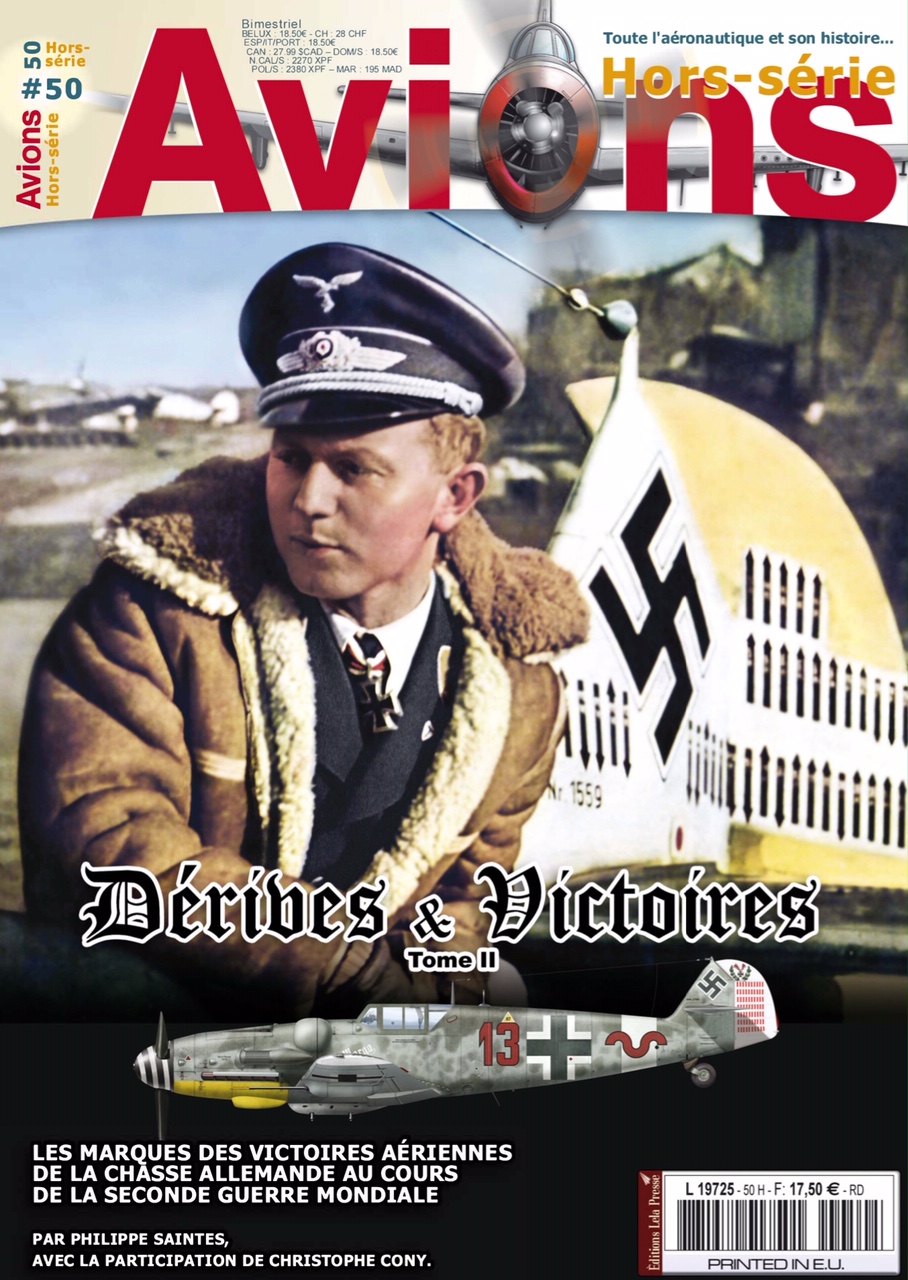
 The latest monograph from Philippe Saintes is Part II of the 'Derives et Victoires' series published by Lela Presse - profile artworks, 96 pages, 185 photos - a bargain from the Lela Presse website where you can download a pdf extract of the title.


On a recent road trip to Belgium I secured a copy of a long sought after title " La chasse de jour allemande en Roumanie" (Luftwaffe Day fighters in Romania) which covers in depth the air battles for Romanian oil from the establishment of JG 4 to 'Tidal Wave' to the combats of April-July 1944 fought by JG 77 and JG 52 to the Russian arrival in Bucharest in August 1944..it is only a slim soft-back and 25 years old but is packed with first-person accounts and rare images..


..and a box full of Jägerblatt magazines - plenty of material for future blog posts!


..and, after his hassles with various publishers, Christer's latest volume in the Black Cross-Red Star series is entitled "Stalingrad to Kuban" ;

" ..masterfully combines the combat experiences of both Soviet and German aviators into a coherent narrative...an indispensable reference.." Highly recommended..


Tuesday, 26 February 2019

Bundesarchiv Photo report series #4 II./JG 27 Trapani, Sicily, June 1943


PK photographer Büschgens was on Sicily during May 1943 and took a nice series of images featuring the men and machines of II./JG 27. The 'official' caption reads; " Nordafrika, Tunesien.- Leutnant Hans Lewes mit Schwimmweste bekleidet vor einem Jagdflugzeug Messerschmitt Me 109 mit Tropenfilter stehend.."

Above; Lt. Hans Lewes of 5./JG 27 seen on the field at Trapani during May 1943. Good view of the sand filter and the white wing-tip and spinner on what was probably a G-4 minus Gondelkanonen. A drop tank is fitted. Lewes was KIA in 'Black 1' on 10 June crashing 25 km south of Marsala most likely as a result of damage in combat. 10 June was a day of peak Allied air activity over Pantelleria with 1350 machines over the island including 650 Viermots..and a 'black' day in the history of II./JG 27. The Gruppe put up 12 Bf 109s and in the face of overwhelming Allied numerical superiority no fewer than nine pilots were shot down and killed. II./JG 27 was withdrawn to the southern Italian mainland from 20 June after these heavy losses..

Below; maintenance Instandsetzung on a G-6 Trop. "Red 1" in Trapani during May 1943. Just visible part of the Sonnenschirm fitting below the windshield.

More from this series in the II./JG 27 Gruppe history from Messrs. Prien/Stemmer/Rodeike. See also JfV 11/I - caption info from the accounts in these works..


Overlooking Trapani and background to this Gondelwaffen-equipped Gustav is Monte Erice which is where the Gefechtsstand of the JaFü Sizilien was located..this is 'Yellow 6'. Note the WerkNr. 16 600 has been chalked onto the prop blade (left) just below the technician's head..


Above; "Red 1" - just visible below the cockpit is the 5.Staffel emblem. Below; "Yellow 8" of 6.Staffel, a G-4 Trop. Note the white wing-tips and fuselage band..


Wednesday, 14 November 2018

Herbert Huppertz JG 2 6-8 June 1944, Jean-Bernard Frappé's revised "La Luftwaffe face au débarquement " published by Heimdal


from the publisher's blurb - a Luftwaffe blog translation

" ....More often than not nowadays it is a celluloid version of history that determines how we may perceive real events! Who has not seen the now-famous scene from Darryl F. Zanuck's film "The Longest Day", when two Luftwaffe fighters, alone and confronted with a huge Allied naval and air armada, came in low for a brief firing pass along Sword Beach, leaving several hundred startled Tommys as dumbfounded as they were amazed, before heading back home eastwards unscathed to their base north of Paris. For many years this enduring image has helped to condition the idea that the Luftwaffe was particularly absent from the skies of Normandy on 6 June 1944 when the liberation of France and the annihilation of the armies of the Third Reich were at stake....

In 1999 Heimdal published a superlative history compiled by Jean-Bernard Frappé -"La Luftwaffe face au débarquement "- detailing the actions of the Jagdwaffe in the skies of Normandy and the Ile de France region around Paris and then again in Provence, after the Allied landings on the Mediterranean coast. With a wealth of detail and photos the book presented an exhaustive panorama of events. And while compared to the 15,000 sorties flown by American and British aircraft during D-day itself, the Luftwaffe had only been able to organize a little over 300, four days later no fewer than 1,300 Luftwaffe machines, including nearly 500 fighters belonging to some 20 fighter Gruppen were able to mount combat sorties. With the Wehrmacht in headlong retreat the largest number of Luftwaffe fighter sorties on the Normandie front was recorded on 20 August with 580 Focke Wulf 190 A and Messerschmitt 109 Gustavs present. Fighting against overwhelming odds of 10 to 1, German fighter pilots paid a heavy price in blood for their interventions - more than a thousand of them were shot down over the course of many hundreds of air battles against USAF Mustangs and Thunderbolts and RAF Typhoons and Spitfires. In return for these terrible losses, these same German pilots carried out their duties to the limits of physical and mental endurance - more than 1200 claims for victories were filed between June 6 and August 31, testifying to their determination and courage.

The success of the first edition of  Jean-Bernard Frappé's tome "La Luftwaffe face au débarquement " - June 6, 1944 to August 31, 1944 - found a ready readership and nowadays has become difficult to find at a sensible price. Therefore, some twenty years after the first printing Heimdal Editions have chosen to offer to a new generation of readers, a revised, corrected and expanded reissue, with extensive photo coverage - some images previously unpublished-  enriched with dozens of colour profiles representing the Focke Wulfs and Messerschmitt 109s that saw action during that terrible summer of 1944....."


Kommandeur III./JG 2 at the time of the Normandy 'invasion' this is Herbert Huppertz on the left. Photos of this pilot appear to be quite rare aside from the usual RK portrait. To the right is Josef Puchinger. Note Huppertz is wearing the officers Fliegermütze or side capknown more colloquially as the Jaegerschliff ...


Hptm. Herbert Huppertz was Gkr. III./JG 2 on 6 June 1944. He was one of those veterans that David Clark in his history of the Normandy air battles "Angels eight" qualified as a 'super-ace'. Having claimed his first victory, a Spitfire, over Dunkirk on 28 May 1940 with 6./JG 51 his victory total at the start of June 1944 was around 70 confirmed.

Below; Huppertz (right) with JG 51 on the Channel coast.."..am Kanal gegen England "


 At noon on 6 June 1944, Obstlt. Kurt Bühligen (who scored his 100th victory on 7 June 1944) and Huppertz participated when 29 Fw 190 attacked at least 24 Thunderbolts (of US 365 FG) and Typhoons (of RAF 183 Sqn). The Germans claimed to have shot down six Allied fighters - including two Typhoons in less than two minutes by Huppertz - for a single loss. Actual Allied losses in this engagement were five (two P-47s, three Typhoons). (Clark, “Angels Eight”, p. 42.) That same evening, Huppertz caught eight Typhoons of 164 Sqn and shot one down, with F/O Roberts KIA. (David Clark, CD “Daily Data tables of the Normandy Air War Diary”, 6 June 1944.)

In the course of another sortie late on 6 June, Huppertz engaged the numerically superior formations of Allied aircraft which by that time filled the skies in the area (on 6 June 1944, the USAAF and RAF conducted 14,674 sorties over the Normandy area - against only 319 Luftwaffe sorties). During this single mission, Huppertz was entangled in combat with several Allied fighter units, involving both Mustangs and Thunderbolts, but in spite of the odds he claimed a Mustang and a Thunderbolt. David Clark has identified the former as one of the 352nd FG’s losses.

Huppertz thus returned five victories in a single day, 6 June 1944.

8 June 1944 was a black day for III./JG 2. At around 0915 the Gruppe was airborne with around ten machines and were engaged by Mustangs and possibly Thunderbolts around Caen. Hptm. Wurmheller claimed one Mustang, while three Fw 190s were shot down - two of the JG 2 pilots were killed  - including Gruppenkommandeur Huppertz. The WASt. loss report gives the time of this action as 10:30.

 (JfV Teil 13/III Einsatz im Westen 1.1 bis 30.9.1944 Prien/Stemmer/Bock)

Also on this blog;

Seine bridgehead 22 August 1944 - the Jagdwaffe vs. US anti-aircraft artillery at Mantes
SKG 10 - first Luftwaffe unit in action on D-Day
Two pilots in Normandy - Hans-Ulrich Jung III./JG 3
Priller's Jutta - Fw 190 A-8 'black 13'