Showing posts with label Aufklärungsgruppe. Show all posts

Saturday, 10 October 2026

2000. Feindflug einer Fernaufklärerstaffel - Werner Breese 5.(F)/AufklGr. 122


published in the 15 October 1942 issue of Flieger- Funker- Kanoniere (Luftflotte 1 Frontzeitung)


The 2,000th Sortie of a Long-Range Reconnaissance Staffel

 It is early morning at a forward airfield in the northern sector of the Eastern Front. Following the previous night’s thunderstorm, the sky is hazy and overcast. The September sun peeks through streaks of blue-grey cloud. The activity on the airfield reflects the familiar routine of daily aviation life. Yet, over by the hangar at the edge of the runway, the Staffelführer has gathered with the officers of the long-range reconnaissance squadron, the mechanics, and the ground crew. They are awaiting "Paula-Nordpol" and her crew, who took off at sunrise for the squadron's 2,000th mission and are due to return in just a few minutes. 

 There is the aircraft! It roars over our heads at low altitude. After one more circuit, it begins its landing approach, rolls to a stop, and is guided into its parking position. The crew climbs out. The mechanics hold up the proud figure—"2-0-0-0"—displayed in large white numbers . 

 The 2,000th sortie of a long-range reconnaissance squadron—this is no mere statistic. Other figures lie behind it, revealing the true extent of the squadron's achievements. Staffel aircraft have flown a total of two million kilometres —the equivalent of circling the equator forty times. This distance was covered over the course of 5,000 flight hours or 201 days of continuous flight. 

 Celebrating the milestone mission of the long-range reconnaissance Staffel 5.(F)/AufklGr. 122. Framed by the numbers are the pilot, Leutnant Werner Breese; the observer, Leutnant Misselwitz, radio operator, Feldwebel Koch and Bordmechaniker Fw. Fink. 


 The film stock containing vital imagery brought back by the reconnaissance crews from their flights measures 45,000 meters in length. The enemy territory captured in these aerial photographs covers an area equivalent to that of Germany, France, Belgium, and the Netherlands combined. The selfless nature of these reconnaissance missions can hardly be conveyed adequately in mere words and figures. Yet, faced with these numbers, one realizes the magnitude of the achievement accomplished by this long-range reconnaissance Staffel. In the course of 2,000 perilous, solitary flights, their aircraft have penetrated deep into enemy territory. The resulting imagery provided excellent targeting data for combat aircraft and thus contributed to the Luftwaffe's successes in this sector of the front. 

The 2,000th combat sortie naturally calls for a celebration by the entire Staffel. In keeping with age-old aviation tradition, champagne corks are popping. The Staffelführer briefly addresses the crew—seasoned by so many missions—and hands them glasses of the fine vintage. Laughter rings out. Witty remarks are exchanged. Joy is visible on every face. They toast to the success of the next thousand flights. Then, the familiar demands and duties of service reclaim each individual. For even today, the first flights of the third thousand will follow the 2,000th mission. 

War Correspondent Schulz.

PDF copies available from wartimepress.com


Thanks to Stefan Kruse for assistance with this blog post. Tim Oliver's extensive biography of Werner Breese featured in Vol IV of Axis Wings (Chandos)

Tuesday, 7 October 2025

NAG Bf 109 G-4 - archive photo scan #41


an ECPA-D image series recently seen on ebay.de as part of the Petrick archive sale showing the activities of an NAG - battlefield short-range recce -Bf 109 G Staffel on the southern sector of the Eastern Front during 1943. This is 'white 3' - other images show  'white 2'. Click on the image to view full-screen.


These images are part of a bigger PK series in the LWEK files held at the ECPA-D in the southern Parisien suburb of  Ivry

Saturday, 11 January 2025

Arado Ar 240 Versuchsflugzeuge - Revell re-release 72nd scale Ar 240


 Ar 240 V-3 'KK+CD'

Here's what the average web site - ie ChatGPT (AI) - will tell you about the Ar 240;

" The Arado Ar 240 was a twin-engine, multi-role aircraft developed by Germany during World War II. Intended to replace the Messerschmitt Bf 110 as a heavy fighter and reconnaissance aircraft, the Ar 240 was designed with advanced features for its time, including a pressurized cockpit, a remotely controlled defensive armament system, and excellent high-speed performance. However, the aircraft suffered from persistent stability issues, poor handling, and mechanical problems during its development and testing phases. Although prototypes demonstrated promising speed and versatility, these shortcomings prevented the Ar 240 from entering full production. Despite its limited deployment and operational use, the aircraft provided valuable lessons for German aviation engineers and remains a fascinating example of ambitious wartime aircraft design.."

 Or in other words, a promising design that failed to deliver. A rare Luftwaffe type, but one that failed to get a production order..

Let's put a slightly different take out there. The Arado Ar 240 was an experimental and test aircraft. In 1937 Dipl.Ing Walter Blume had proposed a twin-engined Zerstörer with both engines in the fuselage driving twin props - a concept rejected by the RLM, who nonetheless recommended that Blume submit a more conventional proposal. A mock-up was produced by March 1939 and in May 1939 the RLM asked for six 'Versuchsflugzeuge' or test aircraft (see Hans-Jürgen Becker, 'Schwere Jäger und Zerstörer der Luftwaffe', p117). The type was never conceived with the idea that it might go into series production. At all. It was designed to the same specification that had already resulted in orders for 3,000 Me 210s - the Ar 240 V1 first flew in June 1940 nearly one year after the Me 210. For more on this see Mankau/Petrick, " Messerchmitt Bf 110, Me 210, Me 410 - die Messerschmitt Zerstörer und ihre Konkurrenten", (Aviatic Verlag, 2001)

'Konkurrenten' means 'competitors' ..but the Ar 240 was never in the race - it was a 'technology demonstrator'.

" Das RLM hatte die Me 210 für die Grossserienproduktion vorgesehen und die Ar 240 in wenigen Exemplaren als Experimentalflugzeug, mit der neue Techniken erprobt werden sollten. Ein Einsatz der Ar 240 war bei der Luftwaffe zunächst nur in Einzelexemplaren zu Erprobungszwecken geplant..."

The Me 210 had been ordered into large-scale production by the RLM who had also ordered a handful of the Ar 240 as an experimental aircraft to test new technologies. Initially, the Luftwaffe only planned to use the Ar 240 in individual examples for testing purposes.


With little prospect of a production order - in the Luftwaffe's planning of 7 November 1938 approx. 3000 Me 210 units were to be delivered up to 1942 - Arado was encouraged to innovate in their design. The company received preliminary approval for the development and construction of six prototypes on 16 May 1939 and began work on a design based on the Bf 110, but with much smaller dimensions. However, the small wings required special high-lift devices. These were provided in the form of automatic leading edge slats, double-slotted flaps outboard of the engines and Fowler flaps inboard of the engine nacelles, along with 'full-span' ailerons on the outer wing. Early examples had tail-mounted dive brakes which were soon dispensed with. 

Following the first flight, instability problems led to extensive redesign work- the V3 pictured here was a rather different beast from the V1. Lengthening the fuselage, relocating the cockpit and enlarging the wing cured the problems - partially. The last line of an Arado report on the instability issue (reproduced in Becker p119) confirmed that " this state was no longer significantly affected by further enlargement of the wing and lengthening of the fuselage. It was considered tolerable, as the instability only occurred with intentional actions or complete removal of the feet from the pedals..." Testing continued on the design. For example, this included development of the pressure cabin and the testing of warm air in a double-glazed canopy to prevent the panes from fogging up for the Arado 234 programme. Elsewhere the Me 210 was in full-scale production - large production orders were a done deal in the case of the Me 210. No such orders were ever likely to have been forthcoming in the case of the Arado - not least because the aircraft did not have a bomb bay. 

In August 1941 the V3 was still at Rechlin being flown by Oberst Siegfried Knemeyer - head of the Amtsgruppe Entwicklung von fliegerischem Gerät - and Oberst Theodor Rowehl. The V4 first flew in June 1941 and crashed on 7 August 1941. The V5  'T5+MH' was powered by two DB 601Es and in March 1942 the Versuchsstelle für Hohenflüge took over the aircraft to test it as an Aufklärer. Initial motorisation with the DB 601 and later DB 603 gave the type relatively good performance - max speed 350-400 mph saw the type deployed over England in the high altitude Aufklärer recce role " with some success". Independently of the Versuchs aircraft 1-6, a further five Ar 240s were built for 'unarmed reconnaissance'- the first of these, the A-01 ('GL+QA'), entered flight testing on 5 June 1942.  


Our good friend Michel Wilhelme has built Revell's re-release of the Arado Ar 240 for this blog. The unit code 'T5' represents a machine of the Aufklärungsgruppe Ob.d.L. (Oberbefehlshaber der Luftwaffe) or Aufklärungsgruppe Rowehl..


Wednesday, 7 August 2024

Ju 88 1(F)./123 Brittany, 1941 -archive photo scan #29


Luftwaffe Helferinnen welcome back a crew from 1.(F)/123 somewhere in Brittany, possibly Morlaix or Brest, following a 'milestone' sortie somewhere over England and the Channel during 1941.


Sunday, 3 December 2023

FalkeEins blog at the ECPA -D photo archive in Paris, Nov 14-22, 2023


.. arriving at the ECPA -D  ( Etablissement de communication et de production audio-visuelle de la defense) in the Paris suburb of Ivry.

As a Luftwaffe enthusiast are you always on the look out for 'new', rare and unpublished Luftwaffe photos? If the answer to that question is a resounding 'Yes!' then a visit to the 'Médiathèque' (multi-media 'room') of the ECPA-D is a 'must'. Just reserve a morning/afternoon/day on-line and turn up with your passport. The ECPA produces images, films  and publications for the French military and general public and is one of the world's biggest photographic archives. Their 'German collection' ('fonds allemand') alone is around 400,000 pictures. While there is some 'over-lap' with the Bundesarchiv in Koblenz, much ECPA-D material is unseen and unpublished. They also have the negatives, which the Germans don't. The great thing is that anyone can visit, just make a booking next time you are in Paris and take along your passport. (taken off you in exchange for a visitor's pass). There is no requirement whatsoever to be a 'serious' researcher, whatever that may be. Modellers and even photo collectors get a great welcome too.

So what is 'special' about the ECPA-D and why come to Paris? I put this question to John M, who was spending several days in the 'Médiathèque' when I was there;

" ..For many years my friend Del has raved about the quality and range of photos stored at the ECPA D and the friendliness of the staff there and the service provided. When he suggested that we go together -meeting up with Neil P who I had been in contact with for many years but never met- it was an opportunity too great to miss. I am a Ju 88 fanatic and modeller and to see so many crystal clear, small detail photos was a life changing event from a modelling point of view. The staff were patient and kind and hospitable and enthusiastic - the family of both workers and visitors was tangible, each helping and supporting the other making the whole investigative mission enjoyable and 100% more rewarding and productive. I would love to go again and recommend it to anyone interested in Luftwaffe research..."


Once inside the facility - this is a government military institution, “inside a fort” - the 'Médiathèque' or 'multi-media library', is quite a small place with desks/PCs for 10-12 people which makes a reservation system necessary. It is not a library in the usual sense of the word - unfortunately there are no books available to consult. Just a huge archive of photos. You are usually advised to bring a thumb drive, since you can order photos on-line once you have identified the file number/photo number that is of interest. 90% of the photos are ‘digitised’ and can be saved into a Word document via the computers in the ‘media room’. You can consult the very large original albums from which the collection is built up – around 410,000 images. Very useful if you happen to want a look at a photo series that has not been scanned. The images are mostly exceptional and mostly extremely clear –  with their Agfa film and Leicas, the PK Berichter (reporters) were after all professional photographers. However, there is no inventory. Luftwaffe images can be found in all sorts of files including German Army, Afrika Korps, even the Kriegsmarine files. There is a block of files (the LWEK files, around 15,000 images) which are not available in albums or on the main ECPA-D computer system but can be viewed on request on another PC system. That is, if some-one has told you about them..

Fortunately there is a 'Search' facility which is easy to use. Searches by unit, aircraft type, location are possible. Any photos can be ordered for personal use, hard copies cost around 2 euros, digital photos are around 9 euros – but have many more conditions attached. Publication fees can be eye-wateringly high but can be discussed with ECPA management - if you speak French.  While the staff in the media room can speak English and in some instances German, their management does not apparently..

One row of the five or six rows of photo albums at the ECPA-D. The blue folders are the DAA files (Documents Allemands Air). The green folders are the DAT files (Documents Allemands Terre). The DAK files (Afrika Korps) are beyond them..


Photos are organised into 'reportages' of around 30-40 thumbnails. Individual pictures can then be viewed large. Much work has been done on captioning each 'report' series. Although a colleague did run across a set of images captioned as "Fw 189 recce pilot" which turned out to be rare and unseen images of leading Eastern front ace Gustav Francsi of NJG 100. 

Below; 'thumbnail' screen for a photo report series on SG 3 and one of the images enlarged on the screen.


This 'reportage' photo report was entitled " JG 1 pilot briefing" and a view of one image on the screen.


A typical photo album page  - this 'reportage' (file DAA 2548) shows US POWs loading a Ju 52 in Tunisia.


- Most of the images available to look at are unpublished. If your interests extend to Normandie Niemen, post-war French conflicts etc then the numbers of images in the archive are in the millions. Heer and Kriegsmarine as well as Luftwaffe. Note French Air Force 1939-1940 is stored at the SHD - Service Historique de la Defense at Vincennes.

Note that the archive features many many hundreds of films, other moving images and radio recordings. I was given the chance of listening to some recordings made by Luftwaffe fighter aces. Even staying here for the best part of a week I did not get around to viewing any of the films!


Why don’t more enthusiasts, writers, publishers, modellers and photo collectors go to the ECPA-D?

- possibly don't know that it exists, how easy it is to access and or are unaware of the huge collection of photos available to view.
- Possibly intimidated by potential bureaucracy. Hard to deal with as a government agency. (Neither of which is the case)
- You need to speak the language (you really don’t)
- Travel hassles. From London, Eurostar trains from St. Pancras through the Channel tunnel go into Gare du Nord at least 10 times/day. Traffic is apparently still down on pre-Covid levels, although the trains I was on were very full. Services to and from Amsterdam are being halted for six months next year. The much-touted EU Entry/Exit system (EES) is currently not set to be introduced until after the Paris Olympics. (summer 2024)

I spent the best part of a week here - I even ran into the infamous 'Denys Boudard'. (..nice guy! Very good English, ex special-forces, a man-mountain, not somebody to get on the wrong side of!)

Needless to say I'm looking forward to going again next year! Thanks to the staff - Nicolas, Justine, Philippe and Christine - for helping us make the most of our week!  Apologies, I forgot to sign the visitors book..and to Del, John and Christophe, thanks for a great week!

Below; typical ECPA-D (thumbnail) photo-file 'reportage', depicting the Ju 188s of  Aufklärungsgruppe 11. An 'LWEK' file, not available in hard copy, nor on the main computer system..


Also on this blog;

More Aufklärungsgruppe Junkers Ju 88s - Ju 88 H with Aufkl.Gr. 123


Tuesday, 24 January 2023

More Aufklärungsgruppe Junkers Ju 88s - Ju 88 H with Aufkl.Gr. 123


The Junkers Ju 88 H was a development of the Ju 88 D intended for long range reconnaissance missions over the Atlantic in support of the U-boats. Powered by BMW 801 engines the design incorporated two additional sections in a fuselage 'stretched' to 17m - 99 cm was added forward of the leading edges and another 230 cm section was incorporated aft of the trailing edge root point to house an extra fuel tank. The wings were taken from the G-1. Three Robot Rb 70/30 and 50/30 cameras were mounted in the rear fuselage. The variant was also notable for the absence of a cupola under the forward fuselage. Prototype machine, the Ju 88 V89 (W. Nr 430820, RG+RP) was fitted with a FuG 200 Hohentweil search radar, two MG 81s in a WT 81Z ventral pod, and one MG 81 in the windshield and rear posts. It was first flown on November 2, 1943.

The Ju 88 H-1 was the reconnaissance version with BMW 801 Ds (1700 hp) and FuG 200. Maximum range was 5130 km. Ten were built. The H-2 was a more heavily armed Zerstörer sub-type not fitted with radar or cameras. Wing span was 20.08 m and engines were BMW 801 D-2s. Armament – two MG 151/20 cannon in the closed nose and four in a ventral pod. Five were built. (Smith and Kay)

Below; ECPA-D images possibly depicting an H-1 (note FuG 200 just visible) operational with 3.(F)/Aufkl.Gr.123 in France.  AufklGr. author Harald Rabeder comments;

".. The photos were taken early 1944 during a visit of General Ulrich Keller at 3.(F)/123 to inspect the Ju 88 H. Beside General Keller is Staffelkapitän Hptm. Höfer and an unknown officer -most-likely the adjudant aide-de-camp of General Keller or Technical officer of 3.(F)/123. The "German mastif" is the Staffelhund of 3.(F)/123 - unfortunately I do not know it's name .."


Ju 88 D of 1.(F) / Aufkl. Gr. 122 based in Greece in early 1944. Note the unit spinner marking. More on this blog at the links below 

Also on this blog;

Thursday, 1 September 2022

Two RK holders of 3.(F)/Aufkl.Gr. 122 - Hermann Hemmer, Ludwig Wagenfeld


3.(F)/Aufkl.Gr. 122 was a Ju 88-equipped recce Staffel based in Holland (Eindhoven and then Schipol) from mid-to-late 1940 and tasked with missions over England. 


The Staffel remained in the West following the launch of Barbarossa attached to IX Fliegerkorps (Luftflotte 3) for continuing operations over England. Elements of the Staffel were temporarily based in Creil north of Paris.


The Staffel recorded its 1,000 Feindflug in March 1942 - the banner states, "Welcome home from the 1000th combat mission!". The crew of Ofw Geuter (FF), Oblt Salecker (BO), Uffz Gärtner (BF) and Uffz Banz (BS) paraded in front of the Staffel on March 31, 1942. Over 900 of the 1000 sorties had been carried out over British territory..


Typical 3(F)./122 sorties for the period of March 1942 included;

08 Mar 1942 – 'F6+CL' possibly gave weather reports for 05E 1469 (55 Km NE of Cromer) at 08:00 and landed back at Schiphol at 09:15.

'F6+KL' flew from Schiphol to 45km NE of Margate, then to the Humber area and then as far north as Whitby. Sighted convoy FN 49 25 miles E by S of Spurn Point at 08:58 and probably also convoy FS 44 to the N of this point. Landed back at Schiphol at 10:54. In its second sortie of the day 'F6+CL' again operated from Schiphol to the Whitby- Clacton area. No shipping was sighted and the Ju 88 returned to Schiphol at 16:36.

09 Mar 1942 – one Ju 88 overflew Folkstone, Dover, Deal and Ramsgate along the south and east Kent Channel coast area between 07:55 and 08:00. No shipping was sighted. 'F6+AL' was sent to the Skegness – Whitby area and reported convoy FS45 between Whitby and Scarborough at 09:40, landing back at Schiphol at 11:46. 'F6+EL' operated from Lowestoft as far north as the Withernsea (East Yorks) area, no shipping was sighted. The operation was probably broken off here on account of the weather conditions and a shortage of fuel. The aircraft landed back at Schiphol to refuel at 10:53 taking off again at 11:38 to resume its sortie.

10 Mar 1942 - 'F6+GL' was dispatched to the Whitby-Skegness area. During the outward flight the crew reported 2 MTBs in 05E 2460 (75km NE of Cromer) at 09:05. No shipping was sighted in the Whitby area, although the crew reported a convoy off Skegness at 09:30. Aircraft returned at 11:33. 'F6+CL' was sent to the area from the Thames Estuary to as far north as Cromer on the east Norfolk Coast. The aircraft returned on reciprocal course. No shipping was sighted in the Thames. Reported two British aircraft off Cromer at 10:00 and two MTBs off Orfordness at 10:15 hrs. 

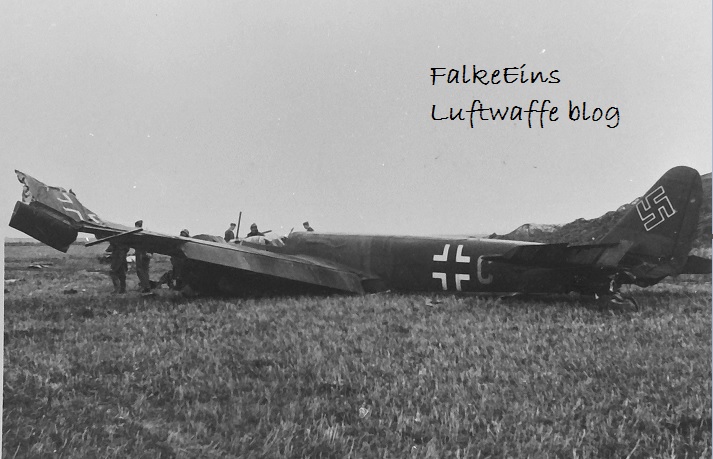
On May 24, 1942, 3. Staffel pilot Hermann Hemmer crash-landed 'F6+CL' at Schipol (80% damage)  - possibly this wreck which appears in Hemmer's album.


On March 7, 1943, 3(F)./122 at Schipol reported the following strength:- 8 Ju 88 D-1, 4 Ju 88 D-5 and a single Fw 58 C-2. In early 1944 the Staffel moved to Soesterburg and took a number of Ju 188s on strength. The Staffel had celebrated their 2,000th sortie during June 1943 in Schipol (below). The 'official' 2000th Feindflug took place on June 15, 1943 with the celebration held the following day. The crew involved were:- Ofw.Von Zabiensky, Obfw.l Tonne, Fw Knörtz and Oblt Salecker (who had flown on the 1,000th FF too), all seen here below to the right of the port engine.


Above; the two Knight's Cross holders of the Staffel with Blumenstrauß leading the parade following the 2000th sortie. On the left with RK, Lt. Hermann Hemmer (RK in September 1942). Alongside him is Oblt Ludwig Wagenfeld. Wagenfeld was awarded the Ritterkreuz on March 24, 1943 for service while StaKa 3.(F)/Aufkl.Gr. 122. Hemmer  (seen below, right) departed 3(F)./122 for ZG 1 later during 1943 and was posted to the Stab JG 4 on the establishment of this unit's III. Gruppe (summer 1944). Both survived the war.


Andy Mitchell's Luftwaffe Data website for Aufkl. Gr. 122 diary entries can be consulted here

Saturday, 16 July 2022

Seeaufklärungsgruppe 126 - SAGr 126 Arado Ar 196


also on this blog;

photo album Ofw. Günther Kurth 4./Seeaufklärungsgruppe 126 Crete/Aegean 1943-44 here

Thursday, 26 May 2022

more Bf 109 Aufklärer - 4.(H)/12 in Tunisia January -April 1943


Bf 109 G-2 of 4.(H)/12 seen on Sicily after departing Tunisia during April-May 1943. To view a larger version of this photo click on the image. 


In January 1943, a weakened 4.(H)/12 were resting at Bir Dufan before the Bf 109s of the Staffel were deployed to Tunisia to operate in the 'pocket' alongside those of 2.(H)/14 which had recently returned to Africa. On January 20th, at Bir el Ghnem, a 'Friedrich' had to be scrapped. Three days later, a further two Bf 109s (which were to be part of a rear commando left near Tripoli) were also destroyed. Two wounded were then reported during landing accidents in Zuara and Gabes. On February 9, Ofw Hönig was injured when his aircraft hit an obstacle in Gabes. It was 80% destroyed and this was the last mention of a Bf 109 F-4 in the Staffel. On February 20, Oblt Gerhard Wernicke was reported MIA, hit by ground fire and forced to make an emergency landing south-west of Zarzis. He was flying 'black 14' WNr. 10764  - one of the first Bf 109 G-2s to be transferred to the unit to replace the unit's Friedrichs. Wernicke, a former observer with 2.(H)/14 transferred to 4.(H)/12 and then turned pilot, managed to evade capture and returned to the unit on foot. Two more 'Gustavs' were damaged on landing at Hadjeb el Aioln on the same day, a ferry flight disrupted by bad weather. On 21 February, in a G-2, Fw Josef Harl was hit by flak at  Ben Gardane (near Medenine) and went into captivity. 

On 24 February, Kapitän Schneider left his post to lead a training unit, 4/Nahaufklärungsgeschwader 102 and then II./NAG 102. His successor was Hptm Rolf Sauer, a veteran who had been shot down south of Arrancy on May 13, 1940 by GC I/5 while flying a 3.(F)/Aufkl.Gr. 22 Dornier Do 17 P.  He had been taken captive but was freed when France fell and, in 1943, was assigned to the Nahaufklärung. On March 10 Fw Werner Schmidt was shot down near Gafsa by three Spitfires of N° 601 Sq. Schmidt was killed and this victory was attributed to P/O Baxter and Sgt Steele. On March 17, a G-2 was destroyed after an emergency landing due to enemy fire, the pilot was unharmed. 


During these risky missions in Tunisian skies, 4.(H)/12 were not 'clay pigeons'. Uffz Friedrich Stannek (left) was the ace of the Staffel, claiming at least six enemy machines downed during this campaign. Lt. Karl-Otto Holzapfel, who knew him, said; "We didn't like flying with Stannek. He was far too much of a Draufgänger. He often came back with a victory... but without his Kaczmarek".  Stannek claimed his 7th on May 23, a P-38 shot down 50 km south-west of  Cap Spartivento. Stannek was awarded the RK late in 1943 and was killed in a crash on October 25, 1944. 


 On March 19, Uffz Antonius Uhler flying Bf 109 G-2 'black 6' WNr. 10672 was hit by flak near Gafsa. He jumped and was captured. 4.(H)/12 had apparently reached the end of the line. In early April, two or three of its G-2s were destroyed at La Fauconnerie and Bir el Djem. (April 9,1943: Bf 109 G-2 W.Nr. 13899 was destroyed by German troops at Fl.Pl. Bir el-Djem). The last recorded loss for 4.(H)/12 in Tunisia was Bf 109 G-2 WNr. 10837, bombed at Sainte-Marie du Zît on April 12. The Staffel evacuated to Sicily and thereafter back to mainland Italy, missing the last of the fighting in the Tunisia and the surrender of the Panzerarmee Afrika in May 1943.


Below;  'white 6' a G-4 of 4./(H)/12 (note prancing horse cowl emblem) on Sicily. 4.(H)/12 was incorporated into the 'new' NAG 11 during October 1943, being re-designated 2./NAG 11.


Also on this blog;


The full story of battlefield recce Staffel 4.(H)/12  - from the Hs 126 to the Bf 109 Gustav, 1939 -1943 - is told by Jean-Louis Roba in the latest issue of 'Avions' magazine (Lela Presse). More details and a pdf extract here 


Tuesday, 3 May 2022

Bf 109 Gustav, 4.(F)/123, Staffelkapitän, Oblt. Werner Kohla, Bernay, Normandy, June 1944


First in a series of posts showing 'new' images from the album of Staffelkapitän  4.(F)/ 123 (Eins), Oblt. Werner Kohla. (Kohla replaced StaKa Feilmayer lost on 17 August) A good friend of the blog has owned a set of negative strips from Kohla's album for many years and not scanned them before until now.

Standing by with an extinguisher, ground crew prepare for an engine test run following an intervention. 4.(F)/ 123 (Eins) flew armed Messerschmitts on tactical 'battlefield' recce sorties over the 'Invasionsfront' during the summer of 1944. Possible location is Nonancourt (Eure), northern France,  late August 1944...or earlier. In June 1944 the unit was flying out of Bernay, just east of Lisieux..

The aircraft appears to be a G-5 or G-6  with Erla Haube - but whether 'classic' Beulen or 'refined cowl' feature is difficult to determine. ( .in his 'La Luftwaffe face au débarquement' page 268, J-B Frappé suggests the Erla Haube is evidence of a camera-equipped G-8) Note the cowl cover on the ground - the 'refined cowl' cover? The unit did have at least one up-rated G-6 (G-6/R2 with the AS engine and refined cowl) during this period. Other images in the sequence show 'standard' Gustavs.  Note possible light blue-grey finish  (windscreen) - no doubt one reason the machine is pushed under the trees..

This image on the negative strip was labelled " Uffz. Parsi ".


Monday, 2 May 2022

Junkers Ju 88 and 188 of Aufklärungsgruppe 33


Some rare Aufklärungsgruppe images from a friend of the blog with a new negative scanner! First time these images have been seen by the negative strip owner...


Junkers Ju 88 D "8H+KL" features regularly in the 'history' of recce Staffel 3.(F)/33 as compiled by LdZ/AM on the LuftwaffeData website. 


Two images of "8H+KL"possibly during June-July 1943 at Ottana in Sardinia from where the Staffel flew two or three recce sorties a day watching Allied convoys and warships in the western Mediterranean and in Algerian harbours.

 
On July 11, 1943  Ju 88 '8H+KL' failed to return - no details, 100%, 4 MIA.  

Below; a general view of the grass strip(s) at Ottana, Sardinia, summer 1943. More at the LdZ  Luftwaffe airfields pdf


The Aufklärungs Staffel 3.(F)/33 began conversion training on the Junkers Ju 188 during late 1943 and were still in Gutenfeld/12 km south-east of Königsberg during January 1944.

 
On March 1, 1944 the Staffel reported 12 x Ju 188 F-1 on strength and on March 16 began transferring from Königsberg to Athens-Kalamaki in Greece where the Staffel relieved 1.(F)/122. Here they were assigned to Fernaufklärungsgruppe 4. According to AM's Luftwaffe Data Wiki (compiled by LdZ)   they were tasked with flying routine day and night photo reconnaissance over the eastern Mediterranean, Cyprus, Egyptian and Libyan ports and also covering southern Italy and Sicily. The rare image below from a Staffel member's album shows a crew in front of their Ju 188 feting a landmark sortie - the 100th, either their own or the aircraft type or flown from Kalamaki (.....possibly) 


 Over the following months  " a bitter rivalry developed between the Staffel and 2.(F)/123, which was considered the better of the two "  According to a PoW, 3.(F)/33 only had 4 operational losses from April to September 1944. Here are two rare photographic records detailing two of them...the crew of '8H+KL' (Ju 188, pilot Lt. Beyer) being killed in a crash on April 12, 1944 and the crew of '8H+AL' (pilot Lt. Haspel) failing to return from an operational sortie on May 15, 1944.


 On September 15 the Staffel transferred from Athens-Kalamaki to Salonika-Sedes.On October 10, 1944 the Staffel transferred from Salonika-Sedes to Skopje/Macedonia on or about this date; still under FAGr. 4, the Staffel had 9(5) Ju 88s and Ju l88s, the former being the high-altitude T-l and T-3 variants.

On October 22, 1944 Ju l88 D-2 (8H+AL) crashed in Greece due to engine failure, or possibly shot down by a RAF Beaufighter, while on a long-range day reconnaissance flight to check shipping between Greece and Crete and then along the approaches to the Dardanelles on the return leg, 100%, 3 KIA and 2 captured.

 (info via Andy Mitchell's LuftwaffeData website)


Friday, 27 November 2020

Aufklärungsgruppe Ju 88 and Do 17 - Ebay photo find #338


Aufklärungsgruppe Ju 88 D1 (no sign of any underwing bomb racks) probably from 1. (F) 122 based in Greece in early 1944. According to the annotation, a 'souvenir snapshot taken prior to our Feindflug (combat sortie) of March 25, 1944 which ended in a crash landing'. Interesting spinner decoration....and fourth image below, " Athens..from 800 meters.." showing the 'effectiveness' of this dappled finish in action.


More recce machines - Western Front Phoney War Do 17 P with a 'comic' Staffel emblem depicting the British and the French (in the form of Chamberlain and Marianne) chasing a fox that has just raided the hen house..


Oliver Rogge's Ebay sales page is here