Showing posts with label Jean-Louis Roba. Show all posts

Tuesday, 5 September 2023

Unit history of III./ZG 26 reprinted (Lela Presse)


publishers blurb

" It may seem surprising in the context of a unit history to cover just a single Gruppe. However, III./ZG 26 - which started WW II as a Bf 109 unit - was 'detached' early on from its parent Geschwader and fought a very 'independent' war. Having received twin-engine Bf 110s during the Phoney War, the unit was largely deployed in the West and over England during 1940. Rested at the end of 1940, like all Zerstörer Gruppen, III./ZG 26 was sent to the Mediterranean in early 1941, where the unit's heavy fighters mainly supported the advance of the Afrika Korps while escorting shipping supplying the German Army in Africa. The Bf 110s also served as 'ad-hoc' transports ferrying in fuel in their 900 ltr drop tanks to be pumped out into jerry cans. In 1943, after the fall of Tunisia and facing the numerical superiority of the Allied air forces, III./ZG 26 returned to Germany and equipped with heavy weapons - including BR 21 rocket grenade launchers - was thrown into the bloody combats above the Reich. The Bf 110s were decimated and the unit was dissolved in mid-1944..."

Reader's review

".. a war diary of a unique Luftwaffe unit, III./26 saw action action from 1939 to 1944, when it was disbanded for lack of personnel, decimated above the dying Reich, its ME-110s by then obsolescent and out-classed by Allied long-range escort fighters. The talented (the word is weak when you know the talent of the author! ) Jean-Louis Roba has reconstructed, page by page and virtually day by day, the glory days and dark hours of a very special unit that flew for 90% of its time on an aircraft that was innovative and elegant but under-powered and under-equipped, which in no way detracted from the courage of its crews and technical personnel. On the contrary, because they were called upon to fight on almost every front. This is an excellent reference work, lavishly illustrated with a number of colour photos and written with great rigour. A book for enthusiasts of Second World War air history, but also for model makers eager to find new subjects .."

A 176-page book with 380 photos and 28 color profiles. French text. A 15-page pdf extract is available to view on the Lela Presse web site here

Also on this blog; The "Luchy" trial - III./ZG 26 pilot murder

Wednesday, 26 April 2023

new from Lela Presse - Luftwaffe over Belgium and Stukas in the Blitzkrieg


"La Luftwaffe en Belgique"  Part II  by Jean-Louis Roba and Peter Taghon.  The second installment of the Roba/Taghon story of the Luftwaffe in Belgian skies. Daily activities in diary format covering both day fighters and night operations.


BA  #104    " Stukas dans la Blitzkrieg " Part 1 

The story of the Stuka units over Poland and Scandinavia, while the last eight pages are devoted to the dates 10 and 11 May in the West. (97 pages, photos, maps profile artworks, 13 euros 50)


Avions magazine #252  - features the second part of 'Fw 190 in the Med 1942-43' and 'Dornier night fighters' Part I. The continuing Ukraine war coverage details the combats for Snake Island. I don't always agree with author Christophe Cony's stance on Ukraine's share of responsibility for Putin's illegal invasion but 'Avions' provides easily the best coverage anywhere of the ongoing conflict in the Ukraine..

Much more on  the website. Click on the image below to go there now!

Saturday, 17 September 2022

" The Luftwaffe in Belgium " by Jean-Louis Roba and Peter Taghon, Lela Presse - new Luftwaffe book


Part I of a new two-volume work 'The Luftwaffe in Belgium' authored by Jean-Louis Roba and Peter Taghon is currently at the printers and due on September 30 from Lela Presse. Pre-order from the publisher now, free postage on orders up to publication date. (link below)

From the publisher's blurb;

From September 1939 and throughout the 'Phoney War', the airspace of neutral Belgium was criss-crossed by the aircraft of the combatants taking advantage of the weakness of the Belgian Aéronautique Militaire. German reconnaissance aircraft were able to identify future invasion routes and on May 10, 1940, the Wehrmacht invaded. Up to the end of that month,air combats raged in this major strategic aerial battleground. With the withdrawal of the British Expeditionary Force trapped in the Dunkirk/La Panne pocket, aerial engagements became less frequent and the Luftwaffe quickly established itself in the country, rebuilding airfields and military installations.

After the armistice with the French, Belgian skies saw little daylight combat, either during the 'Battle of Britain' or the 'Non-Stop Offensive' in 1941, being 'protected' by the distance from RAF fighter bases. At most, shipping and ports became targets for British aircraft. On the other hand, Belgium was (like the Netherlands) on one of the direct routes used by Bomber Command on their night-time raids on the Ruhr factories. Hence the rapid establishment in the country of night fighter units (Nachtjagd) that were to acquire a name for themselves - such as the 'infamous' 'Ghosts of Saint-Trond', feared by RAF crews.

The period 1939-1942 in Belgian skies was one of contrasts - bloody combat during the offensive in the West followed by a relative calm only disturbed by the growing strength of Bomber Command. The few intrusions of the American 'heavies' in 1942 remained relatively insignificant although they heralded a growing threat.

However, 1943, the key year of the Second World War, was marked by increasing incursions into Belgian airspace by US 8th AF 'Viermots'. On April 6, 1943, the population discovered the murderous power of the 'Flying Fortresses' during the bloody bombing of Mortsel. On that occasion, the local weakness of the Tagjagd (day fighters) was exposed. In spite of regular calls for fighters to be based in the vicinity or temporary transfers of parts of the Jagdeschwader, the German fighters (supported by the Flak) could only with difficulty contain the assaults of the USAAF. During the first quarter of 1944, with US escorts capable of overflying the territory of the Reich, the day fighter defences of the Belgian defensive line all but collapsed and the aerial combats in the Belgian skies turned more often than not into bloody reverses for a still present but numerically dominated Tagjagd.

Go to a pdf extract on the publisher's website here

Wednesday, 31 August 2022

new from Lela Presse - The Luftwaffe in Italy 1943-45


Following on from their recent 'Luftwaffe in Tunisia' (Jean-Louis Roba) and 'Last victory in the Mediterranean' ( Jean-Louis Roba with Chris Shores) Lela Presse have just published their latest 'BATAILLES AÉRIENNES' monograph, 'The Luftwaffe in Italy 1943-45' by Jean-Louis Roba.  Coverage of bomber, fighter, transport and recce units is based on archival documents including POW interrogation reports and features plenty of first-person accounts. French text. Still well worth acquiring at only 13 euros - 96 pages, 150+ photos, profile artworks  - but easy enough to read with, for example, the google translate app on your smartphone..


IV- Transport units 

 In the course of the resupply operations flown into the Tunisian pocket, the German Transportgeschwader (the designation TG had replaced the former KGzbV in April) had suffered terribly. Above all else, there was a shortage of escorts for the Ju 52 and Me 323 transports. On April 22, the ‘infamous’ disaster at Cap Bon took place - fourteen TG 5 Me 323 six-engine behemoths were shot down with their passengers and cargoes. - TG 5 continued to be based on its aerodrome at Pomigliano to supply the islands. One Me 323 pilot, Oblt. Ernst Peter*, recalled: 

 "..After the operations in Tunisia, our unit flew almost daily from Naples-Pomigliano to Sardinia, with the handful of aircraft that remained and those that could be brought to us from Leipheim. For a while we were able to enjoy life. From time to time we would see, far above us, the condensation trails of an enemy reconnaissance plane that had come to watch the area or, sometimes, tight formations of heavily laden bombers arriving from Africa to sow death near the Alps. We could continue on our way because these formations were not at the same altitude as we were and any potential fighter escorts they might have did not care about the transport planes flying at much lower altitudes. It was a nice feeling to be able to fly alone, not having to rely on a fighter escort and only having to rely on yourself. We did not have to endure the attacks on our runways like Cagliari/Elmas, Alghero, Venfiorita/Olbia, Decimomannu, Villacidro or Milis, so it was a good time and, after the costly and hard operations in Africa, almost a relief even though we often had to fly for three hours over a sea stretching as far as the eye could see. We mainly refuelled the 90. (leichte) Division with fuel, Flak equipment, vehicles, ammunition, etc..."

* "..schleppte und flog Giganten"

The strains within the German command

The Bf 109s of the 'Pik As', based in Sicily, were to bear the brunt of the powerful air attacks on the island. On 18 May, suitably escorted four-engine bombers dropped their ordnance on Pantelleria and Trapani. Eight P-38s were claimed but no bombers - a testament to the quality of the escort. On the 19th, the USAAF targeted Trapani and, although six Lightnings and two Curtiss were claimed, again no bombers fell victim to the 'Pik As'. That day, 7./JG 53 lost two of its pilots. On the 20th, Spitbombers from Malta bombed Comiso. And so on... These almost daily attacks gradually wore down the Sicilian defence units. 

 JG 77's first major combat since the evacuation from Africa, however, did not take place until June 18, in the Sardinian sector of Olbia. In support of local Italian units, III./JG 77 faced a large formation of B-25s escorted by P-38s of the 27th, 96th and 318th FS. Two P-38s, three B-25s and a Boston were claimed by the three Staffeln, who seem to have lost no aircraft. 

 The Allies had barely paused after the capture of Tunisia. On the night of 10/11 June, they began their invasion of Europe by landing at Pantelleria. On 12 June, after the small Italian island of Pantelleria, the island of Lampedusa surrendered almost without a fight. 

 Confronted with these rapid Allied actions it was decided to completely overhaul the German command in the Mediterranean;
 -all Wehrmacht units in the south came under the control of Marshal Albert Kesselring hastily appointed OBS Süd (Oberbefehlshaber Süd); 
-Luftflotte 2 was taken over by the energetic Field Marshal Wolfram von Richthofen, cousin of the famous Great War pilot;
 -the bomber units dependent on II. Fliegerkorps were regrouped under the Fernkampfführer Mittelmeer, Oberst Dietrich Peltz. Peltz (who in 1941 had led the dive-bombing school at Foggia) was to attempt to instil the new tactics that had been honed in the West against the UK and to develop various measures such as attacks at low altitude or the movement of units to more distant airfields, in order to reduce the risk of destruction by Allied bombers.

 However, given the large number of units assembled in a restricted space that had now become a front line, the Germans faced serious logistical problems, as Karl Gundelach pointed out; 

 "…In Sicily, it was necessary to find new airfields for the fighter and the Schlacht units. This was difficult because very often all that was available was just farmland. Göring received many complaints from his Kommandeure about the slowness of the Italians to find solutions (...) It was also necessary to reinforce the Flak arm; especially the batteries defending the vital Straits of Messina. (...) It was planned to establish barrage balloon booms here, but the Italians preferred to keep them for their own ports. (…).Aerodromes in Sardinia had to established and air transport to the island stepped up. The Allied air forces then sent their long-range aircraft to disrupt this air traffic, which led to losses. (...) The greatest difficulties were in Calabria, where there was a lack of aerodromes for fighters. The best equipped were in Apulia but they were too far away for the Tagjäger. (...) Following the heavy losses of the Flak in Tunisia and the equipment which had been abandoned there, there was a lack of batteries. Most of them were to be assigned to Sicily but Sardinia needed 15% of the manpower that had been gathered. It was therefore necessary to bring in anti-aircraft units from northern Italy at the risk of undermining the protection of the industrial towns working for the Axis war effort… " 

 These problems undermined local command in the face of a numerically superior enemy. Added to this was Göring's mistrust of the Jafü Sizilien, General Theo Osterkamp, who had been installed in this position by OBS Kesselring. Osterkamp had already been removed from the command of a Geschwader by Göring as early as 1940, the Reichsmarshal considering him too old to exercise such responsibilities.

On June 25, a large formation of B-17s passed north of Sicily to raid Naples. II. and III./JG 53 as well as elements of JG 77 were guided towards the bombers from the ground. II./JG 53 missed its interception while JG 77 could only put up a very brief fight due to lack of fuel. Two B-17s were claimed by two aces of III./JG 53 ( 55th victory for Oblt. Schiess and the 68th for Oblt. Roehrig) but Uffz. Alfred Kowaleswki (9./JG 53) was shot down over the Straits. Two other Fortresses were also downed. Enraged by this 'incompetence', Göring demanded that Inspector of Fighters Galland ensure that one pilot from each Gruppe be brought before a court martial and tried for 'cowardice before the enemy' (Feigheit vor dem Feind)....

Web site of publisher Lela Presse is here

Tuesday, 17 December 2019

Fritz Galland, reluctant fighter pilot - eldest and least well-known of the four Galland brothers


Above; Fritz Galland, elder brother of Adolf Galland, seen strapping into the cockpit of his G-6 'white 1' as StaKa 2./NAG 11 in Italy during late 1943. See profile artwork of 'white 1' below, published in the long defunct 'Histoire de guerre' magazine (via J-L Roba).

Interview extract with Adolf Galland via Colin Heaton on history.net


Interestingly both interviewer and interviewee got that one wrong - all three of Galland's brothers were combat pilots! However they did at least both note that there were four Galland brothers including Adolf - most authors only seem to account for three ! Fritz Galland - the 'attorney' according to brother Adolf Galland - alongside AG (left) and in the cockpit of his "white 1" (top) was the eldest brother and had - like Wilhelm-  joined the flak arm. It was possibly as a result of his brothers' achievements in fighters that he had then 'chosen' or taken the opportunity very late on to train as a fighter pilot. Fritz Galland's first posting was to JG 3. During the summer of 1942 he flew Bf 109s with 7./JG 5. According to writer Brian Cull it was possibly Fritz Galland who was held responsible for the shooting down of a He 111 of 8./KG 26 near Petsamo, a loss that occurred on 8 September 1942. However sources are few and far between. Exactly what did happen to Fritz Galland? What we do know - from first person accounts - is that he must have been demoted from his rank of Hauptmann. He was subsequently posted to NAG 11 (2 Staffel) in Italy -where presumably he could do less damage- and arrived there as a lowly Feldwebel. He was appointed Staka 2./NAG 11 in October 1943. (note the error in the Stankey/De Zeng data base entry below)

Even here apparently he wasn't particularly highly rated as a pilot -at least one of his pilots says he always tried to avoid flying with him..(personal account via Jean-Louis Roba published in the now-defunct 'Histoire de Guerre' magazine)

Below; an entry from the superb Stankey/De Zeng Luftwaffe officers database resource which can be found here; I wonder if the single victory mentioned is in fact the 'victory' that cost him his fighter pilot career. Note that after the NAG he went to various training Geschwader.

GALLAND, Dr. Fritz. (DOB:21.05.10 in Recklingshausen). 26.05.42 Oblt., 2./JG 3. 13.06.42 Oblt., in 2./JG 3. 01.07.42 promo to Hptm.(d.R./Fl.). 10.08.42 in 7./JG 5. 10.43 appt Staka 2.(H)/Aufkl.Gr. 14 (to 11.43)? c.15.11.43 appt Staka 1./NAGr. 11 (and 01.44). 07.44 Hptm., appt Staka 3./JG 104 (to 02.08.44). 03.08.44 trf to JGr. 10 and then appt Staka in JG 111. 23.09.44 Hptm., appt Staka 1./JG 104(to 28.04.45). Older brother of Adolf Galland. Credited with one victory.


Sunday, 18 June 2017

Lehrgeschwader 1 - volume 1 by Peter Taghon with Jean-Louis Roba - new from Lela Presse


pre-orders being taken, with free shipping until publication. Due October 2017.


Lehrgeschwader 1 – the Griffon Geschwader

 Lehrgeschwader 1 (Experimental or ‘demonstration’ Bombing Wing 1) was one of the first units established in the new Luftwaffe shortly after 1933. Primarily equipped with the He 111 at the outbreak of the Second World War the unit was multi-purpose, deploying a Gruppe of Bf 110 Zerstörer and another of Ju 87 Stukas. It took an active part in the first Luftwaffe campaigns (Poland, Norway, France ...) before being re-equipped with Ju 88 bombers, which it retained exclusively until 1945. Deployed early on in the Mediterranean, LG 1 would immediately prove to be one of the most formidable and feared opponents of the Royal Navy. Under the orders of Kommodore Helbig, the Helbig flyers as they were dubbed were responsible for sending many Allied ships to the bottom. Notable actions included the sinking of three large transport vessels Clan Campbell, Clan Chattan and Rowallan Castle from the convoy MW 9, during attacks on 13–14 February 1941. On 22 May 1941 during the Battle for Crete, LG 1 Ju 88 pilot Gerd Brenner finished off the RN cruiser HMS Fiji with heavy loss of life (see below) III./LG 1 also damaged the Australian destroyer Waterhen on 9 July 1941, sinking it on 11 July. The Geschwader supported the Afrika Korps effectively in Libya and Egypt until 1942. Bombing raids were made on the Suez Canal, Cairo during this time. On 11/12 May 1942 I.(K)/LG 1 again led by Helbig were responsible for sinking HMS Kipling, HMS Jackal and HMS Lively in the Gulf of Sollum. This Volume I is a new updated French-language edition of Peter Taghon’s original German study with additional text and photos by acknowledged Luftwaffe expert Jean-Louis Roba. Volume 1 describes in detail the first years of combat of LG 1, the text being fleshed out with numerous rare personal accounts. Pre-order here


Below; Iro Ilk Staffelkapitän of 1./LG 1 during 1943 and bomber ace at the controls of his Ju 88. Both Ilk and his close friend in LG 1 Gerd Stamp were awarded the Knight's Cross with I./LG 1 for audacious attacks on British shipping in the Med, before going on to fly single engine night fighters with the wilde Sau. Ilk was shot down and killed by Spitfires as Gruppenkommandeur III./JG 300 on 25 September 1944. Post-war Stamp achieved high rank in NATO and married Ilk's widow.


The following is the text of a letter sent to HMS Fiji Survivor, ex-Boy Seaman Reg Verne by Gerd Stamp in 1986:

" Dear Mr Verne

Thank you very much for yours of 31st October 1986. Let me first mention that I admired your compilation of HMS Fiji news to a scrap book, from which every reader can learn a lot. I was about to write to Admiral William Powlett, but you say that he remembers almost nothing of the 22nd May 1941.

I saw your ship from above, and I dived at her during the early afternoon. However, I am not quite sure if it wasn’t the Gloucester. It must have been during that attack that the Fiji shot down one of our aircrew, who never returned.

The pilot was the son of a Luftwaffe general. Another pilot's JU 88 was hit by the Fiji’s anti-aircraft fire. He force landed near Monemvasia. He is still around and when I told him on the phone about my contacts to Fiji Members, he immediately replied that he was shot down by your anti-aircraft

His engines were fading and near Monemvasia he had to swim. The pilot, who dropped the final bombs on Fiji, was a close friend of mine. I enclose a photograph, but you will get a better one as soon as I shall have copies made. His name was Gerhard Brenner, born 1918 at Ludwigsburg near Stuttgart. He was a cheerful chap, full of humour. He loved girls and he was constantly fighting his 8 years older sister, who is still around.

On 14 June 1942 Brenner attacked a cruiser ‘Vigorous’ south of Crete. His JU 88 was forced to land north of the convoy in a high sea. We shadowed him for 3 days but had neither helicopters nor a ship to rescue him. Seaplanes could not land on the high waves. On the fourth morning the sea was calm and flat, the rubber dingy was empty. The only thing left is his voice on a tape.

I had no time yet to make a written transcript as he described his final raid against the Fiji, you will certainly get a copy.

My research is a one man band, and it takes time to answer all these letters. I got stuck in the middle of February 1941 as I had to move with all my documents and files into another flat, which is less spacious. 22nd May 1941 might became a book of its own, as it was the first great air-sea battle in the history of mankind ..."

below; Ju 88 of the Stab LG 1, September 1941


Saturday, 6 May 2017

new from Lela Presse - He 111 Zwillingsflugzeug and the Luftwaffe 'Blitz', Philippe Saintes study of Me 262 losses


Two new publications from Lela Presse


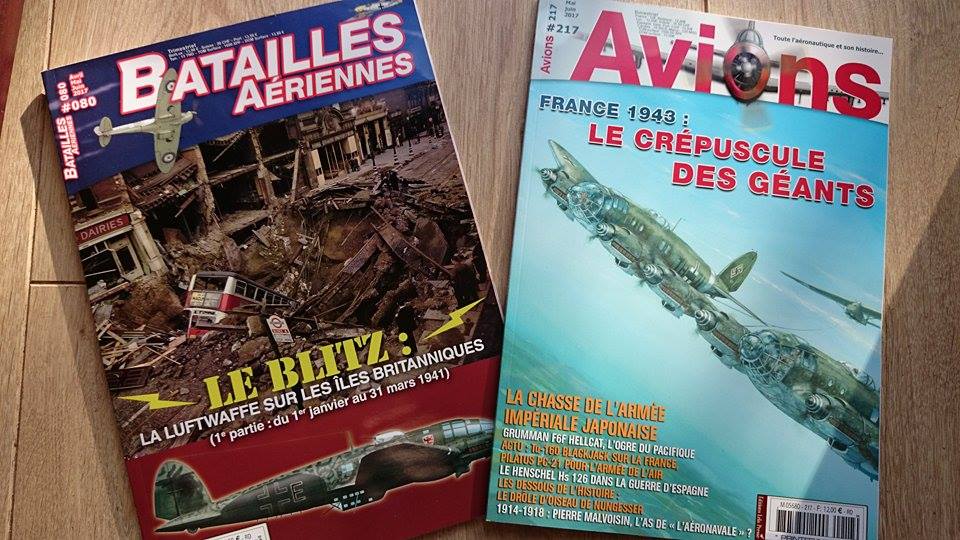
In addition to the second installment of their " Hs 126 in Spain " article the latest issue of  'Avions' magazine (No. 217) covers the He 111 Z in 24 pages in an article entitled 'Twilight of the giants -France 1943' and authored by Dan Gilberti and Jean-Louis Roba . The Zwilling (lit. 'Twin') was constructed in small numbers by the expedient of mating up two He 111 H-6 bombers, joining them at the outer wing section and adding a fifth Jumo 211 F engine at the wing join section. The resulting craft had a wingspan of 35 metres and was a thirty ton machine fully laden. Conceived for the task of hauling the largest glider in the history of aviation  - the Me 321 - the five Jumos each developed some 1350 hp and with supplementary tanks the aircraft could carry some 10,000 litres of fuel. Range in this configuration was 4,000 km. Interestingly the crew - usually of seven depending on the number of gunners - was divided between the two fuselages, with the principal controls in the port fuselage (left)  - although there was a pilot in each fuselage section. The authors have discovered that in addition to two prototypes - Z V1 and Z V2 - some fourteen Zwillingsflugzeuge were constructed  - not the ten usually quoted. The Zwillinge operated both on the Eastern Front and - more unusually - over France.

Below; Me 321 'W6+SW' of the GS-Kdo.2 (Grossraumsegler) seen in the Kuban at Sslawjanskaja just weeks after the fall of Stalingrad in mid-February 1943. He 111 Z-1 'TM+KI' is on the right of the image in the background. The two Bf 109 G-2s are 'white 3' of 4./JG 52 and the 'chevrons + bars' of the Kommodore Major Dietrich Hrabak. Low res image copy courtesy of Michel Ledet via J-L Roba.


The Zwillinge were subsequently assigned to I./LLG 2 and first deployed in early 1943 to the Crimea on glider towing duties. The huge machines arrived in France (Nancy) in April 1943 and from July to September operated out of Istres (south of France) flying troop transporter missions for the Italian front...a pdf extract of this issue can be viewed at the Lela Presse site here


The Luftwaffe's 'Blitz' against England is another richly illustrated monograph from Jean-Louis Roba, covering the period from 1 January 1941 to 31 March 1941. The title opens with a detailed over-view of the Luftwaffe's Kampfgeschwader assembled for this night assault on the British Isles. Not had a chance to read this one yet, but as usual with Jean-Louis, I would expect a pretty comprehensive look at the subject, with plenty of rare photos and Dekker profile artworks. French text. Do take a look at the pdf extract on the Lela Presse web site here


Also from Lela Presse and due soon is Philippe Saintes study of Me 262 losses - according to the publisher's blurb, a work not thus far undertaken in either English or German.  Over 250 photos, 25 artworks and a full list of losses and also featuring numerous pilot biographies. French text. Pre-order your copy here


Sunday, 27 March 2016

Seaplanes over the Black Sea: German-Romanian Ops 1941-44 - Jean-Louis Roba


Seaplanes over the Black Sea: German-Romanian Operations 1941-1944 - Jean-Louis Roba and C. Craciunoiu - Editura Modelism


This very scarce title on German seaplanes was recently on offer via Rich Carrick's ebay sales. Although largely supplanted by the Lela Presse 'Hydravions de la Luftwaffe' titles this is still a fascinating and obscure book for Luftwaffe enthusiasts. Written entirely in a rather fractured English, it is still very readable and covers seaplane operations over Romania in WW II, with many photos, maps and charts. Much as they did with the Romanian Stuka group in ‘Romanian Black Hussars’, authors Roba and Craciunoiu dig into another obscure corner of Russian front air operations. This volume, very similar in format to the Stuka book, but pre-dating it by three years, discusses the pre-war evolution of Rumanian air-sea air units and the German-Romanian force's first missions - and the first Soviet air strikes against them - on 22 June 1941. Subsequent chapters describe ongoing anti-naval patrols, rescue missions, and other sorties. Ongoing Soviet air strikes and occasional air-to-air engagements are also covered. The closing chapter tells of the final days of the Romanian pilots and their seaplanes following departure of the Germans and arrival of the Soviets in 1944. 96 page soft cover, published 1995

Tuesday, 12 January 2016

Oblt. Hermann Westdickenberg, Staffelkapitän 2./ NAG 14 - more Bf 109 recce Aufklärer


Above; Oblt. Hermann Westdickenberg at the controls of his G-6/R2 in Romania during 1944 as Staffelkapitän 2./NAG 14. Click on the photo for a full-screen view.  Text and photos via Roba/Westdickenberg exclusively for FalkeEins blog.

Born in Hamm in June 1917, Hermann Westdickenberg (studio portrait below) joined the Heer (army) in 1936 and participated in the Westfeldzug (campaign in the West) serving with 253 I.D in France. According to his own account his exploits in the field in France with his small advance recce troop were noteworthy - for example, first into Roubaix and into Lille, where he accepted the surrender of a large number of French troops south of the city. 253 I.D spent the winter of 1940-41 in France. Westdickenberg flew sorties as a Heer observer - flying in Luftwaffe recce machines. He eventually took the opportunity to join the Luftwaffe in 1941.  Later that year he was posted to Finland at Kemiaervi near the Russian border with 1.(H)/32, an observer in the Hs 126. Although not a pilot, his rank meant that he was in charge of the aircraft. During 1942 he commanded a detachment of three machines based in Petsamo, specialising in aerial photography and artillery spotting.


In January 1943 he was recalled to Germany and trained as a pilot at Brieg and Jüterbog, before finally achieving the relevant Scheine qualifying him as a Bf 109 pilot, specialising in short-range reconnaissance. Subsequently posted to 2./ NAG 14, his unit moved to Romania in April 1944. During the transfer Westdickenberg turned his Bf 109 over at Craiova and had to complete the journey to Bacau by train. Tragedy soon struck - on his very first sortie from Bacau, the Staffelkapitän Hptm. Hans von Hollenleben (below) was killed in an accident.


Oblt Westdickenberg was immediately named as von Hollenleben's successor. By and large though the first few months at Bacau were relatively pleasant for the men of 2./ NAG 14 - there was little activity in the sector aside from Russian preparations for a large offensive. Everything was to change from mid-August with the subsequent opening of the Soviet offensive in the region of Jassy. Romanian resistance collapsed and Soviet superiority was overwhelming. Flying in Rotten the pilots of NAG 14 were forced to join combat - claiming a number of victories - as well as performing recce missions, such was the numerical superiority of the Soviets.  A recce Staffel such as 2./NAG 14 was an autonomous unit with a strength of sixteen aircraft and up to 270 personnel. Westdickenberg had soon made arrangements for his men and aircraft to fall back to Hungary, a decision which led to disagreement with his hierarchy. However given that the unit was still relatively intact there were no additional complications. However in December 1944 he fell ill while his Staffel suffered losses in the vicinity of Budapest. Large numbers of sorties were flown as the Russians encircled the city. Returning to the front Westdickenberg assumed command of 1./ NAG 14 and ended the war flying missions over Czech territory - on 8 May 1945 1./ NAG 14 was still flying at Budweiss. Although surrendering to the Americans Westdickenberg and his men were handed over to the Russians to endure several years of captivity. Westdickenberg returned to Germany in 1949. A resourceful and competent leader, he enjoyed a successful postwar career in business.

Photos via Jean-Louis Roba above and expired ebay auction below


Celebrating the 2,500th sortie of Nah-Aufklärungs-Staffel 2/14 at Bacau, Romania during the summer of 1944. Westdickenberg is second left (hands in pockets).


More recce Aufklärer on this blog

Scenes from I./ NAG 12

'Heimo' Emmerstorfer NAG 12

Henschel Hs 126 winter recce

Saturday, 2 January 2016

new 2016 catalogue from Lela Presse


The new Lela Presse catalogue for 2016 just dropped through the letter box.

There are lots of new titles in preparation and due to appear in 2016 especially in the 'units' series from Jean-Louis Roba ( 2 volumes on Lehrgeschwader 1) and a new book on JG 54 from Philippe Saintes, not to mention titles on the Junkers Ju 52 (due in April 2016), the Focke Wulf Fw 200 and Philippe Couderchon's long-awaited hardback on French Fw 190s entitled 'From the Fw 190 to the NC 900'.

The second volume from Philippe Ricco on Beute French types in German colours (" Les Avions Français aux couleurs allemandes" ) is also due soon. Read Tom's review of Volume 1 on his blog here.

Also still available via the Lela Presse website is Jean-Louis Roba's superlatively illustrated (French-language) history of Kampfgeschwader 100 which we looked at on this blog here.

Get your paper copy of the new catalogue from the Lela Presse site or download a free copy here


Saturday, 9 May 2015

KG 100 the Viking ship Geschwader - new from Jean-Louis Roba. New and forthcoming Luftwaffe books


...first in a new series due next month from Lela Presse devoted to "les unites de bombardements allemandes" - German bomber units- is this new title on KG 100 - ' the Viking ship Geschwader '. Written and compiled by Luftwaffe blog friend and noted Belgian air warfare historian Jean-Louis Roba this new tome, at 300 pages and 500+ pictures, promises to be the most comprehensive title yet published on KG 100 - certainly since Ulf Balke's 1981 German-language history (Motorbuch).


While I've been asked to reveal not much more than " richly illustrated with many previously unpublished images and comprehensive loss and personnel lists..", Jean-Louis' book almost certainly covers early path-finding sorties over the UK during the Blitz, the desperate and last-ditch re-supply effort into Stalingrad, Arado seaplane missions in the Aegean, He 177 ops during the Baby Blitz and more. The work almost certainly features personal accounts from KG 100 crews on Hs 293 stand-off missile launching sorties, for example Klaus Deumling's sinking of the Italian battle ship Roma and details of missions flown against the Allied D-Day invasion fleet also feature. And lots of new He 177 pictures. A must-have!

More on this forthcoming work from French publisher LeLa Presse on their web-site here

Klaus Deumling on the sinking of the Roma on this blog
http://falkeeins.blogspot.co.uk/2011/01/klaus-deumling-and-sinking-of-roma-kg.html

Roderich Cescotti on flying the Dornier Do 217 M-11 'the best Luftwaffe bomber of the war' on this blog
http://falkeeins.blogspot.co.uk/2012/04/translated-extract-from-roderich.html

Details of over sixty Luftwaffe book and monograph releases from the past five years of this blog at this link
http://falkeeins.blogspot.co.uk/search/label/Luftwaffe%20books

Friday, 5 September 2014

scenes from the Nahaufklärungsgruppe I./NAG 12 - more Messerschmitt Bf 109 recce Aufklärer


The Nahaufklärungsgruppen (NAG or NAGr) flew recce sorties over the battlefield and by mid-1943 these sorties were being flown with unarmed reconnaissance Gustavs. Fitted with Rustsätze comprising the RB 12.5/7 or RB 32/7 camera installations prior to the appearance of the dedicated G-8 recce variant, the Gustavs of  I./NAG 12 - based at Herzogenaurach in southern Germany during the spring of 1943 - were deployed to the hot spots of the European theatre. The following images from the collection of Jean-Louis Roba for 'FalkeEins- The Luftwaffe blog' depict various scenes from NAG 12 Tannenberg. 

The fifteen aircraft of this unit’s 2. Staffel were deployed to the Balkans in the autumn of 1943 and were initially based on the field of Berat (southwest of Tirana) from where they flew sorties alone or in Rotte strength (two machines). The Staffel operated a mix of Gustav variants, having on strength at various stages the G-4, G-5, G-6, G-8 – a dedicated reconnaissance variant - and G-10 sub-types. The unit later deployed to Sarajevo and flew sorties from this base during early 1944 over US-held airfields and ports in Italy.

Unidentified pilot of 'black 7' on his return from a landmark mission, the celebrations continuing in the hut that served as the airfield 'Bierschwemme'


Above; plaque designed to mark the 3000th sortie flown by 2. Staffel of NAG 12 and, below, pilots of the unit commemorate a fallen comrade..

During late 1944 and early 1945, the sixteen Bf 109s of 2./NAG 12 were deployed to Hungary and flew constant sorties from Tapolca as the Russians completed their encirclement of Budapest, threatening the Reich’s last oil fields in southern Hungary. This huge Kesselschlacht (literally ‘cauldron battle’) lasted some six weeks and the Messerschmitt Bf 109 recce Aufklärer were in almost constant action. By April 1945 the Staffel had flown at least 3,000 sorties.


Above; 'new' image of Oblt. Heimo Emmerstorfer climbing into the cockpit of his ‘White 14’.

Below; celebrating the 2500th combat sortie; these images reproduced here courtesy of Jean-Louis Roba and some expired Ebay auctions.. Bf 109 G-6/R2/Trop W.Nr. unknown, Lt. Troebs, 2./NAGr. 12, Mostar .


 'Heimo' Emmerstofer's 'white 14' on this blog

http://falkeeins.blogspot.co.uk/2014/03/bf-109-g-8-wnr-200-weisse-14-oblt-heimo.html

Saturday, 30 August 2014

Latest Airfix 'Dogfight Double', a selection of colourful Emils from "Avions" n°189 & 190 and the latest issue of "Avions" no. 201


Airfix continue to go from strength to strength with their new tools and re-boxings. They are also releasing some great new 'Dogfight Doubles'  - I well recall my first ever model kit which was one of these; the 'Mosquito vs Me 262' from the early 70s! As pointed out by Tony O'Toole on Britmodeller though, the latest Airfix "Dogfight Double" gift set rather improbably pits a Supermarine Spitfire Mk.Vb (No. 229 Squadron, Royal Air Force, Qrendi, Malta, December 1942) against a Messerschmitt Bf 109 E-7 (aircraft flown by Oblt. Joachim Müncheberg, 7./JG 26 “Schlageter”, Gela, Sicily, Spring 1941). Müncheberg did indeed claim a number of Spitfire Vs in December 1942 ..but as Kommodore JG 77 over Tunisia at the controls of a Gustav. During his time over Malta the only British fighters present in theatre were Hurricanes and Fulmars with the odd surviving Sea Gladiator. He certainly didn't meet Spitfires over Malta in his JG 26 Emil "white 12"! Of course that may well not be the point of a "Dogfight Double" - I mean two aircraft that would have run up against each other in combat ? Hats off to Airfix though; two great 48th scale kits, paints and glue for less than a single Tamiya 48th scale fighter!


You might of course not be intending to use the kit decals at all; perhaps you are considering some other colourful Emils as alternatives to the box option - note I'm not saying that these Emils would have met a Spitfire V in combat either!

The following selection is courtesy of the leading aviation history magazine "Avions"  (..and "Avions" editor/manager Michel Ledet) Over the course of two 'special' issues (nos 189 and 190) devoted to the Bf 109 Emil, authors Jean-Louis Roba and Christophe Cony and illustrator Thierry Dekker presented some 50 pages of rare Emil images and artworks .. a small taster follows...back issues can be ordered at the "Avions" secure site  http://www.avions-bateaux.com/  (English spoken!). You can also view PDF extracts for each issue at that link...

Below; a Messerschmitt Bf 109 E-1 of 2./JG 26 force landed on a French beach on returning from England during the Battle of Britain..


Above, a machine apparently destined for North Africa, until diverted to the 'new' Eastern Front, this is  Messerschmitt Bf 109 E-4/B (W.Nr. 2060) of 2.(J)/LG 2 seen at Mizil, Rumania, in June 1941. This aircraft was lost with its pilot, Hans Guse, on 10 July 1941 after tangling with I-16 fighters and DB-3 bombers over Tighina (south-west of Tiraspol)..


"Red 15" Messerschmitt Bf 109 E-7 of 2. Ausbildungsstaffel/ JG 77 in flight over Rumania in late 1941. Note the absence of pilot head armour. I. ErgGr./ JG 77 would shift to Mariupol in the Ukraine during January 1942 and fly ground-attack sorties until April 1942..


Above; two Messerschmitt Bf 109 E-7 sub-types ('black3 ' and 'black 4') of 2.(H)/Aufklärungsgruppe 14 preparing to get airborne in North Africa in late 1941. This unit was the first Luftwaffe recce Staffel to arrive in North Africa during February 1941 and operated successfully in this theatre until late March 1942, with only one recorded loss to British fighters. During April 1942 2. (H)/ 14 returned to Austria to re-equip with the Bf 109 F-4/ R3


Below; Cvitan Galic climbing down from "green 15" his Messerschmitt Bf 109 E-3 of 15.(Kroat.)/JG 52 seen in Mariupol, Ukraine. (WNr. 950 ??) Note the armoured windscreen. Cvitan Galic was the second highest scoring Croatian ace credited with 38 confirmed victories.. He later flew the MS.406 in anti-partisan duties. He was finally killed by strafing Spitfire IXs of No. 2 Squadron SAAF on 6 April 1944 at Zaluzani airfield near Banja Luka..


..and my personal favourite and minus the swastika, in itself something of a rarity  - a housed Messerschmitt Bf 109 E-7 of 2./JG 51 in February 1942. The aircraft is probably being serviced or/and undergoing repairs - the Hakenkreuz appears to have been overpainted...


Meanwhile the latest issue of "Avions" is just published (issue no. 201) - and is absolutely superb again from the team. Articles include the Wildcats of HMS Searcher vs JG 5 during March 1945 ( "Last combats of the Wildcat in Europe,  Spring 1945"), part III of Lennart Andersson's history of the Junkers K 47 (forerunner of the Ju 87 Stuka) and part II of a magnificent feature on D-Day 6 June 1944, replete with a great selection of superlative Dekker artworks! Bravo Thierry !


"Avions" have also released their own version of "Luftwaffe rudder markings" compiled by Philippe Saintes. For 14 euros you get an 80-page A-4 softback featuring some 20+ artworks and around 100 photos on glossy paper - day & night aces covered include Franz Blazytko, Heinz Bretnütz, Wolfgang Falck, Alfred Held, Harald Jung, Erbo Graf von Kageneck, Josef Kraft, Hans Krug, Helmut Lohoff, Werner Machold, Alfred Müller, Paul Schauder, Georg Schirmböck, Heinz-Wolfgang Schnaufer, Adolf Steidle, Karl Willius and more. Recommended ! Go here to order a copy!