Showing posts with label JV 44. Show all posts

Saturday, 29 October 2022

Focke Wulf Fw 190 D-11 Platzschutzstaffel - IBG Models latest release and an updated list of documented airframes

The latest IBG models 72nd scale Fw 190 Doras are released  - the new box features two kits including options to build a rare Dora variant, the D-11.


The D-11 variant of the Focke-Wulf 190 was designed as an interceptor fighter, incorporating many of the features found on the Ta 152.  Developed around the A-8 airframe, the D-11 was powered by a new MW- 50 boosted 35-litre Jumo 213 F inverted V 12 engine rated at 2060 hp for take-off. The sturdier mountings for this powerful engine resulted in a slight bulging of the previously smooth contours of the engine cowling.  Armament was also changed from the D-9; the two cowl-mounted MG 131 machine guns were deleted which made for a refined upper cowl shape. The 20-mm MG 151/20s in the wing roots were retained. The enlarged Ta 152-type supercharger intake on the starboard side of the cowling and the VS 10 paddle-bladed propeller assembly were further characteristics of this sub-type. In addition a 30-mm MK 108 cannon could be installed in each of the outer wing stations, the new spinner also being prepared for the later installation of a further MK 108 or MG 151 firing through the engine camshaft. 

Two rare views of Fw 190 D-11 'Red 4' WNr. 220010  - as featured in the new IBG Models Dora box art - from the well-known München-Riem control tower line-up . 'Red 4' featured the "Der nachste Herr die selbe Dame!" slogan. 


There are only seven (maybe eight) known/documented Fw 190 D-11 aircraft out of some twenty produced. These were manufactured exclusively at the Focke Wulf Sorau factory in the WNr. 220 series and are listed here below in chronological Werknummer order from those known. In the final weeks of the war these machines were gathered together in southern Germany in the Verbandsführerschule General der Jagdflieger (VFS-GdJ – a training school for unit leaders) although the reasons for this are unclear. It has been suggested that as all other units using Doras were front-line there were only limited possibilities to work on these new machines and given their limited number they were assembled in a non-combat unit where Focke-Wulf technicians could spend time on their maintenance and testing. When the VFS-GdJ was finally disbanded these machines were assigned to other units, most notably JV 44, JGr 10 and JG 101. 2./JGr 10 Dora-11’s were equipped with R4M rocket launching rails under the wings in place of the outer wing cannon. JG 101 did not use its Doras in action prior to its disbandment under Kommandeur Maj. Hans Knauth on April 16, 1945.

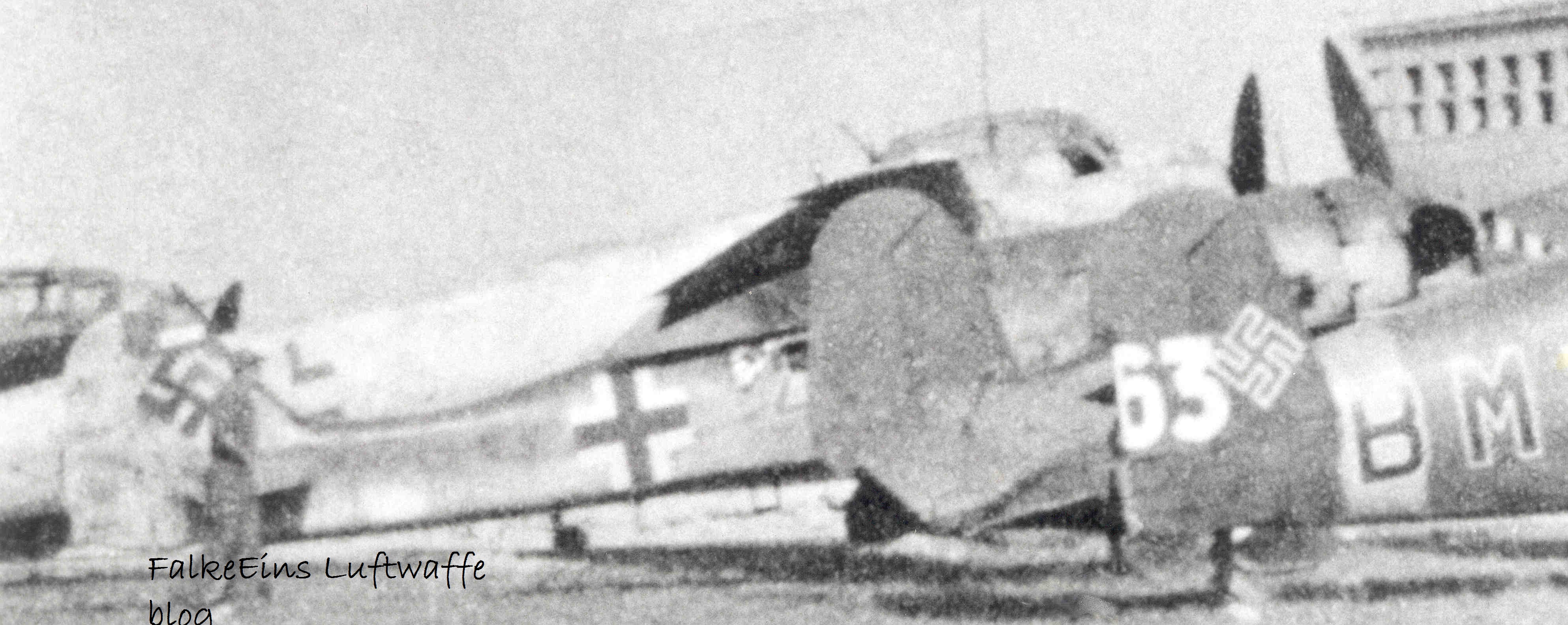
220000, White Chevron 53, VFS-GdJ, Bad Wörishofen
220009, White Double Chevron, VFS-GdJ, Bad Wörishofen
220010, White Chevron 58, VFS-GdJ, 'Red 4', JV 44, Munich-Riem
220011, White Chevron 57, VFS-GdJ, Bad Wörishofen, 
22001?  White Chevron 57  R4Ms  at Schongau JG 101 ("Does this machine have any correlation with WNr 220011  found less than 30 kms away? ")
220012, White Double Chevron + Bar, VFS-GdJ, Salzburg-Maxglan, pos. Major Günther Rall
220013, White Chevron ??, VFS-GdJ, 'Red 2', JV 44, found at Bad Aibling  (JV 44 crest but no inscription)
220014, White Chevron 61, VFS-GdJ, Bad Wörishofen

(with thanks to David E. Brown)

also on this blog;


An extensive Fw 190 Dora feature by this blog writer is published in the next issue (No. 91) of Aerojournal magazine with new personal accounts and rare images. (French language text)

D-11 WNr. 220011, White Chevron 57, VFS-GdJ, Bad Wörishofen


Saturday, 1 January 2022

Notes on the Me 262s of JV 44. Munich, Innsbruck, Salzburg, Hans Ekkehard Bob, Heinz Bär (part 1)


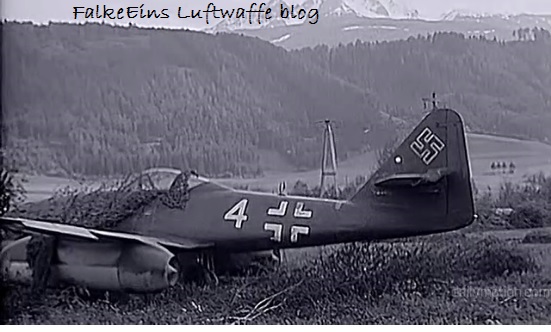
A view of what may or may not have been W.Nr. 170 061 "white 4" of JV 44 seen in a US film excerpt at Innsbruck-Hötting. 

A small post looking at some of the Me 262 Turbos assigned to JV 44. It is relatively well established which aircraft were assigned to Galland's outfit.  Czech writer Martin Sila, " ..at the beginning of its existence, JV 44 received 12 Me 262 aircraft, which probably received a fuselage designator (white) from "1" to "11" while Galland's command machine (the twelfth machine) displayed a ' white double chevron'. In photos the machines look as if they are painted with a uniform color, but in reality they are finished in two shades of green. Some serial numbers from this first group of twelve aircraft are also known.."

Late on JV 44 "absorbed" a number of aircraft from other units (III./EJG 2, KG 51, trial prototype machines). Robert Forsyth's "JV44 The Galland Circus" narrative highlights just how chaotic the circumstances around the unit's formation and its subsequent operations were, with aircraft arriving from a number of units and pilots bringing their own machines with them! Even the Luftwaffe High Command didn't always know the strength of this unit!  

Below;  two JV 44 Turbos that may depict "White 6" and "White 3" W.Nr. 111740 and W.Nr. 111746 operational with JV 44 at München-Riem in April 1945. This image is apparently captioned "Me 262 General Galland and Lt. Willi Roth, Staffelkapitän of 4./JG 103 [sic]." Lt Roth is listed as one of the JV 44-pilots in the well known document dated 27. April 1945 but not mentioned in Forsyth. Notable JV 44 pilots from JG 103 included former instructors Ofw. Dobnig and Ofw. Rudolf Nielinger. 'White 6' is usually assigned to Steinhoff...


The aircraft in which Johannes Steinhoff was badly burnt on 18 April 1945 was "white 6" (WNr. 111740) and Galland flew his last combat sortie on 26 April 1945 in 'white 3' (WNr. 111746). This machine was not destroyed (as has been generally stated) that day, but only damaged. Another well-known member of JV 44 Franz Stigler stated that this "white" 3 "was his machine. According to Sila, "..Stigler's role in the JV 44 is overestimated. He served as Techn.Offz. As to combat flights, it is interesting that other witnesses from JV 44 do not mention him in their recollections .."

The "sister" machine to WNr. 111745 was "white 5" which Eduard Schallmoser damaged heavily on 4 April colliding with a P-38. "White 5" was one of the twelve Me 262s which Jagdverband 44 had taken over in March 1945. A number of pilots flew it in combat. Schallmoser had been assigned to JV 44 as a freshly trained fighter pilot, after completing an accelerated training programme in the Me 262. On 4 April 1945, his Rotte met a group of twelve P-38’s of the 15th USAAF in area of München-Riem, which the German pilots attacked. In the following combat Uffz. Schallmoser collided with one of the Lightnings piloted by Lt. William Randle as a result most probably of his excessive speed. While Schallmoser managed to land his damaged “White 5”, Lt. Randle bailed out of his Lightning and became a POW. 


Below;  'white 6'  in the background seen behind the tail of 'white 5' on the right. The Kennziffer '6' is partially obscured by the camouflage netting. Both machines display the typically basic JV 44 camouflage scheme consisting of RLM 82/83 on the upper surfaces. Eduard Schallmoser is on the right. 


In late April 1945 Galland's unit was ordered to depart Munich - effectively ceasing combat operations - and commencing on April 28, JV 44 began transferring to bases (or rather field strips) in Austria - Salzburg and Innsbruck. Of particular interest is the (unknown) fate of Galland's own 'white double chevron'. According to one account 'white double chevron'  was flown to Innsbruck on 29 April 1945. In Innsbruck, Major Hans Ekkehard Bob was ordered to the landing ground at nearby Hötting to prepare for the arrival of jet aircraft. The runway strip area had to be extended to 1,200 metres necessary for takeoffs and landings by Me 262 and an attempt was made by Bob to adapt the airstrip to the necessary length. However there was no J2 fuel at the base. Bob's efforts were in vain. 

There were two airstrips at Innsbruck at that time. At Innsbruck-Reichenau, a few kilometers east of Hötting, at least two Me 262s came into land, and according to one account, Me 262 A-2a "White 1 "  almost hit buildings on the run-out. The landing strip was still too short for a Me 262 to take-off from, so of the 12 Turbos that landed  in Innsbruck according to Bob's recollections,  all were stuck and subsequently abandoned. However if Galland's  'white double chevron' did go to Innsbruck it does not appear to have been documented photographically there by US personnel. From the video material available there is no sign of such a distinctively marked machine. More on this in part 2.


'White 8' (above) -Me 262 A-1 "White 8 S", WNr. 500492 - was one of possibly two Me 262s that landed at Reichenau, a few kilometers east of the temporary airfield at Hötting where the other JV 44 Me 262s landed and were dispersed. Note that the machine was previously with III./EJG 2 operating from Lechfeld, with the white `8`on the nose and narrow yellow fuselage band behind the cockpit.

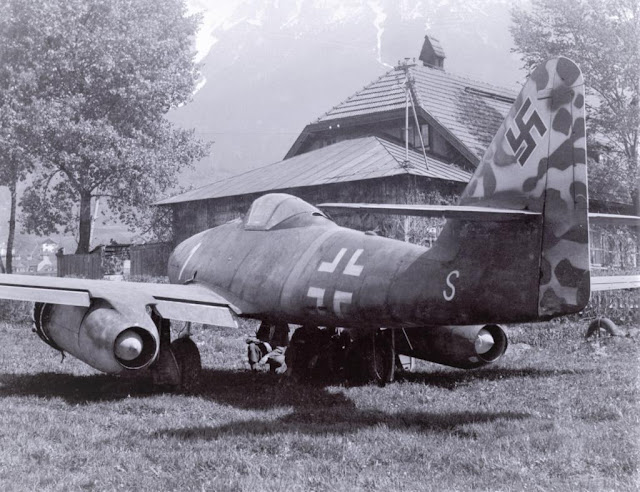
  On the evening of 29 April 1945, at about 1800 hrs., Ofw. Rothert of 2./Fl.U.G. 1 transferred Me 262 A-2a WNr. 170047 'white 1' from München-Brunnthal to Innsbruck-Reichenau. The port view of this machine  (last of the four images) shows the white 'S'  ('Schule') under the horizontal stabilizer - as seen in the well-known Kommando Nowotny line-up from where it went to JV 44. 


Major Bob remained in Innsbruck until 3 May 1945, when he received an order to 'disable' his jets  and transfer to Salzburg which he did as the US Army approached. Based on this information, it is possible to state that all of the Me 262s abandoned here were unserviceable.. 

At least 12 Me 262 Turbos were flown to Innsbruck. However a memo dated 2 May quoted in O'Connell's 'Me 262 Production Log' states that as many as 22 Me 262s of JV 44 were transferred to Hötting and that 7 of them crashed on landing. [The memo states that there was 25 cm. of snow at Hötting on 2 May.]

 JV 44 Me 262s that can be identified at Innsbruck (primarily Hötting airfield) included;

 W.Nr. 111 712 (EZ 42, no Kennziffer)
 W.Nr. 500 490 Me 262 A-1a. No markings, full-fuselage RLM 83 camo 
 W.Nr. 111 857 (original "white 5")
 W.Nr. 111 751
 W.Nr. 500 524
 W.Nr. 112 360
 W.Nr. 170 047 - "white 1"   Innsbruck-Reichenau
 W.Nr. 111 974 - "white 8"   Innsbruck-Reichenau
 W.Nr. 170 061 - "white 4"
 W.Nr. ??? ???  - "white 11"
 W.Nr. ??? ???  - "white 12" (according to David. E. Brown the 113 series aircraft ...)
 W.Nr. ??? ???  -  "red 1" ( another 113 series machine ...)


Below;  Me 262 A-1a, uncoded, JV 44, WNr.111857, Innsbruck-Hotting. Previously 'white 5', III.EJG 2. NSG 9 Stuka D-3 with exhaust flame dampers in the barn in the background.


(to be continued)


Monday, 10 February 2020

Maj. Werner Roell, French-born Stuka ace, Kommandeur I./St.G. 77, JV 44


Many enthusiasts know of Werner Roell through his landmark book "Laurels for Prinz Wittgenstein" about his school friend, Major Heinrich Sayn-Wittgenstein, one of the great Nachtjagd aces. But Roell was a decorated Luftwaffe pilot in his own right, awarded the Ritterkreuz in May 1943 as Kommandeur I./St.G 77. He flew over 400 combat sorties, many at the controls of the Ju 87. He was interviewed only rarely but Belgian writers Philippe Saintes and Jean-Louis Roba spent time with him in early 2008 at his home on Lake Constance (Bodensee). Ahead of a more in-depth eArticle from AWP here are some brief extracts from Roell's biography.


" ..My father Paul Roell was an engineer from Krefeld but loved France. In 1912 he settled in Ailly-sur-Noye (south of Amiens) to work in the local factory. He even organised his wedding there and I was born in Ailly on 8 February 1914. But war broke out soon after and we were interned. My mother and I were exchanged for French civilians while my father was imprisoned at Fort Lautrec in Brest for four years. He was held in harsh captivity, but always maintained his great attachment to France. When he returned to Germany at the end of 1918, he started a trading company and I spent my childhood in Solingen. When I obtained my Abitur ( high school diploma) in 1933, my grandmother, who was originally from East Prussia, offered to let me stay in Königsberg. I was going to discover things that I hadn't known up until that point. I, who lived in a demilitarized Rhineland following the Treaty of Versailles, learned that there was a German navy and army. So I decided to become a sailor. In 1934 I joined the Kriegsmarine and spent several months in Flensburg-Mörvik. I served on ships for a time, but in 1934 I was approached by an officer who told me that the fledgling military air force needed volunteers. I decided to apply for this new service..."

After some gliding practice, Fähnrich Roell entered the Salzwedel school on November 1, 1935. Very quickly, he opted to fly Sturzkampflugzeuge and flew the Hs 123 before mastering the Ju 87 A and then B. As a member of II./St.G. 165, he soon became adept at precision bombing. Still single, he was in principle able to apply for the Legion Condor. In fact his application was declined. He recalled;

 "I applied to go to the other side of the Pyrenees but was not accepted. I was told that the Legion had sufficient personnel and that there was no need for volunteers.."  This is easily explained by the very small number of Ju 87s involved in the civil war! Roell would nevertheless take part in the occupation of Czechoslovakia with his unit. He was one of the first pilots to land in Norway during that campaign. He later flew operations in Yugoslavia and Crete as Staffelkapitän of 4./St. G 77, subsequently flying in Russia.

On the launch of Barbarossa St.G.77 was in almost constant action supporting Guderian's 2. Panzerarmee assaulting Brest-Litovsk, which fell on June 29. The Soviets weathered the initial Blitzkrieg and managed to launch sporadic counter-attacks. Thus, on 7 August, St.G. 77 was called in urgently in the Kanev sector to halt a Soviet assault threatening the German breakthrough towards Uman. The targets did not vary much for Roell and his comrades: tanks, vehicles, fortified positions, flak batteries. From time to time, it became necessary to attack the armoured trains that the Soviets used as artillery support. In September, St.G 77 was deployed to the Crimea in the area of Army Group South. For a while, Roell's 4. Staffel was the only Stuka unit supporting the German troops on the ground in the peninsula. During this period II./St.G. 77 flew sorties against shipping on the Black Sea. On September 21, the Ju 87 Gruppe launched a major operation against a powerful Soviet amphibious force heading towards Grigorevka (west of Odessa). A destroyer, a torpedo boat and a tugboat were sunk within minutes. Two other destroyers are also damaged during this attack. The Ju 87 Bs continued their maritime patrols during the following months. The light cruiser 'Chervona Ukraina' was attacked on 12 November and, badly damaged, was sunk the next day.

Below; Roell, Staffelkapitän of 4./St. G 77, in front of his Berta with his Bf Ofw. Zehle and 1. Wart Uffz. Karl Becker.


Below; loaded 'Berta' of St.G 77 with 'cockerel' badge under the windscreen


After the fall of Sevastopol in July 1942 Roell was promoted to Hauptmann and appointed Staffelkapitän of the Stabsstaffel of St.G. 77. This Staff comprised various aircraft: some Ju 87 Bs and some Ju 88s, the latter replaced by Bf 110s. The new StaKa would develop the offensive character of this unit, which then concentrated on attacks on railway lines while also flying in night pursuit or escorting Ju 87s. Roell achieved some notable successes, among others sinking a light cruiser in the Black Sea. On 27 August 1942, Roell shot down a Soviet twin-engine bomber that fell to the heavy nose armament of his Bf 110 north of Tuaspe. The Stab moved regularly during the summer. After a brief interlude in Armawir at the end of August, the unit reached Taganrog. On September 29, Roell taxied out for a sortie with Ofw Brendemühl and Ofw Rottke from Belorestschenskaja airfield. Powering down the takeoff strip he was on the point of getting airborne when his landing gear collapsed!  The Bf 110 F-4 slid along the runway to finish up in the long grass on the edge of the aerodrome (below). Fortunately for the crew, the bombs attached to the belly rack did not detonate.
The new Kommodore, Alfons "Ali" Orthofer had less luck. He had the misfortune to be caught in a bombing raid at the same airfield on October 12, 1942 and, fatally injured, died the same evening at the Lazarett in Maikop. At that time, St.G. 77 took part in the destruction of the oil fields and refineries in Grozny, Caucasus (10-12 October). A month later Baku received the attentions of St. G 77.

Below;  Roell's Bf 110 after his takeoff accident on 27 August 1942. The 'death's hand' emblem of the Stabsstaffel is just visible on the nose of the machine..


Roell was appointed Gruppenkommandeur of I./ St. G 77 in February 1943 and awarded the Ritterkreuz three months later in May 1943...

 On 1 December 1943, Major Roell was finally withdrawn from the front to become Inspektionschef of the Luftwaffenkriegschule in Bug am Rügen where he taught his pupils the tactics of dive-bombing. Much later in the war, he was sent to serve on the Staff of the "Plenipotentiary of the Reichsmarshall for Jet aircraft" Generalmajor Josef Kammhuber. It was Kammhuber who in early March 1945 ordered JV 44, the so-called Jagdverband Galland, then based at Munich-Riem, to become operational as quickly as possible. JV 44 was an elite unit flying the Luftwaffe's last hope, the Messerchmitt 262. Roell was tasked with ensuring that communication between Kammhuber's staff and the jet combat units ran smoothly. He explained post-war;

 "...at that time the situation was really critical. I was sent to Munich-Riem to take care of the logistics and to help set up the necessary infrastructure for the Galland jets. Galland had called on my services although I did not know him personally. We were in the thick of it from the outset because Riem airfield was the daily target of enemy bombers. The runway had to be repaired every day ... "

 JV 44 had in its ranks prestigious and experienced officers such as Adolf Galland, Steinhoff, Krupinski, Barkhorn, Heinz Bär, Willi Herget and Günther Lützow. All these RK holders now flew as 'simple' fighter pilots. In a little over a month of fighting, this unit took credit for the destruction of forty-five enemy aircraft. On April 9, 1945, Roell and his friend and former St.G 77 comrade, Maj. Herbert Pabst (former StaKa of 6./St.G 77), were on the road in a Kübelwagen. The airfield at Riem and the surrounding area suddenly became the target of cluster bombs dropped by B-17 bombers;

 "..We just had time to reach the Daglfing race-track to take cover. The bombs were literally streaming down, the ground was shaking and the air was filled with thick smoke. Once their cargoes were dropped, the enemy formation headed for Munich in a deluge of fire. The response from our Flak had not been long in coming. At that moment a bomber could be seen breaking away from the formation. Suddenly it exploded in mid-air! Aircraft parts fell tumbling and spinning to the ground, glittering like silver flakes in the sun. What a sight! Suddenly I saw a parachute, just one. At the same time, another tragedy was playing out much closer to us. The stud farm had been hit hard by the raid. Young girls recruited to look after the horses were trembling with fear. An SS man walked to one of the stables, pistol in hand. We heard several shots. Damn the unfortunate horses! It must be awful for a rider to shoot his own horse to shorten his suffering. The individual came out of the stable trembling with rage. Meanwhile, the wind had pushed the parachute in our direction. The bomber crewman who had evidently been the only man to get clear landed behind the building. The man was unable to speak and one of his legs was probably broken. The people from the stud farm put him down on the grass. The poor bugger was obviously in a state of shock but the SS man who was still holding the gun in his hand wanted to shoot him out of hand in retaliation. This was something we could not tolerate. Pabst and I intervened directly. The man may well have been wearing another uniform, but he was first and foremost a human being. We came out of our refuge and confronted him before he committed a terrible act. He didn't understand our reaction, but he finally turned on his heels and walked away. I don't know if the enemy airman, who was prostrate, realized any of this, but he smiled weakly when we gave him a cigarette. You could see the pain in his eyes when we lifted him up to carry him in our Kübelwagen. As we drove through Riem airfield, we also picked up one of our soldiers who was seriously injured. We went to the sisters' house in Eglfing-Haar, the only place where first aid could be obtained. The man guarding the main entrance initially refused to let us in: 'No access for military personnel. We are in the service of the Red Cross. Take them somewhere else!'. (...) However, we managed to convince a doctor to take care of the two wounded. For the German soldier, it was too late because he had succumbed to his wounds. We visited our American charge a few days later, but he had already been transferred to the Schwabinger Hospital in Munich.."

Years after the end of the war, Werner Roell, assisted by an American enthusiast, rediscovered the identity of his "charge" - Lt Warren Cormack Perkins, co-pilot of a 388th BG B-17 (serial number 44-6574). Of the nine crew members, five survived, including Perkins.

As Riem airfield was no longer safe, JV 44 moved to Salzburg-Maxglam at the end of April 1945. The unit was then ordered to move to Prague, but was surprised by American forces on May 3. The war ended for Werner Roell. He escaped capture and was even employed by the Americans as an interpreter. For three years, he even ran a hotel for the occupying troops. He learned, however, that he was formally barred from any course of study. As an officer and Ritterkreuzträger, he could only be a 'fierce Nazi' for the new leaders of Germany. Roell therefore chose to leave the country and cross the border clandestinely in the Alps. Intercepted by the Italian police, he remained in a Rome prison for a few weeks before embarking for Argentina. He worked briefly as a waiter in Buenos Aires before being able to enter the United States. Always passionate about aviation, he became the first German to obtain a pilot's license in the land of Uncle Sam after WWII. Werner Roell then bought a small Cessna 140 for $3,000 and ferried it from Roosevelt Airfield to Long Island. It was the beginning of a new odyssey that would take him across the American continent: Mexico, Guatemala, San Salvador, Nicaragua, Costa Rica, Panama, Colombia, Ecuador, Peru and, finally, Chile, where he became a physical education teacher at the German school in Santiago in 1948. Four years later, having learned of his father's death, he returned to the country to take over as head of the Roell group. After the usual training, he even became a reserve lieutenant-colonel in the Bundeswehr. Married shortly after his return to Germany, he had four children and one of his grandsons also pursued a career as an aviator.

Werner Roell spent his later years in Switzerland, close to the German border and devoted himself to his two great passions: painting and writing.  He passed away on May 10, 2008.

Article based on extracts from "Les As du Junkers Ju 87 Stuka" and with additional material by Jean-Louis Roba.

Sunday, 16 June 2019

James V. Crow RIP - Dora 9 'Red 1' of the Platzschutzstaffel


posted by Steve Sheflin on TOCH

"..I am saddened to report that my friend James V. Crow passed away on Friday 03 March 2019 at his home. Jim was 79 years young, and a gentleman in the broadest sense of the word. The Luftwaffe research community, as well the rest of the world, has lost a star and a friend. Jim is finally with his lovely wife Erika again. Respectfully, Steve Sheflin..."

and from David E. Brown

"..This is a huge loss for many of us who have had the benefit of working with Jim and the honour of having him as a friend. Jim was unselfish in his sharing of Luftwaffe and related photos from his collection that be began building in the 1960s.."

Pick up any Luftwaffe book at random and chances are you will come across a credit for 'James V. Crow'. A veteran US serviceman who lived and worked in Germany for a number of years, Jim devoted much of his spare time to acquiring photos of WWII German aircraft and amassed an enormous collection of rare images. I was always thrilled that Jim would want to share his photo collection with a minor-league translator and blogger such as myself.  He was always ready to send out 'new' photo material for whatever project or article that I happened to be working on. I introduced him to Kagero and many of his photos appeared in their 'Monograph' series - until the day that they failed to return some of his late-war Ju 88 images. Originals - since Jim didn't scan or 'photoshop'. Occasionally he went to the print shop and had copies prepared. Maybe the images sent to Kagero went 'missing' in the post back to him after being used in the monograph (Vol III Junkers Ju 88 is full of his rare images..) We never did get to the bottom of that business. Hopefully I always did the 'right' thing by Jim in sending him a copy of whatever book/monograph or article that his photos had appeared in as a result of my involvement and I of course always sent him small sums of money in exchange for images which he appreciated. And Jim must have written to me many times for help in identifying and captioning where possible his latest images. Jim's notes always appeared on the back of photocopies of the photos in question—I don't think Jim bothered with typing and as far as I am aware never used a computer and everything that went with it. He would always write in long-hand - unfortunately I always had trouble deciphering his hand-writing. He was a fund of stories as well - dining out on his relationship with Hans Ulrich Rudel and his glamorous wife in Chicago during the 70s. ( The Rudels were invited by the US government to participate in the development of the A-10 Warthog, conceived for close air support - 'Stuka Pilot' was required reading for the design team).

The two gentlemen quoted above have put it far better than I could - even if you didn't know him James V. Crow will be sadly missed by all in the Luftwaffe enthusiast community...


Starboard view of 'Red 1' of the Platzschutzstaffel (airfield protection squadron) of JV 44 in front of the control tower at München Riem airfield after the capitulation. Operating from the opposite end of the field to the Me 262 Turbos of JV 44, the Platzschutzstaffel followed specific orders; take off ahead of the Me 262s in Rotte formation, maintain a 1500m altitude umbrella and under no circumstances break off to chase enemy fighters. This view reveals that the cockpit has been ravaged by fire, possibly following orders to destroy the aircraft as the end neared. Built in December 1944 by Fieseler at their Kassel factory, this Dora is finished in the 82/83/76 scheme. Factory stencilling is intact. Undersurfaces are red with thin white stripes as a recognition marking for the airfield flak gunners. Behind the Siebel to the left of the picture is Fw 190 D-11 'Red 4'.  Via Crow. Click to view full screen.


Monday, 14 May 2018

The story behind the Luftwaffe book. Interview with Classic Chevron co-founder and author of " JV 44 - The Galland Circus " Robert Forsyth


Robert Forsyth has studied the history and operations of the Luftwaffe for many years and as co-founder of specialist publisher Classic/Chevron, he has worked full time in publishing since self-publishing his ground-breaking  "JV 44 - The Galland Circus" (1996). He subsequently researched, wrote and published "Battle over Bavaria: The B-26 versus the German Jets" (1998), "Mistel: German Composite Aircraft and Operations 1942-1945" (2001), and "Messerschmitt Me 264 Amerikabomber" (2006 - with Eddie J Creek)


"..with Gerhard Kroll (centre), former Fw 190 D-9 pilot of III./JG 26, and my old friend, Dave Wadman (right), at the Champlin Fighter Museum in Mesa, Arizona, October 1990. Behind us is the museum’s Fw 190 D-13...."


Hello Robert! It's great to welcome you to the 'Luftwaffe blog' as part of our author interview series. Thank you so much for talking to us. Thanks too for raiding that old shoe box of photos and coming up with the captions!  Right, firstly, how did your interest in JV 44 develop?

How far do you want to go back?

I had a typical 1960s boyhood diet of Biggles, war comics and war films which sparked my interest in the machinery and drama of the Second World War. When I was nine, my mother took me to see the film Battle of Britain. I suppose that really ‘did it’. I thought the yellow-nosed Bf 109s looked sleek and business-like, and I think I was perhaps sub-consciously intrigued by how the Luftwaffe, led by a buffoon-like Göring in the film, could have successfully invaded most of Europe and be threatening Britain.

I then bought endless Airfix kits and my bedroom ceiling was hung with badly made and painted Bf 109s and He 111s. I think there was a lone 1/32nd P-47 which I bought because it was so immense.

One day in 1970, I was walking past a local bookshop and in the window I spotted a big book, with a red cover, called Warplanes of the Third Reich. By now I was ten. I walked into the shop, found a copy on the shelf and flicked through it. It was by a man called William Green and it was amazing. I hefted it over to the counter and asked the lady how much it cost. It was very heavy and very expensive. I put it back on the shelf. I went home and asked my mother if I could empty my building society savings account (funded over the years by birthday and Christmas presents) to buy ‘a book’. She seemed to be quietly impressed at her little boy’s literary enthusiasm and agreed. I toddled off, got my money out, but when I told her what the book was, she was perplexed, not a little angry and probably somewhat concerned at her son’s deepening interests in the ‘enemy’.

Roll forward to the mid-1980s (in the 1970s and the first half of the 1980s my interests were given over to rock n’ roll, beer, girls and work in that order), I had what was almost an epiphany when I read Johannes Steinhoff’s The Last Chance. I thought it was – and still is – a fascinating and wonderful insight into life on the ‘other side’, when Germany was losing the war, yet had such an amazing example of technology in the Me 262. I then quickly devoured his first book, The Straits of Messina. My first idea was to write a biography of Steinhoff. In around 1986/87 I wrote to the General, but received no reply. I was particularly interested in the story of JV 44 and what ‘actually happened’ and decided, notwithstanding a lack of response from Steinhoff, to start researching the unit with the goal of writing a book.

There was no internet or email in those days, so I joined the Gemeinschaft der Jagdflieger as an associate member and went to Germany to the meet the association’s secretary, Horst Amberg, who was very helpful. Through him I was able to contact several former pilots who had been associated with JV 44. I went on to meet and interview Adolf Galland, Walter Krupinski, Hans-Ekkehard Bob, Franz Stigler, Klaus Neumann, Erich Hohagen, Herbert Kaiser and others. I also spoke at length with Eduard Schallmoser who lived in South America at the time.

Additionally, I wrote to several German Luftwaffe historians such as Gebhard Aders, Werner Held, Hanfried Schliephake and Heinz Nowarra, not really having any idea what to expect, but it was Manfred Griehl who was most helpful with advice on how to locate documents etc., and I visited him and Hanfried Schliephake.

You presumably ran into Eddie during the research for this book?

I remember buying the last copy of Monogram Publications’ Jet Planes of the Third Reich by Smith and Creek that Motorbooks in London had in their shop. That would have been around 1986. At that time, it was awesome. Fortunately, it mentions Eddie’s home town at the time in the introduction of the book. I called directory enquiries, they gave me the number and I just gave him a call. He was very gracious and friendly, and it was the beginning of a thirty-year-plus friendship. Eddie invited me down to his home along with a bunch of other UK-based enthusiasts and hosted a barbecue.

From that, he and Richard Smith set up ‘Staffel 90’ during 1990 as a way of re-establishing ‘Gruppe 66’ the original, but defunct, Luftwaffe research group. It was all a bit loose, but we had all corresponded regularly (by post – no email!) and held a few gatherings. I recall the core group being Eddie, Richard, Martin Pegg, Steve Coates, Nick Beale, Mike Norton, Tom Willis and myself, but we also welcomed Phil Butler, Jerry Scutts, Steve Ransom and Chris Thomas at different times. We used to get together at Eddie’s house in Sussex and would also make mass trips to research at the IWM in London where we were given pretty free reign, thanks to Phil Reed, as well as to what was then the Public Record Office at Kew where if you wanted photocopies you got them on yellow A3 paper and paid 10 pence a sheet. No cameras.

Why decide to self-publish and so lavishly, back then it was not exactly the done thing?

To be honest, I hadn’t really thought about it. I was still researching the book, and working in London in the shipping industry, doing a lot of travelling. Eddie had just retired. On one occasion, I took a few days off and went with Eddie on our first trip to the IWM document repository at Duxford. It would have been about 1993.

In one of those life-changing moments, after a day looking at dusty files, Eddie and I went for a beer in a local hostelry and he asked me what I was going to do about publishing my book. I said I hadn’t the faintest idea. He said, ‘Well, why don’t we do it?’ At first I thought that was barmy, but after a good night’s sleep, the next morning over breakfast, I asked Eddie if he was serious. He was. I wasn’t particularly happy at that point in my day job, and I was very fortunately in the position of being able to afford to take six months off work. I meekly asked my wife if she would allow me to take six months off to write the book on the basis that we would publish it ourselves and I would then return to work. She was wonderful and agreed.

We really had no idea what we were doing, but we had the Monogram books as a model, for whom Eddie had written, and a very good friend of mine was an excellent graphic designer. I also had contacts with a small printer in Norfolk. So off we went.

I quit work, finished the book and "JV 44 – The Galland Circus" was published by our fledgling imprint, Classic Publications, in May 1996. I was fortunate enough to get an introduction from Adolf Galland shortly before he died, but he never saw the book.

I think, in total, in those days it cost a terrifying £30,000 to put together and print a first run of 3,500 copies. Funnily enough, in the end, exactly 4,400 copies of 'JV 44' were produced. I own the rights to the book and I’m thinking perhaps of doing a revised, smaller format, signed limited edition or POD volume one day. I also wrote about the unit for Osprey Publishing, in which I was able to include the memoirs and photos of Josef Dobnig, which I did not have for The Galland Circus.


Above  ;   "...with Eddie Creek at the Duxford Air Show in September 1996. Classic Publications had just launched and this was our second major outing after the Tangmere Aeromart. The Aviation Bookshop kindly allowed us some table space to sell ‘JV 44’...."

Below;  "...the original Classic Publications team: from left, Eddie Creek, Arthur Bentley and myself, at the IPMS UK National Exhibition at Telford in November 1996. Eddie built the stand and we covered it with a red tablecloth that belonged to my mother. Behind us is some of Eddie’s original airbrush artwork for the book...."


Below;   "...with French researcher, the late Eric Larger, who was staying with me at the time and who was a great help in setting up the stand. I remember Eric would give a wonderful, Gallic shrug as he walked past many of the Luftwaffe models, declaring in his heavily accented favourite expression, that their camouflage was ‘completely maaaaad!’...."


Had you already had the idea for the ‘Luftwaffe Colours’ series at that stage?

After JV 44 Eddie and I got together with Martin Pegg and published his Hs 129 book and then Eddie’s and Richard Smith’s Me 262 series. I never actually went back to work! The idea for 'Luftwafe Colours ' came a little later. Back in the early 1990s, Jim Kitchens had put me in touch with Eric Mombeek, who I knew from his excellent JG 1 history as published by John Vasco. I got to know Eric quite well and when we set up Classic, he suggested Eddie and I go over to Belgium to meet him to discuss potential projects.

It was on the way back home on the cross-Channel ferry from our first visit to see Eric in 1997, that – again over a drink! – Eddie and I came up with the concept of Classic Colours using Eddie’s and Eric’s substantial photographic collections as a basis. At that time, we were also just in touch with Tom Tullis in the States, who was one of the first illustrators to use computer software to ‘paint’ aircraft profiles. So the whole thing was born. It ended up running to 40 titles.


Below;    "..At the IPMS National Exhibition at Columbus, Ohio in 1997 to where we had shipped a few copies of our second book, Hs 129 Panzerjäger! by Martin Pegg. They sold out within an hour. From left to right: model shop owner/wholesaler, Mike Bobe; our good friend and modeller, Bob Hanes, Eddie Creek, Dennis Davison, who is a superb aircraft illustrator, and myself...."


Above;   "...at Columbus with my good friend, Dr. James Kitchens. Behind Jim is one of Dennis Davison’s prints..."


Above;  " ..with the late Jerry Scutts (right) at a book launch at the RAF Museum at Hendon ca. 1999. We had just collaborated on ‘Battle over Bavaria: The B-26 Marauder versus the German Jets – April 1945’, a kind of sequel to ‘JV 44’ which came about as a result of a stream of correspondence from former B-26 crews in response to the first book.."

Below ;   "..With former Mistel pilot Rudi Riedel of 6./KG 200 during the preparation for my Mistel book, in Bremen, 2000..."


left;   "...By the mid-2000s we had taken an office and small warehousing area in a building on my cousin’s farm in East Sussex. Standing outside the entrance to the office is the ‘Classic team’. 
Seen here with Eddie and myself are my good pals, (far left) Tim Brown, profile and graphic artist, and designer whose illustrations and design is seen in many titles published by Classic and Hikoki, whom we also used to work for; and (second from left) Mark Nelson, a talented designer who has worked on some 100 titles for our various imprints..."


Why has Classic not yet done a multi-part series on the Bf 109? A book per sub-type could be interesting, Emil, Friedrich, Gustav x2 for example?

Find me the author willing and ready to do it!

Or an airfield series (for example)?

We did look at this a few years back, after Classic Publications was bought by Ian Allan Publishing, but we could never get the idea off the ground (I don’t think there’s a pun in there anywhere).

Why the (superb and sumptuous) V2 book, since that was not a Luftwaffe weapons system?

That was something that Crecy Publishing, who bought Classic from Ian Allan in 2014, approached us about doing. Fortunately, I’d worked with Murray Barber, the author, before on an associated title for my own Tattered Flag Press imprint. He really knows the V2 and is a wonderful guy to work with. Crecy were committed to the book and we had quite a bit of ‘elbow room’ on photo content, which is really stunning. We were also fortunate to be able to work with Mark Alloway, who did the superb colour graphics. I explained to Crecy that the V2 was a German army project, but they felt it was OK to ‘fit’ the book into the Luftwaffe Classics series.

What is the book you’ve had to work ‘hardest’ on to get it to publication and why?

If you mean to get commissioned, possibly two Luftwaffe titles: the excellent Ju 287: Germany’s Forward Swept Wing Bomber by Stephen Ransom and Peter Korrell with Peter Evans or Nest of Eagles: Messerschmitt Production and Flight-testing at Regensburg 1936-1945 by Peter Schmoll which we bought in from the original German publisher. This is no reflection whatsoever on the authors’ work whatsoever – far from it. They are superb studies, which is why I felt they should be published if at all possible. But it’s hard to get a publisher to invest significantly in books about really specialist types that did not get beyond prototype stage or books about production. Happily however, they did get published. The Ju 287 seems to be quite sought after now on the second-hand market.

If you mean in terms of production, then perhaps Camouflage & Markings of the Aeronautica Nazionale Repubblicana 1943-45: A Photographic Analysis through Speculation and Research by Ferdinando D’Amico and Gabriele Valentini. A superb book, but it was very complex and challenging in terms of content and presentation.

And the most ‘straightforward’?

Happily, most of our projects have been very enjoyable and straightforward to work on.

I believe there were discussions with Jochen Prien about publishing his Jagdfliegerverband series in English? Would this not sell well? And some of his other books - the unit history devoted to IV./JG 3 immediately comes to mind for example - should be in English shouldn't they ?

They are superb books. When Dr. Prien started work on his Jagdfliegerverband series, we were still working on Classic Colours, so there was a bit of a question as to how they could be presented as Classic books. It was also difficult to get a commercial publisher to commit to a series that was open-ended. There was also the issue of the cost of translation. It certainly needs to be done.


How do you feel about your books now selling for hundreds of $$$ in the second-hand market? Other publishers, for example Lela Presse, are just about to start doing limited edition reprints of their OOP titles. Is this something you would suggest that Crecy do?

I guess that’s the market. Look at second-hand vinyl records. The same thing. They’re like the new ‘antiques’. Many of our early titles were produced on film which has deteriorated over the years, or they have fallen victim to changes in computer software, so they cannot simply be reprinted. You have to start again. That means those copies of such titles out there tend to fetch premiums. Also some of the early titles did not get to the States in significant numbers which fuels demand now. Crecy have indeed reprinted some Classic titles, such as the Ho 229 and Do 335 (which I believe is about to get a second reprint).

What is the future of book publishing in general and Luftwaffe research in particular? Has the internet caused a decline in the amount of magazines and books sold as some suggest?

Well, yes..but as far as publishing is concerned though, more and more people will just do it themselves, which is great from one perspective: there are no barriers. The tools are there. When Eddie and I started Classic Publications, there was no email, no internet, no Amazon, no PayPal, no social media, no blogs. We just depended on snail mail and the fax machine. Magazine advertising was prohibitive, but people like Barry Rosch were brilliant: Barry set up the wonderful ‘Luftwaffe Verband’ magazine – which kind of followed on from Gruppe 66’s ‘Archiv’ which was printed on a photocopier! There was – and still is, actually – something of a mystique about the process of publishing, which I have never really understood. Now the tools are there and anyone can publish, as it becomes increasingly affordable, which also includes the development in digital print technology allowing lower runs. There are more private courier mail services and so on. This is fantastic. BUT – I urge a degree of caution. I once attended a seminar at the London Book Fair at which an experienced and respected industry ‘talking head’ pontificated over the question ‘What is the Point of a Publisher?’ In answer, he responded, quite bluntly, ‘Over hundreds of years, publishers have saved the world from millions of crap books!’ There is, I believe, some truth in this. What concerns me, not as a publisher or editor, but as a reader and enthusiast, is that I increasingly read books, both commercially and self-published that contain errors in content – either editorially or in terms of production. Of course, there’s no such thing as a perfect book, but editors, designers, proof-readers, copy-editors and publishers are there to iron these things out and to also take a risk. Are standards in decline? Yes, possibly. As to the future of Luftwaffe research, I have no idea. It would make an interesting discussion. What I am becoming aware of is an increasing and worrying dependency of ‘quick research/quick answers’ on the internet. Having said that, the ability to order digitized documents on line from archives such as the UK National Archives is fantastic. On a slightly different issue, I do think certain official repositories need to get real about the charges they apply to individuals for photographs.

But do you find the process rewarding still?

To bring an author’s book from concept to publication has always been rewarding for me personally. As a business, we’ve either published or produced some 300 books now – aviation, military, history, biography, motor sport, wildlife and author-funded projects, and I have worked with more than 100 authors around the world, many of whom have English as a second language, but aviation remains my core passion and I just hope we continue to see fresh blood and impetus in our little niche. I am very honoured to be on the Editorial Board of The Aviation Historian which is run by my good friends, Mick Oakey and Nick Stroud. Those guys do a fantastic job and it’s really heartening to see them going from strength to strength as an independent.

You’re now doing quite a bit of work for Osprey: can you tell me something about that please?

Yes – with three exceptions, I don’t really have any ‘big’ projects in me anymore, so the smaller-scale projects for Osprey suit me perfectly. Nowadays, I spend my time working from home, from where I work on production work for publishing clients (aviation through to self-publishing – we just worked on a wonderful children’s’ book about hedgehogs!), as well as getting involved as a consultant in a start-up venture which is very exciting and also writing, of course, which I enjoy greatly. The Osprey books give me a chance to visit (or re-visit) subjects which I would never have done, and I know the guys at Osprey feel strongly that their titles are aimed to a great extent at bringing in new readers by perhaps awakening interest – so I believe they serve a purpose. I remember, myself, the wonderfully innovative Osprey/Aircam series from the 1970s/80s which I still have. And aside from the various ‘Aces’, ‘Combat Aircraft’, ‘Duel’ and ‘X-Planes’ titles, I was delighted that Osprey gave me a chance to publish ‘Shadow over the Atlantic’ last year which is an account of the operations of FAGr.5.

Robert, one final question. Can you tell us what you are currently working on?

Well... on a very different tack, I’m working on the history of my favourite band, the Climax Blues Band. I first heard their music played on the British ‘pirate’ station Radio Caroline in 1976 and have loved it ever since. Next year sees the 50th anniversary of the band’s first album, so a couple of years ago I decided that was good enough reason to write a book. It’s been a wonderful thing to do, and I have been fortunate enough that all the surviving members of the band, as well as families, management, roadcrew, sleeve designers and many others have come on board to support the project – and I’ll be self-publishing it! Limited edition, collectors’ item probably. Then I’m also working with Eddie Creek on a detailed history of KG 76’s Ar 234 jet-bombers on the Western Front, based on unit documents, which are amazing. That’ll hopefully be ready in a year or two. Other than that, in a couple of years, I hope to re-start work on the two projects that are very close to my heart: Shadow over England will be an account of the Luftwaffe’s air-launched V-1 offensive against the British Isles and I also want to get back to my biography of Generalfeldmarschall Dr.-Ing. Wolfram Frhr. von Richthofen which I have neglected for too long. When – and if – that gets done, I’ll hang up my boots.

Below;  "  taken on one of my visits to Götz Freiherr von Richthofen in Hamburg, with a portrait of his father behind..."


Robert, thanks again for your time, for answering my questions and good luck with those projects!


" ...Shadow over the Atlantic – fresh out of the box, 2017..."

Between 1943-45 Fernaufklärungsgruppe 5 “Atlantik” acted as the eyes for the U-Boats, flying missions of up to 18 hours at a time over the Atlantic. Equipped with big, four-engined Junkers Ju 290s fitted out with advanced search radar and other maritime ‘ELINT’ (electronic intelligence) devices, Fernaufklärungsgruppe (FAGr) 5 ‘Atlantik’ undertook a distant, isolated campaign far out into the Atlantic and thousands of miles away from its home base in western France. Listen to Robert discussing his latest book 'Shadow over the Atlantic: The Luftwaffe and the U-boats: 1943–45'  at
http://ww2podcast.com/ww2-podcast/52-shadow-atlantic/


Also on this blog; more stories behind the Luftwaffe books!

author interviews with  Eddie Creek
                                      Jean-Yves Lorant
                                      John Vasco
                                      Jan Forsgren
                                      Alexander Steenbeck