Showing posts with label profile artworks. Show all posts

Friday, 24 October 2025

new Luftwaffe books - Claes Sundin Luftwaffe fighters Profile book No. 15


New from Claes Sundin - Luftwaffe fighter aircraft Profile book No. 15

A limited-edition 'special'  (only 200 copies printed) which brings together all of the Eastern Front profile artworks produced by Claes to his best standards including some 30 brand new profile subjects prepared especially for this volume. This comprehensive collection of German fighter aircraft from the Eastern Front - some 230 machines illustrated including new Doras and KG(J) machines - will provide readers with an understanding and appreciation of how Luftwaffe fighter pilots - not necessarily all decorated aces by any means - responded to the evolution of aerial combat during the period 1941–1945, from the early days of Operation Barbarossa to the unconditional surrender in May 1945. Notes on colours and camo application for individual aircraft written by David E. Brown. Claes intends to produce similar limited editions in the future devoted to particular theatres and operations such as 'Fighters defending the West' or 'Luftwaffe fighters in the Mediterranean theatre' etc. The book is produced to the same landscape format as previous titles, presenting one profile per page, after an introductory text. As usual all the artworks are created after careful study of all available photographic evidence.

" ..Once again, Claes returns with a superb book. But this time, it's also larger in size, making it even more superb. Magnificent profiles and longer and more interesting texts. This new book dedicated to the Eastern Front should be the start of a mini-series of books dedicated to the different fronts, allowing us to learn about these aircraft from a different perspective. In short, a must-have without a doubt. Always waiting for the next one. Kudos to Claes..."


Stocked by the Lela Presse bookshop in the EU. 
Or from Claes directly. Not on his Centura website. Go here


Sunday, 21 July 2024

yet more late-war Gustav profile artworks from Angantyr


 A third installment of late-war Gustav profile artworks from Angantyr.


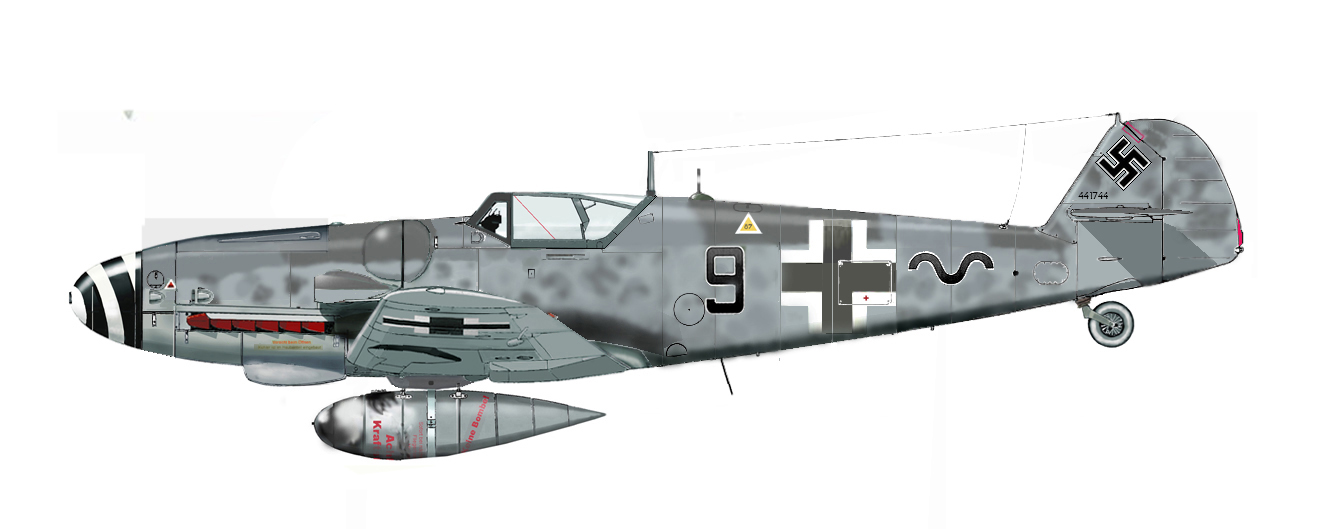
First out is a WNF Bf 109 G-6/U4 WNr 441744. Flown by 11./JG 27 -  it was lost (31.07.1944) in Saint-Germain-d´Elle near Saint-Lô in Normandie, captured by US troops. The original Staffel was back in Dortmund by this time. 


Next is a WNF Bf 109 G-14 of Stab I./JG 4 as seen in Babenhausen in April 1945. WNr 510XXX. The fuselage seems to be covered with something, as the Balkenkreuz cannot be seen. By this time, I Gruppe personnel was being drafted as infantry. (source MAH)


Next, the speculative aircraft last flown by the German cousin of the French fighter ace Pierre Clostermann, namely Bruno Klostermann of 11./JG 300 who was KIA on 14 January 1945 in a Bf 109 G-10 manufactured by Erla. There seems to be some disagreement as to whether he flew “Green 2” or “Green 12” . Erla production G-10's lacked the black cross on the fuselage, only showing the white outline, sometimes “filled in” by the ground crew(as here).


Lastly I have reworked a profile presented in Falcons Messerschmitt website depicting a Bf 109 G-10 produced by Erla, which, in my opinion, is grossly inaccurate, more resembling a Bf 109 G-6/AS than anything else. It also carries the camouflage that was used by 460XXX series G-14:s, ie “spotted dog” pattern. Anyhow, this is WNr 491 375 flown by Uffz Franz Keicher of 3./JG 4 who was lost on 11 February 1945 in air combat over Lübben/Steinau. Pilot was declared MIA.


The last two are both from JG 300, one from 3 Staffel, flown by an unknown pilot in the summer of 1944, the last one is a G-14 flown in the winter of 44-45 by Gefr Ernst Sharf of 16 Staffel.


More late-war Gustav artwork from Angantyr on this blog here

Wednesday, 26 June 2024

new from Claes Sundin - Luftwaffe fighter aircraft Profile book No. 14


A new profile book from Claes Sundin is always an 'event'! Fighter aircraft Profile book No. 14 is just released and pre-orders are shipping. My copy - with 'Jutta' Fw 190 cover artwork - has just arrived ;

- 136 full color pages with 130 aircraft profiles
- Features all-new profiles of fighter types flown by Luftwaffe Experten, with many surprises!
- 140 additional illustrations of unit insignia (Wappen) and personal markings
- Detailed captions for each profile with expanded descriptions of each individual aircraft's markings and camouflage. Text proofed and corrected by experts in the field!
- Historical and descriptive information of the pilots, including many lesser-known airmen
- A pilot and unit index for all Claes' Luftwaffe fighter artworks published to date
- Exceptional high-quality paper and print quality and glossy hard-bound cover


Click on the low-res image of Claes' profile (from book No. 11) of Arnulf Gottschall's G-6 below to go directly to the Centura Publishing web site to order the book. Claes has now self-published a phenomenal 18 titles. 


Saturday, 20 August 2022

More late-war Gustav profile artworks from 'Angantyr'


Artwork and captions by Angantyr. The images are 'clickable' to view large


Information on this aircraft, variously identified in the past and even illustrated with a black-and white profile. On January 29, 1945, Oblt. Waldemar Balasus flying Me109 G-14 WNr. 0464493 'blue 32' of 4./EJG 1 was shot down by a P-51 of the 55th Fighter Group and crashed near Hamburg. He survived, most likely baling out.


Herbert Kutscha's G-6 'yellow 13' (12./JG 3), February 1944. An Erla 'spotted-dog'. See previous post for photographic reference.


Below; Bf 109 G-6 “white 2” of 1./JG 302 as it appeared during August 1944


Below; Uffz Rudolf Dreesmann  flew with  12./JG 51 on the Eastern Front before moving to JG 302. On July 7, 1944  he was airborne in this 4./JG 302 Bf 109 G-6  (WNr 412498). The Staffel had taken off to intercept bombers approaching Munich. At 9000 meters, Dreesmann signaled to his wingman, Lt. Hallenberger, that he was in trouble. He decended to 5000 meters where he entered clouds. He was not seen again. Although the profile is speculative, it is nevertheless based on known facts about this production batch, as well as known practices of 4. Staffel JG 302. (reference source: Luftwaffe im Focus)


Another 'speculative' profile illustrating Bf 109 G-10 WNr 491282 of the Stab III Gruppe JG 6 crash-landed on January 1, 1945 during Bodenplatte. Hptm. Wilhelm Kindler POW.


Bf 109 G-14 W.Nr 460 408, "Gelbe 4", Gefr. Georg Kuhr, 3./JG 76, Nijmegen, 29 September 1944.  
  

Bf 109 G-14/AS of III./ JG 77 at Neuruppin as seen in late 1944. The photo is to some extent covered by fog, so a certain amount of interpretation has been used as well as drawing on “sister ship” WNr 786 316 “white 4” at Kassel.


Next, a correction of an earlier machine from JG 76 a rather short-lived unit that later became part of JG 300, as you probably know...


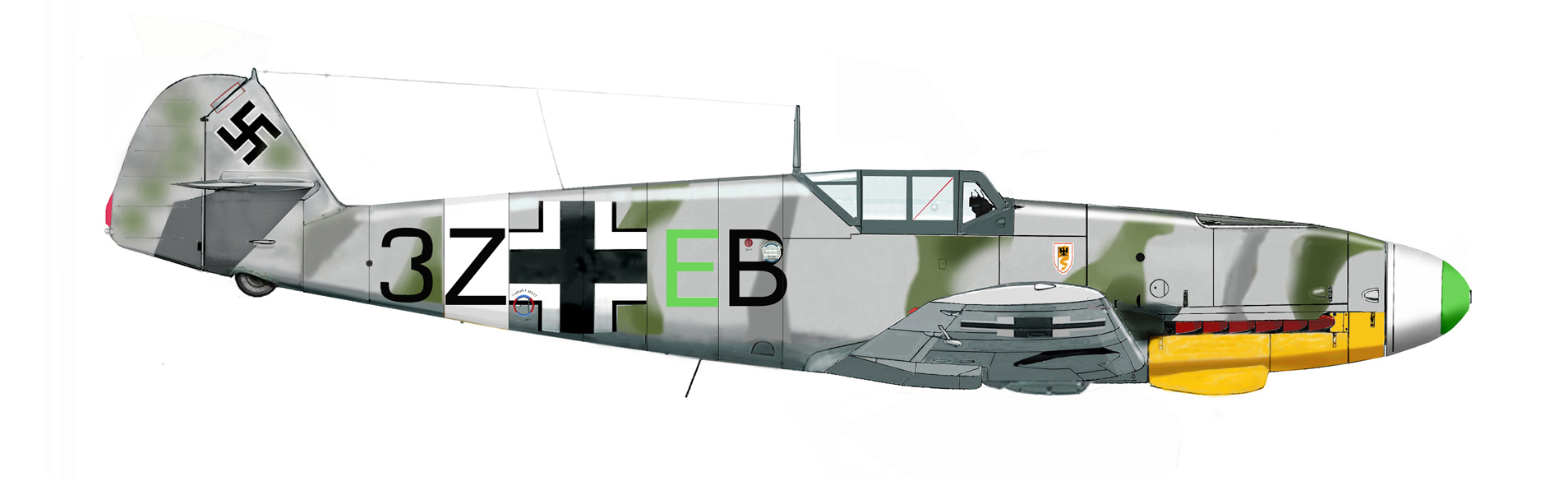
 Next one is something of a "mystery machine" apparently attached to the bomber unit KG 77 - I have wondered why a bomber unit would use fighters? There is a reference picture on the net. It shows a Bf 109 F upgraded to G-2 standard with a pilot that appears not to be german. It also carries the back cockpit armour standard to G-1 and G-3. As no individual letter is shown (or of low contrast) I have made one up. I have speculated that as it was attached to the first Gruppe, and I believe that the last letter of the codes looks like a "B" to me, I have concluded that it belonged to I Gruppe stab, which should explain the medium-colored tip of the spinner. By the way, I believe that interpreting colors from black-and white photos is one of the most difficult tasks imaginable!


Below; Hans Seyringer and his II./JG 27 Bf 109 G-6/R3/R6 (quote) "His G-6 crashed on Winterhaarweg at Boekelo Holland on 30 January, 1944, cause: aerial combat with a P-47; and pilot disposition: bailed and returned (DeSwart). One known victory, a B-17 N of Kaiserslautern on 14 October, 1943. His 2nd, a a P-47 at Borkel, 12 km S of Eindhoven on 30 January, 1944"


Below;   Bf 109 G-10 (Erla) as flown by the Gruppenkommandeur I./JG 300 Stamp in November 1944. As far as I know, the only known image just covers part of the left fuselage, so, some artistic license has been used. Another unknown factor is if it carried the identification band or not. My profiles are a mix of totally authentic pictures (rarely achieved) to more or less speculative ones, where only the WNr is known. There are some factors that will add to the confusion as for example, aircraft that was brought back for overhaul/repair were frequently both up- as downgraded. Another factor is the example that a Bf 109 G-6 equipped with MW50 didn't automatically make it a G-14, and so forth.


Nicely done Angantyr, thank you! More late-war Gustavs in profile by Angantyr on this blog here


Wednesday, 15 September 2021

Late- war Bf 109s - Profile artworks by " Angantyr "


".. Bf 109 G-14/AS of JG 300, photo from Borkheide, found on your blog, proved irresistible to me, so I just had to make an illustration..Anyhow, here is the finished result. As parts of the aircraft are hidden by bushes for camouflage purposes, I have exercised a minimum of artistic license...."


A line-up of JG 300 Bf 109 G-14/AS fighters including W.Nr. 16. ... "Rote 15" of 2. Staffel seen at Borkheide during October 1944....


" ..Following my urge to doodle, I have made an illustration of one of the aircraft serving with 10/JG 76, late August 1944 at Athis-Mons, later a wreck to be found at the same location. It's a standard Erla-built G-14, flown by an unknown pilot..."


" ..Have just finished my interpretation of Ofw Paul Schwerdfegers Bf 109 G-14/AS, WNr 784986 when he was KIA in operation “Bodenplatte” on January 1, 1945. Information on the aircraft itself is scarce, I have only been able to find a photo of the wreck, that doesn’t show much more than a piece of the triple band, carried by JG 6. Although, there is known the WNr, and from that, can be gathered how it probably looked..."


".. it's time again to show what I have been up to lately, this time it's a Bf 109 G-6/AS as seen in a photo of a line-up of 5 Staffel JG 27 machines shown on Marc Haldimann's Late-war Bf 109 FB page.  Admittedly, there are parts of the aircraft which are not shown, so, a modicum of artistic license has been used. Among the things that ARE clearly seen, is the "reverse" spiral on the spinner. I DID however resist the temptation to add the Staffel emblem, as at this late stage in the conflict, they were rare. As for camouflage of the Bf 109 G-6/AS it's an understatement to say that they were not standardized...."


Thursday, 16 July 2020

Eastern Front fighters - Exito Decals - Maj. Gordon M. Gollob Kommodore JG 77


Having recently posted some 'highlights' from the history of JG 77 on this blog, Exito Decals have just featured another JG 77 ace on a new decal set featuring three Bf 109 Eastern Front aces. Entitled 'Eastern Front fighters' the set includes nicely-rendered artwork from Anders Hjortsberg of Maj. Gordon Gollob's F-4 flown during June 1942 as the recently appointed (and relatively short-lived) Kommodore of  JG 77..


another 'exclusive' Luftwaffe Blog extract from a 'history' of JG 77;

"....In mid-May 1942 and promoted to Major, Gollob took command of Jagdgeschwader 77 deployed in the southern sector of the Eastern Front. He had returned the majority of his 86 victories as Kommandeur of II./JG 3. At JG 77 he succeeded the famous Gotthard Handrick who had been leading the Geschwader virtually since the invasion of the USSR. Gordon M. Gollob was to experience the important fighting in the Crimea (Sevastopol) and was very quickly in the thick of the action as JG 77 supported German ground forces pushing into the Kertsch peninsula.

On May 12, III./JG 77 claimed eight victories but lost two pilots including the Kapitän of 9. Staffel, Hptm Brutzer, shot down and killed in combat. He was replaced by Lt. Horst Marotzke. The following day II./JG 77 claimed eighteen. Shortly after Gollob's arrival, on May 16, 1942, the Kommodore himself shot down three LaGG-3s. Enjoying good back-up the Kommodore quickly took the pulse of the front in the sector and upped the number of combat sorties he flew. On 17 May, he was credited with three R-5s and another LaGG-3. The next day, three more R-5s fell to his guns; it was the same story on May 19! On the 20th, he claimed a DB-3 (his hundredth victory) as well as a LaGG-3. At that time he was not the only great ace of the unit since the Kommandeur I./JG 77, Hptm Heinz Bär, was himself credited with his 103rd victory the day before (four I-16s shot down in one combat). But it was rare to see a Kommodore committing himself so much in combat.

The fighting in the Crimea was in full swing. On 7 June, Operation Störfang, the great assault on the fortress of Sevastopol, was launched. I. and II. Gruppen were based at Sarabus while III. Gruppe shifted to Oktoberfeld some 40 km north of Sarabus, all three Gruppen flying in support of Luftwaffe bombers assaulting the fortress. On this day Gollob returned his 102nd victory downing another LaGG-3. Gollob's organizational skills were put to good use as he was responsible for coordinating all the fighter units in the region and was determined to live up to the confidence placed in him by General Wolfram von Richthofen, commander of VIII. Fliegerkorps. On June 23, 1942, Gollob was awarded the Swords to his Ritterkreuz. However at this juncture Jagdgeschwader 77 was to be split up. At the end of June 1942, I./JG 77 left for Sicily to operate against Malta. At the same time, II./JG 77 was sent to the Voronesch sector. Gollob therefore only had III. Gruppe under his direct command when Sevastopol fell on July 3.  On July 22, 1942, Major Herbert Ihlefeld, Kommodore of JG 52, was seriously injured in a takeoff accident at Taganrog airfield at the controls of a Fi 156. Gollob was ordered to ensure the transition and departed to take command of JG 52 while keeping his role as Kommodore of JG 77.  During August 1942, Gordon Gollob was credited with forty more victories, obtaining his 150th (and last) Luftsieg on the 29th of that month. He was the first Luftwaffe fighter ace to reach this figure. The next day, he learnt that he had been awarded the Diamonds, becoming only the third member of the Wehrmacht to be so honoured. At the same time he received a Flugverbot (flying ban, as had Ihlefeld before his accident). On 30 September 1942, the Austrian was withdrawn from the front - the Wiener Kronen Zeitung carried a report in its edition of 23 September of Gollob of being welcomed by cheering crowds of well-wishers while enjoying a spell of leave in Graz (below). His departure from the East more or less coincided with that of JG 77 itself, the Geschwader being posted piecemeal to the Mediterranean to relieve JG 27 engaged in Africa.


Exito site

More extracts from the unpublished history of JG 77 on this blog here

Saturday, 4 July 2020

Wilde Sau JG 300/301/302 ‘Ring of Fire’ from Eduard - Limited Edition Dual Combo


... due this month from Eduard is a ‘Limited Edition’ wilde Sau 'Dual Combo' Bf 109 kit with 10 markings options for JG 300/301/302 night fighters. Some of the schemes selected by Eduard are based on the profile artworks prepared by Anders Hjortsberg for a two-part 2014 feature I compiled for ‘Model Aircraft’ magazine. More markings options are due in a separate decal package coming in August. The kit includes parts to replicate the exhaust stack ‘whistles’ and flame shrouds fitted to wilde Sau Bf 109 Gustavs. Also included are Brassin wheels, masks and a wilde Sau lapel badge. Check out July’s ‘Eduard Info’ for another wilde Sau ‘history’ feature which takes a slightly more ‘technical’ look at wild boar night fighter operations.