Showing posts with label Captured Luftwaffe. Show all posts

Sunday, 7 July 2024

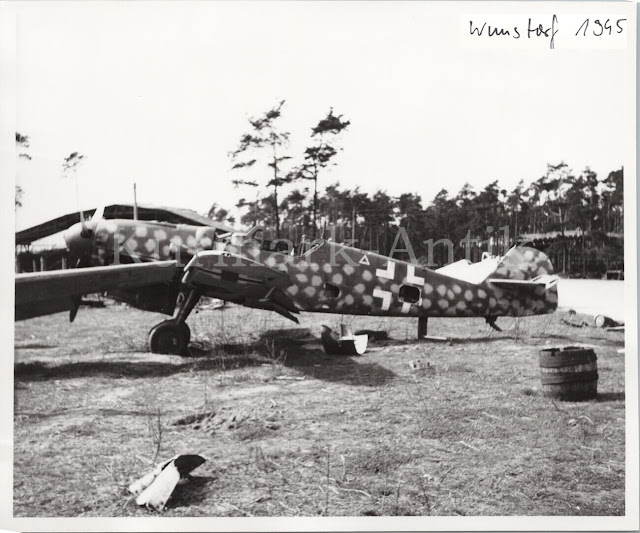
Bf 109 Gustav WNr. 20790 in Wunstorf - not a 'one-off'


Captured G-6s in unusual camo finish - possibly late-war 'greens' with an RLM 02 mottle. Below; WNr. 20790 visible on the tail fin of the machine closest to the camera with a second similarly camouflaged machine behind. These are 'rebuilds' of older airframes.

See pages 84-85 of 'Bf 109 - the latter years' (Goss) for more pictures of these machines. Seen at Fassberg according to the book caption, although A.I.2(g)/131 via Michael Balss states Wunstorf.


Anders Hjortsberg profile and camouflage comments here


Monday, 30 January 2023

Bf 109 F-2 coded 'D-IWAU'


" ..Hi Neil,

..something and nothing really. We came across this "lost" photo when my wife's grandmother passed away. The airman on the extreme right is Joe, a friend of the family, taken in Germany in mid 1945. Joe met and married a Jewish girl who had been in a concentration camp and they eventually emigrated to Canada. I had the pleasure of meeting them when they visited in the 1980's.We found the image again yesterday in a poorer state than it was so I repaired it. I found it odd to see as late as 1945 what I would say were pre-war style 'civilian' markings on the aircraft, I'm guessing a Bf 109? Anyway hope it is of interest....

Regards Steve..."


From Peter Achs; " ..This was the V35, W-Nr. 9227 used in 1941/42 as a testbed for a DB 605 (W-Nr. 76076) with intercooler by Daimler-Benz at Echterdingen. take over: 16 Aug(?) 1941 from Mtt Regensburg by railway ("16. IIX. 41" in the original document) delivered: 22 Oct 1942 to the DVL at Braunschweig.."

More on this machine in Roger Gaemperle's "Captured Eagles" monograph...

Friday, 3 April 2020

Fw 190 in Brussels Evere


" ...On 4 November 1944, 416 Sqn RCAF moved to Base 56 at Evere, Belgium, an ex-German Luftwaffe airfield. When the RCAF pilots flew their Spitfires into the former Luftwaffe base [5 November 1944] they found one abandoned Fw 190 fighter aircraft. Many photos were taken on or beside this enemy fighter, including four images by pilot Gordon Hill...

This became the first German fighter aircraft seen up close by most of the Canadian Spitfire pilots and they climbed all over the enemy fighter... A month later, the British Army came to remove the fighter and it blew-up. It had been booby trapped by the retreating German troops. A lesson learned the hard way by all pilots in 416 Squadron...
"

From the Clarence Simonson blog 'Preserving the Past' " The making of a WWII RCAF Spitfire pilot"

Fw 190 A-8. WNr. 680883
(Best image I’ve seen of this machine, my collection via James V. Crow- click on the image to view large. Note that in the last two photos most ‘detachable’ parts of the airframe have gone!)


Monday, 23 July 2018

Me 410 A-3 (Wk.Nr. 10259, RAF serial TF 209)


Me 410 A-3 at Collyweston 1944

Below; Some nice detail images of Me 410 A-3 Wk.Nr. 10259 (RAF serial TF 209) (presumably) at No. 1426 (Enemy Aircraft) Flight at Collyweston, Northamptonshire (UK). This aircraft was formerly F6+OK of 2(F)./122. The crew, Fw. Hans Beyer and Uffz. Helmut Hein, got lost on the return leg to Perugia and landed by mistake at Monte Corvino, Italy, on 27 November 1943. It arrived for testing at the Royal Aircraft Establishment, Farnborough (UK), on 14 April 1944, and was also evaluated by the Aeroplane and Armament Experimental Establishment, Boscombe Down. TF209 flew with the Fighter Interception Unit at Wittering from August 1944 until March 1946 when it was transferred to No. 6 Maintenance Unit at Brize Norton.


still on offer here

Thursday, 1 March 2018

Bf 109 G-6 W.Nr. 15 270, formerly "gelbe 14", 6./JG 53, VX 101 captured Luftwaffe in colour


Bf 109 G-6 W.Nr. 15 270, formerly "gelbe 14", 6./JG 53, captured at Comiso, Sicily, summer 1943. Sent to RAF Collyweston, 4 February 1944 and flown as VX 101. Seen here on a tour of US fighter bases in East Anglia during the spring of 1944. Note finish was the standard RAF temperate day scheme of green and grey.  Lower surfaces were yellow - see colour images below


Flyable enemy aircraft were repainted in standard RAF upper surface colours as seen here on the Bf 109 VX101.

The Ju 88 is either A-5 EE205 or HM509 probably HM509, ex M2+MK. Both VX 101 and HM 509 were written off on 19 May 1944


Wednesday, 18 May 2016

Crash of Fw 190 D-9 Wk.N. 211018 (FE-119) at Freeman Field, Indiana


Contrary to what has been recently and erroneously posted elsewhere, this is WNr. 211018, one of the four Dora-9s brought to the US for flight testing at Freeman Field, Seymour, Indiana. (See Crandall p381, Rodeike p397 and JAPO p128 for evidence that this is not WNr 211016). Originally assigned to the Stab./JG 26 this D-9 was captured in Flensburg. Since the tactical markings identify it as a machine of the Geschwaderstab of JG 26,  it is from there only a short jump to calling it one of Priller's machines! Note the white-outlined area of black around the exhaust and the spinner spiral covering only the front half of the spinner. The tail bands have been partially over-painted with camouflage colour as in the artwork above and low-res photo copy below. (source unknown, originally posted on FB...)


On 22 September 1945 WNr. 211018 was prepared to perform a demonstration flight for the Institute for Aeronautical Sciences and was piloted by Lt. William V. Haynes, who had only just returned to the US in July 1945. Haynes was a 20 year old Ninth AF pilot with a DFC. Shortly after takeoff Haynes attempted a wingover maneuver at a low altitude and failed to recover, and the aircraft stuck the ground wings level and broke into pieces. Haynes was fatally injured and, according to the accident report below, his body thrown clear of the wreckage. Small pieces of the aircraft were recently excavated, though it was thought that more parts had been buried at the crash site.


Witness statements and more on the accident report at the indianamilitary.org website here

The four Doras that were brought to Wright Field for testing were;

 FE-118 Fw 190 D-13 WNr. 836017 "Yellow 10" of I./JG 26 that still survives and now with the Flying Heritage Collection
 FE-119 Fw 190 D-9 WNr. 211018 "Black 14" of Stab/JG 26 crashed (fatal) September 22, 1945 from pilot error and impact with the ground
 FE-120 Fw 190 D-9 WNr. 601088 now on display at USAF Museum
 FE-121 Fw 190 D-9  WNr. 401392 "Black 5" of JG 26 was scrapped at Wright Field in 1946.

Below; original USAF caption, post-war paint scheme FE -121 ; "Focke-Wulf Fw 190 parked in a hangar at Wright Field circa summer 1945. Ken Chilstrom Wright Field test pilot is sitting in the cockpit and Bob Baird is standing near the wing."


On 2 August 1946 a civilian contractor was performing a slow-speed taxi of FE-121 for a routine brake check. The port landing gear collapsed resulting in substantial damage to the left wing and other parts of the aircraft. The Dora was marked as damaged beyond repair and scrapped.


Sunday, 16 June 2013

Exhibition of Enemy Aircraft, Hyde Park, London September 1945


WNr. 191454 'Yellow 11' Me 163 B

Prior to the RAE Exhibition of Enemy Aircraft at Farnborough in October and November 1945, the RAF organised an exhibition of enemy aircraft in London's Hyde Park from 16-22 September 1945. The aircraft came from no.6 MU RAF Brize Norton and comprised a Me 163, He 162, Me (Bf) 108 Taifun, Bf 110 G, Fw 190, Ju 88 G and an Fi 156. It is most likely that these went back there afterwards, although the He 162 went to Canada.  Most of the aircraft at Brize Norton were scrapped or put on the bonfire in 1946 or '47. According to Clive Barker, there were more than 70 enemy aircraft at Brize Norton at the end of 1947 mostly parked outside. Among others there were approximately 20 Me163s and 20 Ju 52s. The bad winter of 1946/47 took it's toll on most of the larger aircraft which were either blown over or struck by flying debris. By the end of 1948 all had been dismantled and buried in pits on site along with their regular job of disposing of surplus Spitfires, Spitefuls and Liberators.


The photograph below was used in the 13 September 1945 issue of  'Flight' magazine to illustrate the upcoming event


Captured Butcherbirds - Fw 190 F-8 "JFE " May 1945 - edited January 2017


Fw 190 F-8, WNr. unknown, captured by the British according to 'Captured Butcherbirds' on a Deutsche Lufthansa assembly line at Travemuende and test-flown during May 1945. It was eventually marked 'JFE', the initials of the CO of 127 Wing, Wing Commander J.F. Edwards


..and received recently from Dave Fleming;

"I don't think that is JFE, as in addition to a few differences in markings etc, those pics originate in an album from a South African pilot attached to 3 SAAF.."

A stunning album and thanks for the corection Dave!

http://saafww2photographs.yolasite.com/cecil-golding-1.php

Sunday, 4 November 2012

Arsenal VG 33 tested by the Luftwaffe at Rechlin


Courtesy of Jean-Yves Lorant and from his extensive personal archive, I am pleased to present two superb images of the sole example of the Arsenal VG 33 tested by the Luftwaffe. Coded '3+5'  the aircraft is photographed here at the Rechlin Erprobungsstelle. You may have seen these in much lesser quality elsewhere - at least one was previously published in Fremde Vogel unterm Balkenkreuz.. Click on the images to see a larger full screen view !

Je te remercie Jean-Yves!..


The Arsenal VG 33 was the most visible model of a ‘family’ of light, fast and manoeuvrable French fighter types being developed during 1939 - 1940 to replace the Ms 406. In fact many sources quote the VG 33 – of which only a handful of examples approached service due to production difficulties – as being somewhat superior to the Dewoitine D.520....

http://falkeeins.blogspot.co.uk/2012/09/arsenal-vg-33.html


Wednesday, 26 September 2012

Arsenal VG 33 - in service during the Battle of France and tested at Rechlin - this page last edited December 2015


Click on images to view large

The Arsenal VG 33 was the most visible model of a ‘family’ of light, fast and manoeuvrable French fighter types being developed during 1939 - 1940 to replace the Ms 406. In fact many sources quote the VG 33 – of which only a handful of examples approached service due to production difficulties – as being somewhat superior to the Dewoitine D.520, despite the fact that it was powered by a smaller engine. In addition the VG 33 was designed to be a machine that could be constructed quickly by small sub-contractors (a D.520 required 8,000 man-hours per aircraft, a similar figure to the Me 109) and had it been available in numbers the accepted view is that it “might have given the Germans a harder time over France”. As it was one or two examples of the type did see some form of service (the prototype n˚1 and VG33 n˚7) in the short-lived GC I/55 flying some sorties between 17 June and 24 June 1940 as detailed in the Avions Hors-Série n˚ 7: " La chasse française inconnue de Mai-juin 1940 ".


However the results obtained by test pilots at the French CEMA (Centre d’Essais – test centre) during mid-1939 probably posed more questions about this type than they answered. At least one French commentator (Ehrengardt in Aérojournal magazine no. 46) has stated that the constructor – while not openly falsifying the prototype’s performance figures - did everything possible to ensure that they were superior to those of the D.520 – 200 kilos lighter and powered by a smaller 860 hp Hispano Suiza engine developing some 60 hp less, the Arsenal VG 33 was supposedly able to climb to 5,500 m some three minutes quicker than the D.520 and could reach 560 km/h at 5,200 m. Tested by CEMA pilots during March 1940 the VG33 n˚5 apparently flew at 620 km/h at 4,000 m and approached 1,000 km/h in a dive. (Ehrengardt, article in Aerojournal 46) Few commentators stop to point out that the aircraft tested were prototypes – with no ‘military’ value whatsoever. And while the test pilots apparently lauded the aircraft’s flying capabilities the manufacturer’s own handbook placed certain limitations on the type’s flight characteristics which under different circumstances would have straight away precluded any attempt to put this aircraft into production let alone military service. In addition the proximity of the type’s large ventral radiator so close to the ground proved particularly problematic when operated from grass fields. The idea that here was a machine that could easily be constructed by small sub-contractors working with non-strategic materials (spruce) and that French industry was advanced enough to produce the glues required was simply pie in the sky. Construction of the series machines were dogged by a series of logistical and organisational problems that had been completely over-looked by the French Air Ministry. With sub-assembly construction dispersed throughout France and the various components brought together in final assembly plants it was hoped that production could reach 350 machines per month by March 1940. This totally over-looked the fact that for a wooden aircraft each machine required some 880 kg of steel, 436 kg of aluminium and 125 kg of magnesium, requirements that simply caught out those civil servants charged with obtaining stocks of strategic materials. Following on from the first production order of 220 machines passed during September 1939, it was not until March 1940 that the need was seen for a second production/assembly facility which was opened at Michelin in Clermont Ferrand in the south for deliveries to start during July 1940. Even large constructors such as Potez had singularly failed to relocate their factories from northern France despite the experiences of 1914-18. By the time of the evacuation of the Arsenal assembly facility at Satrouville (under the auspices of the Chantiers Adro-Maritimes de la Seine) 17 miles north-west of Paris only 19 aircraft had actually been completed – ten prototypes designated V.30 to V.39 and nine V.33 series production machines. A further 160 fuselage assemblies and some 40 machines approaching completion had to be destroyed.

See more quality VG 33 images on this blog here


Thursday, 6 September 2012

The "RAF-waffe" captured Luftwaffe - No 1426 Flight - Enemy aircraft Circus visit Framlingham Station 153, 390th BG during March 1944


Just back from holiday in the beautiful county of Suffolk. Visited the 390th BG Memorial air museum housed in the original wartime control tower of Framlingham station 153 located just outside Parham village, some five miles from Framlingham. On display are recovered aircraft wreckage and engines, uniforms, documents, photos and rare memorabilia. I was allowed to photograph these interesting and 'atmospheric' views of the "RAFwaffe" - No 1426 Flight - Enemy aircraft Circus, seen visiting Parham/Framlingham airfield, home to the Flying Fortresses of the 390th BG on 12 March 1944. These photos are on display at the control tower museum. American aircrews had the chance to inspect these captured enemy aircraft, observe them in flight as they flew passes over the airfield and generally improve their aircraft recognition skills. The flight was based at Collyweston near Wittering until early 1945. 


The Fw 190 was labelled as 'PE 882', which would make it the SKG 10 machine originally coded " H+ " of II. Gruppe, flown by Uffz. Otto Bechtolder. Disorientated en route and running short of fuel, the pilot had force-landed at RAF West Malling, 16 April 1943. 


There are colour views of some of the RAF's captured Luftwaffe machines elsewhere on this blog..
http://falkeeins.blogspot.co.uk/2010/09/captured-luftwaffe-types-1.html