Showing posts with label Arado. Show all posts

Saturday, 11 January 2025

Arado Ar 240 Versuchsflugzeuge - Revell re-release 72nd scale Ar 240


 Ar 240 V-3 'KK+CD'

Here's what the average web site - ie ChatGPT (AI) - will tell you about the Ar 240;

" The Arado Ar 240 was a twin-engine, multi-role aircraft developed by Germany during World War II. Intended to replace the Messerschmitt Bf 110 as a heavy fighter and reconnaissance aircraft, the Ar 240 was designed with advanced features for its time, including a pressurized cockpit, a remotely controlled defensive armament system, and excellent high-speed performance. However, the aircraft suffered from persistent stability issues, poor handling, and mechanical problems during its development and testing phases. Although prototypes demonstrated promising speed and versatility, these shortcomings prevented the Ar 240 from entering full production. Despite its limited deployment and operational use, the aircraft provided valuable lessons for German aviation engineers and remains a fascinating example of ambitious wartime aircraft design.."

 Or in other words, a promising design that failed to deliver. A rare Luftwaffe type, but one that failed to get a production order..

Let's put a slightly different take out there. The Arado Ar 240 was an experimental and test aircraft. In 1937 Dipl.Ing Walter Blume had proposed a twin-engined Zerstörer with both engines in the fuselage driving twin props - a concept rejected by the RLM, who nonetheless recommended that Blume submit a more conventional proposal. A mock-up was produced by March 1939 and in May 1939 the RLM asked for six 'Versuchsflugzeuge' or test aircraft (see Hans-Jürgen Becker, 'Schwere Jäger und Zerstörer der Luftwaffe', p117). The type was never conceived with the idea that it might go into series production. At all. It was designed to the same specification that had already resulted in orders for 3,000 Me 210s - the Ar 240 V1 first flew in June 1940 nearly one year after the Me 210. For more on this see Mankau/Petrick, " Messerchmitt Bf 110, Me 210, Me 410 - die Messerschmitt Zerstörer und ihre Konkurrenten", (Aviatic Verlag, 2001)

'Konkurrenten' means 'competitors' ..but the Ar 240 was never in the race - it was a 'technology demonstrator'.

" Das RLM hatte die Me 210 für die Grossserienproduktion vorgesehen und die Ar 240 in wenigen Exemplaren als Experimentalflugzeug, mit der neue Techniken erprobt werden sollten. Ein Einsatz der Ar 240 war bei der Luftwaffe zunächst nur in Einzelexemplaren zu Erprobungszwecken geplant..."

The Me 210 had been ordered into large-scale production by the RLM who had also ordered a handful of the Ar 240 as an experimental aircraft to test new technologies. Initially, the Luftwaffe only planned to use the Ar 240 in individual examples for testing purposes.


With little prospect of a production order - in the Luftwaffe's planning of 7 November 1938 approx. 3000 Me 210 units were to be delivered up to 1942 - Arado was encouraged to innovate in their design. The company received preliminary approval for the development and construction of six prototypes on 16 May 1939 and began work on a design based on the Bf 110, but with much smaller dimensions. However, the small wings required special high-lift devices. These were provided in the form of automatic leading edge slats, double-slotted flaps outboard of the engines and Fowler flaps inboard of the engine nacelles, along with 'full-span' ailerons on the outer wing. Early examples had tail-mounted dive brakes which were soon dispensed with. 

Following the first flight, instability problems led to extensive redesign work- the V3 pictured here was a rather different beast from the V1. Lengthening the fuselage, relocating the cockpit and enlarging the wing cured the problems - partially. The last line of an Arado report on the instability issue (reproduced in Becker p119) confirmed that " this state was no longer significantly affected by further enlargement of the wing and lengthening of the fuselage. It was considered tolerable, as the instability only occurred with intentional actions or complete removal of the feet from the pedals..." Testing continued on the design. For example, this included development of the pressure cabin and the testing of warm air in a double-glazed canopy to prevent the panes from fogging up for the Arado 234 programme. Elsewhere the Me 210 was in full-scale production - large production orders were a done deal in the case of the Me 210. No such orders were ever likely to have been forthcoming in the case of the Arado - not least because the aircraft did not have a bomb bay. 

In August 1941 the V3 was still at Rechlin being flown by Oberst Siegfried Knemeyer - head of the Amtsgruppe Entwicklung von fliegerischem Gerät - and Oberst Theodor Rowehl. The V4 first flew in June 1941 and crashed on 7 August 1941. The V5  'T5+MH' was powered by two DB 601Es and in March 1942 the Versuchsstelle für Hohenflüge took over the aircraft to test it as an Aufklärer. Initial motorisation with the DB 601 and later DB 603 gave the type relatively good performance - max speed 350-400 mph saw the type deployed over England in the high altitude Aufklärer recce role " with some success". Independently of the Versuchs aircraft 1-6, a further five Ar 240s were built for 'unarmed reconnaissance'- the first of these, the A-01 ('GL+QA'), entered flight testing on 5 June 1942.  


Our good friend Michel Wilhelme has built Revell's re-release of the Arado Ar 240 for this blog. The unit code 'T5' represents a machine of the Aufklärungsgruppe Ob.d.L. (Oberbefehlshaber der Luftwaffe) or Aufklärungsgruppe Rowehl..


Saturday, 28 October 2023

..somewhere in the East - archive photo scan (4)


Panje ponies and cart on a muddy field in the vicinity of a Feldflugplatz field strip. Click on the image to view large. Below, a closer view of the Arado on the right of the photo.


..and a view of the 'original' photo....


Tuesday, 7 April 2020

new and forthcoming from Chandos - Blitz bombers - Arado 234 jets of KG 76 in the West 1944-45


..from Chandos Publications' Rich Carrick;

 " Hi guys - it gives me great pleasure to announce that I am now taking pre-orders for Chandos Publications' second title 'Blitz Bombers, Kampfgeschwader 76 and the Arado Ar 234: Luftwaffe Jet Bombers on the Western Front 1944-1945' by Eddie J. Creek and Robert Forsyth. (RRP £50, Postage: £4.00 UK, £14 Europe, £20 USA and Canada, £21 ROW)
Aimed at aviation fans (and model makers) in general and Luftwaffe aficionados in particular. Please head on over to my website to place your pre-order. I expect to take delivery towards the end of June but PLEASE allow for COVID-19 related delays! I have been assured that our printers are operating normally..."


This is the first time that the story of the Arado Ar 234 as the world’s first dedicated jet-bomber has been told in such detail in the English language. In late December 1944 the Luftwaffe surprised the Allies when it unexpectedly introduced a new, high-speed bomber to its inventory. Though deployed in small numbers, the Arado Ar 234 B-2 jet-bomber proved itself an effective day and night strike aircraft over the Western Front and a tough challenge for Allied fighter pilots who tried to counter it. Powered by the same Jumo 004 turbojets as the Me 262, the Ar 234 could attack pinpoint targets such as transport hubs or enemy vehicle columns and troop assemblies in ‘glide attacks’ with a high degree of impunity. The jets were flown by experienced and often highly decorated Luftwaffe bomber pilots who worked hard to master the new aircraft in a short time and amidst the chaotic conditions of a Third Reich in decline. ‘Blitz Bombers’ tells the story of KG 76’s operations when equipped with what was the world’s first jet bomber, the Arado Ar 234 B-2. The book is founded on original unit diaries, reports and other records, as well as various German and Allied material drawn from archives and private collections gathered over many years. It traces KG 76’s period working up on the aircraft and its subsequent combat operations over the Western Front from December 1944 through to the end of the war. The Geschwader’s jets took part in operations over the Ardennes, in the ill-fated Bodenplatte attack of New Year’s Day 1945, in missions against the Allied armies driving into the Reich in early 1945, and in a series of intensive strikes against the Ludendorff bridge at Remagen and the bridgehead established there by the Allies in March 1945. Following many years research, the book includes nearly 300 illustrations, comprised of rare photographs of KG 76’s aircraft, personnel and equipment, as well as the Allied aircraft and pilots who encountered the Arados in combat, plus key documents taken from the unit’s records. These are supplemented by specially commissioned and highly detailed colour artwork depicting the unit’s aircraft.

https://www.chandospublications.co.uk/


Also on this blog;
The story behind the book with Eddie Creek and Robert  Forsyth

Sunday, 21 February 2016

the first Arado Ar 234 to fall - Hptm. Josef Regler of 9./KG 76 F1+MT - *new* Arado Ar 234 Valiant Wings Airframe Album


This is Libor Jekl's superlative build of the 72nd scale Dragon kit in the markings of Hptm. Josef Regler, Staffelkapitän 9./KG 76. Regler was shot down near Selgersdorf,  north of Aachen, at the controls of F1+MT (W.Nr. 141073) on 22 February 1945, probably by Lt. David B. Fox (P-47 366. FS ). Regler survived the crash-landing and returned to German lines. The Arado (20% damaged) was captured by Ninth US Army troops attacking across the Rur river in Operation Grenade late on 23 February - three Germans and a truck who were attempting to siphon fuel were also captured. This was the first Arado Ar 234 to fall into Allied hands - captured Ar 234s were rare until the capitulation and their condition generally poor. The well-known image published in “Profile 215- Arado Ar 234 Blitz" (see below) written by Richard P. Bateson dates the event to 24 February 1945, which is not the date of the downing, but rather the date an American Technical Intelligence team made their investigation..

Pierre Clostermann in “The Big Show” gives an account on page 190-191 of the 1974 edition; “..Another poisonous day. Snow, wind. Visibility nil; flying was quite impossible. However, G.C.C. maintained two sections of Tempests at immediate readiness - one from 486 and one from 56 - together with a section of Spit XIV's from 41 Squadron. These three sections had been taking it in turns with no hope of flying, since dawn. At about 1500 hours the weather cleared slightly, and the 6 Spits were scrambled. In this appalling cold they had a job getting heir engines started and we looked at them through our windows, jeering. In the end one pair took off, followed at least three minutes later by the rest. A quarter of an hour later these last four came back and landed, not having been able to join-up in the clouds. They told us, however, that the first two had jumped a German jet-aircraft. We got the remainder of the story that evening in the bar, when the pilots of 41 were distinctly pleased with themselves and let nobody forget it. Flying Officer Johnny Reid D.F.C., shortly after he had scrambled and as he was patrolling Nijmegen bridge at 10,000 feet, had spotted one of the very latest and rarest Luftwaffe planes - an Arado 234 - sneaking into our lines at ground level. Diving straight down, flat out, ignoring the risk of his wings coming off, Johnny succeeded in catching the bastard in a turn, fired at him point plank and gently landed him in flames less than 100 yards from Broadhursts H.Q. at Eindhoven. We were told that the A.O.C. was delighted, as a group of American journalists had witnessed the operation, and it was the first Arado 234 to be destroyed for certain..." 

 Subsequent research established that on 22 February 1945 at 17:35 hrs, northeast of Aachen, Lt. David B. Fox of the 366th FG claimed an Me-262, 10 m NE of Aachen. The OpRep is #328, and can be found on USAF HRA (Maxwell) microfilm B0331 frames 0225-8; his encounter report is on A0794 at frame 0200. What Fox shot down was in fact Ar 234 F1+MT. It crash landed at Selgersdorf (north of Düren) on the banks of the River Rur (or Roer in English-language texts), was recovered by US Technical Intelligence a couple of days later when US troops overran the crash site and taken back to RAE Farnborough. Nick Beale wrote a two-page feature for Aviation News in the UK (see below) in the late 1980s on the confusion and erroneous information surrounding the discovery and subsequent identification of Regler's aircraft. For a long time sources had said the machine was at "Segelsdorf" (no such place AFAIK) and confused the crash date with the date of capture - which, along with the Me 262 misidentification, prevented people making a match with Fox's claim.

Text extract via Art-Maquettes

Hauptmann Regler was KIA on 21 March 1945 after a mission to Antwerpen, his Ar 234 B-2, F1+ET, Werk.Nr. 140598 crashing in Osterbeck. The reason is unknown.( Source: Manfred Griehl "Strahlflugzeug Arado Ar 234 Blitz" )

..below, Aviation News article header- dated 30 September 1988- showing F1+MT of 9./KG 76 - an American Technical Intelligence team recorded that the aircraft was " completely camouflaged a mottled sky-blue with grey..with the upper surfaces a green/brown-green splinter finish.." The aircraft was dismantled for transport back to the UK while still under German fire..


While most of the interior details were scratch-built, Libor also used some Eduard etch on his Dragon kit. Decals came partially from an Aeromaster sheet and some markings were sprayed on. Built for the forthcoming Valiant Wings "Airframe Album" on the type, just announced and due in early April. Thanks to Libor and Mark for permission to repost these images..


via the Valiant Wings FB page

And our next book is......Airframe Album No 9- The Arado Ar 234- A Detailed Guide To The Luftwaffe's Jet Bomber. A must-have if you are tackling Fly's new 1/32 scale offering. Not up on our site yet but will be next week. However if you are at the Huddersfield show you can pre-order. Here's the cover, again expertly created by Seweryn Fleischer


Arado Ar 234 B Blitz, NASM Udvar-Hazy Center pics by Cynrik de Decker


Monday, 14 April 2014

Eastern Front rarities Ar 232, He 177, Me 321 - daily Ebay photo find


click to view large and currently on offer here

He 177 of KG 1


Ar 232 A-02 W.Nr. 100004 "VD+YB" , Eastern Front, early 1943 (?). This aircraft later flew as "L5+AR", 7./Erg.TG 7. ID courtesy the German airplanes WW II group on Facebook


Rare four-engined Ar 232 B on this blog here 


Friday, 8 March 2013

Lastensegler - a rare Arado 232 B Transportflugzeug - Ebay Luftwaffe photo find


A rare four-engine Arado 232 B version Transportflugzeug in Lemberg 1944. Note the emblem of 7./Erg TG on the fuselage side just behind the cockpit. Only around ten examples of the B model were ever constructed, powered by four Bramo 323 R engines; this may be B-09 or B-010. B-07 WNr. 0110029 was assigned to 1./KG 200 and coded A3+RB and was captured by the British and flown to the UK to be exhibited at Farnborough in October 1945. B-010 (WNr. 0110032) was lost at Rechlin on 14 June 1944 with six crew on board. The previous day, 13 June, pilot Paul Bader (sic!) had demonstrated the aircraft to Milch and other high ranking Luftwaffe personalities, landing the aircraft on a 'test track' comprising ditches at least 1.5 metres in width and 'embankments' of sand and rubble at least 80 cms high. The B-09 coded GD+XP appears in the log-book of Hptm Walter Behrendt who succeeded Hptm Joseph Belz as CO of 7./Erg. TG and commanded the Ar 232 Kommando assigned to KG 200.


Saturday, 1 December 2012

Messerschmitt Me 262 production & Arado Ar 234 final operations from JaPo Publishing


Apologies for those blog readers who have been waiting to read a detailed review of JaPo's latest title - the story of Luftwaffe jet reconnaissance operations and aircraft over Czech territory in the final months of the war! This is a seriously impressive work, replete with top quality information and photos - the contents have taken a while to digest and assimilate! This then is the latest 160-page A-4 softback from JaPo devoted to the Luftwaffe over Czech territory at the end of the war and more specifically the relatively little-known history of the production and activities of the reconnaissance variant of the Me 262 jet that took place in Bohemia. Thanks to its superior speed the Me 262 was an idea platform for short-range recce missions and while resources were modest both in terms of pilots and aircraft deployed, the Me 262 reconnaissance force was active right up to the last days of the war, especially over Czech lands. Oblt. Herward Braunegg had been ordered to set up an experimental jet recce unit during the summer of 1944 at Lechfeld leading to the establishment of the first jet recce Gruppe in NAG 6. The first Me 262 recce machines were the interim Me 262A-1a/U3 Behelfsaufklärer, modified from the standard jet fighter, development of which took place at Messerschmitt's parent factory. The aircraft featured two Rb50/30 cameras in the nose, requiring the installation of small teardrop fairings over the gun access panels, the standard nose armament itself being deleted with a single Mk 108 cannon being retained in some instances and moved to a central position in the nose of the aircraft. Trials took place utilising machines assigned to EJG 2. The authors examine in detail the concept of the 'new' ME 262 recce design and then explore the attempts to conceive a reconnaissance variant based on the standard Me 262 fighter. Possibly the most fascinating section of the book is a description of Me 262 production and repair in the Protectorat detailing the activities of the two main constructors,  Heinkel's FWE (Flugzeugwerke Eger) at Cheb and LBB (Leichtbau Budweis). The research is outstanding, assiduously compiled from fragmentary documentary sources and rarely seen photos. There are extensive records of the aircraft repaired, produced and operated in the Protectorat, along with the variants and descriptions of camouflage and markings and operational service. According to documents from the Gen. Qu.  the Luftwaffe took possession of some 33 photo-reconnaissance Me 262As assigned to NAG 6 and NAG 1 which were subsequently re-assigned to III./EJG 2. The accounts of production in both Budweis and Cheb are as complete and as informative as the authors could make them - Allied bombing raids against Bohemian production plants are detailed and there are rare personal testimonies  of flight testing and operations from Czech technicians. Note that the book also includes analysis of standard Me 262 A-1a jet fighters assembled by the LBB with five pages devoted to 'Yellow 3' of 3./ JG 7. Reconnaissance Me 262s were even deployed in their place of origin.1./NAG 1 arrived at Cheb on 17 April 1945 but quickly tangled with 9th AF P-51s and P-47s. "White 5" of the Stab./ NAG 1 was shot down as it set up for a landing at Cheb and the pilot Ofw. Peter Wilke was killed. By late April 1945 those remaining jet Staffeln still operating had transferred to Prague-Ruzyne and were assimilated into the Gefechtsverband Hogeback. The battle for Prague raged until 7 May 1945 with the Me 262 recce Staffeln operating right to the end.  

A certain number of recce Me 262s with two-digit tactical markings were found at Lechfeld after the war and the JaPo authors ( Tomas Poruba, Ales Janda and David E. Brown) have undertaken a detailed analysis of fifteen individual aircraft - of FWE and LBB origin-  mostly on the strength of NAG 6, illustrated with superb profile artwork and photos. This section of the work provides new insights into the evolution of late war camouflage and unit markings for the Me 262. By way of example, no fewer than 10 pages are devoted to colour and B&W photographs of Me 262 A-1a/U3 'Red S'  WNR. 500???  (..identifying it as a FWE machine). This machine crash-landed on 1 April 1945 at Brandis  and was later extensively photographed wearing the markings of 'White 26' of III./EJG 2. The authors attempt a comprehensive history of this machine, assigned to Braunegg's NAG 6 and featuring what was effectively an unauthorised Mk 108 cannon repositioned in the nose. Thanks to its characteristic scribble-pattern camouflage pattern the aircraft could be identified among other wrecks at Lechfeld at war's end.


  'White 27', 'White 29', 'White 30', 'White 33' and 'White 34' receive similar coverage, with the history of each of these machines related through log-book entries and post-war flight test and accident reports from the pilots of the 54th Disarmament Squadron, dubbed 'Watson's Whizzers'. 'White 34' is of particular interest - it was the only aircraft from EJG 2 not found by the Americans at Lechfeld but on the edge of the four lane highway at Brunnthal. The U3 reconnaissance nose had been replaced on this machine with a standard A-1a fighter nose finished in Ikarol 201 Green. Beautifully clear photos of the Brunnthal wrecks also show that this machine featured an entire replacement wing which had been left unpainted - other sources merely mention 'replacement engine intake rings '.. While there remains the possibility that 'White 34' had been 'pieced together' by American technicians post-war the authors conclude on balance that the photographs of 'White 34' show the aircraft's original appearance while in Luftwaffe service making this a particularly motley-looking machine and one worthy of much closer consideration from Luftwaffe modellers! Two pages of artworks ensure that you get the best and most accurate interpretation possible of this fascinating machine..


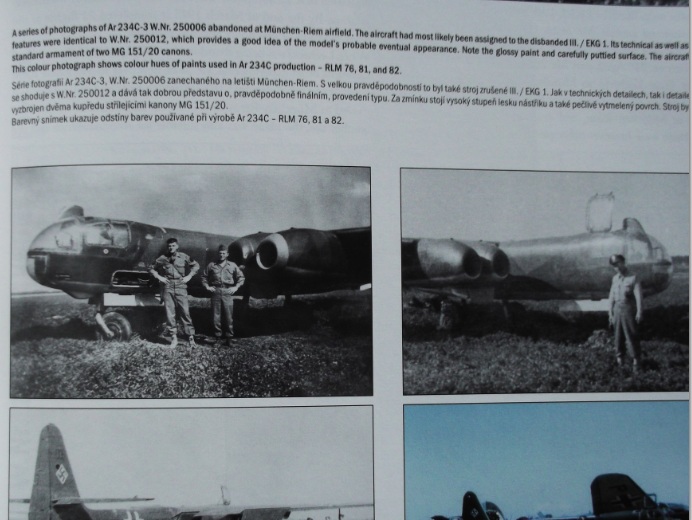
The second part of this very impressive work covers the final operations of Arado Ar 234 Bs and Cs over the Czech lands (partial page view above), detailing sorties flown by aircraft serving with 1.(F)/100 and III./EKG 1 from pilot log books and recollections. The rare Ar 234 C-3s abandoned at Prague-Ruzyne are covered in depth (some eleven pages) and other jet aircraft operating over Bohemia including the Me 262 V11 'V555' receive detailed treatment here (eight pages, partial page view below). 


This chapter also looks at the possibility that other jets and rockets, specifically the Me 163 and He 162, may have been deployed in the Protectorat. The final section of the book comprises ten pages devoted to Luftwaffe dispositions for the fighter protection of Me 262 air bases in Bohemia - this is material supplementary to the publisher's previous " Messerschmitt Me 262s of the KG and KG(J) units". There are several pages of detailed analysis and description of a rare Bf 109 K-4 of III./JG 27 deployed in the Luftwaffe's fighter umbrella over Bohemia.

To conclude, this is a title that the Luftwaffe blog recommends unreservedly especially for aficionados of Luftwaffe jet operations and production. It is replete with incredible details, difficult-to-find high quality information and very many photos (over 200) and documents, including flight log book facsimiles and WNr lists. The profile artworks are stunning. It is difficult not to agree with the publishers when they state that with this volume they have created the definitive account of Me 262 operations over Czech lands at war's end. A top quality work from JaPo!  Congratulations!  


Saturday, 4 August 2012

Bückers with bazookas - Bü 181 'Bestmann' mit Panzerfäusten (1)


Above; Bücker Bü 181 'Bestmann' WNr 501659 was built in Czechoslovakia in early 1944 and served at the FFS A/B 23 in Kaufbeuren with the Kennung RM+HE where it was converted to mount Panzerfaust bazookas in the final weeks of the war. Today it is exhibited at the Deutsche Technik Museum in Berlin. Photo courtesy Marc Hasenbein.

Below; first published in the Modell Magazin issue of 3/83 this was for a long time the only known photo of a fully-armed Panzerfaust-toting Bücker Bü 181 'Bestmann' seen here undergoing trials with the Panzerfaust Versuchskommando (test detachment) at Trebbin on 01 April 1945.


According to Christian Möller in his book “ Das letzte Aufgebot..” , “ kaum jemand weiß, dass die deutsche Luftwaffe kurz vor dem Kriegsende ab April 1945 langsame Schulmaschinen vom Typ Bücker Bü 181 als Schlachtflugzeuge gegen die Bodentruppen der Alliierten eingesetzt hat - very few know that shortly before the end of the war the German Luftwaffe was employing in a ground-attack role slow training types such as the Bücker Bü 181 against Allied ground forces” .

Of course in his inimitable style – his Nachtschlacht book featured well over a 1,000 footnotes - author Möller then provides a footnote detailing a lengthy list of references which prove if anything that there has, on the contrary, been a decent amount of (mostly German-language) coverage, including magazine and web articles, devoted to the late-war combat role of the Bücker Bü 181. I will be covering a few of these over the course of some forthcoming blog posts.

Cover illustration from Christian Möller's “ Das letzte Aufgebot..”  - click on the image to go direct to publisher Helios


Of course I'm being a little unfair to Christian and  I guess the point is nonetheless worth making again for those Luftwaffe 'enthusiasts' who cannot see past the jets and other so-called Wunderwaffen; the reality of late-war collapse was that for every single advanced jet fighter or bomber being put into service by March/April 1945, the Luftwaffe in its death throes was hurriedly deploying antiquated biplanes or obsolescent ab initio type trainers in a combat role- either night ground attack Nachtschlächter or 'tank-hunting' Panzerknacker. With training schools closed and the Luftwaffe starved of fuel - these types did not demand much in the way of piloting skills or even require much gasolene - Bückers and Arados were thus hastily formed into a host of Kommandos and “attack” Staffeln in the forlorn hope of being able to continue the fight to the bitter end. Inexperienced ex-instructors were being ordered to launch perilous early-morning or late-evening ground attack missions against Allied supply columns or tank spearheads with the most derisory of means - the Bü 181 Schulflugzeug (trainer) mounting Panzerfauste rocket launchers on and under the wings. These Panzerfauste bomb-toting Bückers – aerobatic-capable, low-wing, unarmoured monoplanes- were barely able to manage 150 km/h and featured side-by-side seating and dual control columns. It was even planned to re-equip the III. Gruppe of the famed Junkers Ju 87-equipped Schlachtgeschwader 2 with these machines.


In a last-ditch attempt to stem the flow of Allied armour pouring into southern Germany 3. Panzerjagdstaffel was just one such ad-hoc tank-hunting Staffel deployed in the Panzerbekämpfung (tank hunting) role from mid-April 1945 - it was planned to establish some fourteen similar anti-tank units comprising twelve aircraft and some twenty pilots with the units divided between east and western fronts. Established at Kaufbeuren in early March 1945, the Bü 181 trainers of 3. Panzerjagdstaffel were crewed (pilot/observer) by qualified flying instructors from Flugschule A/B 23 under Staffelsfuehrer Oberleutnant Karl-Heinz Dragenscheck. Some details of this unit's exploits - one of the few to actually see service - were given in an issue of Flugzeug classic magazine during 2006. Boring in at low level at barely 150 kph, the intrepid pilots had trained to close to within 500 m of enemy tanks before pulling up to around 20-30 metres altitude and then diving on their targets, unleashing the rockets at a distance of only some 100 metres before banking sharply away in order to escape the blast wave from the exploding rocket. To nullify Allied air supremacy, sorties were to be flown at the crack of dawn or as darkness was falling.

"....Die Bü 181 der 3. Panzerjagdstaffel erhielten am 19. April 1945 ihre Feuertaufe. Sechs Bestmann starteten um 20.20 Uhr vom Flugplatz Ringingen aus in den Raum Tübingen. Zwar entdeckten die Besatzungen keine Panzer, konnten aber einige alliierte Lastkraftwagen zerstören. Einen Tag später, an Adolf Hitlers letztem Geburtstag, wiederholten die Bücker ihre Angriffe. Im Morgengrauen des 24. April startete die 3. Panzerjagdstaffel zum vermutlich letzten Kampfeinsatz...."

Airborne from Ringingen six Bü 181s of 3. Panzerjagdstaffel (tank hunting squadron) underwent their baptism of fire against Allied armour at 20h20 in the vicinity of Tübingen on 19 April 1945. Although the crews (pilot and navigator) failed to locate any tanks, a number of Allied trucks were destroyed. The sortie was repeated on the following day. 3. Panzerjagdstaffel flew what was probably their last sortie of the war at dawn on the 24th. In this instance the targets were not even Allied tanks but abandoned German aircraft left on the field at Memmingen. After this the unit fell back via a number of different airfields to the Bavarian Alps before the personnel surrendered to the Americans at Reit im Winkl on 9 May 1945.... As can be seen in the photo (bottom) the Panzerfaust rockets were fired by means of Bowden cables laid across the wings from the cockpit and the engine cowl mounted a crude aiming device. In practise the upper wing mounted rockets were only rarely fitted - the exhaust gases at launch had a tendency to set the wooden wing surfaces on fire!
Prior to the unit's first sortie there was an event of some note - one of the unit's Bü 181 was stolen by two defectors - former flying instructors Unteroffiziere Hans Ficker and Werner Diermeyer. The two 24-year old officers appropriated one of the light trainers at dawn on 19 April 45 and flew off to Switzerland at the controls of the machine illustrated. Ficker had lost his brother during the Battle of Britain and had himself been badly injured in a crash during October 1944. By January 1945 the lack of fuel for training had effectively ended the careers of the two flying instructors, both now likely candidates to be re-mustered as infantry or as flak crews. Dying a heroes' death for Volk und Vaterland in some muddy trench was not for Unteroffizier Diermeyer. Diermeyer had at one point been offered a chance to re-train on the Me 262 but in the chaos of the last months of the war nothing had come of this. At some stage during the story Diermayer had got wind of the aerial activities taking place at Kaufbeuren. So instead of reporting to barracks in Hoersching, Ostmark (Austria) for infantry service, Diermayer made his way to Munich where he met up with Ficker. The two men carefully prepared their flight and on the evening of 18 April 1945 made their way out to the airfield. Luck was on their side. Training for the first anti-tank missions had just been completed and the following day the tank hunting Bü 181s were to fly their first combat sorties. At that moment an air-raid alarm sent everyone to the bunkers and the two men were able to enter a hangar where the Bü 181 assigned to the Staffelkapitän of 3. PzJgSt was being serviced. Ficker managed to get the engine started, taxiied out onto the field and quickly getting airborne the two men headed for Bregrenz and the Swiss border, touching down at Duebendorf some ninety minutes later. Post war this particular machine served - along with five others - in the Swiss Air Force before being retired in the mid-fifties.