Showing posts with label Flugzeug Classic. Show all posts

Wednesday, 17 December 2025

new Luftwaffe books - JfV 16/I, 'Flieger Asse' and 'Foto Archiv' from Geramond, 'Das Lehrgeschwader 1' Start Verlag


The latest (huge) volume in Rogge Buchverlag's Jagdfliegerverbände series (JfV)  - Teil 16/I - has recently landed! This is the first volume of the Prien team's coverage of 1945- entitled 'Einsatz an allen Fronten 1945' this is a no doubt comprehensive account of the Luftwaffe's fighter force during the first three months of 1945. Although it is almost impossible to 'read' and 'review' and do a meaningful write-up, if you have any interest in the late-war Luftwaffe at all, then you will know to add this to your library. A friend told me he made a decision years ago not to collect this series given his lack of room at home - now some 30-odd volumes later with space on bookshelves shrinking- there are just two more volumes to come. 

Teil 16 Teilband I is a daily chronicle of January-March 1945 covering all Luftwaffe Tagjagd day fighter units in action on both East and West fronts (including Norway) detailed over some 650 pages -  Tagjagdverbände of the Lw.- Kdo. West, Luftflotte Reich (including JG 7 and JG 400) and Luftflotten 1, 6 and 4 covering JGs 51,52 and 54 as well as L.fl 5 (Norwegen). On 1 January 1945 the Luftwaffe still had around 2,200 fighters in service, of which approx 1,500 were listed as serviceable, while there were nearly 3,000 pilots trained and available to man them. Of these organisations Lw.-Kdo West could field over 800 fighters even after the heavy losses of late December 1944 attempting to cover the Ardennes offensive - some 56% of the entire force. Luftflotte Reich comprising mostly JG 300 and JG 301 along with the jet and rocket fighters had at least 300 operational machines, while just 15% of the Luftwaffe's fighter force - barely 300 fighters -were based on the Eastern Front covering a huge area from Courland in the north to Hungary in the south. Lfl 5 had over 100 fighters available. It was proposed to 'bulk' up each Geschwader with a V. Gruppe made up of the EJG auxiliary training unit resources but this did not take place.

While the authors have managed to assemble nearly 300 photo images to illustrate this volume, other scarce 'material' also features. For example, the RLM-Abschussfilme - that had enabled a more or less comprehensive compilation of victory claims in previous volumes -  are non-existent for 1945, with only material for JGs 26 and 27 available to compensate for the lack of films. The authors point out that although there may still be 'gaps' in the claims lists - data for the area covered by Luftflotte 4 in early January is described as 'fragmentary' -  much of what has previously been published has been fully revised and augmented; where this has been done it is footnoted - there are well over 3,000 of these to complement the text! The day-by-day chronicle of the activities of the individual Gruppen is compiled from a host of disparate war diaries (eg KTB Lfl.6), Luftlageberichte, flight logs, strength and loss returns (GQM Verlustmeldungen) and reports, along with ULTRA intercepts; eg an ULTRA report dated 4 January 1945 details that II. and IV. Gruppen of EJG 1 were ordered to send four pilots with at least 10 hours on the Bf 109 to Brandenburg-Briest and Parchim to act as 'targets' for the Me 262s of I and III./JG 7. Details of aircraft abandoned, sabotaged and written off as airfields were evacuated are almost completely absent from German records. Fighter production (including repair) and deliveries (by unit) are covered for all types, including the new variants of the Fw 190 - the D-11 and D-13. There are images and details of a G-6 prototype fitted with wing-mounted Mk 108 cannon (also seen recently on-line from the Petrick archive) and a brutal assessment of the He 162 - it may have been built with non-strategic materials and only used one jet engine, but it could not be flown like any 'conventional' fighter and it consequently killed far more of its own pilots than it did the enemies'. Deliveries for all fighter types in the period covered by this volume amounted to some 6,600 aircraft. With the works at Sorau falling to the Soviets on 13 February 1945 the total of Ta 152s actually built and delivered amounted to just 48 machines of which at least 14 were destroyed on the ground during a strafing attack on Neuhausen, near Cottbus, on 16 January 1945.

The text opens with a statistical reassessment of the 'Bodenplatte' attacks on Allied airfields in the West - over 900 Luftwaffe aircraft took part (perhaps as many as 1,035 according to the OKW KTB). At least 750 of these were fighters. Losses were horrendous - as many as 214 pilots KIA or taken captive, 267 aircraft lost and a further 112 damaged for some 500 Allied aircraft destroyed on the ground. Is it worth pointing out that few of these new Luftwaffe pilots stood no chance of inflicting comparable losses in the air?  And contrary to common belief only a very small percentage of those German aircraft shot down fell to their own anti-aircraft fire. But few Allied airmen were killed while their machines could soon be replaced so the entire enterprise was a 'Fehlschlag'. Countless lives might have been saved had the Luftwaffe fighter forces simply been disbanded at this stage of the war. Since Normandy, air warfare had increasingly turned into a "Materialschlacht". As a postscript (p643-646) a fascinating Lfl.Kdo 6 document considers the pros and cons of a 'Bodenplatte Ost' fighter attack on Eastern Front airfields ahead of the Soviet onslaught about to be launched from the bridgeheads north of Warsaw, but was rejected for the same reasons that nullified the effort in the West at such cost.. 

During early January poor weather in the East saw most activity over the area of Lfl. 4 (Hungary) with II./JG 51 and II./JG 52 active to the north-west of Budapest while on the Western front huge 8th USAAF raids continued virtually unopposed.  Losses continued to accumulate even where no combat  was flown - poor weather, inadequate training levels, rough field strips, Soviet ground fire etc could  bring down as many German Jagdflieger as enemy fighters! While aware of preparations in the East for the forthcoming Soviet onslaught, details of the paltry fuel stocks from the Luftflotten KTBs this early in the year make it clear that this factor alone would hamper any prospect of decisive or effective 'resistance'. 

Elsewhere as the Soviets tank divisions started to roll through the so-called Generalgouvernement (former Poland) from 12 January some western-based fighter units began their move to the Eastern Front ( eg JG 77 on 17 January). III./JG 51 was particularly active over East Prussian airspace. At this time orders were transmitted to 'remove' one Gruppe from each JG and to convert them to so-called 'Ruhe- or 'rest' -Gruppen' to create a 'ready reserve' to be maintained at full strength, but by early March 1945 shortages both of personnel and fuel led to numerous unit disbandments. One of these was IV./JG 301, a new fighter unit that in actual fact only flew one combat mission in the defence of the Reich (02 March) losing 14 aircraft. Some 130 of the best pilots in the disbanded Gruppen went to the jet units JG 7 and KG (J) 54 for re-training. The huge US 8th AF raid carried out on 02 March was virtually the last 8th USAF bombing raid that was defended by the Jagdwaffe over the Reich - henceforward most of their efforts would be spent countering the Allied Tactical Air forces..

In the East by mid-March the Soviets were just 15 miles or so south of Danzig and despite the poor weather the Luftwaffe was facing literally thousands of Soviet fighter and bomber incursions - 2,100 in the area of Lfl. 6 and around 1,150 in the area of Lw.Kdo Ostpreussen during 9 March alone, to take one day by way of example. To counter, the KTB of Lfl. 6 mentions just 172 fighter sorties for 26 victory claims in addition to 116 Schlachtflieger sorties. There were also over 50 recce sorties flown. There were in all probability attempting to establish where the front lines actually were. Some 60 sorties were flown as escort for Schlacht aircraft, as well as strafing and bombing missions in small numbers around Stettin and Kolberg. By 24 March - date of the Allied Rhine crossings - German defences in the West were totally ineffectual - not a single German fighter managed to intervene during the crossings in the vicinity of Wesel (p578). On the Allied side over 1,300 gliders and 4,600 other aircraft had been assembled.

As usual in this huge series of books there are numerous photographic highlights - despite the fact that PK images for this period are virtually non-existent. Among these are a selection of images of the Me 109 K-4s of JG 11 (from the Schalk album in the Archive of Modern Conflict) which are superb and mostly very large and very clear. Some were taken as late as mid-March on the airfield at Strausberg, east of Berlin with snow on the ground. As G.d.Jagdflieger, GenLt. Galland's visit to I./JG 300 at Borkheide on 16 January 1945 which was briefly covered in the JG 300 history (Lorant/Goyat) features on pages 110-111 with both 'new' and larger images and there is another image of 'Timo' Schenk's 'red 5''(p397).The Fw 190 'black 3' of II./JG 76 (p212) in white is unusual. The four 11./JG 3 Bf 109 K-4 images (p484-485) are 'new' as well, as are the images of the 'dump' of I. and IV./JG 51 wrecks left at Danzig-Langfuhr (p562-563) in March 1945.

The reader will be particularly impressed with Ulf Balke's maps - the first of these appears on p28 "Tagjagdverbände of Luftflotte Reich, January 1945" followed by similar maps for Lw.Kdo West, and the Eastern Front Luftflotten 6 during January 1945. These are repeated for the month of March 1945. 

With only two more books to go in the series you are unlikely to want to start collecting them all now but if - like many enthusiasts- you are particularly interested in the late-war period this is one volume you cannot miss. For ordering and a full list of contents go to the Rogge Verlag website at http://jagdgeschwader.net

Below; Ofhr Peter Esser entered the Luftwaffe in late 1942. After being trained in JG 107 and 2./EJG Ost, he joined 7./JG 77 during August 1944. During September, he was transferred to 2./JG 53, ending the war in 6./JG 52. He is seen here at Vesprem, Hungary on 18 March 1945 after an afternoon sortie during which he claimed a P-51 south-east of the airfield. Note the 'tulip' decoration on the yellow nose of this G-14..


A glimpse of a 'White 1' flown by Paul Schalk of 5./JG 11 from the latest Prien team 'Jagdfliegerverbände der Deutschen Luftwaffe Teil 16/1'. According to the caption this machine is a G-14/AS but others have identified it as an Erla-built G-10. See the latest Anders Hjortsberg artwork here

Two recent 'FlugzeugClassic' 'Extra' titles from the team behind Geramond's monthly magazine. 'Flieger Asse' ( 'Air Aces') features a selection of lengthy extracts from the published works of 296 Verlag who are now sadly defunct. I don't have all of their titles by any means so this compilation is very timely, possibly the last chance to become acquainted with some of these books which will undoubtedly become rather rare, most notably Roderich Cesscotti's (KG 30, KG 100, JG 301) memoir 'Langstreckenflug'. 'Foto Archiv' appears to be a selection of the 'Foto album' pages from the magazine 'FlugzeugClassic' there's not an awful lot of text in this one, just 100 pages of rare images from the personal albums of bomber and fighter pilots, maintenance 'black-men' and similar as previously published in the 'Foto album' pages of the monthly magazine. If you've not seen 'FlugzeugClassic' before most of these images will be new to you. My particular favourites concern Gerd Neuhaus who was a Ju 88 nightfighter pilot in NJG 4 before volunteering for II./JG 4. Both of these Geramond monographs can be purchased via amazon.co.uk for around £12 which is a bargain.


The new title from Start/Urbanke is published. "Das Lehrgeschwader 1 -  Mediterranean deployment  1941-42 in rare colour images"

 " ..Christmas came a little early this year. Thanks to my wonderful (and most importantly, partner in crime) wife, I received the long-awaited Start Verlag volume on the LG 1. It's an excellent volume, packed with beautiful colour images, accompanied by a comprehensive text, maps, and beautiful color profiles by Simon Schatz. The final section is also very interesting, with biographies of the war correspondents who took the photos, people about whom little or nothing is generally known. It would be wonderful to have a similar volume covering the years 1943-44 in the near future; who knows! Highly recommended!.."  Giampiero Piva


And a quick mention for 'Defenders of the Reich', Robert Forsyth's latest hardback for Osprey, recently reviewed by Victoria Taylor in the Daily Telegraph.

Sunday, 12 January 2025

Flugzeug Classic Jahrbuch 2024 -DFS 230 Gran Sasso


I finally got around to ordering the Flugzeug Classic Jahrbuch 2024 (Geramond, Heft 12). One hundred pages for 13 euros and packed with interesting features; the history of on-board toilets ( seriously..), Peter Cronauer on JG 54 in 1944 (a stalwart of 'Flugzeug Classic', Peter sadly passed away in 2024), stories of the He 59 and the Ju 34, Jagdflieger navigation techniques, the Luftwaffe in Tunisia, the British Me 163 (DH 108) and more..

Two articles caught my eye in particular. The first is an investigation into the circumstances of the crash of a Lufthansa Boeing 720 airliner in the summer of 1964. I've previously mentioned this accident in a post entitled 'The strange post-war deaths of the Luftwaffe aces'.. 

Werner Baake survived the war as Kommandeur of I./NJG 1 and leading ace on the He 219 with around 40 claims. His last three Halifax 'Viermots' were downed on the night of January 5/6, 1945. Post-war he was a blind flying instructor and and had been flying airliners for Lufthansa since 1954 - like a number of other nightfighter aces. His co-pilot on July 15, 1964 was Flugkapitän Hans Zimmermann, also a former Nachtjagd pilot. What the two pilots had planned for their training flight that day though simply beggars belief   - they were going to recreate 'Tex' Johnston's 'famous' barrel-roll' in the B707 prototype in Lufthansa Boeing 720 'D-ABOP'. However the B720 with its MTOW of over 100 tonnes was not quite the same aircraft. Attempting aerobatic manoeuvres ('Kunstflug Figuren') over Ansbach the pilots overstressed the airframe which broke up in mid-air. Transformed into a burning cascading waterfall of fire, Baake plunged to his death with the two crew - he had been on board the airliner as the check-captain!


The second feature of interest "Den 'Duce' im Schlepptau" covers the activities of III./LLG 1 in the lead up to the operation ('Eiche') to 'liberate' Mussolini, then in detention at the Campo Imperatore hotel in the Abruzzo mountains, Gran Sasso, Italy in September 1943. The Gruppe flew Dornier Do-17s, Henschel Hs-126s and Avia B.534s, adapted to tow DFS 230 gliders. This airborne Gruppe was based at Lézignan-Corbières, then at Pratica di Mare (south of Rome). III./LLG 1 (Luftlandegeschwader 1) had been reinforced in April 1943 by four Staffeln and a Stab. The four Staffeln were: 7./LLG1, 8./LLG1, 9./LLG1 and 12./LLG1. On 19 August 1943, 12./LLG1 was transferred to Ottana (Sardinia), then on 11 September 1943 to Pratica di Mare (south of Rome). It was this unit that transported 1./FJR.7 (Fallschirmjäger-Regiment) to Gran Sasso for the ‘liberation’ of Mussolini. This would also have been the same unit that transported German parachutists to Vassieux in the Vercors post D-Day. The article features a neat selection of PK images - although the photo of the Massey-Ferguson tractor seen towing the DFS 230 (below) was taken at an 8./LLG 1 training detachment in Norway (Banak) at around the time of the Mussolini rescue. 


Wednesday, 13 October 2021

Flugzeug Classic 11/21 exclusive - new pictures of the Me 209


The latest issue of 'Flugzeug Classic' has published new images taken by the-then 'famous' photographer Alexander Stöcker, portraying, in addition to the notorious Me 209 V4 '+ 14' with a fine snake on the forward fuselage, two other Me 209s depicted as being'operational' - for propaganda purposes. Coded '+ 3 ' and '+ 12 ', both long winged, totally unknown to date and can be seen in the sample pdf for the current issue, link below. The front cover image of '+ 14 ' shows an SC 250 being 'loaded' although with no ETC belly rack fitted - and no room to fit one - such ordnance simply could not be carried by this machine.

" ..Sometimes the most effective weapons in the history of war are 'paper tigers'. The German Luftwaffe produced a number of these. Their new "miracle fighter", the Me 209, did not roll not out of Messerschmitt's workshops, but from the offices of the Propaganda Ministry, which produced a series of photographs which showed the viewer the impression of the hustle and bustle of a "209" task force. But the photographic smoke candles were duds - the experienced viewer can immediately see the deception. And so the photos disappeared before the public got to see them. Now the clumsy efforts of the Ministry have resurfaced and provide us with rare images of the Me-209-V prototype..." 

 Below; A close-up of the front cover of 'Flugzeug Classic' 11/21 and link to a 10-page sample PDF on the publisher Geramond's web site 

Also on this blog;


And announced well over a year ago, still no sign of the A&A Models kits, although according to their FB page the A&A Models Me 209 V1 in 48 scale is due imminently..


Saturday, 16 January 2021

Currently reading 'Avions', 'Flugzeug Classic', 'Aerojournal'


If you are a regular visitor here you will know that I will often look at the Luftwaffe content to be seen in the monthly and bi-monthly magazines that are published by our European neighbours. I have a subscription to 'Avions' and pick up issues of 'Aérojournal' from the local supermarket. 'Flugzeug Classic' is usually purchased from the Geramond website or ebay.de as postage from Germany can be expensive. As our own Key Publishing attempts (bizarrely) to turn 'Flypast' into 'Aviation News' and 'Aeroplane' into 'Flypast'  - no doubt in the face of some competition from 'Britain at War' and even the rather hit-and-miss 'Iron Cross' - there is no doubt that titles such as 'Flugzeug Classic', 'Avions' and 'Aérojournal' leave our own UK-based titles floundering in their slipstream. Not a metaphor for what is happening in the wider world. I hope. Try one and see for yourself. 


Markus and his team at Geramond.de (Flugzeug Classic) continue to produce a very nice magazine with a wide range of Luftwaffe-related features. (along with plenty of other content too) In the January 2021 issue Peter Schmoll completes his account of the life and times of JG 52 pilot Ernst Stengl in "Fight for survival". Accounts from Jagdflieger in the East during 1945 are pretty rare and this is a very detailed one. Stengl describes endless strafing and 'freie Jagd' missions against  and over Russian columns during early 1945. On 20 January Stengl was hit by ground fire and made a forced landing some 10 kms behind the front lines, east of the Oder. Making his way through woods  to the banks of the river he recalls the constant engine noise of Soviet columns moving up. Unable to locate any sort of boat or barge to cross in, Stengl took the risk of entering the freezing water with his clothes/uniform bundled inside his Lederkombi held above his head, and half-wading, half-swimming managed to reach the western bank. By March 1945 Stengl was flying two to three resupply sorties per day into the besieged 'fortress' of Breslau - " solange wir genügend Versorgungsbehältern und Sprit hatten.."  ('or as long as we had resupply cannisters and fuel available...'). According to the author the contents of their resupply canisters were on one occasion emptied of food, chocolates and cigarettes  on the orders of the Gestapo since only weapons and munitions were to be dropped on the beleaguered city. Stengl also describes his last - and 17th victory - also in March, prior to his transfer with Staffelkapitän Oblt.Neuböck to II./JG 52 on 17 April 1945. 

Elsewhere in this issue Kurt Braatz presents six pages on Günther Rall, while Holger Lorenz looks at the second generation of Jumo turbojets. Dan Zamansky in 'Gescheiterte Strategie' returns to the African and Mediterranean campaigns, looking specifically at the transfer of fighter units from the East to the Mediterranean theatres. 

Opening his piece with a brief account of events and using claims data from Johannes Matthews, author Zamansky constructs a picture of the movements of Jagdgruppen from the East to the Mediterranean during 1942 as the Soviet front was slowly ‘denuded’ of key resources. I./JG 53 is one unit under the spotlight, removed from the fighting around Stalingrad in late September 1942 – their claims total for the single month of September 1942 was nearly 350 Soviet machines - rather more than the figure achieved by III./JG 53 in the 3-month period June-October 1941 (highest JG 53 scorers in the East during 1941). They were followed by Gruppen of JG 77 and JG 51. The author points out that nothing replaced JG 77 in the East and by the time JG 27 left Africa it was in a very poor state. While all of its Gruppen eventually gathered in Austria to defend the southern part of the Reich, elements of one Gruppe remained in the Mediterranean until well into 1944. The key point is that the resources sent to Rommel may have been of much more use elsewhere, also a point made forcefully by others, such as J-L Roba in his recent ‘Luftwaffe in Africa’ (Casemate). Ultimately, Rommel neglected the problem of supply far too much and, worse, attracted Luftwaffe units to Africa that would have been more useful in Sicily operating against Malta..( or the USSR.)

“ ..In assessing Rommel and the campaign, it is important to remember that Germany was weaker than Britain, even Britain alone. Therefore, after Britain had held out in 1940, Germany had very few good strategic choices left. The attack on the USSR was a desperate choice, but the best choice remaining. […] the problem for the Germans was that giving up Africa would only draw the noose tighter around their necks. After Alamein, evacuation was the obvious choice, but this had equally obvious implications, such as "the beginning" of the end..."

When it comes to unit movements from East to South in 1942, the movement of Kampfgruppen was possibly even more significant but not dealt with in Dan Zamansky's piece. Hopefully the author will be given the chance to publish more on this. Like the fighter forces taken from the East, a number of Stuka and Transport Gruppen transferred to Africa not to mention elements of ZG 26 (Heller of 8./ZG 26 won his RK in Africa) and the Ju 88s of LG 1 and it was these forces that contributed chiefly to the DAK's early successes of course. It could even be argued that the German fighter force - with the pilots’ focus on 'acedom' - did not have the 'crucial'  impact in either theater as, say, the Gruppen of Stuka Geschwader.  After all German fighters went after other fighters and not for example Allied bombers. That said the Stukas operated with success into 1943 in Africa so while the German fighters were outnumbered this strongly indicates that " Marseille and his fellow pilots were as good at tactical bomber escort as they were at air combat..".

The article concludes with a 're-statement' of the author’s somewhat ‘controversial’ thesis that the USSR's role in the war is exaggerated – the author's contention briefly put is that the movement of forces away from the East took place as early as 1942 so that fighting the Western Allies became the dominant focus of Germany's war. 


The latest issue of 'Avions' - the best bi-monthly French aviation magazine* - covers RAF Lysanders in France (J-L Roba) and Mikhail Timine looks at some long-range Zerstörer sorties flown on the opening day of Barbarossa. Elsewhere 'Avions' have also republished the long OOP and hard to find "Romanian Black Hussars" in this new 'Special' edition entitled "Stukisti" - an account of the Romanian Grupul 3 Picaj Stukas in action by J-L Roba and Cristian Craciunoiu. Other units and aircraft types flying in Romania are also covered to a lesser extent with details of training carried out by the experienced airmen of St.G. 77 and Grupul 3 escort flown by the Bf 110s of Küstenstaffel Krim. Text in French. The Luftwaffe blog extends sincere thanks to co-author Jean-Louis Roba for a review copy of  'Stukisti'..


The prolific J-L Roba also has a long feature in the latest Aérojournal - the best bi-monthly French aviation magazine* - in the form of a lengthy bio of JG 77 56-victory RKT Eduard Isken which features many rare images from the albums of JG 77 veterans. Incidentally issue no. 79 also covers the aerial battles over Kasserine (Tunisia) during early 1943. In addition to Chris Goss on the Battle of Britain, recent issues of Yannis Khadari's magazine continue to evoke the spirit of CJE with very nice multi-part features on JG 26 in the Westfeldzug (Philippe Saintes) and a thorough sixteen-page account by J-L Roba of 2.(H)/14 with plenty of colour and artworks!  Issue 77 covered Luftwaffe 'rockets and missiles' in a fantastic 40-page spread with outstanding artworks, photographic content and reproductions of period blueprints.  Highly recommended. Having used the service a number of times now I can confirm that back issues are speedily and professionally shipped via http://caraktere.com  Keep an eye on the website too for a forthcoming 'Encyclopedia of Luftwaffe fighters' from the same publisher.

Saturday, 18 July 2020

Stuka Denkmal im Maßstab 1:1 - life-size Stuka sculpture at the Capel Battle of Britain memorial (Kent, England)


..Just a mile or two distant from the museum featured in the previous blog post, the UK's ‘national’ Battle of Britain Memorial site in Capel-le-Ferne - on the cliff-top between Dover and Folkestone, the wartime 'Hellfire Corner' - re-opened to visitors yesterday following the Covid crisis. Currently on display for the summer season is a stunning 'new' exhibit glittering brilliantly in the sunshine - a full-sized stainless steel sculpture of a crash-landed Ju 87 B Stuka ..


To quote Flugzeug Classic magazine  in the July 2020 issue, " ..Selten zuvor hat eine Skulptur aus Deutschland im Vereinigten Königreich für mehr Aufregung gesorgt als die der abgestürzten Junkers Ju 87 B von »Mister HEX«   or in other words, ' rarely before has a sculpture 'made in Germany' caused more excitement in the United Kingdom than the crashed Junkers Ju 87 B of "Mister HEX"..

'Mister.Hex' is from Munich  and has entitled this work 'Down-two-Earth'. The Junkers Ju 87 - with its 14 meter wingspan - has been given a place within the grounds of the UK's 'National Memorial to the Few' to highlight a new spirit of reconciliation being promoted by the charity that maintains the site. The 'Stuka' stands alongside the replica Mk1 Spitfire and Hurricane aircraft that are major attractions at the memorial’s clifftop home.

Secretary of the Memorial Trust, Group Captain Patrick Tootal, whose father Flt Lt Jack Tootal RAFVR was lost while flying Halifax bombers with Bomber Command, said:

“In early 2019, on the eve of the 80th anniversary of the Battle of Britain, trustees re examined the charity’s role and decided it should also address and record the role of the Luftwaffe in the Battle in order to provide a comprehensive and authoritative overview of the events of 1940.

“As we approach the end of an era with the passing of the Second World War veterans we must look to the future and remember the human cost of war to all nations in a spirit of reconciliation.”


Als Höhepunkt soll die Ju 87 während der Battle-of-Britain Militärparade am 12. Juli 2020 im Sonnenlicht über den weißen Klippen am Ärmelkanal glänzen. It was planned that the Stuka would be a highlight of this year's memorial parade at the Memorial site but due to Covid the event was cancelled.

 'Mister.Hex' has described his motivation in making the giant sculpture;

“The whole project can be separated into three layers of reasons why I did this sculpture. These layers are about private family history, German art history and British military history added up one by one over the years.”

The sculptor's father served in the Luftwaffe in WWII and spent three years training to be a Stuka pilot but ultimately only flew sorties as rear gunner. He regularly bestowed scale model Stukas on his son. Apparently the 'Stuka' combines 'evilness' and 'sexiness' in equal measure and is the only single object he has ever really loved. Hmmm...


The memorial receives no official funding, relying almost entirely on visitor donations. A small entry fee is charged for the exhibition center while the site itself is free to enter. Running costs amount to some £250,000 per annum.

As the airfield at Headcorn is only around 15 mins away (as the crow flies) the site is regularly over-flown by Aero Legend's Spitfires and other aircraft so if visiting you may be lucky enough to experience the thrill of an impromptu flypast. But take care, warning signs around the memorial indicate that the grounds are also home to the UK's only venomous snake, the Adder..


Monday, 31 July 2017

III./JG 2 convert onto the Fw 190 May-June 1942 - 7. Staffel Kapitän Oblt. Egon Mayer. Fw 190 im Westen, Channel Front aces


Above; Oblt. Egon Mayer, about to climb down from the controls of a Stab III./JG 2 Friedrich, seen relating a successful combat account to his erster Wart (Gefr. Bender) probably on or around 17 April 1942. In the three days between 14 and 17 April 1942 7./JG 2 claimed no fewer than 17 victories including 8 claims for Staffelkapitän Oblt. Egon Mayer himself. This tally included two Spitfires on 16 April for his 31st and 32nd victories and three more the following day (two of these remaining unconfirmed).

Mayer's last victory with the Bf 109 was a claim for a Spitfire shot down on 7 May 1942. At that point Staffelkapitän Mayer and his 7.Staffel were taken off operations to convert onto the new Fw 190 fighter. Conversion training took place in Théville. Within a month 7.Staffel was back in action. The first clash of III./JG 2's new Fw 190s and RAF Spitfires took place on 3 June 1942 in a hard-fought action north of Cherbourg. The RCAF's 403 Sqd lost at least seven Spitfires in this action with Mayer himself claiming two, his 43rd and 44th victories

Among the other 7./.JG 2 aces  Ofw. Willi Stratmann, Uffz Guenther Toll and Lt. Jakob Augustin all returned victories. Augustin flew "white 8" (WNr. 333) and returned his 12th victory on 6 June. Oberfeldwebel Alfred Knies returned his first victory, which was feted as the 100th for the Staffel. The next day 7.Staffel was again in action against RAF Spitfires claiming four more and on 6 June Knies returned his second victory, another Spitfire. JG 2 claimed a remarkable eleven Spitfires on this date for no losses.

Below; Fw 190 A-2 "white 11' of 7./ JG 2 (WNr. 105) features the Staffel Zylinderhut emblem on the nose (a thumb pressing down on the British top hat)  rather than the III. Gruppe cockerel's head. After only a few hours flight time the exhaust has already stained the lower forward fuselage and this area of the airframe would soon be over-painted with the usual black trapezoidal eagle wing or Adlerflügel shape outlined with a white border.


Two views of Fw 190 A-2 (WNr. 2194 ?) "white 12" of 7./ JG 2 which sustained 20% damages in a forced landing at Théville on 6 June 1942.  JG 2 filed some 23 claims for Spitfires on this date alone. In a letter home, another 7./ JG 2 pilot Uffz. Otto Kleinert wrote;

"... on one of my first sorties from Théville with 7./ JG 2 on 3 June 1942 we ran into a formation of about ten Spitfires and shot them all down - our Focke Wulfs are largely superior to their machines. I flew as Lt. Augustin's wingman but really saw very little of the action, so close did I stick to my leader's rudder. After we landed I was somewhat surprised to learn that we had accounted for so many enemy machines. Of course as a relative beginner I had little appreciation of the bigger picture..."  ( 'In the skies of France' -Vol 3)


While the introduction of the Fw 190 into service with JG 2 proved to be remarkably successful, fully one quarter of all JG 2 victories for June 1942 were returned by Mayer's 7.Staffel. July 1942 saw a notable decrease in contact with the enemy as the RAF reduced its incursions over northern France while preparing for the (delayed) landings at Dieppe a month later. Of course by that time Armin Faber of the Stab III./JG 2 had presented the RAF with a new Fw 190 after landing in Wales.

Our look at Erik Mombeek's superlative "Dans le ciel de France" Vol 3 elsewhere on this blog
http://falkeeins.blogspot.co.uk/2012/07/dans-le-ciel-de-france-jagdgeschwader-2.html


See "Starker Auftakt" - Alfred Knies' photo album in the August 2017 issue of Flugzeug Classic


Friday, 20 September 2013

Flugzeug Classic, Aérojournal - latest issues


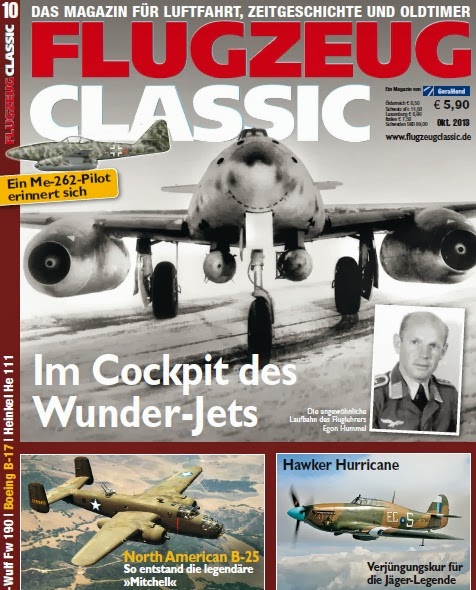
The October 2013 issue of  Flugzeug Classic features the usual selection of interesting Luftwaffe subjects. This month's 'Type history' covers the Flettner FI 282 'Kolibri' and the 'reader's album' devotes four pages to the work of Luftwaffe ground crews. Elsewhere Peter Ocker recounts how during 1944 German industry used increasing amounts of wood in fighter construction while Peter Cronauer interviews and recounts the recollections of Fluglehrer and 5./KG 51 Me 262 jet pilot Egon Hummel. As a flight instructor Egon Hummel almost certainly never reckoned on having to fly combat sorties. Then, in February 1945, he found himself strafing and bombing US troop and re-supply columns at the controls of the revolutionary Me 262.

"..Strapped into the cockpit for the first time with the canopy closed and locked was a thrilling sensation. The aircraft flew beautifully although our combat-radius (endurance) was limited. The Jumos were real 'gas-guzzlers' ('Spritfresser'), there was never more than 45-minutes flying time possible and as a pilot you always had to factor in a reserve for safety so that in practise you couldn't even stay airborne for the full 45 minutes. The speed of the jet was of course phenomenal but it was very possible to approach the sound barrier in a dive which meant having to juggle with the throttles and that was something that you couldn't really do - on two occasions I had an engine flame-out.."

In Aérojournal no. 36 editor Chris Ehrengardt continues his history of the Jagdwaffe in the West, devoting no fewer than 28 pages in Part III of his series which covers the year 1943. Copiously illustrated with a neat selection of photographic images - some from the very expensive and thus rarely seen ECPA-D archive - the 1943 battles over the Reich are recounted mostly in the words of the pilots (French text). The profile artwork is from J-M Guillou - and is outstanding! Well worth the 7 euros cost of the magazine. And if you can manage the French text the feature on Belgian Typhoon pilots in the RAF is worth the admission price alone. In the UK Aérojournal is available from the Aviation Bookshop


Below; also reproduced on page 15 of the current issue of AJ and here courtesy of M. Jean-Yves Lorant, this Bf 110 G Zerstörer of  III./ZG 26 was photographed during the summer of 1943 at Plantlünne. This aircraft is toting twin wing-mounted Doppelrohr BR 21 (BR for Bordrakete) mortar rocket launchers - more colloquially known as "stove-pipes" - for the launch of spin-stabilised mortar rockets intended to break up bomber formations.


Wednesday, 10 July 2013

A new book in my library - " Nachts über den Wolken. Ein Fliegerleben, wie es wirklich war - Erinnerungen an den Zweiten Weltkrieg " Wolfgang Zebrowski SKG 10 - review Osprey Duel Bf 110 vs Lancaster (1942-45)


 a blog update for bibliophiles in the spirit of my favourite thread at ww2aircraft.net " A new book in my library.."  http://www.ww2aircraft.net/forum/wwii-books/new-book-my-library-22210.html  Some new and not so new Luftwaffe books..


" Nachts über den Wolken. Ein Fliegerleben, wie es wirklich war - Erinnerungen an den Zweiten Weltkrieg " is Wolfgang Zebrowski's 144-page tale of combat flying with SKG 10 under Maj. Kurt Dahlmann. Zebrowski was posted to 1./SKG 10 in France in early 1944 and flew 144 combat sorties at the controls of Fw 190 G " Red 2"surviving night raids over England and the Normandy  invasion front. During the later stages of the war he saw action over the Ardennes and even attempted to drop ordnance on the bridge at Remagen. Memoirs from Fw 190 pilots are not exactly thick on the ground and Zebrowski was one of the few survivors from his Staffel. " Nights above the clouds " is written in simple straight forward Fliegersprache German. This second printing appeared in 1997, copies are available from amazon.de re-sellers for less than 10 euros. 


New from Mushroom - nice profile artwork, handbook drawings, museum walkarounds and some text in handy A-5 format. You may have seen much of it before but hard to resist when its this well done and, in this easy-to-read format, great for the morning commute. Must get their Storch and Taifun volumes - and please hurry up with the Hs 123 book, Roger!


New from German publisher Geramond is the latest issue of Flugzeug Classic's "Special" series (No 11 covers Me 262 projects, Misteln, helicopters and liaison types) which is building into encyclopedic coverage of all Luftwaffe types. Similar to Lela Presse's style of monograph these 100-page A-4 soft cover 'magazines' are available in the UK from The Book Depository or even Amazon. If you don't read German each issue features around 250 photos and profiles for around £10. Recommended.


Thompson produced the Classic Pubs Seeflieger volume with Dave Wadman so this volume from Fonthill Media should be recommended. Individual chapters cover all the Küstenfliegergruppen in 160 pages, so unfortunately this will not provide the sort of coverage that Roba gave us in his huge Luftwaffe Seaplanes volumes from Lela Presse. I didn't really see the point of devoting chapter 3 - with one paragraph printed twice - to camouflage and markings. The AS/88 is covered in an appendix at the end of the volume.


 This is Volume 1 and Volume 2 is also out now- Red Kite/ Wingleader's 'Luftwaffe Crash Archive'. While most of the aircraft are familiar a lot of the pictures are not. Nor are the Air Intelligence and police crash reports around which the text is organised.


 Another new series from Kagero entitled "Units". I picked up the JG 54 and Stukageschwader Immelmann titles, both for less than the price of an EagleCals decal sheet. You get photographs, interesting captions, colour profiles in a readable 32-page booklet, along with decals for four machines in three scales - what more could any JG 54 fan want? Well, better photo and text print quality for a start - here it is frankly abysmal and the choice of aircraft for the decals/profile artwork somewhat less than stunning. However their latest 'Topcolors' (no. 34) " Messerschmitt Bf 109s over the Med -Part 1"  is superb with some great subjects "sourced" from and inspired by Erik Mombeek's Luftwaffe Gallery series and Prien's Jagdfliegerverbaende series


 New from Claes Sundin , a work of the highest class - artwork is often a matter of personal preference but Claes has to be the best in his field. I'm just sorry I missed his "RLM 04" limited edition book. Prints are also available as in this lovely Schlacht Hs 123 below. 


Yannick Delefosse's huge monograph " V-1, Weapon of desperation" from Lela Presse. This is the second Edition of  a much-praised work first published in 2006. This 2011 380-page hardback reissue includes 60 new plans, 514 new photos and 20% more text (French language) and represents a considerable re-working of the original volume. Chapters focus on research, development, technology and the operational deployment of the weapon along with a study of underground storage sites and detailed treatment of 155 Flak Regiment, its organisation, its personnel, uniforms and even losses. British counter-measures and intel are also covered and the book sheds new light on certain myths and preconceptions that still exist in the literature, some of which have recently re-appeared in the latest Osprey Duel title 'Meteor vs V-1' Needless to say this book doesn't appear in Osprey's bibliography. This book is the most definitive treatment of the subject presented in any language.  


This latest 'Duel' title features the usual competent text, the usual Bundesarchiv pictures, unfortunately already seen many times before, a relative dearth of first-person accounts and some neat cockpit and 'action' illustration by Hector and Laurier, two of the best in the business. Unsurprisingly (for an American) author Forczyk concludes that Bomber Command's night offensive was on the whole thwarted by the Luftwaffe night fighter defenses, the Lancaster being especially vulnerable to the upward firing armament of the Bf 110 twin-engine night fighter. The 'duel' was largely fought out against a backdrop of tactical innovations by the radar scientists and while the British had the strategic edge at all times, German nightfighters were able to score some tactical victories, although usually (not that the author points this out..) when weather conditions conspired to leave the raiders exposed to night fighter offensive action. Which happened occasionally with disastrous consequences for the bomber crews. While the text skips neatly through events and actions to which entire books have been devoted elsewhere, ultimately though the Lancaster and its crews get relatively little credit here for the almost wholesale destruction wrought on German industrial centres and related infrastructure. The fact that German armament production increased during 1944 is explained, Mr Forczyk, by the FANTASTIC resources devoted by the Germans to bunker building, civil defence, production dispersal, underground factories, the massive deployment of foreign and slave labour and many other factors - not least the relative ineffectiveness of the USAAF's daylight bombing offensive - and not to any failure of Bomber Command's night offensive. The author produces statistics on the cost to the UK of producing a strategic bombing force which make interesting reading - his aim though is to show that the British invested almost as much in the Lancaster "program" as the US did in the atomic bomb project and seemingly got far less in return for their investment. He ignores the evidence that roughly 50% of Germany's entire war effort was devoted to DEFENDING against the RAF's strategic bombing campaign while British expenditure on strategic bombing was 12% of the UK's total war outlay - a decent enough return I'd have thought. And US Lend-Lease "meant that the British didn't have to produce landing craft or machine guns.. ". Maybe not, but simply put, Mr Forczyk, RAF Bomber Command were the much vaunted Second Front in Europe; even early on in the war large numbers of Germans - not just women and children - were manning anti-aircraft guns in German cities and constructing huge bunkers for civil defence. A considerable number of these could perhaps have been fighting soldiers at the front against the British in North Africa or against Stalin's Russia in front of Moscow - not every Flak 88 produced was mounted in a Tiger or deployed as towed piece on the Eastern Front. By the time the RAF launched it's first 1,000 bomber raid (May 1942, not 'late 1942') the city of Cologne had devoted nearly one hundred million RM to civil defence including bunker building. This was just one German city. See Zaloga in 'Defence of the Third Reich' (an Osprey "Fortress" title) for some figures. Hitler of course had ordered the 'Sofortprogram' of huge civil defence projects from the first raids on Berlin that took place in mid-1940. Difficult to describe the bombing of Germany as " ineffectual " in the context of the overall picture of German home defence and the FANTASTIC resources it tied up. Of course the author quotes the RAF's own 1942 Butt report which highlighted the difficulties of hitting individual factory targets from 4 miles up. Hence the campaign against the Ruhr district. For the British, 'Terror bombing' was the only offensive weapon available to Bomber Command in mid-1940 when British backs were to the wall. As usual American writers/historians tend to forget this. Nor do they tend to point out that the USAAF were just as eager to bomb the big German cities and especially Berlin as the RAF were and the USAAF tried any number of times to do just this from March 1944 when they felt sufficiently strong enough. The USAF hid (hides) behind the pretense that collateral casualties were avoidable but the vaunted Norden sight was just as ineffectual above cloud cover and of course US policy over Japan was no more than 'area bombing'. Having already demonstrated that Kammhuber's Himmelbett and the limited 'box' system for the night defence of Germany could be easily overwhelmed, Bomber Command comprehensively defeated & blinded the Nachtjagd over Hamburg in July 1943 - Forcyzk almost says this; his emphasis though is on the "40,000 civilians " that died. In the context of this defeat of the German night fighter force it is perhaps not surprising that 'Bomber' Harris thought his heavy bomber squadrons could go on and finish the job. Even the Nazi hierarchy (men like Speer) thought they could too - not that Forcyzk says this. Rather bizarrely Forczyck ends his text by declaring that the resources devoted to the Lancaster could have been far better spent on another great British aircraft, the de Havilland Mosquito. Mosquitoes were already largely deployed as Pathfinder's, target makers, intruders and in the 'Berlin express', the highly effective 'Light Night Striking Force' that no German defences could counter so this is a somewhat anomalous assertion in the context of this title. The bomber offensive might not make much sense to author Forcyzk 70 years after the event - but I'm afraid authors - and series - like this tend to ignore the context in which the machines they are writing about were deployed. With German bombers over the UK  almost nightly during the early part of the war was it really practical not to retaliate in kind and could Churchill seriously have remained PM until 1945 had he done nothing to take the war to Hitler's Germany ? 

Recommended reading on this topic

 Demystifying the German " Armament Miracle " During World War II: New Insights from the Annual Audits of German Aircraft Producers   -  Lutz Budrass, Jonas Scherner and Jochen Streb (2005)
"1944-1945: Allied Air Power and the German National Railway;"

"..The author focuses on the Reichsbahn as a lynchpin of the German wartime economy. In my studies regarding the Me 262, I have been of a mind that the bombing campaign against oil and its affect on the military, especially the Luftwaffe, was the key to the Luftwaffe's loss of operational ability in the last year of the war. However, the author has made a strong case that bombing attacks against the Reichsbahn were of even greater import against the ability of the German economy and war effort to succeed.  
In its purest terms, it doesn't matter if war materiel could still be fabricated, if you simply couldn't get it from point A to point B it was useless. Coal was the most important commodity carried, as the Reichsbahn, industry, and home heating required it to be available..."