Thursday, 26 May 2022

more Bf 109 Aufklärer - 4.(H)/12 in Tunisia January -April 1943


Bf 109 G-2 of 4.(H)/12 seen on Sicily after departing Tunisia during April-May 1943. To view a larger version of this photo click on the image. 


In January 1943, a weakened 4.(H)/12 were resting at Bir Dufan before the Bf 109s of the Staffel were deployed to Tunisia to operate in the 'pocket' alongside those of 2.(H)/14 which had recently returned to Africa. On January 20th, at Bir el Ghnem, a 'Friedrich' had to be scrapped. Three days later, a further two Bf 109s (which were to be part of a rear commando left near Tripoli) were also destroyed. Two wounded were then reported during landing accidents in Zuara and Gabes. On February 9, Ofw Hönig was injured when his aircraft hit an obstacle in Gabes. It was 80% destroyed and this was the last mention of a Bf 109 F-4 in the Staffel. On February 20, Oblt Gerhard Wernicke was reported MIA, hit by ground fire and forced to make an emergency landing south-west of Zarzis. He was flying 'black 14' WNr. 10764  - one of the first Bf 109 G-2s to be transferred to the unit to replace the unit's Friedrichs. Wernicke, a former observer with 2.(H)/14 transferred to 4.(H)/12 and then turned pilot, managed to evade capture and returned to the unit on foot. Two more 'Gustavs' were damaged on landing at Hadjeb el Aioln on the same day, a ferry flight disrupted by bad weather. On 21 February, in a G-2, Fw Josef Harl was hit by flak at  Ben Gardane (near Medenine) and went into captivity. 

On 24 February, Kapitän Schneider left his post to lead a training unit, 4/Nahaufklärungsgeschwader 102 and then II./NAG 102. His successor was Hptm Rolf Sauer, a veteran who had been shot down south of Arrancy on May 13, 1940 by GC I/5 while flying a 3.(F)/Aufkl.Gr. 22 Dornier Do 17 P.  He had been taken captive but was freed when France fell and, in 1943, was assigned to the Nahaufklärung. On March 10 Fw Werner Schmidt was shot down near Gafsa by three Spitfires of N° 601 Sq. Schmidt was killed and this victory was attributed to P/O Baxter and Sgt Steele. On March 17, a G-2 was destroyed after an emergency landing due to enemy fire, the pilot was unharmed. 


During these risky missions in Tunisian skies, 4.(H)/12 were not 'clay pigeons'. Uffz Friedrich Stannek (left) was the ace of the Staffel, claiming at least six enemy machines downed during this campaign. Lt. Karl-Otto Holzapfel, who knew him, said; "We didn't like flying with Stannek. He was far too much of a Draufgänger. He often came back with a victory... but without his Kaczmarek".  Stannek claimed his 7th on May 23, a P-38 shot down 50 km south-west of  Cap Spartivento. Stannek was awarded the RK late in 1943 and was killed in a crash on October 25, 1944. 


 On March 19, Uffz Antonius Uhler flying Bf 109 G-2 'black 6' WNr. 10672 was hit by flak near Gafsa. He jumped and was captured. 4.(H)/12 had apparently reached the end of the line. In early April, two or three of its G-2s were destroyed at La Fauconnerie and Bir el Djem. (April 9,1943: Bf 109 G-2 W.Nr. 13899 was destroyed by German troops at Fl.Pl. Bir el-Djem). The last recorded loss for 4.(H)/12 in Tunisia was Bf 109 G-2 WNr. 10837, bombed at Sainte-Marie du Zît on April 12. The Staffel evacuated to Sicily and thereafter back to mainland Italy, missing the last of the fighting in the Tunisia and the surrender of the Panzerarmee Afrika in May 1943.


Below;  'white 6' a G-4 of 4./(H)/12 (note prancing horse cowl emblem) on Sicily. 4.(H)/12 was incorporated into the 'new' NAG 11 during October 1943, being re-designated 2./NAG 11.


Also on this blog;


The full story of battlefield recce Staffel 4.(H)/12  - from the Hs 126 to the Bf 109 Gustav, 1939 -1943 - is told by Jean-Louis Roba in the latest issue of 'Avions' magazine (Lela Presse). More details and a pdf extract here 


Wednesday, 25 May 2022

Discipline and 'reprimands' - Eintragungen im Strafbuch (1)


...The "Strafbuch" was the unit's disciplinary log. While 'punishments' and 'discipline' are occasionally mentioned in memoirs and accounts, information on 'types' of punishment meted out to 'offenders' is much harder to come by - there were for example different types of 'reprimand' ('Verweis') and different 'levels' of arrest; 'room' arrest, 'light' confinement etc.. Of course you could be punished for almost anything in the Luftwaffe; talking out of turn, personal insults and failing to look after equipment and uniform, even before infringements of flying 'discipline' and regulations are considered. 

Below; a 'Straftenor' punishment advice for talking out of turn - damaging the reputation of the war academy - with inapprorpriate remarks in the presence of civilians.

".. I hereby punish Oberleutnant Eickmann with a   - stern reprimand -  for damaging the public reputation of the school when, while acting as duty 'Theateroffizier' on December 23, 1943, he confronted an Oberfahnrich in the presence of civilians and repeatedly referred to this unit as a 'club'...."


Fw.Wilhelm Werner, 1./ (F) 100.  Transferred to the penal system today at 13:00 

Zwei Tage gelinder Arrest - 2 days light confinement. As he in March 1943 through carelessness caused the loss of a lined overcoat and a lined work suit. Verschuldet  hat - he was at fault.


" ....out on our isolated field strips, we often took off with a crosswind or even a tailwind, if the wind was not too strong. On one particular occasion I had not noticed that a He 111 was circling overhead and preparing to land. When I landed back in Mariupol at 7.15 p.m. shortly before dusk with S. and O. on board, our chief, Hptm. M., greeted me in a state of utmost agitation. He had been ordered to submit a report to General v. Richthofen against the pilot who had taken off two hours ago across the airfield, having failed to start his run from the laid-out landing cross in accordance with regulations. Richthofen, Chief of Luftflotte 4, was in the He 111 that flew over the airfield when I took off...."

"....For me, this meant a trial by court martial and punishment for offences against aeronautical discipline and order. Richthofen was notorious in such matters, especially among officers. B. had then to carry out the interrogation immediately. I was not unduly worried. Fortunately the wind had been in my favour, because at the time of my take-off there was a light breeze of 15 km/h coming in from the sea, so that technically my take-off was into the wind. The landing cross was therefore in the wrong position, because it had to be moved every time the wind direction changed. But the air traffic control (Flugleitung) had neglected to do this. I was grounded until the trial. After 10 days I was ordered to report to Colonel H.. He told me that Richthofen had personally dropped the charges before the court martial, but that he thought disciplinary action by the disciplinary superior was necessary because I had failed to point out the incorrect position of the landing cross to the air traffic control. H. led me to understand that I had acted correctly, but he could do nothing against the order of the air fleet commander. So I was punished with the lowest level of disciplinary punishment, a simple reprimand. However Richthofen was stubborn - he now demanded a court martial against the unfortunate Flugleiter (flight ops controller), an older Oblt. d.R.. What became of this matter, I never found out..."


Painting a captured 'Wulf' - upper wing pattern on the Farnborough Ta 152 H


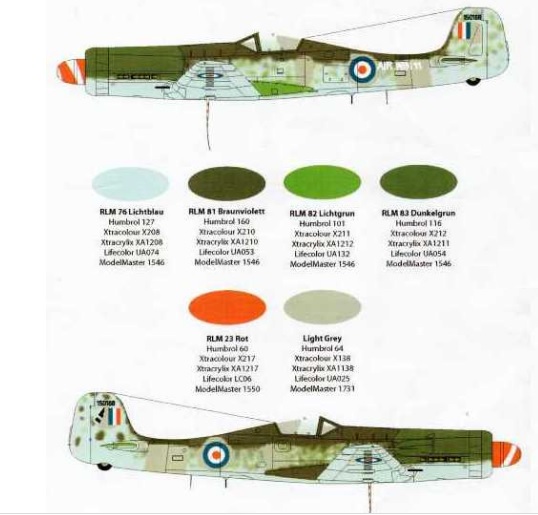
Hobbyboss 2000 have recently re-released the Dragon Ta 152 48th kit. One of the decal options is  'green 9' as seen at the 'Farnborough' captured enemy aircraft exhibition of November 1945. Some 'painting notes' for Ta 152 H-1 WNr. 150 168.  'Green 9' was found at Leck (Schleswig Holstein) and transferred to Farnborough in August 1945. Seen here with Kennung over-painted  with RAF roundels (along with a red spinner)  and JG 301 fuselage bands in RAF medium sea grey (probably) at the Farnborough exhibition later during the year. Note WNr. 150168 at the top of the tail.

Looking through the reference pictures available it is immediately obvious that there are very few views of this machine at Farnborough taken from the port side. There appears to be a difference between the port side which has a very clean demarcation around the engine cowlings and the starboard which appears softer and a little lower (i.e. below the lower edge of the access panel immediately in front of the windscreen).  The Jumo 213E-1 power egg also appears to be a solid colour, probably Dunkelgrün (Dark Green) RLM 83. On the starboard side of the cowling, the exhaust gases were blown down under the supercharger inlet, absent of course on the port side.  


WNr. 150167 showing the partial NMF lowersurfaces


Colour instructions from a Freightdog decals set (low-res image for information) This is FD's interpretation as they think the aircraft looked at the Farnborough display. FD's interpretation of the colours and pattern seems very close to the Hobby 2000 scheme. Note no NMF on the underside although this was a feature of the finish..


Below; closer view of the starboard wing pattern


Tuesday, 17 May 2022

RAF Tempest V against the V1 - Newchurch 'ALG', Kent


Newchurch is a small village three miles west of Dymchurch on the south Kent coast. During the spring and summer of 1944 it was home to 150 Wing - squadrons 3, 56 and 486 flying Spitfires, Typhoons and Tempests under Wing Commander Roland 'Bee' Beamont. The airfield was opened as an 'advanced landing ground' (ALG) to the first squadrons of Spitfires in July 1943 to escort US bombers based in East Anglia. The site is flat and clear and two intersecting runways were constructed using Sommerfield track landing strips laid stright onto the grass and two 'blister' hangars were erected for aircraft maintenance.

 In April 1944 squadrons of Spitfires, Typhoons and Tempests arrived, providing air cover during the ‘D-Day’ landings.Two more 'blister' hangars were built. Conditions on the airfield were spartan, with pilots and ground crews living in tents on the field. In June 1944 the Tempests were ordered to deal with the new threat of the V1 flying bombs ('Doodlebugs'). The first Doodlebug shot down by the Newchurch Wing was on 16th June 1944 and the final tally of V1s shot down by the Newchurch Wing was 638. Commander 'Bee' Beamont's personal tally was 31 V1s brought down - the Tempest could reach 530 mph in a shallow dive!  

After months of intense activity, when the threat posed by the V1s had subsided, the Wing were moved on to other duties. In September 1944 the site was returned to agriculture.


The memorial was unveiled on the site in 2017.

 Wing Commander Roland 'Bee' Beamont's Tempest V, R-B JN 751, on the airfield at Newchurch village, Kent, June 1944....


Below a silent film shot in 1944 showing operations and daily life at Newchurch ALG featuring Beamont and his R-B. At around 3:40, Flight sergeant Rose, who shot down the first flying bomb in daylight, draws a sketch on the blackboard for the Intelligence Officer and other pilots... (IWM CH 13428 above). A single click to view here...


3 Sqn Tempest V based at Newchurch - one of twenty artworks in BATAILLES AÉRIENNES N°93 entitled "V1 SUR L'ANGLETERRE" the most recent account of RAF fighters in action against the V1. French-language, superbly illustrated. 


Also on this blog


Saturday, 7 May 2022

Battle of Britain Emil in colour - future 9./JG 3 Staffelkapitän Viktor Bauer's 'yellow 7' III./JG 3 Desvres late 1940


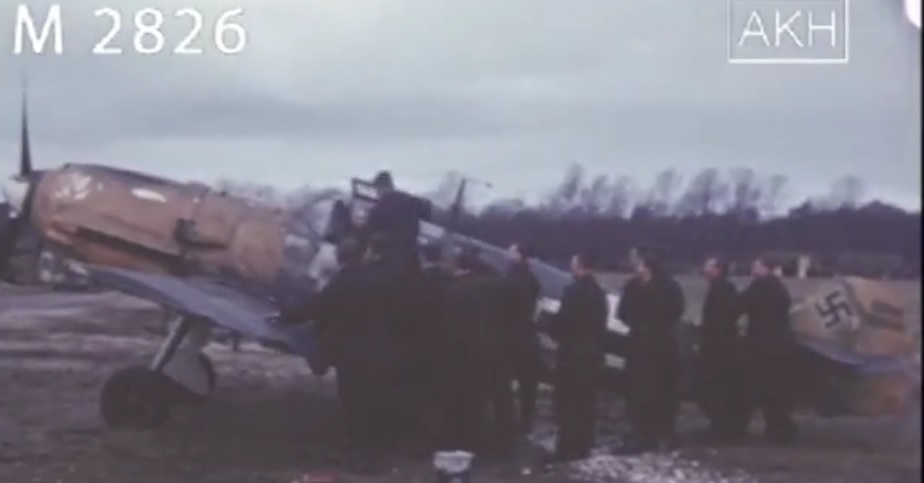
Film 2826 from the Agentur Karl Höffkes film archive features colour material depicting JG 3. The following stills are reproduced here with the kind permission of Karl Höffkes and feature "gelbe 7", the usual machine of the future Staffelkapitän 9./JG 3, Oblt. Viktor Bauer seen wearing a life jacket alongside his Emil speaking to a group.


 III./JG 3 was based at Desvres from Aug 8 1940 to Feb 16, 1941. The yellow rudders and full yellow noses would date this footage to between late October 1940 and Feb 1941. "Schwarze 5" of 8./JG 3 appears briefly in the background and was the machine of Oblt. Franz Beyer.


 " ..The camouflage appears to be in the new greys RLM 74/75 or the famous "mixed greys" - these aircraft do not seem to be in 02/71. Also, if you freeze the shot of the tail of "gelbe 7", you can see that the Hakenkreuz has been masked and a new, lighter shade of 65 (or 76?) has been applied to the airframe... the deeper blue of the original 65 is still visible between the arms of the Hakenkreuz.. The shiny finish on these aircraft is particularly noteworthy- these were well cared for..."

Note this colour section of the footage opens with the this Emil below taxying in.  Either a 'yellow 2' or 'yellow 7' again - note the two rows of Abschussbalken on the rudder. Bauer did not return his third until November. There are not many BoB candidates for this sort of victory total.. any candidates @G.R. Morrison ?


Thanks to GRM and L. Ritger for the captions


Tuesday, 3 May 2022

Bf 109 Gustav, 4.(F)/123, Staffelkapitän, Oblt. Werner Kohla, Bernay, Normandy, June 1944


First in a series of posts showing 'new' images from the album of Staffelkapitän  4.(F)/ 123 (Eins), Oblt. Werner Kohla. (Kohla replaced StaKa Feilmayer lost on 17 August) A good friend of the blog has owned a set of negative strips from Kohla's album for many years and not scanned them before until now.

Standing by with an extinguisher, ground crew prepare for an engine test run following an intervention. 4.(F)/ 123 (Eins) flew armed Messerschmitts on tactical 'battlefield' recce sorties over the 'Invasionsfront' during the summer of 1944. Possible location is Nonancourt (Eure), northern France,  late August 1944...or earlier. In June 1944 the unit was flying out of Bernay, just east of Lisieux..

The aircraft appears to be a G-5 or G-6  with Erla Haube - but whether 'classic' Beulen or 'refined cowl' feature is difficult to determine. ( .in his 'La Luftwaffe face au débarquement' page 268, J-B Frappé suggests the Erla Haube is evidence of a camera-equipped G-8) Note the cowl cover on the ground - the 'refined cowl' cover? The unit did have at least one up-rated G-6 (G-6/R2 with the AS engine and refined cowl) during this period. Other images in the sequence show 'standard' Gustavs.  Note possible light blue-grey finish  (windscreen) - no doubt one reason the machine is pushed under the trees..

This image on the negative strip was labelled " Uffz. Parsi ".


Monday, 2 May 2022

Junkers Ju 88 and 188 of Aufklärungsgruppe 33


Some rare Aufklärungsgruppe images from a friend of the blog with a new negative scanner! First time these images have been seen by the negative strip owner...


Junkers Ju 88 D "8H+KL" features regularly in the 'history' of recce Staffel 3.(F)/33 as compiled by LdZ/AM on the LuftwaffeData website. 


Two images of "8H+KL"possibly during June-July 1943 at Ottana in Sardinia from where the Staffel flew two or three recce sorties a day watching Allied convoys and warships in the western Mediterranean and in Algerian harbours.

 
On July 11, 1943  Ju 88 '8H+KL' failed to return - no details, 100%, 4 MIA.  

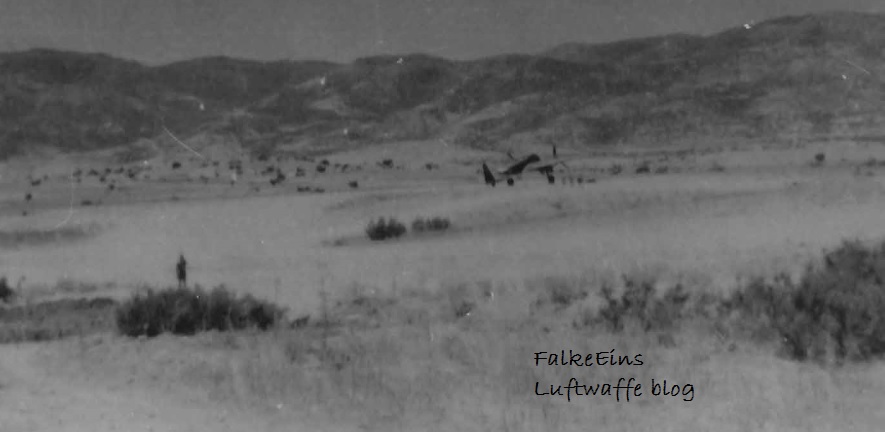
Below; a general view of the grass strip(s) at Ottana, Sardinia, summer 1943. More at the LdZ  Luftwaffe airfields pdf


The Aufklärungs Staffel 3.(F)/33 began conversion training on the Junkers Ju 188 during late 1943 and were still in Gutenfeld/12 km south-east of Königsberg during January 1944.

 
On March 1, 1944 the Staffel reported 12 x Ju 188 F-1 on strength and on March 16 began transferring from Königsberg to Athens-Kalamaki in Greece where the Staffel relieved 1.(F)/122. Here they were assigned to Fernaufklärungsgruppe 4. According to AM's Luftwaffe Data Wiki (compiled by LdZ)   they were tasked with flying routine day and night photo reconnaissance over the eastern Mediterranean, Cyprus, Egyptian and Libyan ports and also covering southern Italy and Sicily. The rare image below from a Staffel member's album shows a crew in front of their Ju 188 feting a landmark sortie - the 100th, either their own or the aircraft type or flown from Kalamaki (.....possibly) 


 Over the following months  " a bitter rivalry developed between the Staffel and 2.(F)/123, which was considered the better of the two "  According to a PoW, 3.(F)/33 only had 4 operational losses from April to September 1944. Here are two rare photographic records detailing two of them...the crew of '8H+KL' (Ju 188, pilot Lt. Beyer) being killed in a crash on April 12, 1944 and the crew of '8H+AL' (pilot Lt. Haspel) failing to return from an operational sortie on May 15, 1944.


 On September 15 the Staffel transferred from Athens-Kalamaki to Salonika-Sedes.On October 10, 1944 the Staffel transferred from Salonika-Sedes to Skopje/Macedonia on or about this date; still under FAGr. 4, the Staffel had 9(5) Ju 88s and Ju l88s, the former being the high-altitude T-l and T-3 variants.

On October 22, 1944 Ju l88 D-2 (8H+AL) crashed in Greece due to engine failure, or possibly shot down by a RAF Beaufighter, while on a long-range day reconnaissance flight to check shipping between Greece and Crete and then along the approaches to the Dardanelles on the return leg, 100%, 3 KIA and 2 captured.

 (info via Andy Mitchell's LuftwaffeData website)