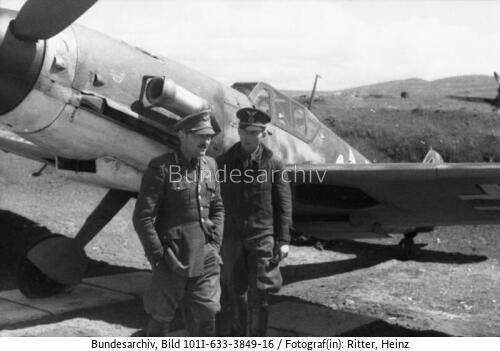
Helmut Bunje provides an operational comparison of the Bf 110 as nightfighter with the Ju 88 in Boiten's 'Night Air War'. He flew both types and achieved downings in both. He achieved his first victory in his 4./NJG 6 Bf 110 G-4 over a Halifax on March 15, 1944. He was still flying with 4./NJG 6 when the Staffel converted to the Ju 88 G-1 and later the G-6 versions in August 1944. In December 1944 Bunje returned his 5th kill, this time over a Lancaster. On February 23, 1945 he claimed three Lancasters and his final two kills were over Lancasters on March 16, 1945 at 3800 metres and 4300 metres south and then north of Schwäbisch Hall. Post-war Bunje trained as an architect and led a successful practise in Hamburg. He passed away in July 2000.


Note the 'draggy' exhaust flame dampers that curve up over the wing, except for the starboard inner which vents below the wing to avoid exhaust gases being ingested in the supercharger intake mounted on the upper cowling. Note the VDM prop blades (minus the VDM emblem) have now been correctly repainted in the 'classic' RLM 70 black-green. Note the cooling scoops on either side of the nacelle. Directly below the supercharger intake is a 'window' for a prop pitch control and engine performance instruments. The supercharger intake for the port engine is situated in the port wing leading edge outboard of the engine. A 300 litre drop tank (79 gallons) was carried under each wing.

Length 42 ft 9.75 inch including antenna
Height 13 ft 8.5 inch with the tail up
Empty: 9,920 lbs.
Loaded: 15,430 lbs
Wing Span 53 ft 3.25 inch
Wing Area 413.33 sq ft
Service ceiling 26245 ft
Maximum speed 342 mph at 22900 ft
Cruising speed 317 mph at 19685 ft
Initial climb rate 2,170 ft per min
Range 560 miles typical, 808 miles max
Armament could include the 7.92 mm MG 81z twin-barrel rearward-firing gun in the rear cockpit
but was primarily cannon;
* 2 × 30 mm MK 108 (nose fixed)
* 2 × 20 mm MG 151/20 (nose fixed)
* 2 × 20 mm MG 151/20 or MG FF fixed obliquely forward- and upward-firing in the rear fuselage in stead of the guns in the rear cockpit.

Ju88 G-1
Engines 2 × BMW 801 D-2 radials of 1,700 hp each
Length (excluding radar) 47 ft 8.5 in, (including SN-2 aerials) 54 ft 1.5 in
Height 15 ft 11 in
Wing Span 65 ft 7.5 in
Wing Area 586.63sq ft
Weights: Empty Equipped 20,020 lb
Maximum Take-off 32,385 lb
Maximum speed 356 mph at 27,890 ft (8,500 m) with SN-2 but no upward-firing guns, 342 mph at same altitude with 'Schräge Musik' installation
Service ceiling 29,000 ft
Normal range 1,553 mls
Armament: Four fixed forward-firing 20mm MG 151 cannon in ventral tray with 200 rounds each and one flexible 13 mm MG 131 machine-gun at rear of cockpit. Optional 'Schräge Musik' installation in upper fuselage with two 20 mm MG151 cannon firing obliquely forward.

BMW radial-powered Ju 88 G-1.


Above; Bf 110 G-4 '2Z+GB' of 2./NJG 6 flown by Kommodore Oblt. Martin 'Tino' Becker. Based at Neubiberg - from a sequence of photos taken on 18 July 1944. Note flash suppressors on the upper nose cannon.
Below - Bf 110 G-4 with an unusual 'reverse' mottle finish; the Farbton 76 appears haphazardly sprayed over the 74/75. In the second image note the non-standard nose cannon.


Me 110 G-4 Nachtjäger mit der neusten Lichtenstein Radaranlage SN - 2 mit FUG 220 (Hirschgeweih).


Because the Bf 110 was used in larger numbers for far longer as a night fighter than the Ju 88 the Bf 110 returned a larger number of night victories than the Ju 88. The Bf 110 was smaller and much lighter than the Ju 88 and presumably more difficult to detect when approaching the bomber stream. The Bf 110's manoeuvrability in an attack on a cork-screwing Lancaster would also be appreciably better. The Bf 110 had sufficient range - but carried underwing tanks which were difficult to jettison in flight (or not at all according to some sources). The Ju 88 enjoyed better endurance and while it could carry drop tanks being a much bigger airframe all fuel could be carried internally. Speed, performance and armament were comparable but probably better in the Ju 88. Note the four cannon in the nose of the Bf 110. Lower gun ports for the MG 151 are visible while one barrel of a Mk 108 of the asymetrically aligned upper nose cannon is visible. In the Bf 110 the Schrägbewaffnung (slanting armament) where fitted was enclosed with the crew...
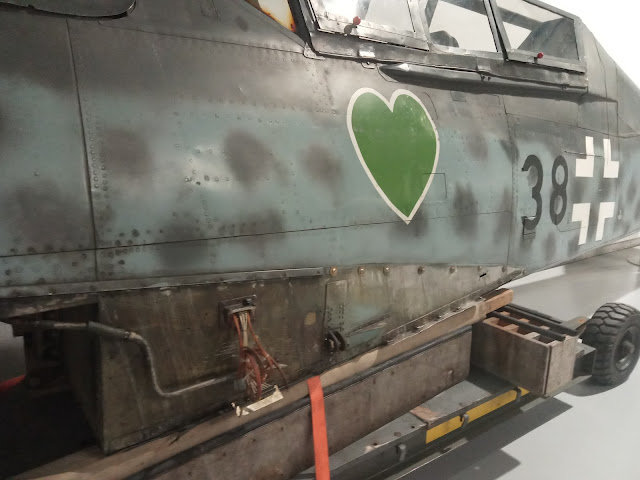
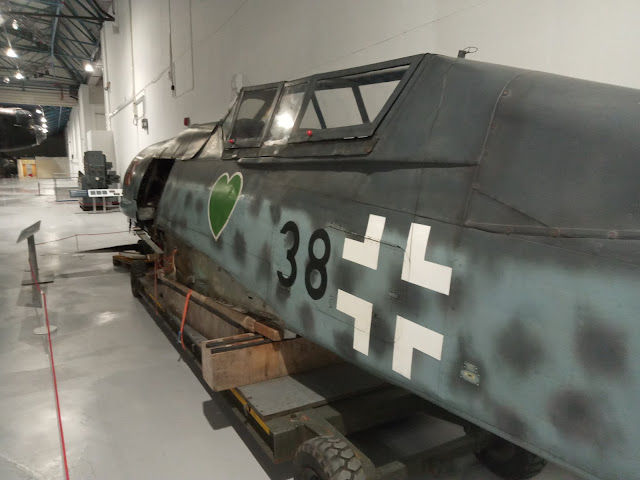
Below; a view of the cockpit/canopy section showing the DF loop antenna and the radio mast. The latter was normally of wood but on this exhibit is a post-war replacement. The DF direction finder is centrally positioned while the mast is offset to port. Antenna extended to the rear tail fin(s) from the mast. To the right of the MG 81 Zwilling (7.92 mm twin-barelled defensive weapon) a rounded aperture for one of two slanted cannon is visible. Note the Wellenmuster camouflage finish extends over the canopy framing. There are no handgrip panels/stencils in this view of the starboard side of the aircraft. Crew access was always via the port side. The large trailing edge slotted flap extends in a single piece out to the aileron. The red triangular 'Rotring' oil stencil is visible at the oil tank cover aft of the engine. The access panel for the starboard wing fuel tank is indicated by the yellow stencil..

The Bf 110 was cheaper to build. The Ju 88 was fitted out with a more modern radar suite -with Naxos and Flensburg- especially for evading Mosquitos and the Ju 88 crew had a decisive advantage with the additional crew member to carry out radar/radio tasks;
Bunje; "in all important aspects the Ju88 - especially the Ju88 G-6 - was clearly superior to the the Bf 110 G-4.. particularly at altitude."
Bunje goes on to note that the endurance of the Bf 110 G was frequently below operational requirements and that the type was often " too slow to catch and infiltrate the bomber stream..." Interestingly he states that "..jettisoning of the external tanks before combat could be a risky enterprise.." - while a trigger release mechanism is visible aft of the tank, most sources state that the Bf 110's wing-mounted drop tanks could not be jettisoned in flight.


In general terms performance figures for the Ju88 G-1 were of course higher than those of the Bf 110 G-4. Aders quotes 335 mph at 6000 m (without flame dampers) and goes on to say that this was 31 mph faster than the Bf 110 G-4 since the larger internal fuel capacity avoided the need for the external tanks required by the Bf 110.
The Ju88 G-1 used BMW 801 G/H engines
Bf 110 G-4 technical data follows; in the night figher configuration, the flame dampers and ventral racks, in addition to the SN-2 antenna array, impose a considerable drag.
Engines 2 × Daimler-Benz DB 605 B-1 inverted-Vee, rated at 1475 hp each (and displayed alongside the airframe at Hendon)
Engines 2 × Daimler-Benz DB 605 B-1 inverted-Vee, rated at 1475 hp each (and displayed alongside the airframe at Hendon)
Length 42 ft 9.75 inch including antenna
Height 13 ft 8.5 inch with the tail up
Empty: 9,920 lbs.
Loaded: 15,430 lbs
Wing Span 53 ft 3.25 inch
Wing Area 413.33 sq ft
Service ceiling 26245 ft
Maximum speed 342 mph at 22900 ft
Cruising speed 317 mph at 19685 ft
Initial climb rate 2,170 ft per min
Range 560 miles typical, 808 miles max
Armament could include the 7.92 mm MG 81z twin-barrel rearward-firing gun in the rear cockpit
but was primarily cannon;
* 2 × 30 mm MK 108 (nose fixed)
* 2 × 20 mm MG 151/20 (nose fixed)
* 2 × 20 mm MG 151/20 or MG FF fixed obliquely forward- and upward-firing in the rear fuselage in stead of the guns in the rear cockpit.
Below; nose-mounted cannon - lower oval ports for the Mauser MG 151 and detachable servicing panel. Note the apertures just aft of the lower radar antenna supports. These are the ejection chute openings for the 30mm spent shell cases. The starboard aperture is protected by a small sheet metal guard to prevent shell casings being ingested in the starboard engine - see first photo above for a better view. There was no requirement for this guard for the port engine. The installation of the upper 30 mm cannon was staggered, with the starboard muzzle protruding. Each 30 mm cannon was supplied with 120-135 rounds. They were charged and triggered by compressed air - note the access opening for the Preßluft bottle unit to the right of the lower MGs. The central opening provided air for the cockpit heater. According to some sources (Mackay) this intake fed cooling air into the nose cannon bay in the G-version ..

Note the lower antennae of the SN-2 air intercept radar with FuG 220 'Hirschgeweih' (Stag antlers) array have been removed. The antennae and extension mounting rods are rounded in profile.
Ju88 G-1
Engines 2 × BMW 801 D-2 radials of 1,700 hp each
Length (excluding radar) 47 ft 8.5 in, (including SN-2 aerials) 54 ft 1.5 in
Height 15 ft 11 in
Wing Span 65 ft 7.5 in
Wing Area 586.63sq ft
Weights: Empty Equipped 20,020 lb
Maximum Take-off 32,385 lb
Maximum speed 356 mph at 27,890 ft (8,500 m) with SN-2 but no upward-firing guns, 342 mph at same altitude with 'Schräge Musik' installation
Service ceiling 29,000 ft
Normal range 1,553 mls
Armament: Four fixed forward-firing 20mm MG 151 cannon in ventral tray with 200 rounds each and one flexible 13 mm MG 131 machine-gun at rear of cockpit. Optional 'Schräge Musik' installation in upper fuselage with two 20 mm MG151 cannon firing obliquely forward.
Below; former NJG 3 Bf 110 G-4 now sits opposite the Lancaster in Hangar 5 of the RAF Museum's Hendon site, Colindale, north London.

George Hopp;
" ..The Bf 110 was just too small to carry all the electronics needed for a night fighter to safely exist in the skies over late-war Germany. Gotha had a merry dance in trying to pack into the nose of the Bf 110 the plumbing for the FuG 202, the FuG 220, and for the MK 108s. The crews actually breathed a sigh of relief when it was decided not to install the FuG 350 in the a/c because there was simply not enough room for it -- although 5 prototypes of the installation were installed. And, with the commencement of the Tame Sow type of night fighting in which fighters might have to roam over much of the Reich territories during RAF raids, it became obvious that the endurance of the Bf 110 was insufficient..."
Ultimately it is probably a little pointless to compare the Ju 88 G-6 and the Bf 110 G-4 - there would be no comparison. Although NJG 1 flew the Bf 110 G-4 until the end of the war so presumably favoured this type. The RLM made its own decision on the comparable quality of the two types. In the late summer of 1944, Bf 110 production was curtailed and in November 1944, the Bf 110 'programme' was terminated. This was largely the result of continuing problems with the DB 605 E -planned to replace the DB605 B in the Bf 110 - and the superiority of the Ju 88.
BMW radial-powered Ju 88 G-1.


Above; Bf 110 G-4 '2Z+GB' of 2./NJG 6 flown by Kommodore Oblt. Martin 'Tino' Becker. Based at Neubiberg - from a sequence of photos taken on 18 July 1944. Note flash suppressors on the upper nose cannon.
Below - Bf 110 G-4 with an unusual 'reverse' mottle finish; the Farbton 76 appears haphazardly sprayed over the 74/75. In the second image note the non-standard nose cannon.


Me 110 G-4 Nachtjäger mit der neusten Lichtenstein Radaranlage SN - 2 mit FUG 220 (Hirschgeweih).