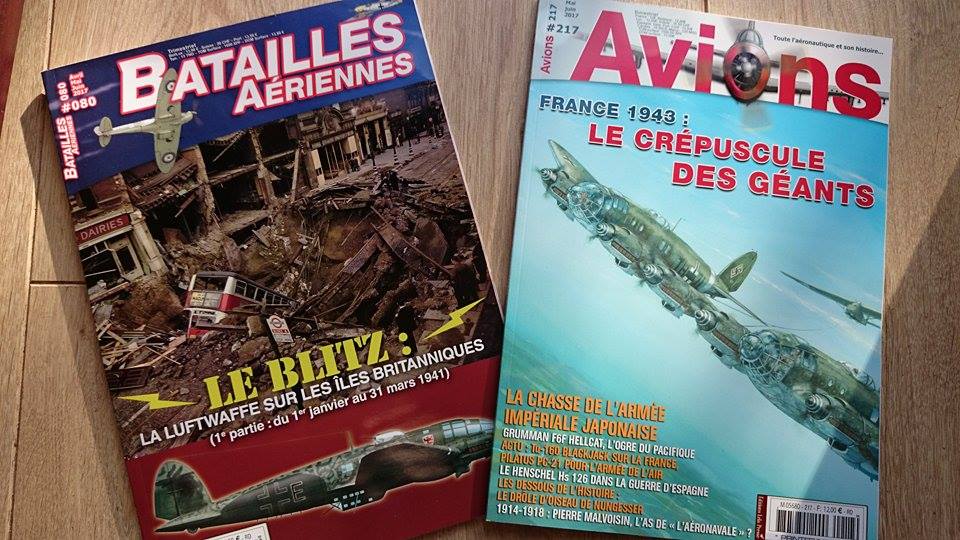
In addition to the second installment of their " Hs 126 in Spain " article the latest issue of 'Avions' magazine (No. 217) covers the He 111 Z in 24 pages in an article entitled 'Twilight of the giants -France 1943' and authored by Dan Gilberti and Jean-Louis Roba . The Zwilling (lit. 'Twin') was constructed in small numbers by the expedient of mating up two He 111 H-6 bombers, joining them at the outer wing section and adding a fifth Jumo 211 F engine at the wing join section. The resulting craft had a wingspan of 35 metres and was a thirty ton machine fully laden. Conceived for the task of hauling the largest glider in the history of aviation - the Me 321 - the five Jumos each developed some 1350 hp and with supplementary tanks the aircraft could carry some 10,000 litres of fuel. Range in this configuration was 4,000 km. Interestingly the crew - usually of seven depending on the number of gunners - was divided between the two fuselages, with the principal controls in the port fuselage (left) - although there was a pilot in each fuselage section. The authors have discovered that in addition to two prototypes - Z V1 and Z V2 - some fourteen Zwillingsflugzeuge were constructed - not the ten usually quoted. The Zwillinge operated both on the Eastern Front and - more unusually - over France.
Below; Me 321 'W6+SW' of the GS-Kdo.2 (Grossraumsegler) seen in the Kuban at Sslawjanskaja just weeks after the fall of Stalingrad in mid-February 1943. He 111 Z-1 'TM+KI' is on the right of the image in the background. The two Bf 109 G-2s are 'white 3' of 4./JG 52 and the 'chevrons + bars' of the Kommodore Major Dietrich Hrabak. Low res image copy courtesy of Michel Ledet via J-L Roba.
The Zwillinge were subsequently assigned to I./LLG 2 and first deployed in early 1943 to the Crimea on glider towing duties. The huge machines arrived in France (Nancy) in April 1943 and from July to September operated out of Istres (south of France) flying troop transporter missions for the Italian front...a pdf extract of this issue can be viewed at the Lela Presse site here
The Luftwaffe's 'Blitz' against England is another richly illustrated monograph from Jean-Louis Roba, covering the period from 1 January 1941 to 31 March 1941. The title opens with a detailed over-view of the Luftwaffe's Kampfgeschwader assembled for this night assault on the British Isles. Not had a chance to read this one yet, but as usual with Jean-Louis, I would expect a pretty comprehensive look at the subject, with plenty of rare photos and Dekker profile artworks. French text. Do take a look at the pdf extract on the Lela Presse web site here
Also from Lela Presse and due soon is Philippe Saintes study of Me 262 losses - according to the publisher's blurb, a work not thus far undertaken in either English or German. Over 250 photos, 25 artworks and a full list of losses and also featuring numerous pilot biographies. French text. Pre-order your copy here
Published in the latest issue of Eduard's Info pdf magazine (no. 83) is Jan Zdiarsky's thorough account of the Memmingen air battle of 18 July 1944 which introduces Eduard's new Fw 190 A-8/R2 Profipack kit. The box-art is striking to say the least. Meticulously researched it is based on the facts as presented by Jan. The artist is in this case Piotr Forkasziewicz.
from the 483rd BG unit citation;
"..As part of the strategic effort of the 15th Air Force against industrial and counter air targets in south-western Germany, a force of 167 B-17s of the 5th Wing was dispatched on 18 July 1944 to attack and destroy the Memmingen airdrome and installations at Memmingen, Germany. The importance of this target is emphasized by its description in the Intelligence Annex to the Operations Order, "Memmingen Airdrome activity has increased, with recent cover showing 70 to 73 ME-110's and 410's not too well dispersed. The installations are used for repair and assembly. This makes this airdrome one of the highest priority counter-air targets.."
At that stage the Americans were almost certainly unaware that following the Oschersleben air battle of 7 July the Sturmjäger of IV./JG 3 had moved to a new and larger field just south of Munich equipped with a concrete runway coincidentally home to the Zerstörer training Gruppe I./ZG 101 - Memmingen!
Due to adverse weather encountered en route the US bombers found themselves devoid of fighter cover. In the absence of a properly authenticated recall signal, the 483rd BG decided to attack the primary target as ordered and continued on alone and unescorted over the northern edge of Italy, over Austria and into the target area in south-west Germany. Kommodore JG 300 Walther Dahl recalled events in his sometimes exaggerated memoir "Rammjäger "..
"....I have been feeling unwell for several days. The flight surgeon reckons I’ve got a touch of angina and has confined me to my bed. I’m off the flight roster of course. It is a beautiful bright morning....my Ia comes in to tell me a call has come in from Division. A force of about one hundred bombers with strong fighter escort is headed towards Munich. Such a relatively small force heading towards a large city like Munich is unusual and it is difficult to track the exact course of the bombers with radar given the proximity of the Alps. Our Einsatzleiter (Mission Co-ordinator) Hptm Kraus has put the pilots on readiness. The first sightings come in from the ground observation post at Kempten. The bombers target must be Memmingen! My gut feeling was right! The bombers will arrive over the field in minutes !..."
Some 45 Fw 190 A-8/R2 Sturmböcke of IV.(Sturm)/JG 3 led by Hptm Wilhelm Moritz were scrambled. The Sturmgruppe climbed to meet the bombers now flying over Innsbruck in a north westerly direction. As they manoeuvred into their attack formation taking up station in line abreast individual Staffelführer selected their targets behind the bombers and calmly ordered their pilots to hold their fire until they had approached to close range....
The Bf 109 F-4 'white 1' flown by Oblt. Erwin Clausen, Stkp. 1./JG 77 from about mid-June 1942 with 57 victories. He claimed an I-16 on 14-Jun-42 for his 57th.
Early 1940 4./JG 77 Emil with black skeleton emblem and eagle crest ahead of the cockpit. Possibly StaKa 4./JG 77 Helmut Henz - note the initials 'LF' ahead of the emblem in the lower two images, Henz's personal emblem. II./JG 77 departed Norway in the fall of 1940..
Test pilot Heini Dittmar chats with leading aviatrix Hanna Reitsch (in fur coat) some time (Franks in the latest Valiant Wings 'Airframe album' devoted to the Komet says 19 April 1944) prior to his record-breaking flight on 6 July 1944 at the controls of this Me 163 B V18 (VA+SP) powered by the new twin- chamber "cruiser" rocket motor which enabled the craft to achieve 1130 km/h or 702 mph, an 'unofficial' world speed record..
With only very limited endurance (seven and a half minutes of powered flight) the Me 163 was never more than a dedicated point defense interceptor. Various attempts were made to improve the short flight time. The aircraft in these screen captures (excerpts from the rocket.aero video "Wings of Fire" posted on youtube and similar stills published in 'Warbirds Photo Album' Vol. 6) was an otherwise standard 'B' airframe 'VA+SP' which in the early summer of 1944 was fitted with a more advanced version of the 509 A rocket engine, the 509 B, which featured two separate combustion chambers of differing sizes, one above the other, for greater efficiency. The main combustion chamber or Hauptofen of the 509 B engine used for the V6 and V 18 utilised the same cube-shaped frame occupying the same location as the A-series' engine, with the lower Marschofen "cruise chamber" housed within the retractable tailwheel's appropriately widened ventral tail fairing beneath the exhaust thrust tube. There is a decent image showing this in the new Valiant Wings Airframe Album devoted to the Komet or alternatively on the walterwerke.co.uk page here. On 6 July 1944, the Me 163 B V18 (VA+SP) was flight tested for the first time. This test almost ended catastrophically but the power boost provided by the second 'cruise' motor broke the world speed record (unofficially). William Green's 1971 book "Rocket Fighter" details the 'world record' flight as having taken place on 6 July 1944. His text is unequivocal that the pilot who flew Komet V 18 that day out over the Baltic with "both rocket chambers functioning" was Rudolph Opitz. The pilot in these screen grabs is obviously Dittmar and not Opitz, although it should be stressed that these shots may not show the 6 July flight. Dittmar had just spent the best part of two years in hospital, recuperating following a 1942 'crash' landing. The record-breaking flight began normally enough, but the rate of climb began to increase rapidly with the pilot soon finding himself exceeding the critical Mach number of the aircraft at above 16,000 feet. Dittmar cut power to the motor, causing a steep dive from which he only just managed to recover. It was later determined that the V 18 had reached a speed of 1130 km/h or 702 miles an hour. Upon landing back at Peenemunde it was found that the aircraft had almost completely lost its rudder. (photo in Green's account - Ransom and Camann's Classic title (2002) shows the same illustration of the V 18's rudder on Volume 1, Page 97, but, state that this occurred on a flight of 23rd December 1943, also flown by Heini Dittmar, and although this airframe was later used for assisted take-off rocket tests, they state this did not begin until 7th July 1944).
Below; the presumably still unmodified VA+SP getting airborne with Dittmar at the controls - unfortunately the 'Wings of Fire' commentary makes no mention whatsover of this developmental avenue. The overall single colour scheme may be RLM 76 or possibly RLM 63, close to Grau 02 but lighter..
The 509 B and 509 C rocket motors' main combustion chambers were supported by the "thrust tube" exactly as the 509 A motor's single chamber had been. They were tuned for "high power" for takeoff and climb. The added, smaller volume "lower" chamber on the two later models - dubbed Marschofen - with approximately 400 kg (880 lb) of thrust at its top performance level, was intended for more efficient, lower power cruise flight. These HWK 109–509 B and C motors could potentially improve endurance by as much as 50%. Two Me 163 Bs, models V6 and V18 (above), were experimentally fitted with the lower-thrust B-version of the new twin-chamber engine.
Below; screen captures showing PK+QP in use by Erprobungskommando 16 at Bad Zwischenahn. Captures from youtube footage taken from the rocket.aero DVD "Wings of Fire. More info here
The DVD includes footage of PK+QP landing, resting on its left wing tip during much of the landing and seen smoking from the engine and turbine after landing. It is then taken away on a Scheuch-Schlepper with inflatable bags. More on PK+QP at Rob de Brie's Me 163 Komet site
Pierre Giustiniani build of the Meng 32nd scale Komet for a forthcoming 'Wingmasters' feature..
Out yesterday the May 2017 issue of 'Aeroplane Monthly' publishes the first of a new Bott/Kightly feature entitled 'Briefing File' - the first of these looks at the Komet's rocket motor. Posted by Ian Bott at the Aviation Enthusiast Book Club on FB.
.
I read on the Black 6 FB page that Russ Snadden passed away in early March. I never met him but remember that I was thrilled when he contacted me back in 2006 to talk about the JG 300 history (Jean-Yves Lorant, Richard Goyat) which had I translated into English from the original German/French text. Which I was very happy to do of course. I think all who visit this blog will be forever grateful to Russ and his team for their magnificent restoration of "Black 6". Thanks to him many of us here would never have had the chance to see a genuine Bf 109 in the air.
".. 'Black 6' is the bitter sweet story of the efforts of (mainly) one man, Russ Snadden and his small team at RAF Benson - against the indifference and even antagonism of the MOD/RAF hierarchy - to restore Bf 109 G-2 'Gustav' 'Black 6' back to flight. Incredibly against such odds he prevailed and for a short while Black 6's distinctive DB 605 engine note thrilled all who were lucky enough to hear it (Below; a photo taken at the VIP 'Roll out' at Benson in 1991). ..The MOD meanwhile were not really interested in supporting this restoration even when it was successfully flying again. Following a landing accident it was grounded and put on static display at Hendon. In the meantime a few lumps of rusty metal were found on the Goodwin Sands and the decision was taken to spend a small fortune in recovering what turned out to be a Dornier Do 17 of unknown provenance in an open ended restoration project of very little interest to anyone. For a fraction of the same expenditure 'Black 6' could still be flying..." Ian Waudby