Wednesday, 16 March 2016

Messerschmitt P.1101 V1 in Oberammergau underground jet aircraft research and development facility


Photo taken at "Oberbayerische Forschungsanstalt OFA" Oberammergau, code name for the Messerschmitt jet aircraft research and development department there. Barracks of the Conrad-von-Hötzendorf-Kaserne" in Bavarian style in the background. Below; USO personnel pose for a snapshot in front of the Me P.1101 V1 with Me 262 wings. The Messerschmitt design lost out to the Fw Ta 183 in the Emergency Fighter programme (1-TL-Jäger)


Due to the ever-growing threat of Allied bombers, in October 1943 Messerschmitt AG moved the administration and research department of its Regensburg factory - some 2,200 employees and forced labourers - to the Conrad-von-Hötzendorf barracks in Oberammergau. Messerschmitt himself was based in Oberammergau from November 1944, working on the development of the Messerschmitt P.1101 jet fighter seen above. A tunnel system was dug out by forced labourers south  of the barracks to house jet aircraft research and development. In late 1944 SS-Obergruppenführer Dr-Engineer Hans Kammler - responsible for all missile technology and who was based in Oberammergau from February 1945 - ordered Messerschmitt Regensburg to stop research into aircraft and missiles and to increase Me 262 jet fighter production. The Oberammergau tunnels were transformed into an underground jet aircraft factory, similar to the "B8 Bergkristall" tunnel complex near the Austrian town of St. Georgen an der Gusen. The factories that were built for Me 262 production in these newly created tunnels, received 'geological' cover names - the facility at Oberammergau was designated "Cerusit".   In spite of the order to focus solely on the production of the Me 262, sporadic work on the P.1101 and successor P.1110 continued in great secrecy at Oberammergau.

   On 29 April 1945, when the P.1101 model was nearing completion, the US Army occupied the town of Oberammergau . The Messerschmitt complex was taken over by US forces and the barracks and associated facilities were subsequently used as a collection point for information and technicians in relation to German weapons systems.  From 1953 the barracks served as a NATO training school. The story of the NATO school at Oberammergau is related at the following link
http://www.natoschool.nato.int/Organization/History/1933-1953

According to this site the prototype P.1101 and a ME-109 were found in Building 615 – now housing the Manfred Wörner Lecture Hall while other experimental airframes where found in the gymnasium, Building 607.  Subsequently virtually the entire Messerschmitt underground production plant along with the P.1101 prototype were shipped to the Bell Aircraft works in Ohio. Although the prototype airframe was badly damaged in transit, this technology resulted in the swept-wing jet engined Bell X-5. Other countries utilised the technology that had been researched at Oberammergau; SAAB in Sweden produced the sucessful crescent-winged Saab 29 “Tunnan” jet fighter. Microfilmed plans of the P.1101 and P.1110 were purportedly hidden in the Ettal Monastery and seized by French personnel. The post war- French designed and built Fouga CM.170 Magister exploited the V-tail technologies developed by Messerschmitt and mimicked the early P.1101 designs. Post war-British transonic aircraft designs such as the Hunter fighter and Valiant and Victor bombers also utilized the crescent-wing technology developed in Oberammergau.

More on late-war German jet production facilities on this blog;

Me 262 construction at the REIMAHG underground facility http://falkeeins.blogspot.co.uk/2010/02/me-262-in-reimahg-plant.html 

Me 262 'forest-factory' production
http://falkeeins.blogspot.co.uk/2010/09/waldwerke-late-war-luftwaffe-fighter.html

He 162 production at Hinterbrühl
http://falkeeins.blogspot.co.uk/2012/05/late-war-fighter-production-he-162.html

Monday, 14 March 2016

more on Balthasar's Battle of Britain Emil Bf 109 E-4WNr. 1559


Above; Desvres, late September 1940. Hptm. Wilhelm Balthasar, right, in conversation with Geschwaderkommodore Maj. Günther Lützow in front of Emil WNr. 1559

Recently received a mail from Iain of the 32nd SIG - ".. doing a quick build of Eduard's 1:32 109 E-4 over on LSP in the markings of Hptm. Wilhelm Balthasar's E-4, Werk Nummer 1559, III./JG 3, based at Desvres/France in August 1940 - do you know of any images showing this aircraft - only found a few poor quality ones - and all the artworks I've seen on this airframe are different - so I don't trust any of them at the moment....

WNr 1559 can be a bit of a confusing one - it was the same machine that Balthasar had through the French campaign while with JG 1 and JG 27 (very briefly and hence the JG 1/JG 27 emblem under the cockpit) before he went off to a Staff job during the first half of the Battle of Britain. He then joined III./JG 3 with the same machine.

 The blog post below has some nice views of Balthasar's JG 1 Emil - some time during July 1940 1./ JG 1 was re-named 7./ JG 27 and thus Balthasar was briefly Staffelkapitän of 7./JG 27 (ex 1./JG 1) although you will be hard-pressed to find this in any bios on the net. Barely a month or so after this re-naming, Balthasar departed for JFS Werneuchen, taking WNr. 1559 with him. Note the profusion of views of the port side of the tailfin, indicating that the victory Balken were unlikely to have been painted on the starboard side.

http://falkeeins.blogspot.co.uk/2015/05/hptm-wilhelm-balthasar-1-jg-1-emil.html

The next link depicts Balthasar's Emil during the period he was Kommandeur of III./ JG 3 during the late Battle of Britain period..

http://falkeeins.blogspot.co.uk/2011/01/hptm-wilhelm-balthasar-kommodore-jg-2.html

 Note that the green overspray has now been applied but there is no 'green 1' Kennziffer in front of the Balkenkreuz; unless Balthasar is standing in front of it ! Most likely WNr. 1559 is still 'White 1' at this stage.


However in the image below note the new Gruppenemblem of III./ JG 3 - introduced by Balthasar -superimposed over the top of the 'White 1' still marked on the engine cowl, while in front of the cockpit the 'old' emblem of I./JG 1 (III./ JG 27) can still be seen. Note the spinner cap, probably red. Compare this image with the photo on page 78 of Jochen Prien's III./ JG 3 unit history.


In early 1941 Balthasar was appointed Kommodore of JG 2, so he was not with III./JG 3 for very long. His successor subsequently took over WNr. 1559 and then had it re-sprayed again. Hence pictures of Balthasar and Oesau with effectively the same aircraft.

 On page 83 of Jochen Prien's III./ JG 3 unit history there are two photos which clearly reveal the evolving finish applied to WNr. 1559 - in the image below, taken just after Balthasar left III. Gruppe in early 1941 to become Kommodore JG 2, the 'white 1' and axe emblem on the cowl have been over-painted. The pennant of the Kapitän on the antenna mast has been removed. In other words the pictures below of 'Green 1' are not of  Balthasar's machine...note straight and lower demarcation on the fuselage and the III. Gruppe bar clearly visible..

Note how the fuselage finish differs from what can be see in the first image here (top). There seems to have a been a rough and ready overspray with a high demarcation with nothing around or over the main fuselage cross compared with the finish below which dates from early 1941. Conclusion;  WNr. 1559 underwent a number of resprays. The image below dates from early 1941 by which time Walter Oesau had assumed command of III./JG 3..
.

Over on his Profile Paintshop check out Anders Hjortsberg's interpretations of the Balthasar/Oesau 1559 schemes here

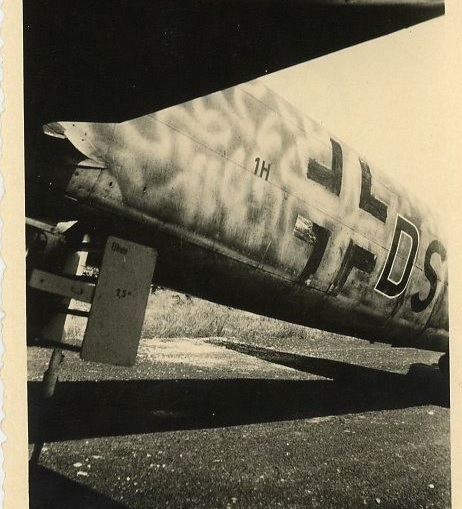
KG 26 Ju 88 "1H+DS", Rumanian Ju 88, JG 51 Fw 190 - daily ebay photo find #166


More  Stabsstaffel JG 51 Fw 190s on this blog here


On offer here 


currently on offer here

Wednesday, 9 March 2016

NJG Ju 88 C-6 - daily Ebay photo find #165


Looking for all the world like C-6's of KG 40 and/or ZG 1 at Bordeaux during the spring of 1944, these Ju 88 C-6s are taken from an album page marked 'Kastrup spring 1945'. The machine shown here has suffered an undercarriage failure on taxiing (note close proximity to other parked aircraft but little damage). Note also the mix of camo schemes with another parked C-6 in normal 70/71/76 still - all in keeping with other photos of KG 40 and I and III ZG 1. However if this is Denmark after the capitulation, then these machines are on the strength of NJG 102 - there is a Flugzeugbestand und Bewegungsmeldungen table for the Stab NJG102 elsewhere which shows a single C-6 on strength from around April 1944...more hopefully on the Luftwaffe Research Group here


http://www.ebay.de/itm/1945-Deutsche-Flugzeuge-Stuka-Zerstorung-Commander-Original-Fotos-2-WK-/401084115909?hash=item5d6279ebc5:g:zLUAAOSwvgdW3TdZ

Tuesday, 8 March 2016

8./ JG 2 Fw 190 'black 9' -daily ebay photo find #164


A Wart points out the finer details of his latest wooden model to Fw. Rudolf Eisele (8./JG 2) and right, Lt.Wilhelm Godt (8./JG 2). Perhaps Eisele is holding a model of a Spitfire; Eisele claimed a Spitfire on 29 January 1943 for his 9th victory. Godt is wearing a recently awarded EK II, probably earned for his 19 Sqn Spitfire claimed on 18 January 1943 north-west of Brest....click to view large


http://www.ebay.de/itm/Orig-Foto-Kleinformat-Flugzeug-Jaeger-Fw190-Pilot-mit-frischem-verliehenem-Ek-/222045007239?

Also on this blog

III./JG 2 in France, December 1942 first frontal attack on the bombers

Ju 88 C-6 9H+SL - expired ebay auction #163


Abandoned Ju 88 C-6 9H+SL with a yellow fuselage band and spinner spirals (just visible to the right of the image -click on the photo to view large). According to this old TOCH thread the code 9H was used by the Nahaufklärungsstaffel Kroatien on its Hs 126s and Do 17s from its formation in March 1943 to May 1945. The Staffel was based at Zagreb-Lučko during its entire existence, although it operated from other airfields in Croatia, Bosnia and Herzegovina.

One contributor to the TOCH thread suggests that this code might be '8H' belonging to the recce Staffel (F)33. See my previous post - this unit's Ju 88s also had a yellow fuselage band and was for a time at least based in the East. The photograph was subsequently published in Roger Gaemperle's "Captured Eagles" book reviewed on this blog here. I'm sure '8H' fits the historical 'story' of this machine better but, that said, you do see what you see.. '9H' appears to fit rather than any other characters. The spinner spirals are of interest - and certainly quite rare on a Ju 88 C-6. Croatian Dornier Do 17s also occasionally featured spinner spirals.

 I asked John McIllmurray of AIMS (the Ju 88 modelling site) to identify the variant and to explain why this was a C-6; ..." obviously it is an A-4 airframe as it has Jumo 211 J engines- you can see the radiator scoop under the engines and the engine temp and propeller pitch window (un-used on outside of engine - the engines were not handed so the window appears on both sides). The angle of the vertical stabilizer rules out a G-variant, as does the small outboard rear bomb bay hatch open, instead of the G series large weapons pack. Finally you can just make out the nose gun battery protruding out from the armour plate - the nose is off that is all .."

Monday, 7 March 2016

Fw 200 of KG 40 Bordeaux- Mérignac and Ju 88 of 3.(F)/AufklGr 33 -daily Ebay photo find #162


Startklar zum Feindflug


C-4s of III./KG 40 seen at Bordeaux- Mérignac. The Germans carried out extensive works at Mérignac for their Atlantic air operations - the aerodrome was developed into arguably the most important Atlantic coast base for anti-shipping and reconnaissance operations. The Germans constructed two concrete runways -  the main runway 2 was oriented north-west/south-east and was some 2,000 metres in length and 80 metres wide. Also constructed were thirteen large metal hangars of some 6,000 sq m organised in three groups. Large numbers of taxiways and dispersal points were constructed over the 410 hectare site - which was surrounded by pines - in attempts to minimise the effects of any Allied air raids. The aerodrome was defended by the RAD-Flakabteilung 595.


Also on this blog;

Unsere Kondor, unser Pilot;  Knight's Cross winner Oberleutnant Bernhard Jope's F8+EL here


Above, Ju 88 of 3.(F)/AufklGr 33; individual letter "Y" in code 8H+YL, yellow ETO fuselage band. Note unusual rune Staffel emblem


Below KG 1 Kopfstand