Saturday, 6 November 2010

Focke Wulf Fw 189 ops in Russia with 2./Aufkl.Gr.10 (Great Wall Hobby Fw 189 kit reference pics!)


some stills from this Russian film - more good reference for the Great Wall hobby kit. Finally some images from the Wikimedia Commons/Bundesarchiv collaboration which are free for re-use


Note the light 'ivory' colours of  Luftwaffe camera equipment - these are two Rb 12.5 cameras fitted in the rear of a Fw 190, image reproduced from an early 1970's issue of Luftfahrt International. The letters 'Rb' indicated the type of role the camera was to be used in, in this instance, Rb - Reihenbilder, shortened from the original name - Reihenbildmesskammer - series-picture, topographic camera..


and the kit itself.....more when I get hold of one ...model pics courtesy Guido at aeroscale.co.uk


Thursday, 4 November 2010

Heinkel He 219 V-4, Ju 88 P-1 and Ju 290 A-2 at Rechlin exhibition September 1943 (1)


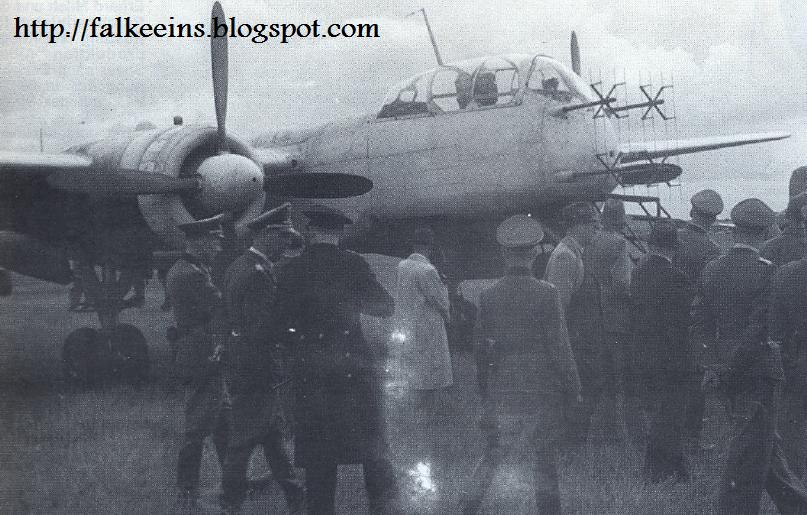
On 3 September 1943 an important Leistungsschau or exhibition was held at the Luftwaffe Erprobungs or test centre, E Stelle Rechlin (Mecklenburg). A crowd of  of high-ranking members of the Generalstab and the Rüstungsstab - Milch, Galland and Speer all attended - hosted by Oberst Petersen, Kommandeur of the E Stelle, enjoyed a demonstration of the latest German types and weaponry. Both Beuteflugzeuge captured types (including a Short Stirling and DH Mosquito in the picture above) and the latest Luftwaffe aeronautical achievements were on show in a "display of the strength of the Luftwaffe" according to press reports. 


At this stage of the war the Luftwaffe hierarchy must have been confident in the apparent superiority of their aircraft and weapons systems - according to at least one source, it was while attending this exhibtion that Speer was handed a telegram by Milch effectively cancelling full scale production of the Me 262 on Hitler's orders - the new jet was surplus to requirements for winning the war!  Other pictures taken at the same event show GfM Milch and armaments minister Speer in discussion in front of the Ju 88 V-45, a prototype which had a jet engine slung under its port wing for testing. The top secret He 219 nightfighter and other types then in development such as the Ju 88 P with its enormous 7.5 cm anti-tank cannon were also on view and the flying display included such types as the huge four-engine Ju 290. A small circle of selected reporters and journalists were present at the exhibition including Hans Hubmann, whose archive is now part of the collection of the BPK (Bildarchiv Preussicher Kulturbesitz) covered in an earlier post on this blog. Jet and Prop magazine published a report on the exhibition in an issue dated 01/ 2001. In a second post we'll look at some of the Beute aircraft on show which included, in addition to the Mosquito and Stirling, a B-17 and Il-2.


According to Peter Petrick this is 'DH+PT' the He 219 V-4 WNr.  19004. The aerial array of the FuG 202 Lichtenstein airborne radar is noteworthy. Click on the images for a slightly bigger view.


Ju 88 P with its enormous 7.5 cm anti-tank cannon housed in a ventral gondola.  


Pictures below show the Ju 290 preparing to get airborne at the show and performing a fly past.  This was Ju 290 A-2 'SB+QG'  WNr. 0157 
 .


Atlantic ditching! An account of a disastrous Kampfgruppe 126 He 111 H-4 torpedo bomber sortie


8 November 1940 - a small formation of three Heinkel He 111 H-4 torpedo bombers under the command of Oberleutnant zur See Helmut Lorenz came into land on the airfield at Brest- Guipavas, or Brest Nord as it was known in the Luftwaffe. This small detachment of aircraft and crews belonged to 1./KGr. 126, the Staffel selected to perform operational testing of the He 111 in the role of torpedo launching bomber, a mission previously carried out solely by Heinkel He115 floatplanes. Kampfgruppe 126 was established from III./KG26 in February 1940, then based in Nantes -Château Bougon with around thirty He 111s on strength which were deployed for mine-laying and anti-shipping bombing sorties.


The following day, 9 November, at around 13h00, Oblt. Lorenz (left) was ordered to fly a sortie against a Royal Navy convoy that had been spotted in the Irish Sea. Weather conditions were poor, with low cloud and visibility from three to five kilometres. Two of the recently arrived He 111 H-4s were hurriedly readied, loaded with fuel, bombs and two torpedoes were slung under the fuselage of each aircraft. At 14h00 the two Heinkels were airborne with Lorenz commanding the formation in the aircraft piloted by Feldwebel Walther von Livonius "1T+FH" (WNr. 6951). The other members of the crew were radio operator Feldwebel Peter Hermsen and flight engineer Flieger Otto Skusa. As the aircraft climbed for height the flight engineer busied himself loading the magazines and running his checks. Shortly after taking off the radio equipment in this machine failed but was working again as the aircraft headed out over the coastline and out into the Atlantic. Weather conditions improved with the ceiling now at 1,000 metres. Suddenly Fw. Hermsen shouted out a warning over the intercom; " an aircraft closing from astern at high speed - a heavy fighter, type unidentified.." It was 14h16. The unidentified fighter was in fact a Blenheim Mk IVF coded FA-Q of 236 Sqn. Coastal Command, a long-range fighter variant of the Blenheim bomber touting 6 Browning machine guns, four in a dorsal fuselage pack. At the controls was twenty year old Pilot Officer Dugald Lumsden - the two remaining crew were navigator Sergeant Gibbons and radio operator/gunner Sgt. Miles. They had taken off at 13h30 (12h30 UKT) from St. Eval in Cornwall for a reconnaissance sortie over Brest.


In an instant all hell broke loose. Oblt. Lorenz gave the order to open fire ...just as the first rounds from the RAF Blenheim hit the Heinkel tearing off the engine cowling panels. More rounds slammed into the pilots armoured seat back. Although they didn't realise it at the time this first salvo from the Blenheim had proved fatal for the radio operator Peter Hermsen who was lying at the back of the cockpit in a pool of blood, a round through his forehead. Wrestling with the controls the pilot jettisoned his bomb load and the two torpedos. More impacts rocked the aircraft, disabling the controls and shattering the instrument panel. Through the intercom Feldwebel von Livonius shouted at the flight engineer to switch off the automatic pilot. Suffering from serious leg injuries flight engineer Skusa dragged himself forward to the pilot still fighting the controls. " ..the intercom is out and Peter is dead! ", to which von Livonius replied insistently .." the autopilot is blocked" ...Despite his wounds the courageous flight engineer managed to haul himself back to the rear of the cabin to disable the automatic flight controls - just in time since the aircraft was now in a dive. The Blenheim was lining up for another firing pass - the aircraft commander and the pilot agreed that when the Blenheim dived on them they too would point the nose of the Heinkel down, letting the Blenheim overrun them before pulling up as brutally as the state of their engines would allow and then trying to head for the cloud banks at full throttle. Suddenly the Heinkel's port engine stopped dead - rendering the wallowing Heinkel even more vulnerable! The German crew braced themselves for the impending assault - before watching in amazement as the Blenheim turned away. In his report later Pilot Officer Lumsden referred only to an 'onboard incident' that forced him to break off the combat. Whatever the reasons for this unexpected turn of events, the Heinkel was to endure only a brief respite. The twin engine bomber had been seriously damaged - with one engine out and most of the instruments including the compass no longer functioning. The pilot had managed to turn back in the direction of Brest but the machine was barely controllable and was losing height all the time. Von Livonius shouted at the crew to fasten their seat belts - he was going to have to ditch the aircraft! At that moment the starboard engine coughed and spluttered - and finally gave up the ghost! Working the ailerons and rudder the pilot struggled to put the aircraft into the wind. At a height of forty metres the elevators refused to respond to the pilot's inputs - winding hard on the wheel, the pilot managed to move the stabiliser back and point the Heinkel nose up just as it came down into the heavy swell. It skidded across the tops of the huge waves briefly before sliding down one crest and disappearing under the surface...

Having already ditched one KGr 126 Heinkel He 111 von Livonius knew what would happen next " Don't worry .;" he shouted to his comrades, ".. the aircraft will float back up ..". Which is exactly what it did. Once on the surface the crew scrambled for the cockpit door and jumped out onto the wing. With blood streaming from his wounds Fliger Skusa shouted from the radio operator's position that he was unable to release the dinghy. Walther von Livonius climbed back into the fuselage, struggled to the rear of the aircraft and pulled the life raft from its station still in its cover. He passed it outside the aircraft to Oblt. Lorenz who had torn off its protective sheet and pulled the toggle on the gas cannister used to inflate it. It took twenty seconds to inflate the raft. The pilot was meanwhile helping the flight engineer out of the ditched machine before the two men wrestled him into the dinghy. Von Livonius went back into the sinking aircraft one last time to pay his final respects to his dead radio operator, Peter Hemsen..


As he climbed back out of the airframe Feldwebel von Livonius lost his footing and slid off the wing into the sea. It was then that the three men noticed the air bubbling away out of the raft - holed by the Blenheim's salvos. Attempting to inflate their life vests, their fingers numbed by the cold, the men found it almost impossible to unscrew the small compressed air bottles designed for this purpose. They finally managed it after several attempts. Before the dinghy sank Lorenz retrieved the flare gun and the small container of flares and attached it around his neck. Supporting the head of his wounded comrade out of the water he also managed to retrieve the canister of coloured dye designed to be released into the water to help search aircraft locate them. By now the Heinkel had slid under the waves and had disappeared for good. It was 14h45.

The three men were more than 15 kilometres from the Brittany coast line - which they could vaguely make out in the far distance when at the top of a wave. The swell was running high and gradually the three men drifted further and further away from each other. While Flieger Skusa and von Livonius clung onto each other Lorenz was soon forty or fifty metres away from them and could catch only brief glimpes of the two men inbetween the waves. More than an hour passed. Half drowned, paralysed with cold and their life jackets slowly deflating, von Livonius and Skusa were in desperate straits. And when the pilot had to let go of his wounded comrade in order to re-inflate his life jacket, Otto Skusa - unable to swim, half-dead through loss of blood and the cold - slipped under the waves and disappeared.

The two survivors had by no means given up hope of rescue. And while they had been unable to use the radio which had been shot up during the Blenheim's attack, they still has the signal flares which Oblt. Lorenz fired off at regular intervals. Von Livonius had already emptied out the yellow dye canister into the sea. What they didn't realise during these dreadful moments was that their encounter with the Blenheim had been witnessed by men of the Wehrmacht based on the coast. Reports had been rapidly passed to the local Luftwaffe units in order to identify the aircraft and a trawler had been commandeered and had already put to sea heading in the general direction of where the Heinkel had been seen to come down. Rescue was possibly closer at hand than they could have imagined. At 14h27 KGr.126 Staff had contacted 1./Seenotflugkommando based at Lanévoc-Poulmic (south of Brest) to advise of a probable ditching in square 59521 north of the Ile d'Ouessant some fifteen kilometres offshore. Thirty five minutes later a Breguet 521 Bizerte seaplane coded KD+BC and piloted by Leutnant Paul Metges took off for the area - with at least 90 minutes of loiter time according to the pilot- in order to pinpoint any potential survivors. It was obvious though that even if he located anyone in the sea the pilot would find it impossible to land given the heavy swell and that he could only hope to 'guide' the trawler to the zone.

Meanwhile at around 17h00, after some two hours in the water the two airmen spotted two Bf 109s flying a recce along the coast. Von Livonius later reported, ".. with the energy of desperation we shouted and screamed even though we knew all too well that they couldn't hear us. We waved our arms like mad men - all to no avail.." The Messerschmitts droned past and disappeared from view....


He 111 H-4 '1T+AA of the Stab/KG26, the regular aircraft of Kommodore Oberst Ernst-August Roth


(to be continued.. ...adapted and translated from an article entitled "He 111 vs. Blenhein IV" by Pierre Babin and published in Avions magazine no. 178 with permission. "Avions" is the leading French aviation bi-monthly magazine published by Lela Presse. More on Lela Presse's publications at http://www.avions-bateaux.com/)

Monday, 1 November 2010

Bf 109 Emil 7./JG2 - 'new' Ebay images

Nice Ebay finds featuring mottle camouflaged Bf109 Emils of 7./JG2 - typical 7. Staffel 'thumb pressing down on the top hat' Wappen....lower image is an E-1 featuring wing-mounted machine guns but with 'updated' canopy retro-fitted.


Sunday, 31 October 2010

Luftwaffe im Focus decals - Döbrich, Grabmann


Available from Startverlag, publishers of 'Luftwaffe im Focus' are new decal sheets covering machines featured in their magazine issues. The 1/72 scale sheet features no less than seven interesting subjects for Bf 109 E, F and G variants and two markings for Fw 190 A. As mentioned they have all been illustrated in “Luftwaffe im Focus” magazine issues 2, 3 and 4.


Article-No. LIF- 72005


Bf 109 G-2 "yellow 10" of 6./JG 5, aircraft flown by Ritterkreuzträger Fw. Döbrich,  Finland, spring 1943
This sheet also features a second Bf 109 G-2 "yellow 10" assigned to JG 5 ace Döbrich.
Bf 109 G-14 "blue 8" of 16./JG 5, aircraft from Ofw. Halstrick with unknown "Kölle alaaf" - emblem, Stavanger/Norway, Autumn 1944
Bf 109 E-4 "yellow 6" from 9./JG 3, France, September 1940
Bf 109 F-2 "black 9" from 8./JG 54, Russia, Winter 1941/42
Bf 109 G-6 “brown 12” from the fighter pilot Uffz. Rudolf Dreesmann, 12./JG 51 “Mölders”, Russia, March 1944
Bf 109 G-14/AS, “white 13” from Uffz. Maxis, 13./JG 53, Germany, January 1945
Fw 190 A-5 "red X”, personal aircraft of Oberstleutnant Grabmann, 3. Jagddivision and Jagdführer Holland, Reich 1942/43


Fw 190 A-4 "black 6”, Fw. Bremer, of 5./JG 1, with unusual camouflage, Woensdrecht/Netherlands, Spring 1943

Price in Germany: 12,00 Euro 19% VAT and postage included
Price in Europe: 15,00 Euro postage included
Price outside Europe: 15.00 Euro postage included


LiF are at http://www.luftfahrtverlag-start.de/

Saturday, 30 October 2010

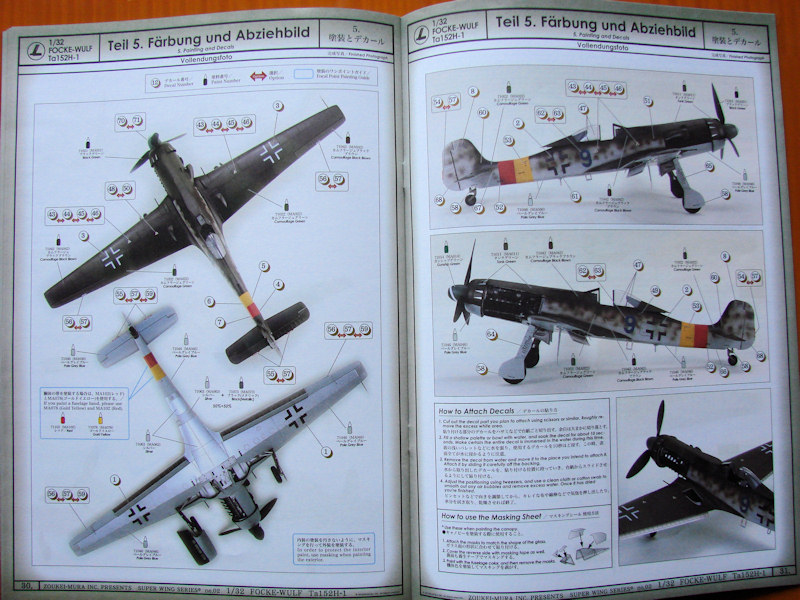
1/32 Focke Wulf Ta 152 H-1 Zoukei-Mura kit

Super wings Series Ta 152 has arrived !

"..Furthermore, I want a “plastic model” worth dreaming about, one where you can finish construction using the same process as if you were building the real aircraft!
I wonder exactly how much time has passed by since I embraced this longing.
Through the act of construction, it's possible to study the airframe structure, and understand the configuration and workings of various parts as they're being assembled. It's also possible to understand what kind of uses and tactics the strongest reciprocating engine fighter was designed, manufactured, and deployed for, simply from the equipped weapons.
Why the engine, the cockpit, the landing gear and the propeller took the forms that they did, why it was implemented in the season that it was, why it vanished so quietly. The time for these dreams of mine to be realized has finally arrived.

The time has finally come for all of the yearning feeling that has been poured into Tank's 152, all of the burning longing, to be fulfilled..."


Model build by Manu Pernes on britmodeller

For more on this kit, some completed examples and Ta152 reference on this blog go  here

Tuesday, 26 October 2010

The Focke Wulf 190 in the Battle for Sicily - Morten Jessen, Andrew Arthy (Airwar Publications)


First impressions of this superlative new publication from Morten Jessen and Andrew Arthy - both the bare facts and a little personal commentary if I may. Many reading this will no doubt recall receiving emails a number of years ago from a teenage Fw 190 enthusiast called Andrew Arthy - I know I do. He was solliciting help in putting together his Butcher Bird web site and I was pleased to be able to send him some profile artwork I had just completed. I wasn't able to offer him much more than that at the time since I was working with Jean-Yves Lorant and Richard Goyat on their massive 2 volume JG 300 history published by Lariviere in France (and which I later translated for Eagle Editions). However a number of years later when Andrew was seeking photos for his first work 'The Fw 190  in North Africa' written in collaboration with Morten Jessen, it was an easy enough matter to put him in touch with Jean-Yves who had written a chapter on the Fw 190 in Africa in his ground-breaking 450-page Docavia Fw 190 publication back in 1981 - as a teenager. Recognising a kindred spirit no doubt and keen to encourage young research talent Jean-Yves sought my advice about collaborating with Andrew and Morten and I urged him to do so. The rest as they say is history. Let me just say here -since he has been very ill but is now happily on the road to recovery- that Jean-Yves' photo contribution to this latest work (in collaboration with Peter Petrick) is outstanding. That's the first 'personal' observation. A second comment is worth making. When examining this book I recalled a post on the TOCH forum a number of years ago by a reputed researcher who wrote that he saw little point in enthusiasts producing 'partial' histories of small units in side-show theatres ( 'this is not 'real' history') when offering comments on Andrew and Morten's first book. Or words to that effect. Well, he has been proved spectacularly wrong again with this latest sumptuous offering from Andrew and Morten devoted to the Fw 190 in the battle for Sicily and published through their own Airwar Publications company. Comparisons with the ground-breaking (that word again!) JV 44 volume produced by the fledgling Classic Publications a number of years ago seem to me to be easy to draw. It is very clear that the authors have carried out a considerable amount of extremely thorough research and it is remarkable that they have unearthed so much new material. The presentation too is quite simply superlative.  This a large-format 220 page hardback of the very highest quality, replete with beautiful photographs, fantastic profile artworks and plenty of previously unpublished personal accounts. Morten's work on the layout and design is absolutely first-class - very 'clean' and uncluttered - and there is little or no 'white space' at all. Dipping in and out I can report that the book itself reads like a thriller and will no doubt delight all those who like to actually read a unit history rather than thumb through a collection of photographs.


The Focke Wulf 190 played an important role in the Mediterranean air war during 1943 and this work covers in great detail the contributions of the Fw 190-equipped Gruppen in this theatre through that summer as I./Sch.G. 2, II/Sch.G.2 and III./SKG 10 - in concert with a number of other weakened Fw 190 Gruppen- took on Allied shipping and fighters massing to invade Sicily. With the fall of this island base, these units withdrew to southern Italy to continue their desperate rearguard actions. Despite facing many difficulties the Fw 190 units flew a number of effective missions in the battle for Sicily and brought some much needed respite to the hard-pressed German army. A number of veteran Fw 190 pilots have contributed in remarkable fashion to this work including Helmut Wenk, TO of 6./SKG 10 - adding both photos and accounts and some quite outstanding war-time sketches to the story - and we can only agree with him when he writes in the book's 'Foreword' that the authors have produced "an outstanding work". It is only when you read a work like this that you realise just how little is known about the activities of the Fw 190 units and the operations of II. Fliegerkorps in the Med. in mid/late 1943. So much for my initial thoughts on this work. I hope to report further after having read the entire story. Straight to the top of the 'to read' pile !  

The work is organised as follows;
Calm before the Storm [14 May - 4 June 1943]
Pantelleria [5 June - 11 June 1943]
Prelude to the Invasion of Sicily [12 June - 9 July 1943]

Schlachtgeschwader 2 in Sardinia [12 June - 9 July 1943]

The Invasion of Sicily [10 July - 13 July 1943]

The Loss of Sicily [17 July - 17 August 1943]

Prelude to the Invasion of Italy [18 August - 2 September 1943]

Schlachtgeschwader 2 in Italy and Sardinia [14 July - 2 September]


To complete the volume are 10 extensive Appendices covering Aircraft & Personal Losses, Aerial, Shipping & Ground Victory Claims, Camouflage & Markings, Fw190 Fighter-Bomber Tactics, Daily Sortie Table, Fighter Bomber Escort and a particularly useful review of Fw190s Abandoned in Sicily There are eleven superb Claus Sundin full page side colour profiles