Sunday, 31 October 2010

Luftwaffe im Focus decals - Döbrich, Grabmann


Available from Startverlag, publishers of 'Luftwaffe im Focus' are new decal sheets covering machines featured in their magazine issues. The 1/72 scale sheet features no less than seven interesting subjects for Bf 109 E, F and G variants and two markings for Fw 190 A. As mentioned they have all been illustrated in “Luftwaffe im Focus” magazine issues 2, 3 and 4.


Article-No. LIF- 72005


Bf 109 G-2 "yellow 10" of 6./JG 5, aircraft flown by Ritterkreuzträger Fw. Döbrich,  Finland, spring 1943
This sheet also features a second Bf 109 G-2 "yellow 10" assigned to JG 5 ace Döbrich.
Bf 109 G-14 "blue 8" of 16./JG 5, aircraft from Ofw. Halstrick with unknown "Kölle alaaf" - emblem, Stavanger/Norway, Autumn 1944
Bf 109 E-4 "yellow 6" from 9./JG 3, France, September 1940
Bf 109 F-2 "black 9" from 8./JG 54, Russia, Winter 1941/42
Bf 109 G-6 “brown 12” from the fighter pilot Uffz. Rudolf Dreesmann, 12./JG 51 “Mölders”, Russia, March 1944
Bf 109 G-14/AS, “white 13” from Uffz. Maxis, 13./JG 53, Germany, January 1945
Fw 190 A-5 "red X”, personal aircraft of Oberstleutnant Grabmann, 3. Jagddivision and Jagdführer Holland, Reich 1942/43


Fw 190 A-4 "black 6”, Fw. Bremer, of 5./JG 1, with unusual camouflage, Woensdrecht/Netherlands, Spring 1943

Price in Germany: 12,00 Euro 19% VAT and postage included
Price in Europe: 15,00 Euro postage included
Price outside Europe: 15.00 Euro postage included


LiF are at http://www.luftfahrtverlag-start.de/

Saturday, 30 October 2010

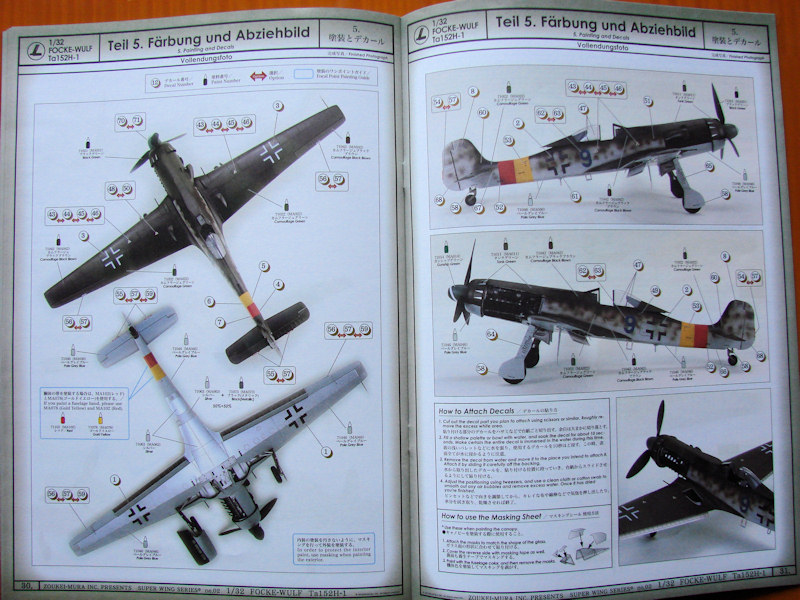
1/32 Focke Wulf Ta 152 H-1 Zoukei-Mura kit

Super wings Series Ta 152 has arrived !

"..Furthermore, I want a “plastic model” worth dreaming about, one where you can finish construction using the same process as if you were building the real aircraft!
I wonder exactly how much time has passed by since I embraced this longing.
Through the act of construction, it's possible to study the airframe structure, and understand the configuration and workings of various parts as they're being assembled. It's also possible to understand what kind of uses and tactics the strongest reciprocating engine fighter was designed, manufactured, and deployed for, simply from the equipped weapons.
Why the engine, the cockpit, the landing gear and the propeller took the forms that they did, why it was implemented in the season that it was, why it vanished so quietly. The time for these dreams of mine to be realized has finally arrived.

The time has finally come for all of the yearning feeling that has been poured into Tank's 152, all of the burning longing, to be fulfilled..."


Model build by Manu Pernes on britmodeller

For more on this kit, some completed examples and Ta152 reference on this blog go  here

Tuesday, 26 October 2010

The Focke Wulf 190 in the Battle for Sicily - Morten Jessen, Andrew Arthy (Airwar Publications)


First impressions of this superlative new publication from Morten Jessen and Andrew Arthy - both the bare facts and a little personal commentary if I may. Many reading this will no doubt recall receiving emails a number of years ago from a teenage Fw 190 enthusiast called Andrew Arthy - I know I do. He was solliciting help in putting together his Butcher Bird web site and I was pleased to be able to send him some profile artwork I had just completed. I wasn't able to offer him much more than that at the time since I was working with Jean-Yves Lorant and Richard Goyat on their massive 2 volume JG 300 history published by Lariviere in France (and which I later translated for Eagle Editions). However a number of years later when Andrew was seeking photos for his first work 'The Fw 190  in North Africa' written in collaboration with Morten Jessen, it was an easy enough matter to put him in touch with Jean-Yves who had written a chapter on the Fw 190 in Africa in his ground-breaking 450-page Docavia Fw 190 publication back in 1981 - as a teenager. Recognising a kindred spirit no doubt and keen to encourage young research talent Jean-Yves sought my advice about collaborating with Andrew and Morten and I urged him to do so. The rest as they say is history. Let me just say here -since he has been very ill but is now happily on the road to recovery- that Jean-Yves' photo contribution to this latest work (in collaboration with Peter Petrick) is outstanding. That's the first 'personal' observation. A second comment is worth making. When examining this book I recalled a post on the TOCH forum a number of years ago by a reputed researcher who wrote that he saw little point in enthusiasts producing 'partial' histories of small units in side-show theatres ( 'this is not 'real' history') when offering comments on Andrew and Morten's first book. Or words to that effect. Well, he has been proved spectacularly wrong again with this latest sumptuous offering from Andrew and Morten devoted to the Fw 190 in the battle for Sicily and published through their own Airwar Publications company. Comparisons with the ground-breaking (that word again!) JV 44 volume produced by the fledgling Classic Publications a number of years ago seem to me to be easy to draw. It is very clear that the authors have carried out a considerable amount of extremely thorough research and it is remarkable that they have unearthed so much new material. The presentation too is quite simply superlative.  This a large-format 220 page hardback of the very highest quality, replete with beautiful photographs, fantastic profile artworks and plenty of previously unpublished personal accounts. Morten's work on the layout and design is absolutely first-class - very 'clean' and uncluttered - and there is little or no 'white space' at all. Dipping in and out I can report that the book itself reads like a thriller and will no doubt delight all those who like to actually read a unit history rather than thumb through a collection of photographs.


The Focke Wulf 190 played an important role in the Mediterranean air war during 1943 and this work covers in great detail the contributions of the Fw 190-equipped Gruppen in this theatre through that summer as I./Sch.G. 2, II/Sch.G.2 and III./SKG 10 - in concert with a number of other weakened Fw 190 Gruppen- took on Allied shipping and fighters massing to invade Sicily. With the fall of this island base, these units withdrew to southern Italy to continue their desperate rearguard actions. Despite facing many difficulties the Fw 190 units flew a number of effective missions in the battle for Sicily and brought some much needed respite to the hard-pressed German army. A number of veteran Fw 190 pilots have contributed in remarkable fashion to this work including Helmut Wenk, TO of 6./SKG 10 - adding both photos and accounts and some quite outstanding war-time sketches to the story - and we can only agree with him when he writes in the book's 'Foreword' that the authors have produced "an outstanding work". It is only when you read a work like this that you realise just how little is known about the activities of the Fw 190 units and the operations of II. Fliegerkorps in the Med. in mid/late 1943. So much for my initial thoughts on this work. I hope to report further after having read the entire story. Straight to the top of the 'to read' pile !  

The work is organised as follows;
Calm before the Storm [14 May - 4 June 1943]
Pantelleria [5 June - 11 June 1943]
Prelude to the Invasion of Sicily [12 June - 9 July 1943]

Schlachtgeschwader 2 in Sardinia [12 June - 9 July 1943]

The Invasion of Sicily [10 July - 13 July 1943]

The Loss of Sicily [17 July - 17 August 1943]

Prelude to the Invasion of Italy [18 August - 2 September 1943]

Schlachtgeschwader 2 in Italy and Sardinia [14 July - 2 September]


To complete the volume are 10 extensive Appendices covering Aircraft & Personal Losses, Aerial, Shipping & Ground Victory Claims, Camouflage & Markings, Fw190 Fighter-Bomber Tactics, Daily Sortie Table, Fighter Bomber Escort and a particularly useful review of Fw190s Abandoned in Sicily There are eleven superb Claus Sundin full page side colour profiles


Saturday, 23 October 2010

Flying Heritage Collection Fw 190 A-5 restoration with genuine BMW 801 (first flight December 2010)


Paul Allens Fw190A-5/U3, WNr.1501227 which served with 4./JG54 complete with genuine BMW 801 on a recent engine-run...for more info about the FHC Fw 190 and its history look up 'Flying Heritage Collection' on Facebook or google the website. There is also an original Fw190 A-8 under restoration as well, but that project is not as far along. The replica Fw190s built use a substitute Russian/Chinese radial of similar power since original engines are so rare and expensive. 


And the Flying Heritage Collection’s Focke-Wulf Fw 190 A-5 flew for the first time on 1 December 2010 - a first flight since 1943. Warbird test pilot Steve Hinton lifted into the skies for a 20-minute maiden flight to test all major systems. Hinton reported that the vintage fighter passed its trial flight with flying colors. “The plane is very light, fast, and responsive,” reported Hinton. “This lived up to the history books.” Future flights will take place though December, and soon, the rare vintage aircraft will be on its way to Washington State to be put on display at the FHC. Photo courtesy of Jim Larsen and Air Classics magazine.

More on the story of this Fw 190 and its Luftwaffe pilot, along with the first published photo of its new paint scheme here
http://falkeeins.blogspot.com/2011/02/flying-heritage-collection-fw-190-a5.html

Flying Heritage Collection's Luftwaffe Day 06 August 2011

http://falkeeins.blogspot.com/2011/08/fw-190-bf-109-emil-paul-allens-flying.html

A single click on the video allows you to watch it here.


Bf 109 Late versions- camouflage and markings (MMP books) - Krzysztof Wotowski


Now this was a nice surprise from MMP books (Mushroom). 'Bf 109 Late versions' is a large A-4 format, card-covered 112-page volume of Krzysztof Wotowski's superb artworks covering the later versions of the Bf109. If you have Banyl-Reipl's Warpaint 'book' then this is similar - although minus all the appalling errors in the B-R Warpaint booklet! Wolowski's new volume is much more carefully compiled and exploits the latest research and picture 'finds'. Starting with Günther Specht's G-5/AS, each late variant is given a page or so of text, scale side-views, three or four pages of photographs and up to eleven pages of very nicely rendered profile artwork (in the case of the K-4). Captions are lengthy and include full discussion of the likely colours. The artworks are reproduced mostly at around 1/32 scale (ie large !) at a guess, including top views, lower surface views and 'offical' camouflage schemes. The text introducing each variant details developmental differences and some operational highlights while providing information on manufacturers and Werknummer blocks and includes decent photographic coverage including some colour images. Are there errors in his artwork - well of course there are! I have yet to come across a 'profile artist' who doesn't fill his artwork with 'errors'. Perhaps it is fairer to say that interpreting colour information from black and white photos is a pretty subjective 'science' so some of the artist's choices will inevitably come under discussion (see below).


Unfortunately the odd photograph is not very well reproduced, being rather too dark and I would say that a majority of the pictures portray abandoned and wrecked aircraft. This certainly doesn't detract from the conviction of the overall presentation since this book is primarily about Krzysztof's artwork. As I mentioned, one or two of his colour choices will raise eyebrows, for example the well-known 'Green 7' of JG 300 (P73) has here become a III./JG 6 machine - 'because JG 300 were never based in Prague' - when we know that the rump of this unit was indeed in Prague, thanks to the accounts in Lorant and Goyat's JG 300 history quoted in this volume's bibliography. However this is pretty minor league criticism. To conclude the profile artist presents a wide range of reasonably convincing profile artworks that will be indispensable viewing/reading for late-war Bf109 enthusiasts and modellers.Certainly one of the better profile artwork books I've come across and an excellent incentive to check out some of MMP's other recent Luftwaffe titles. More info at http://www.mmpbooks.biz/

Sadly author/illustrator Krzysztof Wotowski passed away shortly after the publication of this book.

Friday, 15 October 2010

Preußischer Kultur Besitz picture archive - He 111s of KG26, KG100 (Luftwaffe colour)

 " With more than 12 million images from all areas of fine art, culture and history,  the picture archive of the Preußischer Kultur Besitz is your partner for licensing reproduction rights for editorial and commercial use. In our database you will find more than 300,000 selected images online. Each month we add new pictures for your choice. If you wish personal consulting or support by our research service please contact us "

http://bpkgate.picturemaxx.com/webgate_cms/en/


Tuesday, 12 October 2010

First flight of the DFS 331 cargo glider


The DFS 331 was a cargo glider developed in collaboration between DFS and Gotha. The glider was designed by Dr Hans Jacobs who had worked on the earlier DFS 230 and the design addressed many of the flaws present in the earlier DFS 230 design. The visibility from the cockpit was good, with the entire nose being glazed, and the body was very wide, allowing it to carry light Flak guns and light military vehicles. Contrary to what can be read elsewhere only a single example was constructed which flew for the first time on 30 September 1940.  Although the aircraft was flown and tested ahead of the Go 242, development on the type was halted by the RLM in March 1941. 

Ju-52 pilot for the first towed flights was Oblt. Karl-Heinz Blendermann, Staffelführer of 2./LLG 2 who recalled;

" ...On 27 September 1940 I was ordered to fly Ju 52 H$+BH fitted with glider towing equipment to Gotha where flight testing of a new type was to take place under the authority of a Flugkapitän whose name I no longer recall. There were two airfields at Gotha, one used by the Luftwaffe and the other belonging to the Gothaer Waggonfabrik. It turned out that the Flugkapitän in question had not towed a glider before and when told of my experience (Eben Emael, Drontheim/Norway) put a phone call through to the RLM to suggest that myself and my crew be retained for the flight trials. A telex order confirming this came through and my crew and I were sworn to secrecy and put up in a Gothaer hotel for the duration. On the following day we were taken to view the DFS 331 for the first time in its hangar where it was being prepared for flight testing . The type had been designed and built by a twenty-strong team of DFS Flugingenieure under Hans Jacobs (sic) and was designed to carry up to thirty men. I was then introduced to Flugkapitän Hanna Reitsch who would be at the controls of the new glider. Both Reitsch and the test engineers again questioned me closely on my experiences as a glider tow pilot. My responses seem to satisfy them as did those of my unit. Fine weather the following day, 30 September, saw us make the first test runs with the glider in tow. However the glider remained on the ground at that stage  - Reitsch ordered us to release the tow-rope as we got airborne. We completed a circuit and after landing prepared for the first flight of the glider itself which took place late that afternoon and lasted twenty two minutes. Everything ran without a hitch. The glider made over one hundred test flights and had very pleasant handling qualities which were confirmed by Flugkapitän Franke from Rechlin. In the meantime the Go242 had made its first flight ( 9 November 1940)  from the Gothaer Waggonfabrik works strip - I was at the controls of the Ju-52 tow plane and made two further flights on 9 and 10 November 1940.  While development of the Go 242 proceded - as far as I'm aware because loading and unloading operations proved easier - work on the DFS 331 was brought to an end on the orders of the RLM on 24 March 1941..."