Thursday, 29 July 2010

Eduard weekend edition Fw 190 Sturmbock 1:48 scale


To coincide with the release of their new 'weekend' edition of their Fw 190 Sturmbock kit the Eduard July 2010 newsletter contains an informative and well written piece by Jan Zdiarsky on the history of Sturmbock or 'bomber destroyer' variant of the Focke Wulf 190 heavy fighter with particular reference to IV.(Sturm)/JG3 and II.(Sturm)/JG4. Download currently available from the Eduard homepage. Alternatively you can visit the 'label' links at the bottom of this post for more on the Fw 190 Sturmbock with photos exclusive to this site.

Eduard homepage


Here is the reference photo that Eduard presumably used in preparing their profile above. I first published this shot in my March 2001 SAM 'Sturmgruppen 1944' article. Note this 6. Staffel pilot's named mispelled in the Eduard caption above - he was Fw. Adalbert KOCH and is seen seated on the engine cowl in the photo below. Note that his Sturmbock was in fact 'Yellow 15' and not 'yellow 5'. The open machine gun cowl cover indicates that there were no cowl MG 131s. The inscription 'Titti Wau Wau' (his baby daughter's first 'words') appears on the armour plate below the cockpit. The armoured glass canopy panes were soon dispensed with by the pilots as ice tended to form between them and the canopy at high altitude..

Wednesday, 21 July 2010

Gruppenkommandeur II./ JG 52 Bf 109 G-6 of Hptm Gerhard Barkhorn "Schwarzer Winkel Dreieck kleine weisse 5" -last edit October 2015


Some confusion on a couple of forums recently as to the identity of Gerd Barkhorn's Bf 109 G-6s. This post is probably not about to change that unfortunately. 'Avions' magazine recently devoted a splendid 14 pages to Barkhorn's aircraft and career with profile artwork from Thierry Dekker and a full victory list in issue No. 176 (July-August 2010). First thing to note is that the machine depicted in the lower profile (above) may not be a G-6 as captioned, but a G-5. Note in particular the lack of a windshield air intake correctly illustrated. Other pictures from a Bundesarchiv sequence clearly show the WNr. for this machine as 15909 - assigned to a G-5 batch. However other sources have 15909 as a 'stock' G-6 pointing out that WNr. 15919, one of Hermann Graf's white-tailed machines from JGr.50 and only ten later off the line was also a 'G-6'. Just to confuse the issue as pointed out by Mansur Mustafin all G-5s were constructed by Erla and they were spread among their G-6 production.


Note that this aircraft is lacking the canopy air intake/silica pellets that would also help to identity this as a G-5 variant. The figure '5' appears in-between (and not inside or on) the chevron. We do know that all Erla built G-6s are virtually identical to the G-5's coming off the same lines, except for the silica gel pellets, and head armour which apparently differed on the G-5.


To conclude ...

"This aircraft has been very often mistakenly labeled as a G-5 but this machine is obviously not lacking the pressure bulkhead and silica tablets. Plus the fresh air door on the side. The G-5s were often issued to home defence units when the high altitude pressurized aircraft was needed. Most Eastern front air battles were flown at low and medium altitude."


The more commonly seen 'double chevron 5' with the '5' on the inner chevron is illustrated by 'Avions' on the following article page view with photographs of the machine on the right hand page view. This aircraft is a G-6, the 'Tropical' variant featuring the cockpit fuselage side umbrella holders as here.


Avions 176 is available at the Lela Presse website

The Bundesarchiv picture search facility is
here

Two views of the 'double chevron small white 5'  W.Nr. 162 198


Bf 109 G-6 W.Nr. 162 198 "Schwarzer Winkel Dreieck kleine weisse 5", Maj. Gerhard Barkhorn, Gruppenkommandeur II./JG 52, Khersones, May 1944.


Click on any of the the images to see a larger view.

Sunday, 18 July 2010

SG 2 Fw190 camouflage and markings - Luftwaffe colour, new-tool Revell Fw 190 F-8 in 32nd


According to their 'About' page Critical Past.com is one of the "largest online collections of historic, royalty-free film footage and still images in the world" - here are some stills from footage in their archive taken at Ansbach or Herzogenaurach of two SG 2 Fw 190s being examined by eager GIs.
The stills appear to show a FW 190 F-8 (note the underwing racks on 'chevron green 2') and a Fw 190 A-8 (MG151 in outboard wing stations) - "Green 2" is Wnr. 588453 and the machine is finished in Darkgreen (82), Grauviolett (75) and Light blue (76). The second machine "yellow 8" appears to be finished in dark green (82) and braunviolett (81). The yellow nose band identifies these aircraft as being from I./SG 2 under Luftflotte 4 command, possibly the only Fw190 units with the yellow nose band. The other Gruppen of SG 2 were under Luftflotte 6 and thus had no yellow nose band. Even so these machines appear to be displaying a II. Gruppe bar aft of the fuselage Balkenkreuz.


Friday, 16 July 2010

latest issue of Jet & Prop 4/10 -airfields München-Neubiberg Riem Brunnthal

A very interesting article in the latest Jet & Prop (4/10) by Norbert Loy and Matthias Hundt deals with story of the satellite field at Brunnthal built to accomodate Luftwaffe aircraft as an 'Ausweichs' or diversionary field, offering an alternative to the regular fields at München-Neubiberg and München-Riem which were on the end of almost constant Allied air attacks as the Americans pushed further and further into southern Germany during 1945. A so-called 'Schattenplatz' or 'shadow' field was constructed between the town of Brunnthal and the Hofoldinger forest bounded on one side by the Munich-Salzburg Autobahn. There were two takeoff and landing strips constructed, although one of these was the A8 Autobahn itself. Aircraft including Me 262s were hidden along the forest perimeter in specially cut-out boxes and it is reported that animals were used to tow the aircraft into position on the airfield because of fuel shortages - not the usual oxen or horses, but two elephants from the Munich zoo. However the elephants didn't perform that war service for long - they were not susceptible to obeying commands and at least one aircraft lost its wings as the elephant stomped into the forest ! The authors have contacted American veterans and local eyewitnesses in the course of preparing a book manuscript dealing more fully with the story of the Brunnthal airfield


Wars end in Bavaria. Allied troops moving along the Munich-Salzberg Autobahn towards Salzberg pass abandoned Luftwaffe jets including this Me 262 'White F' coded 9K+FH on the strength of KG 51 and probably re-assigned to JV44


Jet & Prop back issues are available at the VDM Verlag Heinz Nickel homepage.

Do 217 KG 2

Dornier Do 217 M of III./KG 2 'U5+ET' in Nachteinsatz Tarnung or 'night sortie camouflage' (via Petrick/Jet&Prop 04/09)


Jet & Prop back issues are available at the VDM Verlag Heinz Nickel homepage.

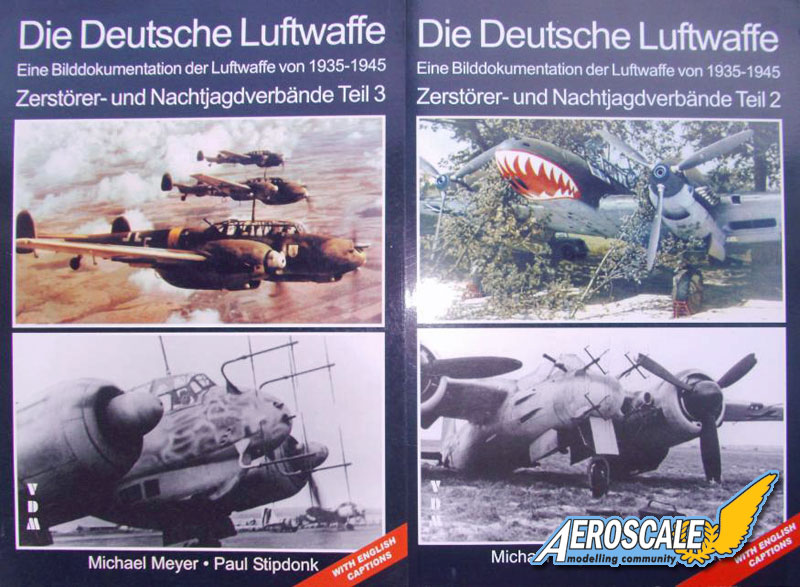
Die Deutsche Luftwaffe - Zerstörer- und Nachtjagdverbände book series by Stipdonk & Meyer


German authors Paul Stipdonk and Michael Meyer have recently published Volume 4 in their "Die Deutsche Luftwaffe - Zerstörer- und Nachtjagdverbände" series through VDM Heinz Nickel, Zweibrücken, Germany. As the title suggests these books are primarily concerned with Luftwaffe Zerstörer (‘destroyer’ or heavy fighters) and Nachtjagd (nightfighting) operations and are essentially photo journals with German and English captions. The authors have released one book per year over the past four years with each volume featuring around 400-500 images over 200 pages in an A4 soft-back format. Most of the photos in each volume are previously unpublished and well printed. They are captioned in German and English except for the latest, Volume 4, which is German-language only. There is also a small section of period colour shots, but the vast majority of shots are in black and white. In general photo quality is good and when not it is generally to illustrate a rarity. For instance, volume 2 includes for the first time anywhere pictures of the Z Staffel of KG30 and a new ZG 1 emblem on a Bf109E. Text throughout is minimal, but listings of unit leaders and changes in unit reporting structures are given.
Volume One covers...
Erg.Zerstörergruppe
Nachtjagdgeschwader 1
Zerstörergeschwader 1
Nachtjagdschule 1
Liaison and HQ Staff for the above units


Volume Two covers...
Stab Zerstörerschule 1
Stab Zerstörervorschule 1
IV./(NJ)/JG 2
11./NJG 2
Stab NJG 2
Stab ZG 2
Stab Zerst.Sch 2
Stab NJG 3
Stab NJG 4


Volume Three features the following units..
13(Z)JG5
NJG5
NJG6
EKdo 25 Zerstörer Staffel
Stab & I ZG26

Volume 4 deals with the remaining Gruppen of ZG26

My only gripe with these books is the indifferent quality of the English captions - in fact volume 4 doesn’t include any translations at all due to cost-cutting measures by the publisher. I subsequently contacted the authors to offer English translations for the rest of the series and the new book devoted to Jagdwaffe fighters. Even without English captions this latest volume is still very good and more than maintains the standards set by this great series. Even better if you can manage the German. Even if you can't, some of the images are worth the purchase price alone - the NJG 4 Ju88 with an enormous Haifischmaul (sharkmouth) or the selection of ‘new’ ZG 26 Me410A-1/U4 images with the crews seen gazing rather dubiously at the BK5 cannon installation. You can almost hear them saying "What the ...!" The cover of next year's Volume 5 is advertised at the back of the book and features a superb Ju88G in flight & a "with English captions" banner. 


This series of books deserves a place on the bookshelf of every serious Luftwaffe modeller and aficionado. Vols 1-4 are still available direct from co-author Paul Stipdonk. Please Paypal € 37,- per copy inc. postage for the UK (and EU-Europe) and € 43,- for mailing to USA (and non EU-Europe) to Paul's Paypal mail address which is; pstipdonk at hotmail.com (obviously replacing 'at' with @ and leaving no spaces). Any queries also go to this address. Please mention that you saw it here !  My thanks to Paul for permission to reproduce the page views accompanying my review which first appeared on aeroscale.co.uk (hence their watermark)


Image lower left (above) shows StaKa 5./ZG26 Theodor Rossiwall's '3U+AN' in early 1941 complete with yellow Balkans theatre markings - see previous blog post

Bf 110 Zerstörer aces ZG 26 'Horst Wessel'


Major Wilhelm Spies Gruppenkommandeur I./ZG 26 achieved 11 aerial victories in the east. Spies was honoured with a posthumous Oakleaves and promotion to Major after being KIA on 27 January 1942. Issue 10 of 'Der Adler' dated 10 May 1942 announced his death and published this view of him in the cockpit of his Zerstörer, wearing the Ritterkreuz awarded on 14 June 1941. Shot down during a close support mission near Sukhinichi on the Eastern Front, he had some 20 kills to his credit at the time of his death. He had flown with the Condor Legion in Spain and was the first member of the original Zerstörer arm to be awarded the Oak Leaves.

3U+AB, the machine of Hptm. Wilhelm Spies, Gruppenkommandeur of I./ZG26, with twenty one victory bars on the fin. The letter 'A' is in the Gruppenstab colour of green, outlined in white. Note the protective cover over the Bordfunker's machine gun.


Bf110 C coded 3U+AA flown by Geschwaderkommodore ZG 26 Oberstleutnant Johannes Schalk displaying a full set of pre-war style Kommodore markings in Geschwaderstab colours (possibly blue). Awarded the RK in Spetember 1940 Schalk led ZG 26 during the opening months of Barbarossa before moving to NJG 3. Like Spies he had achieved some 20 kills. (signed Schalk pic courtesy of Lacy Sutton)
Gruppenkommandeur III./ZG 26 Schalk and his Bordfunker Uffz. Hans Scheuplein had been one of the most succesful Zerstörer crews over France with five kills between them and the pair were credited with a further six over England.


As a Staffelkapitän in II./ZG 26 Theodor Rossiwall was one of the most successful Zerstörer pilots of the Battle of Britain with some five credited victories. Rossiwall claimed some 19 aircraft shot down in over 400 missions. Among these were 2 victories claimed in the Spanish Civil War. He is one of the few Zerstörer pilots to have published a memoir 'Fliegerlegende';

" ..The Me 110 was at least equal if not superior to enemy types such as the PZL, the Morane, Hurricane and Spitfire. Even the improved Spitfires that appeared during the autumn of 1940 could be met on equal terms in combat due to the greater combat experience of the Luftwaffe Zerstörer crews and the greater weight of fire that could be brought to bear in the combat zone..."


In the image below Staffelkapitän 5./ZG 26 Oblt. Thodor Rossiwall is seen at the controls of his Bf 110 E '3U+AN' over Hungary in February 1941. Following deployment over England during the Battle of Britain 5./ZG 26 moved to Memmingen, southern Germany during November 1940 before shifting to Debrecen Hungary during January 1941 and then Rumania and Bulgaria for the Balkans offensive. Promoted in the interim to Hauptmann, Rossiwell flew his first sortie against Yugoslavia on 6 April 1941 before particpating in the campaigns against Greece, Crete and Russia. His RK was awarded on 6 August 1941. After his 10th victory he retrained as a nightfighter before being appointed Staffelkapitän 6./NJG4 on 5 April 1942 and Kommandeur II./NJG 4 on 1 October 1942. He achieved two victories at night before being appointed Kommodore of the re-formed ZG 76 in August 1943 and achieved three Viermot Abschüße. He was seriously injured in a takeoff accident on 24 January 1944 at Fürth. For more on Rossiwall see Paul Stipdonk's 'Die Deutsche Luftwaffe' - Zerstörer-und Nachtjagdverbände Teil 4 available at the VDM Verlag Heinz Nickel homepage.


The following I. and II. Gruppe ZG 26 victory list for 1940 

I./ZG 26 (9 "aces"): 1) Hptm. Wilhelm Makrocki Stab I. 9 vict. RK 6.10.40; 2) Oblt. Wilhelm Spies, 1 Staffel 9 vict. RK 14.6.41; 3) Lt. Walter Manhart 3 Staffel 7 vict No RK (see note below); 4) Oblt. Hans-Jürgen Kirchoff 3 Staffel 7 vict No RK; 5) Oblt. Günther Specht Stab I. 6 vict RK 8.4.44; 6) Oblt. Johannes Kogler 1 Staffel 5 vict No RK; 7) Lt. Werner Thierfelder, Stab I. 5 vict RK 10.10.41; 8) Oblt. Johannes Kiel 3 Staffel 5 vict RK 18.3.42; 9) Oblt. Edward Meyer 1 Staffel 5 vict RK 20.12.41.

II./ZG 26 (6 "aces"): 1) Lt. Walter Manhart 6 Staffel 13 vict NO RK (see note below); 2) Oblt. Theodor Rossiwall 5 Staffel 7 vict RK 6.8.41; 3) Obfw. Karl Herzog 6 Staffel 6 vict. No RK; 4) Oblt. Walter Henken Stab II. 5 vict. No RK; 5) Obfw. Kurt Rochel 5 Staffel 5 vict No RK; 6) Oblt. Arthur Niebuhr 4 Staffel 5 vict No RK.

Notes. 1) Only one member of I. or II./ZG26 received the RK during 1940, Makrocki, the I. Gr. Kdr.
2) Manhart served in both 3 and 6 Staffeln of ZG26 during 1940, so he appears on both lists.

(via  Larry Hickey)