Sunday, 13 November 2016

New Luftwaffe books - 296 Verlag, Luftwaffe Gallery, Luftwaffe in Colour


Compiled by two leading writer/researchers at Lela Presse (the leading French publisher of Luftwaffe publications)  'Luftwaffe in Colour - the Victory years' is part one of a two-part photographic compilation of the best of Luftwaffe colour photography published by Casemate in this English-language edition. This is a card-covered softback featuring some 160 pages on thick glossy paper and divided into nine chapters covering all theatres such as 'Poland and the Sitzkrieg', the 'Blitz and the Battle of Britain", 'Barbarossa', the 'Mediterranean and Africa'. The PK photo reporters on the ground for the launch of Blitzkrieg and the subsequent campaigns had privileged access to colour film for official wartime German outlets but there are a good number of images here from private collections- at least one JG 53 pilot regularly 'raided' local shops in search of colour film. Luftwaffe camouflage schemes have long been a subject of deep debate among modellers and enthusiasts. Here the reader can trace the evolution of Luftwaffe finishes directly from the 1939 dark greens of the Stukas and Heinkels - suitable for low-level attacks over Eastern European conifer forests and fields - to the high altitude blues and light greys introduced for fighter combat in the West and the Battle of Britain during 1940. Bf 109 Friedrichs and Bf 110 Zerstörer appear in winter camouflage schemes in Russia and the Sandgelb yellow and browns of the desert. Aircraft types covered include seaplanes and transports to night fighters, trainers and reconnaissance machines. Among my personal favourites are photos of the Bf 109 Emils of JG 26 and JG 53 in northern France - want to know exactly what the Grau Grün Hellblau 02 /71/65 combination looked like? Then check out pages 57-60. And then follow the attempts of the Jagdgeschwader 54 and 77 to darken these 'bright' colours and tone down the fuselages of their machines for, say, the Balkans campaign - the photos on pages 83-87 are exceptional. It is probably true to state that any photo book stands or falls on the quality of photo reproduction and fortunately here not only is the standard very high but the quality of 90% of the images is very good indeed while each picture is informatively and expertly captioned. This is a book to keep close to hand for reference, to dip into constantly. I look forward to volume II, the 'Years of Defeat 1943-1945'.


The latest Luftwaffe Gallery, edition No. 5, has arrived.  Once again I have worked on the English text


Erik's latest Luftwaffe Gallery includes the first accounts in English from pilots and crews of a little-known weather reconnaissance unit Wekusta 2. Wekusta 2 deployed the He 177 in the long-range weather recce role. The full story of Wekusta 2 is told by Pierre Babin in his French-language book from Heimdal devoted to the unit reviewed in a previous 'new Luftwaffe books' blog piece, see link below..
Page samples of the latest 'Luftwaffe Gallery' and ordering on Erik's site here

More on Wekusta 2 on this blog
http://falkeeins.blogspot.co.uk/2011/07/wekusta-2-cloud-chasers-of-luftwaffe.html

message from Kurt Braatz of 296 Verlag; ".. I managed to publish Vol. I of a new biography of Robert von Greim. It covers v. Greim's career as a fighter pilot in WW I - he returned some 30 victories and was awarded the Pour le Mérite - and the immediate postwar period with Ernst Udet as stunt flyers until v. Greim's first strange encounter with a yet completely unknown wannabe revolutionist named Adolf Hitler in March, 1920. 288 pages, 179 mostly unpublished photographs..order here"

" ...Sie haben lange auf eine Neuerscheinung des NeunundzwanzigSechs Verlags warten müssen, aber hier ist sie nun, rechtzeitig vor Weihnachten. Sie beschreibt das Leben und Überleben des Jagdfliegers Robert von Greim im Ersten Weltkrieg. Am Ende dieses Krieges stehen für Greim nach hunderten von Luftkämpfen und 30 Abschüssen die Verleihung des Ordens Pour le Mérite und die Erhebung in den Adelsstand – aber auch ein ungewisses Schicksal. Eine Weile schlägt er sich noch mit seinem engen Freund Ernst Udet als Stuntpilot durch, ehe das Fliegen in Deutschland völlig verboten wird... Robert v. Greim hat seinen Weg durch den Ersten Weltkrieg und die Zeit danach genau dokumentiert und fotografiert. So ist ein äußerst packendes Buch entstanden, das die Reihe unserer Biographien auf jenem hohen Niveau fortführt, mit dem wir uns über viele Jahre Ihre Anerkennung erwerben konnten. Sie können Robert von Greim. Jagdflieger im Ersten Weltkrieg ab sofort unter www.neunundzwanzigsechs.de bestellen. Dort finden Sie auch weitere ausführliche Informationen und Leseproben..."


 a quick mention for the latest issue of After The Battle - issue no 174 covers the battle of the Vercors - on July 21 the Germans launched the largest operation ever conducted against the Resistance in Western Europe, attacking with airborne and mountain troops to destroy these French insurgent groups in the Vercors. Also in issue no. 174 an article entitled The Dissolution of the Luftwaffe — Following the final defeat of Germany the Allied governments decided that she must not be allowed to rise again as a military power, the thinking being that despite the efforts of the victors after the First World War, Germany had been able to recover so completely that in a relatively short period she was able to unleash another world war within 25 years. This article is the story of the complete disarming of the Luftwaffe.

A quick link to all Luftwaffe book reviews on this blog, click here

Battle of Britain Emil Jabo, Bf 110 LG 2, CR 714 GC 1/145 - daily Ebay photo find #191


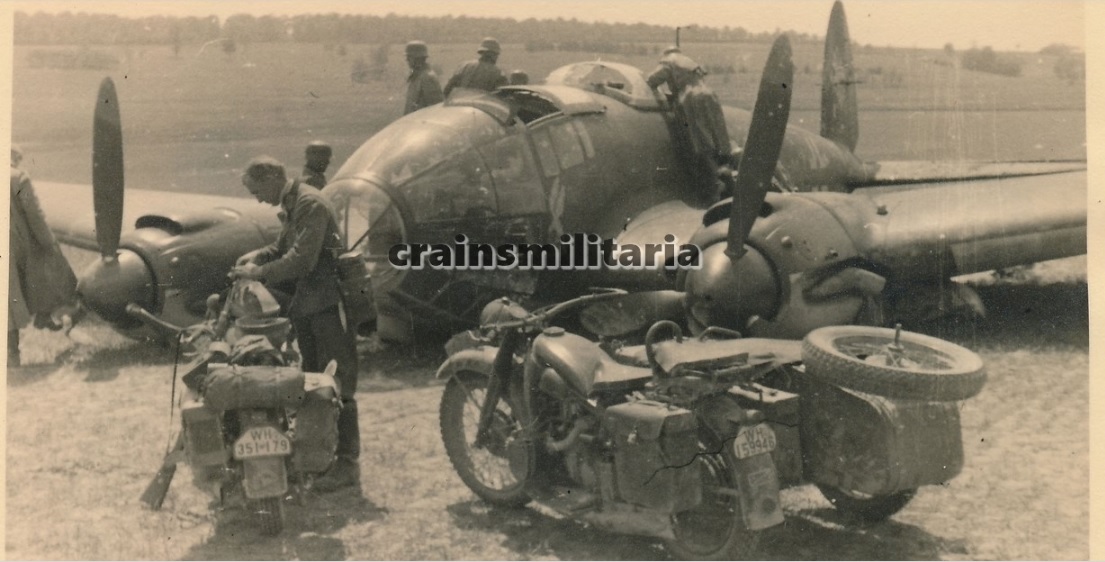
Feldflugplatz Russland bei Orscha Ju 88 Kennung gelbes Rumpfband. On offer here


Above, somewhere on the Channel coast and, below, in the Ardennes


Below; when CG 1/145 evacuated the airfield at Dreux they left behind some fifteen Caudron Cr 714 fighters. Compare with the image in the excellent book "Les aviateurs polonais en France" (B. Belcarz, Artipresse). 'White 13' was a 2e escadrille machine 


crainsmilitaria ebay sales are here


'Teufelskopf' devil's head emblem of LG 2 Bf 110 C here

More on Lehrgeschwader 2 on this blog
http://falkeeins.blogspot.co.uk/2013/11/lehrgeschwader-2-bf-110s-of-7f-lg-2.html

Saturday, 12 November 2016

Hptm Peter Jenne, ZG 26, JG 300


via Peter Kassak;

Ahout Jenne this is what I was able to dig out of his personal Karte at Aachen some years ago:
* Born: 5. June 1920 Wittenberg/Sachsen
Promotions:
1.4.1940 - Fhj-Gefr.
1.6.1940 - Fhj.Uffz.
1.9.1940 - Fhr. at FFS (C) 3
1.2.1941 - Ofhr. 1.4.1941 - Lt. 1.4.1943 - Oblt. 1.4.1944 - Hptm at I./ ZG 26
Units: 5.1.1940 - 2. Komp A/Fl. Ausb Rgt 42
16.7.1940 - Sch./Fl. Ausb Rgt 21
17.7.1940 - -"- 12.12.1940 - FFS C 3 Atl Lönnewitz
25.10.1941 - Nachtjagdschule 1 Neubiberg

20.1.1943 crash with Bf 110 G-0/Tr. W.Nr.5147 (S9+GB) at 11.32 at airfield Schachty-Nord, 70%
Stab I./ ZG 1, pilot Lt. Peter Jenne, Bordfunker Fw. Alfonz Jehle (KIA) during landing maneuver, Pilot overflew landing cross over 150 m, was long on landing strip and finished at the end in 50 cm deep fresh snow.

Summer 1942 - 1./ZG 1, pilot 9.10.43 - 1./ZG 1, StaKa (previous, Oblt. R.Ossmann was killed by B-17 gunners) 13.10.43 - 1./ZG 26, StaKa 4.44 (?) - I./ZG 26, Gr.Kdr. (acting?) 7.44 - 1./JG 6, StaKa 12.09.44 - 12./JG 300, StaKa 1.01.45 - III./JG 300, Gr.Kdr. (previous, Major Hans-Karl Kamp killed in Luftkampf on 31.12.44)
About crash on 20.01.43 - from John Vasco's list it was Bf 110 G-2, 50% damage, and he is listed as 1./ZG 1 pilot.
19.09.42, Ltn. Peter Jenne, 1./ZG 1, LaGG-3,  5 km. südostw. Kotluban: 1.500 m., 06.13 (confirmed together with Oblt.R.Ossmann's victory - both LaGG-3's, 291 iap)
13.12.42, Ltn. Peter Jenne, Stab I./ZG 1, MiG-3,  29 484 at 1.000 m., 12.30
08.07.43, Oblt. Peter Jenne, 3./ZG 1, Il-4,  63 574: at 1.000 m. 09.30 (actually Il-2 two seater)
20.12.43, Oblt. Peter Jenne, 1./ZG 26, B-17,  Rolde b. Assen: no height 13.25
22.12.43, Oblt. Peter Jenne, 1./ZG 26, B-24,  vor Texel i. Holland: 8.000 m., 14.55
22.12.43, Oblt. Peter Jenne, 1./ZG 26, B-24,  vor Texel i. Holland: 8.000 m., 15.00
10.02.44, Oblt. Peter Jenne, 1./ZG 26, B-17,  6 km. S. Nienburg: 6.000 m., 12.25

August 1944 III./ JG 300

17.12.44, Hptm. Peter Jenne, Stab III./JG 300, B-24,  RP: 6.000 m. [Sternburg], 12.15
17.12.44, Hptm. Peter Jenne, Stab III./JG 300, B-24,  RP: 6.000 m. [Sternburg], 12.15-20


In an encounter with enemy fighters on 2 March 1945 over Schmerwitz, Jenne was shot down in Messerschmitt Bf 109 G-10 (W.Nr. 151 533) “Blue 1”.

Hptm. Jenne left I./ZG 26 on the first of June 1944. He was never StaKa of 1./JG 6. Jenne became Kdr of I./ZG 26 on ~23.02.1944 when he was still an Oblt. Hptm. August Bier was Kdr of I./ZG 26 from 10.43 till 2.1944.


Decorations:
26.6.1942 - EK II 4.8.1942 - EK I 20.11.1942 - Ehrenpokal 1.4.1943 - DK in Gold
13.9.1942 - Frontflugspange in Gold
2.2.1945 -RK
His final score was 17 aircraft shot down in air combat and 12 tanks, 12 vehicles destroyed on the ground.

Wednesday, 9 November 2016

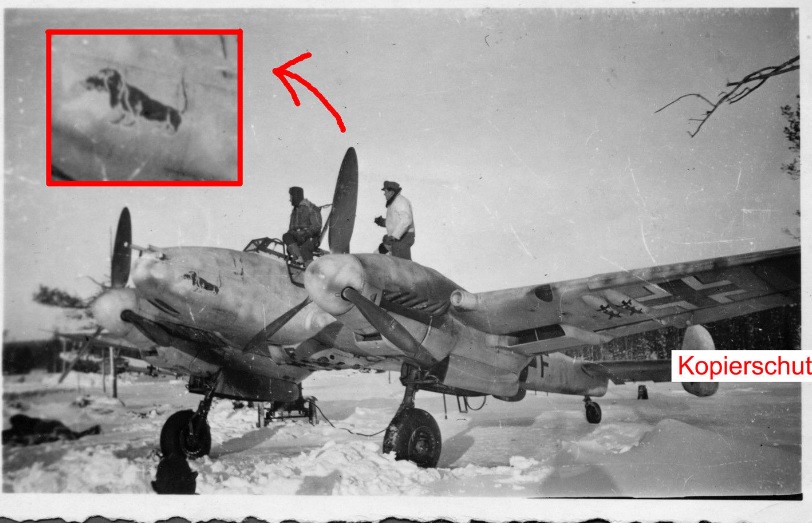
Bf 110 SKG 210 Kennung S9 + NN in Rußland - RK holder Herbert Kutscha, Dackel Staffel JG 5 Bf 110

Bf 110 der 1. SKG 210 mit der Kennung S9 + NN aufgenommen in Rußland. Es ist die Maschine von KC holder Herbert Kutscha. Sehr schön sind das Staffelabzeichen und zahlreiche Details zu sehen!


Herbert Kutscha (1917-2003) served with II./JG 77 at the beginning of the war, but he was soon transferred to 5./ZG 1 equipped with Messerschmitt Bf 110s. During the Battle of France, he shot down a number of aircraft, including a Bf 109 of the air force of neutral Switzerland. Later, he also gained much success on the Eastern Front as a ground attack pilot, partially due to his II./ZG 1 evolving into II./SKG 210. Kutscha's II.Gruppe/SKG 210, under the command of Hptm. Rolf Kaldrack specialized in ground attack operations, specifically low level bombing. Kutscha was awarded the RK after his 22nd victory. At that time his ground tally was 41 aircraft destroyed on the ground, 41 tanks, 15 locomotives, 11 anti-aircraft guns, and 157 transport vehicles. In June 1943 he was appointed to command 15. Staffel IV./JG 3 "Udet". In the summer of 1944, he took control of II./JG 3 in Normandy, and of II./JG 27 by the end of the year. From February, 1945, he commanded III./JG 1 on the Eastern Front. All in all, he flew over 900 sorties, gained 47 kills, six of which were four engined heavies, and 22 of his kills were with the Bf 110.

Bf 110 E der 1. SKG 210 mit der Kennung S9 + AH,aufgenommen am 9.7.1941 in der Nähe Pomisewje, Rußland. Es ist die Maschine von KC holder Oblt. Wolfgang Schenck.


Bf 110 of the " Dackel " Staffel in winter finish probably photographed in Kirkenes ( northern Norway ) in 1943

Friday, 23 September 2016

Le Junkers Ju 52, de la Lufthansa à la Luftwaffe - Alméras, Grégory LeLa Presse - new Luftwaffe books review


Grégory Almeras is a 39-year old WW II aviation enthusiast based near Montpellier in the south of France. He has spent the past ten years assembling a collection of photos of the Junkers Ju 52 and writing detailed captions retracing the story of this iconic aircraft. This new book is the result of all those hours spent poring over his photo albums. At 176 A-4 pages in hardback and featuring over 350 photos, the book is essentially a photo compilation organised into 23 chapters with one, two or three photos per page and captions of a corresponding length (some at least one half page) - in French. The images are mostly excellent, previously unpublished and cover the type's early career as a civilian airliner and transport, with one chapter given over to the French AAC 1 Toucan. The bulk of the work features the type in service with the Luftwaffe prior to and during WWII with much detail of the many resupply operations mounted by the Germans on the Eastern Front. The campaign in the West and other theatres such as Crete, Scandinavia and North Africa also feature. Each chapter has a short introductory text. Some twenty large scale artworks by Thierry Dekker are distributed throughout, while one chapter covers the restoration of a French Ju 52 detailing internal and cockpit views. There is also a small modelling chapter. The author explains that none of the period photos are enhanced or cropped or otherwise manipulated to enable the full context to be appreciated. For the most part they were taken by the crews themselves in the heat of the action. So while a few are less than perfect, many are absolutely first-rate and, reproduced large, take us right into the daily lives of the men that flew or maintained the aircraft through some of the most dramatic moments of WWII and post-war history. A very nice addition to the literature in my view. Below 'sample' photos, captions and general page views courtesy of author Grég Almeras.


Above; Junkers Ju 52 KC+RV (WNr. 7198) seen somewhere seen in the Soukhinitchi sector in the East during January 1942. A crew member is checking the forward defensive MG turret. Prior to being assigned to a Front unit, this machine was serving with FFS C8 at Wiener-Neustadt, a multi-engine training school. During December 1941 Soviet pressure on the central sector had firmed and was increasing, leading to the establishment and dispatch to the front of new transport units, KGr zbv 700, 800, 900 and 999 assembled utilising school machines such as this one. Typically this aircraft is still displaying its factory codes, there being no time to replace them with unit tactical codes. These new Transporter units were quickly sent north to participate in the airlift into Demyansk. During moments of crisis such as Demyansk ad-hoc transport units were hastily assembled and sent to the front often for only a matter of a month or two which meant there was little or no time for codes or emblems - one such unit was KGrzbv 7 which existed for two months during February and March 1942. Note the wing de-icing system common to several Ju 52 variants - the lower engine exhausts feeding directly into the wing leading edge. The thin yellow horizontal band on the cowling was an ID feature. Note also the steel plate cover over the nose engine to the fuselage designed to prevent the oil thrown from obscuring the windscreen and cockpit glazing.

Below; taken on  taken on 5 June 1942 this snapshot depicts a moment of respite for this crew based at Flugplatz Nikolajew, a rear area base in the Ukraine north-west of the Crimean peninsula. Things weren't always this quiet. Barely three months previously this field was the scene of a very successful partisan action. During March 1942 a Russian worker managed to place dynamite among a large stock of bombs and blew several hangars and some twenty aircraft of JG 77 and StG 77 sky high. Captured by 16. Panzer division on 13 August 1941, Nikolajew had quickly become an important Luftwaffe platform as the front moved further eastwards. Additional hangars and concrete runways were constructed. Note the open cockpit access door on this Ju 52 g7e, the variant confirmed by the absence of a generator on the starboard fuselage side. Note also the small mirror on the inner cowl face of the port engine which helped the pilot to synchronise the propellers by enabling him to set up a 'strobe' effect with the nose engine prop by adjusting the engine revolutions accordingly.  The most experienced pilots simply relied on their feel for the aircraft to perform this type of adjustment.


Ten-page PDF extract on the publisher's web site here

Tuesday, 20 September 2016

An interview with Jan Forsgren, author of the new Fonthill Media title " The Junkers Ju 52 Story "


Above; "Junkers Ju 52 Story" author Jan Forsgren in Dübendorf last week as the guest of RIMOWA for the first flight of their new-build Junkers F 13 and prior to boarding Ju 52/3m HB-HOT


Qu: Hello Jan, congratulations on the publication of your latest book " The Junkers Ju 52 Story " ! Can you tell Luftwaffe blog readers a little about yourself as a writer, person, historian. What prompted you to write about Luftwaffe aircraft and history? Why did you choose to write about the Ju 52 given that the type's story must be widely known ? Was it because it was widely used in Scandinavia? Is your interest more in civil aviation? 

I was born in Sweden in 1965, and ever since my childhood, I've been interested in aviation, and, in particular, aviation history. Over the years, this interest has grown steadily and considerably. However, I've worked professionally as an archivist for more than 15 years, as well as an English teacher in Bangkok for a couple of years. The latter was, in part, due to my strong interest in South East Asian aviation. My main research area, apart from historical aviation, concerns Cambodia, and, in particular, its relationship with Sweden between 1970 to 1990. Since 2010, I've been heavily involved in the Arlanda Civil Aviation Collection at Arlanda Airport just north of Stockholm I've written about 250 articles and six books, including two in Swedish and four English, the latter including Swedish Fortresses and Messerschmitt Bf 108 for MMP and Sinking the Beast and The Junkers Ju 52/3m Story for Fonthill. The Ju 52/3m Story came about simply because many other books concentrate on either the Ju 52/3m in Lufthansa or Luftwaffe service, virtually ignoring the other operators. My aim was to provide a concise, single-volume book on the Ju 52/3m, where I would attempt to cover the entire (an impossible task!) history of this deservedly famous aeroplane. Its use in Scandinavia did not, however, make me decide to write the book to any great extent.

Qu: I have your Me 108 book via MMP which was nicely done but from here Fonthill looks like a step up, I'm tempted to say a 'real' publisher. (MMP don't pay their authors I believe) How did the book and your relationship with Fonthill come about?

 During an 11-day whirlwind tour of Britain in 2011 - from Solent Sky in Southampton to the Yorkshire Air Museum at Elvington and air displays at Waddington, Duxford and Old Warden, I met Graham Simons at the latter place. Graham casually mentioned that Jay Slater, then of History Press, was looking for new authors. Upon my return to Sweden, I sent Jay an e-mail along with ideas for books. He rejected my Swedish Air Forces since 1911, but thought that a book about sinking the Tirpitz would be just right. Sinking the Beast was published in August 2014, after which Jay requested more books! MMP does, incidentally, pay royalties, but it is only a pittance. From my point of view, MMP do publish off-beat titles, that few other publishers would accept.

Qu: What was the most surprising or unusual fact you uncovered during your research?

 I would have to say the widespread use and longevity of the Ju 52/3m. It was, as most would assume, not limited to World War II but enjoyed civilian and military service long after 1945.


above; Ju 52/3m "GA+WW" of 4./KGrzbV 900 in Roslawl during February 1942 prior to flying into the Demyansk Kessel (pocket). The crew of pilot Jürgen Pfau is seen shovelling snow away from the machine.(via Meyer)


Qu: How much time was devoted to the research and writing of this particular book ? And compared to your other books ? You mention the 'long, lonely hours' spent writing in your introduction. I bet it's hard work isn't it ? Do you look forward to how it might be received or are you not interested in what people might say about your work?

 The Ju 52/3m Story took me about one year to research and write. And, it is indeed hard work! I do look forward - with some trepidation - to the reviews and opinions offered by reviewers and fellow aviation historians. I am all too aware that some might say -'Oh, there's not enough Luftwaffe, Lufthansa etc', in the book, But, it is intended to be a general, concise overview of a great aeroplane. I do think, incidentally, that there are some areas, such as the French and Spanish use that have never been addressed properly in an English-language publication. That was my reasoning for including so much material on these Toucans and CASA 352s, instead of concentrating on its service with the Luftwaffe.


Below; another Ju 52/3m of 4./KGrzbV 900 "GA+WW" assigned to Fw. Kramer also in Roslawl in February before flying into the pocket.


Qu: I read recently that a Ju 52 'nearly' arrived in the UK during late 1944 flown by a crew deserting from Norway. I think it ditched in the North Sea just off the coast of Scotland. Is this a story you have heard about and what became of the aircraft and crew?

I included some information on this fascinating episode, which is described in greater detail in the book by Martin Pegg listed in the bibliography. Unfortunately, I have no idea about what happened to the crew, presumably they became PoW's, and their Ju 52/3m scrapped or consigned to a sailor's funeral. The whole story must be in an AIR-file at the National Archives, but I haven't been able to locate it, yet.

Qu: I have read that the Ju 52's 'star' shone brightest in adversity. I don't think this was really true was it? The type is associated with big defeats, Stalingrad, Indochine etc etc What's your opinion on this? The Ju 52 was surely also obsolete during WWII but was never replaced by a more capable machine. Why was this ?

 Logistic support and air transport are extremely vital in modern warfare. One might say that one of the major miscalculations in pre-war planning was neglecting the importance of airlift. The Ju 52/3m was obsolete in 1939, but it was available in large numbers, also being easy to operate and maintain under the most arduous and difficult conditions. It was slow, cumbersome but also a very efficient workhorse in its various roles. Its replacement with the Ju 352 and/or the Me 323 did not occur, which meant that the Ju 52/3m simply had to soldier on until the end of the war. Although both the Me 323 and Ju 352 were highly capable, Allied air supremacy meant that few Me 323s remained at war's end, while very few Ju 352s became operational. By the autumn of 1944, the production of transport aircraft was discontinued due to the desperate need for fighters. Interestingly, the highest loss rate in one day occurred on 10 May 1940 during the invasion of the Netherlands. Also, Operation Merkur in May 1941 saw large numbers of Ju 52/3ms lost or damaged. However, both the operations over the Netherlands and Crete were German victories. One can say that the Ju 52/3m required total Luftwaffe air supremacy in order to operate without risking huge losses to enemy fighters and flak. However, the same can be said about Allied airlift operations, with both Arnhem and the crossing of the Rhine being examples of huge losses and wastage of transport aircraft.

Qu: Many will know the Ju 52 from opening sequence of the 1968 war movie "Where Eagles Dare ". I guess that was a Casa 352 though? And did Hitler escape from Berlin in a Ju 52 as two British authors claimed back in 2011 in their book 'Grey Wolf'?

 In my book, I do mention that the Ju 52/3m that 'doubled' as a Luftwaffe aircraft in the movie Where Eagles Dare was a machine that was delivered to the Swiss Air Force in 1939. The winter camouflage applied for the movie was retained for several years. The Ju 52/3m in question was s/n A-702, now flying as HB-HOT. I've never seen any reference to Hitler escaping from Berlin in a Ju 52/3m. He elected to stay in Berlin, eventually committing suicide on 30 April. Two Ju 52/3m units did however attempt to drop supplies, losing some 30 aircraft.

Qu: Aside from the Luftwaffe one of my big interests is the French Armee de l'Air so your coverage of the Toucan is very welcome. By the way the Toucan and Casa production lists in your book are very impressive. Did the French use the Toucan as a bomber ? Did it drop paratroopers at Dien Bien Phu? Do you know how many were lost in Indochine ?

 The French Air Force did indeed use their Toucans as level bombers, both in Indochina, Madagascar and Algeria. Due to lack of first-hand archival information, the exact number of Toucans lost over Indochina are unknown. I would assume that between 30 and 50 aircraft were written off to all causes, crashes, destroyed on the ground and wear and tear. Airlift operations over Dien Bien Phu did not include Toucans, but rather Douglas C-47s and Fairchild C-119s. Regarding Dien Bien Phu, I can highly recommend Martin Windrow's book The Last Valley. Regarding the French use of the Ju 52/3m/Toucan etc, I do believe this is a great topic for a book.

Qu: Jan, your new book looks very nice indeed and it reads very nicely too as I can confirm. I thoroughly recommend it and I wish you much success with it. But what are you working on next ?

 Two weeks ago, I submitted the manuscript and 130 pics for a book on the Bf 109 to Fonthill, which is due to be published next year. Right now, I am working on books dealing with the Me 210/410 and Fi 156, also for Fonthill. I also have manuscripts completed for the Bell P-59 Airacomet and the Boeing B-17 in Military Service, both to be published by MMP. Re the latter, this will cover the B-17 in service with 14 countries, from Bolivia to Yugoslavia. I am still looking for additional pics of the B-17 in Luftwaffe service if anybody reading this is able to help I'd really appreciate it, thanks!

Jan, thank you for answering my questions. We look forward to more books from yourself!  " The Junkers Ju 52 Story " is reviewed on 'FalkeEins - the Luftwaffe Blog' here 

Pilot Fw. Becker hugging the ground (im Tiefflug) en route into the Demyansk pocket at the controls of Ju 52/3m "CH+HY" of 4./KGrzbV 900 during March 1942. (via Meyer)


Below; "Junkers Ju 52 Story" author Jan Forsgren flew on board "Ju-Air" Ju 52/3m HB-HOT in Dübendorf last week as the guest of RIMOWA during the ceremony for the first flight of their new-build Junkers F 13. Note the Swiss Ju 52s have 'original' BMW engines with twin-bladed props unlike the well-known Lufthansa D-AQUI which has P&W engines with three-bladed props turning at higher revolutions..