Monday, 22 June 2015

Ju 52/3m "P4+.H" of the Transportstaffel des Fliegerführers Nord, Ju 88 C 1./ NJG 2 -daily Ebay photo find #136


Ju 52/3m "P4+.H" of the Transportstaffel des Fliegerführers Nord (Ost) TSt.Fl.Fhr.Nord (Ost) in Kirkenes on 6 October 1943 - click to view large


He 115 sporting the emblem of 1./Kü.Fl.Gr.106 in Trondheim early 1940


Above; Breguet Bizerte assigned to a Seenot Staffel, Hourtin, 1941. More on the Luftwaffe's Bizerte's on this blog
http://falkeeins.blogspot.co.uk/2014/06/luftwaffe-seaplanes-vol-3-roba-neulen.html


On offer here


Above; MS 230 "BR+UW" of LNS 2 in Königgrätz, summer 1941. These anacient French parasol wing fighters were deployed as glider tugs for the Fliegersportgruppe of LNS 2.


Ju 88 C 1./NJG 2. Left, BF Ofw. August "Emmes" Hiltrop, to pilot Flugzeugführer Oblt. Gerhard Böhme, Staffelkapitän of 1./NJG 2.


Michael Meyer's Ebay sales are here

Saturday, 20 June 2015

He 111 H of 8./KG 55 May/June 1944


He 111 H of 8./KG 55 in Podlodowka, June 1944. Another possible location would be Deblin-Irena up to late May 1944. Click to view large


More unusual camouflage schemes on Heinkel He 111 bombers of KG 53, KG 55, KG 100 on this blog

http://falkeeins.blogspot.co.uk/2015/05/some-unusual-camouflage-schemes-on.html

Thursday, 18 June 2015

JG 54 Bf 109 Friedrich - early 'old' camo

Bf 109 F-2 W.Nr. unknown "Weiße 10" and 'white 4' , 7./JG 54, Dünaburg (?),  summer 1941. The "old" early 1940 camouflage is noteworthy. Yellow theatre band is just aft of the fuselage Balkenkreuz


Posted by M-AH on the " Bf 109 from Anton to Toni " FB page

Tuesday, 16 June 2015

Me 110 ZG 26 BK 37 mm Flak 18


Pilot Flugzeugführer Uffz. Herbert Weiner of 1./ ZG 26 seen wearing his EK I in Wunstorf in late 1943 in front of his Me 110 G-2 toting the BK 37mm Flak 18 cannon. This large-calibre weapon was trialed and briefly employed against USAAF bomber formations. Click to view large.

More Me 110s with Flak 18 cannon on this blog

http://falkeeins.blogspot.co.uk/2010/01/bf-110-g-with-37mm-flak-18-cannon.html


Monday, 15 June 2015

Me 110 E of 1./Erg.Zerstörergruppe Deblin-Irena - daily Ebay photo find #122


Above; Me 110 E of 1./Erg.Zerstörergruppe Deblin-Irena possibly late November 1942. The larger oil cooler indicates a 'tropicalised' sub-type and an additional rear view mirror above the Wolfskopf emblem is evidence that it may have served as a Schleppmaschine (glider tug) for the Me 321 Gigant  On the left  Flugzeugführer (pilot) Uffz. Josef Scheidler and BordfunkerUffz. Herbert Weiner who both later crewed in I./ZG 1 which became 1./ZG 26.

Below;  Me 110 C/D loaded with practice bombs 1./ErgZGr Deblin-Irena warming up its engines. The wolf's head emblem features on both sides of the nose. Note the sand filters on the compressor intakes.


Michael Meyer's latest Ebay sales are here

Sunday, 14 June 2015

Ju 88 squiggle camo/Mäandertarnung, Italy 1943-4 KG 54, KG 76, KG 77


Junkers Ju 88, Italy 1943-4 Mäandertarnung (squiggle camo) 


Aviano, Italy according to the seller. Colours 'expert' David E. Brown has suggested that this machine might be Ju 88 A-4 “B3+BR” of 7./KG 54 given the style of the aircraft’s code, camouflage, and very small size fuselage Balkenkreuz. The latter is apparently rare on Ju 88s. 

Elements of at least five Ju 88 bomber units were stationed in Italy around the summer of 1943 as KG 76 pilot Joachim Siebers recalled in Smith and Gallaspy's " Luftwaffe Camouflage and Markings 1935-45" Vol.3 (Kookaburra, 1977). Some of these machines were also supplied from Munich direct to the front line, pre-painted in a new over-water test scheme of 'maritime blue' - a royal blue now thought to have been '83'  (although could have been RLM 24?) uppersurfaces with RLM 76 Wellenmuster pattern superimposed. Possible Geschwader codes could be "3Z", "F1" or "L1" or even "B3". However the white theatre band seems to have been a feature of KG 77 machines..


"F1+DP" of 6./KG 76, captioned " March 1944 - Italy"


Junkers Ju 88, Italy 1944 Mäandertarnung (squiggle camo) - click to view large


Ju 88s of KG 77 on this blog
http://falkeeins.blogspot.co.uk/2013/11/ju-88-torpedobomber-im-mittelmeerraum.html

http://falkeeins.blogspot.co.uk/2011/11/diving-luftwaffe-wrecks-in-med-junkers.html

http://falkeeins.blogspot.co.uk/2015/04/junkers-ju-88-3zer-kg77-besatzung-nach.html


Saturday, 13 June 2015

Stabsstaffel. StG 77 'Death's hand' emblem on Bf 110 and Ju 88


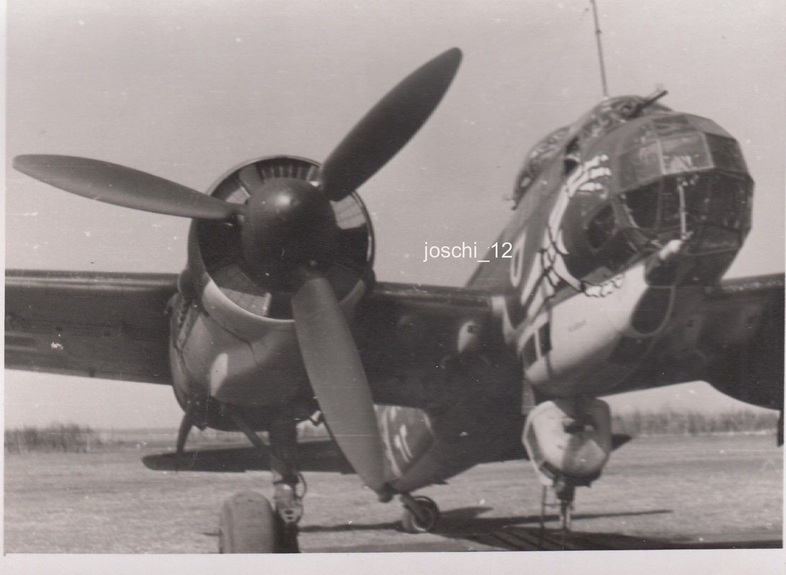
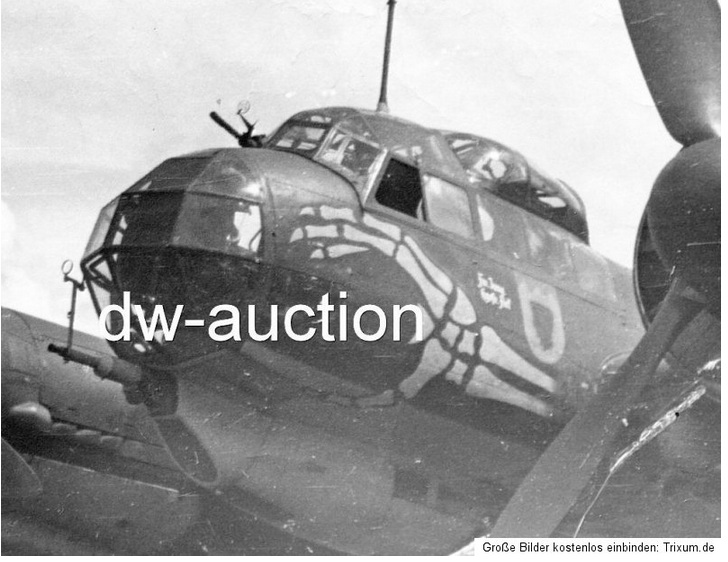
Junkers Ju 88 A-4 operating with the Stabstaffel St.G 77 in the spring of 1943 in Kalinowka (Poland). Note the Schwartzkopf heraldic badge alongside the death's hand emblem, also more clearly  visible in the pictures below. This emblem was designed to honour an earlier Geschwaderkommodore, Oberst Günther Schwartzkopf, who was killed during the Westfeldzug. The Stabsstaffel  StG 77 operated both the Bf 110 and the Ju 88 A-4. The Totenhand emblem has previously and mistakenly been attributed to the Stab. NAG 1.

Below; a Bf 110 of the Stabstaffel StG 77 photo taken in 1942 when the unit was operating on the Eastern front. Note the sign in celebration of  the unit's 1000th combat flight clearly associating the skeleton hand emblem with the Stabsstaffel of StG. 77. Click to view full screen


 Jet & Prop 3/06 featured an article entitled 'Nahaufklärergruppen und ihre Verbandskennzeichen" by Rudolf Hecke which depicted Ju 88 A-4 S2+LA of the Stabsstaffel StG77 in early 1943 in Kalinowka. This photo was taken during the time that StG 77 and StG 2 were being reorganized, both operated the Bf 110 and Ju88 A-4. Both units had about 12 Ju 88 A-4s. According to unit strength records from May 21, 1943 both units were disbanded and their crews reassigned to bomber groups.


Below; a Bf 110 of the Stabstaffel StG 77 photo taken in 1942 when the unit was operating on the Eastern front. Note the sign in celebration of  the unit's 1000th combat flight clearly associating the skeleton hand emblem with the Stabsstaffel of StG. 77.


The following photo, colour profile and information is from Jet & Prop 2/05 in an article entitled 'Uber die Nauaufklärungsgruppen (NAG 1-NAG 16) und deren Verbandkennzeichen (VKZ)" by Rudolf Hecke.


 The unit emblem includes a profile of the Geschwaderkommodore Günther Schwartzkopf who was killed on May 14, 1940. The unit Kennzeichen was S2+xA. Stabstaffel StG 77 relocated to Kolinowka in March, 1943 and was reorganized (as stated previously).


At least one StG 77 Bf 110 was transferred to Stab./NAG1 with the Kennzeichen Q1+VB and still retaining the Totenhand emblem on the nose. There is a photo of this machine, which has been widely circulated, and for this reason the Totenhand emblem has been mistakenly attributed to Stab. NAG 1.