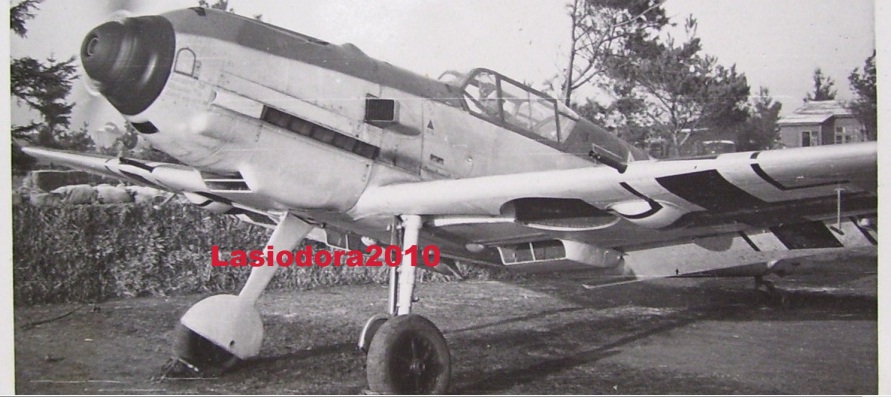
Only a handful of updates so far this month - and with good reason as I've been incredibly busy helping M. Erik Mombeeck prepare volume II of the Jagdgeschwader 4 history for the printers - we should meet our deadline of 30 September ! This volume covers the period from Market-Garden to the final air battles over Berlin and I hope you'll forgive me if I state that this is probably one of the most riveting late-war Jagdgeschwader histories to yet appear in English - a must for all Jagdwaffe fans. With the dissolution of I./JG 4 during March 1945 and the remustering of pilots as infantry there are even personal accounts of the ground fighting as well as plenty of perilous ground-strafing missions and Mistel and "Kamikaze" escort sorties.
The first volume of Erik Mombeeck's two part history of JG 4 cover the unit’s establishment, deployments and combat actions through to Autumn 1944 and is 'reviewed' with a lengthy text extract on this blog at the following link.
http://falkeeins.blogspot.com/2011/09/latest-luftwaffeaxis-titles-jg-4-vol-ii.html
Elsewhere I have also completed my work on Band V of the Stipdonk/Meyer photographic series - some 500 captions into English. However I believe this volume is only appearing in conjunction with the first volume of a new photo series devoted to the Jagdgeschwader so is not exactly imminent. In fact Band V was almost not going to appear at all since VDM declined to pay for the translation of the captions - I stepped in to produce them 'unpaid' to 'unblock' the situation. In addition I have been hard at work on the personal accounts that will feature in the next issue of 'Luftwaffe Gallery' - which will be a 'special' . Now as I've mentioned this translation effort is - for want of a better word - 'unpaid' and very time-comsuming, which makes it difficult to keep up with blog matters....oh and I have a three-page feature on French Desert Storm Jaguars in the current issue of Airfix Model World (personal account by capitaine Alain Mahagne) !
I have managed to read a couple of new books though;
First up the new Pen and Sword title on the "Vichy Air Force at war" by Sutherland and Canwell.
These two authors have produced a huge body of work - some 200 books published - but sheer volume means that quality and quality control don't really get a look-in. Firstly the authors do not appear to have consulted any French-language sources (just one in the bibliography) nor speak French. No serious author would write " the l'Etat..." or even " a single raid did for all of the aircraft of GAO2/551.." There are no personal accounts whatsoever here - it would have been easy enough to source some exciting accounts from Jean Gisclon's "Chasseurs au groupe la Fayette" - Gisclon saw combat over Mers-el-Kebir in 1940 and Casablanca in 1942 with GC 2/5 and wrote about it in detail. Lela Presse in France have produced a range of exciting monographs on the period, including a 400-page history of the Curtiss Hawk in French service, none of which have been consulted. Nor does the Sutherland and Canwell work feature an index or any footnotes whatsoever. Chapter 1 deals adequately enough with the Battle of France but 'historians' and amateurs have generally made such a mess of this period that statements like "The French faced the invasion with 4,360 combat aircraft" need referencing and qualifying. The venerable Potez 25 biplane might have been an extremely potent aircraft in 1925 but it certainly wasn't in 1940 when dropping bombs on Gibraltar (not that the authors even mention this..)
Ehrengardt's two volume 'L'aviation de Vichy au combat' covering fighting in North Africa, Syria, Iraq and Madagascar should at the very least have been consulted. Rather, chapters such as those devoted to operations over Syria are largely based on English-language sources such as Heringtons "Australia in the war of 39-45" - entire page-long quotes in fact. Shores ' Dust Clouds in the Middle East .." must have been used, but doesn't appear in the bibilography. Finally it is worth pointing out that this book is also a pretty slim volume. Chapter 9 - the 'throwaway' last chapter of the book which features potted bios of French pilots who achieved various feats outside of the Vichy Air Force ie Normandie Niemen veterans etc - starts on page 139 and runs to P150. Total page count is 172. Chapter 8 is six-page long 'focus' on those Frenchmen who may or may not have flown with the Luftwaffe including Rene Darbois who flew Bf 109 fighters with JG 4 in Italy - nothing to do with the Vichy air force. As mentioned the photo insert pages are dark and murky. There are some appendices featuring two pages of victory credits and a quick 2-page treatment of the Vichy air Force in Indochina, the subject of new 400-page hardback book from Lela Presse - which just about sums up this rather poor Pen and Sword volume.
Next up is the latest Osprey Duel title entitled " La-7 vs Fw 190" ...Neat idea to get a Russian viewpoint on the two types but be aware that Khazanov is the author responsible for the " Erich Hartmann -352 victories or 80 " revisionist approach to the Eastern Front air war. Usual highly competent computer artwork from Hector & Laurier and yet another re-telling of the development history and chronology of the Fw 190 - including photos of early variants in the factory - which along with the more interesting La-7 chronology takes up some 33 pages of this 80 page work. Some curious translation as expected - first time I've seen the Fw 190 described as a "cavalier's horse" - the phrase in German used to describe the Fw 190 is "
Arbeitspferd" or 'workhorse' ! The account of the air war on the Eastern Front itself occupies only some 10 pages before we arrive at May 1945! The authors then write, "
the heavier armed, and armoured, versions of the Fw 190A-6, A-7 and A-8 were used almost exclusively by Defence of the Reich units in the west (although IV./JG 3 used its anti-bomber Fw 190A-8/R8s in strafing attacks on Soviet troops as the latter advanced on Berlin), and are therefore not detailed in this volume.." Of course not, there simply isn't the space! But by late January 1945, when the Soviets arrival at the Oder meant that there were more pressing concerns than shooting down USAF bombers, ALL three of the
Sturmgruppen were deployed to the Eastern Front along with the Fw 190s of JG 11..and as a result of works by Mombeeck and Lorant there is now plenty of info out there on the deployment and activities of these late-war Fw 190s on the Eastern Front. The chapter devoted to training and conversion from the Bf 109 to the Fw 190 was frankly not of interest. Photographic content is best described as indifferent. Some personal accounts -previously seen- and also a look at the introduction of the Dora on the Eastern Front including the usual picture of " a smart, newly built Fw 190D-9 Wk-Nr. 210051 with a straight-topped cockpit cover ". I think that's a reference to the Dora's flat canopy. The 'meat' of this small book - if you can call it that - is the chapter entitled "Combat" (P58-72 but including full page profiles of Kozedub and Nowotny along with the two-page battle scene 'painting'). The bibliography ("Further Reading") again features mostly Osprey titles (from the Aces series) and always strikes me as being particularly pointless in these Osprey works. As it is, lots of text seems to me to have been drawn from these very books by the authors of this volume! As usual difficult to sum up - recommended with reservations, especially if your library is devoid of works on the La-7 or Fw 190.


Just time to mention here the latest JAPO 'Luftwaffe over Czech territory' title devoted to the Me 262 jets of KG and KG(J) units ahead of a more comprehensive review. A much heftier work of some 180 pages (A-4 softback) than previous titles in this series and featuring as co-author the talents of David E. Brown, the leading researcher on Luftwaffe camouflage and markings, this work should prove absolutely indispensable for late-war Luftwaffe and Me 262 enthusiasts. Needless to say I have been poring over it daily since it arrived and am very much enjoying what is a fine work. Among other subjects, it features a 20-page colour 'walkaround' section, a detailed history of
IX Fliegerkorps jet deployment and combat operations over Bohemia, with a day-by-day reconstruction of events from mid-April 1945 to war's end over 55 pages, along with detailed features on all eleven identified KG and KG(J) jets with sumptuous artworks and a decal sheet covering the featured aircraft for scale modellers. Superb!