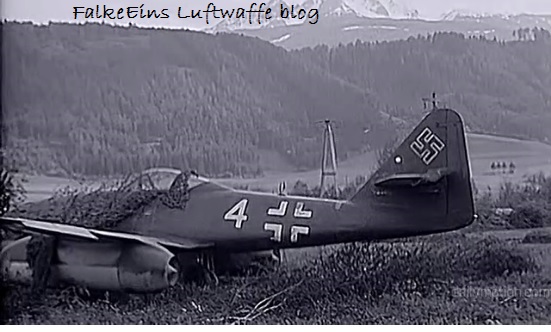
A view of what may or may not have been W.Nr. 170 061 "white 4" of JV 44 seen in a US film excerpt at Innsbruck-Hötting.
A small post looking at some of the Me 262 Turbos assigned to JV 44. It is relatively well established which aircraft were assigned to Galland's outfit. Czech writer Martin Sila, " ..at the beginning of its existence, JV 44 received 12 Me 262 aircraft, which probably received a fuselage designator (white) from "1" to "11" while Galland's command machine (the twelfth machine) displayed a ' white double chevron'. In photos the machines look as if they are painted with a uniform color, but in reality they are finished in two shades of green. Some serial numbers from this first group of twelve aircraft are also known.."
Late on JV 44 "absorbed" a number of aircraft from other units (III./EJG 2, KG 51, trial prototype machines). Robert Forsyth's "JV44 The Galland Circus" narrative highlights just how chaotic the circumstances around the unit's formation and its subsequent operations were, with aircraft arriving from a number of units and pilots bringing their own machines with them! Even the Luftwaffe High Command didn't always know the strength of this unit!
Below; two JV 44 Turbos that may depict "White 6" and "White 3" W.Nr. 111740 and W.Nr. 111746 operational with JV 44 at München-Riem in April 1945. This image is apparently captioned "Me 262 General Galland and Lt. Willi Roth, Staffelkapitän of 4./JG 103 [sic]." Lt Roth is listed as one of the JV 44-pilots in the well known document dated 27. April 1945 but not mentioned in Forsyth. Notable JV 44 pilots from JG 103 included former instructors Ofw. Dobnig and Ofw. Rudolf Nielinger. 'White 6' is usually assigned to Steinhoff...
Below; two JV 44 Turbos that may depict "White 6" and "White 3" W.Nr. 111740 and W.Nr. 111746 operational with JV 44 at München-Riem in April 1945. This image is apparently captioned "Me 262 General Galland and Lt. Willi Roth, Staffelkapitän of 4./JG 103 [sic]." Lt Roth is listed as one of the JV 44-pilots in the well known document dated 27. April 1945 but not mentioned in Forsyth. Notable JV 44 pilots from JG 103 included former instructors Ofw. Dobnig and Ofw. Rudolf Nielinger. 'White 6' is usually assigned to Steinhoff...

The aircraft in which Johannes Steinhoff was badly burnt on 18 April 1945 was "white 6" (WNr. 111740) and Galland flew his last combat sortie on 26 April 1945 in 'white 3' (WNr. 111746). This machine was not destroyed (as has been generally stated) that day, but only damaged. Another well-known member of JV 44 Franz Stigler stated that this "white" 3 "was his machine. According to Sila, "..Stigler's role in the JV 44 is overestimated. He served as Techn.Offz. As to combat flights, it is interesting that other witnesses from JV 44 do not mention him in their recollections .."
The "sister" machine to WNr. 111745 was "white 5" which Eduard Schallmoser damaged heavily on 4 April colliding with a P-38. "White 5" was one of the twelve Me 262s which Jagdverband 44 had taken over in March 1945. A number of pilots flew it in combat. Schallmoser had been assigned to JV 44 as a freshly trained fighter pilot, after completing an accelerated training programme in the Me 262. On 4 April 1945, his Rotte met a group of twelve P-38’s of the 15th USAAF in area of München-Riem, which the German pilots attacked. In the following combat Uffz. Schallmoser collided with one of the Lightnings piloted by Lt. William Randle as a result most probably of his excessive speed. While Schallmoser managed to land his damaged “White 5”, Lt. Randle bailed out of his Lightning and became a POW.


In late April 1945 Galland's unit was ordered to depart Munich - effectively ceasing combat operations - and commencing on April 28, JV 44 began transferring to bases (or rather field strips) in Austria - Salzburg and Innsbruck. Of particular interest is the (unknown) fate of Galland's own 'white double chevron'. According to one account 'white double chevron' was flown to Innsbruck on 29 April 1945. In Innsbruck, Major Hans Ekkehard Bob was ordered to the landing ground at nearby Hötting to prepare for the arrival of jet aircraft. The runway strip area had to be extended to 1,200 metres necessary for takeoffs and landings by Me 262 and an attempt was made by Bob to adapt the airstrip to the necessary length. However there was no J2 fuel at the base. Bob's efforts were in vain.

'White 8' (above) -Me 262 A-1 "White 8 S", WNr. 500492 - was one of possibly two Me 262s that landed at Reichenau, a few kilometers east of the temporary airfield at Hötting where the other JV 44 Me 262s landed and were dispersed. Note that the machine was previously with III./EJG 2 operating from Lechfeld, with the white `8`on the nose and narrow yellow fuselage band behind the cockpit.


W.Nr. 111 712 (EZ 42, no Kennziffer)
W.Nr. 500 490 Me 262 A-1a. No markings, full-fuselage RLM 83 camo
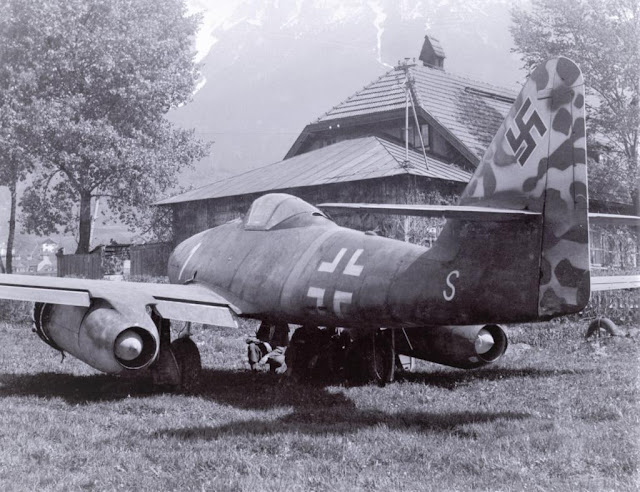
On the evening of 29 April 1945, at about 1800 hrs., Ofw. Rothert of 2./Fl.U.G. 1 transferred Me 262 A-2a WNr. 170047 'white 1' from München-Brunnthal to Innsbruck-Reichenau. The port view of this machine (last of the four images) shows the white 'S' ('Schule') under the horizontal stabilizer - as seen in the well-known Kommando Nowotny line-up from where it went to JV 44.

Major Bob remained in Innsbruck until 3 May 1945, when he received an order to 'disable' his jets and transfer to Salzburg which he did as the US Army approached. Based on this information, it is possible to state that all of the Me 262s abandoned here were unserviceable..
At least 12 Me 262 Turbos were flown to Innsbruck. However a memo dated 2 May quoted in O'Connell's 'Me 262 Production Log' states that as many as 22 Me 262s of JV 44 were transferred to Hötting and that 7 of them crashed on landing. [The memo states that there was 25 cm. of snow at Hötting on 2 May.]
JV 44 Me 262s that can be identified at Innsbruck (primarily Hötting airfield) included;
W.Nr. 111 712 (EZ 42, no Kennziffer)
W.Nr. 500 490 Me 262 A-1a. No markings, full-fuselage RLM 83 camo
W.Nr. 111 857 (original "white 5")
W.Nr. 111 751
W.Nr. 500 524
W.Nr. 112 360
W.Nr. 170 047 - "white 1" Innsbruck-Reichenau
W.Nr. 111 974 - "white 8" Innsbruck-Reichenau
W.Nr. 170 061 - "white 4"
W.Nr. ??? ??? - "white 11"
W.Nr. ??? ??? - "white 12" (according to David. E. Brown the 113 series aircraft ...)
W.Nr. ??? ??? - "red 1" ( another 113 series machine ...)

W.Nr. 111 751
W.Nr. 500 524
W.Nr. 112 360
W.Nr. 170 047 - "white 1" Innsbruck-Reichenau
W.Nr. 111 974 - "white 8" Innsbruck-Reichenau
W.Nr. 170 061 - "white 4"
W.Nr. ??? ??? - "white 11"
W.Nr. ??? ??? - "white 12" (according to David. E. Brown the 113 series aircraft ...)
W.Nr. ??? ??? - "red 1" ( another 113 series machine ...)
Below; Me 262 A-1a, uncoded, JV 44, WNr.111857, Innsbruck-Hotting. Previously 'white 5', III.EJG 2. NSG 9 Stuka D-3 with exhaust flame dampers in the barn in the background.
(to be continued)