Sunday, 21 February 2016

"Britain's greatest pilot" Capain Eric 'Winkle' Brown has passed away aged 97 years


Neil Hanna photo via the Edinburgh Evening news

"... An Edinburgh-born aviator who was dubbed the world’s greatest test pilot has died at the age of 97. Captain Eric “Winkle” Brown, from Leith, a veteran of the Royal Navy Fleet Air Arm holds the world record for flying the greatest number of different aircraft and also piloted Britain’s first supersonic flight..."

 Read more here

 Eric 'Winkle' Brown must rate as one of aviation's leading test pilots of all time, a man who was there at the forefront of the development of aircraft from biplanes to supersonic jets. With his love for danger -   as a teenager he enjoyed earning some spare cash as a wall-of-death motorcycle rider- and having a father who had been a WW I fighter pilot - Brown's love affair with flight began in 1936 when he was taken up on an aerobatic joy-ride by German WW I ace Ernst Udet who made him promise " to learn to speak German and learn to fly.. it was a pivotal point in my life ".


 'Winkle' Brown had many subsequent dealings with Germany and the Germans, from his own early imprisonment in Munich on the outbreak of WW II to his interrogation of Luftwaffe chief Goering, test flying the Luftwaffe's jet and rocket aircraft to 'liberating' Belsen concentration camp and interrogating the notorious camp Kommandant Franz Kramer and Kramer's 'deputy' Irma Grese " the most evil person I've ever met ". Brown's war started as a Fleet Air Arm fighter pilot flying Martlets (Wildcats) deployed on HMS Audacity which had a terrifyingly short flight deck and carried six aircraft..


Audacity (above) was a 'flat-topped former German 'banana boat' converted for Atlantic convoy escort duties protecting against bomber attack from the "Focke Wulf Kurier" (sic) or Condor, the most heavily armed German aircraft in the sky.." Audacity was torpedoed and sunk and Brown and twenty-four of his ship-mates were left for dead- only Brown and one other survived. Audacity's captain had already noted Brown's competence at carrier landings and reported this fact to his superiors, which marked Brown for some highly dangerous test flying ...

 Brown was the first man to land a twin-engine aircraft (a Mosquito) on a carrier and as a result became the chief naval test pilot at RAE Farnborough for the Fleet Air Arm.


He flew a world record 2,400 carrier landings, probably flew more types of aircraft than any other pilot, was the only Allied pilot to fly the rocket-powered Me 163 and also flew the Me 262.

Post-war he was the first man to land a jet on a carrier.


'Winkle' Brown was a test pilot as aerodynamics moved from biplanes to supersonic fighters - indeed supersonic flight was the 'holy grail' of aviation during this period. Brown was tasked with ascertaining why Geoffrey de Havilland died at the controls of the tail-less DH 108 Swallow as it was attempting a new world air speed record.


What he did as a pilot very few - if any - have equalled. not only for the 487 types flown (!). From interrogating Goering, flying as a young lad with WW1's second highest scoring ace Udet and going on to test fly the Luftwaffe's most advanced planes...to ending his flying career on the Buccaneer nuclear strike bomber. A towering figure in aviation, notable not only for his huge service to his own country, but also to the US and during the reconstruction of Germany. Hals und Beinbruch, Captain, we'll miss you. Blue skies, Sir! RIP


Flakabt.182 Blumental-Berlin, KG 26 Heinkel He 111 Mäandertarnung - daily Ebay photo find # 157

Flakabt.182 Blumental-Berlin schwere 8,8 cm Flak in Stellung, 1940, and below live-firing training exercise


Currently on offer here

KG 26 He 111 torpedo bomber (?)  in Salon (Provence), southern France, spring 1943. Superb Mäandertarnung camo scheme. Also on this blog here


On offer here

Saturday, 20 February 2016

32nd scale Revell Bf 109 G-6 by Mike "Spikelhund" and Bf 109 G-10 built by Andy Dyck in the markings of Lt. Friedrich-Wilhelm Schenk, Staffelführer of 2./JG 300


amazing build and finish of a couple of Revell 1/32 Bf 109s, the G-6 by Mike "Spikelhund" and the G-10 in the markings of 'Timo' Schenk by Andy Dyck posted on britmodeller.com and reproduced here with permission, probably two of the best I've seen. Exquisite detail, paint and finish!

The Bf 109 G-6 W.Nr. 412 369 "Gelbe 6" in the markings of 6./JG 53 as seen in January 1944 was completed with Eagle Cal decals, Barracuda intake, exhausts, cooling scoops and oil cooler housing, AlleyCat cowl bulges, spinner and prop, Maketar masks for national markings, Brassin gun pods and an Eduard fabric harness. Paints are Gunze, Tamiya, Vallejo and Citadel, Mike also used the AMMO PLW for the panel lines and some weathering. Final flat coat with AK ultra matte. Click to view large!


Below; Andy Dyck's build of Revell`s fantastic 109 in 1/32. Andy said " I added some parts, like exhaust pipes from Barracuda studios, decals from Barracuda studios, and seat belts from HGW (Lasercut). The whole model was completly riveted with the HobbyBoss rivet tool. The figure in the leather suit is also from Barracuda..."


"Red 5" was a G-10 flown by Lt. Friedrich-Wilhelm “Timo” Schenk, Staffelführer of 2./JG 300. Rare photos of this machine feature in Jean-Yves Lorant's two volume JG 300 history 'Bataille dans le Ciel d'Allemagne' published by Docavia. While the inscription on the fuselage 'Timo-Schenko' is a neat piece of word-play, it must have taken a certain amount of courage for Schenk to fly strafing sorties on the Oder front over Russian spearheads with his machine displaying the name of the Russian military commander leading the assault on Berlin during the Endkampf.  And while no pictures show the blue-white-blue fuselage bands, 'Red 5' almost certainly displayed them. I was fortunate enough to correspond with 'Timo' a few years ago via Jean-Yves Lorant.

vom Timo, October 2002
  
" Liegnitz - February 1945. The Russians had crossed the Oder near Steinau. Our exhausted and over-extended ground troops were in desperate need of close air support.. When the weather allowed, we flew uninterrupted sorties, up to eight a day for some of us. The fields and roads between the villages were teeming with thousands of people, women, children, the elderly, all attempting to flee the Soviet invasion in the bitter cold. Most of the columns of refugees were heading for Dresden. Viewed from the sky these caravans of civilians clogging the roads painted a picture of unspeakable suffering. The Russians were everywhere. We flew strafing attacks with variable results. Going into action at low level against ground targets, tanks, vehicles and infantrymen, was far from easy..". 

While he may have survived the Oder front, 'Timo' had lived through more than his fair share of tragedy - he lost his father aged 46 in a motor vehicle accident- when Timo was just 13 years old- and then lost his mother also aged 46 from illness when Timo was 19 years old. After JG 300 and on the back of a Verbandsführerlehrgang des Generals der Jagdflieger unit leaders' training course, Timo Schenk was subsequently posted to III./ JG 7 where, after a mere handful of training flights, he flew an R4M rocket-toting Me 262 for the last few months of the war - and still vividly recalls launching salvoes of rockets against RAF Lancasters raiding what was left of Germany by day, claiming one Lancaster shot down on 31 March 1945, followed by a B-24 four days later. Post-war he flew commercial airliners for Lufthansa. Today he is still going strong at 93 years of age...


a collection of "classic" German-language Luftwaffe books for sale - Siegfried Radtke's KG 54 Chronik " Von der Ju 52 zur Me 262 " (Schild Verlag)


..well-known ebayer Rich Carrick has a nice selection of German language titles on offer in a 'private' sale. Thanks to Rich I have just acquired Siegfried Radtke's KG 54 Chronik " Von der Ju 52 zur Me 262 " (Schild Verlag).


Uffz. Siegfried Radtke was a Beobachter in 9./KG 54. Flying out of Decimomannu, Sardinia, Radtke and his crew were injured on 5 June 1943 when they were forced to bale out of Ju 88 B3+CT WNr 142481 in darkness after a long night sortie over North Africa which saw them returning on one engine before finally running out of fuel. Radtke himself appears in the photo at the top of page 186. On page 216 he describes a bombing sortie flown by his crew in Ju 88 B3+IT on the night of 26-27 July 1944 from Soesterberg over Giberville south-east of Caen in Normandy. Attacked by night fighters and then hit by anti-aircraft fire over the target area, the port wing of the Junkers was quickly ablaze. Although the blaze took hold and burned vigorously the port wing tanks were full, so, according to the author. " there was little danger of an explosion..". The crew elected to fly on and put down at the nearest 'friendly' airfield which was Le Culot where they carried out a successful belly landing at 03:00. The aircraft (which appears as 'JT' in Radtke's loss lists, W.Nr unknown) sustained 60% damages..

" ..in seconds we had scrambled clear of the machine and with the fire brigade and ambulance in attendance our "IT" disappeared under a mountain of foam. Suddenly all the lights on the airfield were extinguished. There was a sound of engines. Our 'colleagues from the other side' had arrived on the scene - too late! Then we heard voices calling out; " ..where is the crew? " By the light of a pocket lamp (torch) we were met by the Kommodore of KG 30, Obstl. Freiherr von Gravenreuth. Later back in the ops building he said ; " Mensch ..goddamn boys you were lucky there! Two nights ago another Ju 88 came in ablaze, attempted what you've just done ..and exploded 100 meters above the field! " We swallowed hard and toasted our Geburtstag ('birthday'). Later we set out  by train via Brussels and Rotterdam and eventually arrived back at Soesterberg where we were warmly welcomed home.."


Rich has a lot of other nice and often hard-to-find Luftwaffe books for sale too; Kock's NJG 6 book and Peter Achs' Fw 191 title to mention just a couple.. You can contact Rich via the **** or the Luftwaffe SIG on Facebook. Visit these sites to see the full range of books available in Rich's private sale..


A blog post devoted to rare Luftwaffe books on Ebay

Wednesday, 17 February 2016

Angriff ! Me 410 of 5./ZG 26 attacking B-17s, 12 May 1944


Friday 12 May 1944 was a significant day in the war waged by the USAAF over the Reich with some 886 bombers escorted by over 980 fighters attacking the five most important synthetic fuel plants and refineries in central Germany and the Czech 'Protectorate' - Leuna, Merseburg, Böhlen, Zeitz and Brüx. Up to this point fuel production plants had only been attacked on an occasional basis, eg Pölitz on 11 April 1944. Hence forward such targets would become the top priority of the daylight bombing campaign. The KTB of  I. Jagdkorps recorded "sehr gutes Abwehrwetter "  - very good weather for defensive ops in the Reichsverteidigung. Some 16 day fighter and two Zerstörer Gruppen were deployed; some 470 fighters airborne in total - the largest total of fighters ever put up by the Luftwaffe over Germany- resulting in some of the biggest air battles seen up to that stage of the war over the Reich. At around 14:30 between Gotha and Plauen  - as they were withdrawing - a formation of unescorted B-17s came under attack from the Me 410s of II./ ZG 26 as these rare pictures currently on offer from Michael Meyer illustrate (see link below).


Angriff auf B-17 - Me 410s of II./ZG 26 seen closing on and attacking a formation of B-17s on 12 May 1944 over central southern Germany. Pctures taken by Ofw. Dudszus.


At the controls of Me 410 W.Nr 10241 'Black 13' of II./ ZG 26 Lt. Paul Kaschuba was shot down by the bombers defensive fire. This well-known photo of 'Black 13'  (below) was taken from the 388th BG B-17 'Lady Godiva' during the raid ..


1st Lt. Manuel Head, pilot of 562nd BS B-17 'Lady Godiva' reported; " As I recall the 388th BG was attacked from the rear - I saw nothing of the combat with the exception of this Me 410 peeling away just off my starboard wing. I well remember my exclamation, 'what the hell is he doing here?!' and in a fraction of a second he was gone. Victor Labruno took the pic from the right hand window of the radio compartment. Eugene Crossin in the upper turret told me later that his tracers poured into the belly of the Me 410 and a 'kill' was subsequently credited  to him.."

The good weather and few defenders over the target areas meant that the bombardiers had a very good day and the five fuel plants - crucial to Germany's war effort - were heavily bombed;  fuel production at Brüx was halted while production capacity at Leuna and Böhlen was reduced by 50 % over the following two weeks. Over 25,000 tons of fuel went up in flames, an outcome described by Don Caldwell as "the worst single day of the war for Germany".

Michael Meyer's Ebay sales are here

More on the last flight of II./ ZG 26 Me 410 "Black 13" on this blog here

Sunday, 31 January 2016

Latécoère 298 torpedo bomber in the Battle for France


"..On 23 May 1940 some eighteen Latécoère 298s dive-bombed bridges and road junctions between Boulogne and the river Somme...".  (William Green in 'Warplanes of the Second World War' volume 6)

The best aircraft in the world in its class in 1939 according to Morareau and Ledet in their book " Le Latécoère 298 ". First flown in May 1936, at the outbreak of the war, Laté 298s were operated by no fewer than seven escadrilles de Torpillage in the Aéronavale. But the Latécoère 298 never launched a torpedo in anger, being largely deployed on missions for which it was hardly suited and for which its crews had not been trained - bombing and ground-strafing missions against German columns in northern France. The following account provides a rare glimpse (in English) of the reality of what happened to the Latécoère 298-equipped escadrilles (squadrons) of the French naval air arm in May 1940..

Having evacuated Boulogne on 21 May 1940 and come under fire from French anti-aircraft guns over Dieppe, the Latécoère 298s of escadrilles T2 and T3 had reached the relative safety of Cherbourg on the Cotentin Peninsula.

On the morning of 23 May, led by their CO, Lt de vaisseau Marraud, six Laté 298s of escadrille T3 were airborne at 05h00 from Cherbourg tasked with bombing any German armour encountered in the vicinity of Boulogne ; the secondary target was the rail bridge over the shipping canal near Noyelles-sur-Mer. Marraud's T3.1 was hit by anti-aircraft fire south of Boulogne, succeeded in getting as far as Outreau before being hit again and having to carry out an emergency ditching off the Cap d’Alprecht, south of Boulogne (off Le Portel). Marraud and his crew escaped unhurt. Second-maitre Etienne in T3.2 had escorted the CO out to sea and ensured that his crew were picked up by the French torpedo boat Mistral. Crossing back over the coast in search of targets Etienne strafed anti-aircraft positions on the Samer-Montreuil road. He jettisoned his bombs before returning to Cherbourg, his munitions exhausted. Near Le Touquet, two more sections (2x2 aircraft) were also met by anti-aircraft fire but there were no German columns on the road. The aircraft jettisoned their bombs on the Noyelles bridge over the Somme - without hitting it - and returned to Cherbourg at 09h25. Two other  Laté 298s were reportedly shot down by Messerschmitt Bf 109s.

At 10h09 on the morning of 23 May, four Latécoère 298 floatplanes from escadrille T2 were dispatched from Cherbourg  to find and bomb German armour reported between Samer and Boulogne. Lt de vaisseau Jacques Lamiot was one of the pilots who flew the mission and he later recalled;

"... We overflew the coast at Boulogne and followed the road in the direction of Abbeville. Keeping our eyes peeled we scoured the road and the surrounding areas but could spot no signs of life, neither friendly nor enemy, neither civil nor military. We headed back to Boulogne flying at 1,000 metres, a height that would enable us to thwart any diving attack and which allowed us to be able to see what might have been hiding under the tree cover. Suddenly we were caught in a hail of anti-aircraft fire. Initially we were unable to spot where it was coming from although my gunner finally indicated that he could see muzzle flashes some way behind us. With there being no sign of any armour the decision was made to attack this battery which was on a small hill. I gave the signal. But while we'd had our eyes fixed on the ground we had failed to take notice of a line of fighters some way off heading in our direction and which, based on the assurances that I had been given prior to departure, I had assumed were RAF aircraft defending the sector. Just as I was about to let down on a firing pass I found myself caught up in a burst of tracers; what I took for Hurricanes were in fact Messerschmitt Bf 109s and the lead aircraft just avoided colliding with me by a whisker..."   (Icare No 61)

The  Laté 298s of T2 paid a heavy price - Lv Lamiot carried out an emergency landing, engine ablaze, his gunner (Quartier-maître Paul) dead and his radio operator (Second-maître Thénaisie) badly injured. In the Laté flown by EV1 Huet, his gunner, SM Coucal was killed before the pilot ordered his radio operator to take to his chute; Huet put down at sea but the Me 109s strafed the aircraft injuring the pilot. T2-2 got back to Cherbourg QM Payol wounded while T2-4 was reported missing ; the crew (seconds-maitres Halgand and Le Pezron, both wounded and quartier-maître Tassel, who died of his injuries) were taken captive. At 12h15, four more Latés from Cherbourg attacked the Fort de la Crèche (a coastal battery outside Boulogne) : although the target was hit, information that the Fort had been occupied proved unfounded. There were no losses. Later that afternoon four Laté 298s of T2 carried out a strike on a rail bridge over the Abbeville canal at St Valéry sur Somme, which the Laté 298s of T3 had failed to hit that morning. The sortie was again a failure but all the aircraft returned.

(Below; Laté 298 downed on 23 May 1940)


Thursday, 28 January 2016

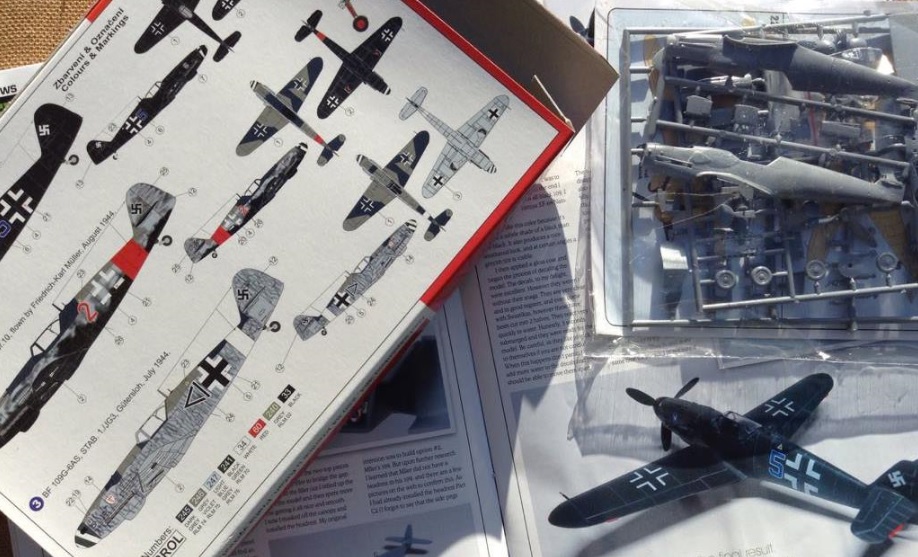
AZ Model Bf 109 G-6/AS 'Special Markings' build review


I was interested to read Patrick Mizgala's build review of the new AZ Bf 109 G-6/AS 'special markings' release over two pages in the current issue of Scale Aircraft Modeller International (SAM Publications). Now I quite like AZ Model's Bf 109 G-6 series - 'Model of the Year 2015' in the small scale category in the German 'Modellfan' magazine. Unfortunately Patrick missed a number of points concerning the subject aircraft in this release clearly explained elsewhere on this blog. Firstly, the G-6/AS variant featured a refined cowl, tall tail and enlarged supercharger. Hence the parts in the box are the same as those featured in AZ Model's Bf 109 G-10 boxes. However for a G-6/AS as depicted in this box the chin bulges will need to be sanded off. Mizgala referred on a number of occasions to the box top presentation of Bf 109 G-6/AS 'Red 2'; this is the 1./NJGr 10 Moskito hunter flown by Friedrich-Karl Müller during July-August 1944. Note the spelling of the name - written incorrectly all through his article. Apparently while doing his research Patrick discovered a picture on the internet that shows Müller's aircraft with no head armour. I'm assuming that this was the photo via Jean-Yves Lorant already posted on my blog - see link below. I published three pictures of Müller's 'Red 2' in SAM Publications own "Model Aircraft" in a 'wilde Sau und Moskito-Jagd' feature back in June and July 2014, exclusive to SAM - with some superb profile artwork by Anders Hjortsberg. The absence of head armour was a particular feature of Mosquito-chasing high performance Bf 109s. It was a shame that Mizgala appeared to be unaware of any of this. I'm assuming too that this is where AZ got their inspiration for the kit from! The all-black Bf 109 G-6/AS that Patrick did eventually build from the box (Dieterle's 'Green 5' of 2./Erg.JG 2) is also covered in-depth on this blog. Note that unfortunately AZ's research for this release has been particularly sloppy; wheel hubs were not red for a start and they have even got the colour of the Staffel number wrong on the decal sheet; it is blue in the kit and should of course have been green. One other point to note about the decal sheet - no spinner spirals. The modeller has to purchase those separately. I have to thank Czech modeller Jan Pavlik for sending me a sheet of these - they were out of stock at Hannants.  Cheers mate!

To conclude, a couple of links on this blog covering both the aircraft and the issues mentioned ..

Bf 109 G-6/AS 'Red 2', 1./NJGr 10 Moskito hunter flown by Friedrich-Karl Müller during July-August 1944 - pictures and artwork here.

'Green 5', the overall black Bf 109 G-6/AS of 2./Erg.JG 2, the Ergänzungsnachtjagdstaffel (night fighter replacement training unit) featured on this blog here